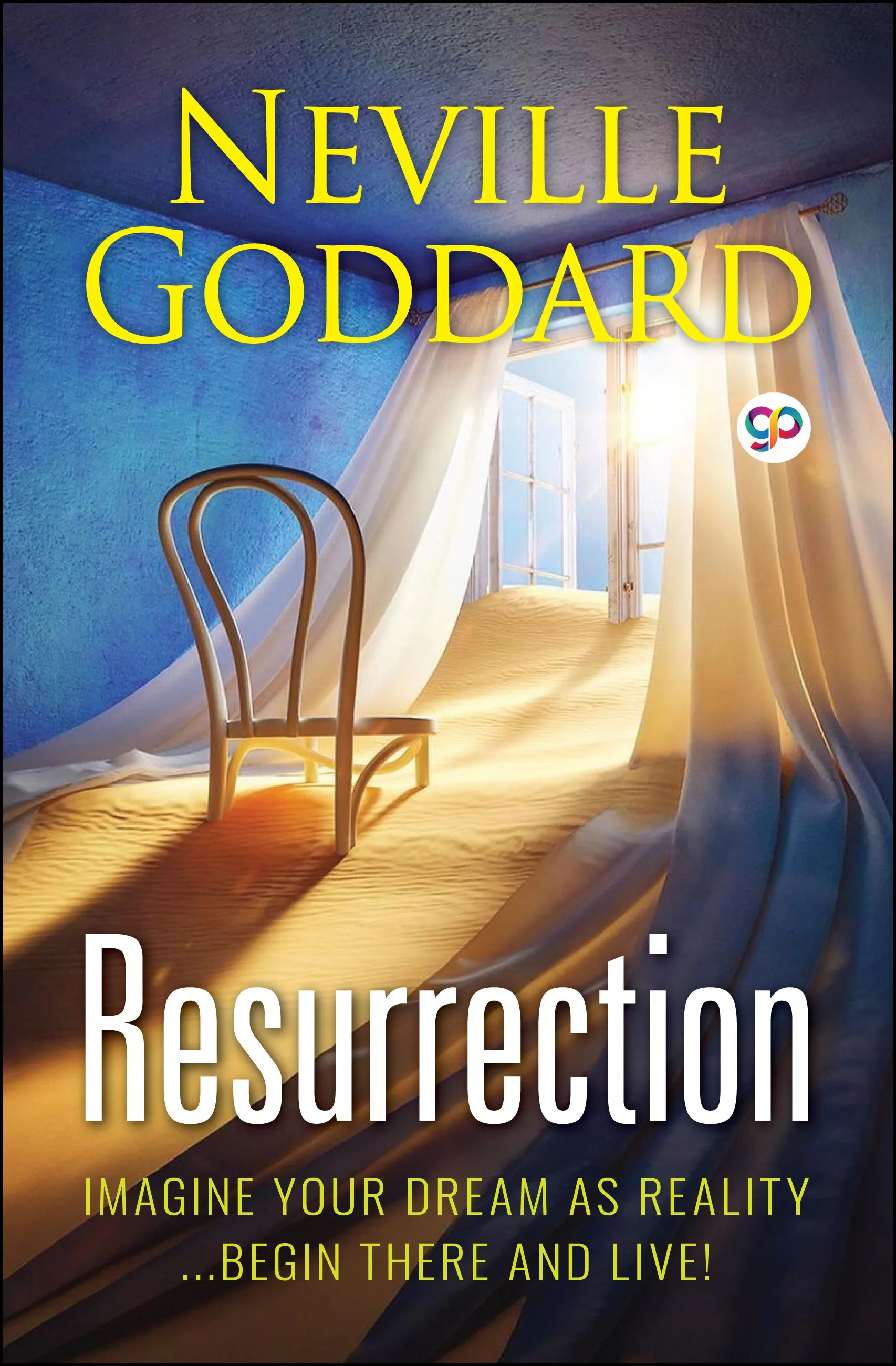
Resurrection
eBook
• INR 99.00
• English
• 9789354992216
No ratings yet
| Publisher | General Press |
|---|---|
| ISBN13 | 9789354992216 |
| ASIN/SKU | B0B3R156CX |
| Book Format | eBook |
| Language | English |
| List Price | INR 99.00 |
| Subject Code | SEL016000 |
| Publishing Date | 10/06/2022 |
| Book Code | BD00068857 |
Buy this Book
Amazon Stores
Ebook Stores
Other Stores
Discover Resurrection by Neville Goddard. This book is published by General Press in eBook format, ISBN 9789354992216, ASIN B0B3R156CX, under Religion and Spirituality, New Thought, Mysticism.
Book Description
First published in 1966, ‘Resurrection’ was written by Neville Goddard, an American author and a profoundly influential teacher. Neville was sent to illustrate the teachings of psychological truth intended in the Biblical teachings, and restore awareness of meaning to what the ancients intended to tell the world.
This is one of Neville's final and most ambitious works. Many students of the visionary mystic Neville Goddard consider it to be his greatest book. It contains five powerful, practical works that describe how to use the imaging powers of your mind to remake reality. He explained his complete philosophy of life's purpose, and the higher destiny that awaits you.
Experience the life-changing power of Neville Goddard with this unforgettable lesson.
This is one of Neville's final and most ambitious works. Many students of the visionary mystic Neville Goddard consider it to be his greatest book. It contains five powerful, practical works that describe how to use the imaging powers of your mind to remake reality. He explained his complete philosophy of life's purpose, and the higher destiny that awaits you.
Experience the life-changing power of Neville Goddard with this unforgettable lesson.
Author Biography
Neville Lancelot Goddard (1905–1972) was a prominent and highly influential teacher in the New Thought movement, best known for his philosophy on the creative power of the human imagination. Born in St. Michael, Barbados, Goddard moved to New York City in 1922 to study drama. While working as a dancer and actor, his interests shifted toward mysticism after meeting an eccentric Ethiopian rabbi named Abdullah, who mentored him in Kabbalah, esoteric Christianity, and the psychological interpretation of scripture.
Leaving the theater behind, Neville dedicated his life to teaching what he termed "The Law of Assumption"—the principle that one can manifest their desires by vividly assuming the feeling of the wish fulfilled. Unlike many of his contemporaries, he taught that the Bible was not a historical record but a psychological drama mapping the evolution of human consciousness, asserting that the divine creator is the human imagination itself.
Throughout the mid-20th century, he delivered hundreds of unscripted lectures across the United States and authored foundational metaphysical classics, including Feeling is the Secret and The Power of Awareness. Today, Goddard’s visionary teachings continue to experience a massive resurgence, profoundly shaping modern self-help, spirituality, and manifestation philosophies.
Leaving the theater behind, Neville dedicated his life to teaching what he termed "The Law of Assumption"—the principle that one can manifest their desires by vividly assuming the feeling of the wish fulfilled. Unlike many of his contemporaries, he taught that the Bible was not a historical record but a psychological drama mapping the evolution of human consciousness, asserting that the divine creator is the human imagination itself.
Throughout the mid-20th century, he delivered hundreds of unscripted lectures across the United States and authored foundational metaphysical classics, including Feeling is the Secret and The Power of Awareness. Today, Goddard’s visionary teachings continue to experience a massive resurgence, profoundly shaping modern self-help, spirituality, and manifestation philosophies.
Editorial Reviews
Editorial Reviews will be added soon…
Book Summary
Resurrection by Neville Goddard is a profound work of spiritual philosophy centered on one of the author’s most important ideas: that the biblical story of resurrection is not merely a historical account of Jesus rising from the dead, but a symbolic description of an inner transformation that can happen within human consciousness. First published in the twentieth century as part of Goddard’s lectures and writings on imagination, faith, and spiritual awakening, the book presents the Bible as a psychological and mystical text. Rather than asking readers to accept biblical events only as literal history, Neville Goddard encourages them to look inward and discover their meaning as experiences of consciousness. The central theme of Resurrection is therefore spiritual rebirth—the awakening of a new state of awareness and the realization that imagination, when consciously directed and united with feeling, can transform a person’s experience of life.
Goddard’s interpretation begins with a radical proposition: the kingdom of God is not primarily a distant place to be reached after death. It is a dimension of consciousness that can be experienced here and now. For Goddard, the Bible describes the drama of the human mind and the stages through which consciousness develops. Characters such as Jesus, Peter, Mary, Lazarus, and others can be understood not only as historical figures but also as symbols of different states and movements within consciousness. This approach changes the way the reader understands biblical language. Resurrection becomes less about an extraordinary event happening to someone else and more about a personal awakening in which the individual moves from an old identity into a new one.
A major idea running through Resurrection is the distinction between the outer circumstances of life and the inner state from which those circumstances arise. Goddard repeatedly emphasizes the power of imagination. He does not treat imagination simply as fantasy or daydreaming. Instead, he presents imagination as a creative faculty through which people construct their experience of themselves and their world. According to this philosophy, the beliefs, assumptions, expectations, and emotional images held within consciousness influence the way life is experienced. When a person persistently identifies with limitation, failure, fear, or lack, those assumptions become part of the person's habitual state. Resurrection occurs when the individual deliberately leaves that old state and enters a new one.
This is why Goddard places such importance on the concept of a “state.” A state is essentially a way of being—a combination of beliefs, feelings, expectations, memories, and assumptions through which a person experiences life. People move between states constantly. Someone may feel confident in one situation and insecure in another; hopeful one day and discouraged the next. Goddard’s teaching suggests that the important question is not simply what is happening externally but which state of consciousness a person is occupying. The practice of spiritual transformation therefore involves learning to recognize unwanted states and consciously choosing a more desirable one.
The metaphor of death becomes particularly important in this context. In Resurrection, death can be understood as the ending of an old consciousness. When an individual releases an identity that no longer serves them and begins to live from a new assumption, something metaphorically dies. The former self is no longer given the same emotional or imaginative energy. Goddard describes this transition as a kind of death and rebirth. The person has not physically ceased to exist; rather, an old pattern of consciousness has been replaced by a new one. Resurrection is the emergence of this new identity into lived experience.
This interpretation gives the book its strong emphasis on inner change rather than external struggle. Goddard argues that many people attempt to change their circumstances directly while continuing to think and feel like the person who created or accepted those circumstances. His method reverses that process. Instead of waiting for the world to change before feeling successful, loved, secure, healthy, or fulfilled, the individual is encouraged to assume the feeling of already being the person who possesses the desired condition. The imagined experience is treated as a rehearsal for a new state of consciousness.
One of the most important practices associated with Goddard’s teaching is visualization or imaginal experience. The reader is encouraged to construct a simple mental scene that would naturally occur if a desired outcome had already become true. Rather than imagining the process of achieving something, the focus is placed on the end result. For example, instead of imagining oneself desperately searching for a new job, one might imagine hearing a friend congratulate them on their new position. The purpose is not simply to picture an object but to enter the emotional reality of having already received it. Goddard believes that such inner experiences can gradually alter the individual’s dominant state.
This practice is closely connected with what he calls the feeling of the wish fulfilled. The phrase is central to understanding Resurrection. The individual is asked to imagine not from the perspective of someone hoping that a desired event will happen, but from the perspective of someone for whom it has already happened. The difference is subtle but significant. Hope places fulfillment in the future; assumption places it in the present. In Goddard’s framework, the transformation begins when the mind stops rehearsing absence and starts experiencing fulfillment.
The biblical concept of faith is also reinterpreted through this psychological lens. Goddard does not present faith primarily as intellectual agreement with a doctrine. Instead, faith means confidently inhabiting a chosen assumption. To believe something, in this sense, is to experience it inwardly as real. The imagination becomes the meeting place between belief and experience. A person does not merely say, “I will be successful someday.” They cultivate the inner state of someone who already experiences themselves as successful. This shift in identity is what Goddard sees as the practical meaning of faith.
The book also places considerable importance on the relationship between consciousness and identity. People often define themselves through their history: their failures, disappointments, family background, financial circumstances, mistakes, and previous relationships. Goddard challenges this attachment to the past. If consciousness can move from one state to another, then the past does not have to remain the permanent definition of the self. Resurrection means that the individual can stop identifying exclusively with who they have been and begin identifying with who they choose to become.
This idea makes Resurrection especially relevant to readers interested in self-concept and personal transformation. Goddard’s philosophy suggests that changing external habits without changing self-concept may produce only temporary results. If someone continually thinks of themselves as unlucky, unwanted, incapable, or unsuccessful, their actions may repeatedly reinforce that identity. But if they begin to experience themselves internally as confident, valued, capable, and secure, their behavior and expectations may gradually change as well. In this sense, resurrection is fundamentally a transformation of self-concept.
Goddard’s treatment of biblical characters reinforces this interpretation. Rather than viewing scripture as a collection of unrelated stories, he sees recurring symbols that describe universal experiences. The crucifixion and resurrection, for example, represent the movement through a difficult transition in consciousness. The old state must be relinquished before the new state can fully emerge. The process can feel uncomfortable because familiar identities often have emotional attachments. Even negative patterns can feel safe simply because they are familiar. Spiritual rebirth therefore requires willingness to let go of an established identity.
Another important theme is persistence. Goddard’s method is not based on a single moment of wishful thinking. The desired state must become natural. If a person imagines being prosperous for five minutes but spends the rest of the day repeatedly thinking and speaking from poverty, the old identity remains dominant. Persistence means returning again and again to the chosen state. When doubt appears, the individual does not need to fight it aggressively. Instead, they can gently redirect attention toward the new assumption. Over time, the new way of thinking can become more familiar and emotionally convincing.
This emphasis on persistence also explains why Goddard gives imagination such a practical role. The imagination is not meant to replace action. Rather, it changes the internal starting point from which action occurs. Someone who believes they are powerless may hesitate, withdraw, or overlook opportunities. Someone who genuinely sees themselves as capable may act differently, communicate differently, and recognize possibilities that previously seemed invisible. In this way, inner transformation can influence outer behavior without requiring the individual to force every circumstance into submission.
The idea of surrender is another subtle aspect of the book. Goddard’s teaching is not simply about controlling every detail of life. The reader is encouraged to select the desired end and then allow the means of achieving it to unfold. Excessive concern about exactly how a desire will be fulfilled can keep the mind focused on uncertainty. By contrast, assuming the desired condition has already been achieved allows the individual to release some of that anxiety. The imagination establishes the destination; life is allowed to reveal the route.
Resurrection also challenges the tendency to search for spiritual transformation exclusively outside oneself. Goddard repeatedly turns attention inward. Instead of asking when circumstances will change, the reader is encouraged to ask, “Who am I being?” Instead of concentrating entirely on what other people are doing, the individual examines their assumptions about those people. Instead of defining the future by the past, the individual imagines the future as already fulfilled. This inward orientation is one of the most distinctive features of Goddard’s philosophy.
At the deepest level, Resurrection is about awakening to personal creative responsibility. Goddard’s worldview places extraordinary importance on consciousness, suggesting that the inner life is not a passive reflection of circumstances but an active force in shaping experience. This can be both empowering and demanding. It encourages readers to examine their habitual thoughts and assumptions rather than automatically blaming external conditions. At the same time, the philosophy should be understood as a spiritual and metaphysical teaching rather than as an established scientific explanation of how reality works. Its value for readers often lies in the reflective practices it encourages: examining self-concept, choosing constructive assumptions, visualizing desired outcomes, and becoming more aware of habitual emotional patterns.
Ultimately, Resurrection by Neville Goddard presents resurrection as a living psychological and spiritual process. The old self dies when the individual stops identifying with an unwanted state, and the new self is born when the person begins to experience a chosen state as present reality. The Bible, in Goddard’s interpretation, becomes a map of this inner journey rather than merely a record of events from the distant past. Through imagination, faith, feeling, persistence, and a transformed sense of identity, the reader is invited to experience a personal rebirth.
The enduring appeal of Resurrection lies in this simple but challenging invitation: do not wait for the world to tell you who you are. Examine the state of consciousness from which you are living, decide what kind of person you wish to become, and begin inwardly to live as that person. For readers interested in Neville Goddard, manifestation, the power of imagination, self-concept, spiritual awakening, biblical symbolism, and personal transformation, Resurrection provides a concentrated expression of his central philosophy. Its deepest message is that renewal begins within consciousness. What appears to be an ending can become the doorway to a new identity, and what feels like the death of an old self can become the beginning of a new way of living.
Goddard’s interpretation begins with a radical proposition: the kingdom of God is not primarily a distant place to be reached after death. It is a dimension of consciousness that can be experienced here and now. For Goddard, the Bible describes the drama of the human mind and the stages through which consciousness develops. Characters such as Jesus, Peter, Mary, Lazarus, and others can be understood not only as historical figures but also as symbols of different states and movements within consciousness. This approach changes the way the reader understands biblical language. Resurrection becomes less about an extraordinary event happening to someone else and more about a personal awakening in which the individual moves from an old identity into a new one.
A major idea running through Resurrection is the distinction between the outer circumstances of life and the inner state from which those circumstances arise. Goddard repeatedly emphasizes the power of imagination. He does not treat imagination simply as fantasy or daydreaming. Instead, he presents imagination as a creative faculty through which people construct their experience of themselves and their world. According to this philosophy, the beliefs, assumptions, expectations, and emotional images held within consciousness influence the way life is experienced. When a person persistently identifies with limitation, failure, fear, or lack, those assumptions become part of the person's habitual state. Resurrection occurs when the individual deliberately leaves that old state and enters a new one.
This is why Goddard places such importance on the concept of a “state.” A state is essentially a way of being—a combination of beliefs, feelings, expectations, memories, and assumptions through which a person experiences life. People move between states constantly. Someone may feel confident in one situation and insecure in another; hopeful one day and discouraged the next. Goddard’s teaching suggests that the important question is not simply what is happening externally but which state of consciousness a person is occupying. The practice of spiritual transformation therefore involves learning to recognize unwanted states and consciously choosing a more desirable one.
The metaphor of death becomes particularly important in this context. In Resurrection, death can be understood as the ending of an old consciousness. When an individual releases an identity that no longer serves them and begins to live from a new assumption, something metaphorically dies. The former self is no longer given the same emotional or imaginative energy. Goddard describes this transition as a kind of death and rebirth. The person has not physically ceased to exist; rather, an old pattern of consciousness has been replaced by a new one. Resurrection is the emergence of this new identity into lived experience.
This interpretation gives the book its strong emphasis on inner change rather than external struggle. Goddard argues that many people attempt to change their circumstances directly while continuing to think and feel like the person who created or accepted those circumstances. His method reverses that process. Instead of waiting for the world to change before feeling successful, loved, secure, healthy, or fulfilled, the individual is encouraged to assume the feeling of already being the person who possesses the desired condition. The imagined experience is treated as a rehearsal for a new state of consciousness.
One of the most important practices associated with Goddard’s teaching is visualization or imaginal experience. The reader is encouraged to construct a simple mental scene that would naturally occur if a desired outcome had already become true. Rather than imagining the process of achieving something, the focus is placed on the end result. For example, instead of imagining oneself desperately searching for a new job, one might imagine hearing a friend congratulate them on their new position. The purpose is not simply to picture an object but to enter the emotional reality of having already received it. Goddard believes that such inner experiences can gradually alter the individual’s dominant state.
This practice is closely connected with what he calls the feeling of the wish fulfilled. The phrase is central to understanding Resurrection. The individual is asked to imagine not from the perspective of someone hoping that a desired event will happen, but from the perspective of someone for whom it has already happened. The difference is subtle but significant. Hope places fulfillment in the future; assumption places it in the present. In Goddard’s framework, the transformation begins when the mind stops rehearsing absence and starts experiencing fulfillment.
The biblical concept of faith is also reinterpreted through this psychological lens. Goddard does not present faith primarily as intellectual agreement with a doctrine. Instead, faith means confidently inhabiting a chosen assumption. To believe something, in this sense, is to experience it inwardly as real. The imagination becomes the meeting place between belief and experience. A person does not merely say, “I will be successful someday.” They cultivate the inner state of someone who already experiences themselves as successful. This shift in identity is what Goddard sees as the practical meaning of faith.
The book also places considerable importance on the relationship between consciousness and identity. People often define themselves through their history: their failures, disappointments, family background, financial circumstances, mistakes, and previous relationships. Goddard challenges this attachment to the past. If consciousness can move from one state to another, then the past does not have to remain the permanent definition of the self. Resurrection means that the individual can stop identifying exclusively with who they have been and begin identifying with who they choose to become.
This idea makes Resurrection especially relevant to readers interested in self-concept and personal transformation. Goddard’s philosophy suggests that changing external habits without changing self-concept may produce only temporary results. If someone continually thinks of themselves as unlucky, unwanted, incapable, or unsuccessful, their actions may repeatedly reinforce that identity. But if they begin to experience themselves internally as confident, valued, capable, and secure, their behavior and expectations may gradually change as well. In this sense, resurrection is fundamentally a transformation of self-concept.
Goddard’s treatment of biblical characters reinforces this interpretation. Rather than viewing scripture as a collection of unrelated stories, he sees recurring symbols that describe universal experiences. The crucifixion and resurrection, for example, represent the movement through a difficult transition in consciousness. The old state must be relinquished before the new state can fully emerge. The process can feel uncomfortable because familiar identities often have emotional attachments. Even negative patterns can feel safe simply because they are familiar. Spiritual rebirth therefore requires willingness to let go of an established identity.
Another important theme is persistence. Goddard’s method is not based on a single moment of wishful thinking. The desired state must become natural. If a person imagines being prosperous for five minutes but spends the rest of the day repeatedly thinking and speaking from poverty, the old identity remains dominant. Persistence means returning again and again to the chosen state. When doubt appears, the individual does not need to fight it aggressively. Instead, they can gently redirect attention toward the new assumption. Over time, the new way of thinking can become more familiar and emotionally convincing.
This emphasis on persistence also explains why Goddard gives imagination such a practical role. The imagination is not meant to replace action. Rather, it changes the internal starting point from which action occurs. Someone who believes they are powerless may hesitate, withdraw, or overlook opportunities. Someone who genuinely sees themselves as capable may act differently, communicate differently, and recognize possibilities that previously seemed invisible. In this way, inner transformation can influence outer behavior without requiring the individual to force every circumstance into submission.
The idea of surrender is another subtle aspect of the book. Goddard’s teaching is not simply about controlling every detail of life. The reader is encouraged to select the desired end and then allow the means of achieving it to unfold. Excessive concern about exactly how a desire will be fulfilled can keep the mind focused on uncertainty. By contrast, assuming the desired condition has already been achieved allows the individual to release some of that anxiety. The imagination establishes the destination; life is allowed to reveal the route.
Resurrection also challenges the tendency to search for spiritual transformation exclusively outside oneself. Goddard repeatedly turns attention inward. Instead of asking when circumstances will change, the reader is encouraged to ask, “Who am I being?” Instead of concentrating entirely on what other people are doing, the individual examines their assumptions about those people. Instead of defining the future by the past, the individual imagines the future as already fulfilled. This inward orientation is one of the most distinctive features of Goddard’s philosophy.
At the deepest level, Resurrection is about awakening to personal creative responsibility. Goddard’s worldview places extraordinary importance on consciousness, suggesting that the inner life is not a passive reflection of circumstances but an active force in shaping experience. This can be both empowering and demanding. It encourages readers to examine their habitual thoughts and assumptions rather than automatically blaming external conditions. At the same time, the philosophy should be understood as a spiritual and metaphysical teaching rather than as an established scientific explanation of how reality works. Its value for readers often lies in the reflective practices it encourages: examining self-concept, choosing constructive assumptions, visualizing desired outcomes, and becoming more aware of habitual emotional patterns.
Ultimately, Resurrection by Neville Goddard presents resurrection as a living psychological and spiritual process. The old self dies when the individual stops identifying with an unwanted state, and the new self is born when the person begins to experience a chosen state as present reality. The Bible, in Goddard’s interpretation, becomes a map of this inner journey rather than merely a record of events from the distant past. Through imagination, faith, feeling, persistence, and a transformed sense of identity, the reader is invited to experience a personal rebirth.
The enduring appeal of Resurrection lies in this simple but challenging invitation: do not wait for the world to tell you who you are. Examine the state of consciousness from which you are living, decide what kind of person you wish to become, and begin inwardly to live as that person. For readers interested in Neville Goddard, manifestation, the power of imagination, self-concept, spiritual awakening, biblical symbolism, and personal transformation, Resurrection provides a concentrated expression of his central philosophy. Its deepest message is that renewal begins within consciousness. What appears to be an ending can become the doorway to a new identity, and what feels like the death of an old self can become the beginning of a new way of living.
Sample Chapters
Sample Chapters will be added soon…
Reader Reviews
No reviews yet.
Resurrection