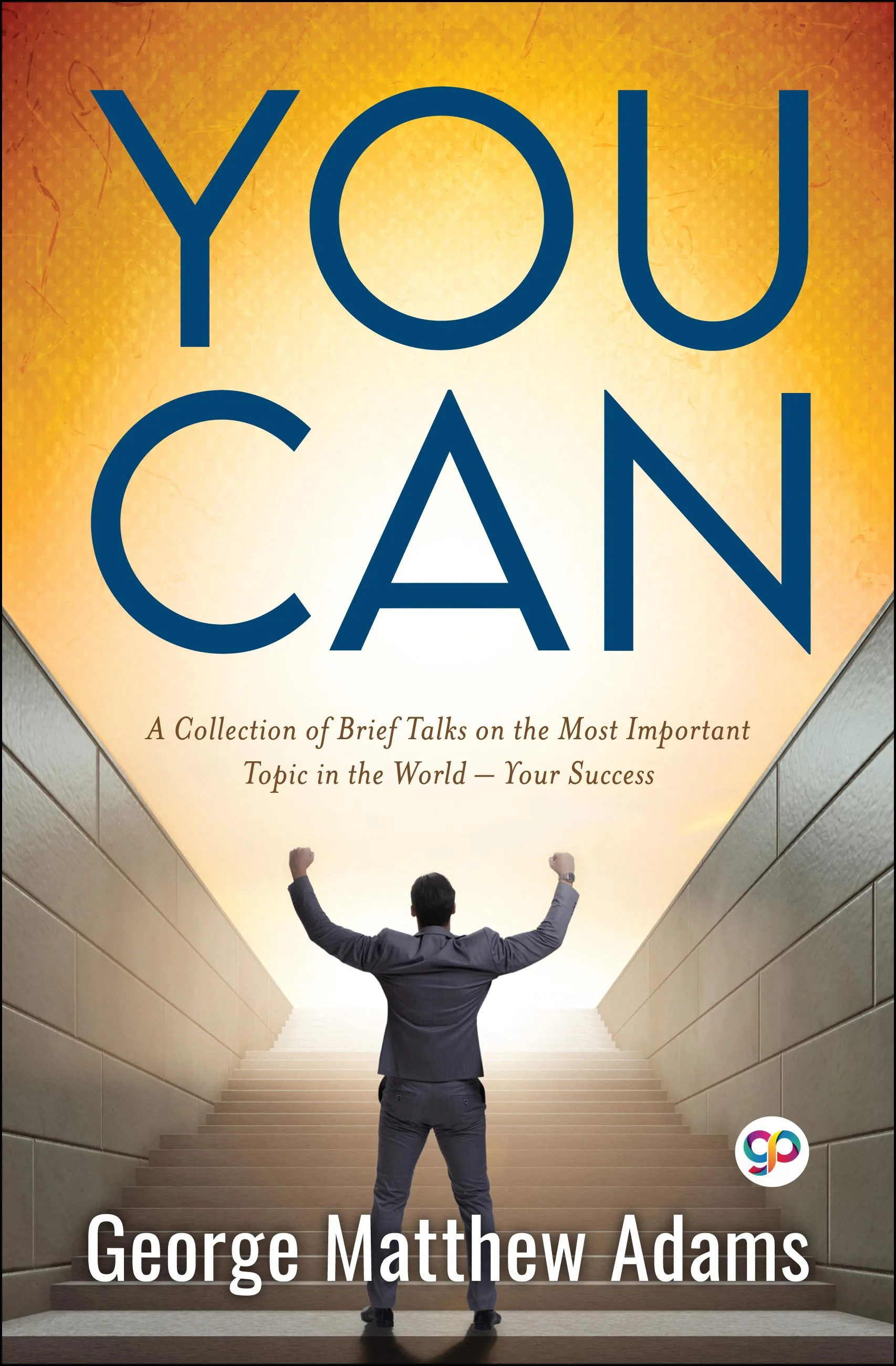
You Can
eBook
• INR 51.00
• English
• 9789354993152
No ratings yet
| Publisher | General Press |
|---|---|
| ISBN13 | 9789354993152 |
| ASIN/SKU | B0B5YN5Y81 |
| Book Format | eBook |
| Language | English |
| List Price | INR 51.00 |
| Subject Code | SEL021000, SEL027000, SEL044000 |
| Publishing Date | 06/07/2022 |
| Book Code | BD00068868 |
Buy this Book
Amazon Stores
Ebook Stores
Other Stores
Discover You Can by George Matthew Adams. This book is published by General Press in eBook format, ISBN 9789354993152, ASIN B0B5YN5Y81, under Self-Help, Motivational, Nonfiction.
Book Description
What if the greatest obstacle standing between you and the life you want is not a lack of ability, but a lack of belief in yourself? 'You Can' by George Matthew Adams is a classic self-help and personal development book that encourages readers to recognize their inner strength, develop confidence, and take purposeful action toward their goals.
Rather than presenting success as something reserved for a fortunate few, Adams focuses on the everyday qualities that can help ordinary people move forward: determination, positive thinking, persistence, courage, and a willingness to make the most of their opportunities. His message is simple but powerful—people often accomplish far more when they stop underestimating themselves and begin acting with faith in their own abilities.
The book explores the relationship between attitude and achievement, showing how thoughts can influence decisions, habits, and ultimately the direction of a person's life. Adams urges readers to replace hesitation and self-doubt with constructive thinking and practical effort. His approach is motivational without being overly complicated, making the book accessible to anyone facing personal challenges, uncertain circumstances, or ambitious goals.
At its heart, 'You Can' is a reminder that progress begins with taking responsibility for what is within your control. Its encouraging ideas invite readers to look at setbacks differently, discover possibilities where they might otherwise see limitations, and develop the confidence to keep moving ahead. Though written in an earlier era, its emphasis on resilience and self-belief remains relatable today. For anyone curious about how a stronger mindset can change the way they approach life, 'You Can' offers an inspiring message worth discovering.
Rather than presenting success as something reserved for a fortunate few, Adams focuses on the everyday qualities that can help ordinary people move forward: determination, positive thinking, persistence, courage, and a willingness to make the most of their opportunities. His message is simple but powerful—people often accomplish far more when they stop underestimating themselves and begin acting with faith in their own abilities.
The book explores the relationship between attitude and achievement, showing how thoughts can influence decisions, habits, and ultimately the direction of a person's life. Adams urges readers to replace hesitation and self-doubt with constructive thinking and practical effort. His approach is motivational without being overly complicated, making the book accessible to anyone facing personal challenges, uncertain circumstances, or ambitious goals.
At its heart, 'You Can' is a reminder that progress begins with taking responsibility for what is within your control. Its encouraging ideas invite readers to look at setbacks differently, discover possibilities where they might otherwise see limitations, and develop the confidence to keep moving ahead. Though written in an earlier era, its emphasis on resilience and self-belief remains relatable today. For anyone curious about how a stronger mindset can change the way they approach life, 'You Can' offers an inspiring message worth discovering.
Author Biography
George Matthew Adams was an American newspaper columnist, motivational writer, and publisher whose warm, practical ideas about success reached millions of readers through the pages of early twentieth-century newspapers. Best known for works such as 'You Can', 'Up', 'Take It', 'Just Among Friends', 'Better Than Gold', and 'The Great Little Things', Adams built a literary career around encouragement, self-belief, character, and everyday wisdom.
Born on August 23, 1878, in Saline, Michigan, Adams graduated from Ottawa University in Kansas in 1901. His professional journey began in Chicago, where he worked for an advertising agency, initially as an elevator operator before advancing to become a copywriter. In 1907, he founded the Adams Newspaper Service, later known as the George Matthew Adams Service, creating a successful syndication business that supplied newspapers with columns and comic strips.
Adams became especially influential through his syndicated column “Today’s Talk,” which appeared in hundreds of newspapers in the United States and Canada for decades. His writing was direct, optimistic, and conversational, presenting short reflections designed to encourage readers to develop confidence, perseverance, kindness, and a stronger sense of purpose. His 1913 book 'You Can' gathered brief talks centered on personal success, while 'Up' and 'Take It' continued his accessible approach to self-improvement. Later collections, including *Better Than Gold* and 'The Great Little Things', preserved the same spirit of practical encouragement.
Adams died on October 29, 1962, after a career spanning more than five decades. His influence extended beyond his own books through the newspaper service that helped popularize the work of other writers and columnists. He received a Freedom Foundation Award in 1959 for outstanding achievement in promoting better understanding between people.
Today, George Matthew Adams remains remembered for turning simple observations into enduring lessons about courage, effort, optimism, and personal growth—ideas that continue to give his writing a surprisingly modern appeal.
Born on August 23, 1878, in Saline, Michigan, Adams graduated from Ottawa University in Kansas in 1901. His professional journey began in Chicago, where he worked for an advertising agency, initially as an elevator operator before advancing to become a copywriter. In 1907, he founded the Adams Newspaper Service, later known as the George Matthew Adams Service, creating a successful syndication business that supplied newspapers with columns and comic strips.
Adams became especially influential through his syndicated column “Today’s Talk,” which appeared in hundreds of newspapers in the United States and Canada for decades. His writing was direct, optimistic, and conversational, presenting short reflections designed to encourage readers to develop confidence, perseverance, kindness, and a stronger sense of purpose. His 1913 book 'You Can' gathered brief talks centered on personal success, while 'Up' and 'Take It' continued his accessible approach to self-improvement. Later collections, including *Better Than Gold* and 'The Great Little Things', preserved the same spirit of practical encouragement.
Adams died on October 29, 1962, after a career spanning more than five decades. His influence extended beyond his own books through the newspaper service that helped popularize the work of other writers and columnists. He received a Freedom Foundation Award in 1959 for outstanding achievement in promoting better understanding between people.
Today, George Matthew Adams remains remembered for turning simple observations into enduring lessons about courage, effort, optimism, and personal growth—ideas that continue to give his writing a surprisingly modern appeal.
Editorial Reviews
Editorial Reviews will be added soon…
Book Summary
George Matthew Adams’s classic self-help book, "You Can", is a timeless collection of inspirational essays that serves as a powerful testament to the boundless potential of the human spirit. Written in the early twentieth century, the book’s message remains strikingly relevant today, cutting through the noise of modern life with a simple, undeniable truth: success, happiness, and personal fulfillment are entirely within your grasp if you truly believe in your own capabilities. Unlike many modern self-help books that rely on complex frameworks or psychological jargon, Adams writes with the warmth and directness of a mentor, offering bite-sized, pragmatic wisdom designed to awaken the dormant ambitions within the reader. The entire philosophy of the book is encapsulated in its two-word title, acting as both a gentle encouragement and a resolute command to take charge of one’s destiny.
At the very core of Adams’s philosophy is the profound impact of one’s mindset on the trajectory of their life. He posits that our thoughts are the architects of our reality; what we vividly imagine and fiercely believe, we eventually become. Adams argues that a negative, self-defeating mindset is the greatest obstacle to achievement, heavier than any external circumstance. Conversely, cultivating a habit of positive expectation transforms the mind into a magnet for opportunity. He urges readers to guard their mental landscape fiercely, weeding out seeds of doubt and fear, and planting instead the firm conviction that they are capable of greatness. This isn't about blind, toxic positivity, but rather a functional, deeply rooted self-assurance that provides the psychological fuel necessary to embark on difficult endeavors.
Beyond mere ambition, Adams places an enormous emphasis on the cultivation of character, viewing it as the bedrock upon which all true success is built. In his view, wealth, fame, or professional accolades are hollow and fleeting if they are not supported by unshakeable personal integrity. He reminds us that character is forged in the quiet moments of everyday life—in our commitment to honesty, our reliability in small matters, and our treatment of those who can do nothing for us. A person of genuine character inspires trust and commands respect organically, qualities that are indispensable in both personal and professional spheres. Adams eloquently suggests that while skills can be taught and knowledge can be acquired, character must be painstakingly chiseled by the individual through consistent, honorable choices over a lifetime.
Recognizing that the mind and body are inextricably linked, Adams dedicates significant attention to the vital importance of physical health. He views the human body not just as a vessel, but as the primary instrument through which we execute our life’s work. To neglect one's health in the pursuit of success is, in his eyes, a foolish and ultimately self-defeating compromise. He advocates for simple, sensible living—adequate rest, nourishing food, and regular physical activity—as non-negotiable prerequisites for sustained high performance. Vitality and energy are presented as essential ingredients for perseverance, allowing an individual to maintain focus, handle stress gracefully, and approach daily challenges with a sense of vigor rather than exhaustion.
Time, according to Adams, is the great equalizer, a finite resource distributed equally to everyone regardless of their station in life, and how one chooses to manage this resource dictates their ultimate success. He is a fierce opponent of procrastination, warning against the seductive trap of waiting for the perfect moment to begin. The book emphasizes the immense power of taking action now, urging readers to seize the present day rather than mortgaging their dreams to an elusive tomorrow. Every hour wasted is a lost opportunity to inch closer to one's goals. By breaking down monumental ambitions into daily, actionable tasks, Adams demystifies the path to success, showing that it is not achieved through sudden, miraculous leaps, but through the compounding effect of well-utilized days.
A significant portion of You Can is devoted to reframing the concept of failure, transforming it from a source of shame into an invaluable teacher. Adams understands that any worthwhile pursuit will inevitably be fraught with setbacks, rejections, and outright defeats. However, he insists that failure only becomes permanent when an individual chooses to surrender. He encourages readers to cultivate a resilient spirit, to analyze their mistakes objectively without losing their enthusiasm, and to recognize that the most successful people in history are often those who have failed the most frequently. Adversity is depicted as a refining fire that burns away illusions and tempers the soul, building the grit and emotional fortitude necessary to sustain long-term achievement.
Natural talent and innate brilliance are acknowledged by Adams, but he staunchly believes that they are entirely secondary to the power of relentless, unyielding hard work. He argues that ordinary ability coupled with extraordinary perseverance will consistently outperform unmotivated genius. The book champions the virtue of persistence—the quiet, unglamorous dedication to one's craft, day in and day out, even when motivation wanes and results are slow to materialize. It is this steadfast commitment, this refusal to be outworked or discouraged, that ultimately separates those who merely dream from those who actually do. Adams elevates the concept of hard work from a drudging necessity to a noble, character-defining endeavor.
Interwoven throughout his pragmatic advice on work and ambition is a recurring theme celebrating the profound value of cheerfulness and human connection. Adams observes that a genuine smile, a kind word, and a generally sunny disposition are immensely powerful assets in navigating the world. Cheerfulness is framed not as a superficial trait, but as a deliberate choice and a form of generosity towards others. People are naturally drawn to those who radiate warmth and optimism, which in turn fosters strong networks, supportive friendships, and collaborative opportunities. He reminds readers that no one achieves true greatness in a vacuum, and that cultivating empathy and goodwill towards one’s fellow human beings is just as crucial as developing professional competence.
In a world that often demands conformity, Adams acts as a passionate advocate for self-reliance and the courage to be an individual. He urges readers to trust their own instincts, to think independently, and to resist the urge to measure their progress against the yardsticks of others. You Can challenges us to discover our own unique talents and passions, rather than pursuing paths dictated by societal expectations or family pressures. True fulfillment, he suggests, comes from authentic self-expression and the willingness to chart one's own course, even if it means walking alone for a time. This profound sense of self-trust is the ultimate culmination of his philosophy, empowering individuals to become the sole authors of their own lives.
Ultimately, George Matthew Adams’s 'You Can' is much more than a manual for acquiring wealth or worldly status; it is a comprehensive guide to living a rich, purposeful, and morally sound life. Its enduring charm lies in its simplicity, its unwavering optimism, and its profound respect for the dignity of individual effort. The book acts as a mirror, reflecting not our current limitations, but our highest potential. As one closes the book, the lingering message is one of profound empowerment and personal responsibility. It leaves the reader with the quiet but unshakable realization that the barriers to their success are largely self-imposed, and that with character, hard work, and a steadfast belief in themselves, they truly can achieve the extraordinary.
At the very core of Adams’s philosophy is the profound impact of one’s mindset on the trajectory of their life. He posits that our thoughts are the architects of our reality; what we vividly imagine and fiercely believe, we eventually become. Adams argues that a negative, self-defeating mindset is the greatest obstacle to achievement, heavier than any external circumstance. Conversely, cultivating a habit of positive expectation transforms the mind into a magnet for opportunity. He urges readers to guard their mental landscape fiercely, weeding out seeds of doubt and fear, and planting instead the firm conviction that they are capable of greatness. This isn't about blind, toxic positivity, but rather a functional, deeply rooted self-assurance that provides the psychological fuel necessary to embark on difficult endeavors.
Beyond mere ambition, Adams places an enormous emphasis on the cultivation of character, viewing it as the bedrock upon which all true success is built. In his view, wealth, fame, or professional accolades are hollow and fleeting if they are not supported by unshakeable personal integrity. He reminds us that character is forged in the quiet moments of everyday life—in our commitment to honesty, our reliability in small matters, and our treatment of those who can do nothing for us. A person of genuine character inspires trust and commands respect organically, qualities that are indispensable in both personal and professional spheres. Adams eloquently suggests that while skills can be taught and knowledge can be acquired, character must be painstakingly chiseled by the individual through consistent, honorable choices over a lifetime.
Recognizing that the mind and body are inextricably linked, Adams dedicates significant attention to the vital importance of physical health. He views the human body not just as a vessel, but as the primary instrument through which we execute our life’s work. To neglect one's health in the pursuit of success is, in his eyes, a foolish and ultimately self-defeating compromise. He advocates for simple, sensible living—adequate rest, nourishing food, and regular physical activity—as non-negotiable prerequisites for sustained high performance. Vitality and energy are presented as essential ingredients for perseverance, allowing an individual to maintain focus, handle stress gracefully, and approach daily challenges with a sense of vigor rather than exhaustion.
Time, according to Adams, is the great equalizer, a finite resource distributed equally to everyone regardless of their station in life, and how one chooses to manage this resource dictates their ultimate success. He is a fierce opponent of procrastination, warning against the seductive trap of waiting for the perfect moment to begin. The book emphasizes the immense power of taking action now, urging readers to seize the present day rather than mortgaging their dreams to an elusive tomorrow. Every hour wasted is a lost opportunity to inch closer to one's goals. By breaking down monumental ambitions into daily, actionable tasks, Adams demystifies the path to success, showing that it is not achieved through sudden, miraculous leaps, but through the compounding effect of well-utilized days.
A significant portion of You Can is devoted to reframing the concept of failure, transforming it from a source of shame into an invaluable teacher. Adams understands that any worthwhile pursuit will inevitably be fraught with setbacks, rejections, and outright defeats. However, he insists that failure only becomes permanent when an individual chooses to surrender. He encourages readers to cultivate a resilient spirit, to analyze their mistakes objectively without losing their enthusiasm, and to recognize that the most successful people in history are often those who have failed the most frequently. Adversity is depicted as a refining fire that burns away illusions and tempers the soul, building the grit and emotional fortitude necessary to sustain long-term achievement.
Natural talent and innate brilliance are acknowledged by Adams, but he staunchly believes that they are entirely secondary to the power of relentless, unyielding hard work. He argues that ordinary ability coupled with extraordinary perseverance will consistently outperform unmotivated genius. The book champions the virtue of persistence—the quiet, unglamorous dedication to one's craft, day in and day out, even when motivation wanes and results are slow to materialize. It is this steadfast commitment, this refusal to be outworked or discouraged, that ultimately separates those who merely dream from those who actually do. Adams elevates the concept of hard work from a drudging necessity to a noble, character-defining endeavor.
Interwoven throughout his pragmatic advice on work and ambition is a recurring theme celebrating the profound value of cheerfulness and human connection. Adams observes that a genuine smile, a kind word, and a generally sunny disposition are immensely powerful assets in navigating the world. Cheerfulness is framed not as a superficial trait, but as a deliberate choice and a form of generosity towards others. People are naturally drawn to those who radiate warmth and optimism, which in turn fosters strong networks, supportive friendships, and collaborative opportunities. He reminds readers that no one achieves true greatness in a vacuum, and that cultivating empathy and goodwill towards one’s fellow human beings is just as crucial as developing professional competence.
In a world that often demands conformity, Adams acts as a passionate advocate for self-reliance and the courage to be an individual. He urges readers to trust their own instincts, to think independently, and to resist the urge to measure their progress against the yardsticks of others. You Can challenges us to discover our own unique talents and passions, rather than pursuing paths dictated by societal expectations or family pressures. True fulfillment, he suggests, comes from authentic self-expression and the willingness to chart one's own course, even if it means walking alone for a time. This profound sense of self-trust is the ultimate culmination of his philosophy, empowering individuals to become the sole authors of their own lives.
Ultimately, George Matthew Adams’s 'You Can' is much more than a manual for acquiring wealth or worldly status; it is a comprehensive guide to living a rich, purposeful, and morally sound life. Its enduring charm lies in its simplicity, its unwavering optimism, and its profound respect for the dignity of individual effort. The book acts as a mirror, reflecting not our current limitations, but our highest potential. As one closes the book, the lingering message is one of profound empowerment and personal responsibility. It leaves the reader with the quiet but unshakable realization that the barriers to their success are largely self-imposed, and that with character, hard work, and a steadfast belief in themselves, they truly can achieve the extraordinary.
Sample Chapters
You Can
YOU CAN make of yourself anything the germ of which lives within you. But to realize your full possibilities—to Dominate and Achieve—you must have High Aims, Ideals and Ambitions—all linked to an Iron Will. You yourself determine the height to which you shall Climb. Have you the Summit in view? All right—
Then Start for it.
YOU CAN take command of yourself at any moment you desire to do so. You can make of yourself a towering figure in the work of the world. No one owns you. One hundred per cent of the Stock in your personal Corporation belongs to you. The little People of Destruction that whine at your door, whine at the door of every forceful man. You can make them mere Pygmies in their Power over your Future. Are you doing this Now? Well—
Then Keep it up!
YOU CAN get Smiles and Cheer and Continued Youth—simply by sticking to your own craft and running your own pilot wheel with “Your Best” as the Place of Port. Results will take care of themselves. Never mind the Sneers, the Criticisms, the Misjudgments of others. Time will fade them all away from you if your Accumulated Strength of Character has taught you how to Wait. To-day is Yesterday’s plans put into action. To-morrow begins To-day. Your Worth to yourself and the World is measured by what you contribute each day in Usefulness. (Success is the Sum of the Days.
Then Do To-day.
YOU CAN make Success sure by Work, Sacrifice, Enthusiasm, Unselfishness and Self-control. You are the Master of your own Destiny. Take personal command of yourself To-day.
YOU CAN!
50-50
No man in all this world ever rightfully Gets more than he Gives. And if he does he is just a plain Thief—a discredit first to Himself, then to everybody else. The Equal Division is always the Just Division—half to you and half to him. In other words, on the basis—50-50.
Be glad to Give as much as you Take.
You who are an Employee, are you Sure you are giving in Service as much as you are taking in Money, Experience, Inspiration and Training from your Employer? Right now, take invoice. Do the results look like—50-50? If not, start this plan into action—
Be glad to Give as much as you Take.
This plan of 50-50—rightly interpreted, means death to Whiners, to the Disgruntled, and to the Assassinators of Success. They can’t five in the atmosphere of it. The Air is too Invigorating.
Be glad to Give as much as you Take.
Every dispute in this World is traceable to the lack of the 50-50 principle. The broken-up Homes, the disintegrated Businesses, the abandoned Friendships, the wasteful Armies of the World. There is need d this principle in every phase of Life. But never will it become a rule of every-day Action until YOU, in your place, begin to apply—50-50.
Be glad to Give as much as you Take.
Silence
Yes, Silence is many times Golden. You know that. But try to realize it more strongly. For the Silent Man is usually the Thinking Man and the Silent Worker is the Get-Things-Done Worker. But best of all, Silence as a rule of daily life Conduct makes you Big and Powerful.
Don’t talk Back.
The World’s great Doers have all been Men and Women of few words—Napoleon, Cromwell, Washington, Grant, Lincoln, Marshall Field—Edison. These men didn’t have time for disputes, wrangles—revenges.
Don’t talk Back.
The World is coming to the Idea of Silence—fewer Words, more Deed-doing. It is the big Law of Nature. It is becoming the great Law of Business. For Silence can’t be answered. There is nothing to answer.
Don’t talk Back.
Look around you. You admire the Silent people—those who mind their own business and Build. You know the names of the Useful men of your town. You can’t waste their time—you can’t get them “mad.” You can’t steal anything from them. Their Silence is their Wealth and every time they walk along the streets they speak volumes. Add another motto to those you may already have. Make it this—Silence.
Don’t talk Back.
Health
Few people Wear out before their time. Mostly they Rust out, Worry out, Run out—Spill out. A Machine must have care and its different parts must be adjusted properly. No Machine has ever approached the Human Machine. When it is right, it is in Health.
Make Confidants of Air and Exercise.
No great Battle was ever won with antiquated Artillery. Nor is it possible for Men or Women to give the best that is in them, aided by weak, ill cared for, abused Bodies. For Health puts on the alert every quality of Soul and makes the Brain and Heart and Nerve stations work in even unison, throbbing out big things in Deeds.
Make Confidants of Air and Exercise.
Pure Air, wholesome Exercise, a few good “Hobbies” put an edge to a human being that all the Pills in creation can’t equal. In addition, by touching up your Pace with plenty of 22-Karat Smiles, you have briefly a Home Remedy for Health of great power and very practicable.
Make Confidants of Air and Exercise.
You have time to eat, you have time to make money, you have time to take to your bed when abuse brings on aches—you will have to take time to die. It is good sense, then, to take time to get Health.
Make Confidants of Air and Exercise.
Everybody is quickened and inspired by the vibrating Health and warm Magnetism that is felt instantly from the Healthy man. He is the man who does things. He is the man who is a Success. He is the fellow who has time to take on Air and Exercise and grasp Health. Also he is the one who accomplishes twice the work of the weakling and has the MOST time.
Make Confidants of Air and Exercise.
If you aspire for large jobs, of necessity you must aspire for—and get—a vigorous Body, filled to the brim with Health. (Half of Health is in the Mind. The rest is in getting into the Air and giving every Muscle of the body and every organ a good daily stirring tip with use and Exercise. Let this thought radiate from your face and bearing toward every man, woman, or child that you meet: “I am a Happy, Healthy Human Being!”
Make Confidants of Air and Exercise.
Character
Character is the sum total, worthwhile, of what a man has after he has won all and the sole thing he has left after he has lost all.
Character is Power.
J. Pierpant Morgan, the greatest single power in Finance in all the world, at the time of his death, once stated under oath, that “Character is the only gauge of a man, or the only rule by which he can be gauged in business, and that physical assets are therefore of secondary importance.”
Character is Power.
The walls of Character that a man builds will withstand the most merciless assaults that any man can direct at them. Ta man’s or a woman’s good Character is absolutely unassailable. Reputation may be besmirched—but not Character. For Reputation is what people may say a man is, but Character is. what he really is.
Character is Power.
Character is greater than talent, genius, fame, money, friends—there is nothing to compare with it. A man may have all these and yet remain comparatively useless—be unhappy—and die a bankrupt in Soul. But—Character pays out endless Dividends, molds a man into a mighty Deed-doer, and builds for him a deathless Name.
Character is Power.
Character is Power in Business, in the Home, on the Street—everywhere. And it’s free for the asking to the man willing to be kind, honest, square, broad, generous, loyal, fearless—Big! Stamp your Character deeper on people to-day and make it rule your work. Let it lead you on. But fight every hour to make it stronger For—
Character is Power.
Mistakes
Study your Mistakes.
There are two kinds of Mistakes. Those that happen from ordinary human mis-thinking and those that come from carelessness and petty un-thinking.
Study your Mistakes.
No one ever gets too big to make Mistakes. The secret is that the big man is greater than his Mistakes, because he rises right out of them and passes beyond them.
After one of Henry Ward Beecher’s sermons in Plymouth Church, Brooklyn, a young man came up to him and said: “Mr. Beecher, did you know that you made a grammatical error in your sermon this morning?”
“A grammatical error,” answered Beecher, “I’ll bet my hat that I made forty of them.”
Half of the power of the forceful man springs out of his Mistakes of one sort or another. They help to keep him human.
Study your Mistakes.
But the Mistakes that tear away the power of a man, weaken him, and make him flabby, are the stupid, the reckless Mistakes. The Clerk who forgets, the Stenographer that doesn’t care, the Worker who neglects—these are the ones whose life blood and vitality is sapped and sucked away into failure.
Study your Mistakes.
One of the great things of each day for you is to do your best—unmindful of Mistakes. But after your work is done and you realize your blunders, don’t shirk, don’t whine, don’t despond, but—
Study your Mistakes.
Then profit from t hem—and go ahead!
YOU CAN make of yourself anything the germ of which lives within you. But to realize your full possibilities—to Dominate and Achieve—you must have High Aims, Ideals and Ambitions—all linked to an Iron Will. You yourself determine the height to which you shall Climb. Have you the Summit in view? All right—
Then Start for it.
YOU CAN take command of yourself at any moment you desire to do so. You can make of yourself a towering figure in the work of the world. No one owns you. One hundred per cent of the Stock in your personal Corporation belongs to you. The little People of Destruction that whine at your door, whine at the door of every forceful man. You can make them mere Pygmies in their Power over your Future. Are you doing this Now? Well—
Then Keep it up!
YOU CAN get Smiles and Cheer and Continued Youth—simply by sticking to your own craft and running your own pilot wheel with “Your Best” as the Place of Port. Results will take care of themselves. Never mind the Sneers, the Criticisms, the Misjudgments of others. Time will fade them all away from you if your Accumulated Strength of Character has taught you how to Wait. To-day is Yesterday’s plans put into action. To-morrow begins To-day. Your Worth to yourself and the World is measured by what you contribute each day in Usefulness. (Success is the Sum of the Days.
Then Do To-day.
YOU CAN make Success sure by Work, Sacrifice, Enthusiasm, Unselfishness and Self-control. You are the Master of your own Destiny. Take personal command of yourself To-day.
YOU CAN!
50-50
No man in all this world ever rightfully Gets more than he Gives. And if he does he is just a plain Thief—a discredit first to Himself, then to everybody else. The Equal Division is always the Just Division—half to you and half to him. In other words, on the basis—50-50.
Be glad to Give as much as you Take.
You who are an Employee, are you Sure you are giving in Service as much as you are taking in Money, Experience, Inspiration and Training from your Employer? Right now, take invoice. Do the results look like—50-50? If not, start this plan into action—
Be glad to Give as much as you Take.
This plan of 50-50—rightly interpreted, means death to Whiners, to the Disgruntled, and to the Assassinators of Success. They can’t five in the atmosphere of it. The Air is too Invigorating.
Be glad to Give as much as you Take.
Every dispute in this World is traceable to the lack of the 50-50 principle. The broken-up Homes, the disintegrated Businesses, the abandoned Friendships, the wasteful Armies of the World. There is need d this principle in every phase of Life. But never will it become a rule of every-day Action until YOU, in your place, begin to apply—50-50.
Be glad to Give as much as you Take.
Silence
Yes, Silence is many times Golden. You know that. But try to realize it more strongly. For the Silent Man is usually the Thinking Man and the Silent Worker is the Get-Things-Done Worker. But best of all, Silence as a rule of daily life Conduct makes you Big and Powerful.
Don’t talk Back.
The World’s great Doers have all been Men and Women of few words—Napoleon, Cromwell, Washington, Grant, Lincoln, Marshall Field—Edison. These men didn’t have time for disputes, wrangles—revenges.
Don’t talk Back.
The World is coming to the Idea of Silence—fewer Words, more Deed-doing. It is the big Law of Nature. It is becoming the great Law of Business. For Silence can’t be answered. There is nothing to answer.
Don’t talk Back.
Look around you. You admire the Silent people—those who mind their own business and Build. You know the names of the Useful men of your town. You can’t waste their time—you can’t get them “mad.” You can’t steal anything from them. Their Silence is their Wealth and every time they walk along the streets they speak volumes. Add another motto to those you may already have. Make it this—Silence.
Don’t talk Back.
Health
Few people Wear out before their time. Mostly they Rust out, Worry out, Run out—Spill out. A Machine must have care and its different parts must be adjusted properly. No Machine has ever approached the Human Machine. When it is right, it is in Health.
Make Confidants of Air and Exercise.
No great Battle was ever won with antiquated Artillery. Nor is it possible for Men or Women to give the best that is in them, aided by weak, ill cared for, abused Bodies. For Health puts on the alert every quality of Soul and makes the Brain and Heart and Nerve stations work in even unison, throbbing out big things in Deeds.
Make Confidants of Air and Exercise.
Pure Air, wholesome Exercise, a few good “Hobbies” put an edge to a human being that all the Pills in creation can’t equal. In addition, by touching up your Pace with plenty of 22-Karat Smiles, you have briefly a Home Remedy for Health of great power and very practicable.
Make Confidants of Air and Exercise.
You have time to eat, you have time to make money, you have time to take to your bed when abuse brings on aches—you will have to take time to die. It is good sense, then, to take time to get Health.
Make Confidants of Air and Exercise.
Everybody is quickened and inspired by the vibrating Health and warm Magnetism that is felt instantly from the Healthy man. He is the man who does things. He is the man who is a Success. He is the fellow who has time to take on Air and Exercise and grasp Health. Also he is the one who accomplishes twice the work of the weakling and has the MOST time.
Make Confidants of Air and Exercise.
If you aspire for large jobs, of necessity you must aspire for—and get—a vigorous Body, filled to the brim with Health. (Half of Health is in the Mind. The rest is in getting into the Air and giving every Muscle of the body and every organ a good daily stirring tip with use and Exercise. Let this thought radiate from your face and bearing toward every man, woman, or child that you meet: “I am a Happy, Healthy Human Being!”
Make Confidants of Air and Exercise.
Character
Character is the sum total, worthwhile, of what a man has after he has won all and the sole thing he has left after he has lost all.
Character is Power.
J. Pierpant Morgan, the greatest single power in Finance in all the world, at the time of his death, once stated under oath, that “Character is the only gauge of a man, or the only rule by which he can be gauged in business, and that physical assets are therefore of secondary importance.”
Character is Power.
The walls of Character that a man builds will withstand the most merciless assaults that any man can direct at them. Ta man’s or a woman’s good Character is absolutely unassailable. Reputation may be besmirched—but not Character. For Reputation is what people may say a man is, but Character is. what he really is.
Character is Power.
Character is greater than talent, genius, fame, money, friends—there is nothing to compare with it. A man may have all these and yet remain comparatively useless—be unhappy—and die a bankrupt in Soul. But—Character pays out endless Dividends, molds a man into a mighty Deed-doer, and builds for him a deathless Name.
Character is Power.
Character is Power in Business, in the Home, on the Street—everywhere. And it’s free for the asking to the man willing to be kind, honest, square, broad, generous, loyal, fearless—Big! Stamp your Character deeper on people to-day and make it rule your work. Let it lead you on. But fight every hour to make it stronger For—
Character is Power.
Mistakes
Study your Mistakes.
There are two kinds of Mistakes. Those that happen from ordinary human mis-thinking and those that come from carelessness and petty un-thinking.
Study your Mistakes.
No one ever gets too big to make Mistakes. The secret is that the big man is greater than his Mistakes, because he rises right out of them and passes beyond them.
After one of Henry Ward Beecher’s sermons in Plymouth Church, Brooklyn, a young man came up to him and said: “Mr. Beecher, did you know that you made a grammatical error in your sermon this morning?”
“A grammatical error,” answered Beecher, “I’ll bet my hat that I made forty of them.”
Half of the power of the forceful man springs out of his Mistakes of one sort or another. They help to keep him human.
Study your Mistakes.
But the Mistakes that tear away the power of a man, weaken him, and make him flabby, are the stupid, the reckless Mistakes. The Clerk who forgets, the Stenographer that doesn’t care, the Worker who neglects—these are the ones whose life blood and vitality is sapped and sucked away into failure.
Study your Mistakes.
One of the great things of each day for you is to do your best—unmindful of Mistakes. But after your work is done and you realize your blunders, don’t shirk, don’t whine, don’t despond, but—
Study your Mistakes.
Then profit from t hem—and go ahead!
Reader Reviews
No reviews yet.
You Can