
The Code of the Woosters
eBook
• INR 99.00
• English
• 9789354992469
No ratings yet
| Publisher | General Press |
|---|---|
| ISBN13 | 9789354992469 |
| ASIN/SKU | B0B6G1BP2R |
| Book Format | eBook |
| Language | English |
| List Price | INR 99.00 |
| Subject Code | FIC060000, FIC004000 |
| Publishing Date | 06/07/2022 |
| Book Code | BD00068884 |
Buy this Book
Amazon Stores
Ebook Stores
Other Stores
Discover The Code of the Woosters by P.G. Wodehouse. This book is published by General Press in eBook format, ISBN 9789354992469, ASIN B0B6G1BP2R, under Literature and Fiction, Classics.
Book Description
P.G. Wodehouse’s "The Code of the Woosters" is a sparkling, joyful masterpiece of comedic fiction that celebrates the absurdities of human nature with immense warmth. The story follows the endlessly well-meaning but hopelessly scatterbrained British aristocrat Bertie Wooster, who finds himself entangled in a web of ridiculous dilemmas at Totleigh Towers.
Driven by the sacred "Code of the Woosters"—which dictates that one must never let a friend or relative down—Bertie is dispatched by his formidable Aunt Dahlia to steal an antique silver cow creamer. What follows is a brilliantly choreographed chaos of misunderstandings, looming marriages, and hilarious dread. Bertie must navigate the menacing Sir Watkyn Bassett, the mushy but terrifying Madeline Bassett (who mistakenly believes Bertie is in love with her), and Roderick Spode, a towering, bombastic fascist leader with a humiliating secret.
Yet, beneath the farcical threats of imprisonment and unwanted matrimony lies a profoundly comforting dynamic: the unwavering bond between Bertie and his peerless valet, Jeeves. Wodehouse writes with an effortless, lucid musicality, painting a world where problems are never truly catastrophic and salvation is always just a clever scheme away. With Jeeves silently engineering the rescue of his employer’s sanity, the novel becomes more than just a riotous farce. It is a loving tribute to loyalty, friendship, and the sheer delight of navigating life’s absurdities with good cheer and a touch of brilliance.
Driven by the sacred "Code of the Woosters"—which dictates that one must never let a friend or relative down—Bertie is dispatched by his formidable Aunt Dahlia to steal an antique silver cow creamer. What follows is a brilliantly choreographed chaos of misunderstandings, looming marriages, and hilarious dread. Bertie must navigate the menacing Sir Watkyn Bassett, the mushy but terrifying Madeline Bassett (who mistakenly believes Bertie is in love with her), and Roderick Spode, a towering, bombastic fascist leader with a humiliating secret.
Yet, beneath the farcical threats of imprisonment and unwanted matrimony lies a profoundly comforting dynamic: the unwavering bond between Bertie and his peerless valet, Jeeves. Wodehouse writes with an effortless, lucid musicality, painting a world where problems are never truly catastrophic and salvation is always just a clever scheme away. With Jeeves silently engineering the rescue of his employer’s sanity, the novel becomes more than just a riotous farce. It is a loving tribute to loyalty, friendship, and the sheer delight of navigating life’s absurdities with good cheer and a touch of brilliance.
Author Biography
Sir Pelham Grenville Wodehouse, KBE, was a comic writer who enjoyed enormous popular success during a career of more than seventy years and continues to be widely read over 40 years after his death. Despite the political and social upheavals that occurred during his life, much of which was spent in France and the United States, Wodehouse's main canvas remained that of prewar English upper-class society, reflecting his birth, education, and youthful writing career.
An acknowledged master of English prose, Wodehouse has been admired both by contemporaries such as Hilaire Belloc, Evelyn Waugh and Rudyard Kipling and by more recent writers such as Douglas Adams, Salman Rushdie and Terry Pratchett. Sean O'Casey famously called him "English literature's performing flea", a description that Wodehouse used as the title of a collection of his letters to a friend, Bill Townend.
Best known today for the Jeeves and Blandings Castle novels and short stories, Wodehouse was also a talented playwright and lyricist who was part author and writer of fifteen plays and of 250 lyrics for some thirty musical comedies. He worked with Cole Porter on the musical Anything Goes (1934) and frequently collaborated with Jerome Kern and Guy Bolton. He wrote the lyrics for the hit song Bill in Kern's Show Boat (1927), wrote the lyrics for the Gershwin/Romberg musical Rosalie (1928), and collaborated with Rudolf Friml on a musical version of The Three Musketeers (1928).
An acknowledged master of English prose, Wodehouse has been admired both by contemporaries such as Hilaire Belloc, Evelyn Waugh and Rudyard Kipling and by more recent writers such as Douglas Adams, Salman Rushdie and Terry Pratchett. Sean O'Casey famously called him "English literature's performing flea", a description that Wodehouse used as the title of a collection of his letters to a friend, Bill Townend.
Best known today for the Jeeves and Blandings Castle novels and short stories, Wodehouse was also a talented playwright and lyricist who was part author and writer of fifteen plays and of 250 lyrics for some thirty musical comedies. He worked with Cole Porter on the musical Anything Goes (1934) and frequently collaborated with Jerome Kern and Guy Bolton. He wrote the lyrics for the hit song Bill in Kern's Show Boat (1927), wrote the lyrics for the Gershwin/Romberg musical Rosalie (1928), and collaborated with Rudolf Friml on a musical version of The Three Musketeers (1928).
Editorial Reviews
Editorial Reviews will be added soon…
Book Summary
"The Code of the Woosters" by P.G. Wodehouse is widely celebrated as one of the finest comedic novels ever written in the English language, serving as a masterclass in farcical plotting and witty prose. Published in 1938, the story plunges readers back into the absurd, high-stakes world of the wealthy, well-meaning, but intellectually vacant aristocrat Bertie Wooster and his incomparably brilliant valet, Jeeves. The narrative kicks off in London with an early-morning summons from Bertie’s formidable Aunt Dahlia. Aunt Dahlia, whose booming voice was honed on the hunting fields, demands that Bertie travel to an antique shop to sneer at an eighteenth-century silver cow creamer. She wants to lower the dealer's asking price so her husband, Uncle Tom, a rabid silver collector, can purchase it.
Unfortunately for Bertie, the plan goes immediately awry. The cow creamer is snatched up by a rival collector, the pompous and fiercely intimidating magistrate Sir Watkyn Bassett. Sir Watkyn is an old nemesis of Bertie’s, having once fined him for stealing a policeman’s helmet on Boat Race night. Enraged by this defeat, Aunt Dahlia issues a terrifying ultimatum: Bertie must travel to Sir Watkyn’s country estate, Totleigh Towers, and steal the cow creamer back for Uncle Tom. If he refuses, she will banish him from her dining table, depriving him forever of the culinary masterpieces crafted by her legendary French chef, Anatole. Faced with the unimaginable prospect of losing Anatole’s cooking, a reluctant Bertie agrees to the mission, fully aware he is walking directly into the lion’s den.
As if the prospect of burglary wasn’t daunting enough, Totleigh Towers houses another tremendous threat to Bertie’s bachelorhood and sanity: Sir Watkyn’s daughter, Madeline Bassett. Madeline is a drippy, sentimental girl who believes the stars are God's daisy chain and is utterly convinced, despite all evidence to the contrary, that Bertie is hopelessly in love with her. She is currently engaged to Bertie’s old friend, the incredibly awkward and newt-obsessed Gussie Fink-Nottle. However, their engagement is notoriously fragile. Bertie knows all too well that if Madeline and Gussie break up, Madeline’s noble sense of pity will drive her to marry Bertie to mend his supposedly broken heart. Therefore, Bertie’s secondary—and perhaps most desperate—mission at Totleigh Towers is to ensure Gussie and Madeline make it to the altar.
Upon arriving in the countryside, Bertie is immediately confronted by an even more visceral danger in the form of Roderick Spode. Spode is an imposing, heavily built amateur dictator who leads a fascist organization known as the "Saviours of Britain" or the "Black Shorts"—Wodehouse’s brilliant parody of Sir Oswald Mosley and his blackshirts in the late 1930s. Spode is a close friend of Sir Watkyn and holds an aggressive, protective fondness for Madeline. Taking an instant disliking to Bertie, Spode promises to beat him to a jelly if he steps out of line or does anything to upset the young woman. Spode’s hulking presence adds a constant element of physical peril to Bertie's social tightrope act, ensuring that every misstep could result in a severe battering as well as social ruin.
The situation complicates further with the introduction of Stiffy Byng, Sir Watkyn’s mischievous niece, who is also residing at Totleigh Towers. Stiffy is deeply in love with a bumbling, well-meaning curate named Harold "Stinker" Pinker, another old Oxford acquaintance of Bertie’s. However, Sir Watkyn refuses to permit the marriage until Stinker manages to secure a vicarage. To force her uncle's hand, Stiffy hatches a diabolical blackmail scheme. She convinces Stinker to steal the helmet of the local village policeman, Constable Eustace Oates, a feat she intends to use as leverage against her uncle. When things inevitably go wrong, she forces Bertie into the middle of the cover-up, threatening to expose his own dubious activities if he refuses to help her navigate the increasingly chaotic helmet heist.
Meanwhile, Gussie Fink-Nottle manages to self-sabotage his relationship with Madeline in spectacular fashion. To bolster his courage in the intimidating environment of Totleigh Towers, Gussie has been keeping a small notebook. Inside this notebook, he has meticulously recorded a series of highly observant and incredibly offensive insults about Sir Watkyn and Spode. In a moment of supreme carelessness, Gussie loses the notebook. It quickly becomes the central volatile object of the novel, passing from hand to hand and causing sheer terror for Bertie and Gussie. If Sir Watkyn or Spode reads the contents, Gussie will be thrown out of the house, his engagement to Madeline will be instantly broken, and Bertie will be doomed to take his place as the bridegroom.
About two-thirds of the way through the novel, Wodehouse masterfully winds these disparate plot threads into a knot of impossible tension. The missing cow creamer, the stolen policeman’s helmet, the volatile engagement, and the explosive notebook all collide. Bertie finds himself cornered from every conceivable angle. He is facing imminent arrest for the theft of the helmet which Stiffy has planted in his room, a vicious beating from the furious Spode, the complete loss of Aunt Dahlia's culinary hospitality, and the absolute worst fate of all: a lifetime of marriage to the treacly Madeline Bassett. It is a quintessential Wodehousian climax, perfectly orchestrated so that the protagonist is trapped with absolutely no visible means of escape.
Just as all hope seems lost, salvation arrives in the serene, unruffled form of Jeeves. Recognizing that Spode is the most immediate physical threat to his young master, Jeeves calls upon his vast network of gentlemen’s personal gentlemen via the Junior Ganymede Club in London. He uncovers a dark, closely guarded secret about the fearsome dictator. Spode, despite his hyper-masculine, militaristic posturing, is secretly the proprietor of a successful ladies' undergarment boutique called "Eulalie Soeurs." Armed with the single, enigmatic word "Eulalie," Bertie confronts the towering fascist. The mere mention of the name utterly deflates Spode, transforming him from a terrifying tyrant into a submissive, quivering wreck who is willing to do whatever Bertie commands to keep his secret safe from his tough-guy followers.
With Spode neutralized, Jeeves elegantly untangles the rest of the colossal mess with his usual psychological mastery and tactical brilliance. He orchestrates a series of sleight-of-hand maneuvers to secure the silver cow creamer, ensuring it safely reaches Aunt Dahlia and Uncle Tom. He manages the delicate recovery and destruction of Gussie’s catastrophic notebook before its contents can ruin the engagement. Furthermore, Jeeves expertly manipulates Sir Watkyn Bassett’s sense of pride and vulnerability to secure a vicarage for Stinker Pinker, allowing Stiffy to marry him. As the dominoes fall precisely where Jeeves intended, Madeline and Gussie are romantically reconciled, completely freeing Bertie from the dreadful shadow of the altar.
The novel concludes with a satisfying return to the status quo, though slightly adjusted to reward the true mastermind of the affair. Bertie, immensely grateful for his miraculous preservation, yields to Jeeves’s earlier request regarding a round-the-world cruise—a trip Bertie had stubbornly resisted at the beginning of the book. As they sail off, the reader is left marveling at the flawless construction of the narrative. 'The Code of the Woosters' stands not merely as a hilarious romp through a romanticized England that never truly existed, but as a masterpiece of structural engineering. It perfectly encapsulates the enduring charm of Wodehouse: a world of innocent malice, sparkling dialogue, and a deeply comforting reassurance that, no matter how chaotic things get, Jeeves will always be there to save the day.
Unfortunately for Bertie, the plan goes immediately awry. The cow creamer is snatched up by a rival collector, the pompous and fiercely intimidating magistrate Sir Watkyn Bassett. Sir Watkyn is an old nemesis of Bertie’s, having once fined him for stealing a policeman’s helmet on Boat Race night. Enraged by this defeat, Aunt Dahlia issues a terrifying ultimatum: Bertie must travel to Sir Watkyn’s country estate, Totleigh Towers, and steal the cow creamer back for Uncle Tom. If he refuses, she will banish him from her dining table, depriving him forever of the culinary masterpieces crafted by her legendary French chef, Anatole. Faced with the unimaginable prospect of losing Anatole’s cooking, a reluctant Bertie agrees to the mission, fully aware he is walking directly into the lion’s den.
As if the prospect of burglary wasn’t daunting enough, Totleigh Towers houses another tremendous threat to Bertie’s bachelorhood and sanity: Sir Watkyn’s daughter, Madeline Bassett. Madeline is a drippy, sentimental girl who believes the stars are God's daisy chain and is utterly convinced, despite all evidence to the contrary, that Bertie is hopelessly in love with her. She is currently engaged to Bertie’s old friend, the incredibly awkward and newt-obsessed Gussie Fink-Nottle. However, their engagement is notoriously fragile. Bertie knows all too well that if Madeline and Gussie break up, Madeline’s noble sense of pity will drive her to marry Bertie to mend his supposedly broken heart. Therefore, Bertie’s secondary—and perhaps most desperate—mission at Totleigh Towers is to ensure Gussie and Madeline make it to the altar.
Upon arriving in the countryside, Bertie is immediately confronted by an even more visceral danger in the form of Roderick Spode. Spode is an imposing, heavily built amateur dictator who leads a fascist organization known as the "Saviours of Britain" or the "Black Shorts"—Wodehouse’s brilliant parody of Sir Oswald Mosley and his blackshirts in the late 1930s. Spode is a close friend of Sir Watkyn and holds an aggressive, protective fondness for Madeline. Taking an instant disliking to Bertie, Spode promises to beat him to a jelly if he steps out of line or does anything to upset the young woman. Spode’s hulking presence adds a constant element of physical peril to Bertie's social tightrope act, ensuring that every misstep could result in a severe battering as well as social ruin.
The situation complicates further with the introduction of Stiffy Byng, Sir Watkyn’s mischievous niece, who is also residing at Totleigh Towers. Stiffy is deeply in love with a bumbling, well-meaning curate named Harold "Stinker" Pinker, another old Oxford acquaintance of Bertie’s. However, Sir Watkyn refuses to permit the marriage until Stinker manages to secure a vicarage. To force her uncle's hand, Stiffy hatches a diabolical blackmail scheme. She convinces Stinker to steal the helmet of the local village policeman, Constable Eustace Oates, a feat she intends to use as leverage against her uncle. When things inevitably go wrong, she forces Bertie into the middle of the cover-up, threatening to expose his own dubious activities if he refuses to help her navigate the increasingly chaotic helmet heist.
Meanwhile, Gussie Fink-Nottle manages to self-sabotage his relationship with Madeline in spectacular fashion. To bolster his courage in the intimidating environment of Totleigh Towers, Gussie has been keeping a small notebook. Inside this notebook, he has meticulously recorded a series of highly observant and incredibly offensive insults about Sir Watkyn and Spode. In a moment of supreme carelessness, Gussie loses the notebook. It quickly becomes the central volatile object of the novel, passing from hand to hand and causing sheer terror for Bertie and Gussie. If Sir Watkyn or Spode reads the contents, Gussie will be thrown out of the house, his engagement to Madeline will be instantly broken, and Bertie will be doomed to take his place as the bridegroom.
About two-thirds of the way through the novel, Wodehouse masterfully winds these disparate plot threads into a knot of impossible tension. The missing cow creamer, the stolen policeman’s helmet, the volatile engagement, and the explosive notebook all collide. Bertie finds himself cornered from every conceivable angle. He is facing imminent arrest for the theft of the helmet which Stiffy has planted in his room, a vicious beating from the furious Spode, the complete loss of Aunt Dahlia's culinary hospitality, and the absolute worst fate of all: a lifetime of marriage to the treacly Madeline Bassett. It is a quintessential Wodehousian climax, perfectly orchestrated so that the protagonist is trapped with absolutely no visible means of escape.
Just as all hope seems lost, salvation arrives in the serene, unruffled form of Jeeves. Recognizing that Spode is the most immediate physical threat to his young master, Jeeves calls upon his vast network of gentlemen’s personal gentlemen via the Junior Ganymede Club in London. He uncovers a dark, closely guarded secret about the fearsome dictator. Spode, despite his hyper-masculine, militaristic posturing, is secretly the proprietor of a successful ladies' undergarment boutique called "Eulalie Soeurs." Armed with the single, enigmatic word "Eulalie," Bertie confronts the towering fascist. The mere mention of the name utterly deflates Spode, transforming him from a terrifying tyrant into a submissive, quivering wreck who is willing to do whatever Bertie commands to keep his secret safe from his tough-guy followers.
With Spode neutralized, Jeeves elegantly untangles the rest of the colossal mess with his usual psychological mastery and tactical brilliance. He orchestrates a series of sleight-of-hand maneuvers to secure the silver cow creamer, ensuring it safely reaches Aunt Dahlia and Uncle Tom. He manages the delicate recovery and destruction of Gussie’s catastrophic notebook before its contents can ruin the engagement. Furthermore, Jeeves expertly manipulates Sir Watkyn Bassett’s sense of pride and vulnerability to secure a vicarage for Stinker Pinker, allowing Stiffy to marry him. As the dominoes fall precisely where Jeeves intended, Madeline and Gussie are romantically reconciled, completely freeing Bertie from the dreadful shadow of the altar.
The novel concludes with a satisfying return to the status quo, though slightly adjusted to reward the true mastermind of the affair. Bertie, immensely grateful for his miraculous preservation, yields to Jeeves’s earlier request regarding a round-the-world cruise—a trip Bertie had stubbornly resisted at the beginning of the book. As they sail off, the reader is left marveling at the flawless construction of the narrative. 'The Code of the Woosters' stands not merely as a hilarious romp through a romanticized England that never truly existed, but as a masterpiece of structural engineering. It perfectly encapsulates the enduring charm of Wodehouse: a world of innocent malice, sparkling dialogue, and a deeply comforting reassurance that, no matter how chaotic things get, Jeeves will always be there to save the day.
Sample Chapters
Chapter 1
I reached out a hand from under the blankets, and rang the bell for Jeeves. ‘Good evening, Jeeves.’
‘Good morning, sir.’
This surprised me.
‘Is it morning?’
‘Yes, sir.’
‘Are you sure? It seems very dark outside.’
‘There is a fog, sir. If you will recollect, we are now in Autumn – season of mists and mellow fruitfulness.’
‘Season of what?’
‘Mists, sir, and mellow fruitfulness.’
‘Oh? Yes. Yes, I see. Well, be that as it may, get me one of those bracers of yours, will you?’
‘I have one in readiness, sir, in the ice-box.’
He shimmered out, and I sat up in bed with that rather unpleasant feeling you get sometimes that you’re going to die in about five minutes. On the previous night, I had given a little dinner at the Drones to Gussie Fink-Nottle as a friendly send-off before his approaching nuptials with Madeline, only daughter of Sir Watkyn Bassett, CBE, and these things take their toll. Indeed, just before Jeeves came in, I had been dreaming that some bounder was driving spikes through my head – not just ordinary spikes, as used by Jael the wife of Heber, but red-hot ones.
He returned with the tissue-restorer. I loosed it down the hatch, and after undergoing the passing discomfort, unavoidable when you drink Jeeves’s patent morning revivers, of having the top of the skull fly up to the ceiling and the eyes shoot out of their sockets and rebound from the opposite wall like racquet balls, felt better. It would have been overstating it to say that even now Bertram was back again in mid-season form, but I had at least slid into the convalescent class and was equal to a spot of conversation.
‘Ha!’ I said, retrieving the eyeballs and replacing them in position. ‘Well, Jeeves, what goes on in the great world? Is that the paper you have there?’
‘No, sir. It is some literature from the Travel Bureau. I thought that you might care to glance at it.’
‘Oh?’ I said. ‘You did, did you?’
And there was a brief and – if that’s the word I want – pregnant silence. I suppose that when two men of iron will live in close association with one another, there are bound to be occasional clashes, and one of these had recently popped up in the Wooster home. Jeeves was trying to get me to go on a Round-The-World cruise, and I would have none of it. But in spite of my firm statements to this effect, scarcely a day passed without him bringing me a sheaf or nosegay of those illustrated folders which the Ho-for-the-open-spaces birds send out in the hope of drumming up custom. His whole attitude recalled irresistibly to the mind that of some assiduous hound who will persist in laying a dead rat on the drawing-room carpet, though repeatedly apprised by word and gesture that the market for same is sluggish or even non-existent.
‘Jeeves,’ I said, ‘this nuisance must now cease.’
‘Travel is highly educational, sir.’
‘I can’t do with any more education. I was full up years ago. No, Jeeves, I know what’s the matter with you. That old Viking strain of yours has come out again. You yearn for the tang of the salt breezes. You see yourself walking the deck in a yachting cap. Possibly someone has been telling you about the Dancing Girls of Bali. I understand, and I sympathize. But not for me. I refuse to be decanted into any blasted ocean-going liner and lugged off round the world.’
‘Very good, sir.’
He spoke with a certain what-is-it in his voice, and I could see that, if not actually disgruntled, he was far from being gruntled, so I tactfully changed the subject.
‘Well, Jeeves, it was quite a satisfactory binge last night.’
‘Indeed, sir?’
‘Oh, most. An excellent time was had by all. Gussie sent his regards.’
‘I appreciate the kind thought, sir. I trust Mr. Fink-Nottle was in good spirits?’
‘Extraordinarily good, considering that the sands are running out and that he will shortly have Sir Watkyn Bassett for a father-in-law. Sooner him than me, Jeeves, sooner him than me.’
I spoke with strong feeling, and I’ll tell you why. A few months before, while celebrating Boat Race night, I had fallen into the clutches of the Law for trying to separate a policeman from his helmet, and after sleeping fitfully on a plank bed had been hauled up at Bosher Street next morning and fined five of the best. The magistrate who had inflicted this monstrous sentence – to the accompaniment, I may add, of some very offensive remarks from the bench – was none other than old Pop Bassett, father of Gussie’s bride-to-be.
As it turned out, I was one of his last customers, for a couple of weeks later he inherited a pot of money from a distant relative and retired to the country. That, at least, was the story that had been put about. My own view was that he had got the stuff by sticking like glue to the fines. Five quid here, five quid there – you can see how it would mount up over a period of years.
‘You have not forgotten that man of wrath, Jeeves? A hard case, eh?’
‘Possibly Sir Watkyn is less formidable in private life, sir.’
‘I doubt it. Slice him where you like, a hellhound is always a hellhound. But enough of this Bassett. Any letters today?’
‘No, sir.’
‘Telephone communications?’
‘One, sir. From Mrs. Travers.’
‘Aunt Dahlia? She’s back in town, then?’
‘Yes, sir. She expressed a desire that you would ring her up at your earliest convenience.’
‘I will do even better,’ I said cordially. ‘I will call in person.’
And half an hour later I was toddling up the steps of her residence and being admitted by old Seppings, her butler. Little knowing, as I crossed that threshold, that in about two shakes of a duck’s tail I was to become involved in an imbroglio that would test the Wooster soul as it had seldom been tested before. I allude to the sinister affair of Gussie Fink-Nottle, Madeline Bassett, old Pop Bassett, Stiffy Byng, the Rev. H. P. (‘Stinker’) Pinker, the eighteenth-century cow-creamer and the small, brown, leather-covered notebook.
No premonition of an impending doom, however, cast a cloud on my serenity as I buzzed in. I was looking forward with bright anticipation to the coming reunion with this Dahlia – she, as I may have mentioned before, being my good and deserving aunt, not to be confused with Aunt Agatha, who eats broken bottles and wears barbed wire next to the skin. Apart from the mere intellectual pleasure of chewing the fat with her, there was the glittering prospect that I might be able to cadge an invitation to lunch. And owing to the outstanding virtuosity of Anatole, her French cook, the browsing at her trough is always of a nature to lure the gourmet.
The door of the morning room was open as I went through the hall, and I caught a glimpse of Uncle Tom messing about with his collection of old silver. For a moment I toyed with the idea of pausing to pip-pip and enquire after his indigestion, a malady to which he is extremely subject, but wiser counsels prevailed. This uncle is a bird who, sighting a nephew, is apt to buttonhole him and become a bit informative on the subject of sconces and foliation, not to mention scrolls, ribbon wreaths in high relief and gadroon borders, and it seemed to me that silence was best. I whizzed by, accordingly, with sealed lips, and headed for the library, where I had been informed that Aunt Dahlia was at the moment roosting.
I found the old flesh-and-blood up to her Marcel-wave in proof sheets. As all the world knows, she is the courteous and popular proprietress of a weekly sheet for the delicately nurtured entitled Milady’s Boudoir. I once contributed an article to it on ‘What The Well-Dressed Man Is Wearing’.
My entry caused her to come to the surface, and she greeted me with one of those cheery view-halloos which, in the days when she went in for hunting, used to make her so noticeable a figure of the Quorn, the Pytchley and other organizations for doing the British fox a bit of no good.
‘Hullo, ugly,’ she said. ‘What brings you here?’
‘I understood, aged relative, that you wished to confer with me.’
‘I didn’t want you to come barging in, interrupting my work. A few words on the telephone would have met the case. But I suppose some instinct told you that this was my busy day.’
‘If you were wondering if I could come to lunch, have no anxiety. I shall be delighted, as always. What will Anatole be giving us?’
‘He won’t be giving you anything, my gay young tapeworm. I am entertaining Pomona Grindle, the novelist, to the midday meal.’
‘I should be charmed to meet her.’
‘Well, you’re not going to. It is to be a strictly tête-à-tête affair. I’m trying to get a serial out of her for the Boudoir. No, all I wanted was to tell you to go to an antique shop in the Brompton Road – it’s just past the Oratory – you can’t miss it – and sneer at a cow-creamer.’
I did not get her drift. The impression I received was that of an aunt talking through the back of her neck.
‘Do what to a what?’
‘They’ve got an eighteenth-century cow-creamer there that Tom’s going to buy this afternoon.’
The scales fell from my eyes.
‘Oh, it’s a silver whatnot, is it?’
‘Yes. A sort of cream jug. Go there and ask them to show it to you, and when they do, register scorn.’
‘The idea being what?’
‘To sap their confidence, of course, chump. To sow doubts and misgivings in their mind and make them clip the price a bit. The cheaper he gets the thing, the better he will be pleased. And I want him to be in cheery mood, because if I succeed in signing the Grindle up for this serial, I shall be compelled to get into his ribs for a biggish sum of money. It’s sinful what these best-selling women novelists want for their stuff. So pop off there without delay and shake your head at the thing.’
I am always anxious to oblige the right sort of aunt, but I was compelled to put in what Jeeves would have called a nolle prosequi. Those morning mixtures of his are practically magical in their effect, but even after partaking of them one does not oscillate the bean.
‘I can’t shake my head. Not today.’
She gazed at me with a censorious waggle of the right eyebrow.
‘Oh, so that’s how it is? Well, if your loathsome excesses have left you incapable of headshaking, you can at least curl your lip.’
‘Oh, rather.’
‘Then carry on. And draw your breath in sharply. Also try clicking the tongue. Oh, yes, and tell them you think it’s Modern Dutch.’
‘Why?’
‘I don’t know. Apparently it’s something a cow-creamer ought not to be.’
She paused, and allowed her eye to roam thoughtfully over my perhaps somewhat corpse-like face.
‘So you were out on the tiles last night, were you, my little chickadee? It’s an extraordinary thing – every time I see you, you appear to be recovering from some debauch. Don’t you ever stop drinking? How about when you are asleep?’
I rebutted the slur.
‘You wrong me, relative. Except at times of special revelry, I am exceedingly moderate in my potations. A brace of cocktails, a glass of wine at dinner and possibly a liqueur with the coffee – that is Bertram Wooster. But last night I gave a small bachelor binge for Gussie Fink-Nottle.’
‘You did, did you?’ She laughed – a bit louder than I could have wished in my frail state of health, but then she is always a woman who tends to bring plaster falling from the ceiling when amused. ‘Spink-Bottle, eh? Bless his heart! How was the old newt-fancier?’
‘Pretty roguish.’
‘Did he make a speech at this orgy of yours?’
‘Yes. I was astounded. I was all prepared for a blushing refusal. But no. We drank his health, and he rose to his feet as cool as some cucumbers, as Anatole would say, and held us spellbound.’
‘Tight as an owl, I suppose?’
‘On the contrary. Offensively sober.’
‘Well, that’s a nice change.’
We fell into a thoughtful silence. We were musing on the summer afternoon down at her place in Worcestershire when Gussie, circumstances having so ordered themselves as to render him full to the back teeth with the right stuff, had addressed the young scholars of Market Snodsbury Grammar School on the occasion of their annual prize giving.
A thing I never know, when I’m starting out to tell a story about a chap I’ve told a story about before, is how much explanation to bung in at the outset. It’s a problem you’ve got to look at from every angle. I mean to say, in the present case, if I take it for granted that my public knows all about Gussie Fink-Nottle and just breeze ahead, those publicans who weren’t hanging on my lips the first time are apt to be fogged. Whereas if before kicking off I give about eight volumes of the man’s life and history, other bimbos who were so hanging will stifle yawns and murmur ‘Old stuff. Get on with it.’
I suppose the only thing to do is to put the salient facts as briefly as possible in the possession of the first gang, waving an apologetic hand at the second gang the while, to indicate that they had better let their attention wander for a minute or two and that I will be with them shortly.
This Gussie, then, was a fish-faced pal of mine who, on reaching man’s estate, had buried himself in the country and devoted himself entirely to the study of newts, keeping the little chaps in a glass tank and observing their habits with a sedulous eye. A confirmed recluse you would have called him, if you had happened to know the word, and you would have been right. By all the rulings of the form book, a less promising prospect for the whispering of tender words into shell-like ears and the subsequent purchase of platinum ring and licence for wedding it would have seemed impossible to discover in a month of Sundays.
But Love will find a way. Meeting Madeline Bassett one day and falling for her like a ton of bricks, he had emerged from his retirement and started to woo, and after numerous vicissitudes had clicked and was slated at no distant date to don the sponge-bag trousers and gardenia for buttonhole and walk up the aisle with the ghastly girl.
I call her a ghastly girl because she was a ghastly girl. The Woosters are chivalrous, but they can speak their minds. A droopy, soupy, sentimental exhibit, with melting eyes and a cooing voice and the most extraordinary views on such things as stars and rabbits. I remember her telling me once that rabbits were gnomes in attendance on the Fairy Queen and that the stars were God’s daisy chain. Perfect rot, of course. They’re nothing of the sort.
Aunt Dahlia emitted a low, rumbling chuckle, for that speech of Gussie’s down at Market Snodsbury has always been one of her happiest memories.
‘Good old Spink-Bottle! Where is he now?’
‘Staying at the Bassett’s father’s place – Totleigh Towers, Totleigh-in-the-Wold, Glos. He went back there this morning. They’re having the wedding at the local church.’
‘Are you going to it?’
‘Definitely no.’
‘No, I suppose it would be too painful for you. You being in love with the girl.’
I stared.
‘In love? With a female who thinks that every time a fairy blows its wee nose a baby is born?’
‘Well, you were certainly engaged to her once.’
‘For about five minutes, yes, and through no fault of my own. My dear old relative,’ I said, nettled, ‘you are perfectly well aware of the inside facts of that frightful affair.’
I winced. It was an incident in my career on which I did not care to dwell. Briefly, what had occurred was this. His nerve sapped by long association with newts, Gussie had shrunk from pleading his cause with Madeline Bassett, and had asked me to plead it for him. And when I did so, the fat-headed girl thought I was pleading mine. With the result that when, after that exhibition of his at the prize giving, she handed Gussie the temporary mitten, she had attached herself to me, and I had had no option but to take the rap. I mean to say, if a girl has got it into her nut that a fellow loves her, and comes and tells him that she is returning her fiancé to store and is now prepared to sign up with him, what can a chap do?
Mercifully, things had been straightened out at the eleventh hour by a reconciliation between the two pills, but the thought of my peril was one at which I still shuddered. I wasn’t going to feel really easy in my mind till the parson had said: ‘Wilt thou, Augustus?’ and Gussie had whispered a shy ‘Yes.’
‘Well, if it is of any interest to you,’ said Aunt Dahlia, ‘I am not proposing to attend that wedding myself. I disapprove of Sir Watkyn Bassett, and don’t think he ought to be encouraged. There’s one of the boys, if you want one!’
‘You know the old crumb, then?’ I said, rather surprised, though of course it bore out what I often say – viz. that it’s a small world.
‘Yes, I know him. He’s a friend of Tom’s. They both collect old silver and snarl at one another like wolves about it all the time. We had him staying at Brinkley last month. And would you care to hear how he repaid me for all the loving care I lavished on him while he was my guest? Sneaked round behind my back and tried to steal Anatole!’
‘No!’
‘That’s what he did. Fortunately, Anatole proved staunch – after I had doubled his wages.’
‘Double them again,’ I said earnestly. ‘Keep on doubling them. Pour out money like water rather than lose that superb master of the roasts and hashes.’
I was visibly affected. The thought of Anatole, that peerless disher-up, coming within an ace of ceasing to operate at Brinkley Court, where I could always enjoy his output by inviting myself for a visit, and going off to serve under old Bassett, the last person in the world likely to set out a knife and fork for Bertram, had stirred me profoundly.
‘Yes,’ said Aunt Dahlia, her eye smouldering as she brooded on the frightful thing, ‘that’s the sort of hornswoggling high-binder Sir Watkyn Bassett is. You had better warn Spink-Bottle to watch out on the wedding day. The slightest relaxation of vigilance, and the old thug will probably get away with his tie-pin in the vestry. And now,’ she said, reaching out for what had the appearance of being a thoughtful essay on the care of the baby in sickness and in health, ‘push off. I’ve got about six tons of proofs to correct. Oh, and give this to Jeeves, when you see him. It’s the “Husbands’ Corner” article. It’s full of deep stuff about braid on the side of men’s dress trousers, and I’d like him to vet it. For all I know, it may be Red propaganda. And I can rely on you not to bungle that job? Tell me in your own words what it is you’re supposed to do.’
‘Go to antique shop –’
‘– in the Brompton Road –’
‘– in, as you say, the Brompton Road. Ask to see cow-creamer –’ ‘– and sneer. Right. Buzz along. The door is behind you.’
It was with a light heart that I went out into the street and hailed a passing barouche. Many men, no doubt, might have been a bit sick at having their morning cut into in this fashion, but I was conscious only of pleasure at the thought that I had it in my power to perform this little act of kindness. Scratch Bertram Wooster, I often say, and you find a Boy Scout.
The antique shop in the Brompton Road proved, as foreshadowed, to be an antique shop in the Brompton Road and, like all antique shops except the swanky ones in the Bond Street neighbourhood, dingy outside and dark and smelly within. I don’t know why it is, but the proprietors of these establishments always seem to be cooking some sort of stew in the back room.
‘I say,’ I began, entering; then paused as I perceived that the bloke in charge was attending to two other customers.
‘Oh, sorry,’ I was about to add, to convey the idea that I had horned in inadvertently, when the words froze on my lips.
Quite a slab of misty fruitfulness had drifted into the emporium, obscuring the view, but in spite of the poor light I was able to note that the smaller and elder of these two customers was no stranger to me.
I reached out a hand from under the blankets, and rang the bell for Jeeves. ‘Good evening, Jeeves.’
‘Good morning, sir.’
This surprised me.
‘Is it morning?’
‘Yes, sir.’
‘Are you sure? It seems very dark outside.’
‘There is a fog, sir. If you will recollect, we are now in Autumn – season of mists and mellow fruitfulness.’
‘Season of what?’
‘Mists, sir, and mellow fruitfulness.’
‘Oh? Yes. Yes, I see. Well, be that as it may, get me one of those bracers of yours, will you?’
‘I have one in readiness, sir, in the ice-box.’
He shimmered out, and I sat up in bed with that rather unpleasant feeling you get sometimes that you’re going to die in about five minutes. On the previous night, I had given a little dinner at the Drones to Gussie Fink-Nottle as a friendly send-off before his approaching nuptials with Madeline, only daughter of Sir Watkyn Bassett, CBE, and these things take their toll. Indeed, just before Jeeves came in, I had been dreaming that some bounder was driving spikes through my head – not just ordinary spikes, as used by Jael the wife of Heber, but red-hot ones.
He returned with the tissue-restorer. I loosed it down the hatch, and after undergoing the passing discomfort, unavoidable when you drink Jeeves’s patent morning revivers, of having the top of the skull fly up to the ceiling and the eyes shoot out of their sockets and rebound from the opposite wall like racquet balls, felt better. It would have been overstating it to say that even now Bertram was back again in mid-season form, but I had at least slid into the convalescent class and was equal to a spot of conversation.
‘Ha!’ I said, retrieving the eyeballs and replacing them in position. ‘Well, Jeeves, what goes on in the great world? Is that the paper you have there?’
‘No, sir. It is some literature from the Travel Bureau. I thought that you might care to glance at it.’
‘Oh?’ I said. ‘You did, did you?’
And there was a brief and – if that’s the word I want – pregnant silence. I suppose that when two men of iron will live in close association with one another, there are bound to be occasional clashes, and one of these had recently popped up in the Wooster home. Jeeves was trying to get me to go on a Round-The-World cruise, and I would have none of it. But in spite of my firm statements to this effect, scarcely a day passed without him bringing me a sheaf or nosegay of those illustrated folders which the Ho-for-the-open-spaces birds send out in the hope of drumming up custom. His whole attitude recalled irresistibly to the mind that of some assiduous hound who will persist in laying a dead rat on the drawing-room carpet, though repeatedly apprised by word and gesture that the market for same is sluggish or even non-existent.
‘Jeeves,’ I said, ‘this nuisance must now cease.’
‘Travel is highly educational, sir.’
‘I can’t do with any more education. I was full up years ago. No, Jeeves, I know what’s the matter with you. That old Viking strain of yours has come out again. You yearn for the tang of the salt breezes. You see yourself walking the deck in a yachting cap. Possibly someone has been telling you about the Dancing Girls of Bali. I understand, and I sympathize. But not for me. I refuse to be decanted into any blasted ocean-going liner and lugged off round the world.’
‘Very good, sir.’
He spoke with a certain what-is-it in his voice, and I could see that, if not actually disgruntled, he was far from being gruntled, so I tactfully changed the subject.
‘Well, Jeeves, it was quite a satisfactory binge last night.’
‘Indeed, sir?’
‘Oh, most. An excellent time was had by all. Gussie sent his regards.’
‘I appreciate the kind thought, sir. I trust Mr. Fink-Nottle was in good spirits?’
‘Extraordinarily good, considering that the sands are running out and that he will shortly have Sir Watkyn Bassett for a father-in-law. Sooner him than me, Jeeves, sooner him than me.’
I spoke with strong feeling, and I’ll tell you why. A few months before, while celebrating Boat Race night, I had fallen into the clutches of the Law for trying to separate a policeman from his helmet, and after sleeping fitfully on a plank bed had been hauled up at Bosher Street next morning and fined five of the best. The magistrate who had inflicted this monstrous sentence – to the accompaniment, I may add, of some very offensive remarks from the bench – was none other than old Pop Bassett, father of Gussie’s bride-to-be.
As it turned out, I was one of his last customers, for a couple of weeks later he inherited a pot of money from a distant relative and retired to the country. That, at least, was the story that had been put about. My own view was that he had got the stuff by sticking like glue to the fines. Five quid here, five quid there – you can see how it would mount up over a period of years.
‘You have not forgotten that man of wrath, Jeeves? A hard case, eh?’
‘Possibly Sir Watkyn is less formidable in private life, sir.’
‘I doubt it. Slice him where you like, a hellhound is always a hellhound. But enough of this Bassett. Any letters today?’
‘No, sir.’
‘Telephone communications?’
‘One, sir. From Mrs. Travers.’
‘Aunt Dahlia? She’s back in town, then?’
‘Yes, sir. She expressed a desire that you would ring her up at your earliest convenience.’
‘I will do even better,’ I said cordially. ‘I will call in person.’
And half an hour later I was toddling up the steps of her residence and being admitted by old Seppings, her butler. Little knowing, as I crossed that threshold, that in about two shakes of a duck’s tail I was to become involved in an imbroglio that would test the Wooster soul as it had seldom been tested before. I allude to the sinister affair of Gussie Fink-Nottle, Madeline Bassett, old Pop Bassett, Stiffy Byng, the Rev. H. P. (‘Stinker’) Pinker, the eighteenth-century cow-creamer and the small, brown, leather-covered notebook.
No premonition of an impending doom, however, cast a cloud on my serenity as I buzzed in. I was looking forward with bright anticipation to the coming reunion with this Dahlia – she, as I may have mentioned before, being my good and deserving aunt, not to be confused with Aunt Agatha, who eats broken bottles and wears barbed wire next to the skin. Apart from the mere intellectual pleasure of chewing the fat with her, there was the glittering prospect that I might be able to cadge an invitation to lunch. And owing to the outstanding virtuosity of Anatole, her French cook, the browsing at her trough is always of a nature to lure the gourmet.
The door of the morning room was open as I went through the hall, and I caught a glimpse of Uncle Tom messing about with his collection of old silver. For a moment I toyed with the idea of pausing to pip-pip and enquire after his indigestion, a malady to which he is extremely subject, but wiser counsels prevailed. This uncle is a bird who, sighting a nephew, is apt to buttonhole him and become a bit informative on the subject of sconces and foliation, not to mention scrolls, ribbon wreaths in high relief and gadroon borders, and it seemed to me that silence was best. I whizzed by, accordingly, with sealed lips, and headed for the library, where I had been informed that Aunt Dahlia was at the moment roosting.
I found the old flesh-and-blood up to her Marcel-wave in proof sheets. As all the world knows, she is the courteous and popular proprietress of a weekly sheet for the delicately nurtured entitled Milady’s Boudoir. I once contributed an article to it on ‘What The Well-Dressed Man Is Wearing’.
My entry caused her to come to the surface, and she greeted me with one of those cheery view-halloos which, in the days when she went in for hunting, used to make her so noticeable a figure of the Quorn, the Pytchley and other organizations for doing the British fox a bit of no good.
‘Hullo, ugly,’ she said. ‘What brings you here?’
‘I understood, aged relative, that you wished to confer with me.’
‘I didn’t want you to come barging in, interrupting my work. A few words on the telephone would have met the case. But I suppose some instinct told you that this was my busy day.’
‘If you were wondering if I could come to lunch, have no anxiety. I shall be delighted, as always. What will Anatole be giving us?’
‘He won’t be giving you anything, my gay young tapeworm. I am entertaining Pomona Grindle, the novelist, to the midday meal.’
‘I should be charmed to meet her.’
‘Well, you’re not going to. It is to be a strictly tête-à-tête affair. I’m trying to get a serial out of her for the Boudoir. No, all I wanted was to tell you to go to an antique shop in the Brompton Road – it’s just past the Oratory – you can’t miss it – and sneer at a cow-creamer.’
I did not get her drift. The impression I received was that of an aunt talking through the back of her neck.
‘Do what to a what?’
‘They’ve got an eighteenth-century cow-creamer there that Tom’s going to buy this afternoon.’
The scales fell from my eyes.
‘Oh, it’s a silver whatnot, is it?’
‘Yes. A sort of cream jug. Go there and ask them to show it to you, and when they do, register scorn.’
‘The idea being what?’
‘To sap their confidence, of course, chump. To sow doubts and misgivings in their mind and make them clip the price a bit. The cheaper he gets the thing, the better he will be pleased. And I want him to be in cheery mood, because if I succeed in signing the Grindle up for this serial, I shall be compelled to get into his ribs for a biggish sum of money. It’s sinful what these best-selling women novelists want for their stuff. So pop off there without delay and shake your head at the thing.’
I am always anxious to oblige the right sort of aunt, but I was compelled to put in what Jeeves would have called a nolle prosequi. Those morning mixtures of his are practically magical in their effect, but even after partaking of them one does not oscillate the bean.
‘I can’t shake my head. Not today.’
She gazed at me with a censorious waggle of the right eyebrow.
‘Oh, so that’s how it is? Well, if your loathsome excesses have left you incapable of headshaking, you can at least curl your lip.’
‘Oh, rather.’
‘Then carry on. And draw your breath in sharply. Also try clicking the tongue. Oh, yes, and tell them you think it’s Modern Dutch.’
‘Why?’
‘I don’t know. Apparently it’s something a cow-creamer ought not to be.’
She paused, and allowed her eye to roam thoughtfully over my perhaps somewhat corpse-like face.
‘So you were out on the tiles last night, were you, my little chickadee? It’s an extraordinary thing – every time I see you, you appear to be recovering from some debauch. Don’t you ever stop drinking? How about when you are asleep?’
I rebutted the slur.
‘You wrong me, relative. Except at times of special revelry, I am exceedingly moderate in my potations. A brace of cocktails, a glass of wine at dinner and possibly a liqueur with the coffee – that is Bertram Wooster. But last night I gave a small bachelor binge for Gussie Fink-Nottle.’
‘You did, did you?’ She laughed – a bit louder than I could have wished in my frail state of health, but then she is always a woman who tends to bring plaster falling from the ceiling when amused. ‘Spink-Bottle, eh? Bless his heart! How was the old newt-fancier?’
‘Pretty roguish.’
‘Did he make a speech at this orgy of yours?’
‘Yes. I was astounded. I was all prepared for a blushing refusal. But no. We drank his health, and he rose to his feet as cool as some cucumbers, as Anatole would say, and held us spellbound.’
‘Tight as an owl, I suppose?’
‘On the contrary. Offensively sober.’
‘Well, that’s a nice change.’
We fell into a thoughtful silence. We were musing on the summer afternoon down at her place in Worcestershire when Gussie, circumstances having so ordered themselves as to render him full to the back teeth with the right stuff, had addressed the young scholars of Market Snodsbury Grammar School on the occasion of their annual prize giving.
A thing I never know, when I’m starting out to tell a story about a chap I’ve told a story about before, is how much explanation to bung in at the outset. It’s a problem you’ve got to look at from every angle. I mean to say, in the present case, if I take it for granted that my public knows all about Gussie Fink-Nottle and just breeze ahead, those publicans who weren’t hanging on my lips the first time are apt to be fogged. Whereas if before kicking off I give about eight volumes of the man’s life and history, other bimbos who were so hanging will stifle yawns and murmur ‘Old stuff. Get on with it.’
I suppose the only thing to do is to put the salient facts as briefly as possible in the possession of the first gang, waving an apologetic hand at the second gang the while, to indicate that they had better let their attention wander for a minute or two and that I will be with them shortly.
This Gussie, then, was a fish-faced pal of mine who, on reaching man’s estate, had buried himself in the country and devoted himself entirely to the study of newts, keeping the little chaps in a glass tank and observing their habits with a sedulous eye. A confirmed recluse you would have called him, if you had happened to know the word, and you would have been right. By all the rulings of the form book, a less promising prospect for the whispering of tender words into shell-like ears and the subsequent purchase of platinum ring and licence for wedding it would have seemed impossible to discover in a month of Sundays.
But Love will find a way. Meeting Madeline Bassett one day and falling for her like a ton of bricks, he had emerged from his retirement and started to woo, and after numerous vicissitudes had clicked and was slated at no distant date to don the sponge-bag trousers and gardenia for buttonhole and walk up the aisle with the ghastly girl.
I call her a ghastly girl because she was a ghastly girl. The Woosters are chivalrous, but they can speak their minds. A droopy, soupy, sentimental exhibit, with melting eyes and a cooing voice and the most extraordinary views on such things as stars and rabbits. I remember her telling me once that rabbits were gnomes in attendance on the Fairy Queen and that the stars were God’s daisy chain. Perfect rot, of course. They’re nothing of the sort.
Aunt Dahlia emitted a low, rumbling chuckle, for that speech of Gussie’s down at Market Snodsbury has always been one of her happiest memories.
‘Good old Spink-Bottle! Where is he now?’
‘Staying at the Bassett’s father’s place – Totleigh Towers, Totleigh-in-the-Wold, Glos. He went back there this morning. They’re having the wedding at the local church.’
‘Are you going to it?’
‘Definitely no.’
‘No, I suppose it would be too painful for you. You being in love with the girl.’
I stared.
‘In love? With a female who thinks that every time a fairy blows its wee nose a baby is born?’
‘Well, you were certainly engaged to her once.’
‘For about five minutes, yes, and through no fault of my own. My dear old relative,’ I said, nettled, ‘you are perfectly well aware of the inside facts of that frightful affair.’
I winced. It was an incident in my career on which I did not care to dwell. Briefly, what had occurred was this. His nerve sapped by long association with newts, Gussie had shrunk from pleading his cause with Madeline Bassett, and had asked me to plead it for him. And when I did so, the fat-headed girl thought I was pleading mine. With the result that when, after that exhibition of his at the prize giving, she handed Gussie the temporary mitten, she had attached herself to me, and I had had no option but to take the rap. I mean to say, if a girl has got it into her nut that a fellow loves her, and comes and tells him that she is returning her fiancé to store and is now prepared to sign up with him, what can a chap do?
Mercifully, things had been straightened out at the eleventh hour by a reconciliation between the two pills, but the thought of my peril was one at which I still shuddered. I wasn’t going to feel really easy in my mind till the parson had said: ‘Wilt thou, Augustus?’ and Gussie had whispered a shy ‘Yes.’
‘Well, if it is of any interest to you,’ said Aunt Dahlia, ‘I am not proposing to attend that wedding myself. I disapprove of Sir Watkyn Bassett, and don’t think he ought to be encouraged. There’s one of the boys, if you want one!’
‘You know the old crumb, then?’ I said, rather surprised, though of course it bore out what I often say – viz. that it’s a small world.
‘Yes, I know him. He’s a friend of Tom’s. They both collect old silver and snarl at one another like wolves about it all the time. We had him staying at Brinkley last month. And would you care to hear how he repaid me for all the loving care I lavished on him while he was my guest? Sneaked round behind my back and tried to steal Anatole!’
‘No!’
‘That’s what he did. Fortunately, Anatole proved staunch – after I had doubled his wages.’
‘Double them again,’ I said earnestly. ‘Keep on doubling them. Pour out money like water rather than lose that superb master of the roasts and hashes.’
I was visibly affected. The thought of Anatole, that peerless disher-up, coming within an ace of ceasing to operate at Brinkley Court, where I could always enjoy his output by inviting myself for a visit, and going off to serve under old Bassett, the last person in the world likely to set out a knife and fork for Bertram, had stirred me profoundly.
‘Yes,’ said Aunt Dahlia, her eye smouldering as she brooded on the frightful thing, ‘that’s the sort of hornswoggling high-binder Sir Watkyn Bassett is. You had better warn Spink-Bottle to watch out on the wedding day. The slightest relaxation of vigilance, and the old thug will probably get away with his tie-pin in the vestry. And now,’ she said, reaching out for what had the appearance of being a thoughtful essay on the care of the baby in sickness and in health, ‘push off. I’ve got about six tons of proofs to correct. Oh, and give this to Jeeves, when you see him. It’s the “Husbands’ Corner” article. It’s full of deep stuff about braid on the side of men’s dress trousers, and I’d like him to vet it. For all I know, it may be Red propaganda. And I can rely on you not to bungle that job? Tell me in your own words what it is you’re supposed to do.’
‘Go to antique shop –’
‘– in the Brompton Road –’
‘– in, as you say, the Brompton Road. Ask to see cow-creamer –’ ‘– and sneer. Right. Buzz along. The door is behind you.’
It was with a light heart that I went out into the street and hailed a passing barouche. Many men, no doubt, might have been a bit sick at having their morning cut into in this fashion, but I was conscious only of pleasure at the thought that I had it in my power to perform this little act of kindness. Scratch Bertram Wooster, I often say, and you find a Boy Scout.
The antique shop in the Brompton Road proved, as foreshadowed, to be an antique shop in the Brompton Road and, like all antique shops except the swanky ones in the Bond Street neighbourhood, dingy outside and dark and smelly within. I don’t know why it is, but the proprietors of these establishments always seem to be cooking some sort of stew in the back room.
‘I say,’ I began, entering; then paused as I perceived that the bloke in charge was attending to two other customers.
‘Oh, sorry,’ I was about to add, to convey the idea that I had horned in inadvertently, when the words froze on my lips.
Quite a slab of misty fruitfulness had drifted into the emporium, obscuring the view, but in spite of the poor light I was able to note that the smaller and elder of these two customers was no stranger to me.
Reader Reviews
No reviews yet.
The Code of the Woosters
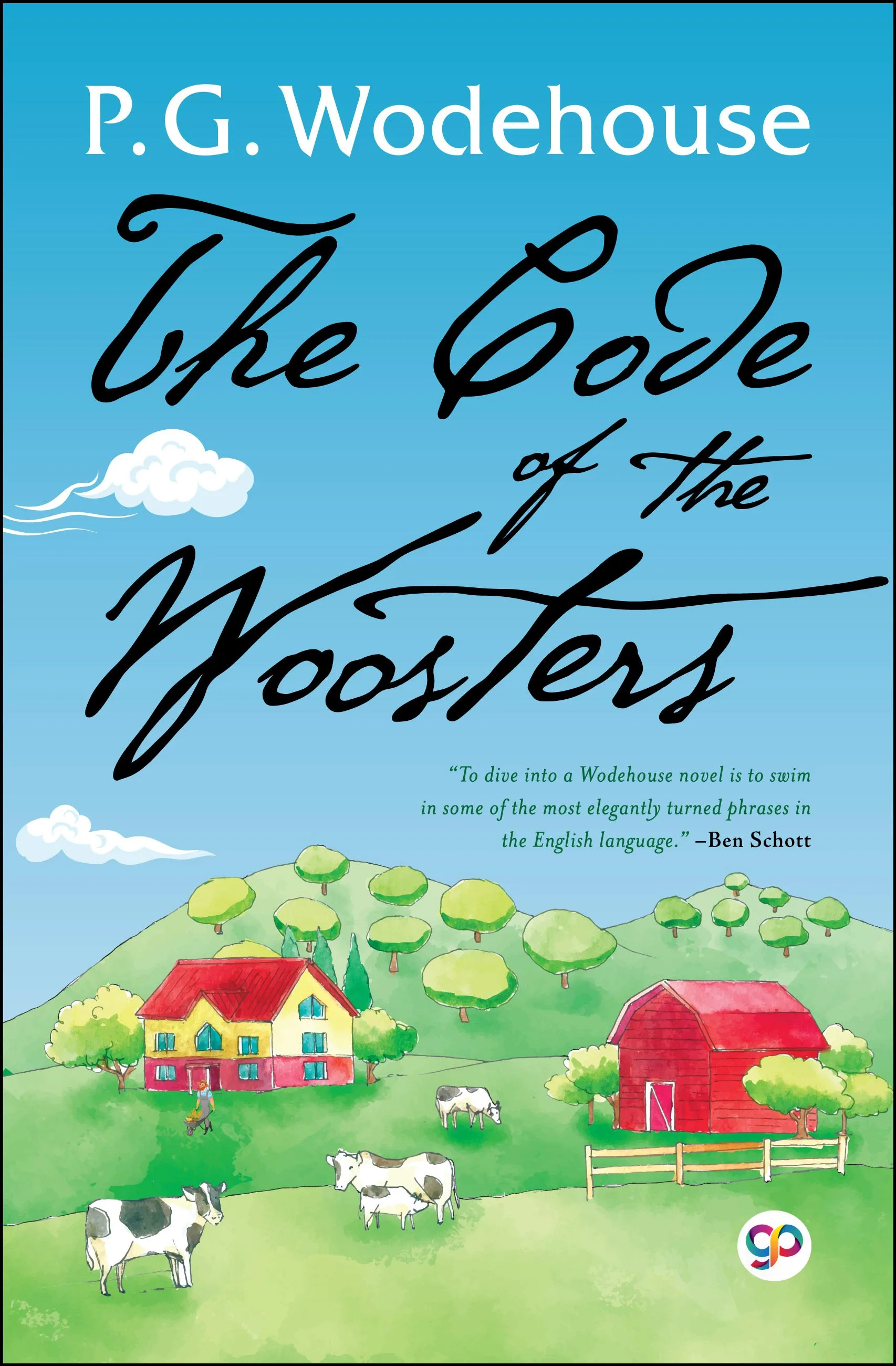
Download Cover Image
Do you want to download the full cover image for The Code of the Woosters?