
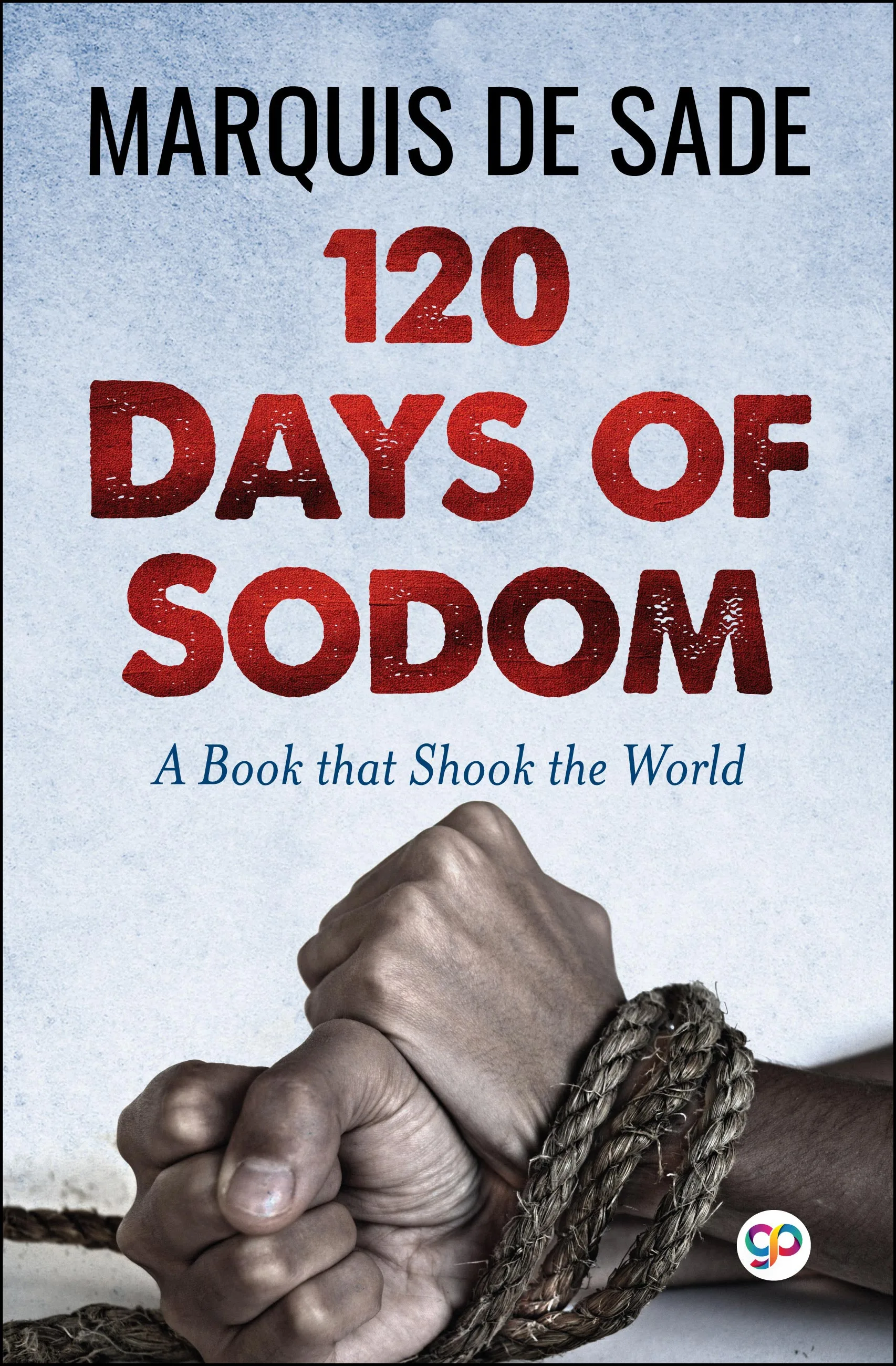
120 Days of Sodom
eBook
• INR 51.00
• English
• 9789354992742
No ratings yet
| Publisher | General Press |
|---|---|
| ISBN13 | 9789354992742 |
| ASIN/SKU | B0B9RHYDRD |
| Book Format | eBook |
| Language | English |
| List Price | INR 51.00 |
| Subject Code | FIC004000, FIC027240 |
| Publishing Date | 01/09/2022 |
| Book Code | BD00068924 |
Buy this Book
Amazon Stores
Ebook Stores
Other Stores
Discover 120 Days of Sodom by Marquis de Sade. This book is published by General Press in eBook format, ISBN 9789354992742, ASIN B0B9RHYDRD, under Literature and Fiction, Horror, Classics.
Book Description
First published in 1904, ‘120 Days of Sodom’ is a 1785 novel by Marquis de Sade, a French nobleman, revolutionary politician, philosopher, and writer celebrated for his literary portrayals of a primarily imagined libertine sexuality. His works include novels, short stories, plays, dialogues, and political tracts.
It is the tale of four noble male libertines who choose to follow ultimate sexual gratification in the form of orgies. To this end, they seclude themselves in an isolated castle in the heart of the Black Forest for four months, along with a harem of 46 victims-most of whom are young male and female teenagers.
It is the tale of four noble male libertines who choose to follow ultimate sexual gratification in the form of orgies. To this end, they seclude themselves in an isolated castle in the heart of the Black Forest for four months, along with a harem of 46 victims-most of whom are young male and female teenagers.
Author Biography
Donatien Alphonse François, better known as the Marquis de Sade (1740–1814), was a French nobleman, novelist, philosopher, and playwright whose writings remain among the most controversial in literary history. His works explored themes of power, desire, freedom, morality, and human nature in ways that shocked readers of his own time and continue to provoke debate today. Although many of his books were banned for decades because of their explicit content, modern scholars also study them for their philosophical ideas and their influence on literature, psychology, and political thought.
The Marquis de Sade was born on June 2, 1740, in Paris, France, into an aristocratic family with close ties to the royal court. He received a classical education and later pursued a military career, serving as an officer during the Seven Years' War. Despite his noble background, his adult life became marked by repeated legal troubles arising from accusations of violent and sexually abusive behavior, scandals, and conflicts with the authorities. He spent nearly thirty years of his life in prisons and asylums, where he wrote much of his literary work.
Among his best-known books are Justine, Juliette, The 120 Days of Sodom, and Philosophy in the Bedroom. These works challenged conventional ideas about religion, law, virtue, and authority through fictional narratives that were intentionally provocative. While the explicit nature of his writing has long been controversial, many literary critics view his works as part of a broader philosophical exploration of individual freedom, the abuse of power, and the limits of social order. His name gave rise to the word "sadism," a term later adopted in psychology to describe deriving pleasure from another person's pain, though the modern clinical concept extends beyond his writings.
The Marquis de Sade died on December 2, 1814, in the Charenton Asylum near Paris at the age of seventy-four. Today, his legacy remains deeply contested. He is remembered both as one of history's most controversial authors and as a figure whose works have influenced writers, philosophers, and artists. His life and writings continue to spark discussions about censorship, freedom of expression, ethics, and the complex relationship between literature and society.
The Marquis de Sade was born on June 2, 1740, in Paris, France, into an aristocratic family with close ties to the royal court. He received a classical education and later pursued a military career, serving as an officer during the Seven Years' War. Despite his noble background, his adult life became marked by repeated legal troubles arising from accusations of violent and sexually abusive behavior, scandals, and conflicts with the authorities. He spent nearly thirty years of his life in prisons and asylums, where he wrote much of his literary work.
Among his best-known books are Justine, Juliette, The 120 Days of Sodom, and Philosophy in the Bedroom. These works challenged conventional ideas about religion, law, virtue, and authority through fictional narratives that were intentionally provocative. While the explicit nature of his writing has long been controversial, many literary critics view his works as part of a broader philosophical exploration of individual freedom, the abuse of power, and the limits of social order. His name gave rise to the word "sadism," a term later adopted in psychology to describe deriving pleasure from another person's pain, though the modern clinical concept extends beyond his writings.
The Marquis de Sade died on December 2, 1814, in the Charenton Asylum near Paris at the age of seventy-four. Today, his legacy remains deeply contested. He is remembered both as one of history's most controversial authors and as a figure whose works have influenced writers, philosophers, and artists. His life and writings continue to spark discussions about censorship, freedom of expression, ethics, and the complex relationship between literature and society.
Editorial Reviews
Editorial Reviews will be added soon…
Book Summary
120 Days of Sodom by Marquis de Sade is one of the most controversial works in the history of literature. Written in 1785 while the author was imprisoned in the Bastille, the book remained unpublished during his lifetime and survives only as an unfinished manuscript. It is often discussed not as a conventional novel but as a philosophical and literary exploration of absolute power, moral corruption, and the destructive consequences of treating other human beings as objects. Because of its disturbing subject matter, the work has long been debated by scholars, historians, and philosophers who seek to understand its social, political, and psychological implications.
At its core, the novel is less about pleasure than about domination. De Sade imagines an isolated setting in which a small group of immensely wealthy and influential men withdraws from society to create an environment where they believe they can act without restraint or accountability. They surround themselves with carefully selected servants, attendants, and captives, believing that their wealth and social status place them beyond ordinary laws and moral responsibility.
The secluded castle in which most of the story takes place functions as more than a physical location. It symbolizes complete isolation from civilization, justice, and compassion. Once inside its walls, the ordinary rules that govern human relationships no longer apply. De Sade creates a closed world in which authority belongs entirely to those who possess power, while everyone else is denied freedom and treated as a means to satisfy the desires of the ruling figures. The castle becomes a literary experiment exploring what happens when power exists without conscience.
The narrative is highly structured despite its shocking reputation. The story is divided into stages corresponding to a carefully organized schedule. Each period introduces increasingly extreme situations, accompanied by lengthy accounts delivered by elderly storytellers who recount episodes from their past. These narratives are intended to inspire or entertain the ruling group, while the events inside the castle become progressively darker. The repetitive structure emphasizes calculation rather than spontaneity, suggesting that cruelty can become systematic when detached from empathy.
Rather than developing a traditional plot driven by suspense, the novel focuses on the psychology of its central figures. The four principal libertines are portrayed as individuals who reject religion, law, social custom, and conventional morality. They argue that human desires should never be limited by ethical principles. According to their philosophy, personal satisfaction becomes the highest good, regardless of the suffering experienced by others.
De Sade presents these ideas through extended conversations and philosophical debates. His characters frequently defend their actions using elaborate arguments about nature, freedom, and individual desire. They claim that moral rules are artificial inventions designed to restrain human instincts. However, the novel does not simply celebrate these views. Instead, by showing their logical consequences, it invites readers to confront the frightening possibility of a society where power alone determines what is considered acceptable.
One of the book's central themes is the relationship between power and corruption. The libertines are wealthy, educated, and politically influential, yet their authority has detached them completely from ordinary human sympathy. They no longer recognize other people as individuals with feelings and dignity. Instead, they reduce human beings to instruments for achieving personal gratification. De Sade repeatedly demonstrates how unchecked authority can erode compassion and encourage increasingly destructive behavior.
The novel also examines the misuse of reason. The principal characters often pride themselves on being rational thinkers who reject superstition and religious belief. Yet their intelligence serves not to promote justice or wisdom but to justify exploitation. They construct elaborate philosophical systems to defend their actions, illustrating how logic can become dangerous when separated from empathy and ethical responsibility. De Sade suggests that reason alone cannot guarantee morality if it lacks compassion.
Another recurring theme is the conflict between civilization and instinct. The isolated castle represents an attempt to strip away every social restraint. Laws, customs, religion, and family relationships disappear, leaving only desire and authority. De Sade explores whether human beings naturally become destructive when freed from external limits or whether civilization exists precisely to prevent such outcomes. The novel offers no comforting resolution, instead forcing readers to confront unsettling questions about the foundations of moral behavior.
Throughout the work, the victims remain largely powerless. Their lack of agency highlights the profound imbalance between those who command and those who obey. Although individual personalities occasionally emerge, the novel primarily uses these characters to illustrate the devastating consequences of absolute domination. Modern readers often interpret this imbalance as part of De Sade's broader critique of societies built upon rigid hierarchies and inherited privilege.
The unfinished nature of the manuscript contributes to its unusual literary character. Large sections exist as outlines or catalogs rather than fully developed scenes. This incomplete form gives the work a documentary quality, revealing De Sade's ambitious plan without fully realizing every aspect of it. Scholars often view the manuscript itself as historically significant because it survived extraordinary circumstances after being hidden during the French Revolution.
The political context of the eighteenth century also shapes many interpretations of the novel. De Sade wrote during a period when European societies were marked by extreme inequalities of wealth and privilege. Aristocrats often possessed immense authority while ordinary people had little legal protection. Some critics argue that the novel exaggerates these realities into grotesque fiction, exposing the dangers of social systems that concentrate power in the hands of a small elite. Others see it as a challenge to Enlightenment optimism, questioning whether reason and progress alone can guarantee moral improvement.
Religion is another important subject throughout the book. The principal characters openly reject traditional religious teachings and frequently ridicule institutions they associate with moral authority. Yet the novel does not simply replace religion with freedom. Instead, it portrays a world in which the complete absence of ethical restraint leads not to liberation but to spiritual emptiness and endless escalation. Desire, once detached from responsibility, becomes incapable of providing lasting satisfaction.
The novel's repetitive structure serves an important artistic purpose. As events become increasingly mechanical and predictable, readers witness not excitement but emotional exhaustion. This repetition undermines the libertines' claim that limitless indulgence produces happiness. Instead, their endless pursuit of novelty suggests profound dissatisfaction. The absence of meaningful relationships leaves them trapped in an endless cycle of excess without fulfillment.
Despite its notorious reputation, 120 Days of Sodom occupies an important place in literary history because of the questions it raises about freedom, authority, morality, and human nature. Writers, philosophers, psychologists, and filmmakers have engaged with the text not because they endorse its characters' beliefs but because it presents an uncompromising examination of what can happen when ethical boundaries collapse. Its influence extends beyond literature into discussions of political tyranny, the abuse of power, and the psychology of cruelty.
Ultimately, 120 Days of Sodom is best understood as a disturbing philosophical and literary experiment rather than a conventional novel. Through its isolated setting, authoritarian characters, and relentless exploration of domination, Marquis de Sade challenges readers to consider the necessity of moral responsibility, empathy, and justice. Far from presenting a vision of genuine freedom, the novel illustrates how the pursuit of unlimited power and desire can destroy both individual humanity and the social bonds that make civilized life possible. Its enduring significance lies not in its sensational content but in its unsettling examination of the consequences of power divorced from conscience.
At its core, the novel is less about pleasure than about domination. De Sade imagines an isolated setting in which a small group of immensely wealthy and influential men withdraws from society to create an environment where they believe they can act without restraint or accountability. They surround themselves with carefully selected servants, attendants, and captives, believing that their wealth and social status place them beyond ordinary laws and moral responsibility.
The secluded castle in which most of the story takes place functions as more than a physical location. It symbolizes complete isolation from civilization, justice, and compassion. Once inside its walls, the ordinary rules that govern human relationships no longer apply. De Sade creates a closed world in which authority belongs entirely to those who possess power, while everyone else is denied freedom and treated as a means to satisfy the desires of the ruling figures. The castle becomes a literary experiment exploring what happens when power exists without conscience.
The narrative is highly structured despite its shocking reputation. The story is divided into stages corresponding to a carefully organized schedule. Each period introduces increasingly extreme situations, accompanied by lengthy accounts delivered by elderly storytellers who recount episodes from their past. These narratives are intended to inspire or entertain the ruling group, while the events inside the castle become progressively darker. The repetitive structure emphasizes calculation rather than spontaneity, suggesting that cruelty can become systematic when detached from empathy.
Rather than developing a traditional plot driven by suspense, the novel focuses on the psychology of its central figures. The four principal libertines are portrayed as individuals who reject religion, law, social custom, and conventional morality. They argue that human desires should never be limited by ethical principles. According to their philosophy, personal satisfaction becomes the highest good, regardless of the suffering experienced by others.
De Sade presents these ideas through extended conversations and philosophical debates. His characters frequently defend their actions using elaborate arguments about nature, freedom, and individual desire. They claim that moral rules are artificial inventions designed to restrain human instincts. However, the novel does not simply celebrate these views. Instead, by showing their logical consequences, it invites readers to confront the frightening possibility of a society where power alone determines what is considered acceptable.
One of the book's central themes is the relationship between power and corruption. The libertines are wealthy, educated, and politically influential, yet their authority has detached them completely from ordinary human sympathy. They no longer recognize other people as individuals with feelings and dignity. Instead, they reduce human beings to instruments for achieving personal gratification. De Sade repeatedly demonstrates how unchecked authority can erode compassion and encourage increasingly destructive behavior.
The novel also examines the misuse of reason. The principal characters often pride themselves on being rational thinkers who reject superstition and religious belief. Yet their intelligence serves not to promote justice or wisdom but to justify exploitation. They construct elaborate philosophical systems to defend their actions, illustrating how logic can become dangerous when separated from empathy and ethical responsibility. De Sade suggests that reason alone cannot guarantee morality if it lacks compassion.
Another recurring theme is the conflict between civilization and instinct. The isolated castle represents an attempt to strip away every social restraint. Laws, customs, religion, and family relationships disappear, leaving only desire and authority. De Sade explores whether human beings naturally become destructive when freed from external limits or whether civilization exists precisely to prevent such outcomes. The novel offers no comforting resolution, instead forcing readers to confront unsettling questions about the foundations of moral behavior.
Throughout the work, the victims remain largely powerless. Their lack of agency highlights the profound imbalance between those who command and those who obey. Although individual personalities occasionally emerge, the novel primarily uses these characters to illustrate the devastating consequences of absolute domination. Modern readers often interpret this imbalance as part of De Sade's broader critique of societies built upon rigid hierarchies and inherited privilege.
The unfinished nature of the manuscript contributes to its unusual literary character. Large sections exist as outlines or catalogs rather than fully developed scenes. This incomplete form gives the work a documentary quality, revealing De Sade's ambitious plan without fully realizing every aspect of it. Scholars often view the manuscript itself as historically significant because it survived extraordinary circumstances after being hidden during the French Revolution.
The political context of the eighteenth century also shapes many interpretations of the novel. De Sade wrote during a period when European societies were marked by extreme inequalities of wealth and privilege. Aristocrats often possessed immense authority while ordinary people had little legal protection. Some critics argue that the novel exaggerates these realities into grotesque fiction, exposing the dangers of social systems that concentrate power in the hands of a small elite. Others see it as a challenge to Enlightenment optimism, questioning whether reason and progress alone can guarantee moral improvement.
Religion is another important subject throughout the book. The principal characters openly reject traditional religious teachings and frequently ridicule institutions they associate with moral authority. Yet the novel does not simply replace religion with freedom. Instead, it portrays a world in which the complete absence of ethical restraint leads not to liberation but to spiritual emptiness and endless escalation. Desire, once detached from responsibility, becomes incapable of providing lasting satisfaction.
The novel's repetitive structure serves an important artistic purpose. As events become increasingly mechanical and predictable, readers witness not excitement but emotional exhaustion. This repetition undermines the libertines' claim that limitless indulgence produces happiness. Instead, their endless pursuit of novelty suggests profound dissatisfaction. The absence of meaningful relationships leaves them trapped in an endless cycle of excess without fulfillment.
Despite its notorious reputation, 120 Days of Sodom occupies an important place in literary history because of the questions it raises about freedom, authority, morality, and human nature. Writers, philosophers, psychologists, and filmmakers have engaged with the text not because they endorse its characters' beliefs but because it presents an uncompromising examination of what can happen when ethical boundaries collapse. Its influence extends beyond literature into discussions of political tyranny, the abuse of power, and the psychology of cruelty.
Ultimately, 120 Days of Sodom is best understood as a disturbing philosophical and literary experiment rather than a conventional novel. Through its isolated setting, authoritarian characters, and relentless exploration of domination, Marquis de Sade challenges readers to consider the necessity of moral responsibility, empathy, and justice. Far from presenting a vision of genuine freedom, the novel illustrates how the pursuit of unlimited power and desire can destroy both individual humanity and the social bonds that make civilized life possible. Its enduring significance lies not in its sensational content but in its unsettling examination of the consequences of power divorced from conscience.
Sample Chapters
Sample Chapters will be added soon…
Reader Reviews
No reviews yet.
120 Days of Sodom
Download Cover Image
Do you want to download the full cover image for 120 Days of Sodom?