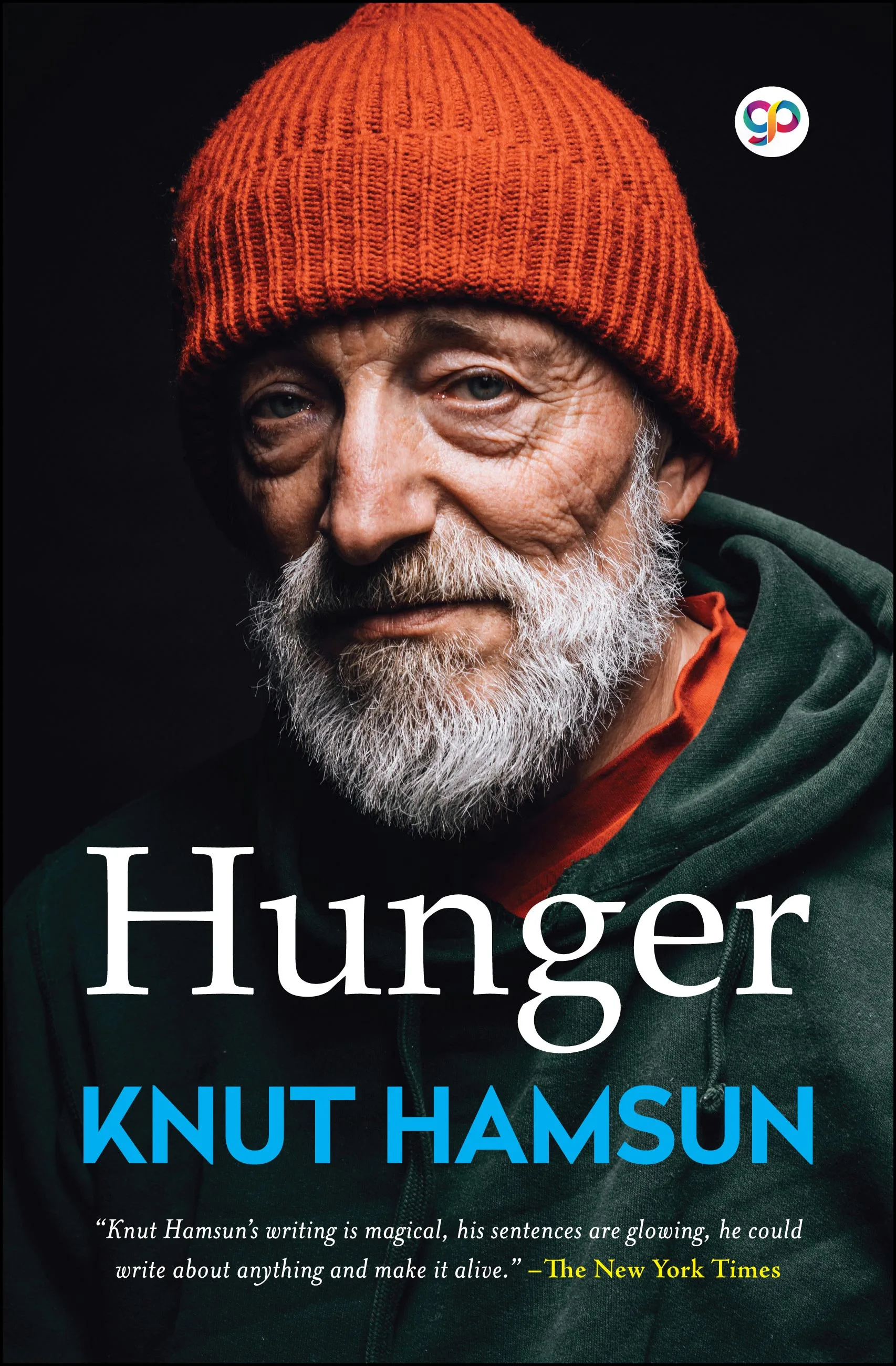
Hunger
eBook
• INR 51.00
• English
• 9789354993930
No ratings yet
| Publisher | General Press |
|---|---|
| ISBN13 | 9789354993930 |
| ASIN/SKU | B0BBRDNKZ4 |
| Book Format | eBook |
| Language | English |
| List Price | INR 51.00 |
| Subject Code | FIC004000, FIC025000, FIC055000 |
| Publishing Date | 05/09/2022 |
| Book Code | BD00068953 |
Buy this Book
Amazon Stores
Ebook Stores
Other Stores
Discover Hunger by Knut Hamsun. This book is published by General Press in eBook format, ISBN 9789354993930, ASIN B0BBRDNKZ4, under Literature and Fiction, Literary Fiction, Classics.
Book Description
What happens when hunger becomes more than an empty stomach and begins to shape a person’s thoughts, pride, and sense of reality? 'Hunger' by Knut Hamsun is a groundbreaking psychological fiction novel that follows a struggling young writer as he tries to survive in the streets of Kristiania, now known as Oslo. With remarkable intimacy, Hamsun explores poverty, loneliness, artistic ambition, and the fragile workings of the human mind.
The unnamed narrator is an aspiring writer who lives from one uncertain day to the next. He has little money, almost nothing to eat, and no stable place to call home, yet he stubbornly refuses to abandon his dream of becoming a successful author. He spends his days wandering through the city, trying to write, searching for opportunities to sell his work, and desperately calculating how to obtain his next meal. As his hunger grows, ordinary experiences become increasingly intense and unpredictable.
What makes the novel so compelling is its focus on the narrator’s inner world. Hunger affects not only his body but also his judgment, emotions, pride, and relationships with other people. He can be generous one moment and irrational the next, driven by dignity even when practical survival would demand compromise. His encounters with strangers, officials, publishers, and a mysterious young woman reveal both his vulnerability and his fierce determination to remain independent.
Rather than presenting poverty as a simple social problem, Hamsun takes readers deep inside the consciousness of someone experiencing it. The result is a restless, deeply personal story about creativity, desperation, isolation, and the strange ways the mind responds when basic needs are constantly threatened. Hamsun’s vivid prose and close psychological perspective make the narrator’s struggle feel immediate and intensely human.
'Hunger' remains a powerful work of literary fiction because it asks difficult questions about dignity, identity, ambition, and survival. If you want to discover why Knut Hamsun’s novel became such an influential work of modern psychological literature, this unforgettable journey into the mind of a starving writer is well worth reading.
The unnamed narrator is an aspiring writer who lives from one uncertain day to the next. He has little money, almost nothing to eat, and no stable place to call home, yet he stubbornly refuses to abandon his dream of becoming a successful author. He spends his days wandering through the city, trying to write, searching for opportunities to sell his work, and desperately calculating how to obtain his next meal. As his hunger grows, ordinary experiences become increasingly intense and unpredictable.
What makes the novel so compelling is its focus on the narrator’s inner world. Hunger affects not only his body but also his judgment, emotions, pride, and relationships with other people. He can be generous one moment and irrational the next, driven by dignity even when practical survival would demand compromise. His encounters with strangers, officials, publishers, and a mysterious young woman reveal both his vulnerability and his fierce determination to remain independent.
Rather than presenting poverty as a simple social problem, Hamsun takes readers deep inside the consciousness of someone experiencing it. The result is a restless, deeply personal story about creativity, desperation, isolation, and the strange ways the mind responds when basic needs are constantly threatened. Hamsun’s vivid prose and close psychological perspective make the narrator’s struggle feel immediate and intensely human.
'Hunger' remains a powerful work of literary fiction because it asks difficult questions about dignity, identity, ambition, and survival. If you want to discover why Knut Hamsun’s novel became such an influential work of modern psychological literature, this unforgettable journey into the mind of a starving writer is well worth reading.
Author Biography
Knut Hamsun (1859–1952) was one of Norway's most influential and innovative novelists. Widely regarded as a pioneer of modern psychological fiction, he transformed the way writers portrayed the inner lives of their characters. His novels explored loneliness, ambition, love, alienation, and humanity's complex relationship with nature. Although his literary achievements earned worldwide admiration, his political views later in life remain deeply controversial and continue to shape discussions about his legacy.
Hamsun was born as Knud Pedersen on August 4, 1859, in Lom, Norway. He spent much of his childhood in poverty after his family moved to Hamarøy in northern Norway. From a young age, he worked in various jobs, including as a shop assistant, teacher, laborer, and clerk. These experiences exposed him to the struggles of ordinary people and later became an important source of inspiration for his writing. During the 1880s, he also traveled to the United States, where he worked several temporary jobs and developed critical views of modern industrial society.
His literary breakthrough came in 1890 with the publication of Hunger, a groundbreaking novel that focused on the psychological experiences of a struggling writer. Unlike many novels of its time, Hunger emphasized thoughts, emotions, and shifting states of mind rather than external events. Hamsun followed this success with acclaimed works such as Mysteries, Pan, Victoria, and Growth of the Soil. The latter earned him the 1920 Nobel Prize in Literature for its powerful portrayal of rural life and humanity's connection to the land.
Despite his remarkable literary accomplishments, Hamsun's reputation was severely damaged by his support for Nazi Germany during the Second World War. After the war, he faced legal proceedings in Norway and was widely criticized for his political stance. This aspect of his life remains a painful and debated chapter in literary history.
Knut Hamsun died on February 19, 1952, at the age of 92. Today, his novels continue to be studied for their originality, psychological depth, and influence on writers such as Franz Kafka, Thomas Mann, and Ernest Hemingway. His life serves as a reminder that extraordinary artistic achievement and deeply flawed personal judgment can exist within the same individual.
Hamsun was born as Knud Pedersen on August 4, 1859, in Lom, Norway. He spent much of his childhood in poverty after his family moved to Hamarøy in northern Norway. From a young age, he worked in various jobs, including as a shop assistant, teacher, laborer, and clerk. These experiences exposed him to the struggles of ordinary people and later became an important source of inspiration for his writing. During the 1880s, he also traveled to the United States, where he worked several temporary jobs and developed critical views of modern industrial society.
His literary breakthrough came in 1890 with the publication of Hunger, a groundbreaking novel that focused on the psychological experiences of a struggling writer. Unlike many novels of its time, Hunger emphasized thoughts, emotions, and shifting states of mind rather than external events. Hamsun followed this success with acclaimed works such as Mysteries, Pan, Victoria, and Growth of the Soil. The latter earned him the 1920 Nobel Prize in Literature for its powerful portrayal of rural life and humanity's connection to the land.
Despite his remarkable literary accomplishments, Hamsun's reputation was severely damaged by his support for Nazi Germany during the Second World War. After the war, he faced legal proceedings in Norway and was widely criticized for his political stance. This aspect of his life remains a painful and debated chapter in literary history.
Knut Hamsun died on February 19, 1952, at the age of 92. Today, his novels continue to be studied for their originality, psychological depth, and influence on writers such as Franz Kafka, Thomas Mann, and Ernest Hemingway. His life serves as a reminder that extraordinary artistic achievement and deeply flawed personal judgment can exist within the same individual.
Editorial Reviews
Editorial Reviews will be added soon…
Book Summary
Knut Hamsun's "Hunger" is a deeply psychological novel that follows the struggles of an unnamed young writer wandering through the streets of Kristiania (now Oslo), Norway. Poor, hungry, and determined to preserve his dignity, he lives on the edge of survival while trying to earn money through his writing. Despite his obvious talent, his articles are frequently rejected or bring only small payments that disappear almost as soon as they arrive. With no steady income, he is forced to pawn his few belongings, sleep wherever he can find shelter, and go for days without proper food. Hunger slowly becomes more than a physical condition—it begins to reshape his thoughts, emotions, and sense of reality. Throughout the novel, the narrator remains fiercely proud, often refusing help even when he desperately needs it, believing that accepting charity would destroy his self-respect.
As the days pass, the effects of starvation become increasingly severe. His empty stomach weakens his body, but it also sends his mind into strange and unpredictable states. At times he feels unusually energetic and optimistic, convinced that success is just around the corner. At other moments, despair overwhelms him, leaving him unable to think clearly or make sensible decisions. He hallucinates, imagines conversations that never happen, and becomes obsessed with small incidents that others would barely notice. Hamsun portrays these mental shifts with remarkable intimacy, allowing readers to experience the narrator's confusion from the inside rather than merely observing it. The novel captures how extreme hardship can blur the boundary between reason and illusion while revealing the fragile relationship between the body and the mind.
The narrator constantly encounters people from different walks of life, yet meaningful human connection remains beyond his reach. He meets landlords, policemen, shopkeepers, editors, strangers, and fellow citizens who briefly enter his life before disappearing again. Sometimes they show him unexpected kindness, while at other times they treat him with suspicion or indifference. Even when opportunities arise, his own pride often prevents him from accepting assistance. Rather than admitting his desperation, he invents stories, behaves strangely, or simply walks away. These encounters emphasize his growing isolation. He exists in the middle of a busy city filled with people, yet he remains profoundly alone, trapped inside his own thoughts and unable to build lasting relationships.
One of the novel's most memorable threads involves the narrator's fascination with a mysterious young woman he affectionately calls "Ylajali." Their meetings are brief, awkward, and filled with emotional uncertainty. She becomes a symbol of beauty, hope, and the normal life he longs to possess but cannot attain. His attraction to her is sincere, yet his poverty and unstable mental condition make genuine romance impossible. He alternates between confidence and embarrassment, imagining possibilities that quickly collapse under the weight of reality. Their relationship reflects the broader tension in the novel: the desire for happiness constantly interrupted by the harsh demands of survival. Love, like food, becomes something he craves but cannot truly possess.
Writing remains the narrator's greatest source of hope throughout his ordeal. Whenever inspiration strikes, he works feverishly, convinced that a brilliant article will rescue him from poverty. These moments of creative excitement briefly allow him to forget his suffering. However, the joy never lasts long. Editors reject his work, payments are delayed, or his physical weakness prevents him from completing his ideas. Even so, he refuses to abandon his identity as a writer. His artistic ambition gives him purpose, but it also deepens his frustration because his dreams seem forever out of reach. Hamsun presents creativity as both a gift and a burden, showing how artistic passion can sustain a person even while exposing them to disappointment.
The narrator's pride is perhaps his greatest strength and his greatest weakness. Again and again, he chooses hardship over humiliation. When offered help, he often rejects it or behaves in ways that make assistance impossible. He even gives away money or possessions during rare moments when he has almost nothing himself, driven by an irrational desire to prove his generosity and independence. His moral code is complicated and sometimes contradictory. He lies without hesitation, yet he also feels overwhelming guilt for small mistakes. He desperately wants to appear honorable, even when hunger pushes him toward irrational behavior. These contradictions make him feel strikingly human rather than simply heroic or tragic.
As his condition worsens, the city itself seems to change in his eyes. Ordinary streets, buildings, and public spaces become stages for his inner drama. Every sound, expression, and chance encounter takes on exaggerated meaning. Hunger transforms the familiar world into something strange and unpredictable. Hamsun's vivid descriptions allow readers to experience the city not as an objective setting but as a landscape shaped by the narrator's psychological state. The novel moves away from traditional plot-driven storytelling and instead focuses on the rhythms of thought, memory, emotion, and sensation. This innovative approach was groundbreaking for its time and influenced many later modernist writers who explored the complexities of human consciousness.
Eventually, the narrator realizes that remaining in the city offers little hope for change. Despite his determination, his circumstances continue to deteriorate, and his mental and physical health become increasingly fragile. An opportunity finally appears when he secures work aboard a ship leaving the city. Accepting this position represents more than simply finding employment. It offers the possibility of escape from the cycle of hunger, rejection, and despair that has consumed his life. As he prepares to leave, there is no dramatic triumph or complete resolution. Instead, the ending carries a quiet sense of relief mixed with uncertainty. The future remains unknown, but movement itself becomes a symbol of renewed possibility.
'Hunger' is far more than a story about poverty. It is an intimate exploration of loneliness, dignity, ambition, and the psychological effects of deprivation. Knut Hamsun challenges readers to look beyond material hardship and consider how identity, pride, and imagination shape human experience. His unnamed narrator is often frustrating, irrational, and contradictory, yet he remains deeply sympathetic because his struggles reveal universal fears about failure, isolation, and the search for meaning. The novel's enduring power lies in its honest portrayal of a mind under extreme pressure and its refusal to offer simple moral lessons or easy solutions. More than a century after its publication, Hunger continues to stand as one of the most influential psychological novels ever written, offering a timeless meditation on resilience, vulnerability, and the complicated nature of the human spirit.
As the days pass, the effects of starvation become increasingly severe. His empty stomach weakens his body, but it also sends his mind into strange and unpredictable states. At times he feels unusually energetic and optimistic, convinced that success is just around the corner. At other moments, despair overwhelms him, leaving him unable to think clearly or make sensible decisions. He hallucinates, imagines conversations that never happen, and becomes obsessed with small incidents that others would barely notice. Hamsun portrays these mental shifts with remarkable intimacy, allowing readers to experience the narrator's confusion from the inside rather than merely observing it. The novel captures how extreme hardship can blur the boundary between reason and illusion while revealing the fragile relationship between the body and the mind.
The narrator constantly encounters people from different walks of life, yet meaningful human connection remains beyond his reach. He meets landlords, policemen, shopkeepers, editors, strangers, and fellow citizens who briefly enter his life before disappearing again. Sometimes they show him unexpected kindness, while at other times they treat him with suspicion or indifference. Even when opportunities arise, his own pride often prevents him from accepting assistance. Rather than admitting his desperation, he invents stories, behaves strangely, or simply walks away. These encounters emphasize his growing isolation. He exists in the middle of a busy city filled with people, yet he remains profoundly alone, trapped inside his own thoughts and unable to build lasting relationships.
One of the novel's most memorable threads involves the narrator's fascination with a mysterious young woman he affectionately calls "Ylajali." Their meetings are brief, awkward, and filled with emotional uncertainty. She becomes a symbol of beauty, hope, and the normal life he longs to possess but cannot attain. His attraction to her is sincere, yet his poverty and unstable mental condition make genuine romance impossible. He alternates between confidence and embarrassment, imagining possibilities that quickly collapse under the weight of reality. Their relationship reflects the broader tension in the novel: the desire for happiness constantly interrupted by the harsh demands of survival. Love, like food, becomes something he craves but cannot truly possess.
Writing remains the narrator's greatest source of hope throughout his ordeal. Whenever inspiration strikes, he works feverishly, convinced that a brilliant article will rescue him from poverty. These moments of creative excitement briefly allow him to forget his suffering. However, the joy never lasts long. Editors reject his work, payments are delayed, or his physical weakness prevents him from completing his ideas. Even so, he refuses to abandon his identity as a writer. His artistic ambition gives him purpose, but it also deepens his frustration because his dreams seem forever out of reach. Hamsun presents creativity as both a gift and a burden, showing how artistic passion can sustain a person even while exposing them to disappointment.
The narrator's pride is perhaps his greatest strength and his greatest weakness. Again and again, he chooses hardship over humiliation. When offered help, he often rejects it or behaves in ways that make assistance impossible. He even gives away money or possessions during rare moments when he has almost nothing himself, driven by an irrational desire to prove his generosity and independence. His moral code is complicated and sometimes contradictory. He lies without hesitation, yet he also feels overwhelming guilt for small mistakes. He desperately wants to appear honorable, even when hunger pushes him toward irrational behavior. These contradictions make him feel strikingly human rather than simply heroic or tragic.
As his condition worsens, the city itself seems to change in his eyes. Ordinary streets, buildings, and public spaces become stages for his inner drama. Every sound, expression, and chance encounter takes on exaggerated meaning. Hunger transforms the familiar world into something strange and unpredictable. Hamsun's vivid descriptions allow readers to experience the city not as an objective setting but as a landscape shaped by the narrator's psychological state. The novel moves away from traditional plot-driven storytelling and instead focuses on the rhythms of thought, memory, emotion, and sensation. This innovative approach was groundbreaking for its time and influenced many later modernist writers who explored the complexities of human consciousness.
Eventually, the narrator realizes that remaining in the city offers little hope for change. Despite his determination, his circumstances continue to deteriorate, and his mental and physical health become increasingly fragile. An opportunity finally appears when he secures work aboard a ship leaving the city. Accepting this position represents more than simply finding employment. It offers the possibility of escape from the cycle of hunger, rejection, and despair that has consumed his life. As he prepares to leave, there is no dramatic triumph or complete resolution. Instead, the ending carries a quiet sense of relief mixed with uncertainty. The future remains unknown, but movement itself becomes a symbol of renewed possibility.
'Hunger' is far more than a story about poverty. It is an intimate exploration of loneliness, dignity, ambition, and the psychological effects of deprivation. Knut Hamsun challenges readers to look beyond material hardship and consider how identity, pride, and imagination shape human experience. His unnamed narrator is often frustrating, irrational, and contradictory, yet he remains deeply sympathetic because his struggles reveal universal fears about failure, isolation, and the search for meaning. The novel's enduring power lies in its honest portrayal of a mind under extreme pressure and its refusal to offer simple moral lessons or easy solutions. More than a century after its publication, Hunger continues to stand as one of the most influential psychological novels ever written, offering a timeless meditation on resilience, vulnerability, and the complicated nature of the human spirit.
Sample Chapters
Part 1
It was during the time I wandered about and starved in Christiania: Christiania, this singular city, from which no man departs without carrying away the traces of his sojourn there.
* * *
I was lying awake in my attic and I heard a clock below strike six. It was already broad daylight, and people had begun to go up and down the stairs. By the door where the wall of the room was papered with old numbers of the Morgenbladet, I could distinguish clearly a notice from the Director of Lighthouses, and a little to the left of that an inflated advertisement of Fabian Olsens’ new-baked bread.
The instant I opened my eyes I began, from sheer force of habit, to think if I had anything to rejoice over that day. I had been somewhat hard-up lately, and one after the other of my belongings had been taken to my “Uncle.” I had grown nervous and irritable. A few times I had kept my bed for the day with vertigo. Now and then, when luck had favoured me, I had managed to get five shillings for a feuilleton from some newspaper or other.
It grew lighter and lighter, and I took to reading the advertisements near the door. I could even make out the grinning lean letters of “winding-sheets to be had at Miss Andersen’s” on the right of it. That occupied me for a long while. I heard the clock below strike eight as I got up and put on my clothes.
I opened the window and looked out. From where I was standing I had a view of a clothes-line and an open field. Farther away lay the ruins of a burnt-out smithy, which some labourers were busy clearing away. I leant with my elbows resting on the window-frame and gazed into open space. It promised to be a clear day – Aautumn, that tender, cool time of the year, when all things change their colour, and die, had come to us. The ever-increasing noise in the streets lured me out. The bare room, the floor of which rocked up and down with every step I took across it, seemed like a gasping, sinister coffin. There was no proper fastening to the door, either, and no stove. I used to lie on my socks at night to dry them a little by the morning. The only thing I had to divert myself with was a little red rocking-chair, in which I used to sit in the evenings and doze and muse on all manner of things. When it blew hard, and the door below stood open, all kinds of eerie sounds moaned up through the floor and from out the walls, and the Morgenbladet near the door was rent in strips a span long.
I stood up and searched through a bundle in the corner by the bed for a bite for breakfast, but finding nothing, went back to the window.
God knows, thought I, if looking for employment will ever again avail me aught. The frequent repulses, half-promises, and curt noes, the cherished, deluded hopes, and fresh endeavours that always resulted in nothing had done my courage to death. As a last resource, I had applied for a place as debt collector, but I was too late, and, besides, I could not have found the fifty shillings demanded as security. There was always something or another in my way. I had even offered to enlist in the Fire Brigade. There we stood and waited in the vestibule, some half-hundred men, thrusting our chests out to give an idea of strength and bravery, whilst an inspector walked up and down and scanned the applicants, felt their arms, and put one question or another to them. Me, he passed by, merely shaking his head, saying I was rejected on account of my sight. I applied again without my glasses, stood there with knitted brows, and made my eyes as sharp as needles, but the man passed me by again with a smile; he had recognized me. And, worse than all, I could no longer apply for a situation in the garb of a respectable man.
How regularly and steadily things had gone downhill with me for a long time, till, in the end, I was so curiously bared of every conceivable thing. I had not even a comb left, not even a book to read, when things grew all too sad with me. All through the summer, up in the churchyards or parks, where I used to sit and write my articles for the newspapers, I had thought out column after column on the most miscellaneous subjects. Strange ideas, quaint fancies, conceits of my restless brain; in despair I had often chosen the most remote themes, that cost me long hours of intense effort, and never were accepted. When one piece was finished I set to work at another. I was not often discouraged by the editors’ “no.” I used to tell myself constantly that someday I was bound to succeed; and really occasionally when I was in luck’s way, and made a hit with something, I could get five shillings for an afternoon’s work.
Once again I raised myself from the window, went over to the washing-stand, and sprinkled some water on the shiny knees of my trousers to dull them a little and make them look a trifle newer. Having done this, I pocketed paper and pencil as usual and went out. I stole very quietly down the stairs in order not to attract my landlady’s attention (a few days had elapsed since my rent had fallen due, and I had no longer anything wherewith to raise it).
It was nine o’clock. The roll of vehicles and hum of voices filled the air, a mighty morning-choir mingled with the footsteps of the pedestrians, and the crack of the hack-drivers’ whips. The clamorous traffic everywhere exhilarated me at once, and I began to feel more and more contented. Nothing was farther from my intention than to merely take a morning walk in the open air. What had the air to do with my lungs? I was strong as a giant; could stop a dray with my shoulders. A sweet, unwonted mood, a feeling of lightsome happy-go-luckiness took possession of me. I fell to observing the people I met and who passed me, to reading the placards on the wall, noted even the impression of a glance thrown at me from a passing tram-car, let each bagatelle, each trifling incident that crossed or vanished from my path impress me.
If one only had just a little to eat on such a lightsome day! The sense of the glad morning overwhelmed me; my satisfaction became ill-regulated, and for no definite reason I began to hum joyfully.
At a butcher’s stall a woman stood speculating on sausage for dinner. As I passed her she looked up at me. She had but one tooth in the front of her head. I had become so nervous and easily affected in the last few days that the woman’s face made a loathsome impression upon me. The long yellow snag looked like a little finger pointing out of her gum, and her gaze was still full of sausage as she turned it upon me. I immediately lost all appetite, and a feeling of nausea came over me. When I reached the market-place I went to the fountain and drank a little. I looked up; the dial marked ten on Our Saviour’s tower.
I went on through the streets, listlessly, without troubling myself about anything at all, stopped aimlessly at a corner, turned off into a side street without having any errand there. I simply let myself go, wandered about in the pleasant morning, swinging myself care-free to and fro amongst other happy human beings. This air was clear and bright and my mind too was without a shadow.
For quite ten minutes I had had an old lame man ahead of me. He carried a bundle in one hand and exerted his whole body, using all his strength in his endeavours to get along speedily. I could hear how he panted from the exertion, and it occurred to me that I might offer to bear his bundle for him, but yet I made no effort to overtake him. Up in Graendsen I met Hans Pauli, who nodded and hurried past me. Why was he in such a hurry? I had not the slightest intention of asking him for a shilling, and, more than that, I intended at the very first opportunity to return him a blanket which I had borrowed from him some weeks before.
Just wait until I could get my foot on the ladder, I would be beholden to no man, not even for a blanket. Perhaps even this very day I might commence an article on the “Crimes of Futurity,” “Freedom of Will,” or what not, at any rate, something worth reading, something for which I would at least get ten shillings… And at the thought of this article I felt myself fired with a desire to set to work immediately and to draw from the contents of my overflowing brain. I would find a suitable place to write in the park and not rest until I had completed my article.
But the old cripple was still making the same sprawling movements ahead of me up the street. The sight of this infirm creature constantly in front of me, commenced to irritate me – his journey seemed endless; perhaps he had made up his mind to go to exactly the same place as I had, and I must needs have him before my eyes the whole way. In my irritation it seemed to me that he slackened his pace a little at every cross street, as if waiting to see which direction I intended to take, upon which he would again swing his bundle in the air and peg away with all his might to keep ahead of me. I follow and watch this tiresome creature and get more and more exasperated with him, I am conscious that he has, little by little, destroyed my happy mood and dragged the pure, beautiful morning down to the level of his own ugliness. He looks like a great sprawling reptile striving with might and main to win a place in the world and reserve the footpath for himself. When we reached the top of the hill I determined to put up with it no longer. I turned to a shop window and stopped in order to give him an opportunity of getting ahead, but when, after a lapse of some minutes, I again walked on there was the man still in front of me – he too had stood stock still, – without stopping to reflect I made three or four furious onward strides, caught him up, and slapped him on the shoulder.
He stopped directly, and we both stared at one another fixedly. “A halfpenny for milk!” he whined, twisting his head askew.
So that was how the wind blew. I felt in my pockets and said: “For milk, eh? Hum-m – money’s scarce these times, and I don’t really know how much you are in need of it.”
“I haven’t eaten a morsel since yesterday in Drammen; I haven’t got a farthing, nor have I got any work yet!”
“Are you an artisan?”
“Yes; a binder.”
“A what”
“A shoe-binder; for that matter, I can make shoes too.”
“Ah, that alters the case,” said I, “you wait here for some minutes and I shall go and get a little money for you; just a few pence.”
I hurried as fast as I could down Pyle Street, where I knew of a pawnbroker on a second-floor (one, besides, to whom I had never been before). When I got inside the hall I hastily took off my waistcoat, rolled it up, and put it under my arm; after which I went upstairs and knocked at the office door. I bowed on entering, and threw the waistcoat on the counter.
“One-and-six,” said the man.
“Yes, yes, thanks,” I replied. “If it weren’t that it was beginning to be a little tight for me, of course I wouldn’t part with it.”
I got the money and the ticket, and went back. Considering all things, pawning that waistcoat was a capital notion. I would have money enough over for a plentiful breakfast, and before evening my thesis on the “Crimes of Futurity” would be ready. I began to find existence more alluring; and I hurried back to the man to get rid of him.
“There it is,” said I. “I am glad you applied to me first.”
The man took the money and scrutinized me closely. At what was he standing there staring? I had a feeling that he particularly examined the knees of my trousers, and his shameless effrontery bored me. Did the scoundrel imagine that I really was as poor as I looked? Had I not as good as begun to write an article for half-a-sovereign? Besides, I had no fear whatever for the future. I had many irons in the fire. What on earth business was it of an utter stranger if I chose to stand him a drink on such a lovely day? The man’s look annoyed me, and I made up my mind to give him a good dressing-down before I left him. I threw back my shoulders, and said:
“My good fellow, you have adopted a most unpleasant habit of staring at a man’s knees when he gives you a shilling.”
He leant his head back against the wall and opened his mouth widely; something was working in that empty pate of his, and he evidently came to the conclusion that I meant to best him in some way, for he handed me back the money. I stamped on the pavement, and, swearing at him, told him to keep it. Did he imagine I was going to all that trouble for nothing? If all came to all, perhaps I owed him this shilling; I had just recollected an old debt; he was standing before an honest man, honourable to his finger-tips – in short, the money was his. Oh, no thanks were needed; it had been a pleasure to me. Good-bye!
I went on. At last I was freed from this work-ridden plague, and I could go my way in peace. I turned down Pyle Street again, and stopped before a grocer’s shop. The whole window was filled with eatables, and I decided to go in and get something to take with me.
“A piece of cheese and a French roll,” I said, and threw my sixpence on to the counter.
“Bread and cheese for the whole of it?” asked the woman ironically, without looking up at me.
“For the whole sixpence? Yes,” I answered, unruffled.
I took them up, bade the fat old woman good-morning, with the utmost politeness, and sped, full tilt, up Castle Hill to the park.
I found a bench to myself, and began to bite greedily into my provender. It did me good; it was a long time since I had had such a square meal, and, by degrees, I felt the same sated quiet steal over me that one feels after a good long cry. My courage rose mightily. I could no longer be satisfied with writing an article about anything so simple and straight-ahead as the “Crimes of Futurity,” that any ass might arrive at, ay, simply deduct from history. I felt capable of a much greater effort than that; I was in a fitting mood to overcome difficulties, and I decided on a treatise, in three sections, on “Philosophical Cognition.” This would, naturally, give me an opportunity of crushing pitiably some of Kant’s sophistries… but, on taking out my writing materials to commence work, I discovered that I no longer owned a pencil: I had forgotten it in the pawn-office. My pencil was lying in my waistcoat pocket.
Good Lord! how everything seems to take a delight in thwarting me today! I swore a few times, rose from the seat, and took a couple of turns up and down the path. It was very quiet all around me; down near the Queen’s arbour two nursemaids were trundling their perambulators; otherwise, there was not a creature anywhere in sight. I was in a thoroughly embittered temper; I placed up and down before my seat like a maniac. How strangely awry things seemed to go! To think that an article in three sections should be downright stranded by the simple fact of my not having a pennyworth of pencil in my pocket. Supposing I were to return to Pyle Street and ask to get my pencil back? There would be still time to get a good piece finished before the promenading public commenced to fill the parks. So much, too, depended on this treatise on “Philosophical Cognition”—mayhap many human beings’ welfare, no one could say; and I told myself it might be of the greatest possible help to many young people. On second thoughts, I would not lay violent hands on Kant; I might easily avoid doing that; I would only need to make an almost imperceptible gliding over when I came to query Time and Space; but I would not answer for Renan, old Parson Renan…
At all events, an article of so-and-so many columns has to be completed. For the unpaid rent, and the landlady’s inquiring look in the morning when I met her on the stairs, tormented me the whole day; it rose up and confronted me again and again, even in my pleasant hours, when I had otherwise not a gloomy thought.
I must put an end to it, so I left the park hurriedly to fetch my pencil from the pawnbroker’s.
As I arrived at the foot of the hill I overtook two ladies, whom I passed. As I did so, I brushed one of them accidentally on the arm. I looked up; she had a full, rather pale, face. But she blushes, and, becomes suddenly surprisingly lovely. I know not why she blushes; maybe at some word she hears from a passer-by, maybe only at some lurking thought of her own. Or can it be because I touched her arm? Her high, full bosom heaves violently several times, and she closes her hand tightly above the handle of her parasol. What has come to her?
I stopped, and let her pass ahead again. I could, for the moment, go no further; the whole thing struck me as being so singular. I was in a tantalizing mood, annoyed with myself on account of the pencil incident, and in a high degree disturbed by all the food I had taken on a totally empty stomach. Suddenly my thoughts, as if whimsically inspired, take a singular direction. I feel myself seized with an odd desire to make this lady afraid; to follow her, and annoy her in some way. I overtake her again, pass her by, turn quickly round, and meet her face-to-face in order to observe her well. I stand and gaze into her eyes, and hit, on the spur of the moment, on a name which I have never heard before – a name with a gliding, nervous sound – Ylajali! When she is quite close to me I draw myself up and say impressively:
“You are losing your book, madam!” I could hear my heart beat audibly as I said it.
“My book?” she asks her companion, and she walks on.
My devilment waxed apace, and I followed them. At the same time, I was fully conscious that I was playing a mad prank without being able to stop myself. My disordered condition ran away with me; I was inspired with the craziest notions, which I followed blindly as they came to me. I couldn’t help it, no matter how much I told myself that I was playing the fool. I made the most idiotic grimaces behind the lady’s back, and coughed frantically as I passed her by. Walking on in this manner – very slowly, and always a few steps in advance – I felt her eyes on my back, and involuntarily put down my head with shame for having caused her annoyance. By degrees, a wonderful feeling stole over me of being far, far away in other places; I had a half-undefined sense that it was not I who was going along over the gravel hanging my head.
A few minutes later, they reached Pascha’s bookshop. I had already stopped at the first window, and as they go by I step forward and repeat:
“You are losing your book, madam!”
“No; what book?” she asks affrightedly. “Can you make out what book it is he is talking about?” and she comes to a stop.
I hug myself with delight at her confusion; the irresolute perplexity in her eyes positively fascinates me. Her mind cannot grasp my short, passionate address. She has no book with her; not a single page of a book, and yet she fumbles in her pockets, looks down repeatedly at her hands, turns her head and scrutinizes the streets behind her, exerts her sensitive little brain to the utmost in trying to discover what book it is I am talking about. Her face changes colour, has now one, now another expression, and she is breathing quite audibly – even the very buttons on her gown seem to stare at me, like a row of frightened eyes.
“Don’t bother about him!” says her companion, taking her by the arm. “He is drunk; can’t you see that the man is drunk?”
It was during the time I wandered about and starved in Christiania: Christiania, this singular city, from which no man departs without carrying away the traces of his sojourn there.
* * *
I was lying awake in my attic and I heard a clock below strike six. It was already broad daylight, and people had begun to go up and down the stairs. By the door where the wall of the room was papered with old numbers of the Morgenbladet, I could distinguish clearly a notice from the Director of Lighthouses, and a little to the left of that an inflated advertisement of Fabian Olsens’ new-baked bread.
The instant I opened my eyes I began, from sheer force of habit, to think if I had anything to rejoice over that day. I had been somewhat hard-up lately, and one after the other of my belongings had been taken to my “Uncle.” I had grown nervous and irritable. A few times I had kept my bed for the day with vertigo. Now and then, when luck had favoured me, I had managed to get five shillings for a feuilleton from some newspaper or other.
It grew lighter and lighter, and I took to reading the advertisements near the door. I could even make out the grinning lean letters of “winding-sheets to be had at Miss Andersen’s” on the right of it. That occupied me for a long while. I heard the clock below strike eight as I got up and put on my clothes.
I opened the window and looked out. From where I was standing I had a view of a clothes-line and an open field. Farther away lay the ruins of a burnt-out smithy, which some labourers were busy clearing away. I leant with my elbows resting on the window-frame and gazed into open space. It promised to be a clear day – Aautumn, that tender, cool time of the year, when all things change their colour, and die, had come to us. The ever-increasing noise in the streets lured me out. The bare room, the floor of which rocked up and down with every step I took across it, seemed like a gasping, sinister coffin. There was no proper fastening to the door, either, and no stove. I used to lie on my socks at night to dry them a little by the morning. The only thing I had to divert myself with was a little red rocking-chair, in which I used to sit in the evenings and doze and muse on all manner of things. When it blew hard, and the door below stood open, all kinds of eerie sounds moaned up through the floor and from out the walls, and the Morgenbladet near the door was rent in strips a span long.
I stood up and searched through a bundle in the corner by the bed for a bite for breakfast, but finding nothing, went back to the window.
God knows, thought I, if looking for employment will ever again avail me aught. The frequent repulses, half-promises, and curt noes, the cherished, deluded hopes, and fresh endeavours that always resulted in nothing had done my courage to death. As a last resource, I had applied for a place as debt collector, but I was too late, and, besides, I could not have found the fifty shillings demanded as security. There was always something or another in my way. I had even offered to enlist in the Fire Brigade. There we stood and waited in the vestibule, some half-hundred men, thrusting our chests out to give an idea of strength and bravery, whilst an inspector walked up and down and scanned the applicants, felt their arms, and put one question or another to them. Me, he passed by, merely shaking his head, saying I was rejected on account of my sight. I applied again without my glasses, stood there with knitted brows, and made my eyes as sharp as needles, but the man passed me by again with a smile; he had recognized me. And, worse than all, I could no longer apply for a situation in the garb of a respectable man.
How regularly and steadily things had gone downhill with me for a long time, till, in the end, I was so curiously bared of every conceivable thing. I had not even a comb left, not even a book to read, when things grew all too sad with me. All through the summer, up in the churchyards or parks, where I used to sit and write my articles for the newspapers, I had thought out column after column on the most miscellaneous subjects. Strange ideas, quaint fancies, conceits of my restless brain; in despair I had often chosen the most remote themes, that cost me long hours of intense effort, and never were accepted. When one piece was finished I set to work at another. I was not often discouraged by the editors’ “no.” I used to tell myself constantly that someday I was bound to succeed; and really occasionally when I was in luck’s way, and made a hit with something, I could get five shillings for an afternoon’s work.
Once again I raised myself from the window, went over to the washing-stand, and sprinkled some water on the shiny knees of my trousers to dull them a little and make them look a trifle newer. Having done this, I pocketed paper and pencil as usual and went out. I stole very quietly down the stairs in order not to attract my landlady’s attention (a few days had elapsed since my rent had fallen due, and I had no longer anything wherewith to raise it).
It was nine o’clock. The roll of vehicles and hum of voices filled the air, a mighty morning-choir mingled with the footsteps of the pedestrians, and the crack of the hack-drivers’ whips. The clamorous traffic everywhere exhilarated me at once, and I began to feel more and more contented. Nothing was farther from my intention than to merely take a morning walk in the open air. What had the air to do with my lungs? I was strong as a giant; could stop a dray with my shoulders. A sweet, unwonted mood, a feeling of lightsome happy-go-luckiness took possession of me. I fell to observing the people I met and who passed me, to reading the placards on the wall, noted even the impression of a glance thrown at me from a passing tram-car, let each bagatelle, each trifling incident that crossed or vanished from my path impress me.
If one only had just a little to eat on such a lightsome day! The sense of the glad morning overwhelmed me; my satisfaction became ill-regulated, and for no definite reason I began to hum joyfully.
At a butcher’s stall a woman stood speculating on sausage for dinner. As I passed her she looked up at me. She had but one tooth in the front of her head. I had become so nervous and easily affected in the last few days that the woman’s face made a loathsome impression upon me. The long yellow snag looked like a little finger pointing out of her gum, and her gaze was still full of sausage as she turned it upon me. I immediately lost all appetite, and a feeling of nausea came over me. When I reached the market-place I went to the fountain and drank a little. I looked up; the dial marked ten on Our Saviour’s tower.
I went on through the streets, listlessly, without troubling myself about anything at all, stopped aimlessly at a corner, turned off into a side street without having any errand there. I simply let myself go, wandered about in the pleasant morning, swinging myself care-free to and fro amongst other happy human beings. This air was clear and bright and my mind too was without a shadow.
For quite ten minutes I had had an old lame man ahead of me. He carried a bundle in one hand and exerted his whole body, using all his strength in his endeavours to get along speedily. I could hear how he panted from the exertion, and it occurred to me that I might offer to bear his bundle for him, but yet I made no effort to overtake him. Up in Graendsen I met Hans Pauli, who nodded and hurried past me. Why was he in such a hurry? I had not the slightest intention of asking him for a shilling, and, more than that, I intended at the very first opportunity to return him a blanket which I had borrowed from him some weeks before.
Just wait until I could get my foot on the ladder, I would be beholden to no man, not even for a blanket. Perhaps even this very day I might commence an article on the “Crimes of Futurity,” “Freedom of Will,” or what not, at any rate, something worth reading, something for which I would at least get ten shillings… And at the thought of this article I felt myself fired with a desire to set to work immediately and to draw from the contents of my overflowing brain. I would find a suitable place to write in the park and not rest until I had completed my article.
But the old cripple was still making the same sprawling movements ahead of me up the street. The sight of this infirm creature constantly in front of me, commenced to irritate me – his journey seemed endless; perhaps he had made up his mind to go to exactly the same place as I had, and I must needs have him before my eyes the whole way. In my irritation it seemed to me that he slackened his pace a little at every cross street, as if waiting to see which direction I intended to take, upon which he would again swing his bundle in the air and peg away with all his might to keep ahead of me. I follow and watch this tiresome creature and get more and more exasperated with him, I am conscious that he has, little by little, destroyed my happy mood and dragged the pure, beautiful morning down to the level of his own ugliness. He looks like a great sprawling reptile striving with might and main to win a place in the world and reserve the footpath for himself. When we reached the top of the hill I determined to put up with it no longer. I turned to a shop window and stopped in order to give him an opportunity of getting ahead, but when, after a lapse of some minutes, I again walked on there was the man still in front of me – he too had stood stock still, – without stopping to reflect I made three or four furious onward strides, caught him up, and slapped him on the shoulder.
He stopped directly, and we both stared at one another fixedly. “A halfpenny for milk!” he whined, twisting his head askew.
So that was how the wind blew. I felt in my pockets and said: “For milk, eh? Hum-m – money’s scarce these times, and I don’t really know how much you are in need of it.”
“I haven’t eaten a morsel since yesterday in Drammen; I haven’t got a farthing, nor have I got any work yet!”
“Are you an artisan?”
“Yes; a binder.”
“A what”
“A shoe-binder; for that matter, I can make shoes too.”
“Ah, that alters the case,” said I, “you wait here for some minutes and I shall go and get a little money for you; just a few pence.”
I hurried as fast as I could down Pyle Street, where I knew of a pawnbroker on a second-floor (one, besides, to whom I had never been before). When I got inside the hall I hastily took off my waistcoat, rolled it up, and put it under my arm; after which I went upstairs and knocked at the office door. I bowed on entering, and threw the waistcoat on the counter.
“One-and-six,” said the man.
“Yes, yes, thanks,” I replied. “If it weren’t that it was beginning to be a little tight for me, of course I wouldn’t part with it.”
I got the money and the ticket, and went back. Considering all things, pawning that waistcoat was a capital notion. I would have money enough over for a plentiful breakfast, and before evening my thesis on the “Crimes of Futurity” would be ready. I began to find existence more alluring; and I hurried back to the man to get rid of him.
“There it is,” said I. “I am glad you applied to me first.”
The man took the money and scrutinized me closely. At what was he standing there staring? I had a feeling that he particularly examined the knees of my trousers, and his shameless effrontery bored me. Did the scoundrel imagine that I really was as poor as I looked? Had I not as good as begun to write an article for half-a-sovereign? Besides, I had no fear whatever for the future. I had many irons in the fire. What on earth business was it of an utter stranger if I chose to stand him a drink on such a lovely day? The man’s look annoyed me, and I made up my mind to give him a good dressing-down before I left him. I threw back my shoulders, and said:
“My good fellow, you have adopted a most unpleasant habit of staring at a man’s knees when he gives you a shilling.”
He leant his head back against the wall and opened his mouth widely; something was working in that empty pate of his, and he evidently came to the conclusion that I meant to best him in some way, for he handed me back the money. I stamped on the pavement, and, swearing at him, told him to keep it. Did he imagine I was going to all that trouble for nothing? If all came to all, perhaps I owed him this shilling; I had just recollected an old debt; he was standing before an honest man, honourable to his finger-tips – in short, the money was his. Oh, no thanks were needed; it had been a pleasure to me. Good-bye!
I went on. At last I was freed from this work-ridden plague, and I could go my way in peace. I turned down Pyle Street again, and stopped before a grocer’s shop. The whole window was filled with eatables, and I decided to go in and get something to take with me.
“A piece of cheese and a French roll,” I said, and threw my sixpence on to the counter.
“Bread and cheese for the whole of it?” asked the woman ironically, without looking up at me.
“For the whole sixpence? Yes,” I answered, unruffled.
I took them up, bade the fat old woman good-morning, with the utmost politeness, and sped, full tilt, up Castle Hill to the park.
I found a bench to myself, and began to bite greedily into my provender. It did me good; it was a long time since I had had such a square meal, and, by degrees, I felt the same sated quiet steal over me that one feels after a good long cry. My courage rose mightily. I could no longer be satisfied with writing an article about anything so simple and straight-ahead as the “Crimes of Futurity,” that any ass might arrive at, ay, simply deduct from history. I felt capable of a much greater effort than that; I was in a fitting mood to overcome difficulties, and I decided on a treatise, in three sections, on “Philosophical Cognition.” This would, naturally, give me an opportunity of crushing pitiably some of Kant’s sophistries… but, on taking out my writing materials to commence work, I discovered that I no longer owned a pencil: I had forgotten it in the pawn-office. My pencil was lying in my waistcoat pocket.
Good Lord! how everything seems to take a delight in thwarting me today! I swore a few times, rose from the seat, and took a couple of turns up and down the path. It was very quiet all around me; down near the Queen’s arbour two nursemaids were trundling their perambulators; otherwise, there was not a creature anywhere in sight. I was in a thoroughly embittered temper; I placed up and down before my seat like a maniac. How strangely awry things seemed to go! To think that an article in three sections should be downright stranded by the simple fact of my not having a pennyworth of pencil in my pocket. Supposing I were to return to Pyle Street and ask to get my pencil back? There would be still time to get a good piece finished before the promenading public commenced to fill the parks. So much, too, depended on this treatise on “Philosophical Cognition”—mayhap many human beings’ welfare, no one could say; and I told myself it might be of the greatest possible help to many young people. On second thoughts, I would not lay violent hands on Kant; I might easily avoid doing that; I would only need to make an almost imperceptible gliding over when I came to query Time and Space; but I would not answer for Renan, old Parson Renan…
At all events, an article of so-and-so many columns has to be completed. For the unpaid rent, and the landlady’s inquiring look in the morning when I met her on the stairs, tormented me the whole day; it rose up and confronted me again and again, even in my pleasant hours, when I had otherwise not a gloomy thought.
I must put an end to it, so I left the park hurriedly to fetch my pencil from the pawnbroker’s.
As I arrived at the foot of the hill I overtook two ladies, whom I passed. As I did so, I brushed one of them accidentally on the arm. I looked up; she had a full, rather pale, face. But she blushes, and, becomes suddenly surprisingly lovely. I know not why she blushes; maybe at some word she hears from a passer-by, maybe only at some lurking thought of her own. Or can it be because I touched her arm? Her high, full bosom heaves violently several times, and she closes her hand tightly above the handle of her parasol. What has come to her?
I stopped, and let her pass ahead again. I could, for the moment, go no further; the whole thing struck me as being so singular. I was in a tantalizing mood, annoyed with myself on account of the pencil incident, and in a high degree disturbed by all the food I had taken on a totally empty stomach. Suddenly my thoughts, as if whimsically inspired, take a singular direction. I feel myself seized with an odd desire to make this lady afraid; to follow her, and annoy her in some way. I overtake her again, pass her by, turn quickly round, and meet her face-to-face in order to observe her well. I stand and gaze into her eyes, and hit, on the spur of the moment, on a name which I have never heard before – a name with a gliding, nervous sound – Ylajali! When she is quite close to me I draw myself up and say impressively:
“You are losing your book, madam!” I could hear my heart beat audibly as I said it.
“My book?” she asks her companion, and she walks on.
My devilment waxed apace, and I followed them. At the same time, I was fully conscious that I was playing a mad prank without being able to stop myself. My disordered condition ran away with me; I was inspired with the craziest notions, which I followed blindly as they came to me. I couldn’t help it, no matter how much I told myself that I was playing the fool. I made the most idiotic grimaces behind the lady’s back, and coughed frantically as I passed her by. Walking on in this manner – very slowly, and always a few steps in advance – I felt her eyes on my back, and involuntarily put down my head with shame for having caused her annoyance. By degrees, a wonderful feeling stole over me of being far, far away in other places; I had a half-undefined sense that it was not I who was going along over the gravel hanging my head.
A few minutes later, they reached Pascha’s bookshop. I had already stopped at the first window, and as they go by I step forward and repeat:
“You are losing your book, madam!”
“No; what book?” she asks affrightedly. “Can you make out what book it is he is talking about?” and she comes to a stop.
I hug myself with delight at her confusion; the irresolute perplexity in her eyes positively fascinates me. Her mind cannot grasp my short, passionate address. She has no book with her; not a single page of a book, and yet she fumbles in her pockets, looks down repeatedly at her hands, turns her head and scrutinizes the streets behind her, exerts her sensitive little brain to the utmost in trying to discover what book it is I am talking about. Her face changes colour, has now one, now another expression, and she is breathing quite audibly – even the very buttons on her gown seem to stare at me, like a row of frightened eyes.
“Don’t bother about him!” says her companion, taking her by the arm. “He is drunk; can’t you see that the man is drunk?”
Reader Reviews
No reviews yet.
Hunger