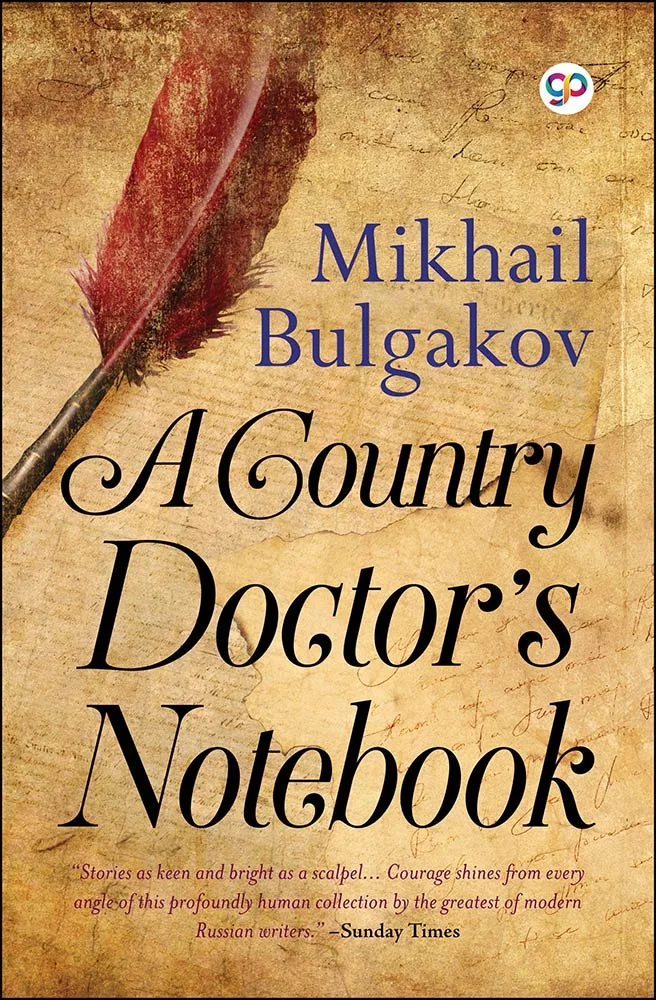
A Country Doctor's Notebook
eBook
• INR 51.00
• English
• 9789354992636
No ratings yet
| Publisher | General Press |
|---|---|
| ISBN13 | 9789354992636 |
| ASIN/SKU | B0BBRF7VL5 |
| Book Format | eBook |
| Language | English |
| List Price | INR 51.00 |
| Subject Code | LCO014000, FIC004000 |
| Publishing Date | 05/09/2022 |
| Book Code | BD00068955 |
Discover A Country Doctor's Notebook by Mikhail Bulgakov. This book is published by General Press in eBook format, ISBN 9789354992636, ASIN B0BBRF7VL5, under Literature and Fiction, Short Stories, Classics.
Book Description
Originally published in 1925, ‘A Country Doctor's Notebook’ is part autobiography and part fiction collection of short stories by Mikhail Bulgakov—Soviet playwright, novelist, and short-story writer best known for his humor and penetrating satire. This records the author’s experiences practicing in a small village hospital in Smolensk Governorate in revolutionary Russia between 1916 and 1918, originally published in installments in Russian medical journals, and later adapted into the British TV series starring Daniel Radcliffe and Jon Hamm.
These stories chronicle the darkly comic adventures of a physician in rural 1917 Russia. Fresh from medical school in the winter of 1917, the young Dr. Bomgard assumes the role of the only doctor in a provincial Russian hospital. Dealing with cases ranging from the horrific to the hilarious to the surreal, Bomgard recounts his solitary time practicing medicine among the superstitious, uneducated, and deeply suspicious populace of his new town.
He exhibits relentless patience and determination while fighting the daily uphill battle against the challenges of an inexperienced country doctor, including scouring ten textbooks at once, hours before a complicated surgery; dealing with patients who either refuse to take their medicine or take it all at once; and handling a colleague with a dangerous morphine addiction. Somehow, despite the near-constant chaos, Bomgard continues to focus on the life-affirming moments that make his efforts worth the uncertainty, isolation and lost sleep.
These stories chronicle the darkly comic adventures of a physician in rural 1917 Russia. Fresh from medical school in the winter of 1917, the young Dr. Bomgard assumes the role of the only doctor in a provincial Russian hospital. Dealing with cases ranging from the horrific to the hilarious to the surreal, Bomgard recounts his solitary time practicing medicine among the superstitious, uneducated, and deeply suspicious populace of his new town.
He exhibits relentless patience and determination while fighting the daily uphill battle against the challenges of an inexperienced country doctor, including scouring ten textbooks at once, hours before a complicated surgery; dealing with patients who either refuse to take their medicine or take it all at once; and handling a colleague with a dangerous morphine addiction. Somehow, despite the near-constant chaos, Bomgard continues to focus on the life-affirming moments that make his efforts worth the uncertainty, isolation and lost sleep.
Author Biography
Mikhail Afanasyevich Bulgakov (Russian: Михаил Булгаков) was a Russian writer, medical doctor, and playwright. His novel The Master and Margarita, published posthumously, has been called one of the masterpieces of the 20th century.
He also wrote the novel The White Guard and the plays Ivan Vasilievich, Flight (also called The Run), and The Days of the Turbins. He wrote mostly about the horrors of the Russian Civil War and about the fate of Russian intellectuals and officers of the Tsarist Army caught up in revolution and Civil War.
Some of his works (Flight, all his works between the years 1922 and 1926, and others) were banned by the Soviet government, and personally by Joseph Stalin, after it was decided by them that they "glorified emigration and White generals". On the other hand, Stalin loved The Days of the Turbins (also called The Turbin Brothers) very much and reportedly saw it at least 15 times.
He also wrote the novel The White Guard and the plays Ivan Vasilievich, Flight (also called The Run), and The Days of the Turbins. He wrote mostly about the horrors of the Russian Civil War and about the fate of Russian intellectuals and officers of the Tsarist Army caught up in revolution and Civil War.
Some of his works (Flight, all his works between the years 1922 and 1926, and others) were banned by the Soviet government, and personally by Joseph Stalin, after it was decided by them that they "glorified emigration and White generals". On the other hand, Stalin loved The Days of the Turbins (also called The Turbin Brothers) very much and reportedly saw it at least 15 times.
Editorial Reviews
Editorial Reviews will be added soon…
Book Summary
Mikhail Bulgakov’s "A Country Doctor's Notebook" is a semi-autobiographical masterpiece that plunges the reader into the mud, snow, and visceral terror of rural Russia in the fateful year of 1917. Before he became the celebrated author of "The Master and Margarita," Bulgakov was a newly minted medical graduate from Kiev University. Sent to the remote hospital of Muryovo in the Smolensk province, he was twenty-four years old, armed with a head full of textbook theory, and completely devoid of practical experience. The collection of interconnected stories captures the profound isolation of this posting, dropping a cultured, anxious young man into a grim, unyielding landscape where he is instantly expected to be a savior, surgeon, and miracle worker to tens of thousands of local peasants.
From the moment the young doctor arrives, having endured a bone-rattling carriage ride through the freezing autumn rain, he is consumed by a crushing case of imposter syndrome. He steps into the shadow of his predecessor, the legendary Leopold Leopoldovich, a man the local staff speaks of with almost mythical reverence. Every glance from the seasoned feldsher (medical assistant) and the two midwives feels like an indictment of his youth and inexperience. He spends his first nights praying that no complicated cases arrive, terrified of the very real possibility that his ignorance might kill someone. The hospital is cut off from the civilized world, meaning there is no one to consult, no senior surgeon to call upon, and nowhere to hide when the clinic doors fly open and a dying patient is carried inside.
The baptism by fire occurs almost immediately in the story often titled "The Towel with a Rooster." A beautiful young girl is brought in with her leg utterly crushed by a flax brake. As her father begs the doctor to save her, the young protagonist is paralyzed by panic. He excuses himself to the bathroom, desperately flipping through a surgical textbook to figure out how to perform an amputation, only to realize the text is utterly useless in the face of shattered bone and spurting blood. Forced to act, he operates in a fugue state of adrenaline and terror. Miraculously, the girl survives, and the doctor experiences his first profound realization of the weight and the strange, grim glory of his profession, marking the beginning of his transformation from a student into a true physician.
However, dramatic medical emergencies are not the only terrors that haunt the young doctor; the sheer ignorance and deep-rooted superstitions of the peasantry provide an equally formidable challenge. He is bewildered to find that his patients frequently refuse necessary treatments, prefer absurd folk remedies, or demand instant cures for chronic, terminal ailments. In one instance, he prescribes medicinal drops to be taken over several days, only to discover the patient gulped the entire bottle at once, nearly dying in the process. He battles constantly against a wall of fatalistic ignorance, where peasants view the hospital not as a place of healing, but as a frightening institution of last resort. His exhaustion is compounded by the endless daily clinic, where he is forced to see up to a hundred patients a day, diagnosing everything from simple colds to advanced, untreated tumors.
Perhaps the most harrowing and memorable of his early trials is the tracheotomy he is forced to perform on a young girl suffocating from diphtheria. In "The Steel Windpipe," the doctor is once again thrust into a life-or-death situation with zero prior experience. As the child turns blue and begins to lose consciousness, he makes the terrifying decision to cut into her throat to insert a breathing tube. The vivid description of the surgery—the slippery tissue, the sudden welling of blood, the fear that he has severed a vital vein—is a masterclass in suspense. When the tube clears and the child draws a sharp, hissing breath, the relief is palpable. This success elevates him to the status of a local deity among the villagers, a reputation he finds deeply uncomfortable given his internal awareness of how close he came to failure.
As winter sets in, the doctor’s isolation becomes absolute, turning the landscape itself into a deadly antagonist. In "The Blizzard," he is called away from the relative safety of his hospital to attend to a woman dying in childbirth at a distant settlement. The journey through the blinding, howling snowstorm is a harrowing descent into whiteout madness, where a single wrong turn means freezing to death. Bulgakov brilliantly contrasts the terrifying, chaotic power of the Russian winter with the fragile, flickering warmth of human endeavor. The doctor’s willingness to risk his own life to perform a seemingly hopeless delivery underscores a deepening sense of duty that begins to override his initial cowardice and self-pity.
Amidst the dramatic surgeries and daring rescues in the snow, the doctor uncovers a slower, quieter tragedy: a pervasive syphilis epidemic ravaging the rural population. In "The Speckled Rash," he is horrified by the casual, almost indifferent way the peasants treat the disease, viewing it as a normal, unavoidable part of life rather than a destructive contagion. He embarks on a passionate but deeply frustrating crusade to educate them and enforce a strict regimen of treatments. This storyline serves as a broader metaphor for the decay and systemic neglect of pre-revolutionary Russia. The doctor is fighting a lonely war not just against microbes, but against centuries of darkness, poverty, and institutional abandonment.
The relentless, grueling pace of rural medicine inevitably takes a massive psychological and physical toll on the young physician. He works seven days a week, his sleep constantly interrupted by the banging on his door signaling a new disaster. He becomes hardened, developing a protective emotional callus to survive the constant exposure to suffering, pain, and inevitable death. While Bulgakov’s related story, "Morphine," is sometimes presented separately, it serves as a dark mirror to the young doctor's experience, detailing how easily a physician in such crushing isolation can slip into drug addiction to cope with the despair. Even without the addiction, the protagonist of the notebook stories is profoundly changed, his youthful idealism eroding into a cynical but fiercely resilient pragmatism.
By the end of his year in Muryovo, the terrified, bookish boy who arrived in the autumn rain has vanished. In his place stands a battle-scarred veteran of rural medicine. He no longer needs to run to his quarters to frantically consult textbooks before seeing a patient; his knowledge is now written in his own memories of blood, pus, and miraculous recoveries. He has learned to read the subtle signs of disease, to command the respect of his hardened staff, and to accept the grim reality that he cannot save everyone. The transformation is complete, yet it is tinged with a deep melancholy. He has survived his trial by fire, but the innocence of his youth has been permanently burned away.
"A Country Doctor's Notebook" remains a stunningly evocative work that strips away the romanticism often associated with the medical profession. Bulgakov’s prose is sharply observational, infused with a dark, self-deprecating humor that keeps the narrative from collapsing under its own heavy themes. It is a testament to the raw reality of early twentieth-century medicine and a profound character study of a man finding his courage in the darkest of places. Ultimately, the book is a brilliant, unflinching tribute to the human endurance required to heal others when the rest of the world has seemingly abandoned you to the snow and the dark.
From the moment the young doctor arrives, having endured a bone-rattling carriage ride through the freezing autumn rain, he is consumed by a crushing case of imposter syndrome. He steps into the shadow of his predecessor, the legendary Leopold Leopoldovich, a man the local staff speaks of with almost mythical reverence. Every glance from the seasoned feldsher (medical assistant) and the two midwives feels like an indictment of his youth and inexperience. He spends his first nights praying that no complicated cases arrive, terrified of the very real possibility that his ignorance might kill someone. The hospital is cut off from the civilized world, meaning there is no one to consult, no senior surgeon to call upon, and nowhere to hide when the clinic doors fly open and a dying patient is carried inside.
The baptism by fire occurs almost immediately in the story often titled "The Towel with a Rooster." A beautiful young girl is brought in with her leg utterly crushed by a flax brake. As her father begs the doctor to save her, the young protagonist is paralyzed by panic. He excuses himself to the bathroom, desperately flipping through a surgical textbook to figure out how to perform an amputation, only to realize the text is utterly useless in the face of shattered bone and spurting blood. Forced to act, he operates in a fugue state of adrenaline and terror. Miraculously, the girl survives, and the doctor experiences his first profound realization of the weight and the strange, grim glory of his profession, marking the beginning of his transformation from a student into a true physician.
However, dramatic medical emergencies are not the only terrors that haunt the young doctor; the sheer ignorance and deep-rooted superstitions of the peasantry provide an equally formidable challenge. He is bewildered to find that his patients frequently refuse necessary treatments, prefer absurd folk remedies, or demand instant cures for chronic, terminal ailments. In one instance, he prescribes medicinal drops to be taken over several days, only to discover the patient gulped the entire bottle at once, nearly dying in the process. He battles constantly against a wall of fatalistic ignorance, where peasants view the hospital not as a place of healing, but as a frightening institution of last resort. His exhaustion is compounded by the endless daily clinic, where he is forced to see up to a hundred patients a day, diagnosing everything from simple colds to advanced, untreated tumors.
Perhaps the most harrowing and memorable of his early trials is the tracheotomy he is forced to perform on a young girl suffocating from diphtheria. In "The Steel Windpipe," the doctor is once again thrust into a life-or-death situation with zero prior experience. As the child turns blue and begins to lose consciousness, he makes the terrifying decision to cut into her throat to insert a breathing tube. The vivid description of the surgery—the slippery tissue, the sudden welling of blood, the fear that he has severed a vital vein—is a masterclass in suspense. When the tube clears and the child draws a sharp, hissing breath, the relief is palpable. This success elevates him to the status of a local deity among the villagers, a reputation he finds deeply uncomfortable given his internal awareness of how close he came to failure.
As winter sets in, the doctor’s isolation becomes absolute, turning the landscape itself into a deadly antagonist. In "The Blizzard," he is called away from the relative safety of his hospital to attend to a woman dying in childbirth at a distant settlement. The journey through the blinding, howling snowstorm is a harrowing descent into whiteout madness, where a single wrong turn means freezing to death. Bulgakov brilliantly contrasts the terrifying, chaotic power of the Russian winter with the fragile, flickering warmth of human endeavor. The doctor’s willingness to risk his own life to perform a seemingly hopeless delivery underscores a deepening sense of duty that begins to override his initial cowardice and self-pity.
Amidst the dramatic surgeries and daring rescues in the snow, the doctor uncovers a slower, quieter tragedy: a pervasive syphilis epidemic ravaging the rural population. In "The Speckled Rash," he is horrified by the casual, almost indifferent way the peasants treat the disease, viewing it as a normal, unavoidable part of life rather than a destructive contagion. He embarks on a passionate but deeply frustrating crusade to educate them and enforce a strict regimen of treatments. This storyline serves as a broader metaphor for the decay and systemic neglect of pre-revolutionary Russia. The doctor is fighting a lonely war not just against microbes, but against centuries of darkness, poverty, and institutional abandonment.
The relentless, grueling pace of rural medicine inevitably takes a massive psychological and physical toll on the young physician. He works seven days a week, his sleep constantly interrupted by the banging on his door signaling a new disaster. He becomes hardened, developing a protective emotional callus to survive the constant exposure to suffering, pain, and inevitable death. While Bulgakov’s related story, "Morphine," is sometimes presented separately, it serves as a dark mirror to the young doctor's experience, detailing how easily a physician in such crushing isolation can slip into drug addiction to cope with the despair. Even without the addiction, the protagonist of the notebook stories is profoundly changed, his youthful idealism eroding into a cynical but fiercely resilient pragmatism.
By the end of his year in Muryovo, the terrified, bookish boy who arrived in the autumn rain has vanished. In his place stands a battle-scarred veteran of rural medicine. He no longer needs to run to his quarters to frantically consult textbooks before seeing a patient; his knowledge is now written in his own memories of blood, pus, and miraculous recoveries. He has learned to read the subtle signs of disease, to command the respect of his hardened staff, and to accept the grim reality that he cannot save everyone. The transformation is complete, yet it is tinged with a deep melancholy. He has survived his trial by fire, but the innocence of his youth has been permanently burned away.
"A Country Doctor's Notebook" remains a stunningly evocative work that strips away the romanticism often associated with the medical profession. Bulgakov’s prose is sharply observational, infused with a dark, self-deprecating humor that keeps the narrative from collapsing under its own heavy themes. It is a testament to the raw reality of early twentieth-century medicine and a profound character study of a man finding his courage in the darkest of places. Ultimately, the book is a brilliant, unflinching tribute to the human endurance required to heal others when the rest of the world has seemingly abandoned you to the snow and the dark.
Sample Chapters
Sample Chapters will be added soon…