
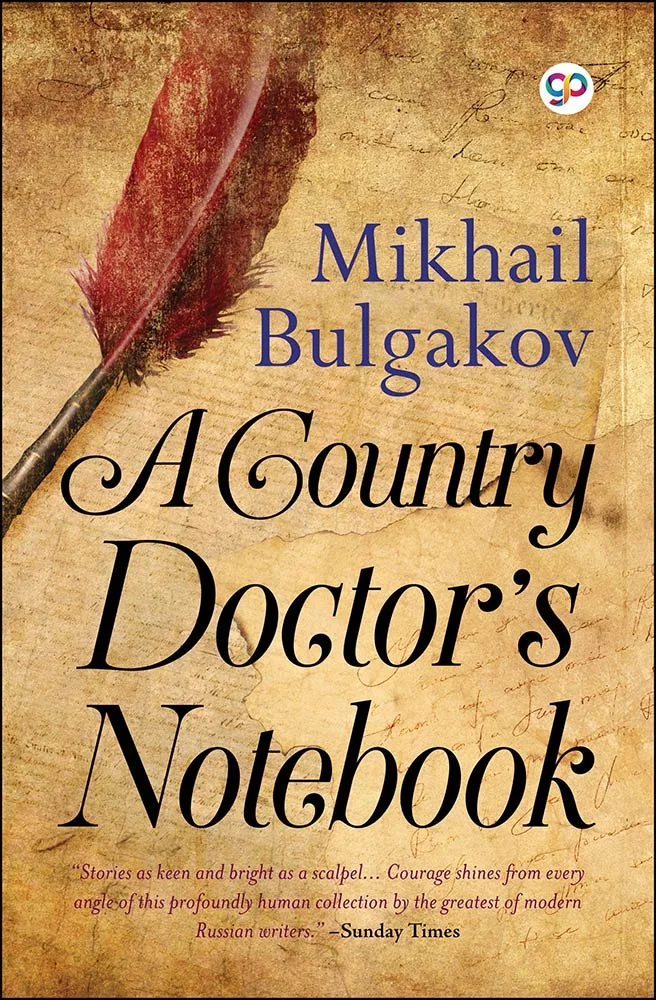
A Country Doctor's Notebook
eBook
• INR 51.00
• English
• 9789354992636
No ratings yet
| Publisher | General Press |
|---|---|
| ISBN13 | 9789354992636 |
| ASIN/SKU | B0BBRF7VL5 |
| Book Format | eBook |
| Language | English |
| List Price | INR 51.00 |
| Subject Code | LCO014000, FIC004000 |
| Publishing Date | 05/09/2022 |
| Book Code | BD00068955 |
Buy this Book
Amazon Stores
Ebook Stores
Other Stores
Discover A Country Doctor's Notebook by Mikhail Bulgakov. This book is published by General Press in eBook format, ISBN 9789354992636, ASIN B0BBRF7VL5, under Literature and Fiction, Short Stories, Classics.
Book Description
What happens when a young doctor is sent to a remote village and suddenly finds himself responsible for lives far beyond his experience? 'A Country Doctor's Notebook' by Mikhail Bulgakov is a classic autobiographical medical fiction work that blends dark humor, psychological drama, and vivid storytelling to portray the harsh realities of rural medicine.
The book follows a newly qualified doctor who arrives at a small, isolated hospital in the Russian countryside, carrying the confidence and theoretical knowledge of medical school but very little practical experience. Far from the sophisticated medical environment he has known, he must confront difficult cases with limited equipment, poor facilities, and enormous expectations from the local population. Every patient who arrives becomes a test not only of his medical knowledge but also of his courage and ability to remain calm under pressure.
Through a series of connected episodes, Bulgakov captures the strange mixture of fear, responsibility, exhaustion, and satisfaction that comes with practicing medicine in such demanding circumstances. The young doctor's early confidence is repeatedly challenged as he encounters injuries, illnesses, emergencies, and situations that cannot be solved simply by following a textbook. His inner thoughts reveal the anxiety that lies beneath the professional appearance of a doctor who is expected to know exactly what to do.
Yet the book is not simply a collection of medical stories. Bulgakov brings warmth, irony, and a sharp understanding of human nature to the doctor's experiences. The patients, nurses, assistants, and villagers form a world filled with vulnerability, superstition, resilience, and sometimes unexpected humor. The remote setting also creates a powerful sense of isolation, emphasizing how alone the young doctor can feel when difficult decisions have to be made without immediate guidance.
What makes 'A Country Doctor's Notebook' especially compelling is the honesty with which Bulgakov explores the gap between knowledge and experience. The book shows how professional confidence is slowly forged through uncertainty, mistakes, responsibility, and repeated encounters with the unpredictable nature of life. Beneath its medical episodes lies a deeply human story about fear, duty, growth, and the struggle to become capable when others are depending on you.
With its vivid rural atmosphere, memorable characters, darkly comic moments, and intimate portrait of a young doctor finding his place in an unforgiving profession, 'A Country Doctor's Notebook' remains an engaging and thought-provoking work. For readers interested in classic literature, medical fiction, Russian literature, or stories about human resilience, Bulgakov's book offers an unforgettable glimpse into the difficult beginnings of a life devoted to healing—and leaves the reader wondering what each new patient will bring.
The book follows a newly qualified doctor who arrives at a small, isolated hospital in the Russian countryside, carrying the confidence and theoretical knowledge of medical school but very little practical experience. Far from the sophisticated medical environment he has known, he must confront difficult cases with limited equipment, poor facilities, and enormous expectations from the local population. Every patient who arrives becomes a test not only of his medical knowledge but also of his courage and ability to remain calm under pressure.
Through a series of connected episodes, Bulgakov captures the strange mixture of fear, responsibility, exhaustion, and satisfaction that comes with practicing medicine in such demanding circumstances. The young doctor's early confidence is repeatedly challenged as he encounters injuries, illnesses, emergencies, and situations that cannot be solved simply by following a textbook. His inner thoughts reveal the anxiety that lies beneath the professional appearance of a doctor who is expected to know exactly what to do.
Yet the book is not simply a collection of medical stories. Bulgakov brings warmth, irony, and a sharp understanding of human nature to the doctor's experiences. The patients, nurses, assistants, and villagers form a world filled with vulnerability, superstition, resilience, and sometimes unexpected humor. The remote setting also creates a powerful sense of isolation, emphasizing how alone the young doctor can feel when difficult decisions have to be made without immediate guidance.
What makes 'A Country Doctor's Notebook' especially compelling is the honesty with which Bulgakov explores the gap between knowledge and experience. The book shows how professional confidence is slowly forged through uncertainty, mistakes, responsibility, and repeated encounters with the unpredictable nature of life. Beneath its medical episodes lies a deeply human story about fear, duty, growth, and the struggle to become capable when others are depending on you.
With its vivid rural atmosphere, memorable characters, darkly comic moments, and intimate portrait of a young doctor finding his place in an unforgiving profession, 'A Country Doctor's Notebook' remains an engaging and thought-provoking work. For readers interested in classic literature, medical fiction, Russian literature, or stories about human resilience, Bulgakov's book offers an unforgettable glimpse into the difficult beginnings of a life devoted to healing—and leaves the reader wondering what each new patient will bring.
Author Biography
Mikhail Afanasyevich Bulgakov (Russian: Михаил Булгаков) was a Russian writer, medical doctor, and playwright. His novel The Master and Margarita, published posthumously, has been called one of the masterpieces of the 20th century.
He also wrote the novel The White Guard and the plays Ivan Vasilievich, Flight (also called The Run), and The Days of the Turbins. He wrote mostly about the horrors of the Russian Civil War and about the fate of Russian intellectuals and officers of the Tsarist Army caught up in revolution and Civil War.
Some of his works (Flight, all his works between the years 1922 and 1926, and others) were banned by the Soviet government, and personally by Joseph Stalin, after it was decided by them that they "glorified emigration and White generals". On the other hand, Stalin loved The Days of the Turbins (also called The Turbin Brothers) very much and reportedly saw it at least 15 times.
He also wrote the novel The White Guard and the plays Ivan Vasilievich, Flight (also called The Run), and The Days of the Turbins. He wrote mostly about the horrors of the Russian Civil War and about the fate of Russian intellectuals and officers of the Tsarist Army caught up in revolution and Civil War.
Some of his works (Flight, all his works between the years 1922 and 1926, and others) were banned by the Soviet government, and personally by Joseph Stalin, after it was decided by them that they "glorified emigration and White generals". On the other hand, Stalin loved The Days of the Turbins (also called The Turbin Brothers) very much and reportedly saw it at least 15 times.
Editorial Reviews
Editorial Reviews will be added soon…
Book Summary
Mikhail Bulgakov’s "A Country Doctor's Notebook" is a semi-autobiographical masterpiece that plunges the reader into the mud, snow, and visceral terror of rural Russia in the fateful year of 1917. Before he became the celebrated author of "The Master and Margarita," Bulgakov was a newly minted medical graduate from Kiev University. Sent to the remote hospital of Muryovo in the Smolensk province, he was twenty-four years old, armed with a head full of textbook theory, and completely devoid of practical experience. The collection of interconnected stories captures the profound isolation of this posting, dropping a cultured, anxious young man into a grim, unyielding landscape where he is instantly expected to be a savior, surgeon, and miracle worker to tens of thousands of local peasants.
From the moment the young doctor arrives, having endured a bone-rattling carriage ride through the freezing autumn rain, he is consumed by a crushing case of imposter syndrome. He steps into the shadow of his predecessor, the legendary Leopold Leopoldovich, a man the local staff speaks of with almost mythical reverence. Every glance from the seasoned feldsher (medical assistant) and the two midwives feels like an indictment of his youth and inexperience. He spends his first nights praying that no complicated cases arrive, terrified of the very real possibility that his ignorance might kill someone. The hospital is cut off from the civilized world, meaning there is no one to consult, no senior surgeon to call upon, and nowhere to hide when the clinic doors fly open and a dying patient is carried inside.
The baptism by fire occurs almost immediately in the story often titled "The Towel with a Rooster." A beautiful young girl is brought in with her leg utterly crushed by a flax brake. As her father begs the doctor to save her, the young protagonist is paralyzed by panic. He excuses himself to the bathroom, desperately flipping through a surgical textbook to figure out how to perform an amputation, only to realize the text is utterly useless in the face of shattered bone and spurting blood. Forced to act, he operates in a fugue state of adrenaline and terror. Miraculously, the girl survives, and the doctor experiences his first profound realization of the weight and the strange, grim glory of his profession, marking the beginning of his transformation from a student into a true physician.
However, dramatic medical emergencies are not the only terrors that haunt the young doctor; the sheer ignorance and deep-rooted superstitions of the peasantry provide an equally formidable challenge. He is bewildered to find that his patients frequently refuse necessary treatments, prefer absurd folk remedies, or demand instant cures for chronic, terminal ailments. In one instance, he prescribes medicinal drops to be taken over several days, only to discover the patient gulped the entire bottle at once, nearly dying in the process. He battles constantly against a wall of fatalistic ignorance, where peasants view the hospital not as a place of healing, but as a frightening institution of last resort. His exhaustion is compounded by the endless daily clinic, where he is forced to see up to a hundred patients a day, diagnosing everything from simple colds to advanced, untreated tumors.
Perhaps the most harrowing and memorable of his early trials is the tracheotomy he is forced to perform on a young girl suffocating from diphtheria. In "The Steel Windpipe," the doctor is once again thrust into a life-or-death situation with zero prior experience. As the child turns blue and begins to lose consciousness, he makes the terrifying decision to cut into her throat to insert a breathing tube. The vivid description of the surgery—the slippery tissue, the sudden welling of blood, the fear that he has severed a vital vein—is a masterclass in suspense. When the tube clears and the child draws a sharp, hissing breath, the relief is palpable. This success elevates him to the status of a local deity among the villagers, a reputation he finds deeply uncomfortable given his internal awareness of how close he came to failure.
As winter sets in, the doctor’s isolation becomes absolute, turning the landscape itself into a deadly antagonist. In "The Blizzard," he is called away from the relative safety of his hospital to attend to a woman dying in childbirth at a distant settlement. The journey through the blinding, howling snowstorm is a harrowing descent into whiteout madness, where a single wrong turn means freezing to death. Bulgakov brilliantly contrasts the terrifying, chaotic power of the Russian winter with the fragile, flickering warmth of human endeavor. The doctor’s willingness to risk his own life to perform a seemingly hopeless delivery underscores a deepening sense of duty that begins to override his initial cowardice and self-pity.
Amidst the dramatic surgeries and daring rescues in the snow, the doctor uncovers a slower, quieter tragedy: a pervasive syphilis epidemic ravaging the rural population. In "The Speckled Rash," he is horrified by the casual, almost indifferent way the peasants treat the disease, viewing it as a normal, unavoidable part of life rather than a destructive contagion. He embarks on a passionate but deeply frustrating crusade to educate them and enforce a strict regimen of treatments. This storyline serves as a broader metaphor for the decay and systemic neglect of pre-revolutionary Russia. The doctor is fighting a lonely war not just against microbes, but against centuries of darkness, poverty, and institutional abandonment.
The relentless, grueling pace of rural medicine inevitably takes a massive psychological and physical toll on the young physician. He works seven days a week, his sleep constantly interrupted by the banging on his door signaling a new disaster. He becomes hardened, developing a protective emotional callus to survive the constant exposure to suffering, pain, and inevitable death. While Bulgakov’s related story, "Morphine," is sometimes presented separately, it serves as a dark mirror to the young doctor's experience, detailing how easily a physician in such crushing isolation can slip into drug addiction to cope with the despair. Even without the addiction, the protagonist of the notebook stories is profoundly changed, his youthful idealism eroding into a cynical but fiercely resilient pragmatism.
By the end of his year in Muryovo, the terrified, bookish boy who arrived in the autumn rain has vanished. In his place stands a battle-scarred veteran of rural medicine. He no longer needs to run to his quarters to frantically consult textbooks before seeing a patient; his knowledge is now written in his own memories of blood, pus, and miraculous recoveries. He has learned to read the subtle signs of disease, to command the respect of his hardened staff, and to accept the grim reality that he cannot save everyone. The transformation is complete, yet it is tinged with a deep melancholy. He has survived his trial by fire, but the innocence of his youth has been permanently burned away.
"A Country Doctor's Notebook" remains a stunningly evocative work that strips away the romanticism often associated with the medical profession. Bulgakov’s prose is sharply observational, infused with a dark, self-deprecating humor that keeps the narrative from collapsing under its own heavy themes. It is a testament to the raw reality of early twentieth-century medicine and a profound character study of a man finding his courage in the darkest of places. Ultimately, the book is a brilliant, unflinching tribute to the human endurance required to heal others when the rest of the world has seemingly abandoned you to the snow and the dark.
From the moment the young doctor arrives, having endured a bone-rattling carriage ride through the freezing autumn rain, he is consumed by a crushing case of imposter syndrome. He steps into the shadow of his predecessor, the legendary Leopold Leopoldovich, a man the local staff speaks of with almost mythical reverence. Every glance from the seasoned feldsher (medical assistant) and the two midwives feels like an indictment of his youth and inexperience. He spends his first nights praying that no complicated cases arrive, terrified of the very real possibility that his ignorance might kill someone. The hospital is cut off from the civilized world, meaning there is no one to consult, no senior surgeon to call upon, and nowhere to hide when the clinic doors fly open and a dying patient is carried inside.
The baptism by fire occurs almost immediately in the story often titled "The Towel with a Rooster." A beautiful young girl is brought in with her leg utterly crushed by a flax brake. As her father begs the doctor to save her, the young protagonist is paralyzed by panic. He excuses himself to the bathroom, desperately flipping through a surgical textbook to figure out how to perform an amputation, only to realize the text is utterly useless in the face of shattered bone and spurting blood. Forced to act, he operates in a fugue state of adrenaline and terror. Miraculously, the girl survives, and the doctor experiences his first profound realization of the weight and the strange, grim glory of his profession, marking the beginning of his transformation from a student into a true physician.
However, dramatic medical emergencies are not the only terrors that haunt the young doctor; the sheer ignorance and deep-rooted superstitions of the peasantry provide an equally formidable challenge. He is bewildered to find that his patients frequently refuse necessary treatments, prefer absurd folk remedies, or demand instant cures for chronic, terminal ailments. In one instance, he prescribes medicinal drops to be taken over several days, only to discover the patient gulped the entire bottle at once, nearly dying in the process. He battles constantly against a wall of fatalistic ignorance, where peasants view the hospital not as a place of healing, but as a frightening institution of last resort. His exhaustion is compounded by the endless daily clinic, where he is forced to see up to a hundred patients a day, diagnosing everything from simple colds to advanced, untreated tumors.
Perhaps the most harrowing and memorable of his early trials is the tracheotomy he is forced to perform on a young girl suffocating from diphtheria. In "The Steel Windpipe," the doctor is once again thrust into a life-or-death situation with zero prior experience. As the child turns blue and begins to lose consciousness, he makes the terrifying decision to cut into her throat to insert a breathing tube. The vivid description of the surgery—the slippery tissue, the sudden welling of blood, the fear that he has severed a vital vein—is a masterclass in suspense. When the tube clears and the child draws a sharp, hissing breath, the relief is palpable. This success elevates him to the status of a local deity among the villagers, a reputation he finds deeply uncomfortable given his internal awareness of how close he came to failure.
As winter sets in, the doctor’s isolation becomes absolute, turning the landscape itself into a deadly antagonist. In "The Blizzard," he is called away from the relative safety of his hospital to attend to a woman dying in childbirth at a distant settlement. The journey through the blinding, howling snowstorm is a harrowing descent into whiteout madness, where a single wrong turn means freezing to death. Bulgakov brilliantly contrasts the terrifying, chaotic power of the Russian winter with the fragile, flickering warmth of human endeavor. The doctor’s willingness to risk his own life to perform a seemingly hopeless delivery underscores a deepening sense of duty that begins to override his initial cowardice and self-pity.
Amidst the dramatic surgeries and daring rescues in the snow, the doctor uncovers a slower, quieter tragedy: a pervasive syphilis epidemic ravaging the rural population. In "The Speckled Rash," he is horrified by the casual, almost indifferent way the peasants treat the disease, viewing it as a normal, unavoidable part of life rather than a destructive contagion. He embarks on a passionate but deeply frustrating crusade to educate them and enforce a strict regimen of treatments. This storyline serves as a broader metaphor for the decay and systemic neglect of pre-revolutionary Russia. The doctor is fighting a lonely war not just against microbes, but against centuries of darkness, poverty, and institutional abandonment.
The relentless, grueling pace of rural medicine inevitably takes a massive psychological and physical toll on the young physician. He works seven days a week, his sleep constantly interrupted by the banging on his door signaling a new disaster. He becomes hardened, developing a protective emotional callus to survive the constant exposure to suffering, pain, and inevitable death. While Bulgakov’s related story, "Morphine," is sometimes presented separately, it serves as a dark mirror to the young doctor's experience, detailing how easily a physician in such crushing isolation can slip into drug addiction to cope with the despair. Even without the addiction, the protagonist of the notebook stories is profoundly changed, his youthful idealism eroding into a cynical but fiercely resilient pragmatism.
By the end of his year in Muryovo, the terrified, bookish boy who arrived in the autumn rain has vanished. In his place stands a battle-scarred veteran of rural medicine. He no longer needs to run to his quarters to frantically consult textbooks before seeing a patient; his knowledge is now written in his own memories of blood, pus, and miraculous recoveries. He has learned to read the subtle signs of disease, to command the respect of his hardened staff, and to accept the grim reality that he cannot save everyone. The transformation is complete, yet it is tinged with a deep melancholy. He has survived his trial by fire, but the innocence of his youth has been permanently burned away.
"A Country Doctor's Notebook" remains a stunningly evocative work that strips away the romanticism often associated with the medical profession. Bulgakov’s prose is sharply observational, infused with a dark, self-deprecating humor that keeps the narrative from collapsing under its own heavy themes. It is a testament to the raw reality of early twentieth-century medicine and a profound character study of a man finding his courage in the darkest of places. Ultimately, the book is a brilliant, unflinching tribute to the human endurance required to heal others when the rest of the world has seemingly abandoned you to the snow and the dark.
Sample Chapters
Chapter 1: The Embroidered Towel
If you have never driven over country roads it is useless for me to tell you about it; you wouldn’t understand anyway. But if you have, I would rather not remind you of it.
To cut a long story short, my driver and I spent exactly twenty-four hours covering the thirty-two miles which separate the district town of Grachyovka from Muryovo hospital. Indeed so nearly exactly twenty-four hours that it was uncanny: at 2 p.m. on 16 September 1916 we were at the last corn-chandler’s store on the outskirts of the remarkable town of Grachyovka, and at five past two on 17 September of that same unforgettable year 1916, I was in the Muryovo hospital yard, standing on trampled, withered grass, flattened by the September rain. My legs were ossified with cold, so much so that as I stood there bemused, I mentally leafed through the textbook pages in an inane attempt to remember whether there was such a complaint as ossification of the muscles or whether it was an illness I had dreamed up while asleep the night before in the village of Grabilovka. What the devil was it in Latin? Every single muscle ached unbearably, like toothache. There is nothing I can say about my toes—they lay immobile in my boots, as rigid as wooden stumps. I confess that in a burst of cowardice I pronounced a whispered curse on the medical profession and on the application form I had handed in five years earlier to the rector of the university. All the time a fine rain was drizzling down as through a sieve. My coat had swelled like a sponge. I vainly tried to grasp my suitcase with the fingers of my right hand, but in the end spat on the wet grass in disgust. My fingers were in capable of gripping anything. It was then, stuffed as I was with all sorts of knowledge from fascinating medical books, that I suddenly remembered the name of the illness—palsy. ‘Paralysis’, I said to myself in despair, God knows why.
‘Your roads take some getting used to,’ I muttered through stony, blue lips, staring resentfully at the driver, although the state of the road was hardly his fault.
‘Ah, comrade doctor,’ he answered, with lips equally stiff under their fair moustache, ‘I’ve been driving fifteen years and I still can’t get used to them.’
I shuddered and glanced round miserably at the peeling, white, two-storey hospital building, at the bare log walls of my assistant’s house, and at my own future residence, a neat, two-storey house with mysterious windows blank as gravestones. I gave a long sigh. Suddenly instead of Latin words a faraway memory flashed through my head, a sweet phrase which a lusty tenor in blue stockings sang in my numbed and shaken head: Salut, demeure chaste et pure... Farewell, farewell, it will be a long time before I see you again, oh golden-red Bolshoi Theatre, Moscow, shop windows... ah, farewell.
‘Next time, I’ll wear a sheepskin coat,’ I said to myself in angry desperation, tugging at the suitcase by its straps with my inflexible hands. ‘I’ll... though next time it’ll be mid-October, I’ll have to wear two sheepskin coats. I certainly shan’t be going to Grachyovka for a month yet. Just think... I actually had to put up for the night en route! When we had only driven fifteen miles and it was as black as the tomb... it was night... we had to stop in Grabilovka, a school teacher put us up. This morning we set off at seven in the morning, and here we are... God, it’s been slower driving here than if we’d come on foot. One wheel got stuck in a ditch, the other swung up into the air, my case fell on to my feet with a crash, we slithered from side to side, lurching forward one moment, backward the next. And all the time a fine rain drizzling down and my bones turning to ice. Who’d believe you can freeze as easily in the middle of a grey, miserable September as in the depth of winter? Ah well, it seems you can. And as you die a slow death there’s nothing to look at except the same endless monotony. On the right the bare, undulating fields and on the left a stunted copse, flanked by five or six grey, dilapidated shacks. Not a living soul in them, it seems, and not a sound to be heard.’
In the end the suitcase yielded. The driver lay on his stomach and shoved it down on top of me. I tried to catch it by the strap but my hand refused to perform and the beastly thing, crammed with books and all sorts of rubbish, flopped down on to the grass, crashing against my legs.
‘Oh Lor...’ the driver began fearfully, but I did not complain. My legs were no more sensitive than two sticks of wood.
‘Hey, anybody at home? Hey!’ the driver cried out and flapped his arms like a rooster flapping its wings. ‘Hey, I’ve brought the doctor!’
At once faces appeared, pressed against the dark windows of the assistant’s house. A door banged and I saw a man hobbling towards me in a ragged coat and worn old boots. He hurriedly and respectfully doffed his cap, ran up and stopped two paces short of me, then smiling somewhat bashfully he welcomed me in a hoarse voice:
‘Good day, comrade doctor.’
‘And who might you be?’ I asked.
‘I’m Yegorich,’ he introduced himself, ‘the watchman here. We’ve been expecting you.’
Without wasting a moment he grabbed the suitcase, swung it over his shoulder and carried it in. I limped after him, trying unsuccessfully to thrust my hand into my trouser pocket to get out my purse.
Man’s basic needs are few. The first of them is fire. Back in Moscow, when I found out that I was to go to remote Muryovo, I had promised myself that I would behave in a dignified manner. My youthful appearance made life intolerable for me in those early days. I always made a point of introducing myself as ‘Doctor So-and-So’, and inevitably people raised their eyebrows and said:
‘Really? I thought you were still a student.’
‘No. I’m qualified,’ I would answer sullenly, thinking: ‘I must start wearing spectacles, that’s what I must do.’ But there was no point in this, as I had perfectly good vision, my eyes as yet unclouded by experience. Unable to wear glasses as a defence against those invariable, affectionately indulgent smiles, I tried to develop a special manner designed to induce respect. I tried to talk evenly and gravely, to repress impulsive movements as far as possible, to walk and not run as twenty-four-year-olds do who have just left university. Looking back, I now realise that the attempt did not come off at all.
At the moment in question I disobeyed my unwritten code of behaviour. I sat hunched up in front of the fire with my shoes off, not in the study but in the kitchen, like a fire worshipper, fervently and passionately drawn to the birch logs blazing in the stove. On my left stood an up turned tub with my boots lying on top of it, next to them a plucked cockerel with a bloodstained neck, and its many-coloured feathers lying in a heap beside it. While still stiff with the cold, I had somehow managed to perform a whole set of vital actions. I had confirmed Yegorich’s wife, the sharp-nosed Aksinya, in her position as my cook. As a result of this she had slaughtered the cockerel and I was to eat it. I had been introduced to everyone in turn. My feldsher was called Demyan Lukich, the mid wives were Pelagea Ivanovna and Anna Nikolaevna. I had been shown round the hospital and was left in no doubt whatever that it was generously equipped. With equal certainty I was forced to admit (inwardly, of course) that I had no idea what very many of these shiny, unsullied instruments were for. Not only had I never held them in my hands, but to tell the truth I had never even seen them.
‘Hm,’ I mumbled significantly, ‘must say you have an excellent set of instruments. Hm...’
‘Oh sir,’ Demyan Lukich remarked sweetly, ‘this is all thanks to your predecessor Leopold Leopoldovich. You see, he used to operate from dawn till dusk.’
I was instantly covered with cold sweat and stared glumly at the gleaming cupboards.
We then went round the empty wards and I satisfied myself that they could easily hold forty patients.
‘Leopold Leopoldovich sometimes had fifty in here,’ Demyan Lukich said consolingly, and Anna Nikolaevna, a woman with a diadem of grey hair, chose to say:
‘Doctor, you look so young, so very young... it’s simply amazing. You look like a student.’
‘Oh, hell,’ I said to myself, ‘really, you’d think they were doing it on purpose!’
Through clenched teeth I grunted:
‘Hm... no, well, I... yes, rather young looking...’
After that we went down to the pharmacy and a glance was enough to tell me that it was supplied with every conceivable medicine. Its two sombre rooms smelled strongly of herbs and its shelves were filled with an endless variety of preparations. There were even foreign patent medicines, which, need I add, I had never heard of.
‘Leopold Leopoldovich ordered these,’ Pelagea Ivanovna reported proudly.
‘This Leopold was nothing short of a genius,’ I thought and was filled with respect for the mysterious Leopold who had left the quiet little village of Muryovo behind him.
Besides fire, man also needs to find his bearings. I had long since eaten the cockerel, Yegorich had stuffed my mattress with straw and covered it with a sheet, and a light was burning in my study. Spellbound, I sat and stared at the legendary Leopold’s third great achievement: the book case was crammed with books. I counted roughly thirty volumes of surgery manuals in Russian and German. And the books on the rapeutics! The beautiful leather-bound anatomical atlases!
Evening drew on and I started to find my bearings.
‘It’s not my fault,’ I repeated to myself stubbornly and unhappily. ‘I’ve got my degree and a first class one at that. Didn’t I warn them back in town that I wanted to start off as a junior partner in a practice? But no, they just smiled and said, “You’ll get your bearings.” So now I’ve got to find my bearings. Suppose they bring me a hernia? Just tell me how I’ll find my bearings with that? And more to the point, what will a hernia patient feel like when I get my hands on him? Will he find his bearings in the next world?’ The thought made my blood run cold.
‘What about peritonitis? Oh no! Or croup, that country children get? When is tracheotomy indicated? Even if it doesn’t need tracheoto my I shall be pretty much at sea... What about... what about... deliveries! I forgot about deliveries! Incorrect positions. What on earth will I do? What a fool I was! I should have refused this job. I really should. They should have found themselves another Leopold.’
Miserable, I paced up and down the twilit study. When I came up to the lamp I caught sight of the reflection of my pale face and of the light of the lamp in the window set against the boundless darkness of the fields.
‘I’m like Dmitry the Pretender—nothing but a sham,’ I thought stupidly and sat down at the table again.
I spent about two lonely hours of self-torment and only stopped when my nerves could no longer bear the horrors I had summoned up. Then I started to calm down and even to work out a plan of action.
‘Let’s see now... they tell me admissions are almost nil at the moment. They’re braking flax in the villages, the roads are impassable...’
‘That’s just when they will bring you a hernia,’ thundered a harsh voice in my mind, ‘because a man with a cold won’t make the effort over impassable roads but rest assured they’ll bring you a hernia, my dear doctor.’
There was something in what the voice said. I shuddered.
‘Be quiet,’ I said to it. ‘It won’t necessarily be a hernia. Stop being so neurotic. You can’t back out once you’ve begun.’
‘You said it!’ the voice answered spitefully.
‘All right then... I won’t take a step without my reference book... If I have to prescribe something I can think it over while I wash my hands and the reference bookwill be lying open on top of the patients’ register. I shall make out wholesome but simple prescriptions, say, sodium salicylate, 0.5 grammes in powder form three times a day.’
‘You might as well prescribe baking soda! Why don’t you just prescribe soda?’ the voice was blatantly making fun of me.
‘What’s soda got to do with it? I’ll also prescribe an infusion of ipecacuanha, 180 c.c.Or 200 c.c. if you don’t mind.’
And although no one was asking for ipecacuanha as I sat there alone by the lamp, I sheepishly turned the pages in the pharmacopoeia and checked ipecacuanha; meanwhile I automatically read in passing that there was a certain substance called ‘Insipin’ which is none other than ‘ethereal sulphate of quinine-diglycolic acid.’ Apparently it doesn’t taste of quinine! What is it for? And how is it prescribed? What is it, a powder? To hell with it!
‘That’s all very well, but what are you going to do about a hernia?’ The voice of Fear continued to pester me.
‘I’ll put them into a bath,’ I defended myself in exasperation, ‘and try to reduce it.’
‘What if it’s a strangulated one, old boy? Baths won’t be much use then, will they! A strangulated hernia!’ Fear chanted in a demoniac voice, ‘You’ll have to cut it out...!’
I gave in and all but burst into tears. I sent out a prayer to the darkness outside the window: please, anything but not a strangulated hernia.
Weariness then crooned:
‘Go to bed, unhappy physician. Sleep on it. Calm down and stop being neurotic. Look how still the dark is outside the window, the fields are cold and sleeping, there is no hernia. You can think about it in the morning. You’ll settle down... Sleep... drop that book of diagrams, you won’t make head or tail of it anyway... hernial orifice...’
* * *
I don’t remember him arriving. I only remember the bolt grating in the door, a shriek from Aksinya and a cart creaking out in the yard.
He was hatless, his sheepskin coat unbuttoned, his beard was dishevelled and there was a mad look in his eyes.
He crossed himself, fell on his knees and banged his forehead against the floor. This to me!
‘I’m a lost man,’ I thought wretchedly.
‘Now, now—what’s the matter?’ I muttered and pulled at his grey sleeve.
His face twisted and he started mumbling a breathless and incoherent answer:
‘Oh doctor, sir... sir... she’s all I’ve got, she’s all I’ve got, she’s all I’ve got,’ he burst out suddenly in a voice so young-sounding and powerful that the lampshade trembled. ‘Oh, sir, oh...’ He wrung his hands in misery and started knocking his forehead against the floorboards as if trying to smash them. ‘Why? Why am I being punished? What have I done to deserve God’s anger?’
‘What is it? What’s happened?’ I cried out, feeling the blood draining from my face.
He jumped to his feet, rushed towards me and whispered:
‘Anything you want, doctor, sir... I’ll give you money, take as much money as you want. As much as you want. We’ll pay you in food if you like. Only don’t let her die. Don’t let her die. Even if she’s to be a cripple, I don’t mind. I don’t mind!’ He shouted to the ceiling. ‘I’ve got enough to feed her, I can manage.’
I could see Aksinya’s pale face in the black rectangle of the door. I was overcome with anguish.
‘Well, what is it? Speak!’ I cried irritably.
He stopped. His eyes went blank and he whispered, as if telling me a secret:
‘She fell into the brake.’
‘Brake... brake? What’s that?’
‘Flax, they were braking flax, doctor,’ Aksinya whispered in explanation, ‘you know, brake, flax braking...’
‘Here’s a fine beginning. This is it. Oh why did I ever come?’ I said to myself in horror.
‘Who?’
‘My daughter,’ he answered in a whisper, and then shouted, ‘Help me!’ Once again he threw himself to the floor and his hair, cut like a mop in peasant fashion, fell into his eyes.
The pressure-lamp with its lopsided tin shade burned with hot beams of light. She lay on the operating table, on white, fresh-smelling oilcloth and when I saw her all thoughts of hernia vanished from my mind.
Her fair, almost reddish hair hung down from the table in a matted clump. She had a gigantic plait which reached to the floor.
Her calico skirt was torn and stained with blood in various shades from brown to oily scarlet. The light of the kerosene lamp was a lively yellow in comparison with her paper-white face, and her nose was beginning to sharpen. On her white face, motionless as a plaster cast, a truly rare beauty was fading away before my eyes. Seldom in life does one see such a face.
The operating theatre was completely silent for about ten seconds, but from behind the closed doors came the muffled sounds of someone shouting and banging his head over and over again.
‘Gone out of his mind,’ I thought. ‘The nurses must be seeing to him. Why is she so beautiful? Though he does have good bone structure; the mother must have been a beautiful woman. He’s a widower...’
‘Is he a widower?’ I whispered automatically.
‘Yes, he is,’ Pelagea Ivanovna answered quietly.
Then Demyan Lukich, almost as if in anger, ripped the skirt from hem to waist, baring her instantly. I looked, and what I saw was even worse than I had expected. Strictly speaking there was no left leg. From the smashed knee down there were just bloody shreds, battered red flesh and splinters of white bone protruding in all directions. The right leg was fractured at the shin so that the tips of both bones had punctured the skin and her foot lay lifelessly on its side, as though disconnected.
‘Yes...’ the feldsher pronounced softly and that was all he said.
Thereupon I regained my wits and started feeling her pulse. Her cold wrist registered nothing. Only after a few seconds did I detect a barely perceptible, irregular ripple. It passed and was followed by a pause during which I had time to glance at her white lips and nostrils, which were turning blue. I already felt like saying ‘It’s all over’, but fortunately controlled myself... there was another hint of a beat.
‘The end of a mangled human being,’ I said to myself. ‘There’s really nothing more to be done.’
But suddenly I said sternly, in a voice that I did not recognise:
‘Camphor.’
Anna Nikolaevna bent over to my ear and whispered:
‘What for, doctor? Don’t torture her. What’s the point of smashing her up any more? She’ll die any minute now... you won’t save her.’
I gave her an angry look and said:
‘I asked for camphor...’ in such a way that she flushed, marched resentfully to the little table and broke an ampoule. The feldsher obviously did not approve of the camphor either. Nonetheless he deftly and swiftly took hold of a syringe and the yellow oil went under the skin of her shoulder.
‘Die. Die quickly,’ I said to myself. ‘Die. Otherwise what am I to do with you?’
‘She’ll die now,’ whispered the feldsher as if guessing my thoughts. He glanced meaningfully at the sheet but apparently changed his mind. It seemed a pity to stain it with blood. But a few seconds later he had to cover her. She lay like a corpse, but did not die. Suddenly my head became quite clear, as if I were standing under the glass roof of the anatomy theatre in that faraway medical school.
‘Camphor again,’ I said hoarsely.
And once again the feldsher obediently injected the oil.
‘Is she really not going to die?’ I thought in despair. ‘Will I really have to...’
Everything lit up in my mind and I suddenly became aware without any textbooks, without any advice or help (and with unshakeable conviction), that now, for the first time in my life I had to perform an amputation on a dying person. And that that person would die under the knife. She was bound to die under the knife; after all, there was no blood left in her body. It had all drained out through her shattered legs over six miles and there was not even a sign that she was conscious. She was silent. Oh, why didn’t she die? What would her maddened father say to me?
If you have never driven over country roads it is useless for me to tell you about it; you wouldn’t understand anyway. But if you have, I would rather not remind you of it.
To cut a long story short, my driver and I spent exactly twenty-four hours covering the thirty-two miles which separate the district town of Grachyovka from Muryovo hospital. Indeed so nearly exactly twenty-four hours that it was uncanny: at 2 p.m. on 16 September 1916 we were at the last corn-chandler’s store on the outskirts of the remarkable town of Grachyovka, and at five past two on 17 September of that same unforgettable year 1916, I was in the Muryovo hospital yard, standing on trampled, withered grass, flattened by the September rain. My legs were ossified with cold, so much so that as I stood there bemused, I mentally leafed through the textbook pages in an inane attempt to remember whether there was such a complaint as ossification of the muscles or whether it was an illness I had dreamed up while asleep the night before in the village of Grabilovka. What the devil was it in Latin? Every single muscle ached unbearably, like toothache. There is nothing I can say about my toes—they lay immobile in my boots, as rigid as wooden stumps. I confess that in a burst of cowardice I pronounced a whispered curse on the medical profession and on the application form I had handed in five years earlier to the rector of the university. All the time a fine rain was drizzling down as through a sieve. My coat had swelled like a sponge. I vainly tried to grasp my suitcase with the fingers of my right hand, but in the end spat on the wet grass in disgust. My fingers were in capable of gripping anything. It was then, stuffed as I was with all sorts of knowledge from fascinating medical books, that I suddenly remembered the name of the illness—palsy. ‘Paralysis’, I said to myself in despair, God knows why.
‘Your roads take some getting used to,’ I muttered through stony, blue lips, staring resentfully at the driver, although the state of the road was hardly his fault.
‘Ah, comrade doctor,’ he answered, with lips equally stiff under their fair moustache, ‘I’ve been driving fifteen years and I still can’t get used to them.’
I shuddered and glanced round miserably at the peeling, white, two-storey hospital building, at the bare log walls of my assistant’s house, and at my own future residence, a neat, two-storey house with mysterious windows blank as gravestones. I gave a long sigh. Suddenly instead of Latin words a faraway memory flashed through my head, a sweet phrase which a lusty tenor in blue stockings sang in my numbed and shaken head: Salut, demeure chaste et pure... Farewell, farewell, it will be a long time before I see you again, oh golden-red Bolshoi Theatre, Moscow, shop windows... ah, farewell.
‘Next time, I’ll wear a sheepskin coat,’ I said to myself in angry desperation, tugging at the suitcase by its straps with my inflexible hands. ‘I’ll... though next time it’ll be mid-October, I’ll have to wear two sheepskin coats. I certainly shan’t be going to Grachyovka for a month yet. Just think... I actually had to put up for the night en route! When we had only driven fifteen miles and it was as black as the tomb... it was night... we had to stop in Grabilovka, a school teacher put us up. This morning we set off at seven in the morning, and here we are... God, it’s been slower driving here than if we’d come on foot. One wheel got stuck in a ditch, the other swung up into the air, my case fell on to my feet with a crash, we slithered from side to side, lurching forward one moment, backward the next. And all the time a fine rain drizzling down and my bones turning to ice. Who’d believe you can freeze as easily in the middle of a grey, miserable September as in the depth of winter? Ah well, it seems you can. And as you die a slow death there’s nothing to look at except the same endless monotony. On the right the bare, undulating fields and on the left a stunted copse, flanked by five or six grey, dilapidated shacks. Not a living soul in them, it seems, and not a sound to be heard.’
In the end the suitcase yielded. The driver lay on his stomach and shoved it down on top of me. I tried to catch it by the strap but my hand refused to perform and the beastly thing, crammed with books and all sorts of rubbish, flopped down on to the grass, crashing against my legs.
‘Oh Lor...’ the driver began fearfully, but I did not complain. My legs were no more sensitive than two sticks of wood.
‘Hey, anybody at home? Hey!’ the driver cried out and flapped his arms like a rooster flapping its wings. ‘Hey, I’ve brought the doctor!’
At once faces appeared, pressed against the dark windows of the assistant’s house. A door banged and I saw a man hobbling towards me in a ragged coat and worn old boots. He hurriedly and respectfully doffed his cap, ran up and stopped two paces short of me, then smiling somewhat bashfully he welcomed me in a hoarse voice:
‘Good day, comrade doctor.’
‘And who might you be?’ I asked.
‘I’m Yegorich,’ he introduced himself, ‘the watchman here. We’ve been expecting you.’
Without wasting a moment he grabbed the suitcase, swung it over his shoulder and carried it in. I limped after him, trying unsuccessfully to thrust my hand into my trouser pocket to get out my purse.
Man’s basic needs are few. The first of them is fire. Back in Moscow, when I found out that I was to go to remote Muryovo, I had promised myself that I would behave in a dignified manner. My youthful appearance made life intolerable for me in those early days. I always made a point of introducing myself as ‘Doctor So-and-So’, and inevitably people raised their eyebrows and said:
‘Really? I thought you were still a student.’
‘No. I’m qualified,’ I would answer sullenly, thinking: ‘I must start wearing spectacles, that’s what I must do.’ But there was no point in this, as I had perfectly good vision, my eyes as yet unclouded by experience. Unable to wear glasses as a defence against those invariable, affectionately indulgent smiles, I tried to develop a special manner designed to induce respect. I tried to talk evenly and gravely, to repress impulsive movements as far as possible, to walk and not run as twenty-four-year-olds do who have just left university. Looking back, I now realise that the attempt did not come off at all.
At the moment in question I disobeyed my unwritten code of behaviour. I sat hunched up in front of the fire with my shoes off, not in the study but in the kitchen, like a fire worshipper, fervently and passionately drawn to the birch logs blazing in the stove. On my left stood an up turned tub with my boots lying on top of it, next to them a plucked cockerel with a bloodstained neck, and its many-coloured feathers lying in a heap beside it. While still stiff with the cold, I had somehow managed to perform a whole set of vital actions. I had confirmed Yegorich’s wife, the sharp-nosed Aksinya, in her position as my cook. As a result of this she had slaughtered the cockerel and I was to eat it. I had been introduced to everyone in turn. My feldsher was called Demyan Lukich, the mid wives were Pelagea Ivanovna and Anna Nikolaevna. I had been shown round the hospital and was left in no doubt whatever that it was generously equipped. With equal certainty I was forced to admit (inwardly, of course) that I had no idea what very many of these shiny, unsullied instruments were for. Not only had I never held them in my hands, but to tell the truth I had never even seen them.
‘Hm,’ I mumbled significantly, ‘must say you have an excellent set of instruments. Hm...’
‘Oh sir,’ Demyan Lukich remarked sweetly, ‘this is all thanks to your predecessor Leopold Leopoldovich. You see, he used to operate from dawn till dusk.’
I was instantly covered with cold sweat and stared glumly at the gleaming cupboards.
We then went round the empty wards and I satisfied myself that they could easily hold forty patients.
‘Leopold Leopoldovich sometimes had fifty in here,’ Demyan Lukich said consolingly, and Anna Nikolaevna, a woman with a diadem of grey hair, chose to say:
‘Doctor, you look so young, so very young... it’s simply amazing. You look like a student.’
‘Oh, hell,’ I said to myself, ‘really, you’d think they were doing it on purpose!’
Through clenched teeth I grunted:
‘Hm... no, well, I... yes, rather young looking...’
After that we went down to the pharmacy and a glance was enough to tell me that it was supplied with every conceivable medicine. Its two sombre rooms smelled strongly of herbs and its shelves were filled with an endless variety of preparations. There were even foreign patent medicines, which, need I add, I had never heard of.
‘Leopold Leopoldovich ordered these,’ Pelagea Ivanovna reported proudly.
‘This Leopold was nothing short of a genius,’ I thought and was filled with respect for the mysterious Leopold who had left the quiet little village of Muryovo behind him.
Besides fire, man also needs to find his bearings. I had long since eaten the cockerel, Yegorich had stuffed my mattress with straw and covered it with a sheet, and a light was burning in my study. Spellbound, I sat and stared at the legendary Leopold’s third great achievement: the book case was crammed with books. I counted roughly thirty volumes of surgery manuals in Russian and German. And the books on the rapeutics! The beautiful leather-bound anatomical atlases!
Evening drew on and I started to find my bearings.
‘It’s not my fault,’ I repeated to myself stubbornly and unhappily. ‘I’ve got my degree and a first class one at that. Didn’t I warn them back in town that I wanted to start off as a junior partner in a practice? But no, they just smiled and said, “You’ll get your bearings.” So now I’ve got to find my bearings. Suppose they bring me a hernia? Just tell me how I’ll find my bearings with that? And more to the point, what will a hernia patient feel like when I get my hands on him? Will he find his bearings in the next world?’ The thought made my blood run cold.
‘What about peritonitis? Oh no! Or croup, that country children get? When is tracheotomy indicated? Even if it doesn’t need tracheoto my I shall be pretty much at sea... What about... what about... deliveries! I forgot about deliveries! Incorrect positions. What on earth will I do? What a fool I was! I should have refused this job. I really should. They should have found themselves another Leopold.’
Miserable, I paced up and down the twilit study. When I came up to the lamp I caught sight of the reflection of my pale face and of the light of the lamp in the window set against the boundless darkness of the fields.
‘I’m like Dmitry the Pretender—nothing but a sham,’ I thought stupidly and sat down at the table again.
I spent about two lonely hours of self-torment and only stopped when my nerves could no longer bear the horrors I had summoned up. Then I started to calm down and even to work out a plan of action.
‘Let’s see now... they tell me admissions are almost nil at the moment. They’re braking flax in the villages, the roads are impassable...’
‘That’s just when they will bring you a hernia,’ thundered a harsh voice in my mind, ‘because a man with a cold won’t make the effort over impassable roads but rest assured they’ll bring you a hernia, my dear doctor.’
There was something in what the voice said. I shuddered.
‘Be quiet,’ I said to it. ‘It won’t necessarily be a hernia. Stop being so neurotic. You can’t back out once you’ve begun.’
‘You said it!’ the voice answered spitefully.
‘All right then... I won’t take a step without my reference book... If I have to prescribe something I can think it over while I wash my hands and the reference bookwill be lying open on top of the patients’ register. I shall make out wholesome but simple prescriptions, say, sodium salicylate, 0.5 grammes in powder form three times a day.’
‘You might as well prescribe baking soda! Why don’t you just prescribe soda?’ the voice was blatantly making fun of me.
‘What’s soda got to do with it? I’ll also prescribe an infusion of ipecacuanha, 180 c.c.Or 200 c.c. if you don’t mind.’
And although no one was asking for ipecacuanha as I sat there alone by the lamp, I sheepishly turned the pages in the pharmacopoeia and checked ipecacuanha; meanwhile I automatically read in passing that there was a certain substance called ‘Insipin’ which is none other than ‘ethereal sulphate of quinine-diglycolic acid.’ Apparently it doesn’t taste of quinine! What is it for? And how is it prescribed? What is it, a powder? To hell with it!
‘That’s all very well, but what are you going to do about a hernia?’ The voice of Fear continued to pester me.
‘I’ll put them into a bath,’ I defended myself in exasperation, ‘and try to reduce it.’
‘What if it’s a strangulated one, old boy? Baths won’t be much use then, will they! A strangulated hernia!’ Fear chanted in a demoniac voice, ‘You’ll have to cut it out...!’
I gave in and all but burst into tears. I sent out a prayer to the darkness outside the window: please, anything but not a strangulated hernia.
Weariness then crooned:
‘Go to bed, unhappy physician. Sleep on it. Calm down and stop being neurotic. Look how still the dark is outside the window, the fields are cold and sleeping, there is no hernia. You can think about it in the morning. You’ll settle down... Sleep... drop that book of diagrams, you won’t make head or tail of it anyway... hernial orifice...’
* * *
I don’t remember him arriving. I only remember the bolt grating in the door, a shriek from Aksinya and a cart creaking out in the yard.
He was hatless, his sheepskin coat unbuttoned, his beard was dishevelled and there was a mad look in his eyes.
He crossed himself, fell on his knees and banged his forehead against the floor. This to me!
‘I’m a lost man,’ I thought wretchedly.
‘Now, now—what’s the matter?’ I muttered and pulled at his grey sleeve.
His face twisted and he started mumbling a breathless and incoherent answer:
‘Oh doctor, sir... sir... she’s all I’ve got, she’s all I’ve got, she’s all I’ve got,’ he burst out suddenly in a voice so young-sounding and powerful that the lampshade trembled. ‘Oh, sir, oh...’ He wrung his hands in misery and started knocking his forehead against the floorboards as if trying to smash them. ‘Why? Why am I being punished? What have I done to deserve God’s anger?’
‘What is it? What’s happened?’ I cried out, feeling the blood draining from my face.
He jumped to his feet, rushed towards me and whispered:
‘Anything you want, doctor, sir... I’ll give you money, take as much money as you want. As much as you want. We’ll pay you in food if you like. Only don’t let her die. Don’t let her die. Even if she’s to be a cripple, I don’t mind. I don’t mind!’ He shouted to the ceiling. ‘I’ve got enough to feed her, I can manage.’
I could see Aksinya’s pale face in the black rectangle of the door. I was overcome with anguish.
‘Well, what is it? Speak!’ I cried irritably.
He stopped. His eyes went blank and he whispered, as if telling me a secret:
‘She fell into the brake.’
‘Brake... brake? What’s that?’
‘Flax, they were braking flax, doctor,’ Aksinya whispered in explanation, ‘you know, brake, flax braking...’
‘Here’s a fine beginning. This is it. Oh why did I ever come?’ I said to myself in horror.
‘Who?’
‘My daughter,’ he answered in a whisper, and then shouted, ‘Help me!’ Once again he threw himself to the floor and his hair, cut like a mop in peasant fashion, fell into his eyes.
The pressure-lamp with its lopsided tin shade burned with hot beams of light. She lay on the operating table, on white, fresh-smelling oilcloth and when I saw her all thoughts of hernia vanished from my mind.
Her fair, almost reddish hair hung down from the table in a matted clump. She had a gigantic plait which reached to the floor.
Her calico skirt was torn and stained with blood in various shades from brown to oily scarlet. The light of the kerosene lamp was a lively yellow in comparison with her paper-white face, and her nose was beginning to sharpen. On her white face, motionless as a plaster cast, a truly rare beauty was fading away before my eyes. Seldom in life does one see such a face.
The operating theatre was completely silent for about ten seconds, but from behind the closed doors came the muffled sounds of someone shouting and banging his head over and over again.
‘Gone out of his mind,’ I thought. ‘The nurses must be seeing to him. Why is she so beautiful? Though he does have good bone structure; the mother must have been a beautiful woman. He’s a widower...’
‘Is he a widower?’ I whispered automatically.
‘Yes, he is,’ Pelagea Ivanovna answered quietly.
Then Demyan Lukich, almost as if in anger, ripped the skirt from hem to waist, baring her instantly. I looked, and what I saw was even worse than I had expected. Strictly speaking there was no left leg. From the smashed knee down there were just bloody shreds, battered red flesh and splinters of white bone protruding in all directions. The right leg was fractured at the shin so that the tips of both bones had punctured the skin and her foot lay lifelessly on its side, as though disconnected.
‘Yes...’ the feldsher pronounced softly and that was all he said.
Thereupon I regained my wits and started feeling her pulse. Her cold wrist registered nothing. Only after a few seconds did I detect a barely perceptible, irregular ripple. It passed and was followed by a pause during which I had time to glance at her white lips and nostrils, which were turning blue. I already felt like saying ‘It’s all over’, but fortunately controlled myself... there was another hint of a beat.
‘The end of a mangled human being,’ I said to myself. ‘There’s really nothing more to be done.’
But suddenly I said sternly, in a voice that I did not recognise:
‘Camphor.’
Anna Nikolaevna bent over to my ear and whispered:
‘What for, doctor? Don’t torture her. What’s the point of smashing her up any more? She’ll die any minute now... you won’t save her.’
I gave her an angry look and said:
‘I asked for camphor...’ in such a way that she flushed, marched resentfully to the little table and broke an ampoule. The feldsher obviously did not approve of the camphor either. Nonetheless he deftly and swiftly took hold of a syringe and the yellow oil went under the skin of her shoulder.
‘Die. Die quickly,’ I said to myself. ‘Die. Otherwise what am I to do with you?’
‘She’ll die now,’ whispered the feldsher as if guessing my thoughts. He glanced meaningfully at the sheet but apparently changed his mind. It seemed a pity to stain it with blood. But a few seconds later he had to cover her. She lay like a corpse, but did not die. Suddenly my head became quite clear, as if I were standing under the glass roof of the anatomy theatre in that faraway medical school.
‘Camphor again,’ I said hoarsely.
And once again the feldsher obediently injected the oil.
‘Is she really not going to die?’ I thought in despair. ‘Will I really have to...’
Everything lit up in my mind and I suddenly became aware without any textbooks, without any advice or help (and with unshakeable conviction), that now, for the first time in my life I had to perform an amputation on a dying person. And that that person would die under the knife. She was bound to die under the knife; after all, there was no blood left in her body. It had all drained out through her shattered legs over six miles and there was not even a sign that she was conscious. She was silent. Oh, why didn’t she die? What would her maddened father say to me?
Reader Reviews
No reviews yet.
A Country Doctor's Notebook
Download Cover Image
Do you want to download the full cover image for A Country Doctor's Notebook?