
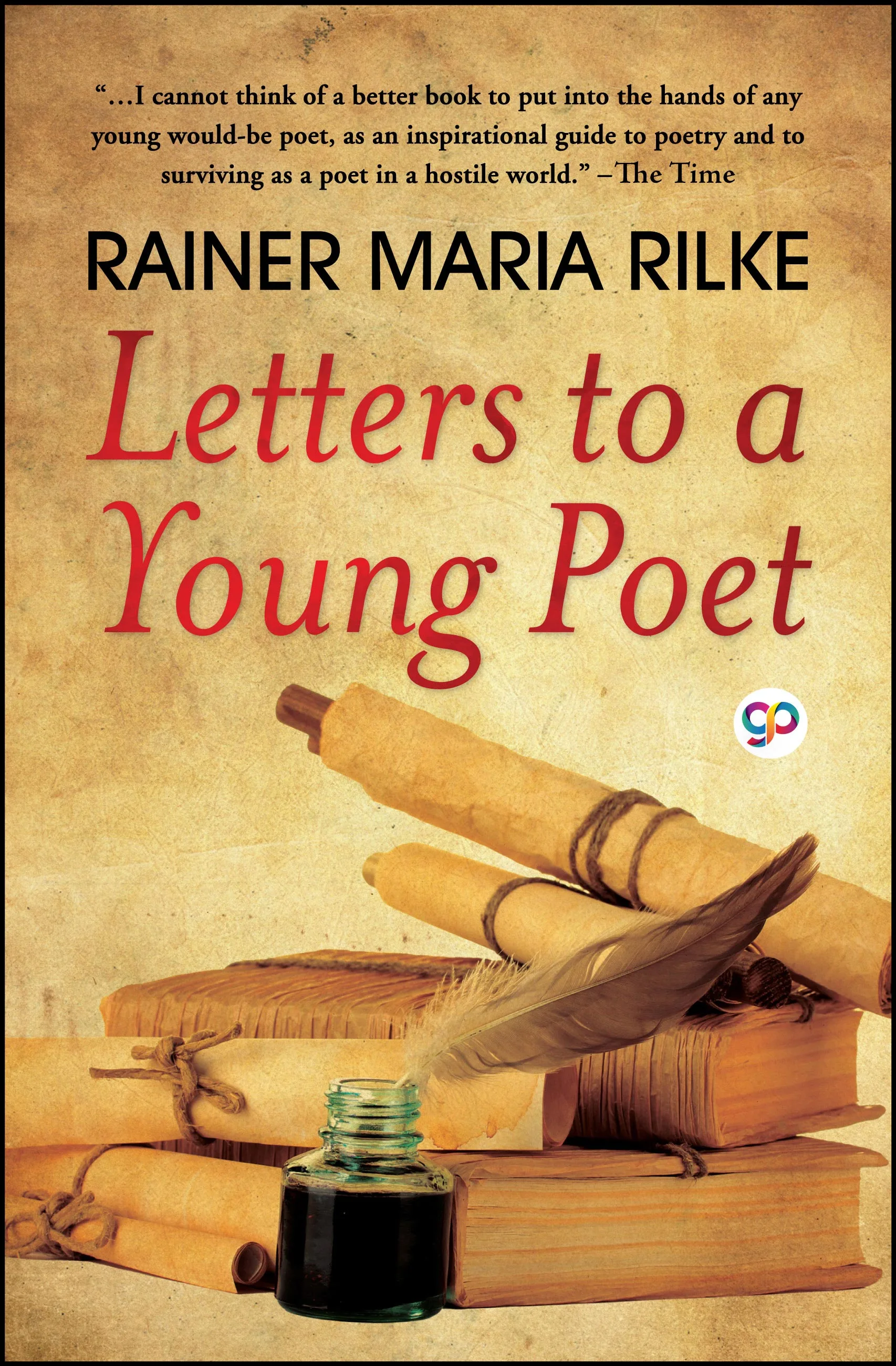
Letters to a Young Poet
eBook
• INR 99.00
• English
• 9789354995644
No ratings yet
| Publisher | General Press |
|---|---|
| ISBN13 | 9789354995644 |
| ASIN/SKU | B0BWDTB7LC |
| Book Format | eBook |
| Language | English |
| List Price | INR 99.00 |
| Subject Code | LIT014000 |
| Publishing Date | 01/03/2023 |
| Book Code | BD00068981 |
Buy this Book
Amazon Stores
Ebook Stores
Other Stores
Discover Letters to a Young Poet by Rainer Maria Rilke. This book is published by General Press in eBook format, ISBN 9789354995644, ASIN B0BWDTB7LC, under Non Fiction, Poetry, Classics.
Book Description
Rainer Maria Rilke’s "Letters to a Young Poet" is a profound, deeply moving collection of ten letters written to a nineteen-year-old military cadet, Franz Xaver Kappus. Seeking guidance on his poetry and life choices, Kappus reached out to the established poet, initiating a correspondence that transcended mere literary advice. Instead of critiquing the young man’s verses, Rilke offers a masterclass in living deeply and authentically.
At its heart, the book is a gentle but urgent plea for introspection. Rilke advises Kappus to turn away from the outside world’s judgments and look inward, urging him to write only if he feels he would die if forbidden to do so. With immense warmth and lucidity, Rilke explores the beautiful, often painful realities of the human condition. He teaches the young man to embrace solitude not as a burden, but as a sacred space for personal growth.
Throughout the letters, Rilke addresses the profound complexities of love, sorrow, and uncertainty. He encourages his reader to 'live the questions' rather than rushing toward answers, and to trust in the difficult moments of life, as they are the very forces that shape our souls. Written with striking empathy and poetic grace, Letters to a Young Poet is much more than a mentor’s correspondence. It is a timeless, compassionate guide to navigating the emotional wilderness of youth, reminding us all to cultivate patience, trust our inner voices, and approach life with a courageous, open heart.
At its heart, the book is a gentle but urgent plea for introspection. Rilke advises Kappus to turn away from the outside world’s judgments and look inward, urging him to write only if he feels he would die if forbidden to do so. With immense warmth and lucidity, Rilke explores the beautiful, often painful realities of the human condition. He teaches the young man to embrace solitude not as a burden, but as a sacred space for personal growth.
Throughout the letters, Rilke addresses the profound complexities of love, sorrow, and uncertainty. He encourages his reader to 'live the questions' rather than rushing toward answers, and to trust in the difficult moments of life, as they are the very forces that shape our souls. Written with striking empathy and poetic grace, Letters to a Young Poet is much more than a mentor’s correspondence. It is a timeless, compassionate guide to navigating the emotional wilderness of youth, reminding us all to cultivate patience, trust our inner voices, and approach life with a courageous, open heart.
Author Biography
Rainer Maria Rilke (1875–1926) was one of the greatest poets of the twentieth century, celebrated for his deeply reflective and lyrical writing. His poetry and prose explore themes of love, solitude, spirituality, creativity, and the search for meaning in human life. Known for the beauty of his language and the emotional depth of his ideas, Rilke continues to inspire readers, artists, and writers across the world with works that speak to the inner life of the human spirit.
He was born René Karl Wilhelm Johann Josef Maria Rilke on December 4, 1875, in Prague, then part of the Austro-Hungarian Empire (now the Czech Republic). His childhood was shaped by a complicated family life and the high expectations of his parents. For a time, he attended military academies, but the rigid discipline proved unsuitable for his sensitive and artistic temperament. He later studied literature, philosophy, and art history, gradually finding his true calling as a writer.
A turning point in Rilke's life came through his friendship with the writer and intellectual Lou Andreas-Salomé, who encouraged his artistic development and introduced him to Russian culture. Together they traveled to Russia, where Rilke met the great novelist Leo Tolstoy and experienced a profound spiritual awakening. These journeys deeply influenced his poetry and broadened his understanding of faith, nature, and human existence.
Rilke spent much of his life traveling across Europe, living in cities such as Paris, Munich, and various locations in Switzerland. During his stay in Paris, he worked as secretary to the renowned sculptor Auguste Rodin, whose dedication to artistic discipline left a lasting impression on him. Among Rilke's most celebrated works are The Book of Hours, New Poems, Duino Elegies, Sonnets to Orpheus, and Letters to a Young Poet. These writings reveal his remarkable ability to express complex emotions with grace, precision, and quiet wisdom.
Rainer Maria Rilke died on December 29, 1926, in Switzerland after suffering from leukemia. His influence on modern literature has been immense, extending far beyond poetry into philosophy, psychology, and the arts. Today, Rilke is remembered as a poet of extraordinary sensitivity whose timeless reflections on beauty, loss, creativity, and the mysteries of existence continue to comfort and inspire readers around the globe.
He was born René Karl Wilhelm Johann Josef Maria Rilke on December 4, 1875, in Prague, then part of the Austro-Hungarian Empire (now the Czech Republic). His childhood was shaped by a complicated family life and the high expectations of his parents. For a time, he attended military academies, but the rigid discipline proved unsuitable for his sensitive and artistic temperament. He later studied literature, philosophy, and art history, gradually finding his true calling as a writer.
A turning point in Rilke's life came through his friendship with the writer and intellectual Lou Andreas-Salomé, who encouraged his artistic development and introduced him to Russian culture. Together they traveled to Russia, where Rilke met the great novelist Leo Tolstoy and experienced a profound spiritual awakening. These journeys deeply influenced his poetry and broadened his understanding of faith, nature, and human existence.
Rilke spent much of his life traveling across Europe, living in cities such as Paris, Munich, and various locations in Switzerland. During his stay in Paris, he worked as secretary to the renowned sculptor Auguste Rodin, whose dedication to artistic discipline left a lasting impression on him. Among Rilke's most celebrated works are The Book of Hours, New Poems, Duino Elegies, Sonnets to Orpheus, and Letters to a Young Poet. These writings reveal his remarkable ability to express complex emotions with grace, precision, and quiet wisdom.
Rainer Maria Rilke died on December 29, 1926, in Switzerland after suffering from leukemia. His influence on modern literature has been immense, extending far beyond poetry into philosophy, psychology, and the arts. Today, Rilke is remembered as a poet of extraordinary sensitivity whose timeless reflections on beauty, loss, creativity, and the mysteries of existence continue to comfort and inspire readers around the globe.
Editorial Reviews
Editorial Reviews will be added soon…
Book Summary
"Letters to a Young Poet" is a profoundly intimate collection of ten letters written between 1903 and 1908 by the acclaimed Bohemian-Austrian poet Rainer Maria Rilke. The correspondence began when Franz Xaver Kappus, a nineteen-year-old cadet at a military academy, decided to send his early poetic efforts to Rilke, seeking the master’s judgment and career advice. Instead of offering a standard critique of the young man’s verses, Rilke delivered a masterpiece of philosophical and artistic guidance. He flatly refused to act as a literary critic, warning Kappus that external validation is the enemy of genuine creation. In doing so, Rilke transformed what could have been a forgotten exchange into a timeless meditation on the human condition, the nature of creativity, and the immense courage required to live authentically.
Rilke’s most immediate and striking piece of advice challenges the very reason Kappus wrote to him in the first place: the desire for outside approval. He implores the young cadet to stop asking others if his poetry is good and to stop comparing his work to that of other writers. Instead, Rilke instructs him to turn his gaze completely inward. He poses a singular, defining question that every artist must ask themselves in the quietest hour of their night: "Must I write?" If the answer is a resounding, instinctual yes, then the writer must build their entire life, even in its most mundane moments, around that inescapable necessity. For Rilke, art is never about publishing or praise; it is a primal urge that emerges directly from the soul, and it can only be judged by the depth of its internal truth.
If a writer feels that their everyday existence is too dull or impoverished to inspire great art, Rilke argues that the fault lies not in their circumstances, but in themselves. He tells Kappus that there is no such thing as a poor or uninteresting life for a true creator. If the present feels empty, the artist must look backward to the vast, inexhaustible wealth of their own childhood. By tapping into old memories, forgotten dreams, and the quiet, deeply felt moments of the past, a person can uncover a limitless internal landscape. This requires a radical turning away from the noisy distractions of the outside world and a commitment to deep, unwavering introspection. The external world is merely raw material; the true alchemy of art happens strictly within.
This intense turning inward naturally leads to one of Rilke’s most famous and recurring themes throughout the letters: the absolute necessity of solitude. He urges Kappus to embrace his loneliness, even when it feels overwhelmingly heavy, isolating, or painful. For Rilke, solitude is not an empty, negative state to be cured or avoided. Rather, it is a fertile, expansive space where true spiritual and artistic growth occurs. It is the necessary crucible in which the soul matures. Society, with its shallow conventions and trivial conversations, only serves to distract us from our core selves. It is only in profound, unbroken quiet that we can learn to hear our own inner voice and cultivate a vision of the world that is entirely our own.
Closely tied to this solitary growth is Rilke’s concept of immense, unyielding patience. He observes that young people are naturally eager for answers, desperate to resolve their anxieties and quickly figure out the trajectory of their lives. But Rilke advises Kappus to have patience with everything that remains unresolved in his heart. Instead of forcing conclusions, he famously tells the young poet to try to "live the questions" themselves, as if they were locked rooms or books written in a foreign tongue. If one lives the questions deeply and authentically every single day, Rilke promises that they will gradually, without even noticing it, live their way into the answers. This requires a profound trust in the natural unfolding of life and a surrender of the need for immediate certainty.
Rilke also extends his profound wisdom to the subject of love, which he describes as the highest, most difficult task entrusted to human beings. He vehemently warns against the hasty merging of two young people who have not yet solidified their own individual identities. When two unformed souls try to unite too quickly, they end up losing themselves and destroying the potential of the relationship. True love, according to Rilke, is not a blurring of boundaries or a desperate clinging to another person. Instead, it is a refined state where two distinct, fully realized solitudes protect, border, and greet each other. It requires immense personal maturity, demanding that both individuals first become a "world in themselves" before they attempt to share their world with someone else.
In addressing physical intimacy and the dynamics between the sexes, Rilke offers thoughts that were radically progressive for his time. He views physical pleasure not as something base or shameful, but as a pure, foundational life experience, deeply connected to the creative spirit. Looking forward, he prophesies a time when the relationship between men and women will transcend traditional, often oppressive gender roles. He imagines a future where the heavy chains of societal expectations are broken, allowing men and women to relate to one another simply as fellow human beings. In this future, they will share the complex burden of humanity together in true equality, mutual respect, and genuine partnership.
When discussing sorrow, depression, and hardship, Rilke offers a deeply transformative perspective that challenges our natural instinct to flee from pain. He tells Kappus that times of profound sadness are actually moments when something entirely new enters into us. We often feel silent and paralyzed during these periods because our old self is making way for a new, unknown reality. Therefore, we should never fear our sadness or try to numb our difficulties. Rilke states plainly that the very fact that something is difficult is exactly why we must do it. Hardships are not punishments; they are necessary catalysts for our transformation, stretching our emotional capacity and deepening our understanding of life.
Rilke’s views on spirituality are equally unconventional and forward-looking. Rather than seeing God as a completed entity from the distant past who created the universe and now sits in judgment, Rilke suggests that God is a supreme state of being that humanity is gradually building toward in the future. He posits that the universe is in a constant state of becoming, and God is the ultimate, distant culmination of that evolutionary process. This philosophy imbues human striving with a profound cosmic purpose. Our attempts to create art, our struggles to love properly, and our quiet hours of solitary reflection are not selfish acts; they are our personal contributions to the vast, ongoing creation of the divine.
Ultimately, 'Letters to a Young Poet' transcends its origins as a private correspondence between an established writer and an aspiring one. It stands today as a universal, secular guidebook for living a deeply felt, authentic life. In the final letter, Kappus has taken a conventional military post, seemingly abandoning his poetic ambitions, yet Rilke does not judge him or express disappointment. Instead, he simply encourages his young friend to trust his own path, whatever it may be, and to allow his life to unfold naturally. The letters endure because they remind us that whether we write poetry or not, the commitment to look inward, to embrace the difficult, and to live with boundless patience is the highest form of art we can achieve.
Rilke’s most immediate and striking piece of advice challenges the very reason Kappus wrote to him in the first place: the desire for outside approval. He implores the young cadet to stop asking others if his poetry is good and to stop comparing his work to that of other writers. Instead, Rilke instructs him to turn his gaze completely inward. He poses a singular, defining question that every artist must ask themselves in the quietest hour of their night: "Must I write?" If the answer is a resounding, instinctual yes, then the writer must build their entire life, even in its most mundane moments, around that inescapable necessity. For Rilke, art is never about publishing or praise; it is a primal urge that emerges directly from the soul, and it can only be judged by the depth of its internal truth.
If a writer feels that their everyday existence is too dull or impoverished to inspire great art, Rilke argues that the fault lies not in their circumstances, but in themselves. He tells Kappus that there is no such thing as a poor or uninteresting life for a true creator. If the present feels empty, the artist must look backward to the vast, inexhaustible wealth of their own childhood. By tapping into old memories, forgotten dreams, and the quiet, deeply felt moments of the past, a person can uncover a limitless internal landscape. This requires a radical turning away from the noisy distractions of the outside world and a commitment to deep, unwavering introspection. The external world is merely raw material; the true alchemy of art happens strictly within.
This intense turning inward naturally leads to one of Rilke’s most famous and recurring themes throughout the letters: the absolute necessity of solitude. He urges Kappus to embrace his loneliness, even when it feels overwhelmingly heavy, isolating, or painful. For Rilke, solitude is not an empty, negative state to be cured or avoided. Rather, it is a fertile, expansive space where true spiritual and artistic growth occurs. It is the necessary crucible in which the soul matures. Society, with its shallow conventions and trivial conversations, only serves to distract us from our core selves. It is only in profound, unbroken quiet that we can learn to hear our own inner voice and cultivate a vision of the world that is entirely our own.
Closely tied to this solitary growth is Rilke’s concept of immense, unyielding patience. He observes that young people are naturally eager for answers, desperate to resolve their anxieties and quickly figure out the trajectory of their lives. But Rilke advises Kappus to have patience with everything that remains unresolved in his heart. Instead of forcing conclusions, he famously tells the young poet to try to "live the questions" themselves, as if they were locked rooms or books written in a foreign tongue. If one lives the questions deeply and authentically every single day, Rilke promises that they will gradually, without even noticing it, live their way into the answers. This requires a profound trust in the natural unfolding of life and a surrender of the need for immediate certainty.
Rilke also extends his profound wisdom to the subject of love, which he describes as the highest, most difficult task entrusted to human beings. He vehemently warns against the hasty merging of two young people who have not yet solidified their own individual identities. When two unformed souls try to unite too quickly, they end up losing themselves and destroying the potential of the relationship. True love, according to Rilke, is not a blurring of boundaries or a desperate clinging to another person. Instead, it is a refined state where two distinct, fully realized solitudes protect, border, and greet each other. It requires immense personal maturity, demanding that both individuals first become a "world in themselves" before they attempt to share their world with someone else.
In addressing physical intimacy and the dynamics between the sexes, Rilke offers thoughts that were radically progressive for his time. He views physical pleasure not as something base or shameful, but as a pure, foundational life experience, deeply connected to the creative spirit. Looking forward, he prophesies a time when the relationship between men and women will transcend traditional, often oppressive gender roles. He imagines a future where the heavy chains of societal expectations are broken, allowing men and women to relate to one another simply as fellow human beings. In this future, they will share the complex burden of humanity together in true equality, mutual respect, and genuine partnership.
When discussing sorrow, depression, and hardship, Rilke offers a deeply transformative perspective that challenges our natural instinct to flee from pain. He tells Kappus that times of profound sadness are actually moments when something entirely new enters into us. We often feel silent and paralyzed during these periods because our old self is making way for a new, unknown reality. Therefore, we should never fear our sadness or try to numb our difficulties. Rilke states plainly that the very fact that something is difficult is exactly why we must do it. Hardships are not punishments; they are necessary catalysts for our transformation, stretching our emotional capacity and deepening our understanding of life.
Rilke’s views on spirituality are equally unconventional and forward-looking. Rather than seeing God as a completed entity from the distant past who created the universe and now sits in judgment, Rilke suggests that God is a supreme state of being that humanity is gradually building toward in the future. He posits that the universe is in a constant state of becoming, and God is the ultimate, distant culmination of that evolutionary process. This philosophy imbues human striving with a profound cosmic purpose. Our attempts to create art, our struggles to love properly, and our quiet hours of solitary reflection are not selfish acts; they are our personal contributions to the vast, ongoing creation of the divine.
Ultimately, 'Letters to a Young Poet' transcends its origins as a private correspondence between an established writer and an aspiring one. It stands today as a universal, secular guidebook for living a deeply felt, authentic life. In the final letter, Kappus has taken a conventional military post, seemingly abandoning his poetic ambitions, yet Rilke does not judge him or express disappointment. Instead, he simply encourages his young friend to trust his own path, whatever it may be, and to allow his life to unfold naturally. The letters endure because they remind us that whether we write poetry or not, the commitment to look inward, to embrace the difficult, and to live with boundless patience is the highest form of art we can achieve.
Sample Chapters
The Letters
I
PARIS, February 17th 1903.
Dear Sir,
Your letter reached me only a few days ago. I want to thank you for its great and welcome trust. I can hardly say more. I cannot go into the quality of your verses; for I am too far removed from every kind of critical intention. In making contact with a work of art nothing serves so ill as words of criticism: the invariable result is more or less happy misunderstandings. Things are not all so comprehensible and utterable as people would mostly have us believe; most events are unutterable, consummating themselves in a sphere where word has never trod, and more unutterable than them all are works of art, whose life endures by the side of our own that passes away.
Having written this note by way of introduction, may I just go on to tell you that your verses have no individual quality, but rather, quiet and hidden tendencies to something personal. I feel this most clearly in the last poem My Soul. And in the beautiful poem To Leopardi there is perhaps growing up a kind of relationship with that great and solitary man. All the same, the poems are not yet anything in themselves, nothing independent, not even the last one or the one to Leopardi. Your friendly letter which accompanied them did not fail to explain to me a number of deficiencies which I felt in reading your verses, without however being able to give a name to them.
You ask if your verses are good. You ask me. You have previously asked others. You send them to journals. You compare them with other poems, and you are troubled when certain editors reject your efforts. Now (as you have permitted me to advise you) I beg you to give all that up. You are looking outwards, and of all things that is what you must now not do. Nobody can advise and help you, nobody. There is only one single means. Go inside yourself. Discover the motive that bids you write; examine whether it sends its roots down to the deepest places of your heart, confess to yourself whether you would have to die if writing were denied you. This before all: ask yourself in the quietest hour of your night: must I write? Dig down into yourself for a deep answer. And if this should be in the affirmative, if you may meet this solemn question with a strong and simple “I must”, then build your life according to this necessity; your life must, right to its most unimportant and insignificant hour, become a token and a witness of this impulse. Then draw near to Nature. Then try, as if you were one of the first men, to say what you see and experience and love and lose. Do not write love poems; avoid at first those forms which are too familiar and usual: they are the most difficult, for great and fully matured strength is needed to make an individual contribution where good and in part brilliant traditions exist in plenty. Turn therefore from the common themes to those which your own everyday life affords; depict your sorrows and desires, your passing thoughts and belief in some kind of beauty-depict all that with heartfelt, quiet, humble sincerity and use to express yourself the things that surround you, the images of your dreams and the objects of your memory. If your everyday life seems poor to you, do not accuse it; accuse yourself, tell yourself you are not poet enough to summon up its riches; since for the creator there is no poverty and no poor or unimportant place. And even if you were in a prison whose walls allowed none of the sounds of the world to reach your senses-would you not still have always your childhood, that precious, royal richness, that treasure house of memories? Turn your attention there. Try to raise the submerged sensations of that distant past; your personality will grow stronger, your solitude will extend itself and will become a twilit dwelling which the noise of others passes by in the distance.—And if from this turning inwards, from this sinking into your private world, there come verses, you will not think to ask anyone whether they are good verses. You will not attempt, either, to interest journals in these works: for you will see in them your own dear genuine possession, a portion and a voice of your life. A work of art is good if it has grown out of necessity. In this manner of its origin lies its true estimate: there is no other. Therefore, my dear Sir, I could give you no advice but this: to go into yourself and to explore the depths whence your life wells forth; at its source you will find the answer to the question whether you must create. Accept it as it sounds, without enquiring too closely into every word. Perhaps it will turn out that you are called to be an artist. Then take your fate upon yourself and bear it, its burden and its greatness, without ever asking for that reward which might come from without. For the creator must be a world for himself, and find everything within himself, and in Nature to which he has attached himself.
Perhaps however, after this descent into yourself and into your aloneness, you will have to renounce your claim to become a poet; (it is sufficient, as I have said, to feel that one could live without writing, in order not to venture it at all.) But even then this introversion which I beg of you has not been in vain. Your life will at all events find thenceforward its individual paths; and that they may be good and rich and far reaching I wish for you more than I can say.
What more shall I say to you? Everything seems to me to have its proper emphasis; I would finally just like to advise you to grow through your development quietly and seriously; you can interrupt it in no more violent manner than by looking outwards, and expecting answer from outside to questions which perhaps only your innermost feeling in your most silent hour can answer.
It was a joy to me to find the name of Professor Horaćek in your letter; I retain a great admiration for that dear and learned man, and a gratitude that persists through the years. Will you please tell him of this sentiment of mine; it is very good of him still to remember me, and I know how to appreciate it.
The verses which you kindly entrusted to me I am returning at the same time as this. And I thank you again for the magnitude and cordiality of your trust; in this answer, given with sincerity and to the best of my knowledge, I have sought to make myself a little worthier of it than, as a stranger, I actually am. With every respect and sympathy:
Rainer Maria Rilke
II
Viareggio near Pisa (Italy),
April 5th 1903.
You must forgive me, my dear and honoured Sir, for not gratefully remembering your letter of February 24th before today: I was suffering the whole time, not exactly from an illness, but oppressed by an influenza-like exhaustion which made me incapable of anything. And finally, when it would not improve, I came to this southerly sea, whose benefit has helped me before now. But I am not yet well, I find writing difficult, and so you must take these few lines in lieu of more.
You must of course know that you will always give me pleasure with every letter, and be only indulgent towards the answer, which will often perhaps leave you empty, handed; for fundamentally, and precisely in the deepest and most important things, we are unspeakably alone, and a great deal must happen in order that one man may be able to advise or even help another-a great deal must succeed, a whole constellation of things must be realized for it once to prosper.
I wanted to say two further things to you today: irony:
Do not let yourself be governed by it, especially not in unproductive moments. In productive ones try to make use of it as one more means of seizing life. Used purely, it is itself pure, and one need not be ashamed of it; and when you feel too familiar with it, when you fear the growing intimacy with it, then turn towards great and serious subjects, before which it becomes small and helpless. Seek for the depth of things: there irony never descends-and when you have thus brought it to the edge of greatness, test at the same time whether this mode of perception springs from a necessity of your being. For under the influence of serious things it will either fall away from you (if it is something non-essential), or else it will (if it belongs to you innately) with gathering strength become a serious tool and be ranked among the means by which you will have to form your art.
And the second thing that I wanted to tell you today is this:
Only a few of all my books are indispensable to me, and two of these are actually always among my things wherever I am. Even here they are round me: the Bible, and the books of the great Danish writer Jens Peter Jacobsen. It occurs to me to wonder whether you know his works. You can easily procure them, for a part of them has appeared in Redam’s Universal Library in a very good translation. Get hold of the little volume called Six Tales by J. P. Jacobsen, and his novel Niels Lyhne, and start with the first story in the former book, which is called Mogens. A world will come over you, the happiness, the wealth, the inconceivable greatness of a world. Live for a while in these books, learn from them what seems to you worth learning, but above all love them. Your love will be repaid a thousand thousandfold, and whatever your life may become,-will, I am convinced, run through the texture of your growing as one of the most important threads among all the threads of your experiences, disappointments and joys.
If I am to say from whom I have learnt anything about the nature of creation, about its depth and everlastingness, there are only two names that I can mention: Jacobsen, that great, great writer, and Auguste Rodin, who has not his peer among all the artists who are alive today. And may all success attend your ways!
Yours:
Rainer Maria Rilke
III
Viateggio near Pisa (Italy),
April 23rd 1903.
You have given me much pleasure, my dear and honoured Sir, with your Easter letter; for it said much that was good of yourself, and the way in which you spoke of Jacobsen’s great and beloved art shewed me that I was not mistaken when I led your life and its many questions to that abundant source.
Now Niels Lyhne will reveal itself to you, a book of splendours and of depths; the oftener one reads it: everything seems to be in it, from the gentlest possible scents of life to the full, large taste of its heaviest fruits. Nothing is there that had not been understood, conceived, experienced and recognized in the vibrating echo of memory; no experience has been too slight, and the smallest happening unfolds like a destiny, and the destiny itself is like a wonderful broad tapestry where every thread is inwoven by an infinitely delicate hand, laid next to its fellow, and held and supported by a hundred others. You will experience the great happiness of reading this book for the first time, and will go through its innumerable surprises as in a new dream. But I can tell you that later too one goes again and again through these books, marvelling in the same way, and that they lose nothing of the wonderful power, and surrender nothing of the fairy-tale quality with which they overwhelm the reader at the start.
One only enjoys them ever increasingly, becomes more grateful and somehow better and simpler in one’s gazing, deeper in one’s believing of life, and in life greater and more blessed.—
And later you must read the wonderful book of the destiny and longing of Marie Grubbe and Jacobsen’s letters and diaries and fragments, and finally his verses, which (even though they are only moderately well translated) live in everlasting sound. (To that end I would advise you to buy, when you get the chance, the lovely complete edition of Jacobsen’s works, which contains all the above. It appeared in three volumes, well translated, published by Eugen Dietrichs of Leipzig, and costs, I rather think, only five or six marks a volume.)
Your opinion of There should have been roses there... (that work of such incomparable delicacy and form) is of course, in contrast with that expressed in the introduction, quite, quite unimpeachably correct. And let me here at once request you: read as few aesthetic-critical things as possible,—they are either partisan opinions, become hardened and meaningless in their lifeless petrifaction, or else they are a skilful play upon words, in which one view is uppermost today and its opposite tomorrow. Works of art are of an infinite solitariness, and nothing is less likely to bring us near to them than criticism. Only love can apprehend and hold them, and can be just towards them. – Decide each time according to yourself and your feelings in the face of every such declaration, discussion or introduction; if you should still be wrong, the natural growth of your inner life will lead you slowly in the course of time to other perceptions. Let your judgments have their own quiet, undisturbed development, which must, like all progress, come from deep within, and cannot in any way be pressed or hurried. It means everything to carry for the full time and then to bring forth. To allow every impression and every germ of a feeling to grow to completion wholly in yourself, in the darkness, in the unutterable, unconscious, inaccessible to your own understanding, and to await with deep humility and patience the hour of birth of a new clarity: that is alone what living as an artist means: in understanding as in creation.
There is no measuring by time there, a year there has no meaning, and ten years are nothing. To be an artist means: not to reckon and count; to ripen like the tree which does not force its sap and stands confident in the storms of Spring without fear lest no Summer might come after. It does come. But it comes only to the patient ones, who are there as if eternity lay in front of them, so unconcernedly still and far. I am learning it daily, learning it through pains to which I am grateful: patience is all!
RICHARD DEHMEL: I feel about his books (and incidentally about the man too, whom I know slightly) that when I have found one of his lovely pages I am always afraid of the one that follows, which may ruin everything again and turn what is charming into something unworthy. You have characterized him quite well in the phrase “living and writing in heat”. – And in point of fact artistic experience really lies so incredibly close to sexual, to its agony and its ecstasy, that both phenomena are actually only different forms of one and the same longing and felicity. And if instead of heat one might speak of – sex, sex in the large, wide, pure sense, without any slur of ecclesiastical error, his art would be very great and infinitely important. His poetic strength is great, and strong as a primitive impulse, it has its own uncompromising rhythms within itself, and gushes out as if from a mountain side.
But it seems that this strength is not always quite sincere and without pose. (But that is just one of the most difficult tests with a creator: he must always remain unconscious, unsuspecting of his best virtues, if he does not want to deprive them of their unselfconsciousness and integrity!) And then, when it comes rushing through his being into sexuality, it finds there a man not quite so pure as it required him to be. There it sees no entirely mature and unmixed sex world, but one which is not human enough, merely masculine, which is heat, intoxication and restlessness, and loaded with the old prejudices and arrogances with which men have disfigured and burdened love. Because he loves only as man, not as human being, there is in his sexual feelings something narrow, seemingly wild, malicious, temporal, finite, which weakens his art and makes it equivocal and dubious. It is not without blemish, it bears the imprint of time and of passion, and little of it will endure and persist. (But most art is like that!) But nevertheless we can deeply enjoy what is great in it, only we must not get lost over it and become adherents of that Dehmel world which is so infinitely frightening, full of adultery and confusion, far from the real destinies which make us suffer more than these temporal glooms, but also give us more opportunity for greatness and more courage for eternity.
Finally, as far as my books are concerned, I should like best to send you all that could give you any pleasure. But I am very poor, and my books, as soon as they have once appeared, belong no more to me. I cannot buy them myself – and, as I should so often like, give them to those who would be good to them.
Therefore I am writing out for you on a slip of paper the titles (and publishers) of my most recent books (the latest, I have published some twelve or thirteen in all), and must leave it to you, dear Sir, to procure some of them for yourself at your leisure.
I am glad to know that my books are in your hands.
Goodbye
Yours:
Rainer Maria Rilke
I
PARIS, February 17th 1903.
Dear Sir,
Your letter reached me only a few days ago. I want to thank you for its great and welcome trust. I can hardly say more. I cannot go into the quality of your verses; for I am too far removed from every kind of critical intention. In making contact with a work of art nothing serves so ill as words of criticism: the invariable result is more or less happy misunderstandings. Things are not all so comprehensible and utterable as people would mostly have us believe; most events are unutterable, consummating themselves in a sphere where word has never trod, and more unutterable than them all are works of art, whose life endures by the side of our own that passes away.
Having written this note by way of introduction, may I just go on to tell you that your verses have no individual quality, but rather, quiet and hidden tendencies to something personal. I feel this most clearly in the last poem My Soul. And in the beautiful poem To Leopardi there is perhaps growing up a kind of relationship with that great and solitary man. All the same, the poems are not yet anything in themselves, nothing independent, not even the last one or the one to Leopardi. Your friendly letter which accompanied them did not fail to explain to me a number of deficiencies which I felt in reading your verses, without however being able to give a name to them.
You ask if your verses are good. You ask me. You have previously asked others. You send them to journals. You compare them with other poems, and you are troubled when certain editors reject your efforts. Now (as you have permitted me to advise you) I beg you to give all that up. You are looking outwards, and of all things that is what you must now not do. Nobody can advise and help you, nobody. There is only one single means. Go inside yourself. Discover the motive that bids you write; examine whether it sends its roots down to the deepest places of your heart, confess to yourself whether you would have to die if writing were denied you. This before all: ask yourself in the quietest hour of your night: must I write? Dig down into yourself for a deep answer. And if this should be in the affirmative, if you may meet this solemn question with a strong and simple “I must”, then build your life according to this necessity; your life must, right to its most unimportant and insignificant hour, become a token and a witness of this impulse. Then draw near to Nature. Then try, as if you were one of the first men, to say what you see and experience and love and lose. Do not write love poems; avoid at first those forms which are too familiar and usual: they are the most difficult, for great and fully matured strength is needed to make an individual contribution where good and in part brilliant traditions exist in plenty. Turn therefore from the common themes to those which your own everyday life affords; depict your sorrows and desires, your passing thoughts and belief in some kind of beauty-depict all that with heartfelt, quiet, humble sincerity and use to express yourself the things that surround you, the images of your dreams and the objects of your memory. If your everyday life seems poor to you, do not accuse it; accuse yourself, tell yourself you are not poet enough to summon up its riches; since for the creator there is no poverty and no poor or unimportant place. And even if you were in a prison whose walls allowed none of the sounds of the world to reach your senses-would you not still have always your childhood, that precious, royal richness, that treasure house of memories? Turn your attention there. Try to raise the submerged sensations of that distant past; your personality will grow stronger, your solitude will extend itself and will become a twilit dwelling which the noise of others passes by in the distance.—And if from this turning inwards, from this sinking into your private world, there come verses, you will not think to ask anyone whether they are good verses. You will not attempt, either, to interest journals in these works: for you will see in them your own dear genuine possession, a portion and a voice of your life. A work of art is good if it has grown out of necessity. In this manner of its origin lies its true estimate: there is no other. Therefore, my dear Sir, I could give you no advice but this: to go into yourself and to explore the depths whence your life wells forth; at its source you will find the answer to the question whether you must create. Accept it as it sounds, without enquiring too closely into every word. Perhaps it will turn out that you are called to be an artist. Then take your fate upon yourself and bear it, its burden and its greatness, without ever asking for that reward which might come from without. For the creator must be a world for himself, and find everything within himself, and in Nature to which he has attached himself.
Perhaps however, after this descent into yourself and into your aloneness, you will have to renounce your claim to become a poet; (it is sufficient, as I have said, to feel that one could live without writing, in order not to venture it at all.) But even then this introversion which I beg of you has not been in vain. Your life will at all events find thenceforward its individual paths; and that they may be good and rich and far reaching I wish for you more than I can say.
What more shall I say to you? Everything seems to me to have its proper emphasis; I would finally just like to advise you to grow through your development quietly and seriously; you can interrupt it in no more violent manner than by looking outwards, and expecting answer from outside to questions which perhaps only your innermost feeling in your most silent hour can answer.
It was a joy to me to find the name of Professor Horaćek in your letter; I retain a great admiration for that dear and learned man, and a gratitude that persists through the years. Will you please tell him of this sentiment of mine; it is very good of him still to remember me, and I know how to appreciate it.
The verses which you kindly entrusted to me I am returning at the same time as this. And I thank you again for the magnitude and cordiality of your trust; in this answer, given with sincerity and to the best of my knowledge, I have sought to make myself a little worthier of it than, as a stranger, I actually am. With every respect and sympathy:
Rainer Maria Rilke
II
Viareggio near Pisa (Italy),
April 5th 1903.
You must forgive me, my dear and honoured Sir, for not gratefully remembering your letter of February 24th before today: I was suffering the whole time, not exactly from an illness, but oppressed by an influenza-like exhaustion which made me incapable of anything. And finally, when it would not improve, I came to this southerly sea, whose benefit has helped me before now. But I am not yet well, I find writing difficult, and so you must take these few lines in lieu of more.
You must of course know that you will always give me pleasure with every letter, and be only indulgent towards the answer, which will often perhaps leave you empty, handed; for fundamentally, and precisely in the deepest and most important things, we are unspeakably alone, and a great deal must happen in order that one man may be able to advise or even help another-a great deal must succeed, a whole constellation of things must be realized for it once to prosper.
I wanted to say two further things to you today: irony:
Do not let yourself be governed by it, especially not in unproductive moments. In productive ones try to make use of it as one more means of seizing life. Used purely, it is itself pure, and one need not be ashamed of it; and when you feel too familiar with it, when you fear the growing intimacy with it, then turn towards great and serious subjects, before which it becomes small and helpless. Seek for the depth of things: there irony never descends-and when you have thus brought it to the edge of greatness, test at the same time whether this mode of perception springs from a necessity of your being. For under the influence of serious things it will either fall away from you (if it is something non-essential), or else it will (if it belongs to you innately) with gathering strength become a serious tool and be ranked among the means by which you will have to form your art.
And the second thing that I wanted to tell you today is this:
Only a few of all my books are indispensable to me, and two of these are actually always among my things wherever I am. Even here they are round me: the Bible, and the books of the great Danish writer Jens Peter Jacobsen. It occurs to me to wonder whether you know his works. You can easily procure them, for a part of them has appeared in Redam’s Universal Library in a very good translation. Get hold of the little volume called Six Tales by J. P. Jacobsen, and his novel Niels Lyhne, and start with the first story in the former book, which is called Mogens. A world will come over you, the happiness, the wealth, the inconceivable greatness of a world. Live for a while in these books, learn from them what seems to you worth learning, but above all love them. Your love will be repaid a thousand thousandfold, and whatever your life may become,-will, I am convinced, run through the texture of your growing as one of the most important threads among all the threads of your experiences, disappointments and joys.
If I am to say from whom I have learnt anything about the nature of creation, about its depth and everlastingness, there are only two names that I can mention: Jacobsen, that great, great writer, and Auguste Rodin, who has not his peer among all the artists who are alive today. And may all success attend your ways!
Yours:
Rainer Maria Rilke
III
Viateggio near Pisa (Italy),
April 23rd 1903.
You have given me much pleasure, my dear and honoured Sir, with your Easter letter; for it said much that was good of yourself, and the way in which you spoke of Jacobsen’s great and beloved art shewed me that I was not mistaken when I led your life and its many questions to that abundant source.
Now Niels Lyhne will reveal itself to you, a book of splendours and of depths; the oftener one reads it: everything seems to be in it, from the gentlest possible scents of life to the full, large taste of its heaviest fruits. Nothing is there that had not been understood, conceived, experienced and recognized in the vibrating echo of memory; no experience has been too slight, and the smallest happening unfolds like a destiny, and the destiny itself is like a wonderful broad tapestry where every thread is inwoven by an infinitely delicate hand, laid next to its fellow, and held and supported by a hundred others. You will experience the great happiness of reading this book for the first time, and will go through its innumerable surprises as in a new dream. But I can tell you that later too one goes again and again through these books, marvelling in the same way, and that they lose nothing of the wonderful power, and surrender nothing of the fairy-tale quality with which they overwhelm the reader at the start.
One only enjoys them ever increasingly, becomes more grateful and somehow better and simpler in one’s gazing, deeper in one’s believing of life, and in life greater and more blessed.—
And later you must read the wonderful book of the destiny and longing of Marie Grubbe and Jacobsen’s letters and diaries and fragments, and finally his verses, which (even though they are only moderately well translated) live in everlasting sound. (To that end I would advise you to buy, when you get the chance, the lovely complete edition of Jacobsen’s works, which contains all the above. It appeared in three volumes, well translated, published by Eugen Dietrichs of Leipzig, and costs, I rather think, only five or six marks a volume.)
Your opinion of There should have been roses there... (that work of such incomparable delicacy and form) is of course, in contrast with that expressed in the introduction, quite, quite unimpeachably correct. And let me here at once request you: read as few aesthetic-critical things as possible,—they are either partisan opinions, become hardened and meaningless in their lifeless petrifaction, or else they are a skilful play upon words, in which one view is uppermost today and its opposite tomorrow. Works of art are of an infinite solitariness, and nothing is less likely to bring us near to them than criticism. Only love can apprehend and hold them, and can be just towards them. – Decide each time according to yourself and your feelings in the face of every such declaration, discussion or introduction; if you should still be wrong, the natural growth of your inner life will lead you slowly in the course of time to other perceptions. Let your judgments have their own quiet, undisturbed development, which must, like all progress, come from deep within, and cannot in any way be pressed or hurried. It means everything to carry for the full time and then to bring forth. To allow every impression and every germ of a feeling to grow to completion wholly in yourself, in the darkness, in the unutterable, unconscious, inaccessible to your own understanding, and to await with deep humility and patience the hour of birth of a new clarity: that is alone what living as an artist means: in understanding as in creation.
There is no measuring by time there, a year there has no meaning, and ten years are nothing. To be an artist means: not to reckon and count; to ripen like the tree which does not force its sap and stands confident in the storms of Spring without fear lest no Summer might come after. It does come. But it comes only to the patient ones, who are there as if eternity lay in front of them, so unconcernedly still and far. I am learning it daily, learning it through pains to which I am grateful: patience is all!
RICHARD DEHMEL: I feel about his books (and incidentally about the man too, whom I know slightly) that when I have found one of his lovely pages I am always afraid of the one that follows, which may ruin everything again and turn what is charming into something unworthy. You have characterized him quite well in the phrase “living and writing in heat”. – And in point of fact artistic experience really lies so incredibly close to sexual, to its agony and its ecstasy, that both phenomena are actually only different forms of one and the same longing and felicity. And if instead of heat one might speak of – sex, sex in the large, wide, pure sense, without any slur of ecclesiastical error, his art would be very great and infinitely important. His poetic strength is great, and strong as a primitive impulse, it has its own uncompromising rhythms within itself, and gushes out as if from a mountain side.
But it seems that this strength is not always quite sincere and without pose. (But that is just one of the most difficult tests with a creator: he must always remain unconscious, unsuspecting of his best virtues, if he does not want to deprive them of their unselfconsciousness and integrity!) And then, when it comes rushing through his being into sexuality, it finds there a man not quite so pure as it required him to be. There it sees no entirely mature and unmixed sex world, but one which is not human enough, merely masculine, which is heat, intoxication and restlessness, and loaded with the old prejudices and arrogances with which men have disfigured and burdened love. Because he loves only as man, not as human being, there is in his sexual feelings something narrow, seemingly wild, malicious, temporal, finite, which weakens his art and makes it equivocal and dubious. It is not without blemish, it bears the imprint of time and of passion, and little of it will endure and persist. (But most art is like that!) But nevertheless we can deeply enjoy what is great in it, only we must not get lost over it and become adherents of that Dehmel world which is so infinitely frightening, full of adultery and confusion, far from the real destinies which make us suffer more than these temporal glooms, but also give us more opportunity for greatness and more courage for eternity.
Finally, as far as my books are concerned, I should like best to send you all that could give you any pleasure. But I am very poor, and my books, as soon as they have once appeared, belong no more to me. I cannot buy them myself – and, as I should so often like, give them to those who would be good to them.
Therefore I am writing out for you on a slip of paper the titles (and publishers) of my most recent books (the latest, I have published some twelve or thirteen in all), and must leave it to you, dear Sir, to procure some of them for yourself at your leisure.
I am glad to know that my books are in your hands.
Goodbye
Yours:
Rainer Maria Rilke
Reader Reviews
No reviews yet.
Letters to a Young Poet
Download Cover Image
Do you want to download the full cover image for Letters to a Young Poet?