
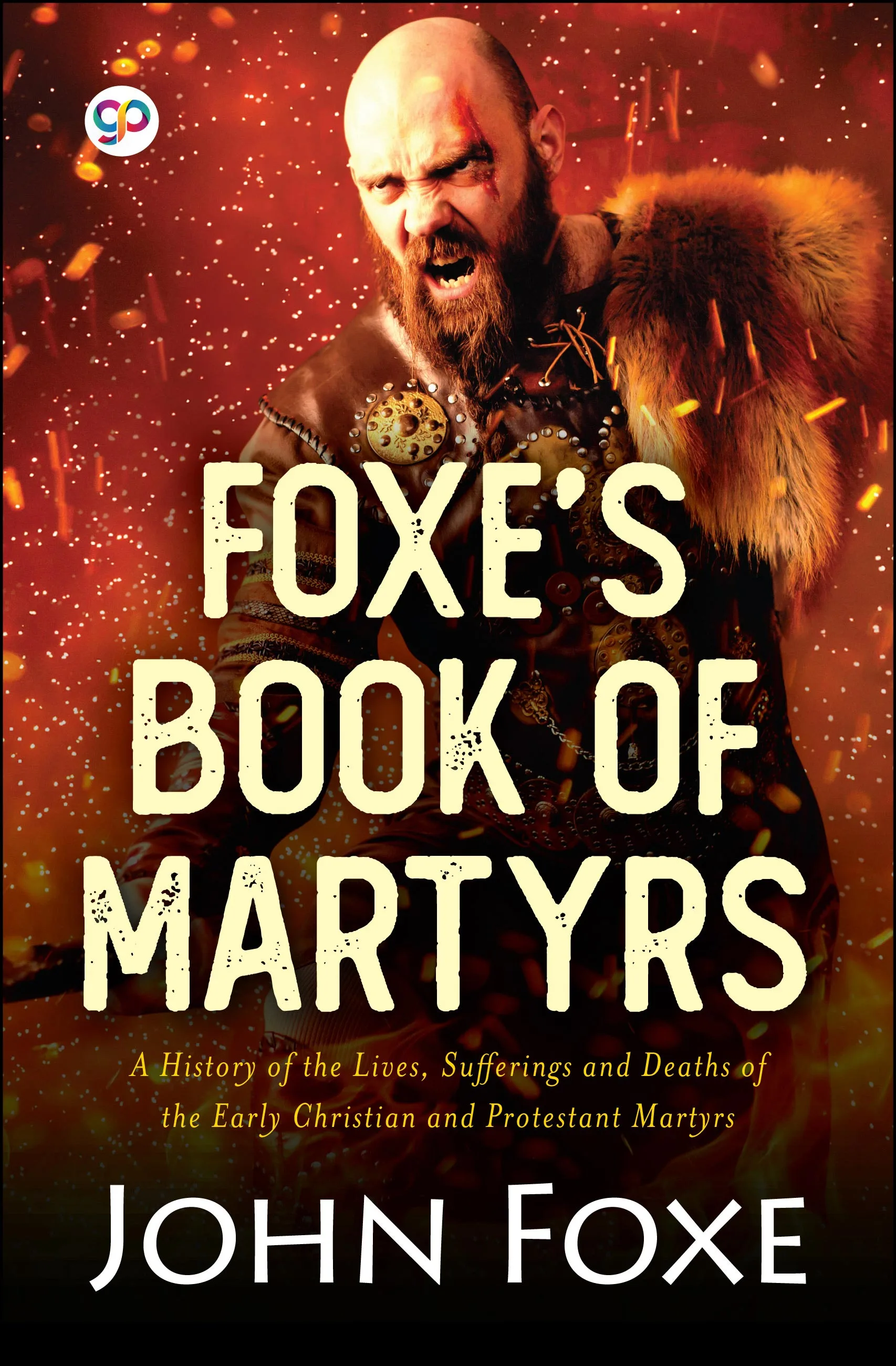
Foxe's Book of Martyrs
eBook
• INR 51.00
• English
• 9789354993015
No ratings yet
| Publisher | General Press |
|---|---|
| ISBN13 | 9789354993015 |
| ASIN/SKU | B0BBRHHXTH |
| Book Format | eBook |
| Language | English |
| List Price | INR 51.00 |
| Subject Code | REL015000 |
| Publishing Date | 05/09/2022 |
| Book Code | BD00068985 |
Buy this Book
Amazon Stores
Ebook Stores
Other Stores
Discover Foxe's Book of Martyrs by John Foxe. This book is published by General Press in eBook format, ISBN 9789354993015, ASIN B0BBRHHXTH, under Christian Books and Bibles, History of Religion, Spirituality.
Book Description
‘Foxe's Book of Martyrs’ by John Foxe, an English Puritan preacher is a graphic and polemic account of those who suffered for the cause of Protestantism. Published early in the reign of Queen Elizabeth I of England, only five years after the death of the Roman Catholic Queen Mary, the work is an affirmation of the Protestant Reformation in England during the ongoing period of religious conflict between Catholics and Protestants.
Since the English monarchs also asserted control over the Church in England, a change in rulers could change the legal status of religious practices. As a consequence, adherents of one religion risked judicial execution by the State depending on the attitudes of the rulers. During Mary's reign, common people of the Christian faith were publicly burned at the stake in an attempt to eliminate dissension from Catholic doctrines.
Foxe's account of Mary's reign and the martyrdoms that took place during it contributed very significantly to the belief in a distinction between the Roman Catholic Church and the Pope as a central aspect of English national identity. By compiling his record, Foxe intended to demonstrate a historical justification for the foundation of the Church of England as a contemporary embodiment of the true and faithful church, rather than as a newly established Christian denomination.
Since the English monarchs also asserted control over the Church in England, a change in rulers could change the legal status of religious practices. As a consequence, adherents of one religion risked judicial execution by the State depending on the attitudes of the rulers. During Mary's reign, common people of the Christian faith were publicly burned at the stake in an attempt to eliminate dissension from Catholic doctrines.
Foxe's account of Mary's reign and the martyrdoms that took place during it contributed very significantly to the belief in a distinction between the Roman Catholic Church and the Pope as a central aspect of English national identity. By compiling his record, Foxe intended to demonstrate a historical justification for the foundation of the Church of England as a contemporary embodiment of the true and faithful church, rather than as a newly established Christian denomination.
Author Biography
John Foxe (1516/1517–1587) was an English historian, theologian, and writer whose enduring work shaped the religious and historical consciousness of Protestant England. Best known for Actes and Monuments, popularly known as Foxe's Book of Martyrs, he devoted his life to documenting the lives, faith, and sufferings of Christian martyrs. His writings became some of the most widely read religious works in the English-speaking world and remain valuable historical sources for understanding the English Reformation.
Born in Boston, Lincolnshire, England, around 1516 or 1517, Foxe displayed exceptional academic promise from an early age. He studied at Brasenose College before transferring to Magdalen College, Oxford, where he earned his bachelor's and master's degrees. During his university years, he became deeply interested in church history, theology, and the writings of the early Christian Fathers. His growing Protestant convictions eventually brought him into conflict with the religious authorities of the time, leading him to leave Oxford.
When Queen Mary I, a Catholic monarch, came to the English throne in 1553, Protestant reformers faced severe persecution. Foxe fled to continental Europe, living in exile in cities such as Strasbourg and Basel. During these difficult years, he continued his historical research, collecting eyewitness accounts, official records, letters, and testimonies from those affected by religious persecution. His dedication to preserving these stories reflected both his scholarly discipline and his deep concern for religious freedom.
After the accession of Queen Elizabeth I, Foxe returned to England and published the first English edition of Actes and Monuments in 1563. The work chronicled the persecution of Christians from the early Church through the Reformation, with particular attention to those executed during Queen Mary's reign. Richly illustrated and extensively documented, the book became enormously influential, helping shape Protestant identity for generations. While modern historians recognize that some sections reflect the religious perspectives and limitations of Foxe's time, his work remains an invaluable historical resource and a landmark in English historical writing.
Throughout his life, Foxe remained a humble scholar, minister, and advocate for religious tolerance. He continued revising and expanding his great work while also writing theological and devotional texts.
John Foxe passed away on April 18, 1587, in London. Today, he is remembered as a dedicated historian whose commitment to preserving the stories of faith, sacrifice, and conscience has left an enduring legacy in religious history, historical scholarship, and English literature.
Born in Boston, Lincolnshire, England, around 1516 or 1517, Foxe displayed exceptional academic promise from an early age. He studied at Brasenose College before transferring to Magdalen College, Oxford, where he earned his bachelor's and master's degrees. During his university years, he became deeply interested in church history, theology, and the writings of the early Christian Fathers. His growing Protestant convictions eventually brought him into conflict with the religious authorities of the time, leading him to leave Oxford.
When Queen Mary I, a Catholic monarch, came to the English throne in 1553, Protestant reformers faced severe persecution. Foxe fled to continental Europe, living in exile in cities such as Strasbourg and Basel. During these difficult years, he continued his historical research, collecting eyewitness accounts, official records, letters, and testimonies from those affected by religious persecution. His dedication to preserving these stories reflected both his scholarly discipline and his deep concern for religious freedom.
After the accession of Queen Elizabeth I, Foxe returned to England and published the first English edition of Actes and Monuments in 1563. The work chronicled the persecution of Christians from the early Church through the Reformation, with particular attention to those executed during Queen Mary's reign. Richly illustrated and extensively documented, the book became enormously influential, helping shape Protestant identity for generations. While modern historians recognize that some sections reflect the religious perspectives and limitations of Foxe's time, his work remains an invaluable historical resource and a landmark in English historical writing.
Throughout his life, Foxe remained a humble scholar, minister, and advocate for religious tolerance. He continued revising and expanding his great work while also writing theological and devotional texts.
John Foxe passed away on April 18, 1587, in London. Today, he is remembered as a dedicated historian whose commitment to preserving the stories of faith, sacrifice, and conscience has left an enduring legacy in religious history, historical scholarship, and English literature.
Editorial Reviews
Editorial Reviews will be added soon…
Book Summary
John Foxe’s seminal work, widely known today as "Foxe’s Book of Martyrs" but originally titled Actes and Monuments of these Latter and Perillous Days, stands as one of the most profoundly influential works in English history. First published in English in 1563, early in the reign of Queen Elizabeth I, the book is a sprawling, deeply impassioned historical account of Christian martyrs throughout the centuries. However, it is fundamentally remembered for its vivid and harrowing depiction of the Protestant suffering under the Catholic Queen Mary I. Far more than a mere historical ledger of deaths, Foxe’s magnum opus was designed to be a definitive theological statement, framing the English Reformation not as a political rebellion, but as the triumphant climax of a cosmic struggle between the true, persecuted church of Christ and the corrupt, oppressive forces of the papacy.
To fully understand the weight of his argument, one must look at how Foxe structures his historical narrative. He does not begin his account in the sixteenth century; rather, he casts his gaze all the way back to the dawn of Christianity. The early chapters of the book meticulously chronicle the martyrdoms of the apostles and the brutal persecutions endured by the early church under the Roman Empire. By establishing this foundation, Foxe creates a vital, unbroken lineage of suffering. He argues that true faith has always been met with earthly violence. In Foxe’s eyes, the early martyrs who were thrown to the lions or burned at the stake by Roman emperors were the spiritual ancestors of the English Protestants, suffering for the exact same pure, unadulterated gospel.
Moving forward through the centuries, Foxe carefully constructs a narrative that spans the Middle Ages, a period he largely views as a dark era dominated by the spiritual tyranny of the Catholic Church. To prove that the light of the true gospel was never completely extinguished, he highlights the "proto-reformers"—men and women who dared to challenge papal authority long before Martin Luther nailed his theses to the church door. He devotes significant attention to figures like John Wycliffe and his Lollard followers in England, as well as Jan Hus in Bohemia. By detailing their trials, theological stances, and ultimate executions, Foxe attempts to demonstrate that the Protestant Reformation was not a sudden, radical departure from history, but rather the glorious restoration of the ancient, original Christian faith that had survived underground for a millennium.
The emotional and historical center of gravity in Foxe’s Book of Martyrs, however, rests squarely in its account of the Marian persecutions, which took place from 1553 to 1558. When Mary Tudor, a devout Catholic, ascended to the English throne, she was determined to reverse the Protestant reforms of her father and half-brother, bringing England back under papal authority. This resulted in the execution of nearly three hundred Protestants, who were burned at the stake for heresy. Foxe captures this agonizing five-year period with excruciating, deeply personal detail. He collected letters, trial transcripts, and eyewitness testimonies to ensure that the sacrifices of these men, women, and even teenagers were etched permanently into the national memory. His graphic descriptions of the burnings were meant to evoke horror, pity, and a fierce, unyielding devotion to the Protestant cause.
Among the hundreds of tragic stories, Foxe elevates a few key figures to near-mythic status, most notably the Oxford Martyrs: Thomas Cranmer, Hugh Latimer, and Nicholas Ridley. The executions of these prominent Protestant leaders are recounted with a cinematic intensity that has resonated through the centuries. Foxe famously records the final words of Hugh Latimer as he and Ridley were chained to the stake in 1555: "Be of good comfort, Master Ridley, and play the man; we shall this day light such a candle, by God's grace, in England, as I trust shall never be put out." This single sentence encapsulated the defiant, hopeful spirit of the entire book. Similarly, Foxe’s account of Archbishop Thomas Cranmer—who initially recanted his Protestant faith out of fear, only to dramatically withdraw his recantation and thrust his offending right hand into the fire first—serves as a powerful narrative of human frailty overcome by ultimate spiritual redemption.
From a modern historical perspective, Foxe’s methodology is a fascinating blend of meticulous documentation and fierce ideological bias. He was undeniably a brilliant compiler, aggressively seeking out primary source documents, episcopal registers, and firsthand accounts to lend unquestionable authenticity to his work. However, he was not an objective historian in the modern sense; he was an unabashed propagandist for the Protestant faith. He frequently editorialized his sources, amplifying the cruelty of Catholic inquisitors while painting the Protestant martyrs as incredibly serene, doctrinally pure, and practically flawless in their final moments. For Foxe, the Catholics were not merely misguided theologians; they were literal agents of the Antichrist, and his writing drips with righteous, inflammatory rhetoric designed to permanently alienate the English populace from Rome.
The theological underpinnings of the book rely heavily on an apocalyptic interpretation of history, drawing deeply from the Book of Revelation. Foxe taught his readers to view the contemporary struggles of the sixteenth century through a cosmic, biblical lens. The true church, he argued, is always a suffering church, characterized by its vulnerability and its reliance on scripture alone. Conversely, the false church is identified by its reliance on earthly power, pomp, wealth, and its willingness to use state violence to enforce its dogma. By drawing this sharp dichotomy, Foxe provided English Protestants with a profound sense of meaning. Their suffering was not a sign of God’s abandonment, but rather the ultimate proof of their divine election and their alignment with the ancient, persecuted saints.
The cultural and political impact of Foxe’s Book of Martyrs upon the English-speaking world can scarcely be overstated. Following its publication, the English government ordered that a copy of the massive volume be placed in every cathedral church, and many parish churches chained it to a lectern alongside the English Bible so that the public could read it freely. For generations of English people, Foxe’s narratives were the primary lens through which they understood their history and their national identity. The book instilled a deep, almost instinctual anti-Catholicism in the English consciousness that would heavily influence national politics, foreign policy, and social attitudes for the next three hundred years, shaping everything from the rejection of the Spanish Armada to the political disenfranchisement of Catholics in Britain.
Ultimately, "Foxe’s Book of Martyrs" remains a monumental testament to the power of narrative in shaping the destiny of a nation. John Foxe succeeded in creating a foundational mythos for Protestant England, turning the trauma of the Marian burnings into a triumphant story of spiritual victory. While modern historians may critique his lack of objectivity and his polemical excesses, the emotional truth of the martyrs' bravery remains undeniably compelling. The book is a harrowing exploration of the darkest capabilities of religious intolerance, balanced by an awe-inspiring look at human courage, conviction, and the extraordinary lengths to which people will go when they believe their very souls are at stake.
To fully understand the weight of his argument, one must look at how Foxe structures his historical narrative. He does not begin his account in the sixteenth century; rather, he casts his gaze all the way back to the dawn of Christianity. The early chapters of the book meticulously chronicle the martyrdoms of the apostles and the brutal persecutions endured by the early church under the Roman Empire. By establishing this foundation, Foxe creates a vital, unbroken lineage of suffering. He argues that true faith has always been met with earthly violence. In Foxe’s eyes, the early martyrs who were thrown to the lions or burned at the stake by Roman emperors were the spiritual ancestors of the English Protestants, suffering for the exact same pure, unadulterated gospel.
Moving forward through the centuries, Foxe carefully constructs a narrative that spans the Middle Ages, a period he largely views as a dark era dominated by the spiritual tyranny of the Catholic Church. To prove that the light of the true gospel was never completely extinguished, he highlights the "proto-reformers"—men and women who dared to challenge papal authority long before Martin Luther nailed his theses to the church door. He devotes significant attention to figures like John Wycliffe and his Lollard followers in England, as well as Jan Hus in Bohemia. By detailing their trials, theological stances, and ultimate executions, Foxe attempts to demonstrate that the Protestant Reformation was not a sudden, radical departure from history, but rather the glorious restoration of the ancient, original Christian faith that had survived underground for a millennium.
The emotional and historical center of gravity in Foxe’s Book of Martyrs, however, rests squarely in its account of the Marian persecutions, which took place from 1553 to 1558. When Mary Tudor, a devout Catholic, ascended to the English throne, she was determined to reverse the Protestant reforms of her father and half-brother, bringing England back under papal authority. This resulted in the execution of nearly three hundred Protestants, who were burned at the stake for heresy. Foxe captures this agonizing five-year period with excruciating, deeply personal detail. He collected letters, trial transcripts, and eyewitness testimonies to ensure that the sacrifices of these men, women, and even teenagers were etched permanently into the national memory. His graphic descriptions of the burnings were meant to evoke horror, pity, and a fierce, unyielding devotion to the Protestant cause.
Among the hundreds of tragic stories, Foxe elevates a few key figures to near-mythic status, most notably the Oxford Martyrs: Thomas Cranmer, Hugh Latimer, and Nicholas Ridley. The executions of these prominent Protestant leaders are recounted with a cinematic intensity that has resonated through the centuries. Foxe famously records the final words of Hugh Latimer as he and Ridley were chained to the stake in 1555: "Be of good comfort, Master Ridley, and play the man; we shall this day light such a candle, by God's grace, in England, as I trust shall never be put out." This single sentence encapsulated the defiant, hopeful spirit of the entire book. Similarly, Foxe’s account of Archbishop Thomas Cranmer—who initially recanted his Protestant faith out of fear, only to dramatically withdraw his recantation and thrust his offending right hand into the fire first—serves as a powerful narrative of human frailty overcome by ultimate spiritual redemption.
From a modern historical perspective, Foxe’s methodology is a fascinating blend of meticulous documentation and fierce ideological bias. He was undeniably a brilliant compiler, aggressively seeking out primary source documents, episcopal registers, and firsthand accounts to lend unquestionable authenticity to his work. However, he was not an objective historian in the modern sense; he was an unabashed propagandist for the Protestant faith. He frequently editorialized his sources, amplifying the cruelty of Catholic inquisitors while painting the Protestant martyrs as incredibly serene, doctrinally pure, and practically flawless in their final moments. For Foxe, the Catholics were not merely misguided theologians; they were literal agents of the Antichrist, and his writing drips with righteous, inflammatory rhetoric designed to permanently alienate the English populace from Rome.
The theological underpinnings of the book rely heavily on an apocalyptic interpretation of history, drawing deeply from the Book of Revelation. Foxe taught his readers to view the contemporary struggles of the sixteenth century through a cosmic, biblical lens. The true church, he argued, is always a suffering church, characterized by its vulnerability and its reliance on scripture alone. Conversely, the false church is identified by its reliance on earthly power, pomp, wealth, and its willingness to use state violence to enforce its dogma. By drawing this sharp dichotomy, Foxe provided English Protestants with a profound sense of meaning. Their suffering was not a sign of God’s abandonment, but rather the ultimate proof of their divine election and their alignment with the ancient, persecuted saints.
The cultural and political impact of Foxe’s Book of Martyrs upon the English-speaking world can scarcely be overstated. Following its publication, the English government ordered that a copy of the massive volume be placed in every cathedral church, and many parish churches chained it to a lectern alongside the English Bible so that the public could read it freely. For generations of English people, Foxe’s narratives were the primary lens through which they understood their history and their national identity. The book instilled a deep, almost instinctual anti-Catholicism in the English consciousness that would heavily influence national politics, foreign policy, and social attitudes for the next three hundred years, shaping everything from the rejection of the Spanish Armada to the political disenfranchisement of Catholics in Britain.
Ultimately, "Foxe’s Book of Martyrs" remains a monumental testament to the power of narrative in shaping the destiny of a nation. John Foxe succeeded in creating a foundational mythos for Protestant England, turning the trauma of the Marian burnings into a triumphant story of spiritual victory. While modern historians may critique his lack of objectivity and his polemical excesses, the emotional truth of the martyrs' bravery remains undeniably compelling. The book is a harrowing exploration of the darkest capabilities of religious intolerance, balanced by an awe-inspiring look at human courage, conviction, and the extraordinary lengths to which people will go when they believe their very souls are at stake.
Sample Chapters
Chapter 1 : History of Christian Martyrs to the First General Persecution under Nero
The history of the church may almost be said to be a history of the trials and sufferings of its members, as experienced at the hands of wicked men. At one time, persecution, as waged against the friends of Christ, was confined to those without; at another, schisms and divisions have arrayed brethren of the same name against each other, and scenes of cruelty and woe have been exhibited within the sanctuary, rivalling in horror the direst cruelties ever inflicted by pagan or barbarian fanaticism. This, however, instead of implying any defect in the gospel system, which breathes peace and love; only pourtrays in darker colours the deep and universal depravity of the human heart. Pure and unsophisticated morality, especially when attempted to be inculcated on mankind, as essential to their preserving an interest with their Creator, have constantly met with opposition. It was this which produced the premature death of John the Baptist. It was the cutting charge of adultery and incest, which excited the resentment of Herodias, who never ceased to persecute him, until she had accomplished his destruction. The same observation is equally applicable to the Jewish doctors, in their treatment of our blessed Lord and Saviour JESUS CHRIST. In the sudden martyrdom of John the Baptist, and the crucifixion of our Lord, the history of christian martyrdom must be admitted to commence; and from these, as a basis for the subsequent occurrences, we may fairly trace the origin of that hostility, which produced so lavish an effusion of christian blood, and led to so much slaughter in the progressive state of Christianity.
As it is not our business to enlarge upon our Saviour’s history, either before or after his crucifixion, we shall only find it necessary to remind our readers of the discomfiture of the Jews by his subsequent resurrection. Though one apostle had betrayed him; though another had denied him, under the solemn sanction of an oath; and though the rest had forsaken him, unless we may except “the disciple who was known unto the high-priest;” the history of his resurrection gave a new direction to all their hearts, and, after the mission of the Holy Spirit, imparted new confidence to their minds. The powers with which they were endued emboldened them to proclaim his name, to the confusion of the Jewish rulers, and the astonishment of Gentile proselytes.
I. St. Stephen
St. Stephen suffered the next in order. His death was occasioned by the faithful manner in which he preached the gospel to the betrayers and murderers of Christ. To such a degree of madness were they excited, that they cast him out of the city and stoned him to death. The time when he suffered is generally supposed to have been at the passover which succeeded to that of our Lord’s crucifixion, and to the æra of his ascension, in the following spring.
Upon this a great persecution was raised against all who professed their belief in Christ as the Messiah, or as a prophet. We are immediately told by St. Luke, that “there was a great persecution against the church, which was at Jerusalem;” and that “they were all scattered abroad throughout the regions of Judea and Samaria, except the apostles.”
About two thousand Christians, with Nicanor, one of the seven deacons, suffered martyrdom during the “persecution which arose about Stephen.”
II. James the Great
The next martyr we meet with, according to St. Luke, in the History of the Apostles’ Acts, was James the son of Zebedee, the elder brother of John, and a relative of our Lord; for his mother Salome was cousin-german to the Virgin Mary. It was not until ten years after the death of Stephen, that the second martyrdom took place; for no sooner had Herod Agrippa been appointed governor of Judea, than, with a view to ingratiate himself with them, he raised a sharp persecution against the Christians, and determined to make an effectual blow, by striking at their leaders. The account given us by an eminent primitive writer, Clemens Alexandrinus, ought not to be overlooked; that, as James was led to the place of martyrdom, his accuser was brought to repent of his conduct by the apostle’s extraordinary courage and undauntedness, and fell down at his feet to request his pardon, professing himself a christian, and resolving that James should not receive the crown of martyrdom alone. Hence they were both beheaded at the same time. Thus did the first apostolic martyr cheerfully and resolutely receive that cup, which he had told our Saviour he was ready to drink. Timon and Parmenas suffered martyrdom about the same time; the one at Phillippi, and the other in Macedonia. These events took place A. D. 44.
III. Philip
Was born at Bethsaida, in Galilee, and was the first called by the name of “Disciple.” He laboured diligently in Upper Asia, and suffered martyrdom at Heliopolis, in Phrygia. He was scourged, thrown into prison, and afterwards crucified, A. D. 54.
IV. Matthew
Whose occupation was that of a toll-gatherer, was born at Nazareth. He wrote his gospel in Hebrew, which was afterwards translated into Greek by James the Less. The scene of his labors was Parthia, and Ethiopia, in which latter country he suffered martyrdom, being slain with a halberd in the city of Nadabah, A. D. 60.
V. James the Less
Is supposed by some to have been the brother of our Lord, by a former wife of Joseph. This is very doubtful, and accords too much with the catholic superstition, that Mary never had any other children except our Saviour. He was elected to the oversight of the churches of Jerusalem; and was the author of the epistle ascribed to James in the sacred canon. At the age of ninety-four, he was beat and stoned by the Jews; and finally had his brains dashed out with a fuller’s club.
VI. Matthias
Of whom less is known than of most of the other disciples, was elected to fill the vacant place of Judas. He was stoned at Jerusalem and then beheaded.
VII. Andrew
Was the brother of Peter. He preached the gospel to many Asiatic nations; but on his arrival at Edessa, he was taken and crucified on a cross, the two ends of which were fixed transversely in the ground. Hence the derivation of the term, St. Andrew’s Cross.
VIII. St. Mark
Was born of Jewish parents of the tribe of Levi. He is supposed to have been converted to Christianity by Peter, whom he served as an amanuensis, and under whose inspection he wrote his gospel in the Greek language. Mark was dragged to pieces by the people of Alexandria, at the great solemnity of Serapis their idol, ending his life under their merciless hands.
IX. Peter
Was born at Bethsaida, in Galilee. He was by occupation a fisherman. Christ gave him a name which in Syriac implies a rock. Peter is supposed to have suffered martyrdom at Rome, during the reign of the emperor Nero, being crucified with his head downward, at his own request.
[It is, however, very uncertain, whether Peter ever visited Rome at all. The evidence rather favouring the supposition that he ended his days in some other country.—Ed.]
X. Paul
The great apostle of the Gentiles, was a Jew of the tribe of Benjamin, a native of Tarsus in Cilicia, and before his conversion was called Saul. After suffering various persecutions at Jerusalem, Iconium, Lystra, Phillippi and Thessalonica, he was carried prisoner to Rome, where he continued for two years, and was then released. He afterwards visited the churches of Greece and Rome, and preached the gospel in Spain and France, but returning to Rome, he was apprehended by order of Nero, and beheaded.
XI. Jude
The brother of James, was commonly called Thaddeus. He was crucified at Edessa, A. D. 72.
XII. Bartholomew
Preached in several countries, and having translated the gospel of Matthew into the language of India, he propagated it in that country. He was at length cruelly beaten and then crucified by the impatient idolaters.
XIII. Thomas
Called Didymus, preached the gospel in Parthia and India, where exciting the rage of the pagan priests, he was martyred by being thrust through with a spear.
XIV. Luke
The evangelist, was the author of the gospel which goes under his name. He travelled with Paul through various countries, and is supposed to have been hanged on an olive tree, by the idolatrous priests of Greece.
XV. Simon
Surnamed Zelotes, preached the gospel in Mauritania, Africa, and even in Britain, which latter country he was crucified, A. D. 74.
XVI. John
The “beloved disciple,” was brother to James the Great. The churches of Smyrna, Pergamos, Sardis, Philadelphia, Laodicea, and Thyatira, were founded by him. From Ephesus he was ordered to be sent to Rome, where it is affirmed he was cast into a cauldron of boiling oil. He escaped by miracle, without injury. Domitian afterwards banished him to the Isle of Patmos, where he wrote the Book of Revelation. Nerva, the successor of Domitian, recalled him. He was the only apostle who escaped a violent death.
XVII. Barnabas
Was of Cyprus, but of Jewish descent, his death is supposed to have taken place about A. D. 73.
Chapter 2 : The Ten Primitive Persecutions
The First Persecution under Nero, A. D. 67
The first persecution of the church took place in the year 67, under Nero, the sixth emperor of Rome. This monarch reigned for the space of five years, with tolerable credit to himself, but then gave way to the greatest extravagancy of temper, and to the most atrocious barbarities. Among other diabolical whims, he ordered that the city of Rome should be set on fire, which order was executed by his officers, guards, and servants. While the imperial city was in flames, he went up to the tower of Macænas, played upon his harp, sung the song of the burning of Troy, and openly declared, “That he wished the ruin of all things before his death.” Besides the noble pile, called the circus, many other palaces and houses were consumed; several thousand perished in the flames, were smothered in the smoke, or buried beneath the ruins.
This dreadful conflagration continued nine days; when Nero, finding that his conduct was greatly blamed, and a severe odium cast upon him, determined to lay the whole upon the Christians, at once to excuse himself, and have an opportunity of glutting his sight with new cruelties. This was the occasion of the first persecution; and the barbarities exercised on the Christians were such as even excited the commisseration of the Romans themselves. Nero even refined upon cruelty, and contrived all manner of punishments for the Christians that the most infernal imagination could design. In particular, he had some sewed up in the skins of wild beasts, and then worried by dogs till they expired; and others dressed in shirts made stiff with wax, fixed to axletrees, and set on fire in his gardens, in order to illuminate them. This persecution was general throughout the whole Roman empire; but it rather increased than diminished the spirit of Christianity. In the course of it, St. Paul and St. Peter were martyred.
To their names may be added, Erastus, chamberlain of Corinth; Aristarchus, the Macedonian; and Trophimus, an Ephesian, converted by St. Paul, and fellow-labourer with him; Joseph, commonly called Barsabas; and Ananias, bishop of Damascus; each of the seventy.
The Second Persecution, under Domitian, A. D. 81
The emperor Domitian, who was naturally inclined to cruelty, first slew his brother, and then raised the second persecution against the Christians. In his rage he put to death some of the Roman senators, some through malice; and others to confiscate their estates. He then commanded all the lineage of David to be put to death.
Among the numerous martyrs that suffered during this persecution was Simeon, bishop of Jerusalem, who was crucified; and St. John, who was boiled in oil, and afterward banished to Patmos. Flavia, the daughter of a Roman senator, was likewise banished to Pontus; and a law was made, “That no christian, once brought before the tribunal, should be exempted from punishment without renouncing his religion.”
A variety of fabricated tales were, during this reign, composed in order to injure the Christians. Such was the infatuation of the pagans, that, if famine, pestilence, or earthquakes afflicted any of the Roman provinces, it was laid upon the Christians. These persecutions among the Christians increased the number of informers and many, for the sake of gain, swore away the lives of the innocent.
Another hardship was, that, when any Christians were brought before the magistrates, a test oath was proposed, when, if they refused to take it, death was pronounced against them; and if they confessed themselves Christians, the sentence was the same.
The following were the most remarkable among the numerous martyrs who suffered during this persecution.
Dionysius, the Areopagite, was an Athenian by birth, and educated in all the useful and ornamental literature of Greece. He then travelled to Egypt to study astronomy, and made very particular observations on the great and supernatural eclipse, which happened at the time of our Saviour’s crucifixion.
The sanctity of his conversation, and the purity of his manners, recommended him so strongly to the Christians in general, that he was appointed bishop of Athens.
Nicodemus, a benevolent christian of some distinction, suffered at Rome during the rage of Domitian’s persecution.
Protasius and Gervasius were martyred at Milan.
Timothy was the celebrated disciple of St. Paul, and bishop of Ephesus, where he zealously governed the church till A. D. 97. At this period, as the pagans were about to celebrate a feast called Catagogion, Timothy, meeting the procession, severely reproved them for their ridiculous idolatry, which so exasperated the people, that they fell upon him with their clubs, and beat him in so dreadful a manner, that he expired of the bruises two days after.
The Third Persecution, under Trajan, A. D. 108
Nerva, succeeding Domitian, gave a respite to the sufferings of the Christians; but reigning only thirteen months, his successor Trajan, in the tenth year of his reign A. D. 108, began the third persecution against the Christians. While the persecution raged, Pliny 2d, a heathen philosopher wrote to the emperor in favor of the Christians; to whose epistle Trajan returned this indecisive answer: “The Christians ought not to be sought after, but when brought before the magistracy, they should be punished.” Trajan, however, soon after wrote to Jerusalem, and gave orders to his officers to exterminate the stock of David; in consequence of which, all that could be found of that race were put to death.
Symphorosa, a widow, and her seven sons, were commanded by the emperor to sacrifice to the heathen deities. She was carried to the temple of Hercules, scourged, and hung up, for some time, by the hair of her head: then being taken down, a large stone was fastened to her neck, and she was thrown into the river, where she expired. With respect to the sons, they were fastened to seven posts, and being drawn up by pullies, their limbs were dislocated: these tortures, not affecting their resolution, they were martyred by stabbing, except Eugenius, the youngest, who was sawed asunder.
Phocas, bishop of Pontus, refusing to sacrifice to Neptune, was, by the immediate order of Trajan, cast first into a hot lime-kiln, and then thrown into a scalding bath till he expired.
Trajan likewise commanded the martyrdom of Ignatius, bishop of Antioch. This holy man was the person whom, when an infant, Christ took into his arms, and showed to his disciples, as one that would be a pattern of humility and innocence. He received the gospel afterward from St. John the Evangelist, and was exceedingly zealous in his mission. He boldly vindicated the faith of Christ before the emperor, for which he was cast into prison, and tormented in a most cruel manner. After being dreadfully scourged, he was compelled to hold fire in his hands, and, at the same time, papers clipped in oil were put to his sides, and set on fire. His flesh was then torn with red hot pincers, and at last he was despatched by being torn to pieces by wild beasts.
Trajan being succeeded by Adrian, the latter continued this third persecution with as much severity as his predecessor. About this time Alexander, bishop of Rome, with his two deacons, were martyred; as were Quirinus and Hernes, with their families; Zenon, a Roman nobleman, and about ten thousand other Christians.
In Mount Ararat many were crucified, crowned with thorns, and spears run into their sides, in imitation of Christ’s passion. Eustachius, a brave and successful Roman commander, was by the emperor ordered to join in an idolatrous sacrifice to celebrate some of his own victories; but his faith (being a christian in his heart) was so much greater than his vanity, that he nobly refused it. Enraged at the denial, the ungrateful emperor forgot the service of this skilful commander, and ordered him and his whole family to be martyred.
At the martyrdom of Faustines and Jovita, brothers and citizens of Brescia, their torments were so many, and their patience so great, that Calocerius, a pagan, beholding them, was struck with admiration, and exclaimed in a kind of ecstacy, “Great is the God of the Christians!” for which he was apprehended, and suffered a similar fate.
Many other similar cruelties and rigours were exercised against the Christians, until Quadratus, bishop of Athens, made a learned apology in their favour before the emperor, who happened to be there and Aristides, a philosopher of the same city, wrote an elegant epistle, which caused Adrian to relax in his severities, and relent in their favour.
Adrian dying A. D. 138, was succeeded by Antoninus Pius, one of the most amiable monarchs that ever reigned, and who stayed the persecution against the Christians.
The Fourth Persecution, under Marcus Aurelius Antoninus, A. D. 162
This commenced A. D. 162, under Marcus Aurelius Antoninus Philosophus, a strong pagan.
The cruelties used in this persecution were such, that many of the spectators shuddered with horror at the sight, and were astonished at the intrepidity of the sufferers. Some of the martyrs were obliged to pass, with their already wounded feet, over thorns, nails, sharp shells, &c. upon their points, others were scourged till their sinews and veins lay bare, and after suffering the most excruciating tortures that could be devised, they were destroyed by the most terrible deaths.
Germanicus, a young man, but a true christian, being delivered to the wild beasts on account of his faith, behaved with such astonishing courage, that several pagans became converts to a faith which inspired such fortitude.
Polycarp, the venerable bishop of Smyrna, hearing that persons were seeking for him, escaped, but was discovered by a child. After feasting the guards who apprehended him, he desired an hour in prayer, which being allowed, he prayed with such fervency, that his guards repented that they had been instrumental in taking him. He was, however, carried before the proconsul, condemned, and burnt in the market-place. Twelve other Christians, who had been intimate with Polycarp, were soon after martyred.
The history of the church may almost be said to be a history of the trials and sufferings of its members, as experienced at the hands of wicked men. At one time, persecution, as waged against the friends of Christ, was confined to those without; at another, schisms and divisions have arrayed brethren of the same name against each other, and scenes of cruelty and woe have been exhibited within the sanctuary, rivalling in horror the direst cruelties ever inflicted by pagan or barbarian fanaticism. This, however, instead of implying any defect in the gospel system, which breathes peace and love; only pourtrays in darker colours the deep and universal depravity of the human heart. Pure and unsophisticated morality, especially when attempted to be inculcated on mankind, as essential to their preserving an interest with their Creator, have constantly met with opposition. It was this which produced the premature death of John the Baptist. It was the cutting charge of adultery and incest, which excited the resentment of Herodias, who never ceased to persecute him, until she had accomplished his destruction. The same observation is equally applicable to the Jewish doctors, in their treatment of our blessed Lord and Saviour JESUS CHRIST. In the sudden martyrdom of John the Baptist, and the crucifixion of our Lord, the history of christian martyrdom must be admitted to commence; and from these, as a basis for the subsequent occurrences, we may fairly trace the origin of that hostility, which produced so lavish an effusion of christian blood, and led to so much slaughter in the progressive state of Christianity.
As it is not our business to enlarge upon our Saviour’s history, either before or after his crucifixion, we shall only find it necessary to remind our readers of the discomfiture of the Jews by his subsequent resurrection. Though one apostle had betrayed him; though another had denied him, under the solemn sanction of an oath; and though the rest had forsaken him, unless we may except “the disciple who was known unto the high-priest;” the history of his resurrection gave a new direction to all their hearts, and, after the mission of the Holy Spirit, imparted new confidence to their minds. The powers with which they were endued emboldened them to proclaim his name, to the confusion of the Jewish rulers, and the astonishment of Gentile proselytes.
I. St. Stephen
St. Stephen suffered the next in order. His death was occasioned by the faithful manner in which he preached the gospel to the betrayers and murderers of Christ. To such a degree of madness were they excited, that they cast him out of the city and stoned him to death. The time when he suffered is generally supposed to have been at the passover which succeeded to that of our Lord’s crucifixion, and to the æra of his ascension, in the following spring.
Upon this a great persecution was raised against all who professed their belief in Christ as the Messiah, or as a prophet. We are immediately told by St. Luke, that “there was a great persecution against the church, which was at Jerusalem;” and that “they were all scattered abroad throughout the regions of Judea and Samaria, except the apostles.”
About two thousand Christians, with Nicanor, one of the seven deacons, suffered martyrdom during the “persecution which arose about Stephen.”
II. James the Great
The next martyr we meet with, according to St. Luke, in the History of the Apostles’ Acts, was James the son of Zebedee, the elder brother of John, and a relative of our Lord; for his mother Salome was cousin-german to the Virgin Mary. It was not until ten years after the death of Stephen, that the second martyrdom took place; for no sooner had Herod Agrippa been appointed governor of Judea, than, with a view to ingratiate himself with them, he raised a sharp persecution against the Christians, and determined to make an effectual blow, by striking at their leaders. The account given us by an eminent primitive writer, Clemens Alexandrinus, ought not to be overlooked; that, as James was led to the place of martyrdom, his accuser was brought to repent of his conduct by the apostle’s extraordinary courage and undauntedness, and fell down at his feet to request his pardon, professing himself a christian, and resolving that James should not receive the crown of martyrdom alone. Hence they were both beheaded at the same time. Thus did the first apostolic martyr cheerfully and resolutely receive that cup, which he had told our Saviour he was ready to drink. Timon and Parmenas suffered martyrdom about the same time; the one at Phillippi, and the other in Macedonia. These events took place A. D. 44.
III. Philip
Was born at Bethsaida, in Galilee, and was the first called by the name of “Disciple.” He laboured diligently in Upper Asia, and suffered martyrdom at Heliopolis, in Phrygia. He was scourged, thrown into prison, and afterwards crucified, A. D. 54.
IV. Matthew
Whose occupation was that of a toll-gatherer, was born at Nazareth. He wrote his gospel in Hebrew, which was afterwards translated into Greek by James the Less. The scene of his labors was Parthia, and Ethiopia, in which latter country he suffered martyrdom, being slain with a halberd in the city of Nadabah, A. D. 60.
V. James the Less
Is supposed by some to have been the brother of our Lord, by a former wife of Joseph. This is very doubtful, and accords too much with the catholic superstition, that Mary never had any other children except our Saviour. He was elected to the oversight of the churches of Jerusalem; and was the author of the epistle ascribed to James in the sacred canon. At the age of ninety-four, he was beat and stoned by the Jews; and finally had his brains dashed out with a fuller’s club.
VI. Matthias
Of whom less is known than of most of the other disciples, was elected to fill the vacant place of Judas. He was stoned at Jerusalem and then beheaded.
VII. Andrew
Was the brother of Peter. He preached the gospel to many Asiatic nations; but on his arrival at Edessa, he was taken and crucified on a cross, the two ends of which were fixed transversely in the ground. Hence the derivation of the term, St. Andrew’s Cross.
VIII. St. Mark
Was born of Jewish parents of the tribe of Levi. He is supposed to have been converted to Christianity by Peter, whom he served as an amanuensis, and under whose inspection he wrote his gospel in the Greek language. Mark was dragged to pieces by the people of Alexandria, at the great solemnity of Serapis their idol, ending his life under their merciless hands.
IX. Peter
Was born at Bethsaida, in Galilee. He was by occupation a fisherman. Christ gave him a name which in Syriac implies a rock. Peter is supposed to have suffered martyrdom at Rome, during the reign of the emperor Nero, being crucified with his head downward, at his own request.
[It is, however, very uncertain, whether Peter ever visited Rome at all. The evidence rather favouring the supposition that he ended his days in some other country.—Ed.]
X. Paul
The great apostle of the Gentiles, was a Jew of the tribe of Benjamin, a native of Tarsus in Cilicia, and before his conversion was called Saul. After suffering various persecutions at Jerusalem, Iconium, Lystra, Phillippi and Thessalonica, he was carried prisoner to Rome, where he continued for two years, and was then released. He afterwards visited the churches of Greece and Rome, and preached the gospel in Spain and France, but returning to Rome, he was apprehended by order of Nero, and beheaded.
XI. Jude
The brother of James, was commonly called Thaddeus. He was crucified at Edessa, A. D. 72.
XII. Bartholomew
Preached in several countries, and having translated the gospel of Matthew into the language of India, he propagated it in that country. He was at length cruelly beaten and then crucified by the impatient idolaters.
XIII. Thomas
Called Didymus, preached the gospel in Parthia and India, where exciting the rage of the pagan priests, he was martyred by being thrust through with a spear.
XIV. Luke
The evangelist, was the author of the gospel which goes under his name. He travelled with Paul through various countries, and is supposed to have been hanged on an olive tree, by the idolatrous priests of Greece.
XV. Simon
Surnamed Zelotes, preached the gospel in Mauritania, Africa, and even in Britain, which latter country he was crucified, A. D. 74.
XVI. John
The “beloved disciple,” was brother to James the Great. The churches of Smyrna, Pergamos, Sardis, Philadelphia, Laodicea, and Thyatira, were founded by him. From Ephesus he was ordered to be sent to Rome, where it is affirmed he was cast into a cauldron of boiling oil. He escaped by miracle, without injury. Domitian afterwards banished him to the Isle of Patmos, where he wrote the Book of Revelation. Nerva, the successor of Domitian, recalled him. He was the only apostle who escaped a violent death.
XVII. Barnabas
Was of Cyprus, but of Jewish descent, his death is supposed to have taken place about A. D. 73.
Chapter 2 : The Ten Primitive Persecutions
The First Persecution under Nero, A. D. 67
The first persecution of the church took place in the year 67, under Nero, the sixth emperor of Rome. This monarch reigned for the space of five years, with tolerable credit to himself, but then gave way to the greatest extravagancy of temper, and to the most atrocious barbarities. Among other diabolical whims, he ordered that the city of Rome should be set on fire, which order was executed by his officers, guards, and servants. While the imperial city was in flames, he went up to the tower of Macænas, played upon his harp, sung the song of the burning of Troy, and openly declared, “That he wished the ruin of all things before his death.” Besides the noble pile, called the circus, many other palaces and houses were consumed; several thousand perished in the flames, were smothered in the smoke, or buried beneath the ruins.
This dreadful conflagration continued nine days; when Nero, finding that his conduct was greatly blamed, and a severe odium cast upon him, determined to lay the whole upon the Christians, at once to excuse himself, and have an opportunity of glutting his sight with new cruelties. This was the occasion of the first persecution; and the barbarities exercised on the Christians were such as even excited the commisseration of the Romans themselves. Nero even refined upon cruelty, and contrived all manner of punishments for the Christians that the most infernal imagination could design. In particular, he had some sewed up in the skins of wild beasts, and then worried by dogs till they expired; and others dressed in shirts made stiff with wax, fixed to axletrees, and set on fire in his gardens, in order to illuminate them. This persecution was general throughout the whole Roman empire; but it rather increased than diminished the spirit of Christianity. In the course of it, St. Paul and St. Peter were martyred.
To their names may be added, Erastus, chamberlain of Corinth; Aristarchus, the Macedonian; and Trophimus, an Ephesian, converted by St. Paul, and fellow-labourer with him; Joseph, commonly called Barsabas; and Ananias, bishop of Damascus; each of the seventy.
The Second Persecution, under Domitian, A. D. 81
The emperor Domitian, who was naturally inclined to cruelty, first slew his brother, and then raised the second persecution against the Christians. In his rage he put to death some of the Roman senators, some through malice; and others to confiscate their estates. He then commanded all the lineage of David to be put to death.
Among the numerous martyrs that suffered during this persecution was Simeon, bishop of Jerusalem, who was crucified; and St. John, who was boiled in oil, and afterward banished to Patmos. Flavia, the daughter of a Roman senator, was likewise banished to Pontus; and a law was made, “That no christian, once brought before the tribunal, should be exempted from punishment without renouncing his religion.”
A variety of fabricated tales were, during this reign, composed in order to injure the Christians. Such was the infatuation of the pagans, that, if famine, pestilence, or earthquakes afflicted any of the Roman provinces, it was laid upon the Christians. These persecutions among the Christians increased the number of informers and many, for the sake of gain, swore away the lives of the innocent.
Another hardship was, that, when any Christians were brought before the magistrates, a test oath was proposed, when, if they refused to take it, death was pronounced against them; and if they confessed themselves Christians, the sentence was the same.
The following were the most remarkable among the numerous martyrs who suffered during this persecution.
Dionysius, the Areopagite, was an Athenian by birth, and educated in all the useful and ornamental literature of Greece. He then travelled to Egypt to study astronomy, and made very particular observations on the great and supernatural eclipse, which happened at the time of our Saviour’s crucifixion.
The sanctity of his conversation, and the purity of his manners, recommended him so strongly to the Christians in general, that he was appointed bishop of Athens.
Nicodemus, a benevolent christian of some distinction, suffered at Rome during the rage of Domitian’s persecution.
Protasius and Gervasius were martyred at Milan.
Timothy was the celebrated disciple of St. Paul, and bishop of Ephesus, where he zealously governed the church till A. D. 97. At this period, as the pagans were about to celebrate a feast called Catagogion, Timothy, meeting the procession, severely reproved them for their ridiculous idolatry, which so exasperated the people, that they fell upon him with their clubs, and beat him in so dreadful a manner, that he expired of the bruises two days after.
The Third Persecution, under Trajan, A. D. 108
Nerva, succeeding Domitian, gave a respite to the sufferings of the Christians; but reigning only thirteen months, his successor Trajan, in the tenth year of his reign A. D. 108, began the third persecution against the Christians. While the persecution raged, Pliny 2d, a heathen philosopher wrote to the emperor in favor of the Christians; to whose epistle Trajan returned this indecisive answer: “The Christians ought not to be sought after, but when brought before the magistracy, they should be punished.” Trajan, however, soon after wrote to Jerusalem, and gave orders to his officers to exterminate the stock of David; in consequence of which, all that could be found of that race were put to death.
Symphorosa, a widow, and her seven sons, were commanded by the emperor to sacrifice to the heathen deities. She was carried to the temple of Hercules, scourged, and hung up, for some time, by the hair of her head: then being taken down, a large stone was fastened to her neck, and she was thrown into the river, where she expired. With respect to the sons, they were fastened to seven posts, and being drawn up by pullies, their limbs were dislocated: these tortures, not affecting their resolution, they were martyred by stabbing, except Eugenius, the youngest, who was sawed asunder.
Phocas, bishop of Pontus, refusing to sacrifice to Neptune, was, by the immediate order of Trajan, cast first into a hot lime-kiln, and then thrown into a scalding bath till he expired.
Trajan likewise commanded the martyrdom of Ignatius, bishop of Antioch. This holy man was the person whom, when an infant, Christ took into his arms, and showed to his disciples, as one that would be a pattern of humility and innocence. He received the gospel afterward from St. John the Evangelist, and was exceedingly zealous in his mission. He boldly vindicated the faith of Christ before the emperor, for which he was cast into prison, and tormented in a most cruel manner. After being dreadfully scourged, he was compelled to hold fire in his hands, and, at the same time, papers clipped in oil were put to his sides, and set on fire. His flesh was then torn with red hot pincers, and at last he was despatched by being torn to pieces by wild beasts.
Trajan being succeeded by Adrian, the latter continued this third persecution with as much severity as his predecessor. About this time Alexander, bishop of Rome, with his two deacons, were martyred; as were Quirinus and Hernes, with their families; Zenon, a Roman nobleman, and about ten thousand other Christians.
In Mount Ararat many were crucified, crowned with thorns, and spears run into their sides, in imitation of Christ’s passion. Eustachius, a brave and successful Roman commander, was by the emperor ordered to join in an idolatrous sacrifice to celebrate some of his own victories; but his faith (being a christian in his heart) was so much greater than his vanity, that he nobly refused it. Enraged at the denial, the ungrateful emperor forgot the service of this skilful commander, and ordered him and his whole family to be martyred.
At the martyrdom of Faustines and Jovita, brothers and citizens of Brescia, their torments were so many, and their patience so great, that Calocerius, a pagan, beholding them, was struck with admiration, and exclaimed in a kind of ecstacy, “Great is the God of the Christians!” for which he was apprehended, and suffered a similar fate.
Many other similar cruelties and rigours were exercised against the Christians, until Quadratus, bishop of Athens, made a learned apology in their favour before the emperor, who happened to be there and Aristides, a philosopher of the same city, wrote an elegant epistle, which caused Adrian to relax in his severities, and relent in their favour.
Adrian dying A. D. 138, was succeeded by Antoninus Pius, one of the most amiable monarchs that ever reigned, and who stayed the persecution against the Christians.
The Fourth Persecution, under Marcus Aurelius Antoninus, A. D. 162
This commenced A. D. 162, under Marcus Aurelius Antoninus Philosophus, a strong pagan.
The cruelties used in this persecution were such, that many of the spectators shuddered with horror at the sight, and were astonished at the intrepidity of the sufferers. Some of the martyrs were obliged to pass, with their already wounded feet, over thorns, nails, sharp shells, &c. upon their points, others were scourged till their sinews and veins lay bare, and after suffering the most excruciating tortures that could be devised, they were destroyed by the most terrible deaths.
Germanicus, a young man, but a true christian, being delivered to the wild beasts on account of his faith, behaved with such astonishing courage, that several pagans became converts to a faith which inspired such fortitude.
Polycarp, the venerable bishop of Smyrna, hearing that persons were seeking for him, escaped, but was discovered by a child. After feasting the guards who apprehended him, he desired an hour in prayer, which being allowed, he prayed with such fervency, that his guards repented that they had been instrumental in taking him. He was, however, carried before the proconsul, condemned, and burnt in the market-place. Twelve other Christians, who had been intimate with Polycarp, were soon after martyred.
Reader Reviews
No reviews yet.
Foxe's Book of Martyrs
Download Cover Image
Do you want to download the full cover image for Foxe's Book of Martyrs?