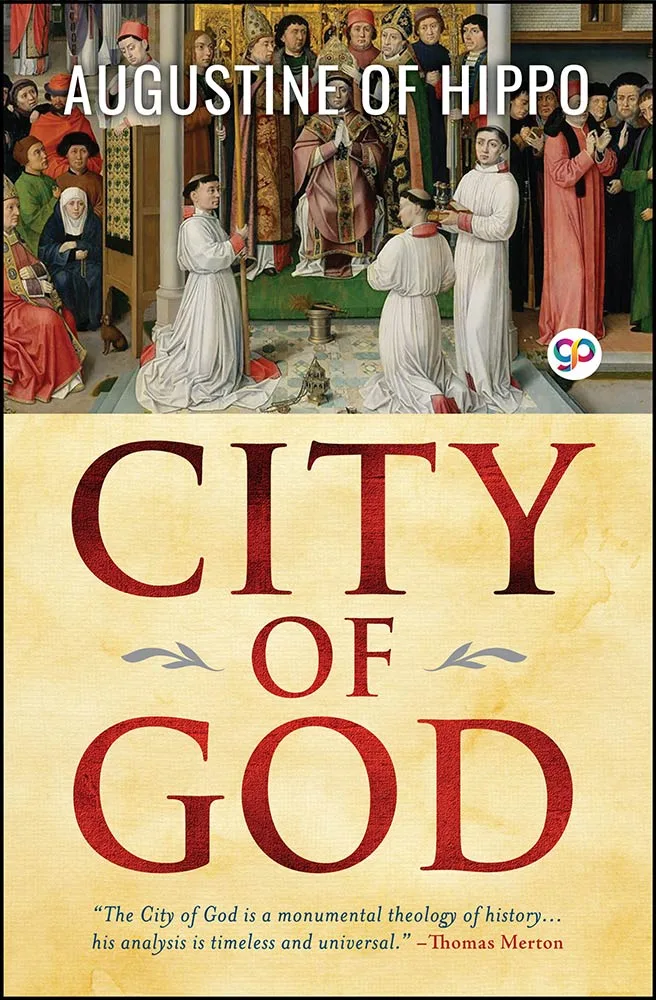
City of God
eBook
• INR 99.00
• English
• 9788196769765
No ratings yet
| Publisher | General Press |
|---|---|
| ISBN13 | 9788196769765 |
| ASIN/SKU | B0G1BL8VS7 |
| Book Format | eBook |
| Language | English |
| List Price | INR 99.00 |
| Subject Code | REL067000, REL015000, PHI022000 |
| Book Code | BD00069016 |
Buy this Book
Amazon Stores
Ebook Stores
Other Stores
Discover City of God by Augustine of Hippo. This book is published by General Press in eBook format, ISBN 9788196769765, ASIN B0G1BL8VS7, under Christian Books and Bibles, Christian Theology, Christianity.
Book Description
‘City of God’ is an extensive theological book, written in the early fifth century by Augustine of Hippo, the man who would go on to become a Doctor of the Church, offered a persuasive defense of Christianity at a time when it was being blamed for the horrific sack of Rome that had happened only a few years before. It describes a kind of citizenship that transcends the material, political, and egotistical, emphasizing a community of pious, God-centered, and grace-seeking people.
In assessing history through a sharply defined lens of good and evil, Augustine was effectively interpreting human behavior in light of eternity. He examines Greek philosophers such as Plato, the Bible, and paganism in addition to drawing striking comparisons between earthly and heavenly cities. This book is regarded as a founding work of Christianity and is still a potent Christian classic today, just as it inspired the people of the author's own time.
In assessing history through a sharply defined lens of good and evil, Augustine was effectively interpreting human behavior in light of eternity. He examines Greek philosophers such as Plato, the Bible, and paganism in addition to drawing striking comparisons between earthly and heavenly cities. This book is regarded as a founding work of Christianity and is still a potent Christian classic today, just as it inspired the people of the author's own time.
Author Biography
Early church father and philosopher Saint Augustine served from 396 as the bishop of Hippo in present-day Algeria and through such writings as the autobiographical Confessions in 397 and the voluminous City of God from 413 to 426 profoundly influenced Christianity, argued against Manichaeism and Donatism, and helped to establish the doctrine of original sin. An Augustinian follows the principles and doctrines of Saint Augustine.
People also know Aurelius Augustinus in English of Regius (Annaba). From the Africa province of the Roman Empire, people generally consider this Latin theologian of the greatest thinkers of all times. He very developed the west. According to Jerome, a contemporary, Augustine renewed "The Ancient Faith."
The Neo-Platonism of Plotinus afterward heavily weighed his years. After conversion and his baptism in 387, Augustine developed his own approach to theology and accommodated a variety of methods and different perspectives. He believed in the indispensable grace to human freedom and framed the concept of just war. When the Western Roman Empire started to disintegrate from the material earth, Augustine developed the concept of the distinct Catholic spirituality in a book of the same name. He thought the medieval worldview. Augustine closely identified with the community that worshiped the Trinity. The Catholics and the Anglican communion revere this preeminent doctor. Many Protestants, especially Calvinists, consider his due teaching on salvation and divine grace of the theology of the Reformation. The Eastern Orthodox also consider him. He carries the additional title of blessed. The Orthodox call him "Blessed Augustine" or "Saint Augustine the Blessed."
People also know Aurelius Augustinus in English of Regius (Annaba). From the Africa province of the Roman Empire, people generally consider this Latin theologian of the greatest thinkers of all times. He very developed the west. According to Jerome, a contemporary, Augustine renewed "The Ancient Faith."
The Neo-Platonism of Plotinus afterward heavily weighed his years. After conversion and his baptism in 387, Augustine developed his own approach to theology and accommodated a variety of methods and different perspectives. He believed in the indispensable grace to human freedom and framed the concept of just war. When the Western Roman Empire started to disintegrate from the material earth, Augustine developed the concept of the distinct Catholic spirituality in a book of the same name. He thought the medieval worldview. Augustine closely identified with the community that worshiped the Trinity. The Catholics and the Anglican communion revere this preeminent doctor. Many Protestants, especially Calvinists, consider his due teaching on salvation and divine grace of the theology of the Reformation. The Eastern Orthodox also consider him. He carries the additional title of blessed. The Orthodox call him "Blessed Augustine" or "Saint Augustine the Blessed."
Editorial Reviews
Editorial Reviews will be added soon…
Book Summary
Augustine of Hippo’s City of God is one of the most influential works in Christian philosophy and Western thought. Written in the early fifth century, the book is Augustine’s response to a profound historical and religious crisis: the sack of Rome in 410 CE. For centuries, Rome had been regarded as the great center of civilization and imperial power. When the city was attacked by the Visigoths, many people blamed Christianity. They argued that Rome had become weak because its traditional Roman gods were no longer properly worshipped. Augustine wrote The City of God partly to answer this accusation, but his purpose soon became much larger. He developed a sweeping vision of history, human nature, politics, morality, sin, salvation, and the ultimate destiny of humanity.
The title refers to two symbolic communities that Augustine calls the City of God and the earthly city. These are not simply two physical places. They represent two different orientations of human life. The City of God is formed by people whose deepest love is directed toward God, while the earthly city is characterized by people who ultimately love themselves and worldly power more than God. Augustine does not mean that every Christian institution belongs perfectly to one city or that every non-Christian person is simply evil. The two communities are spiritual and moral realities that exist alongside one another throughout human history.
The immediate issue that begins the work is the fall of Rome. Augustine first challenges the claim that Christianity caused Rome’s troubles. He points out that Rome had experienced disasters, wars, political corruption, and internal violence long before Christianity became influential. The traditional Roman gods had not protected the empire from suffering. Therefore, it is unreasonable to blame Christianity for the sack of the city.
Augustine also makes an important moral argument about the invasion itself. Although Rome suffered terrible violence, many people survived, including pagans. Christian churches sometimes served as places of refuge where people could escape killing. Augustine uses this fact to challenge the idea that Christianity had brought only destruction. He also argues that Christians should not measure the value of their faith by whether they enjoy uninterrupted worldly prosperity.
The first part of The City of God therefore examines the weakness of earthly power. Rome appeared permanent, but no political empire is permanent. Governments rise and fall, cities are destroyed, and rulers eventually die. Augustine does not deny the achievements of Rome. He recognizes its greatness, organization, military strength, and cultural influence. But he argues that political success cannot provide the ultimate security human beings seek.
This leads to one of the book’s deepest themes: the difference between earthly glory and lasting happiness. Human beings often pursue wealth, honor, status, political power, and reputation because they believe these things will make them secure. Yet all of them are temporary. Even the most powerful emperor cannot escape death.
Augustine then turns to the nature of the Roman gods and pagan religion. He argues that these gods were unable to provide true moral guidance or eternal salvation. The stories told about them often portray the gods as jealous, violent, deceptive, and sexually immoral. Augustine finds it contradictory that people would worship divine beings whose behavior would be condemned in ordinary human beings.
His criticism is not limited to religion. Augustine also examines Roman philosophy, especially the philosophical traditions that attempted to explain happiness and the good life. He respects certain philosophers, particularly Plato and thinkers influenced by Platonism, because they recognized that the human soul must seek something higher than material pleasure. Yet he ultimately argues that philosophy alone cannot provide the complete answer to humanity’s deepest problems.
The central problem, in Augustine’s understanding, is sin. Human beings were created good, but they possess disordered desires. They often love good things in the wrong way or place temporary goods above the highest good. Pride is especially important. Augustine sees pride as a fundamental form of rebellion because it turns the human being away from dependence on God and toward self-glorification.
This idea helps explain the contrast between the two cities. The City of God is characterized by love of God, humility, and a willingness to serve. The earthly city is characterized by amor sui—love of self carried to the point of rejecting the proper order of things. One city seeks glory in God; the other seeks glory in itself.
Augustine illustrates this contrast through the biblical story of Cain and Abel. Cain becomes an early symbol of the earthly city because his jealousy and self-centeredness lead him to murder his brother. Abel represents the pilgrim character of the City of God. The contrast demonstrates that the two cities are not simply political entities. They are patterns of love that appear throughout history.
Another major theme is the meaning of history. Before Augustine, history was often understood as a cycle in which civilizations repeatedly rose and declined. Augustine presents a more linear understanding. History has a beginning, a meaningful development, and an ultimate end. Creation begins with God, humanity falls into sin, redemption becomes possible through Christ, and history moves toward final judgment and the fulfillment of God’s purposes.
This gives history a moral and spiritual meaning. Events are not simply random repetitions. Human beings are living within a larger story whose final outcome cannot be understood solely by looking at political victories and defeats.
Augustine also discusses the role of the Christian Church. He does not claim that the Church is made up only of perfect people. The visible Christian community contains both good and bad individuals. The final separation between the righteous and the wicked belongs to God’s judgment. This idea becomes important because it prevents Christians from imagining that earthly institutions can ever become perfectly pure.
The later sections of the book turn toward the final destiny of humanity. Augustine discusses resurrection, judgment, eternal life, and eternal punishment. For him, death is not the final word. Human beings are ultimately destined for a resurrection in which body and soul are restored. The redeemed will enter the eternal City of God, where they will enjoy perfect peace and communion with God.
Peace is particularly important to Augustine. He recognizes that every human being desires peace, even when people pursue it through violence or domination. Political communities seek peace by maintaining order, families seek peace within relationships, and individuals seek peace within themselves. But earthly peace is incomplete because it can be destroyed by death, conflict, and human weakness. The perfect peace of the City of God is different because it is eternal and grounded in the right relationship between humanity and God.
Importantly, Augustine does not tell Christians to abandon the earthly world. People still have responsibilities toward their families, communities, and governments. Christians should contribute to society and seek earthly peace where possible. But they should not mistake political stability or material prosperity for ultimate salvation.
At its deepest level, City of God is therefore a book about what human beings love. Augustine suggests that our deepest loves determine the direction of our lives. If we make temporary things—wealth, power, reputation, pleasure, or political success—the center of our existence, disappointment is inevitable. If we orient ourselves toward what is eternal, our lives acquire a different purpose.
The enduring power of City of God comes from the way Augustine transforms a crisis in Roman history into a universal reflection on human existence. Rome falls, but Augustine asks a larger question: what, if anything, can never fall? His answer is that earthly civilizations are temporary, while the City of God represents an eternal community grounded in divine love.
Ultimately, Augustine’s message is not that the world is worthless. Rather, it is that the world is not enough. Human beings naturally seek permanence in things that cannot provide it. City of God invites readers to recognize the difference between temporary success and lasting happiness, between pride and humility, and between power over others and genuine peace. Its vision of history and human nature has shaped theology, philosophy, political thought, and Western ideas of civilization for centuries. Even for modern readers who do not share Augustine’s religious beliefs, the book remains a profound meditation on power, mortality, suffering, hope, and the question of what makes a human life truly meaningful.
The title refers to two symbolic communities that Augustine calls the City of God and the earthly city. These are not simply two physical places. They represent two different orientations of human life. The City of God is formed by people whose deepest love is directed toward God, while the earthly city is characterized by people who ultimately love themselves and worldly power more than God. Augustine does not mean that every Christian institution belongs perfectly to one city or that every non-Christian person is simply evil. The two communities are spiritual and moral realities that exist alongside one another throughout human history.
The immediate issue that begins the work is the fall of Rome. Augustine first challenges the claim that Christianity caused Rome’s troubles. He points out that Rome had experienced disasters, wars, political corruption, and internal violence long before Christianity became influential. The traditional Roman gods had not protected the empire from suffering. Therefore, it is unreasonable to blame Christianity for the sack of the city.
Augustine also makes an important moral argument about the invasion itself. Although Rome suffered terrible violence, many people survived, including pagans. Christian churches sometimes served as places of refuge where people could escape killing. Augustine uses this fact to challenge the idea that Christianity had brought only destruction. He also argues that Christians should not measure the value of their faith by whether they enjoy uninterrupted worldly prosperity.
The first part of The City of God therefore examines the weakness of earthly power. Rome appeared permanent, but no political empire is permanent. Governments rise and fall, cities are destroyed, and rulers eventually die. Augustine does not deny the achievements of Rome. He recognizes its greatness, organization, military strength, and cultural influence. But he argues that political success cannot provide the ultimate security human beings seek.
This leads to one of the book’s deepest themes: the difference between earthly glory and lasting happiness. Human beings often pursue wealth, honor, status, political power, and reputation because they believe these things will make them secure. Yet all of them are temporary. Even the most powerful emperor cannot escape death.
Augustine then turns to the nature of the Roman gods and pagan religion. He argues that these gods were unable to provide true moral guidance or eternal salvation. The stories told about them often portray the gods as jealous, violent, deceptive, and sexually immoral. Augustine finds it contradictory that people would worship divine beings whose behavior would be condemned in ordinary human beings.
His criticism is not limited to religion. Augustine also examines Roman philosophy, especially the philosophical traditions that attempted to explain happiness and the good life. He respects certain philosophers, particularly Plato and thinkers influenced by Platonism, because they recognized that the human soul must seek something higher than material pleasure. Yet he ultimately argues that philosophy alone cannot provide the complete answer to humanity’s deepest problems.
The central problem, in Augustine’s understanding, is sin. Human beings were created good, but they possess disordered desires. They often love good things in the wrong way or place temporary goods above the highest good. Pride is especially important. Augustine sees pride as a fundamental form of rebellion because it turns the human being away from dependence on God and toward self-glorification.
This idea helps explain the contrast between the two cities. The City of God is characterized by love of God, humility, and a willingness to serve. The earthly city is characterized by amor sui—love of self carried to the point of rejecting the proper order of things. One city seeks glory in God; the other seeks glory in itself.
Augustine illustrates this contrast through the biblical story of Cain and Abel. Cain becomes an early symbol of the earthly city because his jealousy and self-centeredness lead him to murder his brother. Abel represents the pilgrim character of the City of God. The contrast demonstrates that the two cities are not simply political entities. They are patterns of love that appear throughout history.
Another major theme is the meaning of history. Before Augustine, history was often understood as a cycle in which civilizations repeatedly rose and declined. Augustine presents a more linear understanding. History has a beginning, a meaningful development, and an ultimate end. Creation begins with God, humanity falls into sin, redemption becomes possible through Christ, and history moves toward final judgment and the fulfillment of God’s purposes.
This gives history a moral and spiritual meaning. Events are not simply random repetitions. Human beings are living within a larger story whose final outcome cannot be understood solely by looking at political victories and defeats.
Augustine also discusses the role of the Christian Church. He does not claim that the Church is made up only of perfect people. The visible Christian community contains both good and bad individuals. The final separation between the righteous and the wicked belongs to God’s judgment. This idea becomes important because it prevents Christians from imagining that earthly institutions can ever become perfectly pure.
The later sections of the book turn toward the final destiny of humanity. Augustine discusses resurrection, judgment, eternal life, and eternal punishment. For him, death is not the final word. Human beings are ultimately destined for a resurrection in which body and soul are restored. The redeemed will enter the eternal City of God, where they will enjoy perfect peace and communion with God.
Peace is particularly important to Augustine. He recognizes that every human being desires peace, even when people pursue it through violence or domination. Political communities seek peace by maintaining order, families seek peace within relationships, and individuals seek peace within themselves. But earthly peace is incomplete because it can be destroyed by death, conflict, and human weakness. The perfect peace of the City of God is different because it is eternal and grounded in the right relationship between humanity and God.
Importantly, Augustine does not tell Christians to abandon the earthly world. People still have responsibilities toward their families, communities, and governments. Christians should contribute to society and seek earthly peace where possible. But they should not mistake political stability or material prosperity for ultimate salvation.
At its deepest level, City of God is therefore a book about what human beings love. Augustine suggests that our deepest loves determine the direction of our lives. If we make temporary things—wealth, power, reputation, pleasure, or political success—the center of our existence, disappointment is inevitable. If we orient ourselves toward what is eternal, our lives acquire a different purpose.
The enduring power of City of God comes from the way Augustine transforms a crisis in Roman history into a universal reflection on human existence. Rome falls, but Augustine asks a larger question: what, if anything, can never fall? His answer is that earthly civilizations are temporary, while the City of God represents an eternal community grounded in divine love.
Ultimately, Augustine’s message is not that the world is worthless. Rather, it is that the world is not enough. Human beings naturally seek permanence in things that cannot provide it. City of God invites readers to recognize the difference between temporary success and lasting happiness, between pride and humility, and between power over others and genuine peace. Its vision of history and human nature has shaped theology, philosophy, political thought, and Western ideas of civilization for centuries. Even for modern readers who do not share Augustine’s religious beliefs, the book remains a profound meditation on power, mortality, suffering, hope, and the question of what makes a human life truly meaningful.
Sample Chapters
Sample Chapters will be added soon…
Reader Reviews
No reviews yet.
City of God