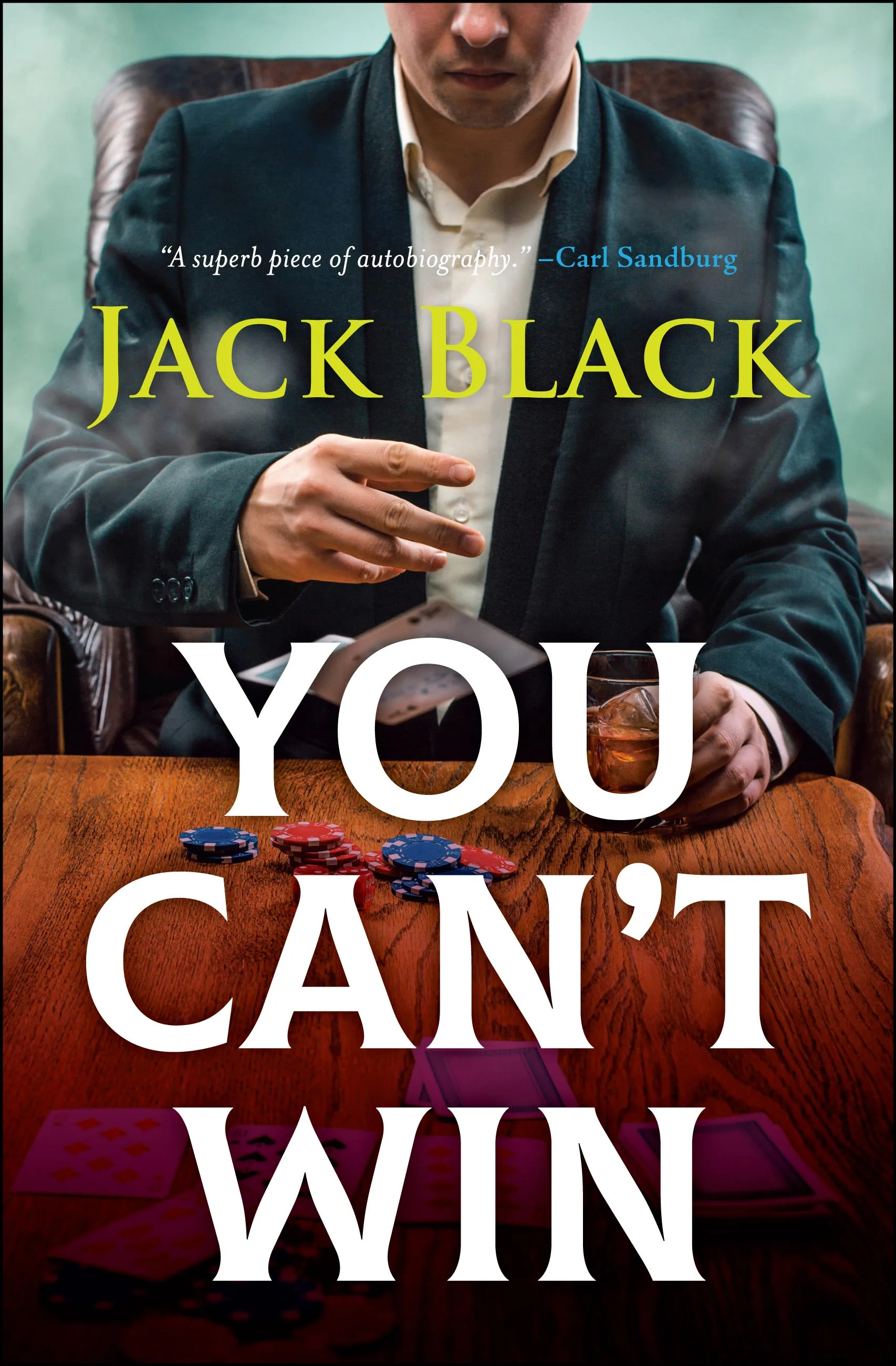
You Can't Win
eBook
• INR 99.00
• English
• 9789354991080
No ratings yet
| Publisher | General Press |
|---|---|
| ISBN13 | 9789354991080 |
| ASIN/SKU | B0BBRKKT3Z |
| Book Format | eBook |
| Language | English |
| List Price | INR 99.00 |
| Subject Code | JNF025170 |
| Publishing Date | 05/09/2022 |
| Book Code | BD00069045 |
Buy this Book
Amazon Stores
Ebook Stores
Other Stores
Discover You Can't Win by Jack Black. This book is published by General Press in eBook format, ISBN 9789354991080, ASIN B0BBRKKT3Z, under Biographies and Memoirs, Memoirs, Criminals and Outlaws.
Book Description
Originally published in 1926, ‘You Can't Win’ is an amazing autobiography of a criminal from a forgotten time in American history by Jack Black, a burglar, safe-cracker, highwayman, and petty thief.
The book recounts Black's adventures in the hobo underworld, freight-hopping around the western United States and Canada, with the bulk of incidents taking place from the late 1880s to around 1910. He narrates of becoming a thief, burglar, and member of the yegg (safe-cracking) subculture, exploring the topics of crime, criminal justice, vice, addictions, penology, and human folly from various viewpoints, from observer to consumer to supplier, and from victim to perpetrator.
It is a true lost masterpiece, one of the most legendary cult books ever published in America.
The book recounts Black's adventures in the hobo underworld, freight-hopping around the western United States and Canada, with the bulk of incidents taking place from the late 1880s to around 1910. He narrates of becoming a thief, burglar, and member of the yegg (safe-cracking) subculture, exploring the topics of crime, criminal justice, vice, addictions, penology, and human folly from various viewpoints, from observer to consumer to supplier, and from victim to perpetrator.
It is a true lost masterpiece, one of the most legendary cult books ever published in America.
Author Biography
Jack Black (1871-1932) was a hobo and professional burglar. Born in 1871 in New Westminster, British Columbia, [1] he was raised from infancy in the U.S. state of Missouri in the town of Maysville and eventually Kansas City. He wrote You Can't Win (Macmillan, 1926), a memoir or sketched autobiography describing his days on the road and life as an outlaw. Black's book was written as an anti-crime book urging criminals to go straight, but it is also his statement of belief in the futility of prisons and the criminal justice system, hence the title of the book.
Editorial Reviews
Editorial Reviews will be added soon…
Book Summary
Jack Black’s You Can’t Win, first published in 1926, is one of the most unusual autobiographies in American literature: part true-crime memoir, part hobo narrative, part prison autobiography, and part social critique. Black recounts roughly twenty-five years spent moving through the criminal underworld of the American and Canadian West, describing his experiences as a thief, burglar, safecracker, highwayman, hobo, prisoner, and opium user. The book grew out of Black’s life on the road and was originally serialized in the San Francisco Call-Bulletin before becoming a successful book. Yet You Can’t Win is much more than a collection of criminal adventures. Beneath its stories of robberies, freight trains, jails, saloons, gambling houses, opium dens, and encounters with other outcasts lies a deeper argument: the criminal life may appear to offer freedom, excitement, money, and independence, but eventually it traps the person who chooses it. The title itself expresses Black’s central philosophy. In the world he describes, the thief cannot truly win against society, the law, addiction, poverty, or eventually himself.
Black begins by looking back at the circumstances that shaped him. His childhood does not initially seem destined for a life of crime. He experiences conventional institutions and authority, but gradually becomes alienated from respectable society. The death of his mother and the instability that follows contribute to his movement toward the margins. Eventually, he encounters experienced criminals who introduce him to a completely different social world. Figures such as “The Smiler” become teachers of survival, crime, and the unwritten rules of the underworld. Rather than presenting criminality as something purely monstrous, Black shows how a young and restless person can be drawn into it almost naturally when the people around him provide an alternative set of values. The criminal world has its own hierarchy, language, loyalties, professions, and moral standards. A young man who might feel like an outsider in ordinary society can suddenly find belonging among people who understand his restlessness.
This transformation is one of the most important parts of the You Can’t Win story. Black does not portray himself as an innocent victim who was simply forced into crime. He accepts responsibility for his choices, but he also asks readers to consider the social environment surrounding those choices. His memoir repeatedly shows how poverty, homelessness, institutional punishment, addiction, and the absence of meaningful opportunities can reinforce one another. The result is a cycle that becomes increasingly difficult to escape. Once Black learns how to steal, travel, hide, deceive, and survive outside conventional society, ordinary life begins to feel less natural. The road becomes an alternative home, and the people living on the road become his community.
A major attraction of the book is its vivid portrait of the American hobo underworld. Black travels by freight train, moves through railroad towns, sleeps in improvised camps, works intermittently, begs when necessary, and associates with people who live outside stable employment and permanent homes. His descriptions preserve a vanished world of early twentieth-century America, when the railroads provided a vast network through which hoboes, workers, criminals, drifters, gamblers, and adventurers could move across the country. Historians and literary critics have noted that this mobile population included many different kinds of outsiders, from itinerant laborers to petty criminals and people escaping conventional social expectations. Black's experiences therefore become more than personal memories; they offer a firsthand window into a forgotten American subculture.
Within this world, Black gradually becomes part of the “yegg” brotherhood, the criminal subculture associated particularly with professional burglary and safecracking. His criminal adventures are among the book's most memorable episodes. He describes the planning of thefts, the personalities of criminals, the dangers of being caught, and the relationships among people who depend upon one another while simultaneously competing for money and status. Black understands that criminals are not automatically united by friendship. Their world contains trust and betrayal, loyalty and selfishness, courage and cowardice. The criminal code can sometimes demand more loyalty than respectable society does, yet violating that code can have serious consequences.
This creates one of the memoir’s most fascinating contradictions. Black repeatedly demonstrates that criminals can possess qualities such as loyalty, courage, generosity, and personal honor. Some of the people he meets are criminals by occupation but have strict rules about informing on their associates or exploiting their friends. At the same time, respectable institutions are not necessarily presented as morally superior. Judges, guards, police officers, prison officials, and other representatives of authority can be cruel, indifferent, corrupt, or simply trapped inside a system that values punishment more than rehabilitation. Black therefore refuses to divide the world neatly into good citizens and bad criminals. His experiences lead him toward a much more complicated understanding of morality.
Prison becomes central to this argument. Black spends years moving through jails, prisons, workhouses, and other institutions. The book describes confinement not simply as a punishment for crime but as an environment that can actually strengthen criminal identities. He remembers solitary confinement, harsh discipline, physical abuse, forced labor, deprivation, and the psychological effects of imprisonment. The publisher's description of the original memoir emphasizes Black's experiences with county jails, city prisons, penitentiaries, solitary confinement, floggings, and other brutal forms of punishment. His conclusion is devastating: if the purpose of prison is to turn criminals into responsible citizens, the system frequently fails.
One reason You Can’t Win remains powerful is that Black does not write about prison as an abstract political issue. He writes about it as someone who has lived inside the system. He knows the boredom, fear, humiliation, violence, and strange social structures of confinement. He also understands how prisoners develop their own communities and strategies for survival. Prison becomes another version of the criminal world, except that the rules are imposed from above rather than created collectively by the people living outside the law. This leads Black to question whether punishment alone can ever produce genuine moral change.
Another major thread in You Can’t Win is addiction, especially Black's experience with opium. His involvement with drugs takes him into another hidden society, populated by addicts, dealers, prostitutes, gamblers, and other marginalized people. His descriptions of opium dens and drug culture are not simply sensational. Addiction gradually changes the meaning of freedom. At first, the road seems to represent independence: Black can go wherever he wants, take risks, earn money, and escape conventional responsibilities. But addiction introduces a new form of captivity. The man who believes he has escaped society discovers that he is now controlled by his own desires.
This tension between freedom and imprisonment runs through the entire book. Black is constantly moving because movement feels like freedom. He avoids permanent commitments, crosses borders, changes occupations, and disappears into new communities. But the more he runs from one form of authority, poverty, or responsibility, the more he becomes trapped in another. The road provides freedom from one set of rules while exposing him to hunger, violence, loneliness, addiction, arrest, and uncertainty. His life becomes a paradox: he is physically free much of the time but psychologically and economically constrained.
Black's storytelling style makes these difficult subjects unusually readable. He does not present himself as a heroic outlaw or tragic romantic figure. Instead, he often writes with dry humor and an understated tone. The original publisher's description emphasizes that he intends to tell his experiences as he encountered them, “with a smile.” That attitude is important because it prevents the memoir from becoming either self-pitying or moralistic. Black has experienced terrible things, committed serious crimes, and suffered harsh punishment, but he is able to look backward with irony and perspective.
The deeper meaning of You Can’t Win emerges as Black begins to understand the cumulative consequences of his choices. Crime produces money, excitement, and status for a time, but it also creates fear and instability. Every successful theft contains the possibility of arrest. Every new friendship may conceal betrayal. Every escape can be followed by another imprisonment. Every indulgence can become an addiction. Every period of freedom can lead back to the same destructive patterns. Black's title is therefore not merely pessimistic. It is his summary of the entire criminal equation: even when the criminal appears to succeed, the larger system eventually collects its price.
Importantly, Black's message is not simply “crime is bad.” That would make the book much less interesting. Instead, he explores why crime can become attractive and why people remain in it even when they understand its dangers. Criminal society offers identity, belonging, adventure, money, and a sense of personal competence. For someone who feels rejected by conventional society, these rewards can be powerful. Black's own life demonstrates that reform requires more than punishment. A person must actually want another kind of existence and find a realistic way to build it.
This is where the book becomes a story of transformation. Black gradually develops a desire to escape the life he has spent decades building. His intellectual development matters here. During imprisonment, access to books and education helps awaken interests that exist beyond the criminal world. A well-run prison and a good library, for example, become unexpectedly important in his development. The contrast is revealing: constructive opportunities can influence a person in ways that punishment cannot. Knowledge gives Black another identity, one not dependent upon criminal achievement.
Eventually, Black moves toward a different life and becomes connected with journalism and prison reform. His experiences give him a perspective that outsiders could not easily possess. He has been both offender and victim, prisoner and observer, addict and critic, participant and eventual reformer. This unusual position gives You Can’t Win its authority. Black is not preaching about a world he has never seen. He is trying to explain a world he knows intimately and from which he is attempting to emerge.
The book also has considerable literary importance. Although it remained relatively obscure for long periods, You Can’t Win became especially influential among later writers of countercultural and Beat literature. William S. Burroughs regarded it as a major influence and drew heavily on its atmosphere and subject matter when developing his own writing. Black's combination of outsider experience, drug culture, criminal life, wandering, and unsentimental observation anticipated themes that would become central to later American underground literature.
Ultimately, the best way to understand You Can’t Win is as a memoir about the search for freedom and the discovery that freedom without direction can become another kind of prison. Jack Black's life is filled with movement, but movement does not necessarily mean progress. He crosses borders but repeatedly returns to the same destructive patterns. He escapes prisons but carries other forms of imprisonment with him. He earns money but cannot achieve lasting security. He develops a reputation among criminals but discovers that such status has little value outside the underworld. His eventual desire for change gives the memoir its emotional center.
As a book summary of You Can’t Win by Jack Black, the central lesson can therefore be expressed simply: a life built around crime, addiction, and constant escape eventually defeats the person who lives it. But Black's memoir is also a compassionate examination of the people caught inside that life. It asks readers to look beyond labels such as “criminal,” “hobo,” “addict,” or “prisoner” and consider the human being underneath them. His story is simultaneously a true crime autobiography, outlaw memoir, hobo narrative, prison memoir, and American counterculture classic. It is historically valuable because it documents a vanished criminal and hobo subculture; psychologically compelling because it examines addiction, belonging, and self-destruction; and philosophically important because it questions whether punishment alone can change human behavior. First published in 1926, You Can’t Win remains striking precisely because Jack Black refuses to romanticize his past while also refusing to pretend that criminals are less than human. His final insight is bleak but ultimately constructive: if the game itself is designed so that nobody can truly win, the only meaningful victory may be finding the courage to stop playing.
Black begins by looking back at the circumstances that shaped him. His childhood does not initially seem destined for a life of crime. He experiences conventional institutions and authority, but gradually becomes alienated from respectable society. The death of his mother and the instability that follows contribute to his movement toward the margins. Eventually, he encounters experienced criminals who introduce him to a completely different social world. Figures such as “The Smiler” become teachers of survival, crime, and the unwritten rules of the underworld. Rather than presenting criminality as something purely monstrous, Black shows how a young and restless person can be drawn into it almost naturally when the people around him provide an alternative set of values. The criminal world has its own hierarchy, language, loyalties, professions, and moral standards. A young man who might feel like an outsider in ordinary society can suddenly find belonging among people who understand his restlessness.
This transformation is one of the most important parts of the You Can’t Win story. Black does not portray himself as an innocent victim who was simply forced into crime. He accepts responsibility for his choices, but he also asks readers to consider the social environment surrounding those choices. His memoir repeatedly shows how poverty, homelessness, institutional punishment, addiction, and the absence of meaningful opportunities can reinforce one another. The result is a cycle that becomes increasingly difficult to escape. Once Black learns how to steal, travel, hide, deceive, and survive outside conventional society, ordinary life begins to feel less natural. The road becomes an alternative home, and the people living on the road become his community.
A major attraction of the book is its vivid portrait of the American hobo underworld. Black travels by freight train, moves through railroad towns, sleeps in improvised camps, works intermittently, begs when necessary, and associates with people who live outside stable employment and permanent homes. His descriptions preserve a vanished world of early twentieth-century America, when the railroads provided a vast network through which hoboes, workers, criminals, drifters, gamblers, and adventurers could move across the country. Historians and literary critics have noted that this mobile population included many different kinds of outsiders, from itinerant laborers to petty criminals and people escaping conventional social expectations. Black's experiences therefore become more than personal memories; they offer a firsthand window into a forgotten American subculture.
Within this world, Black gradually becomes part of the “yegg” brotherhood, the criminal subculture associated particularly with professional burglary and safecracking. His criminal adventures are among the book's most memorable episodes. He describes the planning of thefts, the personalities of criminals, the dangers of being caught, and the relationships among people who depend upon one another while simultaneously competing for money and status. Black understands that criminals are not automatically united by friendship. Their world contains trust and betrayal, loyalty and selfishness, courage and cowardice. The criminal code can sometimes demand more loyalty than respectable society does, yet violating that code can have serious consequences.
This creates one of the memoir’s most fascinating contradictions. Black repeatedly demonstrates that criminals can possess qualities such as loyalty, courage, generosity, and personal honor. Some of the people he meets are criminals by occupation but have strict rules about informing on their associates or exploiting their friends. At the same time, respectable institutions are not necessarily presented as morally superior. Judges, guards, police officers, prison officials, and other representatives of authority can be cruel, indifferent, corrupt, or simply trapped inside a system that values punishment more than rehabilitation. Black therefore refuses to divide the world neatly into good citizens and bad criminals. His experiences lead him toward a much more complicated understanding of morality.
Prison becomes central to this argument. Black spends years moving through jails, prisons, workhouses, and other institutions. The book describes confinement not simply as a punishment for crime but as an environment that can actually strengthen criminal identities. He remembers solitary confinement, harsh discipline, physical abuse, forced labor, deprivation, and the psychological effects of imprisonment. The publisher's description of the original memoir emphasizes Black's experiences with county jails, city prisons, penitentiaries, solitary confinement, floggings, and other brutal forms of punishment. His conclusion is devastating: if the purpose of prison is to turn criminals into responsible citizens, the system frequently fails.
One reason You Can’t Win remains powerful is that Black does not write about prison as an abstract political issue. He writes about it as someone who has lived inside the system. He knows the boredom, fear, humiliation, violence, and strange social structures of confinement. He also understands how prisoners develop their own communities and strategies for survival. Prison becomes another version of the criminal world, except that the rules are imposed from above rather than created collectively by the people living outside the law. This leads Black to question whether punishment alone can ever produce genuine moral change.
Another major thread in You Can’t Win is addiction, especially Black's experience with opium. His involvement with drugs takes him into another hidden society, populated by addicts, dealers, prostitutes, gamblers, and other marginalized people. His descriptions of opium dens and drug culture are not simply sensational. Addiction gradually changes the meaning of freedom. At first, the road seems to represent independence: Black can go wherever he wants, take risks, earn money, and escape conventional responsibilities. But addiction introduces a new form of captivity. The man who believes he has escaped society discovers that he is now controlled by his own desires.
This tension between freedom and imprisonment runs through the entire book. Black is constantly moving because movement feels like freedom. He avoids permanent commitments, crosses borders, changes occupations, and disappears into new communities. But the more he runs from one form of authority, poverty, or responsibility, the more he becomes trapped in another. The road provides freedom from one set of rules while exposing him to hunger, violence, loneliness, addiction, arrest, and uncertainty. His life becomes a paradox: he is physically free much of the time but psychologically and economically constrained.
Black's storytelling style makes these difficult subjects unusually readable. He does not present himself as a heroic outlaw or tragic romantic figure. Instead, he often writes with dry humor and an understated tone. The original publisher's description emphasizes that he intends to tell his experiences as he encountered them, “with a smile.” That attitude is important because it prevents the memoir from becoming either self-pitying or moralistic. Black has experienced terrible things, committed serious crimes, and suffered harsh punishment, but he is able to look backward with irony and perspective.
The deeper meaning of You Can’t Win emerges as Black begins to understand the cumulative consequences of his choices. Crime produces money, excitement, and status for a time, but it also creates fear and instability. Every successful theft contains the possibility of arrest. Every new friendship may conceal betrayal. Every escape can be followed by another imprisonment. Every indulgence can become an addiction. Every period of freedom can lead back to the same destructive patterns. Black's title is therefore not merely pessimistic. It is his summary of the entire criminal equation: even when the criminal appears to succeed, the larger system eventually collects its price.
Importantly, Black's message is not simply “crime is bad.” That would make the book much less interesting. Instead, he explores why crime can become attractive and why people remain in it even when they understand its dangers. Criminal society offers identity, belonging, adventure, money, and a sense of personal competence. For someone who feels rejected by conventional society, these rewards can be powerful. Black's own life demonstrates that reform requires more than punishment. A person must actually want another kind of existence and find a realistic way to build it.
This is where the book becomes a story of transformation. Black gradually develops a desire to escape the life he has spent decades building. His intellectual development matters here. During imprisonment, access to books and education helps awaken interests that exist beyond the criminal world. A well-run prison and a good library, for example, become unexpectedly important in his development. The contrast is revealing: constructive opportunities can influence a person in ways that punishment cannot. Knowledge gives Black another identity, one not dependent upon criminal achievement.
Eventually, Black moves toward a different life and becomes connected with journalism and prison reform. His experiences give him a perspective that outsiders could not easily possess. He has been both offender and victim, prisoner and observer, addict and critic, participant and eventual reformer. This unusual position gives You Can’t Win its authority. Black is not preaching about a world he has never seen. He is trying to explain a world he knows intimately and from which he is attempting to emerge.
The book also has considerable literary importance. Although it remained relatively obscure for long periods, You Can’t Win became especially influential among later writers of countercultural and Beat literature. William S. Burroughs regarded it as a major influence and drew heavily on its atmosphere and subject matter when developing his own writing. Black's combination of outsider experience, drug culture, criminal life, wandering, and unsentimental observation anticipated themes that would become central to later American underground literature.
Ultimately, the best way to understand You Can’t Win is as a memoir about the search for freedom and the discovery that freedom without direction can become another kind of prison. Jack Black's life is filled with movement, but movement does not necessarily mean progress. He crosses borders but repeatedly returns to the same destructive patterns. He escapes prisons but carries other forms of imprisonment with him. He earns money but cannot achieve lasting security. He develops a reputation among criminals but discovers that such status has little value outside the underworld. His eventual desire for change gives the memoir its emotional center.
As a book summary of You Can’t Win by Jack Black, the central lesson can therefore be expressed simply: a life built around crime, addiction, and constant escape eventually defeats the person who lives it. But Black's memoir is also a compassionate examination of the people caught inside that life. It asks readers to look beyond labels such as “criminal,” “hobo,” “addict,” or “prisoner” and consider the human being underneath them. His story is simultaneously a true crime autobiography, outlaw memoir, hobo narrative, prison memoir, and American counterculture classic. It is historically valuable because it documents a vanished criminal and hobo subculture; psychologically compelling because it examines addiction, belonging, and self-destruction; and philosophically important because it questions whether punishment alone can change human behavior. First published in 1926, You Can’t Win remains striking precisely because Jack Black refuses to romanticize his past while also refusing to pretend that criminals are less than human. His final insight is bleak but ultimately constructive: if the game itself is designed so that nobody can truly win, the only meaningful victory may be finding the courage to stop playing.
Sample Chapters
Sample Chapters will be added soon…
Reader Reviews
No reviews yet.
You Can't Win