
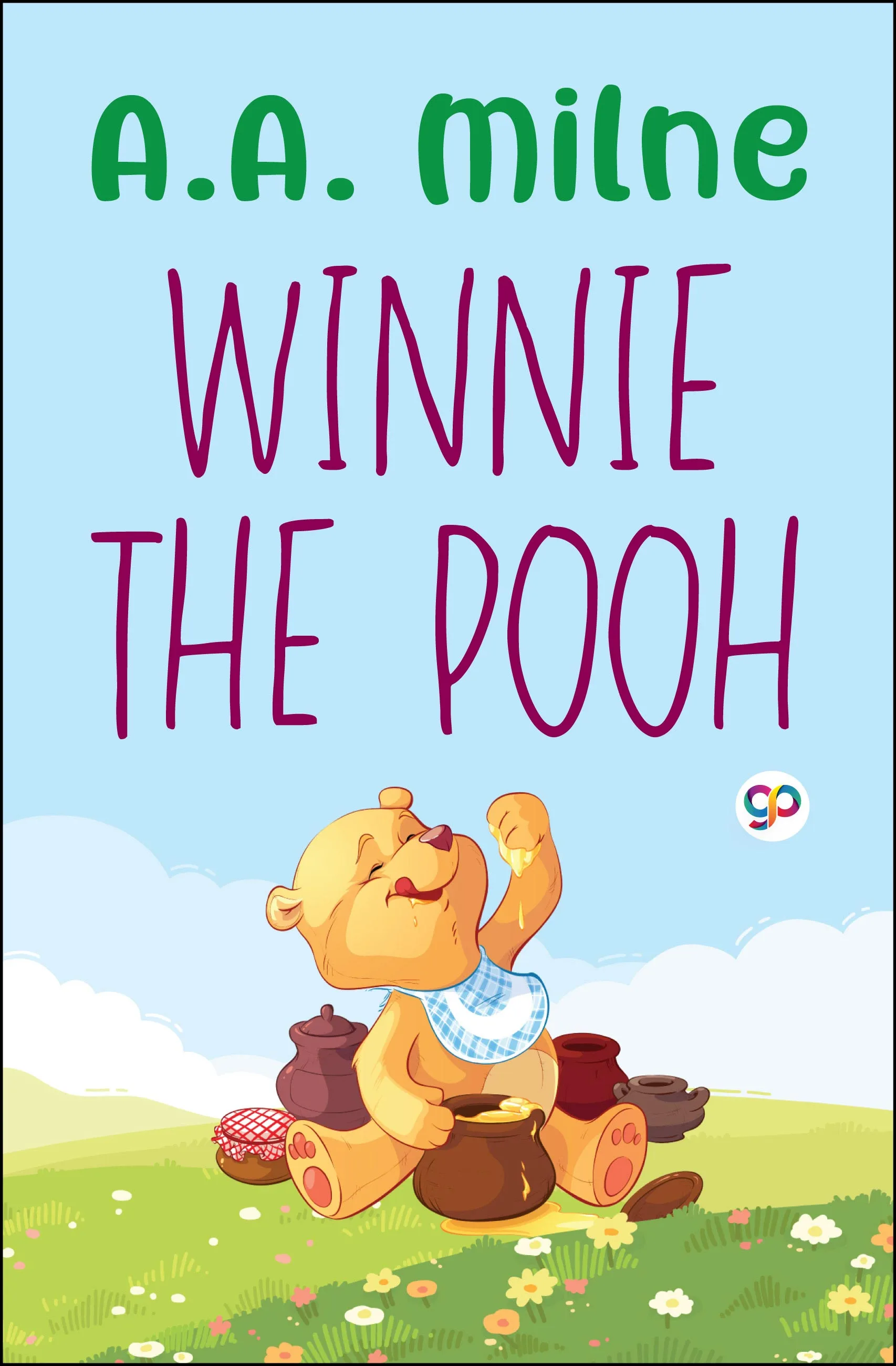
Winnie-the-Pooh
eBook
• 176 Pages
• INR 51.00
• English
• 9789354994289
No ratings yet
| Publisher | General Press |
|---|---|
| ISBN13 | 9789354994289 |
| ASIN/SKU | B0BBRKQKM5 |
| Book Format | eBook |
| Language | English |
| Pages | 176 |
| List Price | INR 51.00 |
| Subject Code | JUV012030, JUV022000, JUV007000, JUV002340 |
| Publishing Date | 05/09/2022 |
| Book Code | BD00069048 |
Buy this Book
Amazon Stores
Ebook Stores
Other Stores
Discover Winnie-the-Pooh by A.A. Milne. This book is published by General Press in eBook format, ISBN 9789354994289, ASIN B0BBRKQKM5, under Children's Books, Children's Classics.
Book Description
What happens when an ordinary little boy steps into a world where a bear with a serious weakness for honey, a gloomy donkey, a timid pig, and a lively tiger can become the most important friends imaginable? 'Winnie-the-Pooh' by A.A. Milne is a beloved children’s fiction classic that brings together gentle humor, imaginative adventures, and the simple joys of friendship. Set in the enchanting Hundred Acre Wood, the book follows Christopher Robin and his collection of unforgettable animal companions as they turn everyday moments into charming adventures.
At the heart of the story is Winnie-the-Pooh, a lovable bear whose thoughts are often delightfully muddled but whose heart is always in the right place. Pooh’s constant search for honey leads him into one amusing situation after another, while his friendships with Piglet, Eeyore, Rabbit, Owl, Kanga, Roo, and Tigger create a warm and wonderfully varied community. Each character has a distinct personality, from Piglet’s nervous courage and Eeyore’s melancholy outlook to Rabbit’s organized nature and Christopher Robin’s steady kindness. Their differences often cause confusion, but they also show how friendship can bring together people who see the world in completely different ways.
Rather than relying on grand heroic quests, Milne finds magic in small events: visiting a friend, solving a problem, celebrating together, getting lost, or simply wondering about an important question. The stories gently explore loyalty, bravery, imagination, kindness, and the value of being there for someone when they need you. Beneath the playful dialogue and whimsical situations is a tender understanding of childhood and the powerful imaginative world that children create around themselves.
Warm, funny, thoughtful, and filled with characters who have remained beloved for generations, 'Winnie-the-Pooh' is much more than a children’s book. It is an invitation to slow down and rediscover the wonder hidden in ordinary days. Step into the Hundred Acre Wood, and you may find that its smallest adventures have something surprisingly memorable to say.
At the heart of the story is Winnie-the-Pooh, a lovable bear whose thoughts are often delightfully muddled but whose heart is always in the right place. Pooh’s constant search for honey leads him into one amusing situation after another, while his friendships with Piglet, Eeyore, Rabbit, Owl, Kanga, Roo, and Tigger create a warm and wonderfully varied community. Each character has a distinct personality, from Piglet’s nervous courage and Eeyore’s melancholy outlook to Rabbit’s organized nature and Christopher Robin’s steady kindness. Their differences often cause confusion, but they also show how friendship can bring together people who see the world in completely different ways.
Rather than relying on grand heroic quests, Milne finds magic in small events: visiting a friend, solving a problem, celebrating together, getting lost, or simply wondering about an important question. The stories gently explore loyalty, bravery, imagination, kindness, and the value of being there for someone when they need you. Beneath the playful dialogue and whimsical situations is a tender understanding of childhood and the powerful imaginative world that children create around themselves.
Warm, funny, thoughtful, and filled with characters who have remained beloved for generations, 'Winnie-the-Pooh' is much more than a children’s book. It is an invitation to slow down and rediscover the wonder hidden in ordinary days. Step into the Hundred Acre Wood, and you may find that its smallest adventures have something surprisingly memorable to say.
Author Biography
Alan Alexander Milne (pronounced /ˈmɪln/) was an English author, best known for his books about the teddy bear Winnie-the-Pooh and for various children's poems.
A. A. Milne was born in Kilburn, London, to parents Vince Milne and Sarah Marie Milne (née Heginbotham) and grew up at Henley House School, 6/7 Mortimer Road (now Crescent), Kilburn, a small public school run by his father. One of his teachers was H. G. Wells who taught there in 1889–90. Milne attended Westminster School and Trinity College, Cambridge, where he studied on a mathematics scholarship. While there, he edited and wrote for Granta, a student magazine. He collaborated with his brother Kenneth and their articles appeared over the initials AKM. Milne's work came to the attention of the leading British humour magazine Punch, where Milne was to become a contributor and later an assistant editor. Milne joined the British Army in World War I and served as an officer in the Royal Warwickshire Regiment and later, after a debilitating illness, the Royal Corps of Signals. He was discharged on February 14, 1919.
After the war, he wrote a denunciation of war titled Peace with Honour (1934), which he retracted somewhat with 1940's War with Honour. During World War II, Milne was one of the most prominent critics of English writer P. G. Wodehouse, who was captured at his country home in France by the Nazis and imprisoned for a year. Wodehouse made radio broadcasts about his internment, which were broadcast from Berlin. Although the light-hearted broadcasts made fun of the Germans, Milne accused Wodehouse of committing an act of near treason by cooperating with his country's enemy. Wodehouse got some revenge on his former friend by creating fatuous parodies of the Christopher Robin poems in some of his later stories, and claiming that Milne "was probably jealous of all other writers.... But I loved his stuff."
He married Dorothy "Daphne" de Sélincourt in 1913, and their only son, Christopher Robin Milne, was born in 1920. In 1925, A. A. Milne bought a country home, Cotchford Farm, in Hartfield, East Sussex. During World War II, A. A. Milne was Captain of the Home Guard in Hartfield & Forest Row, insisting on being plain 'Mr. Milne' to the members of his platoon. He retired to the farm after a stroke and brain surgery in 1952 left him an invalid and by August 1953 "he seemed very old and disenchanted". He was 74 years old when he passed away in 1956.
A. A. Milne was born in Kilburn, London, to parents Vince Milne and Sarah Marie Milne (née Heginbotham) and grew up at Henley House School, 6/7 Mortimer Road (now Crescent), Kilburn, a small public school run by his father. One of his teachers was H. G. Wells who taught there in 1889–90. Milne attended Westminster School and Trinity College, Cambridge, where he studied on a mathematics scholarship. While there, he edited and wrote for Granta, a student magazine. He collaborated with his brother Kenneth and their articles appeared over the initials AKM. Milne's work came to the attention of the leading British humour magazine Punch, where Milne was to become a contributor and later an assistant editor. Milne joined the British Army in World War I and served as an officer in the Royal Warwickshire Regiment and later, after a debilitating illness, the Royal Corps of Signals. He was discharged on February 14, 1919.
After the war, he wrote a denunciation of war titled Peace with Honour (1934), which he retracted somewhat with 1940's War with Honour. During World War II, Milne was one of the most prominent critics of English writer P. G. Wodehouse, who was captured at his country home in France by the Nazis and imprisoned for a year. Wodehouse made radio broadcasts about his internment, which were broadcast from Berlin. Although the light-hearted broadcasts made fun of the Germans, Milne accused Wodehouse of committing an act of near treason by cooperating with his country's enemy. Wodehouse got some revenge on his former friend by creating fatuous parodies of the Christopher Robin poems in some of his later stories, and claiming that Milne "was probably jealous of all other writers.... But I loved his stuff."
He married Dorothy "Daphne" de Sélincourt in 1913, and their only son, Christopher Robin Milne, was born in 1920. In 1925, A. A. Milne bought a country home, Cotchford Farm, in Hartfield, East Sussex. During World War II, A. A. Milne was Captain of the Home Guard in Hartfield & Forest Row, insisting on being plain 'Mr. Milne' to the members of his platoon. He retired to the farm after a stroke and brain surgery in 1952 left him an invalid and by August 1953 "he seemed very old and disenchanted". He was 74 years old when he passed away in 1956.
Editorial Reviews
Editorial Reviews will be added soon…
Book Summary
Winnie-the-Pooh is one of the world's most beloved collections of children's stories, first published in 1926. Set in the enchanting Hundred Acre Wood, the book follows the gentle adventures of Winnie-the-Pooh, a kind-hearted bear with an endless love for honey, and his close friends. Although the stories are simple and playful on the surface, they offer timeless reflections on friendship, kindness, imagination, courage, and the quiet joys of everyday life.
The stories revolve around a memorable group of characters, each with a unique personality. Winnie-the-Pooh is cheerful, thoughtful in his own unhurried way, and always willing to help a friend, even if his plans do not always work out perfectly. His innocent curiosity and optimistic outlook make him a comforting and lovable companion.
Pooh's closest human friend is Christopher Robin, whose calm wisdom and gentle encouragement often help guide the group through their adventures. Christopher Robin represents the warmth and imagination of childhood, treating every creature in the forest with patience, respect, and affection.
The Hundred Acre Wood is home to several unforgettable companions. Piglet is small and timid but consistently proves that courage is not the absence of fear but the willingness to help despite it. Rabbit is practical, organized, and fond of making plans, though his confidence sometimes leads him into amusing situations. Eeyore, the thoughtful donkey, often expects the worst, yet his friends never abandon him, demonstrating the importance of compassion and acceptance. Owl enjoys sharing his knowledge, while Kanga and her energetic son Roo bring warmth, care, and family life into the woodland community.
Rather than following one continuous plot, the book is made up of individual adventures that celebrate ordinary moments. A search for honey, a misunderstanding between friends, an unexpected visitor, or a small act of kindness can become the center of an entire story. Milne shows that everyday experiences often contain the greatest opportunities for laughter, learning, and connection.
Friendship lies at the heart of the collection. The characters are very different from one another, and their personalities sometimes lead to disagreements or confusion. Yet they accept each other's strengths and weaknesses without judgment. They celebrate successes together, offer comfort during disappointments, and remain loyal even when mistakes are made. Their friendships are built not on perfection but on patience, forgiveness, and genuine affection.
Another important theme is imagination. The Hundred Acre Wood transforms ordinary places into landscapes filled with adventure and possibility. Small discoveries become exciting quests, and familiar surroundings become magical through the eyes of curious children and imaginative friends. Milne reminds readers that imagination enriches life by encouraging creativity, wonder, and playful exploration.
The book also gently explores the meaning of courage. Characters such as Piglet frequently feel frightened, yet they continue to support their friends when needed. Milne suggests that bravery is not measured by size, strength, or confidence but by kindness and determination. Even the smallest individual can make an important difference through acts of loyalty and compassion.
Humor is another defining feature of the stories. Much of the comedy comes from Pooh's innocent misunderstandings, Rabbit's careful planning, Owl's elaborate explanations, and the unexpected outcomes of simple situations. The humor is warm rather than mocking, inviting readers to laugh with the characters instead of at them. Milne's playful language, gentle irony, and charming dialogue make the stories enjoyable for both children and adults.
Beneath the lighthearted adventures lies a deeper appreciation for emotional intelligence. The characters experience happiness, worry, excitement, disappointment, and uncertainty, yet they face these feelings together. Friends listen, encourage one another, and offer reassurance without trying to change who anyone is. This acceptance gives the stories their lasting emotional appeal.
Nature also plays a central role in the collection. The forests, streams, trees, and changing seasons provide a peaceful setting where adventures unfold naturally. The woodland environment encourages curiosity and reminds readers to appreciate the beauty found in simple surroundings. Rather than rushing from one event to another, the stories invite readers to slow down and notice life's quiet pleasures.
One of the reasons Winnie-the-Pooh has remained popular across generations is its ability to speak to readers of all ages. Children delight in the amusing adventures and lovable characters, while adults often discover gentle wisdom hidden within the conversations and friendships. The stories celebrate qualities such as patience, humility, gratitude, and loyalty—virtues that remain meaningful throughout life.
Milne's writing style is elegant yet remarkably accessible. His prose combines warmth, humor, and poetic simplicity, allowing profound ideas to emerge naturally through ordinary conversations and playful situations. The stories never preach or force lessons upon readers. Instead, they allow kindness, understanding, and friendship to reveal their own value through the characters' actions.
Ultimately, Winnie-the-Pooh is far more than a collection of children's stories. It is a celebration of friendship, imagination, and the simple moments that make life meaningful. Through the gentle adventures of Pooh and his companions, A. A. Milne reminds readers that true happiness is often found not in extraordinary achievements but in shared laughter, loyal friendships, quiet acts of kindness, and the comforting knowledge that we are never alone when we have friends who care for us.
The stories revolve around a memorable group of characters, each with a unique personality. Winnie-the-Pooh is cheerful, thoughtful in his own unhurried way, and always willing to help a friend, even if his plans do not always work out perfectly. His innocent curiosity and optimistic outlook make him a comforting and lovable companion.
Pooh's closest human friend is Christopher Robin, whose calm wisdom and gentle encouragement often help guide the group through their adventures. Christopher Robin represents the warmth and imagination of childhood, treating every creature in the forest with patience, respect, and affection.
The Hundred Acre Wood is home to several unforgettable companions. Piglet is small and timid but consistently proves that courage is not the absence of fear but the willingness to help despite it. Rabbit is practical, organized, and fond of making plans, though his confidence sometimes leads him into amusing situations. Eeyore, the thoughtful donkey, often expects the worst, yet his friends never abandon him, demonstrating the importance of compassion and acceptance. Owl enjoys sharing his knowledge, while Kanga and her energetic son Roo bring warmth, care, and family life into the woodland community.
Rather than following one continuous plot, the book is made up of individual adventures that celebrate ordinary moments. A search for honey, a misunderstanding between friends, an unexpected visitor, or a small act of kindness can become the center of an entire story. Milne shows that everyday experiences often contain the greatest opportunities for laughter, learning, and connection.
Friendship lies at the heart of the collection. The characters are very different from one another, and their personalities sometimes lead to disagreements or confusion. Yet they accept each other's strengths and weaknesses without judgment. They celebrate successes together, offer comfort during disappointments, and remain loyal even when mistakes are made. Their friendships are built not on perfection but on patience, forgiveness, and genuine affection.
Another important theme is imagination. The Hundred Acre Wood transforms ordinary places into landscapes filled with adventure and possibility. Small discoveries become exciting quests, and familiar surroundings become magical through the eyes of curious children and imaginative friends. Milne reminds readers that imagination enriches life by encouraging creativity, wonder, and playful exploration.
The book also gently explores the meaning of courage. Characters such as Piglet frequently feel frightened, yet they continue to support their friends when needed. Milne suggests that bravery is not measured by size, strength, or confidence but by kindness and determination. Even the smallest individual can make an important difference through acts of loyalty and compassion.
Humor is another defining feature of the stories. Much of the comedy comes from Pooh's innocent misunderstandings, Rabbit's careful planning, Owl's elaborate explanations, and the unexpected outcomes of simple situations. The humor is warm rather than mocking, inviting readers to laugh with the characters instead of at them. Milne's playful language, gentle irony, and charming dialogue make the stories enjoyable for both children and adults.
Beneath the lighthearted adventures lies a deeper appreciation for emotional intelligence. The characters experience happiness, worry, excitement, disappointment, and uncertainty, yet they face these feelings together. Friends listen, encourage one another, and offer reassurance without trying to change who anyone is. This acceptance gives the stories their lasting emotional appeal.
Nature also plays a central role in the collection. The forests, streams, trees, and changing seasons provide a peaceful setting where adventures unfold naturally. The woodland environment encourages curiosity and reminds readers to appreciate the beauty found in simple surroundings. Rather than rushing from one event to another, the stories invite readers to slow down and notice life's quiet pleasures.
One of the reasons Winnie-the-Pooh has remained popular across generations is its ability to speak to readers of all ages. Children delight in the amusing adventures and lovable characters, while adults often discover gentle wisdom hidden within the conversations and friendships. The stories celebrate qualities such as patience, humility, gratitude, and loyalty—virtues that remain meaningful throughout life.
Milne's writing style is elegant yet remarkably accessible. His prose combines warmth, humor, and poetic simplicity, allowing profound ideas to emerge naturally through ordinary conversations and playful situations. The stories never preach or force lessons upon readers. Instead, they allow kindness, understanding, and friendship to reveal their own value through the characters' actions.
Ultimately, Winnie-the-Pooh is far more than a collection of children's stories. It is a celebration of friendship, imagination, and the simple moments that make life meaningful. Through the gentle adventures of Pooh and his companions, A. A. Milne reminds readers that true happiness is often found not in extraordinary achievements but in shared laughter, loyal friendships, quiet acts of kindness, and the comforting knowledge that we are never alone when we have friends who care for us.
Sample Chapters
Chapter 1 : In which we are Introduced to Winnie-The-Pooh and some Bees, and the Stories Begin
Here is Edward Bear, coming downstairs now, bump, bump, bump, on the back of his head, behind Christopher Robin. It is, as far as he knows, the only way of coming downstairs, but sometimes he feels that there really is another way, if only he could stop bumping for a moment and think of it. And then he feels that perhaps there isn’t. Anyhow, here he is at the bottom, and ready to be introduced to you. Winnie-the-Pooh.
When I first heard his name, I said, just as you are going to say, “But I thought he was a boy?”
“So did I,” said Christopher Robin.
“Then you can’t call him Winnie?”
“I don’t.”
“But you said——”
“He’s Winnie-ther-Pooh. Don’t you know what ‘ther’ means?”
“Ah, yes, now I do,” I said quickly; and I hope you do too, because it is all the explanation you are going to get.
Sometimes Winnie-the-Pooh likes a game of some sort when he comes downstairs, and sometimes he likes to sit quietly in front of the fire and listen to a story. This evening——
“What about a story?” said Christopher Robin.
“What about a story?” I said.
“Could you very sweetly tell Winnie-the-Pooh one?”
“I suppose I could,” I said. “What sort of stories does he like?”
“About himself. Because he’s that sort of Bear.”
“Oh, I see.”
“So could you very sweetly?”
“I’ll try,” I said.
So I tried.
* * *
Once upon a time, a very long time ago now, about last Friday, Winnie-the-Pooh lived in a forest all by himself under the name of Sanders.
(“What does ‘under the name’ mean?” asked Christopher Robin.
“It means he had the name over the door in gold letters, and lived under it.”
“Winnie-the-Pooh wasn’t quite sure,” said Christopher Robin.
“Now I am,” said a growly voice.
“Then I will go on,” said I.)
One day when he was out walking, he came to an open place in the middle of the forest, and in the middle of this place was a large oak-tree, and, from the top of the tree, there came a loud buzzing-noise.
Winnie-the-Pooh sat down at the foot of the tree, put his head between his paws and began to think.
First of all he said to himself: “That buzzing-noise means something. You don’t get a buzzing-noise like that, just buzzing and buzzing, without its meaning something. If there’s a buzzing-noise, somebody’s making a buzzing-noise, and the only reason for making a buzzing-noise that I know of is because you’re a bee.”
Then he thought another long time, and said: “And the only reason for being a bee that I know of is making honey.”
And then he got up, and said: “And the only reason for making honey is so as I can eat it.” So he began to climb the tree.
He climbed and he climbed and he climbed, and as he climbed he sang a little song to himself. It went like this:
Isn’t it funny
How a bear likes honey?
Buzz! Buzz! Buzz!
I wonder why he does?
Then he climbed a little further... and a little further... and then just a little further. By that time he had thought of another song.
It’s a very funny thought that, if Bears were Bees,
They’d build their nests at the bottom of trees.
And that being so (if the Bees were Bears),
We shouldn’t have to climb up all these stairs.
He was getting rather tired by this time, so that is why he sang a Complaining Song. He was nearly there now, and if he just stood on that branch...
Crack!
“Oh, help!” said Pooh, as he dropped ten feet on the branch below him.
“If only I hadn’t——” he said, as he bounced twenty feet on to the next branch.
“You see, what I meant to do,” he explained, as he turned head-over-heels, and crashed on to another branch thirty feet below, “what I meant to do——”
“Of course, it was rather——” he admitted, as he slithered very quickly through the next six branches.
“It all comes, I suppose,” he decided, as he said good-bye to the last branch, spun round three times, and flew gracefully into a gorse-bush, “it all comes of liking honey so much. Oh, help!”
He crawled out of the gorse-bush, brushed the prickles from his nose, and began to think again. And the first person he thought of was Christopher Robin.
(“Was that me?” said Christopher Robin in an awed voice, hardly daring to believe it.
“That was you.”
Christopher Robin said nothing, but his eyes got larger and larger, and his face got pinker and pinker.)
So Winnie-the-Pooh went round to his friend Christopher Robin, who lived behind a green door in another part of the forest.
“Good morning, Christopher Robin,” he said.
“Good morning, Winnie-ther-Pooh,” said you.
“I wonder if you’ve got such a thing as a balloon about you?”
“A balloon?”
“Yes, I just said to myself coming along: ‘I wonder if Christopher Robin has such a thing as a balloon about him?’ I just said it to myself, thinking of balloons, and wondering.”
“What do you want a balloon for?” you said.
Winnie-the-Pooh looked round to see that nobody was listening, put his paw to his mouth, and said in a deep whisper: “Honey!”
“But you don’t get honey with balloons!”
“I do,” said Pooh.
Well, it just happened that you had been to a party the day before at the house of your friend Piglet, and you had balloons at the party. You had had a big green balloon; and one of Rabbit’s relations had had a big blue one, and had left it behind, being really too young to go to a party at all; and so you had brought the green one and the blue one home with you.
“Which one would you like?” you asked Pooh.
He put his head between his paws and thought very carefully.
“It’s like this,” he said. “When you go after honey with a balloon, the great thing is not to let the bees know you’re coming. Now, if you have a green balloon, they might think you were only part of the tree, and not notice you, and, if you have a blue balloon, they might think you were only part of the sky, and not notice you, and the question is: Which is most likely?”
“Wouldn’t they notice you underneath the balloon?” you asked.
“They might or they might not,” said Winnie-the-Pooh. “You never can tell with bees.” He thought for a moment and said: “I shall try to look like a small black cloud. That will deceive them.”
“Then you had better have the blue balloon,” you said; and so it was decided.
Well, you both went out with the blue balloon, and you took your gun with you, just in case, as you always did, and Winnie-the-Pooh went to a very muddy place that he knew of, and rolled and rolled until he was black all over; and then, when the balloon was blown up as big as big, and you and Pooh were both holding on to the string, you let go suddenly, and Pooh Bear floated gracefully up into the sky, and stayed there—level with the top of the tree and about twenty feet away from it.
“Hooray!” you shouted.
“Isn’t that fine?” shouted Winnie-the-Pooh down to you. “What do I look like?”
“You look like a Bear holding on to a balloon,” you said.
“Not,” said Pooh anxiously, “—not like a small black cloud in a blue sky?”
“Not very much.”
“Ah, well, perhaps from up here it looks different. And, as I say, you never can tell with bees.”
There was no wind to blow him nearer to the tree, so there he stayed. He could see the honey, he could smell the honey, but he couldn’t quite reach the honey.
After a little while he called down to you.
“Christopher Robin!” he said in a loud whisper.
“Hallo!”
“I think the bees suspect something!”
“What sort of thing?”
“I don’t know. But something tells me that they’re suspicious!”
“Perhaps they think that you’re after their honey.”
“It may be that. You never can tell with bees.”
There was another little silence, and then he called down to you again.
“Christopher Robin!”
“Yes?”
“Have you an umbrella in your house?”
“I think so.”
“I wish you would bring it out here, and walk up and down with it, and look up at me every now and then, and say ‘Tut-tut, it looks like rain.’ I think, if you did that, it would help the deception which we are practising on these bees.”
Well, you laughed to yourself, “Silly old Bear!” but you didn’t say it aloud because you were so fond of him, and you went home for your umbrella.
“Oh, there you are!” called down Winnie-the-Pooh, as soon as you got back to the tree. “I was beginning to get anxious. I have discovered that the bees are now definitely Suspicious.”
“Shall I put my umbrella up?” you said.
“Yes, but wait a moment. We must be practical. The important bee to deceive is the Queen Bee. Can you see which is the Queen Bee from down there?”
“No.”
“A pity. Well, now, if you walk up and down with your umbrella, saying, ‘Tut-tut, it looks like rain,’ I shall do what I can by singing a little Cloud Song, such as a cloud might sing... Go!”
So, while you walked up and down and wondered if it would rain, Winnie-the-Pooh sang this song:
How sweet to be a Cloud
Floating in the Blue!
Every little cloud
Always sings aloud.
“How sweet to be a Cloud
Floating in the Blue!”
It makes him very proud
To be a little cloud.
The bees were still buzzing as suspiciously as ever. Some of them, indeed, left their nests and flew all round the cloud as it began the second verse of this song, and one bee sat down on the nose of the cloud for a moment, and then got up again.
“Christopher—ow!—Robin,” called out the cloud.
“Yes?”
“I have just been thinking, and I have come to a very important decision. These are the wrong sort of bees.”
“Are they?”
“Quite the wrong sort. So I should think they would make the wrong sort of honey, shouldn’t you?”
“Would they?”
“Yes. So I think I shall come down.”
“How?” asked you.
Winnie-the-Pooh hadn’t thought about this. If he let go of the string, he would fall—bump—and he didn’t like the idea of that. So he thought for a long time, and then he said:
“Christopher Robin, you must shoot the balloon with your gun. Have you got your gun?”
“Of course I have,” you said. “But if I do that, it will spoil the balloon,” you said.
“But if you don’t,” said Pooh, “I shall have to let go, and that would spoil me.”
When he put it like this, you saw how it was, and you aimed very carefully at the balloon, and fired.
“Ow!” said Pooh.
“Did I miss?” you asked.
“You didn’t exactly miss,” said Pooh, “but you missed the balloon.”
“I’m so sorry,” you said, and you fired again, and this time you hit the balloon, and the air came slowly out, and Winnie-the-Pooh floated down to the ground.
But his arms were so stiff from holding on to the string of the balloon all that time that they stayed up straight in the air for more than a week, and whenever a fly came and settled on his nose he had to blow it off. And I think—but I am not sure—that that is why he was always called Pooh.
“Is that the end of the story?” asked Christopher Robin.
“That’s the end of that one. There are others.”
“About Pooh and Me?”
“And Piglet and Rabbit and all of you. Don’t you remember?”
“I do remember, and then when I try to remember, I forget.”
“That day when Pooh and Piglet tried to catch the Heffalump——”
“They didn’t catch it, did they?”
“No.”
“Pooh couldn’t, because he hasn’t any brain. Did I catch it?”
“Well, that comes into the story.”
Christopher Robin nodded.
“I do remember,” he said, “only Pooh doesn’t very well, so that’s why he likes having it told to him again. Because then it’s a real story and not just a remembering.”
“That’s just how I feel,” I said.
Christopher Robin gave a deep sigh, picked his Bear up by the leg, and walked off to the door, trailing Pooh behind him. At the door he turned and said, “Coming to see me have my bath?”
“I might,” I said.
“I didn’t hurt him when I shot him, did I?”
“Not a bit.”
He nodded and went out, and in a moment I heard Winnie-the-Pooh—bump, bump, bump—going up the stairs behind him.
Here is Edward Bear, coming downstairs now, bump, bump, bump, on the back of his head, behind Christopher Robin. It is, as far as he knows, the only way of coming downstairs, but sometimes he feels that there really is another way, if only he could stop bumping for a moment and think of it. And then he feels that perhaps there isn’t. Anyhow, here he is at the bottom, and ready to be introduced to you. Winnie-the-Pooh.
When I first heard his name, I said, just as you are going to say, “But I thought he was a boy?”
“So did I,” said Christopher Robin.
“Then you can’t call him Winnie?”
“I don’t.”
“But you said——”
“He’s Winnie-ther-Pooh. Don’t you know what ‘ther’ means?”
“Ah, yes, now I do,” I said quickly; and I hope you do too, because it is all the explanation you are going to get.
Sometimes Winnie-the-Pooh likes a game of some sort when he comes downstairs, and sometimes he likes to sit quietly in front of the fire and listen to a story. This evening——
“What about a story?” said Christopher Robin.
“What about a story?” I said.
“Could you very sweetly tell Winnie-the-Pooh one?”
“I suppose I could,” I said. “What sort of stories does he like?”
“About himself. Because he’s that sort of Bear.”
“Oh, I see.”
“So could you very sweetly?”
“I’ll try,” I said.
So I tried.
* * *
Once upon a time, a very long time ago now, about last Friday, Winnie-the-Pooh lived in a forest all by himself under the name of Sanders.
(“What does ‘under the name’ mean?” asked Christopher Robin.
“It means he had the name over the door in gold letters, and lived under it.”
“Winnie-the-Pooh wasn’t quite sure,” said Christopher Robin.
“Now I am,” said a growly voice.
“Then I will go on,” said I.)
One day when he was out walking, he came to an open place in the middle of the forest, and in the middle of this place was a large oak-tree, and, from the top of the tree, there came a loud buzzing-noise.
Winnie-the-Pooh sat down at the foot of the tree, put his head between his paws and began to think.
First of all he said to himself: “That buzzing-noise means something. You don’t get a buzzing-noise like that, just buzzing and buzzing, without its meaning something. If there’s a buzzing-noise, somebody’s making a buzzing-noise, and the only reason for making a buzzing-noise that I know of is because you’re a bee.”
Then he thought another long time, and said: “And the only reason for being a bee that I know of is making honey.”
And then he got up, and said: “And the only reason for making honey is so as I can eat it.” So he began to climb the tree.
He climbed and he climbed and he climbed, and as he climbed he sang a little song to himself. It went like this:
Isn’t it funny
How a bear likes honey?
Buzz! Buzz! Buzz!
I wonder why he does?
Then he climbed a little further... and a little further... and then just a little further. By that time he had thought of another song.
It’s a very funny thought that, if Bears were Bees,
They’d build their nests at the bottom of trees.
And that being so (if the Bees were Bears),
We shouldn’t have to climb up all these stairs.
He was getting rather tired by this time, so that is why he sang a Complaining Song. He was nearly there now, and if he just stood on that branch...
Crack!
“Oh, help!” said Pooh, as he dropped ten feet on the branch below him.
“If only I hadn’t——” he said, as he bounced twenty feet on to the next branch.
“You see, what I meant to do,” he explained, as he turned head-over-heels, and crashed on to another branch thirty feet below, “what I meant to do——”
“Of course, it was rather——” he admitted, as he slithered very quickly through the next six branches.
“It all comes, I suppose,” he decided, as he said good-bye to the last branch, spun round three times, and flew gracefully into a gorse-bush, “it all comes of liking honey so much. Oh, help!”
He crawled out of the gorse-bush, brushed the prickles from his nose, and began to think again. And the first person he thought of was Christopher Robin.
(“Was that me?” said Christopher Robin in an awed voice, hardly daring to believe it.
“That was you.”
Christopher Robin said nothing, but his eyes got larger and larger, and his face got pinker and pinker.)
So Winnie-the-Pooh went round to his friend Christopher Robin, who lived behind a green door in another part of the forest.
“Good morning, Christopher Robin,” he said.
“Good morning, Winnie-ther-Pooh,” said you.
“I wonder if you’ve got such a thing as a balloon about you?”
“A balloon?”
“Yes, I just said to myself coming along: ‘I wonder if Christopher Robin has such a thing as a balloon about him?’ I just said it to myself, thinking of balloons, and wondering.”
“What do you want a balloon for?” you said.
Winnie-the-Pooh looked round to see that nobody was listening, put his paw to his mouth, and said in a deep whisper: “Honey!”
“But you don’t get honey with balloons!”
“I do,” said Pooh.
Well, it just happened that you had been to a party the day before at the house of your friend Piglet, and you had balloons at the party. You had had a big green balloon; and one of Rabbit’s relations had had a big blue one, and had left it behind, being really too young to go to a party at all; and so you had brought the green one and the blue one home with you.
“Which one would you like?” you asked Pooh.
He put his head between his paws and thought very carefully.
“It’s like this,” he said. “When you go after honey with a balloon, the great thing is not to let the bees know you’re coming. Now, if you have a green balloon, they might think you were only part of the tree, and not notice you, and, if you have a blue balloon, they might think you were only part of the sky, and not notice you, and the question is: Which is most likely?”
“Wouldn’t they notice you underneath the balloon?” you asked.
“They might or they might not,” said Winnie-the-Pooh. “You never can tell with bees.” He thought for a moment and said: “I shall try to look like a small black cloud. That will deceive them.”
“Then you had better have the blue balloon,” you said; and so it was decided.
Well, you both went out with the blue balloon, and you took your gun with you, just in case, as you always did, and Winnie-the-Pooh went to a very muddy place that he knew of, and rolled and rolled until he was black all over; and then, when the balloon was blown up as big as big, and you and Pooh were both holding on to the string, you let go suddenly, and Pooh Bear floated gracefully up into the sky, and stayed there—level with the top of the tree and about twenty feet away from it.
“Hooray!” you shouted.
“Isn’t that fine?” shouted Winnie-the-Pooh down to you. “What do I look like?”
“You look like a Bear holding on to a balloon,” you said.
“Not,” said Pooh anxiously, “—not like a small black cloud in a blue sky?”
“Not very much.”
“Ah, well, perhaps from up here it looks different. And, as I say, you never can tell with bees.”
There was no wind to blow him nearer to the tree, so there he stayed. He could see the honey, he could smell the honey, but he couldn’t quite reach the honey.
After a little while he called down to you.
“Christopher Robin!” he said in a loud whisper.
“Hallo!”
“I think the bees suspect something!”
“What sort of thing?”
“I don’t know. But something tells me that they’re suspicious!”
“Perhaps they think that you’re after their honey.”
“It may be that. You never can tell with bees.”
There was another little silence, and then he called down to you again.
“Christopher Robin!”
“Yes?”
“Have you an umbrella in your house?”
“I think so.”
“I wish you would bring it out here, and walk up and down with it, and look up at me every now and then, and say ‘Tut-tut, it looks like rain.’ I think, if you did that, it would help the deception which we are practising on these bees.”
Well, you laughed to yourself, “Silly old Bear!” but you didn’t say it aloud because you were so fond of him, and you went home for your umbrella.
“Oh, there you are!” called down Winnie-the-Pooh, as soon as you got back to the tree. “I was beginning to get anxious. I have discovered that the bees are now definitely Suspicious.”
“Shall I put my umbrella up?” you said.
“Yes, but wait a moment. We must be practical. The important bee to deceive is the Queen Bee. Can you see which is the Queen Bee from down there?”
“No.”
“A pity. Well, now, if you walk up and down with your umbrella, saying, ‘Tut-tut, it looks like rain,’ I shall do what I can by singing a little Cloud Song, such as a cloud might sing... Go!”
So, while you walked up and down and wondered if it would rain, Winnie-the-Pooh sang this song:
How sweet to be a Cloud
Floating in the Blue!
Every little cloud
Always sings aloud.
“How sweet to be a Cloud
Floating in the Blue!”
It makes him very proud
To be a little cloud.
The bees were still buzzing as suspiciously as ever. Some of them, indeed, left their nests and flew all round the cloud as it began the second verse of this song, and one bee sat down on the nose of the cloud for a moment, and then got up again.
“Christopher—ow!—Robin,” called out the cloud.
“Yes?”
“I have just been thinking, and I have come to a very important decision. These are the wrong sort of bees.”
“Are they?”
“Quite the wrong sort. So I should think they would make the wrong sort of honey, shouldn’t you?”
“Would they?”
“Yes. So I think I shall come down.”
“How?” asked you.
Winnie-the-Pooh hadn’t thought about this. If he let go of the string, he would fall—bump—and he didn’t like the idea of that. So he thought for a long time, and then he said:
“Christopher Robin, you must shoot the balloon with your gun. Have you got your gun?”
“Of course I have,” you said. “But if I do that, it will spoil the balloon,” you said.
“But if you don’t,” said Pooh, “I shall have to let go, and that would spoil me.”
When he put it like this, you saw how it was, and you aimed very carefully at the balloon, and fired.
“Ow!” said Pooh.
“Did I miss?” you asked.
“You didn’t exactly miss,” said Pooh, “but you missed the balloon.”
“I’m so sorry,” you said, and you fired again, and this time you hit the balloon, and the air came slowly out, and Winnie-the-Pooh floated down to the ground.
But his arms were so stiff from holding on to the string of the balloon all that time that they stayed up straight in the air for more than a week, and whenever a fly came and settled on his nose he had to blow it off. And I think—but I am not sure—that that is why he was always called Pooh.
“Is that the end of the story?” asked Christopher Robin.
“That’s the end of that one. There are others.”
“About Pooh and Me?”
“And Piglet and Rabbit and all of you. Don’t you remember?”
“I do remember, and then when I try to remember, I forget.”
“That day when Pooh and Piglet tried to catch the Heffalump——”
“They didn’t catch it, did they?”
“No.”
“Pooh couldn’t, because he hasn’t any brain. Did I catch it?”
“Well, that comes into the story.”
Christopher Robin nodded.
“I do remember,” he said, “only Pooh doesn’t very well, so that’s why he likes having it told to him again. Because then it’s a real story and not just a remembering.”
“That’s just how I feel,” I said.
Christopher Robin gave a deep sigh, picked his Bear up by the leg, and walked off to the door, trailing Pooh behind him. At the door he turned and said, “Coming to see me have my bath?”
“I might,” I said.
“I didn’t hurt him when I shot him, did I?”
“Not a bit.”
He nodded and went out, and in a moment I heard Winnie-the-Pooh—bump, bump, bump—going up the stairs behind him.
Reader Reviews
No reviews yet.
Winnie-the-Pooh
Download Cover Image
Do you want to download the full cover image for Winnie-the-Pooh?