
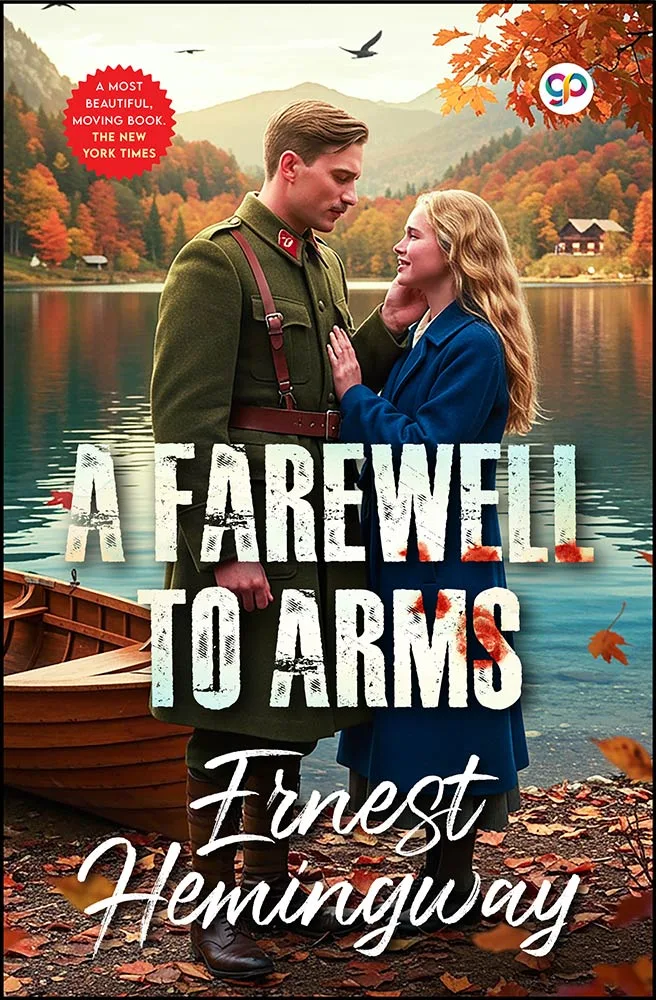
A Farewell to Arms
eBook
• INR 51.00
• English
• 9788198854865
No ratings yet
| Publisher | General Press |
|---|---|
| ISBN13 | 9788198854865 |
| ASIN/SKU | B0G1BQY8ZP |
| Book Format | eBook |
| Language | English |
| List Price | INR 51.00 |
| Subject Code | FIC014000, FIC004000, FIC027050 |
| Book Code | BD00069067 |
Buy this Book
Amazon Stores
Ebook Stores
Other Stores
Discover A Farewell to Arms by Ernest Hemingway. This book is published by General Press in eBook format, ISBN 9788198854865, ASIN B0G1BQY8ZP, under Literature and Fiction, Historical Fiction.
Book Description
"A most beautiful, moving and human book." —Vita Sackville-West
"A novel of rare intensity and truth, as powerful now as it was upon its release." —Literary Review
First published in 1929, A Farewell to Arms is one of Ernest Hemingway’s most powerful and enduring works. Hemingway, renowned for his crisp, economical prose and understated emotional depth, was a leading figure of 20th-century American literature. His distinctive writing style, often called the "iceberg theory," conveys deep emotion through simple, restrained language.
Set during World War I, the novel follows Frederic Henry, an American ambulance driver in the Italian army, as he falls in love with a British nurse, Catherine Barkley. Against the brutal backdrop of war, their romance blossoms, offering a fragile refuge from the chaos surrounding them. But as the war intensifies and circumstances unravel, their love is tested in heartbreaking ways.
A Farewell to Arms is both a stark anti-war novel and a deeply human story of love, loss, and resilience. Hemingway draws on his own wartime experiences to create a narrative that is at once intimate and universal. The novel’s raw honesty, emotional restraint, and haunting conclusion have secured its place as a literary classic. With themes that resonate across generations, Hemingway’s masterpiece continues to captivate readers with its beauty, simplicity, and profound emotional impact.
"A novel of rare intensity and truth, as powerful now as it was upon its release." —Literary Review
First published in 1929, A Farewell to Arms is one of Ernest Hemingway’s most powerful and enduring works. Hemingway, renowned for his crisp, economical prose and understated emotional depth, was a leading figure of 20th-century American literature. His distinctive writing style, often called the "iceberg theory," conveys deep emotion through simple, restrained language.
Set during World War I, the novel follows Frederic Henry, an American ambulance driver in the Italian army, as he falls in love with a British nurse, Catherine Barkley. Against the brutal backdrop of war, their romance blossoms, offering a fragile refuge from the chaos surrounding them. But as the war intensifies and circumstances unravel, their love is tested in heartbreaking ways.
A Farewell to Arms is both a stark anti-war novel and a deeply human story of love, loss, and resilience. Hemingway draws on his own wartime experiences to create a narrative that is at once intimate and universal. The novel’s raw honesty, emotional restraint, and haunting conclusion have secured its place as a literary classic. With themes that resonate across generations, Hemingway’s masterpiece continues to captivate readers with its beauty, simplicity, and profound emotional impact.
Author Biography
Ernest Miller Hemingway (1899–1961) was a legendary American novelist, short-story writer, and journalist whose economical, understated prose style profoundly influenced 20th-century fiction. Born in Oak Park, Illinois, Hemingway began his career as a reporter before volunteering as an ambulance driver in Italy during World War I. He was severely wounded and returned home, a traumatic but formative experience that heavily informed his early fiction, particularly his acclaimed 1929 novel A Farewell to Arms.
In the 1920s, Hemingway moved to Paris, where he became a central figure in the "Lost Generation" of expatriate artists and writers, associating with luminaries like F. Scott Fitzgerald and Gertrude Stein. During this period, he published his breakthrough debut novel, The Sun Also Rises (1926), which perfectly captured the post-war disillusionment of his peers. Hemingway's writing was famously characterized by his "iceberg theory"—a minimalist approach where the underlying meaning and emotion are implied rather than explicitly stated. His thirst for adventure frequently mirrored the rugged lives of his characters; he passionately pursued bullfighting, deep-sea fishing, and big-game hunting. He later covered the Spanish Civil War as a journalist, an experience that inspired his 1940 masterpiece For Whom the Bell Tolls.
Hemingway’s later years were marked by a tumultuous personal life, failing physical health, and enduring literary triumph. In 1952, he published The Old Man and the Sea, a short, powerful novel about an aging Cuban fisherman's epic battle with a giant marlin. The book earned him the Pulitzer Prize for Fiction in 1953 and was instrumental in his winning the Nobel Prize in Literature in 1954. Despite his immense global success, Hemingway struggled with severe depression in his final years. He tragically took his own life in Ketchum, Idaho, in 1961, leaving behind a monumental legacy that forever reshaped modern literature.
In the 1920s, Hemingway moved to Paris, where he became a central figure in the "Lost Generation" of expatriate artists and writers, associating with luminaries like F. Scott Fitzgerald and Gertrude Stein. During this period, he published his breakthrough debut novel, The Sun Also Rises (1926), which perfectly captured the post-war disillusionment of his peers. Hemingway's writing was famously characterized by his "iceberg theory"—a minimalist approach where the underlying meaning and emotion are implied rather than explicitly stated. His thirst for adventure frequently mirrored the rugged lives of his characters; he passionately pursued bullfighting, deep-sea fishing, and big-game hunting. He later covered the Spanish Civil War as a journalist, an experience that inspired his 1940 masterpiece For Whom the Bell Tolls.
Hemingway’s later years were marked by a tumultuous personal life, failing physical health, and enduring literary triumph. In 1952, he published The Old Man and the Sea, a short, powerful novel about an aging Cuban fisherman's epic battle with a giant marlin. The book earned him the Pulitzer Prize for Fiction in 1953 and was instrumental in his winning the Nobel Prize in Literature in 1954. Despite his immense global success, Hemingway struggled with severe depression in his final years. He tragically took his own life in Ketchum, Idaho, in 1961, leaving behind a monumental legacy that forever reshaped modern literature.
Editorial Reviews
Editorial Reviews will be added soon…
Book Summary
Book Summary will be added soon…
Sample Chapters
Sample Chapters will be added soon…
Reader Reviews
No reviews yet.
A Farewell to Arms
Download Cover Image
Do you want to download the full cover image for A Farewell to Arms?