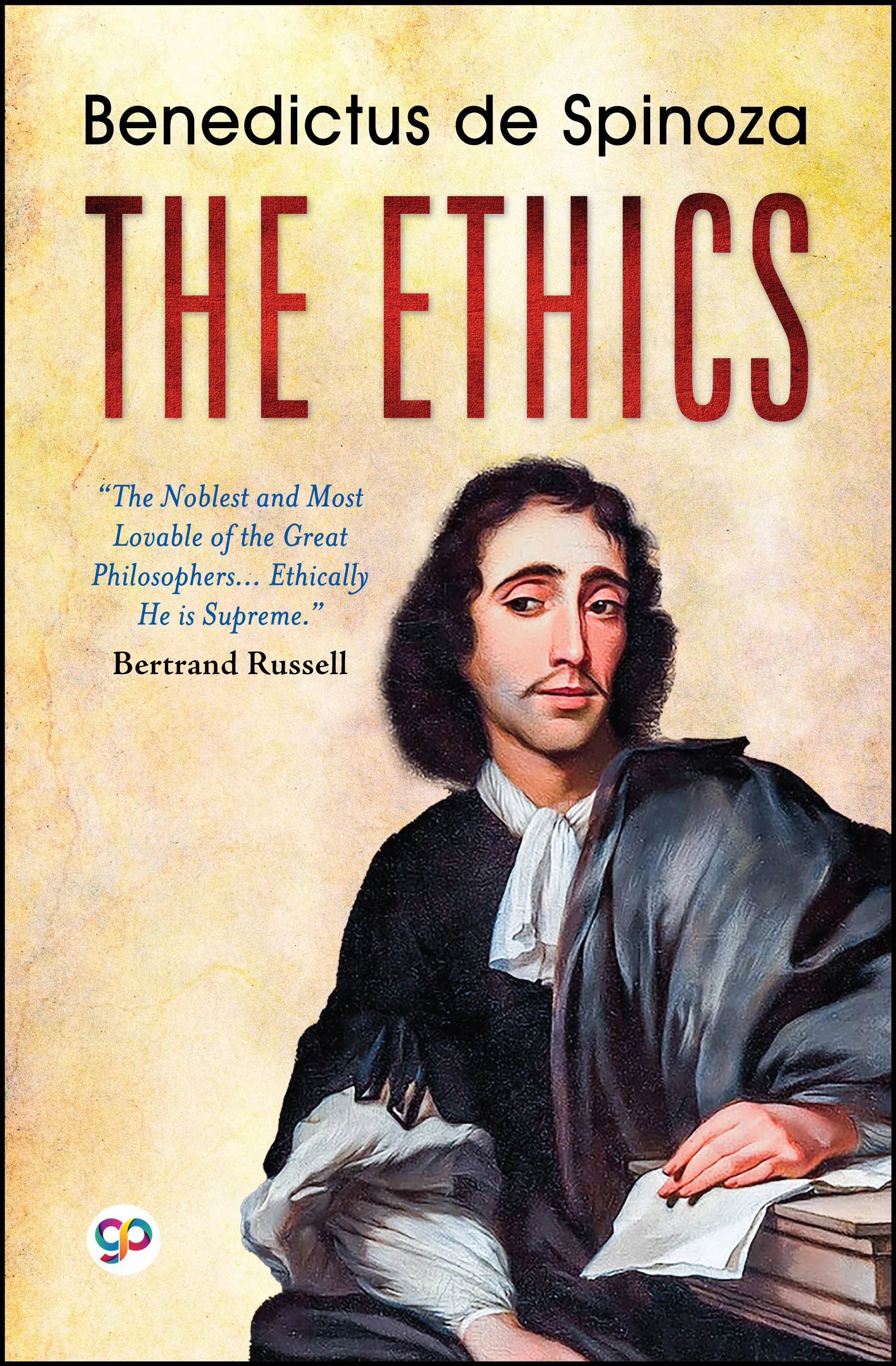
The Ethics
eBook
• INR 99.00
• English
• 9789354997242
No ratings yet
| Publisher | General Press |
|---|---|
| ISBN13 | 9789354997242 |
| ASIN/SKU | B0BYZJ1MBL |
| Book Format | eBook |
| Language | English |
| List Price | INR 99.00 |
| Subject Code | PSY000000 |
| Publishing Date | 24/03/2023 |
| Book Code | BD00069079 |
Buy this Book
Amazon Stores
Ebook Stores
Other Stores
Discover The Ethics by Benedictus De Spinoza. This book is published by General Press in eBook format, ISBN 9789354997242, ASIN B0BYZJ1MBL, under Non Fiction, Philosophy.
Book Description
‘The Ethics’ is a philosophical book written by Benedictus de Spinoza. Although published after Spinoza's death, in 1677, it is considered his greatest and most famous work. In it, Spinoza tries to set out a "fully cohesive philosophical system that strives to provide a coherent picture of reality and to comprehend the meaning of ethical life. Following a logical step-by-step format, it defines in turn the nature of God, the mind, human bondage to emotions, and the power of understanding -- moving from a consideration of the eternal, to speculate upon humanity's place in the natural order, freedom, and the path to attainable happiness."
The book is perhaps the most ambitious attempt to apply this method of Euclid in philosophy. Spinoza puts forward a small number of definitions and axioms from which he attempts to derive hundreds of propositions and corollaries, such as "When the Mind imagines its lack of power, it is saddened by it", "A free man thinks of nothing less than of death", and "The human Mind cannot be destroyed with the Body, but something of it remains which is eternal." The Euclidean style is larded with stretches of informal and at times pugnacious prose.
The book is perhaps the most ambitious attempt to apply this method of Euclid in philosophy. Spinoza puts forward a small number of definitions and axioms from which he attempts to derive hundreds of propositions and corollaries, such as "When the Mind imagines its lack of power, it is saddened by it", "A free man thinks of nothing less than of death", and "The human Mind cannot be destroyed with the Body, but something of it remains which is eternal." The Euclidean style is larded with stretches of informal and at times pugnacious prose.
Author Biography
Benedictus de Spinoza (1632–1677), also known as Baruch Spinoza, was a Dutch philosopher whose bold and original ideas transformed the history of Western philosophy. Widely regarded as one of the great rationalist thinkers of the seventeenth century, Spinoza believed that reason, rather than superstition or prejudice, should guide human understanding. His writings on ethics, religion, politics, and the nature of reality challenged many accepted beliefs of his time and laid the intellectual foundations for the Enlightenment. Today, he is recognized as one of the most influential philosophers in history.
Spinoza was born on November 24, 1632, in Amsterdam, in the Dutch Republic, to a family of Portuguese-Jewish refugees who had fled religious persecution. He received a traditional Jewish education and showed exceptional intellectual promise from an early age. As he grew older, however, he became increasingly interested in philosophy, science, and the works of thinkers such as René Descartes. His unconventional views on religion and scripture eventually brought him into conflict with the Jewish community, and in 1656 he was formally excommunicated. Rather than abandoning his pursuit of knowledge, Spinoza chose a quiet life devoted to study, writing, and the craft of grinding optical lenses to support himself.
Despite living modestly, Spinoza produced works of extraordinary philosophical depth. His masterpiece, Ethics, published after his death in 1677, presented a systematic vision of reality in which God and nature are inseparable, a view often summarized by the phrase Deus sive Natura ("God or Nature"). He argued that everything in the universe follows natural laws and that true human freedom comes from understanding these laws through reason. His other important works, including Theological-Political Treatise, defended freedom of thought, religious tolerance, and the separation of philosophy from theology, ideas that were revolutionary for his time.
Although many of his writings were controversial during his lifetime, Spinoza's commitment to intellectual honesty, tolerance, and rational inquiry earned him lasting admiration among later philosophers, including G.W.F. Hegel, Albert Einstein, and Bertrand Russell. He consistently rejected fame and wealth, choosing instead a life of simplicity and independent thought.
Benedictus de Spinoza died in 1677 at the age of forty-four, likely from a lung illness aggravated by years of lens grinding. His philosophical legacy continues to shape modern discussions of ethics, freedom, religion, and human reason, securing his place as one of the greatest and most enduring thinkers in the history of philosophy.
Spinoza was born on November 24, 1632, in Amsterdam, in the Dutch Republic, to a family of Portuguese-Jewish refugees who had fled religious persecution. He received a traditional Jewish education and showed exceptional intellectual promise from an early age. As he grew older, however, he became increasingly interested in philosophy, science, and the works of thinkers such as René Descartes. His unconventional views on religion and scripture eventually brought him into conflict with the Jewish community, and in 1656 he was formally excommunicated. Rather than abandoning his pursuit of knowledge, Spinoza chose a quiet life devoted to study, writing, and the craft of grinding optical lenses to support himself.
Despite living modestly, Spinoza produced works of extraordinary philosophical depth. His masterpiece, Ethics, published after his death in 1677, presented a systematic vision of reality in which God and nature are inseparable, a view often summarized by the phrase Deus sive Natura ("God or Nature"). He argued that everything in the universe follows natural laws and that true human freedom comes from understanding these laws through reason. His other important works, including Theological-Political Treatise, defended freedom of thought, religious tolerance, and the separation of philosophy from theology, ideas that were revolutionary for his time.
Although many of his writings were controversial during his lifetime, Spinoza's commitment to intellectual honesty, tolerance, and rational inquiry earned him lasting admiration among later philosophers, including G.W.F. Hegel, Albert Einstein, and Bertrand Russell. He consistently rejected fame and wealth, choosing instead a life of simplicity and independent thought.
Benedictus de Spinoza died in 1677 at the age of forty-four, likely from a lung illness aggravated by years of lens grinding. His philosophical legacy continues to shape modern discussions of ethics, freedom, religion, and human reason, securing his place as one of the greatest and most enduring thinkers in the history of philosophy.
Editorial Reviews
Editorial Reviews will be added soon…
Book Summary
Book Summary will be added soon…
Sample Chapters
Sample Chapters will be added soon…
Reader Reviews
No reviews yet.
The Ethics