
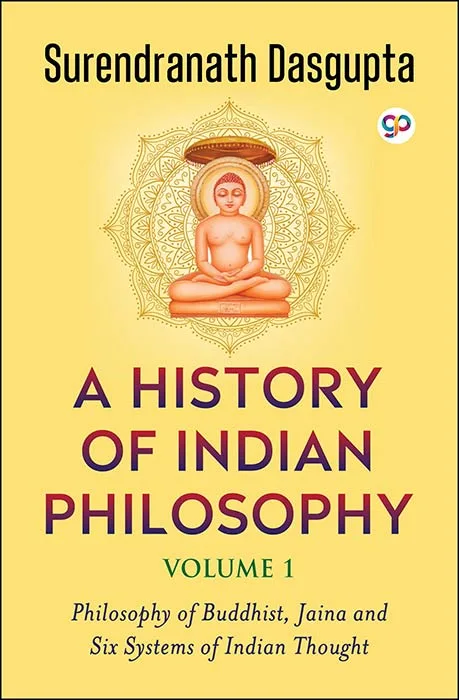
A History of Indian Philosophy (Volume 1)
eBook
• INR 99.00
• English
• 9789354994890
No ratings yet
| Publisher | General Press |
|---|---|
| ISBN13 | 9789354994890 |
| ASIN/SKU | B0BCVR9SQT |
| Book Format | eBook |
| Language | English |
| List Price | INR 99.00 |
| Subject Code | PHI003000 |
| Publishing Date | 12/09/2022 |
| Book Code | BD00069088 |
Buy this Book
Amazon Stores
Ebook Stores
Other Stores
Discover A History of Indian Philosophy (Volume 1) by Surendranath Dasgupta. This book is published by General Press in eBook format, ISBN 9789354994890, ASIN B0BCVR9SQT, under Non Fiction, Philosophy.
Book Description
First published between 1922 and 1955, ‘A History of Indian Philosophy Volume 1’ is written by Surendranath Dasgupta, in which he examines the principal schools of thought that define Indian philosophy. It elaborates on Buddhist and Jaina Philosophy and the six systems of Hindu thought; Samkara School of Vedanta besides the philosophy of the Yoga-vasistha and the Bhagavadgita; a detailed account of the principal dualistic and pluralistic system; the Bhagavata Purana, Madhva and his school; and Southern Schools of Saivism.
Professor Dasgupta describes philosophy as the most important achievement of Indian thought, arguing that understanding its history is necessary to appreciate the significance and potentialities of India's complex culture.
Professor Dasgupta describes philosophy as the most important achievement of Indian thought, arguing that understanding its history is necessary to appreciate the significance and potentialities of India's complex culture.
Author Biography
Surendranath Dasgupta (1887–1952) was one of India's foremost philosophers, Sanskrit scholars, and historians of philosophy. Renowned for his deep knowledge of Indian intellectual traditions, he devoted his life to interpreting and presenting the richness of Indian philosophy to readers around the world. His scholarship helped bridge Eastern and Western thought, making the profound ideas of ancient Indian thinkers accessible to modern students and researchers. Today, he is remembered as one of the most influential scholars of Indian philosophy in the twentieth century.
Dasgupta was born on October 18, 1887, in Kushtia, then part of Bengal Presidency in British India (now in Bangladesh). He grew up in a family that valued education and scholarship, and from an early age he developed a strong interest in Sanskrit, philosophy, and classical literature. He studied at Ripon College and later at Presidency College in Calcutta, where he excelled in philosophy. His academic brilliance earned him opportunities for advanced study both in India and abroad, including research at the University of Cambridge.
Throughout his career, Dasgupta taught philosophy at several prestigious institutions, including the University of Calcutta. He also served as Professor of Indian Philosophy at the University of Cambridge and was invited to lecture at universities across Europe and Asia. His ability to explain complex philosophical ideas with clarity earned him great respect among students and fellow scholars alike.
Dasgupta's greatest achievement was his monumental five-volume work, A History of Indian Philosophy. Published over several decades, it remains one of the most comprehensive and authoritative studies of Indian philosophical traditions. In these volumes, he examined schools such as Vedanta, Samkhya, Yoga, Nyaya, Buddhism, and Jainism with remarkable depth and scholarly precision. He also wrote important books on Yoga, Indian mysticism, and religious thought, contributing significantly to the global understanding of India's intellectual heritage.
Surendranath Dasgupta passed away on December 18, 1952. His legacy lives on through his groundbreaking research and enduring contributions to philosophy. By combining rigorous scholarship with genuine respect for India's spiritual and philosophical traditions, he helped establish Indian philosophy as a respected field of academic study throughout the world. His works continue to inspire students, scholars, and readers seeking a deeper understanding of the rich and diverse traditions of Indian thought.
Dasgupta was born on October 18, 1887, in Kushtia, then part of Bengal Presidency in British India (now in Bangladesh). He grew up in a family that valued education and scholarship, and from an early age he developed a strong interest in Sanskrit, philosophy, and classical literature. He studied at Ripon College and later at Presidency College in Calcutta, where he excelled in philosophy. His academic brilliance earned him opportunities for advanced study both in India and abroad, including research at the University of Cambridge.
Throughout his career, Dasgupta taught philosophy at several prestigious institutions, including the University of Calcutta. He also served as Professor of Indian Philosophy at the University of Cambridge and was invited to lecture at universities across Europe and Asia. His ability to explain complex philosophical ideas with clarity earned him great respect among students and fellow scholars alike.
Dasgupta's greatest achievement was his monumental five-volume work, A History of Indian Philosophy. Published over several decades, it remains one of the most comprehensive and authoritative studies of Indian philosophical traditions. In these volumes, he examined schools such as Vedanta, Samkhya, Yoga, Nyaya, Buddhism, and Jainism with remarkable depth and scholarly precision. He also wrote important books on Yoga, Indian mysticism, and religious thought, contributing significantly to the global understanding of India's intellectual heritage.
Surendranath Dasgupta passed away on December 18, 1952. His legacy lives on through his groundbreaking research and enduring contributions to philosophy. By combining rigorous scholarship with genuine respect for India's spiritual and philosophical traditions, he helped establish Indian philosophy as a respected field of academic study throughout the world. His works continue to inspire students, scholars, and readers seeking a deeper understanding of the rich and diverse traditions of Indian thought.
Editorial Reviews
Editorial Reviews will be added soon…
Book Summary
Book Summary will be added soon…
Sample Chapters
Sample Chapters will be added soon…
Reader Reviews
No reviews yet.
A History of Indian Philosophy (Volume 1)
Download Cover Image
Do you want to download the full cover image for A History of Indian Philosophy (Volume 1)?