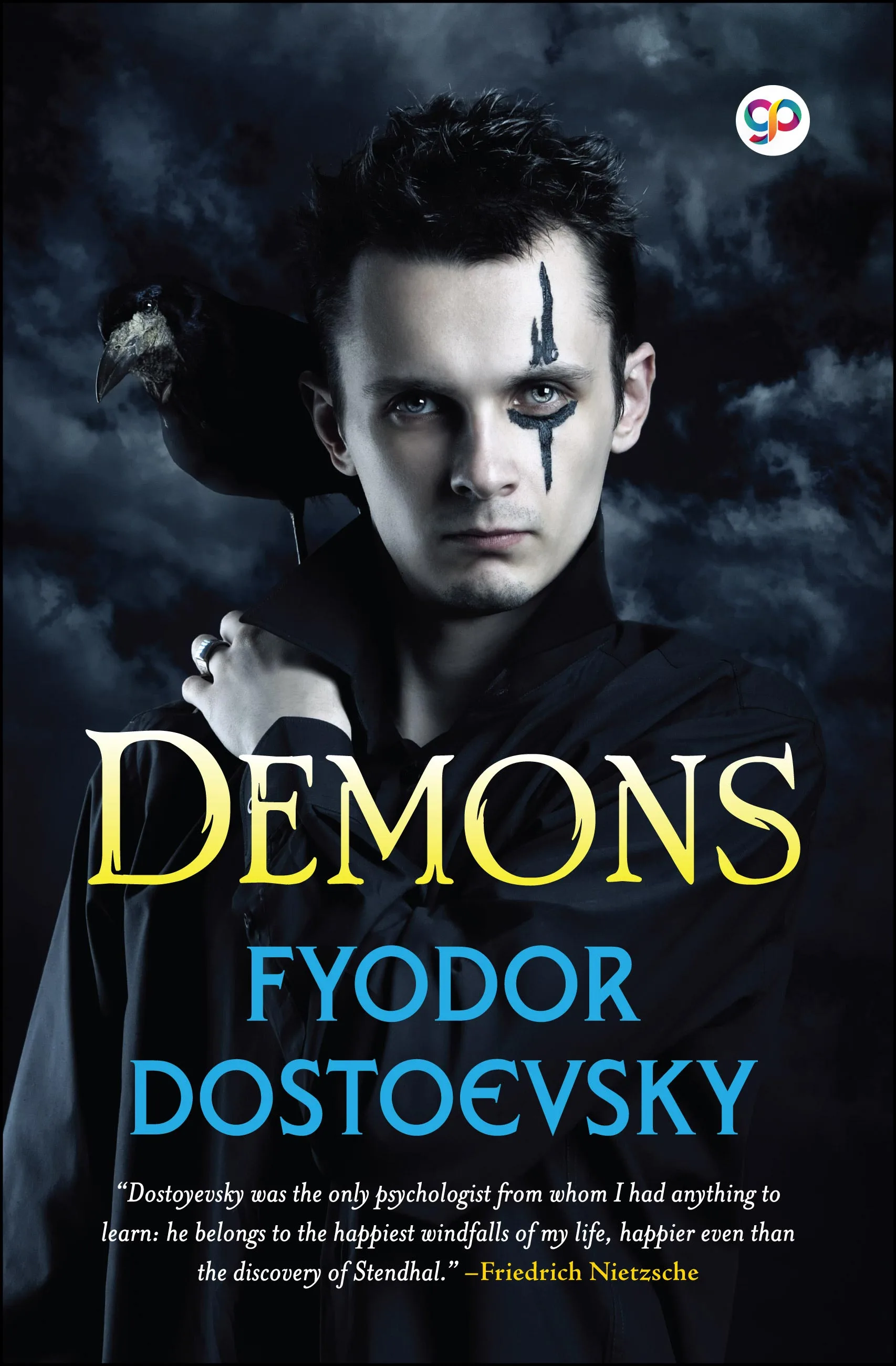
Demons
eBook
• INR 51.00
• English
• 9789354994920
No ratings yet
| Publisher | General Press |
|---|---|
| ISBN13 | 9789354994920 |
| ASIN/SKU | B0BCVRXLPY |
| Book Format | eBook |
| Language | English |
| List Price | INR 51.00 |
| Subject Code | FIC004000 |
| Publishing Date | 12/09/2022 |
| Book Code | BD00069097 |
Buy this Book
Amazon Stores
Ebook Stores
Other Stores
Discover Demons by Fyodor Dostoyevsky. This book is published by General Press in eBook format, ISBN 9789354994920, ASIN B0BCVRXLPY, under Literature and Fiction, Russian Literature, Classics.
Book Description
What happens when political idealism, wounded pride, and a hunger for power begin to consume an entire community? 'Demons' by Fyodor Dostoyevsky is a psychological and political novel that explores revolution, nihilism, moral confusion, and the dangerous consequences of ideas detached from human responsibility.
Set in a provincial Russian town, the novel follows a troubled circle of intellectuals, radicals, and social outsiders whose personal ambitions and political beliefs gradually become entangled. At the center of this tense world is Pyotr Stepanovich Verkhovensky, a clever and manipulative revolutionary who sees his companions less as friends than as pieces in a larger scheme. His activities are closely connected to the enigmatic Nikolai Stavrogin, a charismatic and deeply conflicted figure whose influence over those around him is both powerful and unsettling. Alongside them are older idealists, young revolutionaries, aristocrats, and ordinary townspeople, each caught in a society where traditional values are weakening and new beliefs are emerging without clear moral direction.
As rival loyalties, secret plans, ideological arguments, and personal obsessions collide, the town becomes increasingly unstable. Dostoyevsky examines how the desire to destroy an old order can turn into a desire to control people, and how individuals searching for freedom may become trapped by fear, pride, fanaticism, or despair. The novel is not simply a political story; it is also a penetrating study of human psychology and the moral costs of extremism.
Dark, intense, and remarkably relevant, 'Demons' challenges readers to consider how ideas can shape—and ultimately distort—the people who embrace them. Its atmosphere of growing tension makes every page feel like a step toward an inevitable reckoning, leaving readers eager to discover where these dangerous ambitions will lead.
Set in a provincial Russian town, the novel follows a troubled circle of intellectuals, radicals, and social outsiders whose personal ambitions and political beliefs gradually become entangled. At the center of this tense world is Pyotr Stepanovich Verkhovensky, a clever and manipulative revolutionary who sees his companions less as friends than as pieces in a larger scheme. His activities are closely connected to the enigmatic Nikolai Stavrogin, a charismatic and deeply conflicted figure whose influence over those around him is both powerful and unsettling. Alongside them are older idealists, young revolutionaries, aristocrats, and ordinary townspeople, each caught in a society where traditional values are weakening and new beliefs are emerging without clear moral direction.
As rival loyalties, secret plans, ideological arguments, and personal obsessions collide, the town becomes increasingly unstable. Dostoyevsky examines how the desire to destroy an old order can turn into a desire to control people, and how individuals searching for freedom may become trapped by fear, pride, fanaticism, or despair. The novel is not simply a political story; it is also a penetrating study of human psychology and the moral costs of extremism.
Dark, intense, and remarkably relevant, 'Demons' challenges readers to consider how ideas can shape—and ultimately distort—the people who embrace them. Its atmosphere of growing tension makes every page feel like a step toward an inevitable reckoning, leaving readers eager to discover where these dangerous ambitions will lead.
Author Biography
Few writers have explored the depths of the human mind as boldly as Fyodor Dostoyevsky. Fyodor Mikhailovich Dostoyevsky was a Russian novelist and philosopher whose powerful works of psychological fiction include 'Crime and Punishment', 'The Brothers Karamazov', 'The Idiot', and 'Demons'.
Born in Moscow in 1821, Dostoyevsky grew up in a deeply religious and disciplined household. He studied engineering before turning seriously toward literature, and his first novel, 'Poor Folk', published in 1846, brought him early recognition. His life soon took a dramatic turn when he was arrested for participating in a literary discussion group viewed as politically dangerous. In 1849, he was sentenced to death, only to learn at the last moment that the execution had been commuted to years of imprisonment and hard labor in Siberia. The experience profoundly shaped his beliefs about suffering, faith, freedom, and human nature.
After returning to literary life, Dostoyevsky produced some of the most influential novels in world literature. His writing often places troubled characters in moments of intense moral and psychological conflict, examining guilt, redemption, poverty, love, faith, free will, and the struggle between good and evil. His characters are rarely simple; they are contradictory, passionate, vulnerable, and deeply human.
Dostoyevsky died in 1881, but his influence has continued to grow across literature, philosophy, psychology, and popular culture. Writers and thinkers around the world have drawn inspiration from his profound understanding of human consciousness. His novels remain enduring works because they ask difficult questions about what it means to live, suffer, believe, and choose.
Born in Moscow in 1821, Dostoyevsky grew up in a deeply religious and disciplined household. He studied engineering before turning seriously toward literature, and his first novel, 'Poor Folk', published in 1846, brought him early recognition. His life soon took a dramatic turn when he was arrested for participating in a literary discussion group viewed as politically dangerous. In 1849, he was sentenced to death, only to learn at the last moment that the execution had been commuted to years of imprisonment and hard labor in Siberia. The experience profoundly shaped his beliefs about suffering, faith, freedom, and human nature.
After returning to literary life, Dostoyevsky produced some of the most influential novels in world literature. His writing often places troubled characters in moments of intense moral and psychological conflict, examining guilt, redemption, poverty, love, faith, free will, and the struggle between good and evil. His characters are rarely simple; they are contradictory, passionate, vulnerable, and deeply human.
Dostoyevsky died in 1881, but his influence has continued to grow across literature, philosophy, psychology, and popular culture. Writers and thinkers around the world have drawn inspiration from his profound understanding of human consciousness. His novels remain enduring works because they ask difficult questions about what it means to live, suffer, believe, and choose.
Editorial Reviews
Editorial Reviews will be added soon…
Book Summary
"Demons" by Fyodor Dostoyevsky is a powerful and unsettling novel that explores the dangers of political extremism, moral decay, and the loss of spiritual values in nineteenth-century Russia. Set in a quiet provincial town, the story begins almost peacefully, introducing a society of respected officials, intellectuals, landowners, and idealistic young people. Beneath this calm surface, however, tensions are quietly building. Old beliefs are being questioned, and a new generation is becoming fascinated with radical political ideas that promise to reshape society. As these revolutionary influences spread through the town, ordinary relationships begin to fracture, and a sense of unease slowly takes hold. Dostoyevsky carefully creates an atmosphere where every conversation hints at deeper conflicts, preparing the reader for the chaos that is about to unfold.
At the center of the novel is Nikolai Stavrogin, a mysterious, intelligent, and charismatic man whose presence influences nearly everyone around him. Handsome and self-confident, Stavrogin attracts admiration as well as fear because of his unpredictable behavior. Although he rarely reveals his true thoughts, his emotional emptiness and inability to commit to any moral or spiritual belief make him a deeply troubling figure. Around him gather people who either worship him, resent him, or hope to use him for their own purposes. His silence often speaks louder than words, and his hidden past casts a long shadow over the lives of others. Through Stavrogin, Dostoyevsky presents a man whose lack of inner conviction becomes a destructive force for both himself and those who place their hopes in him.
Another central figure is Pyotr Verkhovensky, an ambitious and manipulative revolutionary who dreams of overthrowing the existing order. Unlike Stavrogin, Pyotr is energetic, calculating, and completely devoted to spreading political chaos. He believes that society can only be transformed through destruction, fear, and absolute control. Gathering a secret group of followers, he persuades them that violence is necessary for a greater future. Many of these young men are driven by frustration, idealism, or personal ambition rather than genuine understanding of the ideas they claim to support. Pyotr skillfully exploits their weaknesses, turning them into willing participants in increasingly dangerous actions. His ability to manipulate people highlights how extremist movements often grow by taking advantage of confusion, insecurity, and the desire to belong.
The older generation is represented by characters such as Stepan Trofimovich Verkhovensky, Pyotr’s father, an intellectual who spent much of his life promoting fashionable liberal ideas without fully understanding where they might lead. He enjoys discussing philosophy and politics but has lived comfortably without accepting responsibility for the consequences of his beliefs. As he watches younger radicals embrace violence and revolution, he realizes that the ideas he once admired have evolved into something far more dangerous than he ever imagined. His relationship with his son symbolizes the conflict between generations, showing how careless idealism can unintentionally prepare the ground for fanaticism. Through Stepan, Dostoyevsky reflects on the failures of intellectuals who influence society but avoid confronting the practical results of their ideas.
As the story progresses, the town gradually descends into disorder. Personal scandals, betrayals, secret relationships, and political conspiracies become increasingly intertwined. Rumors spread rapidly, trust disappears, and fear replaces ordinary social life. The revolutionary group believes that acts of violence will strengthen their cause, leading them toward shocking crimes that forever change the community. Innocent people become victims of manipulation, while others remain silent out of fear or confusion. Dostoyevsky shows how evil rarely appears all at once; instead, it grows slowly through small compromises, lies, and moral indifference until it eventually overwhelms everyone involved. The once peaceful town becomes a symbol of a society losing its moral foundation.
The novel is filled with deeply human struggles that go far beyond politics. Many characters wrestle with guilt, pride, loneliness, jealousy, and the search for meaning. Some desperately seek love or forgiveness, while others try to escape the emptiness inside themselves through power, ideology, or reckless behavior. Dostoyevsky examines how the rejection of moral responsibility leaves individuals vulnerable to despair. Characters who deny the existence of higher values often discover that nothing meaningful remains to guide their choices. Even those who begin with good intentions gradually become trapped by their own pride or ambition. Through these personal stories, the novel suggests that political crises are ultimately rooted in spiritual and moral crises within individuals.
One of the most striking aspects of Demons is the way Dostoyevsky portrays the contagious nature of destructive ideas. Rumors, fear, and fanaticism spread almost like an epidemic, influencing people who never intended to become involved. Some join the revolutionary movement out of genuine conviction, while others participate simply because they are afraid of being left behind or because they seek excitement and purpose. The novel illustrates how easily societies can be destabilized when truth is replaced by manipulation and when individuals stop thinking independently. Dostoyevsky does not merely criticize revolutionary politics; he warns against any ideology that demands blind obedience while rejecting compassion, conscience, and personal responsibility.
Despite its dark and tragic events, the novel also contains moments of compassion, repentance, and spiritual reflection. Several characters come to recognize the consequences of their actions and long for redemption, though not all are able to find it. Dostoyevsky suggests that genuine renewal is possible only through humility, honesty, and acceptance of moral responsibility. Material success, political power, or intellectual brilliance cannot replace the need for inner truth. The emotional weight of the novel comes from watching individuals struggle between destruction and redemption, freedom and responsibility, belief and doubt. Even when hope appears distant, Dostoyevsky leaves open the possibility that sincere repentance can restore human dignity.
In the end, Demons is far more than a political novel. It is a profound psychological and philosophical exploration of how ideas shape individuals and societies. Through unforgettable characters, intense moral conflicts, and an atmosphere of growing suspense, Dostoyevsky examines the consequences of abandoning faith, conscience, and compassion in favor of pride and ideological certainty. The novel remains remarkably relevant because its warnings about extremism, manipulation, and moral emptiness continue to resonate in every age. By combining personal tragedy with social criticism, Dostoyevsky creates a timeless masterpiece that challenges readers to reflect on the importance of truth, responsibility, and the values that hold both individuals and communities together.
At the center of the novel is Nikolai Stavrogin, a mysterious, intelligent, and charismatic man whose presence influences nearly everyone around him. Handsome and self-confident, Stavrogin attracts admiration as well as fear because of his unpredictable behavior. Although he rarely reveals his true thoughts, his emotional emptiness and inability to commit to any moral or spiritual belief make him a deeply troubling figure. Around him gather people who either worship him, resent him, or hope to use him for their own purposes. His silence often speaks louder than words, and his hidden past casts a long shadow over the lives of others. Through Stavrogin, Dostoyevsky presents a man whose lack of inner conviction becomes a destructive force for both himself and those who place their hopes in him.
Another central figure is Pyotr Verkhovensky, an ambitious and manipulative revolutionary who dreams of overthrowing the existing order. Unlike Stavrogin, Pyotr is energetic, calculating, and completely devoted to spreading political chaos. He believes that society can only be transformed through destruction, fear, and absolute control. Gathering a secret group of followers, he persuades them that violence is necessary for a greater future. Many of these young men are driven by frustration, idealism, or personal ambition rather than genuine understanding of the ideas they claim to support. Pyotr skillfully exploits their weaknesses, turning them into willing participants in increasingly dangerous actions. His ability to manipulate people highlights how extremist movements often grow by taking advantage of confusion, insecurity, and the desire to belong.
The older generation is represented by characters such as Stepan Trofimovich Verkhovensky, Pyotr’s father, an intellectual who spent much of his life promoting fashionable liberal ideas without fully understanding where they might lead. He enjoys discussing philosophy and politics but has lived comfortably without accepting responsibility for the consequences of his beliefs. As he watches younger radicals embrace violence and revolution, he realizes that the ideas he once admired have evolved into something far more dangerous than he ever imagined. His relationship with his son symbolizes the conflict between generations, showing how careless idealism can unintentionally prepare the ground for fanaticism. Through Stepan, Dostoyevsky reflects on the failures of intellectuals who influence society but avoid confronting the practical results of their ideas.
As the story progresses, the town gradually descends into disorder. Personal scandals, betrayals, secret relationships, and political conspiracies become increasingly intertwined. Rumors spread rapidly, trust disappears, and fear replaces ordinary social life. The revolutionary group believes that acts of violence will strengthen their cause, leading them toward shocking crimes that forever change the community. Innocent people become victims of manipulation, while others remain silent out of fear or confusion. Dostoyevsky shows how evil rarely appears all at once; instead, it grows slowly through small compromises, lies, and moral indifference until it eventually overwhelms everyone involved. The once peaceful town becomes a symbol of a society losing its moral foundation.
The novel is filled with deeply human struggles that go far beyond politics. Many characters wrestle with guilt, pride, loneliness, jealousy, and the search for meaning. Some desperately seek love or forgiveness, while others try to escape the emptiness inside themselves through power, ideology, or reckless behavior. Dostoyevsky examines how the rejection of moral responsibility leaves individuals vulnerable to despair. Characters who deny the existence of higher values often discover that nothing meaningful remains to guide their choices. Even those who begin with good intentions gradually become trapped by their own pride or ambition. Through these personal stories, the novel suggests that political crises are ultimately rooted in spiritual and moral crises within individuals.
One of the most striking aspects of Demons is the way Dostoyevsky portrays the contagious nature of destructive ideas. Rumors, fear, and fanaticism spread almost like an epidemic, influencing people who never intended to become involved. Some join the revolutionary movement out of genuine conviction, while others participate simply because they are afraid of being left behind or because they seek excitement and purpose. The novel illustrates how easily societies can be destabilized when truth is replaced by manipulation and when individuals stop thinking independently. Dostoyevsky does not merely criticize revolutionary politics; he warns against any ideology that demands blind obedience while rejecting compassion, conscience, and personal responsibility.
Despite its dark and tragic events, the novel also contains moments of compassion, repentance, and spiritual reflection. Several characters come to recognize the consequences of their actions and long for redemption, though not all are able to find it. Dostoyevsky suggests that genuine renewal is possible only through humility, honesty, and acceptance of moral responsibility. Material success, political power, or intellectual brilliance cannot replace the need for inner truth. The emotional weight of the novel comes from watching individuals struggle between destruction and redemption, freedom and responsibility, belief and doubt. Even when hope appears distant, Dostoyevsky leaves open the possibility that sincere repentance can restore human dignity.
In the end, Demons is far more than a political novel. It is a profound psychological and philosophical exploration of how ideas shape individuals and societies. Through unforgettable characters, intense moral conflicts, and an atmosphere of growing suspense, Dostoyevsky examines the consequences of abandoning faith, conscience, and compassion in favor of pride and ideological certainty. The novel remains remarkably relevant because its warnings about extremism, manipulation, and moral emptiness continue to resonate in every age. By combining personal tragedy with social criticism, Dostoyevsky creates a timeless masterpiece that challenges readers to reflect on the importance of truth, responsibility, and the values that hold both individuals and communities together.
Sample Chapters
Part I
Chapter 1 : Introductory
SOME DETAILS OF THE BIOGRAPHY OF THAT HIGHLY RESPECTED GENTLEMAN STEPAN TROFIMOVITCH VERHOENSKY.
I
In undertaking to describe the recent and strange incidents in our town, till lately wrapped in uneventful obscurity, I find myself forced in absence of literary skill to begin my story rather far back, that is to say, with certain biographical details concerning that talented and highly-esteemed gentleman, Stepan Trofimovitch Verhovensky. I trust that these details may at least serve as an introduction, while my projected story itself will come later.
I will say at once that Stepan Trofimovitch had always filled a particular rôle among us, that of the progressive patriot, so to say, and he was passionately fond of playing the part – so much so that I really believe he could not have existed without it. Not that I would put him on a level with an actor at a theatre, God forbid, for I really have a respect for him. This may all have been the effect of habit, or rather, more exactly of a generous propensity he had from his earliest years for indulging in an agreeable day-dream in which he figured as a picturesque public character. He fondly loved, for instance, his position as a “persecuted” man and, so to speak, an “exile.” There is a sort of traditional glamour about those two little words that fascinated him once for all and, exalting him gradually in his own opinion, raised him in the course of years to a lofty pedestal very gratifying to vanity. In an English satire of the last century, Gulliver, returning from the land of the Lilliputians where the people were only three or four inches high, had grown so accustomed to consider himself a giant among them, that as he walked along the streets of London he could not help crying out to carriages and passers-by to be careful and get out of his way for fear he should crush them, imagining that they were little and he was still a giant. He was laughed at and abused for it, and rough coachmen even lashed at the giant with their whips. But was that just? What may not be done by habit? Habit had brought Stepan Trofimovitch almost to the same position, but in a more innocent and inoffensive form, if one may use such expressions, for he was a most excellent man.
I am even inclined to suppose that towards the end he had been entirely forgotten everywhere; but still it cannot be said that his name had never been known. It is beyond question that he had at one time belonged to a certain distinguished constellation of celebrated leaders of the last generation, and at one time – though only for the briefest moment – his name was pronounced by many hasty persons of that day almost as though it were on a level with the names of Tchaadaev, of Byelinsky, of Granovsky, and of Herzen, who had only just begun to write abroad. But Stepan Trofimovitch’s activity ceased almost at the moment it began, owing, so to say, to a “vortex of combined circumstances.” And would you believe it? It turned out afterwards that there had been no “vortex” and even no “circumstances,” at least in that connection. I only learned the other day to my intense amazement, though on the most unimpeachable authority, that Stepan Trofimovitch had lived among us in our province not as an “exile” as we were accustomed to believe, and had never even been under police supervision at all. Such is the force of imagination! All his life he sincerely believed that in certain spheres he was a constant cause of apprehension, that every step he took was watched and noted, and that each one of the three governors who succeeded one another during twenty years in our province came with special and uneasy ideas concerning him, which had, by higher powers, been impressed upon each before everything else, on receiving the appointment. Had anyone assured the honest man on the most irrefutable grounds that he had nothing to be afraid of, he would certainly have been offended. Yet Stepan Trofimovitch was a most intelligent and gifted man, even, so to say, a man of science, though indeed, in science… well, in fact he had not done such great things in science. I believe indeed he had done nothing at all. But that’s very often the case, of course, with men of science among us in Russia.
He came back from abroad and was brilliant in the capacity of lecturer at the university, towards the end of the forties. He only had time to deliver a few lectures, I believe they were about the Arabs; he maintained, too, a brilliant thesis on the political and Hanseatic importance of the German town Hanau, of which there was promise in the epoch between 1413 and 1428, and on the special and obscure reasons why that promise was never fulfilled. This dissertation was a cruel and skilful thrust at the Slavophils of the day, and at once made him numerous and irreconcilable enemies among them. Later on – after he had lost his post as lecturer, however – he published (by way of revenge, so to say, and to show them what a man they had lost) in a progressive monthly review, which translated Dickens and advocated the views of George Sand, the beginning of a very profound investigation into the causes, I believe, of the extraordinary moral nobility of certain knights at a certain epoch or something of that nature.
Some lofty and exceptionally noble idea was maintained in it, anyway. It was said afterwards that the continuation was hurriedly forbidden and even that the progressive review had to suffer for having printed the first part. That may very well have been so, for what was not possible in those days? Though, in this case, it is more likely that there was nothing of the kind, and that the author himself was too lazy to conclude his essay. He cut short his lectures on the Arabs because, somehow and by someone (probably one of his reactionary enemies) a letter had been seized giving an account of certain circumstances, in consequence of which someone had demanded an explanation from him. I don’t know whether the story is true, but it was asserted that at the same time there was discovered in Petersburg a vast, unnatural, and illegal conspiracy of thirty people which almost shook society to its foundations. It was said that they were positively on the point of translating Fourier. As though of design a poem of Stepan Trofimovitch’s was seized in Moscow at that very time, though it had been written six years before in Berlin in his earliest youth, and manuscript copies had been passed round a circle consisting of two poetical amateurs and one student. This poem is lying now on my table. No longer ago than last year I received a recent copy in his own handwriting from Stepan Trofimovitch himself, signed by him, and bound in a splendid red leather binding. It is not without poetic merit, however, and even a certain talent. It’s strange, but in those days (or to be more exact, in the thirties) people were constantly composing in that style. I find it difficult to describe the subject, for I really do not understand it. It is some sort of an allegory in lyrical-dramatic form, recalling the second part of Faust. The scene opens with a chorus of women, followed by a chorus of men, then a chorus of incorporeal powers of some sort, and at the end of all a chorus of spirits not yet living but very eager to come to life. All these choruses sing about something very indefinite, for the most part about somebody’s curse, but with a tinge of the higher humour. But the scene is suddenly changed. There begins a sort of “festival of life” at which even insects sing, a tortoise comes on the scene with certain sacramental Latin words, and even, if I remember aright, a mineral sings about something that is a quite inanimate object. In fact, they all sing continually, or if they converse, it is simply to abuse one another vaguely, but again with a tinge of higher meaning. At last the scene is changed again; a wilderness appears, and among the rocks there wanders a civilized young man who picks and sucks certain herbs. Asked by a fairy why he sucks these herbs, he answers that, conscious of a superfluity of life in himself, he seeks forgetfulness, and finds it in the juice of these herbs, but that his great desire is to lose his reason at once (a desire possibly superfluous). Then a youth of indescribable beauty rides in on a black steed, and an immense multitude of all nations follow him. The youth represents death, for whom all the peoples are yearning. And finally, in the last scene we are suddenly shown the Tower of Babel, and certain athletes at last finish building it with a song of new hope, and when at length they complete the topmost pinnacle, the lord (of Olympia, let us say) takes flight in a comic fashion, and man, grasping the situation and seizing his place, at once begins a new life with new insight into things. Well, this poem was thought at that time to be dangerous. Last year I proposed to Stepan Trofimovitch to publish it, on the ground of its perfect harmlessness nowadays, but he declined the suggestion with evident dissatisfaction. My view of its complete harmlessness evidently displeased him, and I even ascribe to it a certain coldness on his part, which lasted two whole months.
And what do you think? Suddenly, almost at the time I proposed printing it here, our poem was published abroad in a collection of revolutionary verse, without the knowledge of Stepan Trofimovitch. He was at first alarmed, rushed to the governor, and wrote a noble letter in self-defence to Petersburg. He read it to me twice, but did not send it, not knowing to whom to address it. In fact he was in a state of agitation for a whole month, but I am convinced that in the secret recesses of his heart he was enormously flattered. He almost took the copy of the collection to bed with him, and kept it hidden under his mattress in the daytime; he positively would not allow the women to turn his bed, and although he expected every day a telegram, he held his head high. No telegram came. Then he made friends with me again, which is a proof of the extreme kindness of his gentle and unresentful heart.
II
Of course I don’t assert that he had never suffered for his convictions at all, but I am fully convinced that he might have gone on lecturing on his Arabs as long as he liked, if he had only given the necessary explanations. But he was too lofty, and he proceeded with peculiar haste to assure himself that his career was ruined forever “by the vortex of circumstance.” And if the whole truth is to be told the real cause of the change in his career was the very delicate proposition which had been made before and was then renewed by Varvara Petrovna Stavrogin, a lady of great wealth, the wife of a lieutenant-general, that he should undertake the education and the whole intellectual development of her only son in the capacity of a superior sort of teacher and friend, to say nothing of a magnificent salary. This proposal had been made to him the first time in Berlin, at the moment when he was first left a widower. His first wife was a frivolous girl from our province, whom he married in his early and unthinking youth, and apparently he had had a great deal of trouble with this young person, charming as she was, owing to the lack of means for her support; and also from other, more delicate, reasons. She died in Paris after three years’ separation from him, leaving him a son of five years old; “the fruit of our first, joyous, and unclouded love,” were the words the sorrowing father once let fall in my presence.
The child had, from the first, been sent back to Russia, where he was brought up in the charge of distant cousins in some remote region. Stepan Trofimovitch had declined Varvara Petrovna’s proposal on that occasion and had quickly married again, before the year was over, a taciturn Berlin girl, and, what makes it more strange, there was no particular necessity for him to do so. But apart from his marriage there were, it appears, other reasons for his declining the situation. He was tempted by the resounding fame of a professor, celebrated at that time, and he, in his turn, hastened to the lecturer’s chair for which he had been preparing himself, to try his eagle wings in flight. But now with singed wings he naturally remembered the proposition which even then had made him hesitate. The sudden death of his second wife, who did not live a year with him, settled the matter decisively. To put it plainly it was all brought about by the passionate sympathy and priceless, so to speak, classic friendship of Varvara Petrovna, if one may use such an expression of friendship. He flung himself into the arms of this friendship, and his position was settled for more than twenty years. I use the expression “flung himself into the arms of,” but God forbid that anyone should fly to idle and superfluous conclusions. These embraces must be understood only in the most loftily moral sense. The most refined and delicate tie united these two beings, both so remarkable, forever.
The post of tutor was the more readily accepted too, as the property – a very small one – left to Stepan Trofimovitch by his first wife was close to Skvoreshniki, the Stavrogins’ magnificent estate on the outskirts of our provincial town. Besides, in the stillness of his study, far from the immense burden of university work, it was always possible to devote himself to the service of science, and to enrich the literature of his country with erudite studies. These works did not appear. But on the other hand it did appear possible to spend the rest of his life, more than twenty years, “a reproach incarnate,” so to speak, to his native country, in the words of a popular poet:
Reproach incarnate thou didst stand
Erect before thy Fatherland,
O Liberal idealist!
But the person to whom the popular poet referred may perhaps have had the right to adopt that pose for the rest of his life if he had wished to do so, though it must have been tedious. Our Stepan Trofimovitch was, to tell the truth, only an imitator compared with such people; moreover, he had grown weary of standing erect and often lay down for a while. But, to do him justice, the “incarnation of reproach” was preserved even in the recumbent attitude, the more so as that was quite sufficient for the province. You should have seen him at our club when he sat down to cards. His whole figure seemed to exclaim “Cards! Me sit down to whist with you! Is it consistent? Who is responsible for it? Who has shattered my energies and turned them to whist? Ah, perish, Russia!” and he would majestically trump with a heart.
And to tell the truth he dearly loved a game of cards, which led him, especially in later years, into frequent and unpleasant skirmishes with Varvara Petrovna, particularly as he was always losing. But of that later. I will only observe that he was a man of tender conscience (that is, sometimes) and so was often depressed. In the course of his twenty years’ friendship with Varvara Petrovna he used regularly, three or four times a year, to sink into a state of “patriotic grief,” as it was called among us, or rather really into an attack of spleen, but our estimable Varvara Petrovna preferred the former phrase. Of late years his grief had begun to be not only patriotic, but at times alcoholic too; but Varvara Petrovna’s alertness succeeded in keeping him all his life from trivial inclinations. And he needed someone to look after him indeed, for he sometimes behaved very oddly: in the midst of his exalted sorrow he would begin laughing like any simple peasant. There were moments when he began to take a humorous tone even about himself. But there was nothing Varvara Petrovna dreaded so much as a humorous tone. She was a woman of the classic type, a female Mæcenas, invariably guided only by the highest considerations. The influence of this exalted lady over her poor friend for twenty years is a fact of the first importance. I shall need to speak of her more particularly, which I now proceed to do.
III
There are strange friendships. The two friends are always ready to fly at one another, and go on like that all their lives, and yet they cannot separate. Parting, in fact, is utterly impossible. The one who has begun the quarrel and separated will be the first to fall ill and even die, perhaps, if the separation comes off. I know for a positive fact that several times Stepan Trofimovitch has jumped up from the sofa and beaten the wall with his fists after the most intimate and emotional tête-à-tête with Varvara Petrovna.
This proceeding was by no means an empty symbol; indeed, on one occasion, he broke some plaster off the wall. It may be asked how I come to know such delicate details. What if I were myself a witness of it? What if Stepan Trofimovitch himself has, on more than one occasion, sobbed on my shoulder while he described to me in lurid colours all his most secret feelings. (And what was there he did not say at such times!) But what almost always happened after these tearful outbreaks was that next day he was ready to crucify himself for his ingratitude. He would send for me in a hurry or run over to see me simply to assure me that Varvara Petrovna was “an angel of honour and delicacy, while he was very much the opposite.” He did not only run to confide in me, but, on more than one occasion, described it all to her in the most eloquent letter, and wrote a full signed confession that no longer ago than the day before he had told an outsider that she kept him out of vanity, that she was envious of his talents and erudition, that she hated him and was only afraid to express her hatred openly, dreading that he would leave her and so damage her literary reputation, that this drove him to self-contempt, and he was resolved to die a violent death, and that he was waiting for the final word from her which would decide everything, and so on and so on in the same style. You can fancy after this what an hysterical pitch the nervous outbreaks of this most innocent of all fifty-year-old infants sometimes reached! I once read one of these letters after some quarrel between them, arising from a trivial matter, but growing venomous as it went on. I was horrified and besought him not to send it.
“I must… more honourable… duty… I shall die if I don’t confess everything, everything!” he answered almost in delirium, and he did send the letter.
Chapter 1 : Introductory
SOME DETAILS OF THE BIOGRAPHY OF THAT HIGHLY RESPECTED GENTLEMAN STEPAN TROFIMOVITCH VERHOENSKY.
I
In undertaking to describe the recent and strange incidents in our town, till lately wrapped in uneventful obscurity, I find myself forced in absence of literary skill to begin my story rather far back, that is to say, with certain biographical details concerning that talented and highly-esteemed gentleman, Stepan Trofimovitch Verhovensky. I trust that these details may at least serve as an introduction, while my projected story itself will come later.
I will say at once that Stepan Trofimovitch had always filled a particular rôle among us, that of the progressive patriot, so to say, and he was passionately fond of playing the part – so much so that I really believe he could not have existed without it. Not that I would put him on a level with an actor at a theatre, God forbid, for I really have a respect for him. This may all have been the effect of habit, or rather, more exactly of a generous propensity he had from his earliest years for indulging in an agreeable day-dream in which he figured as a picturesque public character. He fondly loved, for instance, his position as a “persecuted” man and, so to speak, an “exile.” There is a sort of traditional glamour about those two little words that fascinated him once for all and, exalting him gradually in his own opinion, raised him in the course of years to a lofty pedestal very gratifying to vanity. In an English satire of the last century, Gulliver, returning from the land of the Lilliputians where the people were only three or four inches high, had grown so accustomed to consider himself a giant among them, that as he walked along the streets of London he could not help crying out to carriages and passers-by to be careful and get out of his way for fear he should crush them, imagining that they were little and he was still a giant. He was laughed at and abused for it, and rough coachmen even lashed at the giant with their whips. But was that just? What may not be done by habit? Habit had brought Stepan Trofimovitch almost to the same position, but in a more innocent and inoffensive form, if one may use such expressions, for he was a most excellent man.
I am even inclined to suppose that towards the end he had been entirely forgotten everywhere; but still it cannot be said that his name had never been known. It is beyond question that he had at one time belonged to a certain distinguished constellation of celebrated leaders of the last generation, and at one time – though only for the briefest moment – his name was pronounced by many hasty persons of that day almost as though it were on a level with the names of Tchaadaev, of Byelinsky, of Granovsky, and of Herzen, who had only just begun to write abroad. But Stepan Trofimovitch’s activity ceased almost at the moment it began, owing, so to say, to a “vortex of combined circumstances.” And would you believe it? It turned out afterwards that there had been no “vortex” and even no “circumstances,” at least in that connection. I only learned the other day to my intense amazement, though on the most unimpeachable authority, that Stepan Trofimovitch had lived among us in our province not as an “exile” as we were accustomed to believe, and had never even been under police supervision at all. Such is the force of imagination! All his life he sincerely believed that in certain spheres he was a constant cause of apprehension, that every step he took was watched and noted, and that each one of the three governors who succeeded one another during twenty years in our province came with special and uneasy ideas concerning him, which had, by higher powers, been impressed upon each before everything else, on receiving the appointment. Had anyone assured the honest man on the most irrefutable grounds that he had nothing to be afraid of, he would certainly have been offended. Yet Stepan Trofimovitch was a most intelligent and gifted man, even, so to say, a man of science, though indeed, in science… well, in fact he had not done such great things in science. I believe indeed he had done nothing at all. But that’s very often the case, of course, with men of science among us in Russia.
He came back from abroad and was brilliant in the capacity of lecturer at the university, towards the end of the forties. He only had time to deliver a few lectures, I believe they were about the Arabs; he maintained, too, a brilliant thesis on the political and Hanseatic importance of the German town Hanau, of which there was promise in the epoch between 1413 and 1428, and on the special and obscure reasons why that promise was never fulfilled. This dissertation was a cruel and skilful thrust at the Slavophils of the day, and at once made him numerous and irreconcilable enemies among them. Later on – after he had lost his post as lecturer, however – he published (by way of revenge, so to say, and to show them what a man they had lost) in a progressive monthly review, which translated Dickens and advocated the views of George Sand, the beginning of a very profound investigation into the causes, I believe, of the extraordinary moral nobility of certain knights at a certain epoch or something of that nature.
Some lofty and exceptionally noble idea was maintained in it, anyway. It was said afterwards that the continuation was hurriedly forbidden and even that the progressive review had to suffer for having printed the first part. That may very well have been so, for what was not possible in those days? Though, in this case, it is more likely that there was nothing of the kind, and that the author himself was too lazy to conclude his essay. He cut short his lectures on the Arabs because, somehow and by someone (probably one of his reactionary enemies) a letter had been seized giving an account of certain circumstances, in consequence of which someone had demanded an explanation from him. I don’t know whether the story is true, but it was asserted that at the same time there was discovered in Petersburg a vast, unnatural, and illegal conspiracy of thirty people which almost shook society to its foundations. It was said that they were positively on the point of translating Fourier. As though of design a poem of Stepan Trofimovitch’s was seized in Moscow at that very time, though it had been written six years before in Berlin in his earliest youth, and manuscript copies had been passed round a circle consisting of two poetical amateurs and one student. This poem is lying now on my table. No longer ago than last year I received a recent copy in his own handwriting from Stepan Trofimovitch himself, signed by him, and bound in a splendid red leather binding. It is not without poetic merit, however, and even a certain talent. It’s strange, but in those days (or to be more exact, in the thirties) people were constantly composing in that style. I find it difficult to describe the subject, for I really do not understand it. It is some sort of an allegory in lyrical-dramatic form, recalling the second part of Faust. The scene opens with a chorus of women, followed by a chorus of men, then a chorus of incorporeal powers of some sort, and at the end of all a chorus of spirits not yet living but very eager to come to life. All these choruses sing about something very indefinite, for the most part about somebody’s curse, but with a tinge of the higher humour. But the scene is suddenly changed. There begins a sort of “festival of life” at which even insects sing, a tortoise comes on the scene with certain sacramental Latin words, and even, if I remember aright, a mineral sings about something that is a quite inanimate object. In fact, they all sing continually, or if they converse, it is simply to abuse one another vaguely, but again with a tinge of higher meaning. At last the scene is changed again; a wilderness appears, and among the rocks there wanders a civilized young man who picks and sucks certain herbs. Asked by a fairy why he sucks these herbs, he answers that, conscious of a superfluity of life in himself, he seeks forgetfulness, and finds it in the juice of these herbs, but that his great desire is to lose his reason at once (a desire possibly superfluous). Then a youth of indescribable beauty rides in on a black steed, and an immense multitude of all nations follow him. The youth represents death, for whom all the peoples are yearning. And finally, in the last scene we are suddenly shown the Tower of Babel, and certain athletes at last finish building it with a song of new hope, and when at length they complete the topmost pinnacle, the lord (of Olympia, let us say) takes flight in a comic fashion, and man, grasping the situation and seizing his place, at once begins a new life with new insight into things. Well, this poem was thought at that time to be dangerous. Last year I proposed to Stepan Trofimovitch to publish it, on the ground of its perfect harmlessness nowadays, but he declined the suggestion with evident dissatisfaction. My view of its complete harmlessness evidently displeased him, and I even ascribe to it a certain coldness on his part, which lasted two whole months.
And what do you think? Suddenly, almost at the time I proposed printing it here, our poem was published abroad in a collection of revolutionary verse, without the knowledge of Stepan Trofimovitch. He was at first alarmed, rushed to the governor, and wrote a noble letter in self-defence to Petersburg. He read it to me twice, but did not send it, not knowing to whom to address it. In fact he was in a state of agitation for a whole month, but I am convinced that in the secret recesses of his heart he was enormously flattered. He almost took the copy of the collection to bed with him, and kept it hidden under his mattress in the daytime; he positively would not allow the women to turn his bed, and although he expected every day a telegram, he held his head high. No telegram came. Then he made friends with me again, which is a proof of the extreme kindness of his gentle and unresentful heart.
II
Of course I don’t assert that he had never suffered for his convictions at all, but I am fully convinced that he might have gone on lecturing on his Arabs as long as he liked, if he had only given the necessary explanations. But he was too lofty, and he proceeded with peculiar haste to assure himself that his career was ruined forever “by the vortex of circumstance.” And if the whole truth is to be told the real cause of the change in his career was the very delicate proposition which had been made before and was then renewed by Varvara Petrovna Stavrogin, a lady of great wealth, the wife of a lieutenant-general, that he should undertake the education and the whole intellectual development of her only son in the capacity of a superior sort of teacher and friend, to say nothing of a magnificent salary. This proposal had been made to him the first time in Berlin, at the moment when he was first left a widower. His first wife was a frivolous girl from our province, whom he married in his early and unthinking youth, and apparently he had had a great deal of trouble with this young person, charming as she was, owing to the lack of means for her support; and also from other, more delicate, reasons. She died in Paris after three years’ separation from him, leaving him a son of five years old; “the fruit of our first, joyous, and unclouded love,” were the words the sorrowing father once let fall in my presence.
The child had, from the first, been sent back to Russia, where he was brought up in the charge of distant cousins in some remote region. Stepan Trofimovitch had declined Varvara Petrovna’s proposal on that occasion and had quickly married again, before the year was over, a taciturn Berlin girl, and, what makes it more strange, there was no particular necessity for him to do so. But apart from his marriage there were, it appears, other reasons for his declining the situation. He was tempted by the resounding fame of a professor, celebrated at that time, and he, in his turn, hastened to the lecturer’s chair for which he had been preparing himself, to try his eagle wings in flight. But now with singed wings he naturally remembered the proposition which even then had made him hesitate. The sudden death of his second wife, who did not live a year with him, settled the matter decisively. To put it plainly it was all brought about by the passionate sympathy and priceless, so to speak, classic friendship of Varvara Petrovna, if one may use such an expression of friendship. He flung himself into the arms of this friendship, and his position was settled for more than twenty years. I use the expression “flung himself into the arms of,” but God forbid that anyone should fly to idle and superfluous conclusions. These embraces must be understood only in the most loftily moral sense. The most refined and delicate tie united these two beings, both so remarkable, forever.
The post of tutor was the more readily accepted too, as the property – a very small one – left to Stepan Trofimovitch by his first wife was close to Skvoreshniki, the Stavrogins’ magnificent estate on the outskirts of our provincial town. Besides, in the stillness of his study, far from the immense burden of university work, it was always possible to devote himself to the service of science, and to enrich the literature of his country with erudite studies. These works did not appear. But on the other hand it did appear possible to spend the rest of his life, more than twenty years, “a reproach incarnate,” so to speak, to his native country, in the words of a popular poet:
Reproach incarnate thou didst stand
Erect before thy Fatherland,
O Liberal idealist!
But the person to whom the popular poet referred may perhaps have had the right to adopt that pose for the rest of his life if he had wished to do so, though it must have been tedious. Our Stepan Trofimovitch was, to tell the truth, only an imitator compared with such people; moreover, he had grown weary of standing erect and often lay down for a while. But, to do him justice, the “incarnation of reproach” was preserved even in the recumbent attitude, the more so as that was quite sufficient for the province. You should have seen him at our club when he sat down to cards. His whole figure seemed to exclaim “Cards! Me sit down to whist with you! Is it consistent? Who is responsible for it? Who has shattered my energies and turned them to whist? Ah, perish, Russia!” and he would majestically trump with a heart.
And to tell the truth he dearly loved a game of cards, which led him, especially in later years, into frequent and unpleasant skirmishes with Varvara Petrovna, particularly as he was always losing. But of that later. I will only observe that he was a man of tender conscience (that is, sometimes) and so was often depressed. In the course of his twenty years’ friendship with Varvara Petrovna he used regularly, three or four times a year, to sink into a state of “patriotic grief,” as it was called among us, or rather really into an attack of spleen, but our estimable Varvara Petrovna preferred the former phrase. Of late years his grief had begun to be not only patriotic, but at times alcoholic too; but Varvara Petrovna’s alertness succeeded in keeping him all his life from trivial inclinations. And he needed someone to look after him indeed, for he sometimes behaved very oddly: in the midst of his exalted sorrow he would begin laughing like any simple peasant. There were moments when he began to take a humorous tone even about himself. But there was nothing Varvara Petrovna dreaded so much as a humorous tone. She was a woman of the classic type, a female Mæcenas, invariably guided only by the highest considerations. The influence of this exalted lady over her poor friend for twenty years is a fact of the first importance. I shall need to speak of her more particularly, which I now proceed to do.
III
There are strange friendships. The two friends are always ready to fly at one another, and go on like that all their lives, and yet they cannot separate. Parting, in fact, is utterly impossible. The one who has begun the quarrel and separated will be the first to fall ill and even die, perhaps, if the separation comes off. I know for a positive fact that several times Stepan Trofimovitch has jumped up from the sofa and beaten the wall with his fists after the most intimate and emotional tête-à-tête with Varvara Petrovna.
This proceeding was by no means an empty symbol; indeed, on one occasion, he broke some plaster off the wall. It may be asked how I come to know such delicate details. What if I were myself a witness of it? What if Stepan Trofimovitch himself has, on more than one occasion, sobbed on my shoulder while he described to me in lurid colours all his most secret feelings. (And what was there he did not say at such times!) But what almost always happened after these tearful outbreaks was that next day he was ready to crucify himself for his ingratitude. He would send for me in a hurry or run over to see me simply to assure me that Varvara Petrovna was “an angel of honour and delicacy, while he was very much the opposite.” He did not only run to confide in me, but, on more than one occasion, described it all to her in the most eloquent letter, and wrote a full signed confession that no longer ago than the day before he had told an outsider that she kept him out of vanity, that she was envious of his talents and erudition, that she hated him and was only afraid to express her hatred openly, dreading that he would leave her and so damage her literary reputation, that this drove him to self-contempt, and he was resolved to die a violent death, and that he was waiting for the final word from her which would decide everything, and so on and so on in the same style. You can fancy after this what an hysterical pitch the nervous outbreaks of this most innocent of all fifty-year-old infants sometimes reached! I once read one of these letters after some quarrel between them, arising from a trivial matter, but growing venomous as it went on. I was horrified and besought him not to send it.
“I must… more honourable… duty… I shall die if I don’t confess everything, everything!” he answered almost in delirium, and he did send the letter.
Reader Reviews
No reviews yet.
Demons