
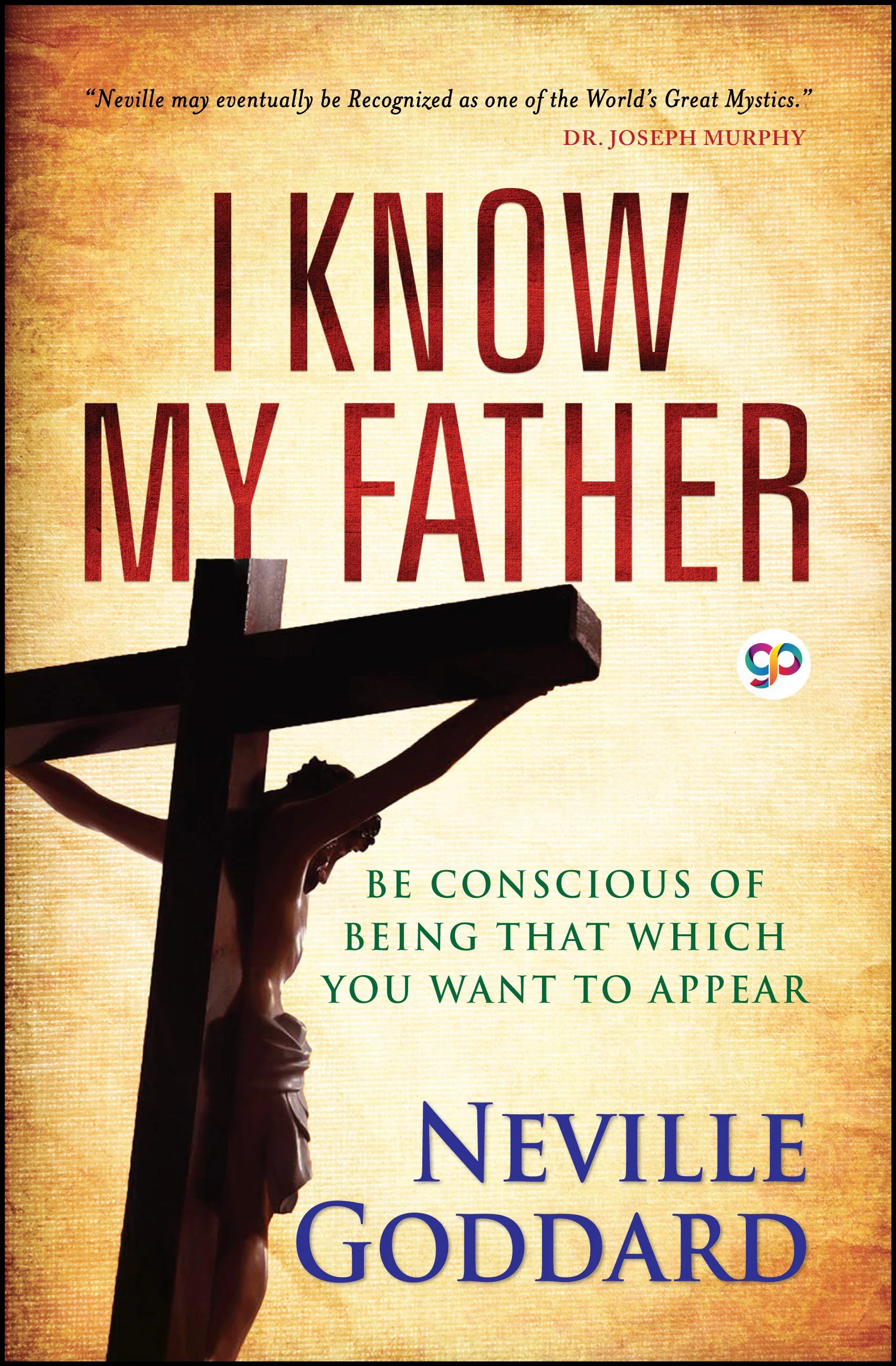
I Know My Father
eBook
• INR 99.00
• English
• 9789354997259
No ratings yet
| Publisher | General Press |
|---|---|
| ISBN13 | 9789354997259 |
| ASIN/SKU | B0BYZKSTFT |
| Book Format | eBook |
| Language | English |
| List Price | INR 99.00 |
| Subject Code | OCC019000 |
| Publishing Date | 24/03/2023 |
| Book Code | BD00069104 |
Buy this Book
Amazon Stores
Ebook Stores
Other Stores
Discover I Know My Father by Neville Goddard. This book is published by General Press in eBook format, ISBN 9789354997259, ASIN B0BYZKSTFT, under Christian Books and Bibles, Christian Living, Christianity.
Book Description
An outstanding book by Neville Goddard detailing the law of attraction. Your desires are the invisible realities that respond only to the commands of God. God commands the invisible to appear by claiming himself to be the thing commanded. "He made himself equal with God and found it not robbery to do the works of God."
Neville Goddard came to the United States in 1922 and enjoyed a career in the theater. His interest in mysticism grew as did his esoteric interpretations of the Bible. He studied with a man named Abdullah for many years, learning Hebrew and delving deeply into the hidden symbolic meaning of the Kabbalah and scripture. Neville began lecturing and traveling throughout the United States, making his home In Los Angeles.
Just as Seth gave us the immortal words, “You create your reality,” Neville has told us how with his spectacular phrase, “Imagining creates reality.” What a gift to humankind! He also translates the Bible in a new light, explaining how the stories and parables are psychological dramas representing our consciousness. That all of its characters and actors are personified qualities and attributes of our consciousness.
Neville Goddard came to the United States in 1922 and enjoyed a career in the theater. His interest in mysticism grew as did his esoteric interpretations of the Bible. He studied with a man named Abdullah for many years, learning Hebrew and delving deeply into the hidden symbolic meaning of the Kabbalah and scripture. Neville began lecturing and traveling throughout the United States, making his home In Los Angeles.
Just as Seth gave us the immortal words, “You create your reality,” Neville has told us how with his spectacular phrase, “Imagining creates reality.” What a gift to humankind! He also translates the Bible in a new light, explaining how the stories and parables are psychological dramas representing our consciousness. That all of its characters and actors are personified qualities and attributes of our consciousness.
Author Biography
Neville Lancelot Goddard (1905–1972) was a prominent and highly influential teacher in the New Thought movement, best known for his philosophy on the creative power of the human imagination. Born in St. Michael, Barbados, Goddard moved to New York City in 1922 to study drama. While working as a dancer and actor, his interests shifted toward mysticism after meeting an eccentric Ethiopian rabbi named Abdullah, who mentored him in Kabbalah, esoteric Christianity, and the psychological interpretation of scripture.
Leaving the theater behind, Neville dedicated his life to teaching what he termed "The Law of Assumption"—the principle that one can manifest their desires by vividly assuming the feeling of the wish fulfilled. Unlike many of his contemporaries, he taught that the Bible was not a historical record but a psychological drama mapping the evolution of human consciousness, asserting that the divine creator is the human imagination itself.
Throughout the mid-20th century, he delivered hundreds of unscripted lectures across the United States and authored foundational metaphysical classics, including Feeling is the Secret and The Power of Awareness. Today, Goddard’s visionary teachings continue to experience a massive resurgence, profoundly shaping modern self-help, spirituality, and manifestation philosophies.
Leaving the theater behind, Neville dedicated his life to teaching what he termed "The Law of Assumption"—the principle that one can manifest their desires by vividly assuming the feeling of the wish fulfilled. Unlike many of his contemporaries, he taught that the Bible was not a historical record but a psychological drama mapping the evolution of human consciousness, asserting that the divine creator is the human imagination itself.
Throughout the mid-20th century, he delivered hundreds of unscripted lectures across the United States and authored foundational metaphysical classics, including Feeling is the Secret and The Power of Awareness. Today, Goddard’s visionary teachings continue to experience a massive resurgence, profoundly shaping modern self-help, spirituality, and manifestation philosophies.
Editorial Reviews
Editorial Reviews will be added soon…
Book Summary
I Know My Father by Neville Goddard is one of the most mystical and inward-looking works in his body of writing. First published in 1960, the short book moves beyond Goddard’s familiar teachings about imagination and manifestation and focuses on what he regarded as the deeper spiritual meaning of the Bible. Its ten chapters—beginning with “I AM” and ending with “Be Ears That Hear”—explore God, consciousness, imagination, faith, desire, circumcision, crucifixion, resurrection, and the mystical relationship between the individual and the divine Father.
For readers searching for an I Know My Father book summary, the central idea can be expressed simply: Goddard argues that the divine Father is not a distant being somewhere outside us. God is experienced through the deepest awareness of being—the simple realization, “I AM.” According to Goddard, this awareness is shared by every human being, and recognizing it is the beginning of spiritual awakening. The book therefore asks the reader to look inward rather than searching for God exclusively through external institutions, historical events, or conventional religious interpretations.
The Central Idea: “I AM”
The opening chapter, “I AM,” establishes the foundation for everything that follows. Goddard begins with the biblical idea that the Father of Jesus is also our Father and that the divine is one. His interpretation is radical: what all people have in common is not their nationality, personality, occupation, beliefs, or circumstances, but the fact that they are conscious of existing.
Before someone can say, “I am successful,” “I am poor,” “I am happy,” “I am afraid,” or “I am a parent,” there is the more fundamental awareness: “I am.”
Goddard treats this basic consciousness as sacred. The personal identity we attach to it changes constantly, but the awareness of being remains. In his view, this is the divine presence within us. The distinction between an ordinary person and God is therefore not as absolute as conventional religious thinking might suggest. The deepest “I AM” is the point where human consciousness and divine consciousness meet.
This idea also explains why Goddard places so much importance on statements of identity. What follows “I am” matters because it gives direction to consciousness. If a person repeatedly identifies with limitation, failure, fear, or helplessness, those assumptions shape the way the person experiences life. If the person instead identifies with a desired state and genuinely experiences it inwardly, consciousness begins operating from a different position.
This is closely connected with Goddard’s famous Law of Assumption. Rather than trying desperately to make something happen from the outside, the individual imagines and inwardly accepts the condition as already real.
“I Come With a Sword”: The Power of Inner Transformation
The second chapter, “I Come With a Sword,” continues the challenge to conventional thinking. The “sword” can be understood as a force that cuts through false assumptions and inherited beliefs. Goddard’s Bible is not primarily a historical record for him. It is a symbolic map of human consciousness.
This approach is crucial to understanding I Know My Father. Goddard repeatedly takes familiar biblical language and interprets it psychologically and mystically. Characters, events, places, and miracles are not merely things that happened to other people in the distant past. They represent processes that can take place within individual consciousness.
The result is a very personal reading of scripture. The Bible becomes a story about you.
Goddard wants the reader to stop treating spiritual transformation as something that happened only to prophets or biblical figures. Instead, the same patterns are potentially experienced within every human being.
The Foundation Stone: What Supports Your Reality?
The third chapter, “The Foundation Stone,” asks the reader to examine what lies beneath everyday experience. In Goddard’s philosophy, consciousness is the foundation from which experience develops.
A person’s outer circumstances may appear to be the foundation of life. If someone has financial difficulties, for example, it is natural to think that those circumstances determine how the person must feel and think. Goddard reverses this relationship. He asks the reader to consider whether the inner state is actually more fundamental than the external condition.
This is one of the recurring themes throughout his work: circumstances are not the ultimate authority. Consciousness is.
The practical implication is that changing life begins with changing the inner position from which life is experienced. Rather than waiting for external evidence before adopting a new state of mind, the individual assumes the desired state first.
“The I’M-PRESSION”: Consciousness Leaves an Impression
The fourth chapter, “The I’M-PRESSION,” develops this idea further. Goddard emphasizes the importance of impressions made upon consciousness.
Everyday life continually leaves impressions on the mind. Conversations, memories, fears, successes, disappointments, images, and expectations all influence what we assume to be true. But Goddard believes that people do not have to remain passive recipients of these impressions.
They can deliberately choose what they impress upon consciousness.
This is where imagination becomes important. For Goddard, imagination is not simply the ability to create fantasy. It is a creative faculty. The inner image, feeling, or assumption can become the starting point from which external experience changes.
Suppose a person wants to become confident. Instead of repeatedly thinking, “I am not confident,” the person can imagine situations in which confidence is already natural. The important element is not merely seeing an image but experiencing the state inwardly. The goal is to make the desired condition feel normal.
Goddard's philosophy therefore places unusual emphasis on feeling. The question is not only, “What do I want?” but also, “What would it feel like if I already had it?”
“He Who Has”: The State of Having
The fifth chapter, “He Who Has,” reinforces the principle of assumption. Goddard argues that desire should not be approached entirely from a position of lack.
If you constantly think, “I want success,” your attention remains fixed on not having success. Instead, Goddard encourages the reader to enter psychologically into the state of already having what is desired.
This does not mean pretending in a superficial way. It means using imagination to experience the fulfillment of the desire internally.
For example, someone seeking a new career might imagine receiving congratulations from a friend after getting the position. Someone hoping for financial stability might imagine the relief and naturalness of opening a bank statement showing security. The specific image is less important than the inner state it represents.
In Goddard's system, the fulfilled state becomes the seed.
Circumcision: Cutting Away the Old Identity
The sixth chapter, “Circumcision,” is interpreted symbolically rather than merely physically. Goddard sees circumcision as the cutting away of what is unnecessary or limiting.
Psychologically, this means removing identification with unwanted states.
If a person has spent years thinking of themselves as unlucky, powerless, rejected, unsuccessful, or incapable, Goddard would say that the person has become identified with those states. Spiritual transformation requires cutting the attachment.
This does not necessarily happen through force. Instead, the individual chooses a new identity and repeatedly returns to it.
The process is essentially one of inner reorientation: stop feeding the old assumption and begin inhabiting the new one.
Crucifixion and Resurrection: Dying to the Old State
The seventh chapter, “Crucifixion and Resurrection,” is perhaps the clearest expression of Goddard’s mystical interpretation of transformation.
Crucifixion represents the death of an old state of consciousness, while resurrection represents the emergence of a new one.
This can happen psychologically every time a person abandons an old identity and fully accepts another. The person who has always thought, “I am a failure” must eventually allow that identity to die if they want to live from a new sense of self.
For Goddard, this is not merely positive thinking. It is a transformation in identity.
The old state must lose its authority.
The new state must become natural.
This idea explains why Goddard repeatedly tells readers to live from the end rather than merely wishing for an end. The person must imaginatively occupy the destination rather than continually staring at the distance between the present and the desired future.
“No Other God”: Taking Responsibility for Consciousness
Chapter eight, “No Other God,” develops one of Goddard’s boldest teachings. If God is experienced as the deepest “I AM,” then there is no separate external power that ultimately determines the individual’s inner state.
The teaching can feel both liberating and demanding.
It is liberating because it places creative power within consciousness rather than somewhere inaccessible. But it is demanding because it also places responsibility on the individual.
If you believe that your entire life is controlled by forces outside you, you become passive. If you believe that consciousness has creative power, you must become more careful about what you consistently assume, imagine, and accept.
Goddard's point is not that people should deny reality or ignore genuine difficulties. Rather, he asks readers not to grant external appearances the final word.
This principle appears repeatedly in the text: appearances may describe the current condition, but they do not necessarily define the final possibility.
“Thy Will Be Done”: Aligning Desire With the Divine
The ninth chapter, “Thy Will Be Done,” explores the relationship between personal desire and divine will.
At first glance, the phrase “Thy will be done” might sound like surrendering personal desires. Goddard gives it a more inward interpretation. If the divine operates through consciousness, then realizing a desire can itself be part of the creative process.
The key is to distinguish between desperate wanting and confident assumption.
Instead of begging for something while believing it is distant, the individual can imaginatively accept its fulfillment. Prayer becomes less about persuading an external God and more about changing consciousness.
This is why imagination and prayer are so closely connected in Goddard’s philosophy. Prayer is an inner act of assumption.
“Be Ears That Hear”: Listening Beyond the Surface
The final chapter, “Be Ears That Hear,” brings the book to a contemplative conclusion. Goddard asks the reader to listen differently—not merely to words but to the deeper meaning behind scripture and experience.
To have “ears that hear” means being receptive to spiritual insight.
The reader is encouraged to move beyond literalism and develop an inner sensitivity to the symbolic language of scripture. Goddard believes the Bible contains descriptions of psychological and mystical processes that can be personally experienced.
This final chapter also reinforces the book’s larger message: spiritual knowledge is not simply information that can be collected. It is something that must be experienced.
The Mystical Experiences Behind the Book
An important part of I Know My Father is that Goddard presents his own mystical experiences as evidence for his interpretation. He describes extraordinary experiences associated with what he regarded as the fulfillment of biblical promises. Sources reproducing the text record his account of an experience in April 1960 involving a powerful sensation moving through his body and his interpretation of it as the fulfillment of biblical imagery.
These experiences are important because they show that the book is not simply a collection of motivational advice. Goddard believed he was describing stages of genuine spiritual awakening.
His later lectures likewise describe a sequence of mystical experiences beginning in 1959 and continuing through 1960, including what he interpreted as the revelation of the Fatherhood of God and the descent of the Holy Spirit.
Readers do not have to accept these experiences literally to understand their significance within Goddard’s philosophy. They represent the culmination of his belief that biblical promises are meant to be fulfilled within individual consciousness.
What I Know My Father Ultimately Teaches
At its deepest level, I Know My Father is not primarily a book about material success. It is a book about identity.
Goddard asks the reader to reconsider the meaning of “I.” Who are you beneath your name, history, social position, successes, and failures? What remains when all those descriptions change?
His answer is consciousness—the awareness that you are.
From this foundation, he develops a spiritual philosophy in which imagination becomes creative, assumptions influence experience, and biblical stories become descriptions of inner transformation.
For readers interested in Neville Goddard’s Law of Assumption, manifestation, spiritual awakening, biblical symbolism, consciousness, or the relationship between imagination and reality, I Know My Father is especially significant because it represents the mystical side of his teaching. It is less of a step-by-step manifestation manual than a meditation on what Goddard believed was the ultimate truth behind his earlier practical teachings.
The book’s enduring appeal comes from the simplicity of its deepest question: What does it mean to say “I AM”?
Goddard’s answer is expansive. The “I AM” is not merely a personal label. It is, in his philosophy, the doorway to the divine. To change your experience, you begin by examining what you are conscious of being. To transform your life, you change the state from which you live. And to understand God, Goddard asks you to look inward rather than only outward.
In that sense, I Know My Father can be read as the culmination of a simple but profound movement: from wanting something outside yourself, to discovering the creative power of consciousness, and finally to recognizing the divine presence within the very awareness that says, “I am.”
For readers searching for an I Know My Father book summary, the central idea can be expressed simply: Goddard argues that the divine Father is not a distant being somewhere outside us. God is experienced through the deepest awareness of being—the simple realization, “I AM.” According to Goddard, this awareness is shared by every human being, and recognizing it is the beginning of spiritual awakening. The book therefore asks the reader to look inward rather than searching for God exclusively through external institutions, historical events, or conventional religious interpretations.
The Central Idea: “I AM”
The opening chapter, “I AM,” establishes the foundation for everything that follows. Goddard begins with the biblical idea that the Father of Jesus is also our Father and that the divine is one. His interpretation is radical: what all people have in common is not their nationality, personality, occupation, beliefs, or circumstances, but the fact that they are conscious of existing.
Before someone can say, “I am successful,” “I am poor,” “I am happy,” “I am afraid,” or “I am a parent,” there is the more fundamental awareness: “I am.”
Goddard treats this basic consciousness as sacred. The personal identity we attach to it changes constantly, but the awareness of being remains. In his view, this is the divine presence within us. The distinction between an ordinary person and God is therefore not as absolute as conventional religious thinking might suggest. The deepest “I AM” is the point where human consciousness and divine consciousness meet.
This idea also explains why Goddard places so much importance on statements of identity. What follows “I am” matters because it gives direction to consciousness. If a person repeatedly identifies with limitation, failure, fear, or helplessness, those assumptions shape the way the person experiences life. If the person instead identifies with a desired state and genuinely experiences it inwardly, consciousness begins operating from a different position.
This is closely connected with Goddard’s famous Law of Assumption. Rather than trying desperately to make something happen from the outside, the individual imagines and inwardly accepts the condition as already real.
“I Come With a Sword”: The Power of Inner Transformation
The second chapter, “I Come With a Sword,” continues the challenge to conventional thinking. The “sword” can be understood as a force that cuts through false assumptions and inherited beliefs. Goddard’s Bible is not primarily a historical record for him. It is a symbolic map of human consciousness.
This approach is crucial to understanding I Know My Father. Goddard repeatedly takes familiar biblical language and interprets it psychologically and mystically. Characters, events, places, and miracles are not merely things that happened to other people in the distant past. They represent processes that can take place within individual consciousness.
The result is a very personal reading of scripture. The Bible becomes a story about you.
Goddard wants the reader to stop treating spiritual transformation as something that happened only to prophets or biblical figures. Instead, the same patterns are potentially experienced within every human being.
The Foundation Stone: What Supports Your Reality?
The third chapter, “The Foundation Stone,” asks the reader to examine what lies beneath everyday experience. In Goddard’s philosophy, consciousness is the foundation from which experience develops.
A person’s outer circumstances may appear to be the foundation of life. If someone has financial difficulties, for example, it is natural to think that those circumstances determine how the person must feel and think. Goddard reverses this relationship. He asks the reader to consider whether the inner state is actually more fundamental than the external condition.
This is one of the recurring themes throughout his work: circumstances are not the ultimate authority. Consciousness is.
The practical implication is that changing life begins with changing the inner position from which life is experienced. Rather than waiting for external evidence before adopting a new state of mind, the individual assumes the desired state first.
“The I’M-PRESSION”: Consciousness Leaves an Impression
The fourth chapter, “The I’M-PRESSION,” develops this idea further. Goddard emphasizes the importance of impressions made upon consciousness.
Everyday life continually leaves impressions on the mind. Conversations, memories, fears, successes, disappointments, images, and expectations all influence what we assume to be true. But Goddard believes that people do not have to remain passive recipients of these impressions.
They can deliberately choose what they impress upon consciousness.
This is where imagination becomes important. For Goddard, imagination is not simply the ability to create fantasy. It is a creative faculty. The inner image, feeling, or assumption can become the starting point from which external experience changes.
Suppose a person wants to become confident. Instead of repeatedly thinking, “I am not confident,” the person can imagine situations in which confidence is already natural. The important element is not merely seeing an image but experiencing the state inwardly. The goal is to make the desired condition feel normal.
Goddard's philosophy therefore places unusual emphasis on feeling. The question is not only, “What do I want?” but also, “What would it feel like if I already had it?”
“He Who Has”: The State of Having
The fifth chapter, “He Who Has,” reinforces the principle of assumption. Goddard argues that desire should not be approached entirely from a position of lack.
If you constantly think, “I want success,” your attention remains fixed on not having success. Instead, Goddard encourages the reader to enter psychologically into the state of already having what is desired.
This does not mean pretending in a superficial way. It means using imagination to experience the fulfillment of the desire internally.
For example, someone seeking a new career might imagine receiving congratulations from a friend after getting the position. Someone hoping for financial stability might imagine the relief and naturalness of opening a bank statement showing security. The specific image is less important than the inner state it represents.
In Goddard's system, the fulfilled state becomes the seed.
Circumcision: Cutting Away the Old Identity
The sixth chapter, “Circumcision,” is interpreted symbolically rather than merely physically. Goddard sees circumcision as the cutting away of what is unnecessary or limiting.
Psychologically, this means removing identification with unwanted states.
If a person has spent years thinking of themselves as unlucky, powerless, rejected, unsuccessful, or incapable, Goddard would say that the person has become identified with those states. Spiritual transformation requires cutting the attachment.
This does not necessarily happen through force. Instead, the individual chooses a new identity and repeatedly returns to it.
The process is essentially one of inner reorientation: stop feeding the old assumption and begin inhabiting the new one.
Crucifixion and Resurrection: Dying to the Old State
The seventh chapter, “Crucifixion and Resurrection,” is perhaps the clearest expression of Goddard’s mystical interpretation of transformation.
Crucifixion represents the death of an old state of consciousness, while resurrection represents the emergence of a new one.
This can happen psychologically every time a person abandons an old identity and fully accepts another. The person who has always thought, “I am a failure” must eventually allow that identity to die if they want to live from a new sense of self.
For Goddard, this is not merely positive thinking. It is a transformation in identity.
The old state must lose its authority.
The new state must become natural.
This idea explains why Goddard repeatedly tells readers to live from the end rather than merely wishing for an end. The person must imaginatively occupy the destination rather than continually staring at the distance between the present and the desired future.
“No Other God”: Taking Responsibility for Consciousness
Chapter eight, “No Other God,” develops one of Goddard’s boldest teachings. If God is experienced as the deepest “I AM,” then there is no separate external power that ultimately determines the individual’s inner state.
The teaching can feel both liberating and demanding.
It is liberating because it places creative power within consciousness rather than somewhere inaccessible. But it is demanding because it also places responsibility on the individual.
If you believe that your entire life is controlled by forces outside you, you become passive. If you believe that consciousness has creative power, you must become more careful about what you consistently assume, imagine, and accept.
Goddard's point is not that people should deny reality or ignore genuine difficulties. Rather, he asks readers not to grant external appearances the final word.
This principle appears repeatedly in the text: appearances may describe the current condition, but they do not necessarily define the final possibility.
“Thy Will Be Done”: Aligning Desire With the Divine
The ninth chapter, “Thy Will Be Done,” explores the relationship between personal desire and divine will.
At first glance, the phrase “Thy will be done” might sound like surrendering personal desires. Goddard gives it a more inward interpretation. If the divine operates through consciousness, then realizing a desire can itself be part of the creative process.
The key is to distinguish between desperate wanting and confident assumption.
Instead of begging for something while believing it is distant, the individual can imaginatively accept its fulfillment. Prayer becomes less about persuading an external God and more about changing consciousness.
This is why imagination and prayer are so closely connected in Goddard’s philosophy. Prayer is an inner act of assumption.
“Be Ears That Hear”: Listening Beyond the Surface
The final chapter, “Be Ears That Hear,” brings the book to a contemplative conclusion. Goddard asks the reader to listen differently—not merely to words but to the deeper meaning behind scripture and experience.
To have “ears that hear” means being receptive to spiritual insight.
The reader is encouraged to move beyond literalism and develop an inner sensitivity to the symbolic language of scripture. Goddard believes the Bible contains descriptions of psychological and mystical processes that can be personally experienced.
This final chapter also reinforces the book’s larger message: spiritual knowledge is not simply information that can be collected. It is something that must be experienced.
The Mystical Experiences Behind the Book
An important part of I Know My Father is that Goddard presents his own mystical experiences as evidence for his interpretation. He describes extraordinary experiences associated with what he regarded as the fulfillment of biblical promises. Sources reproducing the text record his account of an experience in April 1960 involving a powerful sensation moving through his body and his interpretation of it as the fulfillment of biblical imagery.
These experiences are important because they show that the book is not simply a collection of motivational advice. Goddard believed he was describing stages of genuine spiritual awakening.
His later lectures likewise describe a sequence of mystical experiences beginning in 1959 and continuing through 1960, including what he interpreted as the revelation of the Fatherhood of God and the descent of the Holy Spirit.
Readers do not have to accept these experiences literally to understand their significance within Goddard’s philosophy. They represent the culmination of his belief that biblical promises are meant to be fulfilled within individual consciousness.
What I Know My Father Ultimately Teaches
At its deepest level, I Know My Father is not primarily a book about material success. It is a book about identity.
Goddard asks the reader to reconsider the meaning of “I.” Who are you beneath your name, history, social position, successes, and failures? What remains when all those descriptions change?
His answer is consciousness—the awareness that you are.
From this foundation, he develops a spiritual philosophy in which imagination becomes creative, assumptions influence experience, and biblical stories become descriptions of inner transformation.
For readers interested in Neville Goddard’s Law of Assumption, manifestation, spiritual awakening, biblical symbolism, consciousness, or the relationship between imagination and reality, I Know My Father is especially significant because it represents the mystical side of his teaching. It is less of a step-by-step manifestation manual than a meditation on what Goddard believed was the ultimate truth behind his earlier practical teachings.
The book’s enduring appeal comes from the simplicity of its deepest question: What does it mean to say “I AM”?
Goddard’s answer is expansive. The “I AM” is not merely a personal label. It is, in his philosophy, the doorway to the divine. To change your experience, you begin by examining what you are conscious of being. To transform your life, you change the state from which you live. And to understand God, Goddard asks you to look inward rather than only outward.
In that sense, I Know My Father can be read as the culmination of a simple but profound movement: from wanting something outside yourself, to discovering the creative power of consciousness, and finally to recognizing the divine presence within the very awareness that says, “I am.”
Sample Chapters
Sample Chapters will be added soon…
Reader Reviews
No reviews yet.
I Know My Father
Download Cover Image
Do you want to download the full cover image for I Know My Father?