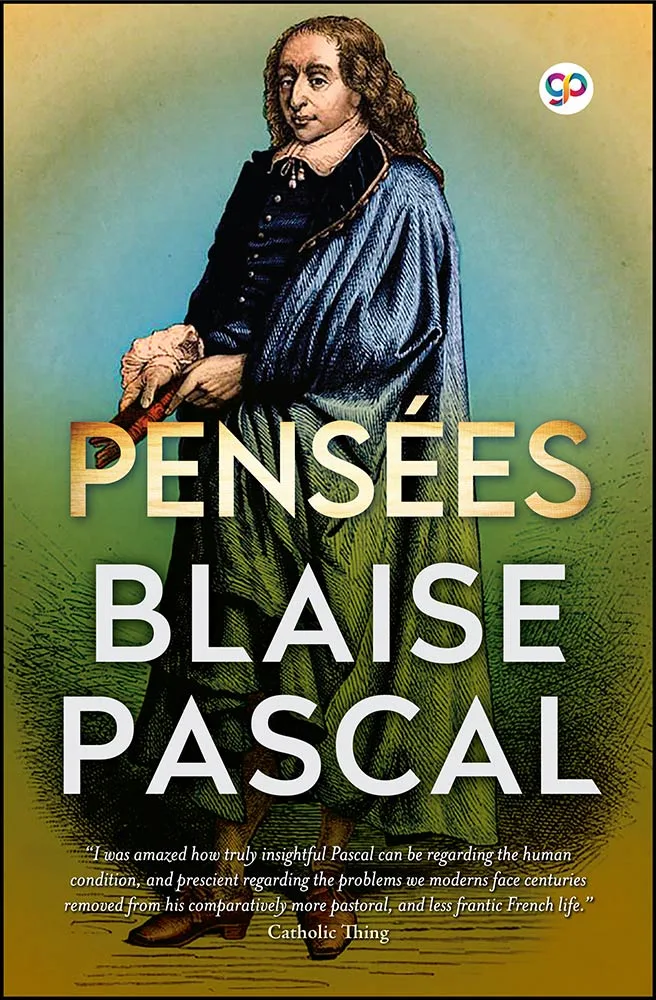
Pensées
eBook
• INR 99.00
• English
• 9788196772482
No ratings yet
| Publisher | General Press |
|---|---|
| ISBN13 | 9788196772482 |
| ASIN/SKU | B0G1BWT74P |
| Book Format | eBook |
| Language | English |
| List Price | INR 99.00 |
| Subject Code | PHI022000, PHI016000, REL067030 |
| Book Code | BD00069105 |
Buy this Book
Amazon Stores
Ebook Stores
Other Stores
Discover Pensées by Blaise Pascal. This book is published by General Press in eBook format, ISBN 9788196772482, ASIN B0G1BWT74P, under Non Fiction, Philosophy of Religion, Christian Apologetics.
Book Description
The important essay defending religion written by the mathematician and philosopher in the seventeenth century. Despite not being a gambler, Blaise Pascal proposed one of the most well-known bets in history: Every man's life is a wager against God. Still, it's a gamble that any man can win. Give up vices like alcohol, desire, sin, and other earthly pleasures, and you will either live happily ever after or in a different world. You can never lose if you live each day as though God exists.
Although Pascal came up with his wager in the seventeenth century, his insightful writings still hold true today. Everything is debatable in this collection of fragments meant to serve as a defense of Christianity. Pascal demonstrates how skepticism and commitment go hand in hand by discussing topics such as the nature of love and the connection between scientific research and religious conviction.
Although Pascal came up with his wager in the seventeenth century, his insightful writings still hold true today. Everything is debatable in this collection of fragments meant to serve as a defense of Christianity. Pascal demonstrates how skepticism and commitment go hand in hand by discussing topics such as the nature of love and the connection between scientific research and religious conviction.
Author Biography
Early work of Blaise Pascal of France included the invention of the adding machine and syringe and the co-development with Pierre de Fermat of the mathematical theory of probability; later, he, a Jansenist, wrote on philosophy and theology, notably as collected in the posthumous Pensées (1670).
This contemporary of René Descartes attained ten years of age in 1633, when people forced Galileo Galilei to recant his belief that Earth circled the Sun. He lived in Paris at the same time, when Thomas Hobbes in 1640 published his famous Leviathan (1651). Together, Pascal created the calculus.
A near-fatal carriage accident in November 1654 persuaded him to turn his intellect finally toward religion. The story goes that on the proverbial dark and stormy night, while Pascal rode in a carriage across a bridge in a suburb of Paris, a fright caused the horses to bolt, sending them over the edge. The carriage, bearing Pascal, survived. Pascal took the incident as a sign and devoted. At this time, he began a series, called the Provincial Letters , against the Jesuits in 1657.
Pascal perhaps most famously wagered not as clearly in his language as this summary: "If Jesus does not exist, the non Christian loses little by believing in him and gains little by not believing. If Jesus does exist, the non Christian gains eternal life by believing and loses an infinite good by not believing.” Sick throughout life, Pascal died in Paris from a combination of tuberculosis and stomach cancer at 39 years of age. At the last, he confessed Catholicism.
This contemporary of René Descartes attained ten years of age in 1633, when people forced Galileo Galilei to recant his belief that Earth circled the Sun. He lived in Paris at the same time, when Thomas Hobbes in 1640 published his famous Leviathan (1651). Together, Pascal created the calculus.
A near-fatal carriage accident in November 1654 persuaded him to turn his intellect finally toward religion. The story goes that on the proverbial dark and stormy night, while Pascal rode in a carriage across a bridge in a suburb of Paris, a fright caused the horses to bolt, sending them over the edge. The carriage, bearing Pascal, survived. Pascal took the incident as a sign and devoted. At this time, he began a series, called the Provincial Letters , against the Jesuits in 1657.
Pascal perhaps most famously wagered not as clearly in his language as this summary: "If Jesus does not exist, the non Christian loses little by believing in him and gains little by not believing. If Jesus does exist, the non Christian gains eternal life by believing and loses an infinite good by not believing.” Sick throughout life, Pascal died in Paris from a combination of tuberculosis and stomach cancer at 39 years of age. At the last, he confessed Catholicism.
Editorial Reviews
Editorial Reviews will be added soon…
Book Summary
Book Summary will be added soon…
Sample Chapters
Sample Chapters will be added soon…
Reader Reviews
No reviews yet.
Pensées