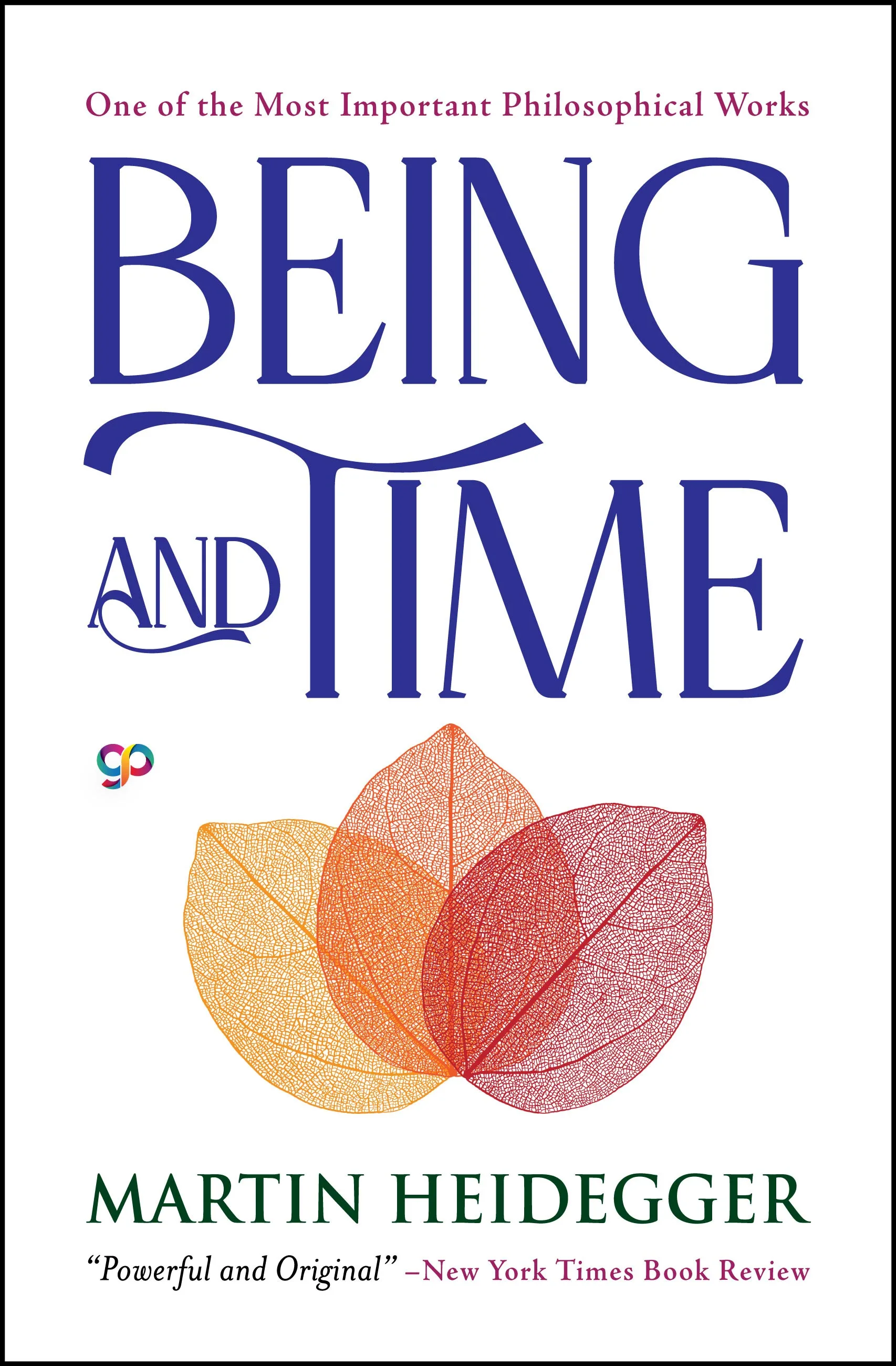
Being and Time
eBook
• INR 99.00
• English
• 9789354997174
No ratings yet
| Publisher | General Press |
|---|---|
| ISBN13 | 9789354997174 |
| ASIN/SKU | B0BYZKWW2Y |
| Book Format | eBook |
| Language | English |
| List Price | INR 99.00 |
| Subject Code | PHI046000 |
| Publishing Date | 24/03/2023 |
| Book Code | BD00069109 |
Discover Being and Time by Martin Heidegger. This book is published by General Press in eBook format, ISBN 9789354997174, ASIN B0BYZKWW2Y, under Non Fiction, European Literature, Philosophy.
Book Description
Heidegger's lecture course at the University of Marburg in the summer of 1925, an early version of ‘Being and Time’ (1927), offers a unique glimpse into the motivations that prompted the writing of this great philosopher's masterwork and the presuppositions that gave shape to it.
The book embarks upon a provisional description of what Heidegger calls ‘Dasein’, the field in which both being and time become manifest. Heidegger analyzes Dasein in its everydayness in a deepening sequence of terms: being-in-the-world, worldhood, and care as the being of Dasein.
The course ends by sketching the themes of death and conscience and their relevance to an ontology that makes the phenomenon of time central. Theodore Kisiel's outstanding translation permits English-speaking readers to appreciate the central importance of this text in the development of Heidegger's thought.
"Temporality temporalizes as a future which makes present in the process of having been."
— Martin Heidegger (Being and Time)
The book embarks upon a provisional description of what Heidegger calls ‘Dasein’, the field in which both being and time become manifest. Heidegger analyzes Dasein in its everydayness in a deepening sequence of terms: being-in-the-world, worldhood, and care as the being of Dasein.
The course ends by sketching the themes of death and conscience and their relevance to an ontology that makes the phenomenon of time central. Theodore Kisiel's outstanding translation permits English-speaking readers to appreciate the central importance of this text in the development of Heidegger's thought.
"Temporality temporalizes as a future which makes present in the process of having been."
— Martin Heidegger (Being and Time)
Author Biography
Martin Heidegger (1889–1976) was one of the most influential and controversial philosophers of the twentieth century. His work transformed modern philosophy by exploring profound questions about existence, human experience, language, and the meaning of being. Although his ideas have shaped fields such as philosophy, psychology, literature, theology, and architecture, his reputation has also been deeply affected by his association with Nazism during the 1930s, a subject that continues to be widely debated.
Heidegger was born on September 26, 1889, in Messkirch, a small town in southwestern Germany. Raised in a modest Catholic family, he initially considered becoming a priest before turning his attention to philosophy. He studied theology and philosophy at the University of Freiburg, where he came under the influence of the philosopher Edmund Husserl, the founder of phenomenology. Heidegger later expanded phenomenology into a new and original approach that focused on the nature of human existence.
His greatest work, Being and Time (Sein und Zeit), was published in 1927 and is regarded as one of the most important philosophical books of the modern era. In it, Heidegger introduced the concept of Dasein, referring to human existence as something deeply connected to the world, time, and the search for meaning. Rather than treating philosophy as an abstract discipline, he encouraged readers to examine everyday life, mortality, and personal responsibility. His later writings explored language, poetry, technology, and humanity's relationship with nature, influencing generations of thinkers across many disciplines.
In 1933, Heidegger became rector of the University of Freiburg and joined the Nazi Party. His support for the regime during that period has remained a central and troubling aspect of his legacy. After the Second World War, he was temporarily prohibited from teaching while his political conduct was investigated. Although he later returned to academic life, debates about the relationship between his philosophy and his political choices have continued ever since.
Martin Heidegger died on May 26, 1976, in his hometown of Messkirch. Today, he is remembered as both a brilliant philosophical innovator and a deeply controversial historical figure. His writings continue to challenge readers to think carefully about existence, truth, technology, and the human condition, while his life serves as a reminder that intellectual greatness and moral judgment do not always go hand in hand.
Heidegger was born on September 26, 1889, in Messkirch, a small town in southwestern Germany. Raised in a modest Catholic family, he initially considered becoming a priest before turning his attention to philosophy. He studied theology and philosophy at the University of Freiburg, where he came under the influence of the philosopher Edmund Husserl, the founder of phenomenology. Heidegger later expanded phenomenology into a new and original approach that focused on the nature of human existence.
His greatest work, Being and Time (Sein und Zeit), was published in 1927 and is regarded as one of the most important philosophical books of the modern era. In it, Heidegger introduced the concept of Dasein, referring to human existence as something deeply connected to the world, time, and the search for meaning. Rather than treating philosophy as an abstract discipline, he encouraged readers to examine everyday life, mortality, and personal responsibility. His later writings explored language, poetry, technology, and humanity's relationship with nature, influencing generations of thinkers across many disciplines.
In 1933, Heidegger became rector of the University of Freiburg and joined the Nazi Party. His support for the regime during that period has remained a central and troubling aspect of his legacy. After the Second World War, he was temporarily prohibited from teaching while his political conduct was investigated. Although he later returned to academic life, debates about the relationship between his philosophy and his political choices have continued ever since.
Martin Heidegger died on May 26, 1976, in his hometown of Messkirch. Today, he is remembered as both a brilliant philosophical innovator and a deeply controversial historical figure. His writings continue to challenge readers to think carefully about existence, truth, technology, and the human condition, while his life serves as a reminder that intellectual greatness and moral judgment do not always go hand in hand.
Editorial Reviews
Editorial Reviews will be added soon…
Book Summary
Published in 1927, Martin Heidegger’s "Being and Time" stands as one of the most towering, difficult, and profoundly influential philosophical works of the twentieth century. At its heart, the book is driven by a single, monumental inquiry that Heidegger calls the "question of the meaning of Being." He argues that for over two millennia, the tradition of Western philosophy has suffered from a deep forgetfulness. Since the time of the ancient Greeks, philosophers have been preoccupied with "beings"—the various entities that populate our universe, from trees and tables to human minds and mathematical concepts. In doing so, they have entirely overlooked "Being" itself, which is the underlying condition that allows any specific entity to show up in the world, to matter, or to exist at all. Heidegger’s ambitious project was to reawaken this fundamental question, forcing us to look past the superficial reality of things to understand the profound mystery of existence itself.
To investigate the nature of Being, Heidegger realizes he cannot just look at ordinary objects; he must interrogate the one entity that actually cares about existence and has the capacity to ask philosophical questions. He turns his attention to us, human beings, but he discards traditional terms like "man," "subject," or "soul," because they come burdened with centuries of philosophical baggage. Instead, he introduces the term "Dasein," a German word that literally translates to "being-there." Dasein is not merely a biological organism or a rational machine operating in a void. It is a unique kind of entity whose very being is an issue for it. Unlike a rock, which simply is, Dasein is actively invested in its own existence. We are constantly navigating our lives, projecting ourselves into the future, making choices, and caring about who we are and what our lives mean.
A fundamental and inescapable characteristic of Dasein is what Heidegger calls "Being-in-the-world." With this concept, he systematically dismantles the traditional idea—most famously proposed by René Descartes—that a human being is essentially an isolated, thinking mind cut off from an objective, external physical reality. For Heidegger, there is no separation between the subject and the world; we are always already deeply immersed in a web of contexts, relationships, and environments. When we go about our daily lives, we do not encounter things as detached scientific observers analyzing geometric properties. We encounter them practically. A hammer, for example, is not initially understood as a wooden cylinder attached to a metal chunk of a specific weight; it is understood as a tool for driving nails, something "ready-to-hand." The world is fundamentally a network of equipment and meanings that we engage with seamlessly, long before we ever stop to theorize about it.
Despite this deep, meaningful engagement with the world, Dasein constantly struggles with a tendency Heidegger describes as "fallenness." Existing is a heavy burden, fraught with the responsibility of choice and the uncertainty of the future. To escape this weight, Dasein naturally tends to flee from its own individuality and become absorbed into the anonymous mass of society, which Heidegger calls "the they" (das Man). The "they" dictates what is normal, what is acceptable, what is worth talking about, and how one should behave. We end up reading what "they" read, judging what "they" judge, and finding outrageous what "they" find outrageous. In this state of inauthenticity, we surrender our unique potential to the comforting, tranquilizing conformity of the crowd, drifting along in superficial curiosity and idle chatter rather than taking ownership of our own lives.
What disrupts this comfortable but deeply inauthentic slumber is the profound, overwhelming mood of "angst," or anxiety. Heidegger is very careful to distinguish angst from ordinary fear. Fear is always directed at some specific, identifiable entity or event in the world—you fear a dangerous animal, a financial crisis, or an upcoming exam. Angst, on the other hand, has no specific object. In a state of angst, the familiar, everyday web of meanings and purposes suddenly collapses and drains away, leaving you confronted with the sheer, naked, unsettling fact of your own existence. While it is an incredibly terrifying experience, angst is philosophically vital for Heidegger. It pulls Dasein away from the comforting illusions of the "they" and forces you to confront your own radical freedom and the ultimate responsibility you have to shape your own unique path in the world.
Facing the reality of our individual existence inevitably brings us face-to-face with our most absolute and defining limit: death. Heidegger famously defines human existence as "Being-towards-death." He does not mean this in a morbid, pessimistic sense, nor is he referring to the biological event of passing away at the end of a long life. Rather, he is talking about death as an ever-present structural condition of our lives. Death is the one possibility that is absolutely certain, entirely uniquely your own, and impossible to outstrip. No one else can die your death for you, and when it happens, it strips away all of your worldly roles, projects, and connections. Most of the time, the "they" tries to conceal this terrifying reality, treating death as a generic event that just happens to other people. But to live a genuine life, Heidegger argues, Dasein must resolutely anticipate its own death. By deeply acknowledging our finitude, we realize that our time is painfully limited, which strips away trivial concerns and gives our choices ultimate weight.
This confrontation with mortality gives rise to Heidegger’s concept of authenticity. An authentic Dasein is one that has fully owned up to its limits and accepted the heavy burden of its freedom. Achieving authenticity does not mean that you completely disconnect from society or invent a radically new life out of thin air. We are always "thrown" into a specific historical period, culture, and family situation—a condition Heidegger calls "thrownness." Authenticity involves a kind of "resoluteness" where you actively and consciously take up the specific historical and cultural possibilities you have inherited, and project them toward your own future. Instead of sleepwalking through the roles society has handed you, you make those roles your own, living with a heightened sense of clarity, urgency, and purpose, fully aware that every commitment you make is carved out of the limited time you have left.
Ultimately, the thread that ties all of these complex existential structures together is time itself. For Heidegger, time is far more profound than just a sequence of ticking seconds moving uniformly on a clock, which he dismisses as a "vulgar" understanding of time. Instead, foundational temporality is the very fabric of Dasein’s existence. We are not trapped in a momentary present; we are structurally stretched out across time. We are profoundly shaped by our past (our thrownness), we are practically engaged in our current environment (our present fallenness), and we are constantly projecting ourselves toward our ultimate possibilities in the future (Being-towards-death). The fundamental meaning of Dasein’s being is temporality itself. Although Heidegger tragically never completed the planned second half of the book, which was meant to deconstruct the entire history of Western philosophy through this temporal lens, the published portion fundamentally transformed modern thought, setting the stage for existential phenomenology and reshaping how humanity understands its own existence.
To investigate the nature of Being, Heidegger realizes he cannot just look at ordinary objects; he must interrogate the one entity that actually cares about existence and has the capacity to ask philosophical questions. He turns his attention to us, human beings, but he discards traditional terms like "man," "subject," or "soul," because they come burdened with centuries of philosophical baggage. Instead, he introduces the term "Dasein," a German word that literally translates to "being-there." Dasein is not merely a biological organism or a rational machine operating in a void. It is a unique kind of entity whose very being is an issue for it. Unlike a rock, which simply is, Dasein is actively invested in its own existence. We are constantly navigating our lives, projecting ourselves into the future, making choices, and caring about who we are and what our lives mean.
A fundamental and inescapable characteristic of Dasein is what Heidegger calls "Being-in-the-world." With this concept, he systematically dismantles the traditional idea—most famously proposed by René Descartes—that a human being is essentially an isolated, thinking mind cut off from an objective, external physical reality. For Heidegger, there is no separation between the subject and the world; we are always already deeply immersed in a web of contexts, relationships, and environments. When we go about our daily lives, we do not encounter things as detached scientific observers analyzing geometric properties. We encounter them practically. A hammer, for example, is not initially understood as a wooden cylinder attached to a metal chunk of a specific weight; it is understood as a tool for driving nails, something "ready-to-hand." The world is fundamentally a network of equipment and meanings that we engage with seamlessly, long before we ever stop to theorize about it.
Despite this deep, meaningful engagement with the world, Dasein constantly struggles with a tendency Heidegger describes as "fallenness." Existing is a heavy burden, fraught with the responsibility of choice and the uncertainty of the future. To escape this weight, Dasein naturally tends to flee from its own individuality and become absorbed into the anonymous mass of society, which Heidegger calls "the they" (das Man). The "they" dictates what is normal, what is acceptable, what is worth talking about, and how one should behave. We end up reading what "they" read, judging what "they" judge, and finding outrageous what "they" find outrageous. In this state of inauthenticity, we surrender our unique potential to the comforting, tranquilizing conformity of the crowd, drifting along in superficial curiosity and idle chatter rather than taking ownership of our own lives.
What disrupts this comfortable but deeply inauthentic slumber is the profound, overwhelming mood of "angst," or anxiety. Heidegger is very careful to distinguish angst from ordinary fear. Fear is always directed at some specific, identifiable entity or event in the world—you fear a dangerous animal, a financial crisis, or an upcoming exam. Angst, on the other hand, has no specific object. In a state of angst, the familiar, everyday web of meanings and purposes suddenly collapses and drains away, leaving you confronted with the sheer, naked, unsettling fact of your own existence. While it is an incredibly terrifying experience, angst is philosophically vital for Heidegger. It pulls Dasein away from the comforting illusions of the "they" and forces you to confront your own radical freedom and the ultimate responsibility you have to shape your own unique path in the world.
Facing the reality of our individual existence inevitably brings us face-to-face with our most absolute and defining limit: death. Heidegger famously defines human existence as "Being-towards-death." He does not mean this in a morbid, pessimistic sense, nor is he referring to the biological event of passing away at the end of a long life. Rather, he is talking about death as an ever-present structural condition of our lives. Death is the one possibility that is absolutely certain, entirely uniquely your own, and impossible to outstrip. No one else can die your death for you, and when it happens, it strips away all of your worldly roles, projects, and connections. Most of the time, the "they" tries to conceal this terrifying reality, treating death as a generic event that just happens to other people. But to live a genuine life, Heidegger argues, Dasein must resolutely anticipate its own death. By deeply acknowledging our finitude, we realize that our time is painfully limited, which strips away trivial concerns and gives our choices ultimate weight.
This confrontation with mortality gives rise to Heidegger’s concept of authenticity. An authentic Dasein is one that has fully owned up to its limits and accepted the heavy burden of its freedom. Achieving authenticity does not mean that you completely disconnect from society or invent a radically new life out of thin air. We are always "thrown" into a specific historical period, culture, and family situation—a condition Heidegger calls "thrownness." Authenticity involves a kind of "resoluteness" where you actively and consciously take up the specific historical and cultural possibilities you have inherited, and project them toward your own future. Instead of sleepwalking through the roles society has handed you, you make those roles your own, living with a heightened sense of clarity, urgency, and purpose, fully aware that every commitment you make is carved out of the limited time you have left.
Ultimately, the thread that ties all of these complex existential structures together is time itself. For Heidegger, time is far more profound than just a sequence of ticking seconds moving uniformly on a clock, which he dismisses as a "vulgar" understanding of time. Instead, foundational temporality is the very fabric of Dasein’s existence. We are not trapped in a momentary present; we are structurally stretched out across time. We are profoundly shaped by our past (our thrownness), we are practically engaged in our current environment (our present fallenness), and we are constantly projecting ourselves toward our ultimate possibilities in the future (Being-towards-death). The fundamental meaning of Dasein’s being is temporality itself. Although Heidegger tragically never completed the planned second half of the book, which was meant to deconstruct the entire history of Western philosophy through this temporal lens, the published portion fundamentally transformed modern thought, setting the stage for existential phenomenology and reshaping how humanity understands its own existence.
Sample Chapters
Sample Chapters will be added soon…