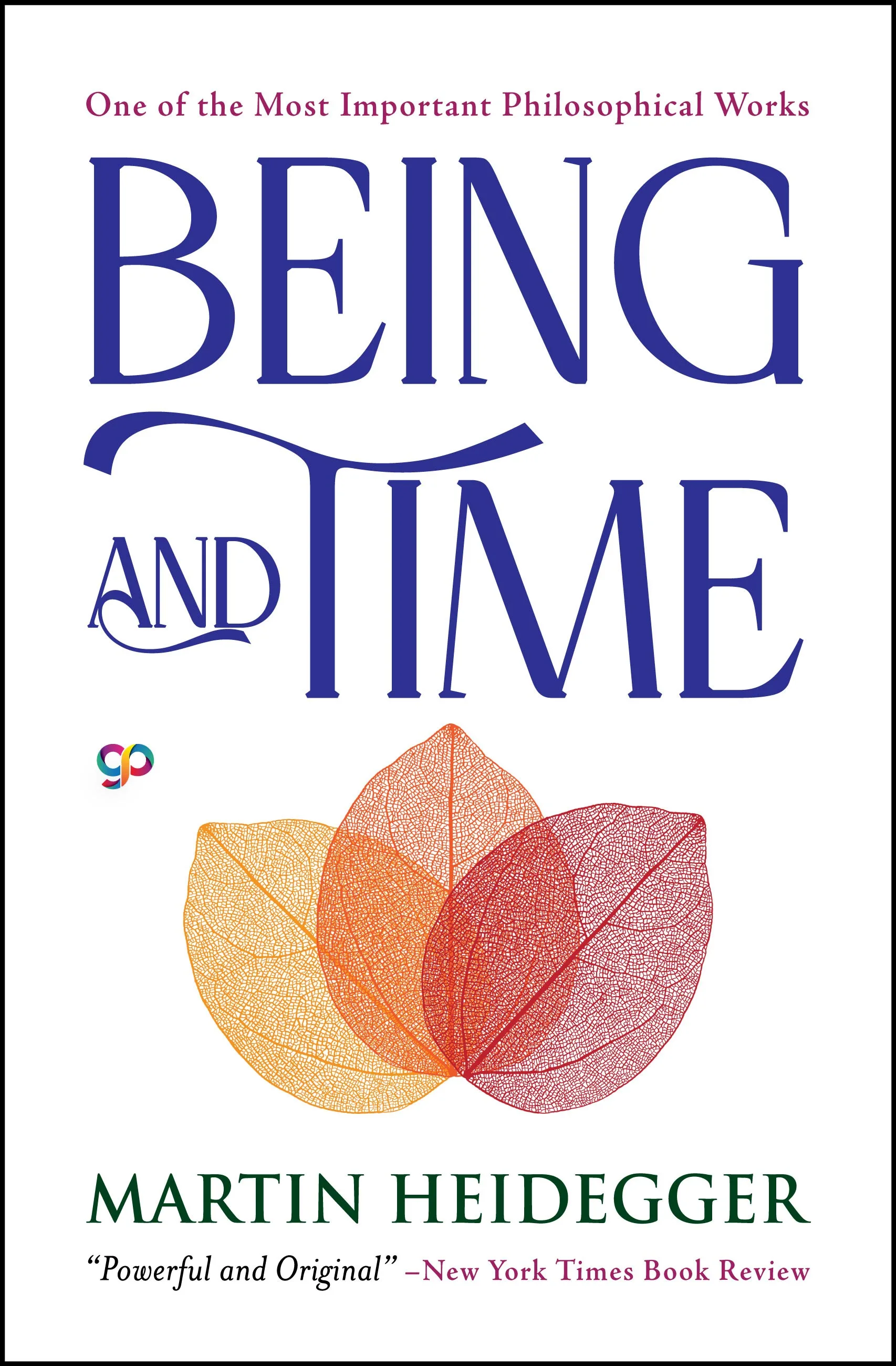
Being and Time
eBook
• INR 99.00
• English
• 9789354997174
No ratings yet
| Publisher | General Press |
|---|---|
| ISBN13 | 9789354997174 |
| ASIN/SKU | B0BYZKWW2Y |
| Book Format | eBook |
| Language | English |
| List Price | INR 99.00 |
| Subject Code | PHI046000 |
| Publishing Date | 24/03/2023 |
| Book Code | BD00069109 |
Buy this Book
Amazon Stores
Ebook Stores
Other Stores
Discover Being and Time by Martin Heidegger. This book is published by General Press in eBook format, ISBN 9789354997174, ASIN B0BYZKWW2Y, under Non Fiction, European Literature, Philosophy.
Book Description
'Being and Time' by Martin Heidegger is a landmark work of 20th-century philosophy, blending existential philosophy and phenomenology to ask one of the most basic yet difficult questions: what does it mean to be? Rather than offering an easy definition, Heidegger takes readers on a challenging journey into the hidden structures of everyday human existence.
At the heart of the book is the idea that human beings are not detached observers standing outside the world. We are already involved in it, surrounded by people, responsibilities, choices, habits, relationships, and practical concerns. Heidegger calls this distinctive kind of existence “Dasein,” or “being-there,” and uses it to explore how we experience ourselves and the world around us. He examines familiar but often overlooked experiences such as anxiety, boredom, care, death, freedom, and the pressure to live according to the expectations of others.
A major theme of 'Being and Time' is the difference between simply drifting through life and living with a genuine awareness of our own existence. Heidegger explores how easily people become absorbed in social routines and accepted opinions, losing sight of their individual possibilities. His discussion of mortality is especially important, suggesting that awareness of death can transform how we understand the limited time available to us and how we choose to live.
Dense but deeply influential, 'Being and Time' invites readers to look at ordinary existence in an entirely new way. Its questions continue to challenge anyone willing to pause and ask what it truly means to live, choose, and be human.
At the heart of the book is the idea that human beings are not detached observers standing outside the world. We are already involved in it, surrounded by people, responsibilities, choices, habits, relationships, and practical concerns. Heidegger calls this distinctive kind of existence “Dasein,” or “being-there,” and uses it to explore how we experience ourselves and the world around us. He examines familiar but often overlooked experiences such as anxiety, boredom, care, death, freedom, and the pressure to live according to the expectations of others.
A major theme of 'Being and Time' is the difference between simply drifting through life and living with a genuine awareness of our own existence. Heidegger explores how easily people become absorbed in social routines and accepted opinions, losing sight of their individual possibilities. His discussion of mortality is especially important, suggesting that awareness of death can transform how we understand the limited time available to us and how we choose to live.
Dense but deeply influential, 'Being and Time' invites readers to look at ordinary existence in an entirely new way. Its questions continue to challenge anyone willing to pause and ask what it truly means to live, choose, and be human.
Author Biography
Martin Heidegger (1889–1976) was one of the most influential and controversial philosophers of the twentieth century. His work transformed modern philosophy by exploring profound questions about existence, human experience, language, and the meaning of being. Although his ideas have shaped fields such as philosophy, psychology, literature, theology, and architecture, his reputation has also been deeply affected by his association with Nazism during the 1930s, a subject that continues to be widely debated.
Heidegger was born on September 26, 1889, in Messkirch, a small town in southwestern Germany. Raised in a modest Catholic family, he initially considered becoming a priest before turning his attention to philosophy. He studied theology and philosophy at the University of Freiburg, where he came under the influence of the philosopher Edmund Husserl, the founder of phenomenology. Heidegger later expanded phenomenology into a new and original approach that focused on the nature of human existence.
His greatest work, Being and Time (Sein und Zeit), was published in 1927 and is regarded as one of the most important philosophical books of the modern era. In it, Heidegger introduced the concept of Dasein, referring to human existence as something deeply connected to the world, time, and the search for meaning. Rather than treating philosophy as an abstract discipline, he encouraged readers to examine everyday life, mortality, and personal responsibility. His later writings explored language, poetry, technology, and humanity's relationship with nature, influencing generations of thinkers across many disciplines.
In 1933, Heidegger became rector of the University of Freiburg and joined the Nazi Party. His support for the regime during that period has remained a central and troubling aspect of his legacy. After the Second World War, he was temporarily prohibited from teaching while his political conduct was investigated. Although he later returned to academic life, debates about the relationship between his philosophy and his political choices have continued ever since.
Martin Heidegger died on May 26, 1976, in his hometown of Messkirch. Today, he is remembered as both a brilliant philosophical innovator and a deeply controversial historical figure. His writings continue to challenge readers to think carefully about existence, truth, technology, and the human condition, while his life serves as a reminder that intellectual greatness and moral judgment do not always go hand in hand.
Heidegger was born on September 26, 1889, in Messkirch, a small town in southwestern Germany. Raised in a modest Catholic family, he initially considered becoming a priest before turning his attention to philosophy. He studied theology and philosophy at the University of Freiburg, where he came under the influence of the philosopher Edmund Husserl, the founder of phenomenology. Heidegger later expanded phenomenology into a new and original approach that focused on the nature of human existence.
His greatest work, Being and Time (Sein und Zeit), was published in 1927 and is regarded as one of the most important philosophical books of the modern era. In it, Heidegger introduced the concept of Dasein, referring to human existence as something deeply connected to the world, time, and the search for meaning. Rather than treating philosophy as an abstract discipline, he encouraged readers to examine everyday life, mortality, and personal responsibility. His later writings explored language, poetry, technology, and humanity's relationship with nature, influencing generations of thinkers across many disciplines.
In 1933, Heidegger became rector of the University of Freiburg and joined the Nazi Party. His support for the regime during that period has remained a central and troubling aspect of his legacy. After the Second World War, he was temporarily prohibited from teaching while his political conduct was investigated. Although he later returned to academic life, debates about the relationship between his philosophy and his political choices have continued ever since.
Martin Heidegger died on May 26, 1976, in his hometown of Messkirch. Today, he is remembered as both a brilliant philosophical innovator and a deeply controversial historical figure. His writings continue to challenge readers to think carefully about existence, truth, technology, and the human condition, while his life serves as a reminder that intellectual greatness and moral judgment do not always go hand in hand.
Editorial Reviews
Editorial Reviews will be added soon…
Book Summary
Published in 1927, Martin Heidegger’s "Being and Time" stands as one of the most towering, difficult, and profoundly influential philosophical works of the twentieth century. At its heart, the book is driven by a single, monumental inquiry that Heidegger calls the "question of the meaning of Being." He argues that for over two millennia, the tradition of Western philosophy has suffered from a deep forgetfulness. Since the time of the ancient Greeks, philosophers have been preoccupied with "beings"—the various entities that populate our universe, from trees and tables to human minds and mathematical concepts. In doing so, they have entirely overlooked "Being" itself, which is the underlying condition that allows any specific entity to show up in the world, to matter, or to exist at all. Heidegger’s ambitious project was to reawaken this fundamental question, forcing us to look past the superficial reality of things to understand the profound mystery of existence itself.
To investigate the nature of Being, Heidegger realizes he cannot just look at ordinary objects; he must interrogate the one entity that actually cares about existence and has the capacity to ask philosophical questions. He turns his attention to us, human beings, but he discards traditional terms like "man," "subject," or "soul," because they come burdened with centuries of philosophical baggage. Instead, he introduces the term "Dasein," a German word that literally translates to "being-there." Dasein is not merely a biological organism or a rational machine operating in a void. It is a unique kind of entity whose very being is an issue for it. Unlike a rock, which simply is, Dasein is actively invested in its own existence. We are constantly navigating our lives, projecting ourselves into the future, making choices, and caring about who we are and what our lives mean.
A fundamental and inescapable characteristic of Dasein is what Heidegger calls "Being-in-the-world." With this concept, he systematically dismantles the traditional idea—most famously proposed by René Descartes—that a human being is essentially an isolated, thinking mind cut off from an objective, external physical reality. For Heidegger, there is no separation between the subject and the world; we are always already deeply immersed in a web of contexts, relationships, and environments. When we go about our daily lives, we do not encounter things as detached scientific observers analyzing geometric properties. We encounter them practically. A hammer, for example, is not initially understood as a wooden cylinder attached to a metal chunk of a specific weight; it is understood as a tool for driving nails, something "ready-to-hand." The world is fundamentally a network of equipment and meanings that we engage with seamlessly, long before we ever stop to theorize about it.
Despite this deep, meaningful engagement with the world, Dasein constantly struggles with a tendency Heidegger describes as "fallenness." Existing is a heavy burden, fraught with the responsibility of choice and the uncertainty of the future. To escape this weight, Dasein naturally tends to flee from its own individuality and become absorbed into the anonymous mass of society, which Heidegger calls "the they" (das Man). The "they" dictates what is normal, what is acceptable, what is worth talking about, and how one should behave. We end up reading what "they" read, judging what "they" judge, and finding outrageous what "they" find outrageous. In this state of inauthenticity, we surrender our unique potential to the comforting, tranquilizing conformity of the crowd, drifting along in superficial curiosity and idle chatter rather than taking ownership of our own lives.
What disrupts this comfortable but deeply inauthentic slumber is the profound, overwhelming mood of "angst," or anxiety. Heidegger is very careful to distinguish angst from ordinary fear. Fear is always directed at some specific, identifiable entity or event in the world—you fear a dangerous animal, a financial crisis, or an upcoming exam. Angst, on the other hand, has no specific object. In a state of angst, the familiar, everyday web of meanings and purposes suddenly collapses and drains away, leaving you confronted with the sheer, naked, unsettling fact of your own existence. While it is an incredibly terrifying experience, angst is philosophically vital for Heidegger. It pulls Dasein away from the comforting illusions of the "they" and forces you to confront your own radical freedom and the ultimate responsibility you have to shape your own unique path in the world.
Facing the reality of our individual existence inevitably brings us face-to-face with our most absolute and defining limit: death. Heidegger famously defines human existence as "Being-towards-death." He does not mean this in a morbid, pessimistic sense, nor is he referring to the biological event of passing away at the end of a long life. Rather, he is talking about death as an ever-present structural condition of our lives. Death is the one possibility that is absolutely certain, entirely uniquely your own, and impossible to outstrip. No one else can die your death for you, and when it happens, it strips away all of your worldly roles, projects, and connections. Most of the time, the "they" tries to conceal this terrifying reality, treating death as a generic event that just happens to other people. But to live a genuine life, Heidegger argues, Dasein must resolutely anticipate its own death. By deeply acknowledging our finitude, we realize that our time is painfully limited, which strips away trivial concerns and gives our choices ultimate weight.
This confrontation with mortality gives rise to Heidegger’s concept of authenticity. An authentic Dasein is one that has fully owned up to its limits and accepted the heavy burden of its freedom. Achieving authenticity does not mean that you completely disconnect from society or invent a radically new life out of thin air. We are always "thrown" into a specific historical period, culture, and family situation—a condition Heidegger calls "thrownness." Authenticity involves a kind of "resoluteness" where you actively and consciously take up the specific historical and cultural possibilities you have inherited, and project them toward your own future. Instead of sleepwalking through the roles society has handed you, you make those roles your own, living with a heightened sense of clarity, urgency, and purpose, fully aware that every commitment you make is carved out of the limited time you have left.
Ultimately, the thread that ties all of these complex existential structures together is time itself. For Heidegger, time is far more profound than just a sequence of ticking seconds moving uniformly on a clock, which he dismisses as a "vulgar" understanding of time. Instead, foundational temporality is the very fabric of Dasein’s existence. We are not trapped in a momentary present; we are structurally stretched out across time. We are profoundly shaped by our past (our thrownness), we are practically engaged in our current environment (our present fallenness), and we are constantly projecting ourselves toward our ultimate possibilities in the future (Being-towards-death). The fundamental meaning of Dasein’s being is temporality itself. Although Heidegger tragically never completed the planned second half of the book, which was meant to deconstruct the entire history of Western philosophy through this temporal lens, the published portion fundamentally transformed modern thought, setting the stage for existential phenomenology and reshaping how humanity understands its own existence.
To investigate the nature of Being, Heidegger realizes he cannot just look at ordinary objects; he must interrogate the one entity that actually cares about existence and has the capacity to ask philosophical questions. He turns his attention to us, human beings, but he discards traditional terms like "man," "subject," or "soul," because they come burdened with centuries of philosophical baggage. Instead, he introduces the term "Dasein," a German word that literally translates to "being-there." Dasein is not merely a biological organism or a rational machine operating in a void. It is a unique kind of entity whose very being is an issue for it. Unlike a rock, which simply is, Dasein is actively invested in its own existence. We are constantly navigating our lives, projecting ourselves into the future, making choices, and caring about who we are and what our lives mean.
A fundamental and inescapable characteristic of Dasein is what Heidegger calls "Being-in-the-world." With this concept, he systematically dismantles the traditional idea—most famously proposed by René Descartes—that a human being is essentially an isolated, thinking mind cut off from an objective, external physical reality. For Heidegger, there is no separation between the subject and the world; we are always already deeply immersed in a web of contexts, relationships, and environments. When we go about our daily lives, we do not encounter things as detached scientific observers analyzing geometric properties. We encounter them practically. A hammer, for example, is not initially understood as a wooden cylinder attached to a metal chunk of a specific weight; it is understood as a tool for driving nails, something "ready-to-hand." The world is fundamentally a network of equipment and meanings that we engage with seamlessly, long before we ever stop to theorize about it.
Despite this deep, meaningful engagement with the world, Dasein constantly struggles with a tendency Heidegger describes as "fallenness." Existing is a heavy burden, fraught with the responsibility of choice and the uncertainty of the future. To escape this weight, Dasein naturally tends to flee from its own individuality and become absorbed into the anonymous mass of society, which Heidegger calls "the they" (das Man). The "they" dictates what is normal, what is acceptable, what is worth talking about, and how one should behave. We end up reading what "they" read, judging what "they" judge, and finding outrageous what "they" find outrageous. In this state of inauthenticity, we surrender our unique potential to the comforting, tranquilizing conformity of the crowd, drifting along in superficial curiosity and idle chatter rather than taking ownership of our own lives.
What disrupts this comfortable but deeply inauthentic slumber is the profound, overwhelming mood of "angst," or anxiety. Heidegger is very careful to distinguish angst from ordinary fear. Fear is always directed at some specific, identifiable entity or event in the world—you fear a dangerous animal, a financial crisis, or an upcoming exam. Angst, on the other hand, has no specific object. In a state of angst, the familiar, everyday web of meanings and purposes suddenly collapses and drains away, leaving you confronted with the sheer, naked, unsettling fact of your own existence. While it is an incredibly terrifying experience, angst is philosophically vital for Heidegger. It pulls Dasein away from the comforting illusions of the "they" and forces you to confront your own radical freedom and the ultimate responsibility you have to shape your own unique path in the world.
Facing the reality of our individual existence inevitably brings us face-to-face with our most absolute and defining limit: death. Heidegger famously defines human existence as "Being-towards-death." He does not mean this in a morbid, pessimistic sense, nor is he referring to the biological event of passing away at the end of a long life. Rather, he is talking about death as an ever-present structural condition of our lives. Death is the one possibility that is absolutely certain, entirely uniquely your own, and impossible to outstrip. No one else can die your death for you, and when it happens, it strips away all of your worldly roles, projects, and connections. Most of the time, the "they" tries to conceal this terrifying reality, treating death as a generic event that just happens to other people. But to live a genuine life, Heidegger argues, Dasein must resolutely anticipate its own death. By deeply acknowledging our finitude, we realize that our time is painfully limited, which strips away trivial concerns and gives our choices ultimate weight.
This confrontation with mortality gives rise to Heidegger’s concept of authenticity. An authentic Dasein is one that has fully owned up to its limits and accepted the heavy burden of its freedom. Achieving authenticity does not mean that you completely disconnect from society or invent a radically new life out of thin air. We are always "thrown" into a specific historical period, culture, and family situation—a condition Heidegger calls "thrownness." Authenticity involves a kind of "resoluteness" where you actively and consciously take up the specific historical and cultural possibilities you have inherited, and project them toward your own future. Instead of sleepwalking through the roles society has handed you, you make those roles your own, living with a heightened sense of clarity, urgency, and purpose, fully aware that every commitment you make is carved out of the limited time you have left.
Ultimately, the thread that ties all of these complex existential structures together is time itself. For Heidegger, time is far more profound than just a sequence of ticking seconds moving uniformly on a clock, which he dismisses as a "vulgar" understanding of time. Instead, foundational temporality is the very fabric of Dasein’s existence. We are not trapped in a momentary present; we are structurally stretched out across time. We are profoundly shaped by our past (our thrownness), we are practically engaged in our current environment (our present fallenness), and we are constantly projecting ourselves toward our ultimate possibilities in the future (Being-towards-death). The fundamental meaning of Dasein’s being is temporality itself. Although Heidegger tragically never completed the planned second half of the book, which was meant to deconstruct the entire history of Western philosophy through this temporal lens, the published portion fundamentally transformed modern thought, setting the stage for existential phenomenology and reshaping how humanity understands its own existence.
Sample Chapters
Introduction: Exposition of the Question of the Meaning of Being
Chapter 1. The Necessity, Structure, and Priority of the Question of Being
1. The Necessity for Explicitly Restating the Question of Being
This question has today been forgotten. Even though in our time we deem it progressive to give our approval to ‘metaphysics’ again, it is held that we have been exempted from the exertions of a newly rekindled γιγαντομαχία περί τής ούσίας. [“a Battle of Giants concerning Being,” Plato, Sophist 245e6-246e1]. Yet the question we are touching upon is not just any question. It is one which provided a stimulus for the researches of Plato and Aristotle, only to subside from then on as a theme for actual investigation. What these two men achieved was to persist through many alterations and ‘retouchings’ down to the ‘logic’ of Hegel. And what they wrested with the utmost intellectual effort from the phenomena, fragmentary and incipient though it was, has long since become trivialized.
Not only that. On the basis of the Greeks’ initial contributions towards an Interpretation of Being, a dogma has been developed which not only declares the question about the meaning of Being to be superfluous, but sanctions its complete neglect. It is said that ‘Being’ is the most universal and the emptiest of concepts. As such it resists every attempt at definition. Nor does this most universal and hence indefinable concept require any definition, for everyone uses it constantly and already understands what he means by it. In this way, that which the ancient philosophers found continually disturbing as something obscure and hidden has taken on a clarity and self-evidence such that if anyone continues to ask about it he is charged with an error of method.
At the beginning of our investigation it is not possible to give a detailed account of the presuppositions and prejudices which are constantly reimplanting and fostering the belief that an inquiry into Being is unnecessary. They are rooted in ancient ontology itself, and it will not be possible to interpret that ontology adequately until the question of Being has been clarified and answered and taken as a clue-at least, if we are to have regard for the soil from which the basic ontological concepts developed, and if we are to see whether the categories have been demonstrated in a way that is appropriate and complete. We shall therefore carry the discussion of these presuppositions only to the point at which the necessity for restating the question about the meaning of Being become plain. There are three such presuppositions.
1. First, it has been maintained that ‘Being’ is the ‘most universal’ concept: To τό όν έστι καθόλον μάλιστα πάντων.i lllud quod primo cadit sub apprehensione est ens, cuius intellectus includitur in omnibus, quaecumque quis apprehendit. ‘An understanding of Being is already included in conceiving anything which one apprehends as an entity.’,ii But the ‘universality’ of ‘Being’ is not that of a class or genus. The term ‘Being’ does not define that realm of entities which is uppermost when these are Articulated conceptually according to genus and species: οντε τό όν γένος.iii The ‘universality’ of Being ‘transcends’ any universality of genus. In medieval ontology ‘Being’ is designated as a ‘transcendens’. Aristotle himself knew the unity of this transcendental ‘universal’ as a unity of analogy in contrast to the multiplicity of the highest generic concepts applicable to things. With this discovery, in spite of his dependence on the way in which the ontological question had been formulated by Plato, he put the problem of Being on what was, in principle, a new basis. To be sure, even Aristotle failed to clear away the darkness of these categorial interconnections. In medieval ontology this problem was widely discussed, especially in the Thomist and Scotist schools, without reaching clarity as to principles. And when Hegel at last defines ‘Being’ as the ‘indeterminate immediate’ and makes this definition basic for all the further categorial explications of his ‘logic’, he keeps looking in the same direction as ancient ontology, except that he no longer pays heed to Aristotle’s problem of the unity of Being as over against the multiplicity of ‘categories’ applicable to things. So if it is said that ‘Being’ is the most universal concept, this cannot mean that it is the one which is clearest or that it needs no further discussion. It is rather the darkest of all.
2. It has been maintained secondly that the concept of ‘Being’ is indefinable. This is deduced from its supreme universality,iv and rightly so, if definitio fit per genus proximum et differentiam specificam. ‘Being’ cannot indeed be conceived as an entity; entinon additur aliqua natura: nor can it acquire such a character as to have the term “entity” applied to it. “Being” cannot be derived from higher concepts by definition, nor can it be presented through lower ones. But does this imply that ‘Being’ no longer offers a problem? Not at all. We can infer only that ‘Being’ cannot have the character of an entity. Thus we cannot apply to Being the concept of ‘definition’ as presented in traditional logic, which itself has its foundations in ancient ontology and which, within certain limits, provides a quite justifiable way of’ defining “entities”. The indefinability of Being does not eliminate the question of its meaning; it demands that we look that question in the face.
3. Thirdly, it is held that ‘Being’ is of all concepts the one that is self-evident. Whenever one cognizes anything or makes an assertion, whenever one comports oneself towards entities, even towards oneself, some use is made of ‘Being’; and this expression is held to be intelligible ‘without further ado’, just as everyone understands “The sky is blue’, ‘I am merry’, and the like. But here we have an average kind of intelligibility, which merely demonstrates that this is unintelligible. It makes manifest that in any way of comporting oneself towards entities as entities-even in any Being towards entities as entities-there lies a priori an enigma. The very fact that we already live in an understanding of Being and that the meaning of Being is still veiled in darkness proves that it is necessary in principle to raise this question again.
With in the range of basic philosophical concepts—especially when we come to the concept of ‘Being’—it is a dubious procedure to invoke self-evidence, even if the ‘self-evident’ (Kant’s ‘covert judgments of the common reason’) is to become the sole explicit and abiding theme for one’s analytic—’ the business of philosophers’.
By considering these prejudices, however, we have made plain not only that the question of Being lacks an answer, but that the question itself is obscure and without direction. So if it is to be revived, this means that we must first work out an adequate way of formulating it.
2. The Formal Structure of the Question of Being
The question of the meaning of Being must be formulated. If it is a fundamental question, or indeed the fundamental question, it must be made transparent, and in an appropriate way. We must therefore explain briefly what belongs to any question whatsoever, so that from this standpoint the question of Being can be made visible as a very special one with its own distinctive character.
Every inquiry is a seeking [Suchen]. Every seeking gets guided beforehand by what is sought. Inquiry is a cognizant seeking for an entity both with regard to the fact that it is and with regard to its Being as it is. This cognizant seeking can take the form of ‘investigating’ [“Untersuchen”], in which one lays bare that which the question is about and ascertains its character. Any inquiry, as an inquiry about something, has that which is asked about [sein Gefragtes]. But all inquiry about something is somehow a questioning of something [Anfragen bei…]. So in addition to what is asked about, an inquiry has that which is interrogated [ein Befragtes]. In investigative questions—that is, in questions which are specifically theoretical—what is asked about is determined and conceptualized. Further-more, in what is asked about there lies also that which is to be found out by the asking [das Erfragte]; this is what is really intended: with this the inquiry reaches its goal. Inquiry itself is the behaviour of a questioner, and therefore of an entity, and as such has its own character of Being. When one makes an inquiry one may do so ‘just casually’ or one may formulate the question explicitly. The latter case is peculiar in that the inquiry does not become transparent to itself until all these constitutive factors of the question have themselves become transparent.
The question about the meaning of Being is to be formulated. We must therefore discuss it with an eye to these structural items.
Inquiry, as a kind of seeking, must be guided beforehand by what is sought. So the meaning of Being must already be available to us in some way. As we have intimated, we always conduct our activities in an understanding of Being. Out of this understanding arise both the explicit question of the meaning of Being and the tendency that leads us towards its conception. We do not know what ‘Being’ means. But even if we ask, ‘What is “Being”?’, we keep within an understanding of the ‘is’, though we are unable to fix conceptionally what that ‘is’ signifies. We do not even know the horizon in terms of which that meaning is to be grasped and fixed. But this vague average understanding of Being is still a Fact.
However much this understanding of Being (an understanding which is already available to us) may fluctuate and grow dim, and border on mere acquaintance with a word, its very indefiniteness is itself a positive phenomenon which needs to be clarified. An investigation of the meaning of Being cannot be expected to give this clarification at the outset. If we are to obtain the clue we need for Interpreting this average understanding of Being, we must first develop the concept of Being. In the light of this concept and the ways in which it may be explicitly understood, we can make out what this obscured or still unillumined understanding of Being means, and what kinds of obscuration—or hindrance to an explicit illumination—of the meaning of Being are possible and even inevitable.
Further, this vague average understanding of Being may be so infiltrated with traditional theories and opinions about Being that these remain hidden as sources of the way in which it is prevalently understood. What we seek when we inquire into Being is not something entirely unfamiliar, even if proximally we cannot grasp it at all.
In the question which we are to work out, what is asked about is Being—that which determines entities as entities, that on the basis of which [woraufhin] entities are already understood, however we may discuss them in detail. The Being of entities ‘is’ not itself an entity. If we are to understand the problem of Being, our first philosophical step consists in not μύθόν τινα διηγείσθαι,v in not ‘telling a story’—that is to say, in not defining entities as entities by tracing them back in their origin to some other entities, as if Being had the character of some possible entity. Hence Being, as that which is asked about, must be exhibited in a way of its own, essentially different from the way in which entities are discovered. Accordingly, what is to be found out by the asking—the meaning of Being—also demands that it be conceived in a way of its own, essentially contrasting with the concepts in which entities acquire their determinate signification.
In so far as Being constitutes what is asked about, and “Being” means the Being of entities, then entities themselves turn out to be what is interrogated. These are, so to speak, questioned as regards their Being. But if the characteristics of their Being can be yielded without falsification, then these entities must, on their part, have become accessible as they are in themselves. When we come to what is to be interrogated, the question of Being requires that the right way of access to entities shall have been obtained and secured in advance. But there are many things which we designate as ‘being’ [“seined”], and we do so in various senses. Everything we talk about, everything we have in view, everything towards which we comport ourselves in any way, is being; what we are is being, and so is how we are. Being lies in the fact that something is, and in its Being as it is; in Reality; in presence-at-hand; in subsistence; in validity; in Dasein; in the ‘there is’. In which entities is the meaning of Being to be discerned? From which entities is the disclosure of Being to take its departure? Is the starting-point optional, or does some particular entity have priority when we come to work out the question of Being? Which entity shall we take for our example, and in what sense does it have priority?
If the question about Being is to be explicitly formulated and carried through in such a manner as to be completely transparent to itself, then any treatment of it in line with the elucidations we have given requires us to explain how Being is to be looked at, how its meaning is to be understood and conceptually grasped; it requires us to prepare the way for choosing the right entity for our example, and to work out the genuine way of access to it. Looking at something, understanding and conceiving it, choosing, access to it—all these ways of behaving are constitutive for our inquiry, and therefore are modes of Being for those particular entities which we, the inquirers, are ourselves. Thus to work out the question of Being adequately, we must make an entity—the inquirer—transparent in his own Being. The very asking of this question is an entity’s mode of Being; and as such it gets its essential character from what is inquired about—namely, Being. This entity which each of us is himself and which includes inquiring as one of the possibilities of its Being, we shall denote by the term “Dasein”. If we are to formulate our question explicitly and transparently, we must first give a proper explication of an entity (Dasein}, with regard to its Being.
Is there not, however, a manifest circularity in such an undertaking? If we must first define an entity in its Being, and if we want to formulate the question of Being only on this basis, what is this but going in a circle? In working out our question, have we not ‘presupposed’ something which only the answer can bring? Formal objections such as the argument about ‘circular reasoning’, which can easily be cited at any time in the study of first principles, are always sterile when one is considering concrete ways of investigating. When it comes to understanding the matter at hand, they carry no weight and keep us from penetrating into the field of study.
But factically there is no circle at all in formulating our question as we have described. One can determine the nature of entities in their Being without necessarily having the explicit concept of the meaning of Being at one’s disposal. Otherwise there could have been no ontological knowledge heretofore. One would hardly deny that factically there has been such knowledge. Of course ‘Being’ has been presupposed in all ontology up till now, but not as a concept at one’s disposal-not as the sort of thing we are seeking. This ‘presupposing’ of Being has rather the character of taking a look at it beforehand, so that in the light of it the entities presented to us get provisionally Articulated in their Being. This guiding activity of taking a look at Being arises from the average understanding of Being in which we always operate and which in the end belongs to the essential constitution of Dasein itself. Such ‘presupposing’ has nothing to do with laying down an axiom from which a sequence of propositions is deductively derived. It is quite impossible for there to be any ‘circular argument’ in formulating the question about the meaning of Being; for in answering this question, the issue is not one of grounding something by such a derivation; it is rather one of laying bare the grounds for it and exhibiting them.
In the question of the meaning of Being there is no ‘circular reasoning’ but rather a remarkable ‘relatedness backward or forward’ which what we are asking about (Being) bears to the inquiry itself as a mode of Being of an entity. Here what is asked about has an essential pertinence to the inquiry itself, and this belongs to the ownmost meaning [eigensten Sinn] of the question of Being. This only means, however, that there is a way—perhaps even a very special one—in which entities with the character of Dasein are related to the question of Being. But have we not thus demonstrated that a certain kind of entity has a priority with regard to its Being? And have we not thus presented that entity which shall serve as the primary example to be interrogated in the question of Being? So far our discussion has not demonstrated Dasein’s priority, nor has it shown decisively whether Dasein may possibly or even necessarily serve as the primary entity to be interrogated. But indeed something like a priority of Dasein has announced itself.
Chapter 1. The Necessity, Structure, and Priority of the Question of Being
1. The Necessity for Explicitly Restating the Question of Being
This question has today been forgotten. Even though in our time we deem it progressive to give our approval to ‘metaphysics’ again, it is held that we have been exempted from the exertions of a newly rekindled γιγαντομαχία περί τής ούσίας. [“a Battle of Giants concerning Being,” Plato, Sophist 245e6-246e1]. Yet the question we are touching upon is not just any question. It is one which provided a stimulus for the researches of Plato and Aristotle, only to subside from then on as a theme for actual investigation. What these two men achieved was to persist through many alterations and ‘retouchings’ down to the ‘logic’ of Hegel. And what they wrested with the utmost intellectual effort from the phenomena, fragmentary and incipient though it was, has long since become trivialized.
Not only that. On the basis of the Greeks’ initial contributions towards an Interpretation of Being, a dogma has been developed which not only declares the question about the meaning of Being to be superfluous, but sanctions its complete neglect. It is said that ‘Being’ is the most universal and the emptiest of concepts. As such it resists every attempt at definition. Nor does this most universal and hence indefinable concept require any definition, for everyone uses it constantly and already understands what he means by it. In this way, that which the ancient philosophers found continually disturbing as something obscure and hidden has taken on a clarity and self-evidence such that if anyone continues to ask about it he is charged with an error of method.
At the beginning of our investigation it is not possible to give a detailed account of the presuppositions and prejudices which are constantly reimplanting and fostering the belief that an inquiry into Being is unnecessary. They are rooted in ancient ontology itself, and it will not be possible to interpret that ontology adequately until the question of Being has been clarified and answered and taken as a clue-at least, if we are to have regard for the soil from which the basic ontological concepts developed, and if we are to see whether the categories have been demonstrated in a way that is appropriate and complete. We shall therefore carry the discussion of these presuppositions only to the point at which the necessity for restating the question about the meaning of Being become plain. There are three such presuppositions.
1. First, it has been maintained that ‘Being’ is the ‘most universal’ concept: To τό όν έστι καθόλον μάλιστα πάντων.i lllud quod primo cadit sub apprehensione est ens, cuius intellectus includitur in omnibus, quaecumque quis apprehendit. ‘An understanding of Being is already included in conceiving anything which one apprehends as an entity.’,ii But the ‘universality’ of ‘Being’ is not that of a class or genus. The term ‘Being’ does not define that realm of entities which is uppermost when these are Articulated conceptually according to genus and species: οντε τό όν γένος.iii The ‘universality’ of Being ‘transcends’ any universality of genus. In medieval ontology ‘Being’ is designated as a ‘transcendens’. Aristotle himself knew the unity of this transcendental ‘universal’ as a unity of analogy in contrast to the multiplicity of the highest generic concepts applicable to things. With this discovery, in spite of his dependence on the way in which the ontological question had been formulated by Plato, he put the problem of Being on what was, in principle, a new basis. To be sure, even Aristotle failed to clear away the darkness of these categorial interconnections. In medieval ontology this problem was widely discussed, especially in the Thomist and Scotist schools, without reaching clarity as to principles. And when Hegel at last defines ‘Being’ as the ‘indeterminate immediate’ and makes this definition basic for all the further categorial explications of his ‘logic’, he keeps looking in the same direction as ancient ontology, except that he no longer pays heed to Aristotle’s problem of the unity of Being as over against the multiplicity of ‘categories’ applicable to things. So if it is said that ‘Being’ is the most universal concept, this cannot mean that it is the one which is clearest or that it needs no further discussion. It is rather the darkest of all.
2. It has been maintained secondly that the concept of ‘Being’ is indefinable. This is deduced from its supreme universality,iv and rightly so, if definitio fit per genus proximum et differentiam specificam. ‘Being’ cannot indeed be conceived as an entity; entinon additur aliqua natura: nor can it acquire such a character as to have the term “entity” applied to it. “Being” cannot be derived from higher concepts by definition, nor can it be presented through lower ones. But does this imply that ‘Being’ no longer offers a problem? Not at all. We can infer only that ‘Being’ cannot have the character of an entity. Thus we cannot apply to Being the concept of ‘definition’ as presented in traditional logic, which itself has its foundations in ancient ontology and which, within certain limits, provides a quite justifiable way of’ defining “entities”. The indefinability of Being does not eliminate the question of its meaning; it demands that we look that question in the face.
3. Thirdly, it is held that ‘Being’ is of all concepts the one that is self-evident. Whenever one cognizes anything or makes an assertion, whenever one comports oneself towards entities, even towards oneself, some use is made of ‘Being’; and this expression is held to be intelligible ‘without further ado’, just as everyone understands “The sky is blue’, ‘I am merry’, and the like. But here we have an average kind of intelligibility, which merely demonstrates that this is unintelligible. It makes manifest that in any way of comporting oneself towards entities as entities-even in any Being towards entities as entities-there lies a priori an enigma. The very fact that we already live in an understanding of Being and that the meaning of Being is still veiled in darkness proves that it is necessary in principle to raise this question again.
With in the range of basic philosophical concepts—especially when we come to the concept of ‘Being’—it is a dubious procedure to invoke self-evidence, even if the ‘self-evident’ (Kant’s ‘covert judgments of the common reason’) is to become the sole explicit and abiding theme for one’s analytic—’ the business of philosophers’.
By considering these prejudices, however, we have made plain not only that the question of Being lacks an answer, but that the question itself is obscure and without direction. So if it is to be revived, this means that we must first work out an adequate way of formulating it.
2. The Formal Structure of the Question of Being
The question of the meaning of Being must be formulated. If it is a fundamental question, or indeed the fundamental question, it must be made transparent, and in an appropriate way. We must therefore explain briefly what belongs to any question whatsoever, so that from this standpoint the question of Being can be made visible as a very special one with its own distinctive character.
Every inquiry is a seeking [Suchen]. Every seeking gets guided beforehand by what is sought. Inquiry is a cognizant seeking for an entity both with regard to the fact that it is and with regard to its Being as it is. This cognizant seeking can take the form of ‘investigating’ [“Untersuchen”], in which one lays bare that which the question is about and ascertains its character. Any inquiry, as an inquiry about something, has that which is asked about [sein Gefragtes]. But all inquiry about something is somehow a questioning of something [Anfragen bei…]. So in addition to what is asked about, an inquiry has that which is interrogated [ein Befragtes]. In investigative questions—that is, in questions which are specifically theoretical—what is asked about is determined and conceptualized. Further-more, in what is asked about there lies also that which is to be found out by the asking [das Erfragte]; this is what is really intended: with this the inquiry reaches its goal. Inquiry itself is the behaviour of a questioner, and therefore of an entity, and as such has its own character of Being. When one makes an inquiry one may do so ‘just casually’ or one may formulate the question explicitly. The latter case is peculiar in that the inquiry does not become transparent to itself until all these constitutive factors of the question have themselves become transparent.
The question about the meaning of Being is to be formulated. We must therefore discuss it with an eye to these structural items.
Inquiry, as a kind of seeking, must be guided beforehand by what is sought. So the meaning of Being must already be available to us in some way. As we have intimated, we always conduct our activities in an understanding of Being. Out of this understanding arise both the explicit question of the meaning of Being and the tendency that leads us towards its conception. We do not know what ‘Being’ means. But even if we ask, ‘What is “Being”?’, we keep within an understanding of the ‘is’, though we are unable to fix conceptionally what that ‘is’ signifies. We do not even know the horizon in terms of which that meaning is to be grasped and fixed. But this vague average understanding of Being is still a Fact.
However much this understanding of Being (an understanding which is already available to us) may fluctuate and grow dim, and border on mere acquaintance with a word, its very indefiniteness is itself a positive phenomenon which needs to be clarified. An investigation of the meaning of Being cannot be expected to give this clarification at the outset. If we are to obtain the clue we need for Interpreting this average understanding of Being, we must first develop the concept of Being. In the light of this concept and the ways in which it may be explicitly understood, we can make out what this obscured or still unillumined understanding of Being means, and what kinds of obscuration—or hindrance to an explicit illumination—of the meaning of Being are possible and even inevitable.
Further, this vague average understanding of Being may be so infiltrated with traditional theories and opinions about Being that these remain hidden as sources of the way in which it is prevalently understood. What we seek when we inquire into Being is not something entirely unfamiliar, even if proximally we cannot grasp it at all.
In the question which we are to work out, what is asked about is Being—that which determines entities as entities, that on the basis of which [woraufhin] entities are already understood, however we may discuss them in detail. The Being of entities ‘is’ not itself an entity. If we are to understand the problem of Being, our first philosophical step consists in not μύθόν τινα διηγείσθαι,v in not ‘telling a story’—that is to say, in not defining entities as entities by tracing them back in their origin to some other entities, as if Being had the character of some possible entity. Hence Being, as that which is asked about, must be exhibited in a way of its own, essentially different from the way in which entities are discovered. Accordingly, what is to be found out by the asking—the meaning of Being—also demands that it be conceived in a way of its own, essentially contrasting with the concepts in which entities acquire their determinate signification.
In so far as Being constitutes what is asked about, and “Being” means the Being of entities, then entities themselves turn out to be what is interrogated. These are, so to speak, questioned as regards their Being. But if the characteristics of their Being can be yielded without falsification, then these entities must, on their part, have become accessible as they are in themselves. When we come to what is to be interrogated, the question of Being requires that the right way of access to entities shall have been obtained and secured in advance. But there are many things which we designate as ‘being’ [“seined”], and we do so in various senses. Everything we talk about, everything we have in view, everything towards which we comport ourselves in any way, is being; what we are is being, and so is how we are. Being lies in the fact that something is, and in its Being as it is; in Reality; in presence-at-hand; in subsistence; in validity; in Dasein; in the ‘there is’. In which entities is the meaning of Being to be discerned? From which entities is the disclosure of Being to take its departure? Is the starting-point optional, or does some particular entity have priority when we come to work out the question of Being? Which entity shall we take for our example, and in what sense does it have priority?
If the question about Being is to be explicitly formulated and carried through in such a manner as to be completely transparent to itself, then any treatment of it in line with the elucidations we have given requires us to explain how Being is to be looked at, how its meaning is to be understood and conceptually grasped; it requires us to prepare the way for choosing the right entity for our example, and to work out the genuine way of access to it. Looking at something, understanding and conceiving it, choosing, access to it—all these ways of behaving are constitutive for our inquiry, and therefore are modes of Being for those particular entities which we, the inquirers, are ourselves. Thus to work out the question of Being adequately, we must make an entity—the inquirer—transparent in his own Being. The very asking of this question is an entity’s mode of Being; and as such it gets its essential character from what is inquired about—namely, Being. This entity which each of us is himself and which includes inquiring as one of the possibilities of its Being, we shall denote by the term “Dasein”. If we are to formulate our question explicitly and transparently, we must first give a proper explication of an entity (Dasein}, with regard to its Being.
Is there not, however, a manifest circularity in such an undertaking? If we must first define an entity in its Being, and if we want to formulate the question of Being only on this basis, what is this but going in a circle? In working out our question, have we not ‘presupposed’ something which only the answer can bring? Formal objections such as the argument about ‘circular reasoning’, which can easily be cited at any time in the study of first principles, are always sterile when one is considering concrete ways of investigating. When it comes to understanding the matter at hand, they carry no weight and keep us from penetrating into the field of study.
But factically there is no circle at all in formulating our question as we have described. One can determine the nature of entities in their Being without necessarily having the explicit concept of the meaning of Being at one’s disposal. Otherwise there could have been no ontological knowledge heretofore. One would hardly deny that factically there has been such knowledge. Of course ‘Being’ has been presupposed in all ontology up till now, but not as a concept at one’s disposal-not as the sort of thing we are seeking. This ‘presupposing’ of Being has rather the character of taking a look at it beforehand, so that in the light of it the entities presented to us get provisionally Articulated in their Being. This guiding activity of taking a look at Being arises from the average understanding of Being in which we always operate and which in the end belongs to the essential constitution of Dasein itself. Such ‘presupposing’ has nothing to do with laying down an axiom from which a sequence of propositions is deductively derived. It is quite impossible for there to be any ‘circular argument’ in formulating the question about the meaning of Being; for in answering this question, the issue is not one of grounding something by such a derivation; it is rather one of laying bare the grounds for it and exhibiting them.
In the question of the meaning of Being there is no ‘circular reasoning’ but rather a remarkable ‘relatedness backward or forward’ which what we are asking about (Being) bears to the inquiry itself as a mode of Being of an entity. Here what is asked about has an essential pertinence to the inquiry itself, and this belongs to the ownmost meaning [eigensten Sinn] of the question of Being. This only means, however, that there is a way—perhaps even a very special one—in which entities with the character of Dasein are related to the question of Being. But have we not thus demonstrated that a certain kind of entity has a priority with regard to its Being? And have we not thus presented that entity which shall serve as the primary example to be interrogated in the question of Being? So far our discussion has not demonstrated Dasein’s priority, nor has it shown decisively whether Dasein may possibly or even necessarily serve as the primary entity to be interrogated. But indeed something like a priority of Dasein has announced itself.
Reader Reviews
No reviews yet.
Being and Time