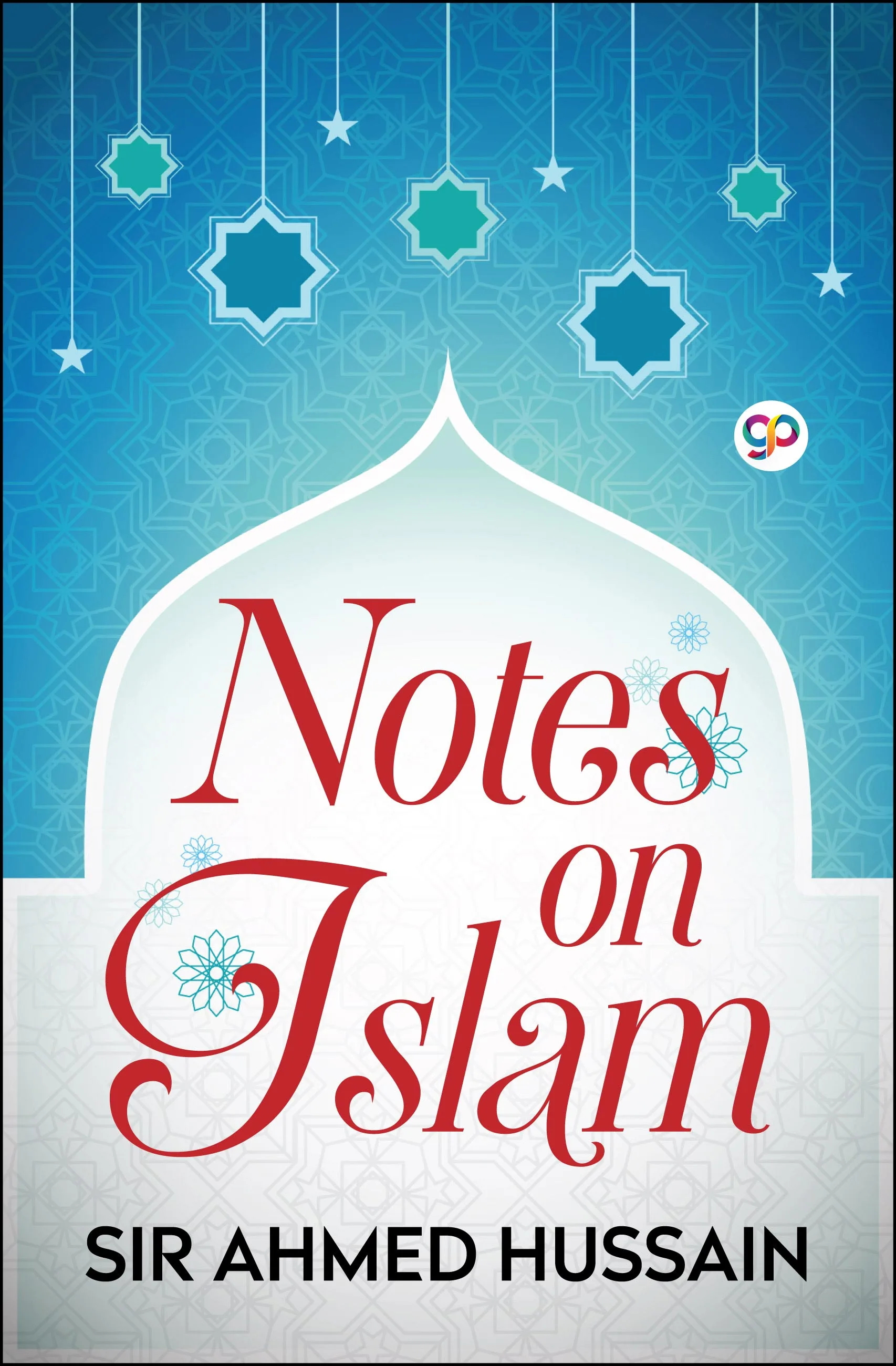
Notes on Islam
eBook
• INR 99.00
• English
• 9789354994999
No ratings yet
| Publisher | General Press |
|---|---|
| ISBN13 | 9789354994999 |
| ASIN/SKU | B0BCVTG6QJ |
| Book Format | eBook |
| Language | English |
| List Price | INR 99.00 |
| Subject Code | REL037010, REL037000, REL000000 |
| Publishing Date | 12/09/2022 |
| Book Code | BD00069118 |
Buy this Book
Amazon Stores
Ebook Stores
Other Stores
Discover Notes on Islam by Sir Ahmed Hussain. This book is published by General Press in eBook format, ISBN 9789354994999, ASIN B0BCVTG6QJ, under Religion and Spirituality, Islam, Islamic Studies.
Book Description
First published in 1922, ‘Notes on Islam’ is written by Sir Ahmed Hussain.
The book talks about Christianity and Islam’s surprisingly similar messages to their adherents. Islam is not the only true religion; it is simply the “best” of the monotheistic religions. The “spirit” of Islam takes precedence over the “letter” as revealed in the Quran. True Islam is not an extremist religion: it is a moderate religion, seeking the mean between two extremes. Hussain contrasts pure Islam with Muhammadanism, which he says has “forgotten the spirit of Islam and remembers only the letter of its law.” Islam is not a static faith but one that seeks truth not only in past doctrines but in the discoveries of science and philosophy.
It is intended as a guide for people of the faith, which is also an important resource for anyone seeking insight into this religion whose growing presence in our lives lends urgency to our understanding of its true nature.
The book talks about Christianity and Islam’s surprisingly similar messages to their adherents. Islam is not the only true religion; it is simply the “best” of the monotheistic religions. The “spirit” of Islam takes precedence over the “letter” as revealed in the Quran. True Islam is not an extremist religion: it is a moderate religion, seeking the mean between two extremes. Hussain contrasts pure Islam with Muhammadanism, which he says has “forgotten the spirit of Islam and remembers only the letter of its law.” Islam is not a static faith but one that seeks truth not only in past doctrines but in the discoveries of science and philosophy.
It is intended as a guide for people of the faith, which is also an important resource for anyone seeking insight into this religion whose growing presence in our lives lends urgency to our understanding of its true nature.
Author Biography
Sir Ahmed Hussain (1863–1935), also known by the honorific title Nawab Amin Jung Bahadur, was an Indian civil servant, scholar, and Islamic thinker who sought to present the teachings of Islam in a clear, rational, and intellectually engaging manner. Best known for his book Notes on Islam, he belonged to a generation of Muslim intellectuals who believed that religious faith and modern education could complement one another. His writings encouraged thoughtful reflection, moral responsibility, and a deeper understanding of Islam in the context of the modern world.
Born in 1863 in British India, Ahmed Hussain received a strong education that combined traditional Islamic learning with modern academic studies. He entered government service in the princely State of Hyderabad, where he built a distinguished administrative career. His dedication and ability earned him high honors, including the titles K.C.I.E. (Knight Commander of the Order of the Indian Empire) and C.S.I. (Companion of the Order of the Star of India). These distinctions reflected his valued contributions to public administration and governance.
Although deeply involved in official duties, Hussain remained committed to intellectual and spiritual pursuits. His most influential work, Notes on Islam, originated as a series of letters written to his brother and sons while they were studying at British universities. Responding to their questions about religion and modern thought, he explained Islamic principles in a concise, reflective style. He openly stated that his interpretation was neither strictly orthodox nor entirely heterodox, but aimed to encourage readers to think independently and appreciate the ethical and spiritual foundations of Islam. The work was later collected and edited by Khan Bahadur Hajee Khaja Muhammad Hussain and published in Hyderabad in 1922.
Throughout his writings, Sir Ahmed Hussain emphasized reason, personal responsibility, and harmony between faith and scientific inquiry. Rather than encouraging blind acceptance, he invited readers to explore religious ideas with honesty, curiosity, and intellectual discipline. His thoughtful approach reflected the broader reformist spirit that influenced many educated Muslim scholars in India during the late nineteenth and early twentieth centuries.
Sir Ahmed Hussain passed away in 1935, leaving behind a legacy of public service and reflective scholarship. Though not as widely known as some of his contemporaries, he is remembered for presenting Islam as a faith grounded in moral character, rational inquiry, and spiritual growth. His writings continue to interest readers seeking a balanced and thoughtful understanding of Islamic philosophy and its place in the modern world.
Born in 1863 in British India, Ahmed Hussain received a strong education that combined traditional Islamic learning with modern academic studies. He entered government service in the princely State of Hyderabad, where he built a distinguished administrative career. His dedication and ability earned him high honors, including the titles K.C.I.E. (Knight Commander of the Order of the Indian Empire) and C.S.I. (Companion of the Order of the Star of India). These distinctions reflected his valued contributions to public administration and governance.
Although deeply involved in official duties, Hussain remained committed to intellectual and spiritual pursuits. His most influential work, Notes on Islam, originated as a series of letters written to his brother and sons while they were studying at British universities. Responding to their questions about religion and modern thought, he explained Islamic principles in a concise, reflective style. He openly stated that his interpretation was neither strictly orthodox nor entirely heterodox, but aimed to encourage readers to think independently and appreciate the ethical and spiritual foundations of Islam. The work was later collected and edited by Khan Bahadur Hajee Khaja Muhammad Hussain and published in Hyderabad in 1922.
Throughout his writings, Sir Ahmed Hussain emphasized reason, personal responsibility, and harmony between faith and scientific inquiry. Rather than encouraging blind acceptance, he invited readers to explore religious ideas with honesty, curiosity, and intellectual discipline. His thoughtful approach reflected the broader reformist spirit that influenced many educated Muslim scholars in India during the late nineteenth and early twentieth centuries.
Sir Ahmed Hussain passed away in 1935, leaving behind a legacy of public service and reflective scholarship. Though not as widely known as some of his contemporaries, he is remembered for presenting Islam as a faith grounded in moral character, rational inquiry, and spiritual growth. His writings continue to interest readers seeking a balanced and thoughtful understanding of Islamic philosophy and its place in the modern world.
Editorial Reviews
Editorial Reviews will be added soon…
Book Summary
Notes on Islam by Sir Ahmed Hussain is a thoughtful early twentieth-century work that attempts to explain the essential spirit of Islam through reason, spirituality, morality, and a willingness to engage with modern science and philosophy. First published in Hyderabad in 1922, the book was collected and edited by Khan Bahadur Hajee Khaja Muhammad Hussain from notes that Sir Ahmed Hussain had originally written in weekly letters to his brother and sons, who were studying at Cambridge, Edinburgh, and Birmingham. The author himself describes his interpretation as neither completely orthodox nor completely heterodox, but as something between the two. This background is important because Notes on Islam is not intended to be a formal theological textbook. It is a personal attempt to answer questions about the value, meaning, and relevance of Islam for educated readers living in a rapidly changing modern world.
The book begins with a very personal concern. Hussain's sons had encountered questions from Christian missionaries and had begun asking what Islam meant and why it should be regarded as valuable, especially when Muslim societies appeared politically weak in comparison with the Christian powers of the time. Hussain does not answer these questions by simply appealing to inherited authority. Instead, he tries to make his sons think critically about their faith. This gives the book its distinctive tone. Notes on Islam is simultaneously a defense of Islam and an invitation to examine Islam intelligently. Hussain is interested in what he considers the underlying principles of the religion rather than in every historical custom or rigid interpretation that may have accumulated around it.
One of the book's most important distinctions is between “true Islam” and what Hussain calls “Muhammadanism.” He uses the latter term critically to describe a form of religious practice that, in his view, can become excessively concerned with external rules while forgetting the spirit behind them. His concern is not that religious law has no value, but that religion becomes distorted when technical details, customs, and formalities replace the larger purposes of faith. For Hussain, Islam should be understood through its central principles of devotion to God, moral responsibility, truth, humanity, moderation, and spiritual development. Modern descriptions of the book similarly emphasize its distinction between the spirit of Islam and rigid adherence to what Hussain regarded as the mere “letter” of religious law.
The first chapter of the Qur'an, Surah al-Fatihah, provides Hussain with an especially important foundation. The book reproduces and reflects upon the Muslim prayer beginning with praise of God as the Lord of the worlds and emphasizing divine mercy, worship, dependence upon God, and the request for guidance along the straight path. For Hussain, these ideas summarize much of the religious outlook of Islam. The believer recognizes God as the ultimate source of existence, acknowledges human dependence upon Him, and asks for guidance rather than assuming that human beings can discover the right path through pride or self-interest alone.
From this starting point, Hussain asks the fundamental question: What is religion? His answer moves beyond the idea that religion consists merely of rituals, ceremonies, doctrines, or membership in a particular community. Religion concerns the relationship between human beings and the Divine, but it also concerns the way people live with one another. Faith must therefore express itself through conduct. A religion that produces worship without moral improvement has failed to achieve its deepest purpose. This connection between belief and behavior becomes one of the central themes of the book.
Hussain's approach is particularly notable for its attempt to connect religion with reason. He writes at a time when modern science, evolutionary theory, philosophy, and comparative religion were challenging traditional ways of understanding the world. Rather than treating scientific thought as an automatic enemy of religion, Hussain attempts to show that Islam can coexist with intellectual inquiry. The book's contents explicitly include discussions of evolution and survival, while its bibliographic record shows references to thinkers and scientific writers such as Herbert Spencer, Auguste Comte, Karl Pearson, and Sir Oliver Lodge.
This willingness to engage with modern thought is central to Hussain's argument that Islam is not a static or intellectually closed religion. He wants Muslims to distinguish between the eternal principles of faith and the historical interpretations that may need reconsideration. In his view, truth should not be feared simply because it comes through a modern scientific or philosophical investigation. If something is genuinely true, religious faith should ultimately be capable of meeting it. This makes Notes on Islam part of a broader tradition of early modern Muslim intellectual engagement with Western education, science, philosophy, and religious criticism.
Hussain also argues that Islam should not be understood as hostile to other religions. His interpretation gives particular importance to the Qur'anic recognition of earlier revelation and religious traditions. The book discusses Christianity and Islam as possessing important similarities and argues that Islam recognizes truths associated with earlier religious traditions rather than treating them as wholly meaningless. Contemporary descriptions of the book likewise emphasize Hussain's belief that Islam is not the only true religion in an exclusive sense but that it represents, in his view, the best expression of monotheistic religion.
This leads naturally to the question posed in the chapter “Why is Islam the Best Religion?” Hussain's answer is not based primarily on political power, historical empire, or the size of the Muslim population. Indeed, the original motivation for the book came partly from the apparent weakness of Muslim governments in the face of Christian imperial powers. Hussain's response is that the truth or value of a religion cannot be measured by the temporary political success of the people who profess it. A religion must instead be judged by its principles, its conception of God, its moral teachings, and its ability to guide human beings toward a better life.
The principle of unity and union is another major element of Hussain's interpretation. Islam's emphasis on the oneness of God becomes, in his reasoning, connected with the unity of humanity. If there is one Creator, then human beings share a fundamental relationship with one another. Differences of race, nationality, social position, and sect should not destroy the deeper unity of humanity. Religion therefore has a social dimension: spiritual realization should encourage cooperation rather than hatred and division.
Hussain's discussion of perfection and self-help develops this idea at the level of the individual. Human beings are not expected to remain morally or intellectually stagnant. They should cultivate themselves through knowledge, discipline, work, reflection, and moral effort. Self-improvement, in this framework, is not opposed to dependence upon God. Instead, human effort becomes one of the ways through which divine guidance is expressed. A person should pray for guidance but must also act upon that guidance.
This emphasis gives the book a practical character. Islam, for Hussain, is not merely a system of metaphysical beliefs. It is a way of organizing life around responsibility. A believer has duties toward God, but also toward himself and other people. The search for spiritual perfection therefore involves personal discipline as well as social responsibility. The book's recurring themes of duty, action, truth, love, and humanity reflect this broad understanding of religious life.
One of Hussain's strongest themes is moderation, described in the contents as “Moderation & via media.” He rejects religious extremism and presents Islam as a path between opposing extremes. This principle applies not only to theology but to everyday life. Human beings can become excessive in either direction: excessive materialism can destroy spiritual life, while excessive asceticism can ignore legitimate human needs. Similarly, blind traditionalism can prevent intellectual growth, while uncritical imitation of modern ideas can cause people to abandon valuable moral principles. Hussain's ideal is a balanced path that preserves spiritual depth while remaining open to reason and experience.
The idea of moderation also shapes his understanding of religious reform. Hussain does not appear to advocate the abandonment of Islam in favor of Westernization. Instead, he wants Muslims to recover what he sees as the original spirit of their religion while removing unnecessary accretions and rigid interpretations. This concern becomes especially explicit in the appendix titled “Muslim Reformation.” The inclusion of this section shows that the book is not only an explanation of Islam but also a proposal for how Muslims might rethink their religious and intellectual life in the modern era.
The chapter on evolution and survival further demonstrates Hussain's effort to reconcile religion with changing intellectual ideas. Rather than treating evolution as proof that religion must disappear, he considers how religious thought might understand development and adaptation. This reflects a broader conviction running through the book: Islam should not be frightened by intellectual change. A living religion must be capable of responding to new knowledge while preserving its essential spiritual principles.
Hussain's understanding of religion ultimately moves toward love of humanity. The final main chapter is titled “Religion begins with the Fear of the Lord and ends in the Love of Man,” which captures the direction of the entire argument. Fear or reverence for God may be the beginning of religious consciousness, but it is not supposed to be the final destination. If genuine faith does not eventually produce compassion, justice, generosity, and respect for human beings, then something has gone wrong. Religion should make a person more humane rather than more arrogant or hostile.
This idea also explains why Hussain repeatedly emphasizes truth, worship, love, and humanity. These concepts appear together in the book's introductory material and provide a useful summary of its moral vision. Worship establishes the individual's relationship with God; truth provides intellectual and moral direction; love transforms relationships with other people; and humanity becomes the social expression of spiritual understanding.
The final appendix, “Our Prayer,” gives the book a reflective conclusion. After discussing theology, philosophy, science, religious reform, and social responsibility, Hussain returns to prayer. This return is significant because his intellectual argument is ultimately intended to serve spiritual life rather than replace it. Reason can clarify faith, science can enlarge knowledge, and reform can remove unnecessary obstacles, but religion must still lead toward an actual relationship with God and a transformed way of living.
It is also important to understand Notes on Islam as a historical document. Hussain was writing in colonial India, at a time when Muslim intellectuals were grappling with Western political dominance, modern education, scientific thought, Christian missionary criticism, and questions about the future of Islamic societies. His attempt to reconcile Islam with modern intellectual life reflects those pressures. The original book was published by the Government Central Press in Hyderabad in 1922 and runs to about 96 pages, making it a concise rather than exhaustive treatment of Islamic theology.
The foreword also cautions readers about the character of the work. Hussain's notes were originally brief memoranda written between his official duties, and the editor explains that some passages are intentionally concise, abstract, or even enigmatic. They were written partly to encourage his sons to think, question, and argue rather than passively accept conclusions. This makes Notes on Islam feel more like an extended intellectual conversation than a systematic theological manual.
Ultimately, Notes on Islam by Sir Ahmed Hussain is a book about recovering what its author regards as the essential spirit of Islam: belief in one God, moral responsibility, intellectual inquiry, moderation, self-improvement, unity, and love of humanity. Hussain argues that Islam should not be judged by political decline, cultural stereotypes, or narrow interpretations of religious law. It should be understood through its deepest principles and its capacity to guide human beings toward truth and moral development. For readers searching for a Notes on Islam summary, Sir Ahmed Hussain's views on Islam, true Islam explained, Islam and modern science, Islam and Christianity, Islamic reform, Islamic philosophy, unity in Islam, moderation in Islam, or the main ideas of Notes on Islam, the book offers a distinctive early twentieth-century perspective. Its central message is that faith and reason need not be enemies, tradition need not mean intellectual stagnation, and religious devotion should ultimately express itself through a life of truth, self-discipline, moderation, cooperation, and love for humanity.
The book begins with a very personal concern. Hussain's sons had encountered questions from Christian missionaries and had begun asking what Islam meant and why it should be regarded as valuable, especially when Muslim societies appeared politically weak in comparison with the Christian powers of the time. Hussain does not answer these questions by simply appealing to inherited authority. Instead, he tries to make his sons think critically about their faith. This gives the book its distinctive tone. Notes on Islam is simultaneously a defense of Islam and an invitation to examine Islam intelligently. Hussain is interested in what he considers the underlying principles of the religion rather than in every historical custom or rigid interpretation that may have accumulated around it.
One of the book's most important distinctions is between “true Islam” and what Hussain calls “Muhammadanism.” He uses the latter term critically to describe a form of religious practice that, in his view, can become excessively concerned with external rules while forgetting the spirit behind them. His concern is not that religious law has no value, but that religion becomes distorted when technical details, customs, and formalities replace the larger purposes of faith. For Hussain, Islam should be understood through its central principles of devotion to God, moral responsibility, truth, humanity, moderation, and spiritual development. Modern descriptions of the book similarly emphasize its distinction between the spirit of Islam and rigid adherence to what Hussain regarded as the mere “letter” of religious law.
The first chapter of the Qur'an, Surah al-Fatihah, provides Hussain with an especially important foundation. The book reproduces and reflects upon the Muslim prayer beginning with praise of God as the Lord of the worlds and emphasizing divine mercy, worship, dependence upon God, and the request for guidance along the straight path. For Hussain, these ideas summarize much of the religious outlook of Islam. The believer recognizes God as the ultimate source of existence, acknowledges human dependence upon Him, and asks for guidance rather than assuming that human beings can discover the right path through pride or self-interest alone.
From this starting point, Hussain asks the fundamental question: What is religion? His answer moves beyond the idea that religion consists merely of rituals, ceremonies, doctrines, or membership in a particular community. Religion concerns the relationship between human beings and the Divine, but it also concerns the way people live with one another. Faith must therefore express itself through conduct. A religion that produces worship without moral improvement has failed to achieve its deepest purpose. This connection between belief and behavior becomes one of the central themes of the book.
Hussain's approach is particularly notable for its attempt to connect religion with reason. He writes at a time when modern science, evolutionary theory, philosophy, and comparative religion were challenging traditional ways of understanding the world. Rather than treating scientific thought as an automatic enemy of religion, Hussain attempts to show that Islam can coexist with intellectual inquiry. The book's contents explicitly include discussions of evolution and survival, while its bibliographic record shows references to thinkers and scientific writers such as Herbert Spencer, Auguste Comte, Karl Pearson, and Sir Oliver Lodge.
This willingness to engage with modern thought is central to Hussain's argument that Islam is not a static or intellectually closed religion. He wants Muslims to distinguish between the eternal principles of faith and the historical interpretations that may need reconsideration. In his view, truth should not be feared simply because it comes through a modern scientific or philosophical investigation. If something is genuinely true, religious faith should ultimately be capable of meeting it. This makes Notes on Islam part of a broader tradition of early modern Muslim intellectual engagement with Western education, science, philosophy, and religious criticism.
Hussain also argues that Islam should not be understood as hostile to other religions. His interpretation gives particular importance to the Qur'anic recognition of earlier revelation and religious traditions. The book discusses Christianity and Islam as possessing important similarities and argues that Islam recognizes truths associated with earlier religious traditions rather than treating them as wholly meaningless. Contemporary descriptions of the book likewise emphasize Hussain's belief that Islam is not the only true religion in an exclusive sense but that it represents, in his view, the best expression of monotheistic religion.
This leads naturally to the question posed in the chapter “Why is Islam the Best Religion?” Hussain's answer is not based primarily on political power, historical empire, or the size of the Muslim population. Indeed, the original motivation for the book came partly from the apparent weakness of Muslim governments in the face of Christian imperial powers. Hussain's response is that the truth or value of a religion cannot be measured by the temporary political success of the people who profess it. A religion must instead be judged by its principles, its conception of God, its moral teachings, and its ability to guide human beings toward a better life.
The principle of unity and union is another major element of Hussain's interpretation. Islam's emphasis on the oneness of God becomes, in his reasoning, connected with the unity of humanity. If there is one Creator, then human beings share a fundamental relationship with one another. Differences of race, nationality, social position, and sect should not destroy the deeper unity of humanity. Religion therefore has a social dimension: spiritual realization should encourage cooperation rather than hatred and division.
Hussain's discussion of perfection and self-help develops this idea at the level of the individual. Human beings are not expected to remain morally or intellectually stagnant. They should cultivate themselves through knowledge, discipline, work, reflection, and moral effort. Self-improvement, in this framework, is not opposed to dependence upon God. Instead, human effort becomes one of the ways through which divine guidance is expressed. A person should pray for guidance but must also act upon that guidance.
This emphasis gives the book a practical character. Islam, for Hussain, is not merely a system of metaphysical beliefs. It is a way of organizing life around responsibility. A believer has duties toward God, but also toward himself and other people. The search for spiritual perfection therefore involves personal discipline as well as social responsibility. The book's recurring themes of duty, action, truth, love, and humanity reflect this broad understanding of religious life.
One of Hussain's strongest themes is moderation, described in the contents as “Moderation & via media.” He rejects religious extremism and presents Islam as a path between opposing extremes. This principle applies not only to theology but to everyday life. Human beings can become excessive in either direction: excessive materialism can destroy spiritual life, while excessive asceticism can ignore legitimate human needs. Similarly, blind traditionalism can prevent intellectual growth, while uncritical imitation of modern ideas can cause people to abandon valuable moral principles. Hussain's ideal is a balanced path that preserves spiritual depth while remaining open to reason and experience.
The idea of moderation also shapes his understanding of religious reform. Hussain does not appear to advocate the abandonment of Islam in favor of Westernization. Instead, he wants Muslims to recover what he sees as the original spirit of their religion while removing unnecessary accretions and rigid interpretations. This concern becomes especially explicit in the appendix titled “Muslim Reformation.” The inclusion of this section shows that the book is not only an explanation of Islam but also a proposal for how Muslims might rethink their religious and intellectual life in the modern era.
The chapter on evolution and survival further demonstrates Hussain's effort to reconcile religion with changing intellectual ideas. Rather than treating evolution as proof that religion must disappear, he considers how religious thought might understand development and adaptation. This reflects a broader conviction running through the book: Islam should not be frightened by intellectual change. A living religion must be capable of responding to new knowledge while preserving its essential spiritual principles.
Hussain's understanding of religion ultimately moves toward love of humanity. The final main chapter is titled “Religion begins with the Fear of the Lord and ends in the Love of Man,” which captures the direction of the entire argument. Fear or reverence for God may be the beginning of religious consciousness, but it is not supposed to be the final destination. If genuine faith does not eventually produce compassion, justice, generosity, and respect for human beings, then something has gone wrong. Religion should make a person more humane rather than more arrogant or hostile.
This idea also explains why Hussain repeatedly emphasizes truth, worship, love, and humanity. These concepts appear together in the book's introductory material and provide a useful summary of its moral vision. Worship establishes the individual's relationship with God; truth provides intellectual and moral direction; love transforms relationships with other people; and humanity becomes the social expression of spiritual understanding.
The final appendix, “Our Prayer,” gives the book a reflective conclusion. After discussing theology, philosophy, science, religious reform, and social responsibility, Hussain returns to prayer. This return is significant because his intellectual argument is ultimately intended to serve spiritual life rather than replace it. Reason can clarify faith, science can enlarge knowledge, and reform can remove unnecessary obstacles, but religion must still lead toward an actual relationship with God and a transformed way of living.
It is also important to understand Notes on Islam as a historical document. Hussain was writing in colonial India, at a time when Muslim intellectuals were grappling with Western political dominance, modern education, scientific thought, Christian missionary criticism, and questions about the future of Islamic societies. His attempt to reconcile Islam with modern intellectual life reflects those pressures. The original book was published by the Government Central Press in Hyderabad in 1922 and runs to about 96 pages, making it a concise rather than exhaustive treatment of Islamic theology.
The foreword also cautions readers about the character of the work. Hussain's notes were originally brief memoranda written between his official duties, and the editor explains that some passages are intentionally concise, abstract, or even enigmatic. They were written partly to encourage his sons to think, question, and argue rather than passively accept conclusions. This makes Notes on Islam feel more like an extended intellectual conversation than a systematic theological manual.
Ultimately, Notes on Islam by Sir Ahmed Hussain is a book about recovering what its author regards as the essential spirit of Islam: belief in one God, moral responsibility, intellectual inquiry, moderation, self-improvement, unity, and love of humanity. Hussain argues that Islam should not be judged by political decline, cultural stereotypes, or narrow interpretations of religious law. It should be understood through its deepest principles and its capacity to guide human beings toward truth and moral development. For readers searching for a Notes on Islam summary, Sir Ahmed Hussain's views on Islam, true Islam explained, Islam and modern science, Islam and Christianity, Islamic reform, Islamic philosophy, unity in Islam, moderation in Islam, or the main ideas of Notes on Islam, the book offers a distinctive early twentieth-century perspective. Its central message is that faith and reason need not be enemies, tradition need not mean intellectual stagnation, and religious devotion should ultimately express itself through a life of truth, self-discipline, moderation, cooperation, and love for humanity.
Sample Chapters
Sample Chapters will be added soon…
Reader Reviews
No reviews yet.
Notes on Islam