
45 Years in Wall Street
eBook
• INR 51.00
• English
• 9789354995521
No ratings yet
| Publisher | General Press |
|---|---|
| ISBN13 | 9789354995521 |
| ASIN/SKU | B0BWDQMXST |
| Book Format | eBook |
| Language | English |
| List Price | INR 51.00 |
| Subject Code | BUS036060 |
| Publishing Date | 01/03/2023 |
| Book Code | BD00069160 |
Buy this Book
Amazon Stores
Ebook Stores
Other Stores
Discover 45 Years in Wall Street by William D. Gann. This book is published by General Press in eBook format, ISBN 9789354995521, ASIN B0BWDQMXST, under Business and Money, Memoirs, Economics.
Book Description
'45 Years in Wall Street' by William D. Gann is one of the most remarkable books ever written about trading and financial markets — a dense, wisdom-packed memoir and technical manual from a man who spent nearly half a century decoding the rhythms of the stock and commodity markets. Published in 1949, this legendary work sits firmly in the genre of financial trading literature, and it remains as relevant and thought-provoking today as it was the day it first landed on traders' desks.
Gann opens with a sense of hard-won authority. He is not theorizing from an armchair — he is writing from decades of real trades, real losses, and real triumphs. From the very first pages, the reader gets the feeling of sitting across from a grizzled market veteran who has seen every kind of boom, panic, and correction imaginable, and survived them all with his wits sharpened rather than dulled. That tone alone sets the book apart from the dry, detached financial texts that crowd most shelves.
At the heart of the book is Gann's conviction that markets are not random. He argues, with detailed charts and historical case studies, that price movements follow natural laws — mathematical patterns, time cycles, and geometric relationships that repeat themselves across decades. His famous rules for trading, which include guidance on stop-losses, when to pyramid a position, and how to read the underlying trend, are presented with a clarity that feels almost deceptively simple. Yet underneath that simplicity is a philosophy built on discipline, patience, and deep respect for risk.
What makes this book especially compelling is Gann's belief that self-mastery is inseparable from market mastery. He returns again and again to the idea that the trader's greatest enemy is not the market itself but their own emotions — greed, hope, and fear dressed up as rational decisions.
Whether you trade stocks, commodities, or anything in between, this book challenges you to look at markets in an entirely different way — and once you do, you may never look at a price chart the same way again.
Gann opens with a sense of hard-won authority. He is not theorizing from an armchair — he is writing from decades of real trades, real losses, and real triumphs. From the very first pages, the reader gets the feeling of sitting across from a grizzled market veteran who has seen every kind of boom, panic, and correction imaginable, and survived them all with his wits sharpened rather than dulled. That tone alone sets the book apart from the dry, detached financial texts that crowd most shelves.
At the heart of the book is Gann's conviction that markets are not random. He argues, with detailed charts and historical case studies, that price movements follow natural laws — mathematical patterns, time cycles, and geometric relationships that repeat themselves across decades. His famous rules for trading, which include guidance on stop-losses, when to pyramid a position, and how to read the underlying trend, are presented with a clarity that feels almost deceptively simple. Yet underneath that simplicity is a philosophy built on discipline, patience, and deep respect for risk.
What makes this book especially compelling is Gann's belief that self-mastery is inseparable from market mastery. He returns again and again to the idea that the trader's greatest enemy is not the market itself but their own emotions — greed, hope, and fear dressed up as rational decisions.
Whether you trade stocks, commodities, or anything in between, this book challenges you to look at markets in an entirely different way — and once you do, you may never look at a price chart the same way again.
Author Biography
William Delbert Gann (1878-1955) was an outstanding stock and commodities trader. He was also a prolific teacher of how to make speculation a profitable profession, writing some seven books and producing two courses on trading the stock and commodity markets. However Gann's superlative skill was his ability to forecast accurately the stock and commodity markets.
Editorial Reviews
Editorial Reviews will be added soon…
Book Summary
45 Years in Wall Street by William D. Gann is a practical and philosophical reflection on speculation, market behavior, money management, and the lessons Gann believed he had learned during decades of trading. Rather than presenting a conventional autobiography, the book combines personal experience with observations about stocks, commodities, cycles, market psychology, and the habits that separate successful traders from unsuccessful ones. Gann writes from the perspective of a veteran who has witnessed many market booms, crashes, panics, and periods of prosperity. His central message is that successful speculation requires preparation, discipline, patience, and a willingness to learn from history.
Gann begins by emphasizing that markets are not simply games of chance. Although unexpected events can affect prices, he argues that recurring patterns can be observed when markets are studied carefully. His many years on Wall Street convinced him that prices move according to recognizable forces and that traders who understand these forces have a better chance of protecting and increasing their capital. He repeatedly stresses that knowledge must come before action. A person who enters the market without adequate preparation, he suggests, is essentially gambling.
One of the strongest themes throughout the book is the importance of preserving capital. Gann argues that making money is only one part of successful trading; avoiding large losses is equally important. A trader who repeatedly suffers substantial losses eventually loses the ability to participate in future opportunities. For this reason, he encourages traders to avoid risking too much money on any single position. He favors careful position sizing, predetermined limits on losses, and disciplined exits rather than emotional decisions made after a trade begins to move against them.
Gann also places great importance on knowing what you are doing before entering a trade. He warns against buying or selling simply because someone else recommends a particular security. Tips, rumors, newspaper stories, and enthusiastic predictions can easily mislead inexperienced traders. Instead, the individual trader should develop an independent method of analysis and have a clear reason for every transaction.
The book repeatedly returns to the idea that human psychology is one of the greatest causes of market losses. Fear, greed, hope, impatience, and overconfidence can cause traders to abandon sound plans. A person may hold a losing position because they hope it will recover, or sell a profitable position too quickly because they are afraid the gain will disappear. Gann argues that successful traders must learn to control these emotional impulses.
He also warns against overtrading. Constantly buying and selling can create unnecessary losses through poor timing, commissions, and emotional exhaustion. According to Gann's philosophy, a trader should wait for favorable opportunities rather than feeling compelled to participate in every market movement. Patience is therefore not inactivity; it is a deliberate decision to act only when conditions appear favorable.
Another important lesson concerns leverage and borrowed money. Gann strongly cautions traders against taking excessive financial risks. Borrowing heavily may produce large profits when a trade moves in the desired direction, but it can also destroy an account rapidly when the market moves the other way. The ability to remain in the market long enough to take advantage of future opportunities is more valuable, in his view, than attempting to become rich through a few spectacular trades.
Gann's discussion of market analysis is closely connected to his belief in cycles and historical repetition. He encourages traders to study previous market movements rather than treating every new event as completely unprecedented. Prices may behave differently in detail, but recurring tendencies can sometimes be identified through careful comparison of past and present conditions. For Gann, history is therefore not merely a record of what happened; it is a practical source of information for understanding future possibilities.
He pays particular attention to time and price. A market cannot be understood solely by looking at whether prices are rising or falling. The amount of time involved in a movement is also significant. Gann believed that important changes could occur when particular relationships between time and price developed. His broader philosophy is that markets have an underlying order that becomes visible when a trader studies movements from multiple perspectives rather than focusing on isolated price changes.
The book also reflects Gann's interest in natural cycles and broader forces. He believed that financial markets could display rhythms comparable to patterns found in nature. Seasonal changes, historical cycles, and recurring periods of expansion and contraction could influence economic activity and market behavior. While modern financial theory does not necessarily accept all of Gann's methods or conclusions, these ideas form an important part of his distinctive approach to speculation.
Gann is especially concerned with the difference between investment and speculation. He does not present speculation as inherently irresponsible. Instead, he argues that speculation becomes dangerous when people enter markets without knowledge, discipline, or adequate financial resources. A person who understands risk and follows a carefully developed plan can approach speculation systematically. Someone who relies on luck, rumors, or emotional impulses is effectively gambling.
The book also contains practical observations about bull markets and bear markets. Gann encourages readers to recognize that no trend continues forever. Periods of rising prices eventually encounter resistance, while prolonged declines eventually create conditions for recovery. Traders should therefore avoid becoming emotionally attached to a particular market direction. The fact that prices have been rising for a long time does not mean they must continue rising, just as a prolonged decline does not guarantee an immediate recovery.
An important part of Gann's philosophy is the need to adapt without abandoning discipline. Markets change, and methods that work in one situation may not work in another. The trader must therefore remain observant and willing to revise assumptions when evidence changes. At the same time, flexibility should not become an excuse for abandoning rules whenever a trade goes badly.
Gann also emphasizes the value of record-keeping and self-analysis. Traders should examine their past decisions, identify recurring mistakes, and learn from them. A trading record can reveal patterns that are difficult to recognize emotionally. Perhaps a trader enters too early, takes profits too quickly, holds losses too long, or risks too much after a successful trade. By studying these behaviors honestly, the trader can gradually improve.
Underlying all of these recommendations is Gann's belief that success is a matter of character as much as technique. Intelligence alone is not enough. A trader may understand charts and market cycles perfectly but still lose money through impatience or greed. Successful speculation requires self-control, persistence, humility, and the ability to accept mistakes.
The title 45 Years in Wall Street therefore represents more than the amount of time Gann spent observing financial markets. It represents a lifetime of accumulated lessons. The author presents Wall Street as a place where knowledge can be rewarded but ignorance can be extremely expensive. Every boom and crash, in his view, offers a lesson for anyone willing to study it.
Ultimately, the book's most enduring message is that trading success cannot be built on excitement or shortcuts. Gann encourages readers to study markets carefully, protect their capital, understand risk, control emotions, recognize patterns, and wait patiently for opportunities. His approach reflects the ideas of an earlier era of market analysis, but many of his warnings remain broadly relevant: do not risk money you cannot afford to lose, do not blindly follow others, do not allow hope to replace analysis, and do not confuse a lucky result with a sound method.
45 Years in Wall Street is therefore best understood not simply as a manual for predicting prices, but as a veteran trader's meditation on the discipline required to survive financial markets. Its central lesson is simple yet demanding: the market rewards preparation and punishes carelessness, and lasting success depends as much on mastering oneself as on understanding the market.
Gann begins by emphasizing that markets are not simply games of chance. Although unexpected events can affect prices, he argues that recurring patterns can be observed when markets are studied carefully. His many years on Wall Street convinced him that prices move according to recognizable forces and that traders who understand these forces have a better chance of protecting and increasing their capital. He repeatedly stresses that knowledge must come before action. A person who enters the market without adequate preparation, he suggests, is essentially gambling.
One of the strongest themes throughout the book is the importance of preserving capital. Gann argues that making money is only one part of successful trading; avoiding large losses is equally important. A trader who repeatedly suffers substantial losses eventually loses the ability to participate in future opportunities. For this reason, he encourages traders to avoid risking too much money on any single position. He favors careful position sizing, predetermined limits on losses, and disciplined exits rather than emotional decisions made after a trade begins to move against them.
Gann also places great importance on knowing what you are doing before entering a trade. He warns against buying or selling simply because someone else recommends a particular security. Tips, rumors, newspaper stories, and enthusiastic predictions can easily mislead inexperienced traders. Instead, the individual trader should develop an independent method of analysis and have a clear reason for every transaction.
The book repeatedly returns to the idea that human psychology is one of the greatest causes of market losses. Fear, greed, hope, impatience, and overconfidence can cause traders to abandon sound plans. A person may hold a losing position because they hope it will recover, or sell a profitable position too quickly because they are afraid the gain will disappear. Gann argues that successful traders must learn to control these emotional impulses.
He also warns against overtrading. Constantly buying and selling can create unnecessary losses through poor timing, commissions, and emotional exhaustion. According to Gann's philosophy, a trader should wait for favorable opportunities rather than feeling compelled to participate in every market movement. Patience is therefore not inactivity; it is a deliberate decision to act only when conditions appear favorable.
Another important lesson concerns leverage and borrowed money. Gann strongly cautions traders against taking excessive financial risks. Borrowing heavily may produce large profits when a trade moves in the desired direction, but it can also destroy an account rapidly when the market moves the other way. The ability to remain in the market long enough to take advantage of future opportunities is more valuable, in his view, than attempting to become rich through a few spectacular trades.
Gann's discussion of market analysis is closely connected to his belief in cycles and historical repetition. He encourages traders to study previous market movements rather than treating every new event as completely unprecedented. Prices may behave differently in detail, but recurring tendencies can sometimes be identified through careful comparison of past and present conditions. For Gann, history is therefore not merely a record of what happened; it is a practical source of information for understanding future possibilities.
He pays particular attention to time and price. A market cannot be understood solely by looking at whether prices are rising or falling. The amount of time involved in a movement is also significant. Gann believed that important changes could occur when particular relationships between time and price developed. His broader philosophy is that markets have an underlying order that becomes visible when a trader studies movements from multiple perspectives rather than focusing on isolated price changes.
The book also reflects Gann's interest in natural cycles and broader forces. He believed that financial markets could display rhythms comparable to patterns found in nature. Seasonal changes, historical cycles, and recurring periods of expansion and contraction could influence economic activity and market behavior. While modern financial theory does not necessarily accept all of Gann's methods or conclusions, these ideas form an important part of his distinctive approach to speculation.
Gann is especially concerned with the difference between investment and speculation. He does not present speculation as inherently irresponsible. Instead, he argues that speculation becomes dangerous when people enter markets without knowledge, discipline, or adequate financial resources. A person who understands risk and follows a carefully developed plan can approach speculation systematically. Someone who relies on luck, rumors, or emotional impulses is effectively gambling.
The book also contains practical observations about bull markets and bear markets. Gann encourages readers to recognize that no trend continues forever. Periods of rising prices eventually encounter resistance, while prolonged declines eventually create conditions for recovery. Traders should therefore avoid becoming emotionally attached to a particular market direction. The fact that prices have been rising for a long time does not mean they must continue rising, just as a prolonged decline does not guarantee an immediate recovery.
An important part of Gann's philosophy is the need to adapt without abandoning discipline. Markets change, and methods that work in one situation may not work in another. The trader must therefore remain observant and willing to revise assumptions when evidence changes. At the same time, flexibility should not become an excuse for abandoning rules whenever a trade goes badly.
Gann also emphasizes the value of record-keeping and self-analysis. Traders should examine their past decisions, identify recurring mistakes, and learn from them. A trading record can reveal patterns that are difficult to recognize emotionally. Perhaps a trader enters too early, takes profits too quickly, holds losses too long, or risks too much after a successful trade. By studying these behaviors honestly, the trader can gradually improve.
Underlying all of these recommendations is Gann's belief that success is a matter of character as much as technique. Intelligence alone is not enough. A trader may understand charts and market cycles perfectly but still lose money through impatience or greed. Successful speculation requires self-control, persistence, humility, and the ability to accept mistakes.
The title 45 Years in Wall Street therefore represents more than the amount of time Gann spent observing financial markets. It represents a lifetime of accumulated lessons. The author presents Wall Street as a place where knowledge can be rewarded but ignorance can be extremely expensive. Every boom and crash, in his view, offers a lesson for anyone willing to study it.
Ultimately, the book's most enduring message is that trading success cannot be built on excitement or shortcuts. Gann encourages readers to study markets carefully, protect their capital, understand risk, control emotions, recognize patterns, and wait patiently for opportunities. His approach reflects the ideas of an earlier era of market analysis, but many of his warnings remain broadly relevant: do not risk money you cannot afford to lose, do not blindly follow others, do not allow hope to replace analysis, and do not confuse a lucky result with a sound method.
45 Years in Wall Street is therefore best understood not simply as a manual for predicting prices, but as a veteran trader's meditation on the discipline required to survive financial markets. Its central lesson is simple yet demanding: the market rewards preparation and punishes carelessness, and lasting success depends as much on mastering oneself as on understanding the market.
Sample Chapters
Sample Chapters will be added soon…
Reader Reviews
No reviews yet.
45 Years in Wall Street
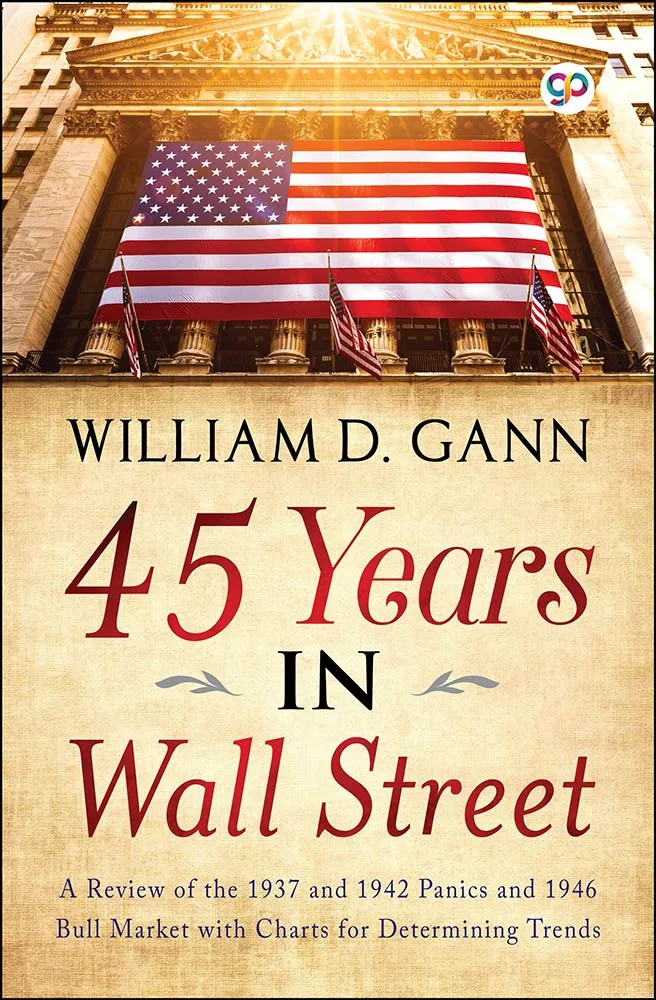
Download Cover Image
Do you want to download the full cover image for 45 Years in Wall Street?