
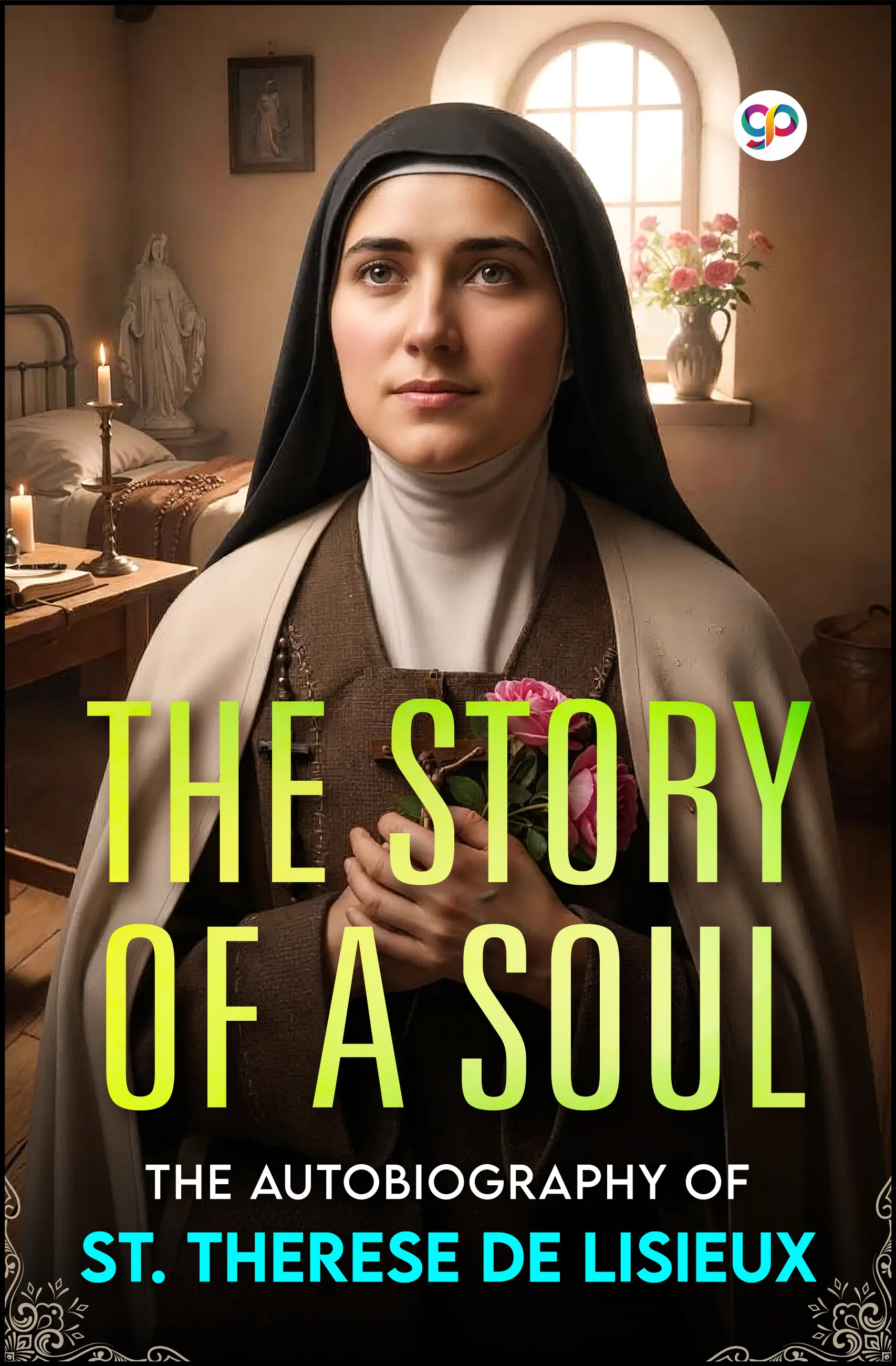
The Story of a Soul
eBook
• INR 99.00
• English
• 9788199107373
No ratings yet
| Publisher | General Press |
|---|---|
| ISBN13 | 9788199107373 |
| ASIN/SKU | B0G1THD2VZ |
| Book Format | eBook |
| Language | English |
| List Price | INR 99.00 |
| Subject Code | BIO018000, REL022000, REL036000 |
| Book Code | BD00069197 |
Buy this Book
Amazon Stores
Ebook Stores
Other Stores
Discover The Story of a Soul by St. Therese de Lisieux. This book is published by General Press in eBook format, ISBN 9788199107373, ASIN B0G1THD2VZ, under Religion and Spirituality, Christian Books and Bibles, Biographies.
Book Description
St. Thérèse de Lisieux’s "The Story of a Soul" is a profoundly intimate, radiant spiritual autobiography that transforms the pursuit of holiness from a distant, heroic feat into an accessible journey of the heart. Originally written as a private memoir for her convent sisters, this book invites us into the quiet, inner life of a young French Carmelite nun who found extraordinary grace in the most ordinary moments.
Thérèse candidly chronicles her early years, detailing her deeply sensitive nature, the pain of losing her mother, and her passionate, almost stubborn determination to enter the cloister at just fifteen. Yet, it is within the restrictive, hidden walls of the monastery that her true spiritual genius blossoms. Realizing she was too small and weak to achieve the grand, sweeping acts of martyrdom celebrated in church history, Thérèse discovers her revolutionary "Little Way."
With beautiful lucidity, she explains this philosophy: doing small, everyday things with immense love. Whether it is enduring the irritating habits of a fellow nun or sweeping a floor, she offers every fleeting moment as an act of profound devotion.
In her final chapters, the narrative deepens into a moving testament of resilience. As she battles agonizing tuberculosis and a profound darkness of faith, her child-like trust never wavers. Written with gentle humility and immense compassion, 'The Story of a Soul' is a timeless, deeply human reminder that true greatness is not found in spectacular achievements, but in the quiet, unyielding power of everyday love.
Thérèse candidly chronicles her early years, detailing her deeply sensitive nature, the pain of losing her mother, and her passionate, almost stubborn determination to enter the cloister at just fifteen. Yet, it is within the restrictive, hidden walls of the monastery that her true spiritual genius blossoms. Realizing she was too small and weak to achieve the grand, sweeping acts of martyrdom celebrated in church history, Thérèse discovers her revolutionary "Little Way."
With beautiful lucidity, she explains this philosophy: doing small, everyday things with immense love. Whether it is enduring the irritating habits of a fellow nun or sweeping a floor, she offers every fleeting moment as an act of profound devotion.
In her final chapters, the narrative deepens into a moving testament of resilience. As she battles agonizing tuberculosis and a profound darkness of faith, her child-like trust never wavers. Written with gentle humility and immense compassion, 'The Story of a Soul' is a timeless, deeply human reminder that true greatness is not found in spectacular achievements, but in the quiet, unyielding power of everyday love.
Author Biography
St. Thérèse of Lisieux (1873–1897), author of The Story of a Soul, was a French Carmelite nun whose simple yet profound spirituality left a lasting mark on Christian thought. Born Marie Françoise-Thérèse Martin in Alençon, France, she was the youngest of nine children in a deeply religious family. Her mother died when she was four, and the loss profoundly shaped her emotional and spiritual life. At age 15, after appealing directly to the Pope, she entered the Carmelite convent in Lisieux.
In the convent, Thérèse lived a quiet, hidden life of prayer, humility, and devotion. She developed her famous “Little Way,” which taught that holiness could be achieved through small acts of love and complete trust in God. At the request of her superiors, she wrote her spiritual autobiography, L’Histoire d’une Âme (The Story of a Soul), which was published after her death in 1898. The book quickly gained worldwide popularity for its heartfelt sincerity and spiritual depth.
Thérèse died from tuberculosis at age 24, yet her influence grew rapidly. She was canonized in 1925 and declared a Doctor of the Church in 1997—one of only four women to receive that title. Her message of love, simplicity, and trust continues to inspire millions.
In the convent, Thérèse lived a quiet, hidden life of prayer, humility, and devotion. She developed her famous “Little Way,” which taught that holiness could be achieved through small acts of love and complete trust in God. At the request of her superiors, she wrote her spiritual autobiography, L’Histoire d’une Âme (The Story of a Soul), which was published after her death in 1898. The book quickly gained worldwide popularity for its heartfelt sincerity and spiritual depth.
Thérèse died from tuberculosis at age 24, yet her influence grew rapidly. She was canonized in 1925 and declared a Doctor of the Church in 1997—one of only four women to receive that title. Her message of love, simplicity, and trust continues to inspire millions.
Editorial Reviews
Editorial Reviews will be added soon…
Book Summary
"The Story of a Soul" by St. Thérèse of Lisieux is not your typical saintly autobiography filled with miraculous visions or grand crusades. Instead, it is a deeply intimate collection of three autobiographical manuscripts written by a young French Carmelite nun who died in obscurity at age twenty-four. Penned purely under obedience to her religious superiors, the book was never originally intended for a global audience. Yet, shortly after her death from tuberculosis in 1897, these personal notebooks were compiled and published, inadvertently sparking a worldwide spiritual revolution. The enduring magic of the book lies in its striking simplicity and psychological honesty, offering a completely new, accessible roadmap to spiritual perfection that she famously dubbed the "Little Way."
The narrative begins with a tender look at her early childhood in Alençon, France. Born in 1873 to devout parents, Louis and Zélie Martin, Thérèse paints her earliest years as a time of unclouded joy. However, this idyllic period was shattered by the tragic death of her mother from breast cancer when Thérèse was only four years old. With striking self-awareness, she describes how this devastating loss profoundly altered her personality. The once lively child retreated into a fragile shell, becoming excessively shy, hypersensitive, and prone to endless fits of tears. Though her father and sisters enveloped her in love after a move to Lisieux, Thérèse remained emotionally crippled by her grief for nearly a decade.
The great turning point of her life, which she calls her "Christmas Conversion," occurred in 1886. Returning from Midnight Mass, she overheard her beloved father grumbling about the childhood tradition of leaving her shoes by the fireplace for gifts, sighing that she was too old for such things. Ordinarily, this would have sent the fragile Thérèse fleeing to her room in tears. Instead, she received a sudden grace of emotional maturity. She swallowed her tears, walked downstairs, and joyfully opened her gifts, sparing her father any guilt. In that brief, mundane moment, she recovered the strength of soul lost at her mother's death, shifting her lifelong focus away from her own feelings and outward toward God and others.
Empowered by this newfound fortitude, Thérèse became consumed by a singular desire: to enter the strict, cloistered Carmelite convent in Lisieux. Because she was only fifteen, local religious authorities flatly refused her request, urging her to wait. Unfazed, the stubborn teenager took her case to the top during a diocesan pilgrimage to Rome. In a famous and daring scene, she broke protocol during a papal audience, throwing herself at the feet of Pope Leo XIII and tearfully begging him to let her enter Carmel. Though the Pope gently told her that God’s will would be done, her bold display of determination ultimately swayed her superiors back home, and she was admitted to the cloister in 1888.
Once inside the convent walls, Thérèse quickly discovered that the romanticized ideals of religious life were vastly different from the gritty reality. Carmel was not a sanctuary of perpetual spiritual ecstasy; it was a place of biting physical cold, meager meals, and the constant friction of living alongside flawed human beings. Rather than seeking out grand, dramatic mortifications, Thérèse embraced a radically different approach to holiness. She realized her battlefield was found in the ordinary annoyances of daily life. She writes of her conscious efforts to show profound love to the most difficult nuns, folding laundry without complaint, and accepting unfair criticism with silence. Her heroism was entirely hidden, composed of thousands of tiny, invisible sacrifices.
This approach formed the foundation of her groundbreaking theology, the "Little Way" of spiritual childhood. Looking at the towering, intimidating perfection of the great saints, Thérèse felt like a tiny grain of sand at the bottom of a massive staircase she was too weak to climb. In a stroke of brilliant spiritual intuition, she decided that she did not need to climb the stairs at all; she simply needed an "elevator" to lift her to God. That elevator, she concluded, was the arms of Jesus. The Little Way was not about childish naivety, but absolute, radical trust. God did not demand great deeds from her, only a recognition of her poverty and unwavering trust in His mercy.
As her spiritual maturity deepened, so did her desires. In the second manuscript, often considered the theological climax of the book, Thérèse expresses a tormented longing to be everything for God—a priest, an apostle, a missionary, a martyr. Knowing she was confined to a tiny convent, she frantically searched the epistles of Saint Paul for an answer. She finally found her resolution in Paul's discourse on love, realizing that love is the engine driving all other vocations. With joyous relief, she penned her most famous line: "In the heart of the Church, my Mother, I shall be Love." By doing the smallest things with extraordinary love, she could participate in every mission from within her hidden cloister.
The final section of the book is a poignant descent into extreme physical and spiritual agony. In 1896, Thérèse began coughing up blood, signaling the onset of tuberculosis, which would slowly suffocate her. Tragically, this physical deterioration coincided with a terrifying "dark night of the soul." The veil of heaven, which had always felt so vividly real to her, was suddenly replaced by an impenetrable wall of darkness. She writes candidly of being assailed by voices of atheism and despair. Yet, she refused to yield. She chose to make acts of blind faith, sitting at what she called "the table of sinners," offering her inner torment as a sacrifice for unbelievers who had lost their way.
The Story of a Soul concludes in the shadow of her impending death, capturing her grueling final months in the convent infirmary. She died in September 1897 at twenty-four, her final words being a simple declaration: "My God, I love you." She had promised to spend her heaven doing good on earth, letting fall a "shower of roses," but she died practically unknown outside her community. It was only when her sisters compiled her scattered exercise books and distributed them that the explosion of devotion began. The deeply relatable, vulnerable voice captured in those pages resonated globally, leading millions to embrace her spirituality and resulting in her rapid canonization just twenty-eight years after her death.
Ultimately, 'The Story of a Soul' endures as a masterpiece of Christian literature because it entirely demystifies the pursuit of holiness. Thérèse stripped away the impossible, intimidating standards of asceticism and replaced them with the simple mechanics of love, trust, and acceptance of one's own weakness. By laying bare her flaws, her hypersensitivity, her doubts, and her ordinary struggles, she assured everyday people that they, too, were capable of profound sanctity without leaving their ordinary lives. The young woman who felt too small to do great deeds left behind a memoir that reshaped modern theology, earning her the title of Doctor of the Church and proving that there is immense power in small things done with great love.
The narrative begins with a tender look at her early childhood in Alençon, France. Born in 1873 to devout parents, Louis and Zélie Martin, Thérèse paints her earliest years as a time of unclouded joy. However, this idyllic period was shattered by the tragic death of her mother from breast cancer when Thérèse was only four years old. With striking self-awareness, she describes how this devastating loss profoundly altered her personality. The once lively child retreated into a fragile shell, becoming excessively shy, hypersensitive, and prone to endless fits of tears. Though her father and sisters enveloped her in love after a move to Lisieux, Thérèse remained emotionally crippled by her grief for nearly a decade.
The great turning point of her life, which she calls her "Christmas Conversion," occurred in 1886. Returning from Midnight Mass, she overheard her beloved father grumbling about the childhood tradition of leaving her shoes by the fireplace for gifts, sighing that she was too old for such things. Ordinarily, this would have sent the fragile Thérèse fleeing to her room in tears. Instead, she received a sudden grace of emotional maturity. She swallowed her tears, walked downstairs, and joyfully opened her gifts, sparing her father any guilt. In that brief, mundane moment, she recovered the strength of soul lost at her mother's death, shifting her lifelong focus away from her own feelings and outward toward God and others.
Empowered by this newfound fortitude, Thérèse became consumed by a singular desire: to enter the strict, cloistered Carmelite convent in Lisieux. Because she was only fifteen, local religious authorities flatly refused her request, urging her to wait. Unfazed, the stubborn teenager took her case to the top during a diocesan pilgrimage to Rome. In a famous and daring scene, she broke protocol during a papal audience, throwing herself at the feet of Pope Leo XIII and tearfully begging him to let her enter Carmel. Though the Pope gently told her that God’s will would be done, her bold display of determination ultimately swayed her superiors back home, and she was admitted to the cloister in 1888.
Once inside the convent walls, Thérèse quickly discovered that the romanticized ideals of religious life were vastly different from the gritty reality. Carmel was not a sanctuary of perpetual spiritual ecstasy; it was a place of biting physical cold, meager meals, and the constant friction of living alongside flawed human beings. Rather than seeking out grand, dramatic mortifications, Thérèse embraced a radically different approach to holiness. She realized her battlefield was found in the ordinary annoyances of daily life. She writes of her conscious efforts to show profound love to the most difficult nuns, folding laundry without complaint, and accepting unfair criticism with silence. Her heroism was entirely hidden, composed of thousands of tiny, invisible sacrifices.
This approach formed the foundation of her groundbreaking theology, the "Little Way" of spiritual childhood. Looking at the towering, intimidating perfection of the great saints, Thérèse felt like a tiny grain of sand at the bottom of a massive staircase she was too weak to climb. In a stroke of brilliant spiritual intuition, she decided that she did not need to climb the stairs at all; she simply needed an "elevator" to lift her to God. That elevator, she concluded, was the arms of Jesus. The Little Way was not about childish naivety, but absolute, radical trust. God did not demand great deeds from her, only a recognition of her poverty and unwavering trust in His mercy.
As her spiritual maturity deepened, so did her desires. In the second manuscript, often considered the theological climax of the book, Thérèse expresses a tormented longing to be everything for God—a priest, an apostle, a missionary, a martyr. Knowing she was confined to a tiny convent, she frantically searched the epistles of Saint Paul for an answer. She finally found her resolution in Paul's discourse on love, realizing that love is the engine driving all other vocations. With joyous relief, she penned her most famous line: "In the heart of the Church, my Mother, I shall be Love." By doing the smallest things with extraordinary love, she could participate in every mission from within her hidden cloister.
The final section of the book is a poignant descent into extreme physical and spiritual agony. In 1896, Thérèse began coughing up blood, signaling the onset of tuberculosis, which would slowly suffocate her. Tragically, this physical deterioration coincided with a terrifying "dark night of the soul." The veil of heaven, which had always felt so vividly real to her, was suddenly replaced by an impenetrable wall of darkness. She writes candidly of being assailed by voices of atheism and despair. Yet, she refused to yield. She chose to make acts of blind faith, sitting at what she called "the table of sinners," offering her inner torment as a sacrifice for unbelievers who had lost their way.
The Story of a Soul concludes in the shadow of her impending death, capturing her grueling final months in the convent infirmary. She died in September 1897 at twenty-four, her final words being a simple declaration: "My God, I love you." She had promised to spend her heaven doing good on earth, letting fall a "shower of roses," but she died practically unknown outside her community. It was only when her sisters compiled her scattered exercise books and distributed them that the explosion of devotion began. The deeply relatable, vulnerable voice captured in those pages resonated globally, leading millions to embrace her spirituality and resulting in her rapid canonization just twenty-eight years after her death.
Ultimately, 'The Story of a Soul' endures as a masterpiece of Christian literature because it entirely demystifies the pursuit of holiness. Thérèse stripped away the impossible, intimidating standards of asceticism and replaced them with the simple mechanics of love, trust, and acceptance of one's own weakness. By laying bare her flaws, her hypersensitivity, her doubts, and her ordinary struggles, she assured everyday people that they, too, were capable of profound sanctity without leaving their ordinary lives. The young woman who felt too small to do great deeds left behind a memoir that reshaped modern theology, earning her the title of Doctor of the Church and proving that there is immense power in small things done with great love.
Sample Chapters
Chapter 1: Earliest Memories
It is to you, dear Mother, that I am about to confide the story of my soul. When you asked me to write it, I feared the task might unsettle me, but since then Our Lord has deigned to make me understand that by simple obedience I shall please Him best. I begin therefore to sing what must be my eternal song: “the Mercies of the Lord.”
Before setting about my task I knelt before the statue of Our Lady which had given my family so many proofs of Our Heavenly Mother’s loving care. As I knelt I begged of that dear Mother to guide my hand, and thus ensure that only what was pleasing to her should find place here.
Then opening the Gospels, my eyes fell on these words: “Jesus, going up into a mountain, called unto Him whom He would Himself.”
They threw a clear light upon the mystery of my vocation and of my entire life, and above all upon the favours which Our Lord has granted to my soul. He does not call those who are worthy, but those whom He will. As St. Paul says: “God will have mercy on whom He will have mercy. So then it is not of him that willeth, nor of him that runneth, but of God that showeth mercy.”
I often asked myself why God had preferences, why all souls did not receive an equal measure of grace. I was filled with wonder when I saw extraordinary favours showered on great sinners like St. Paul, St. Augustine, St. Mary Magdalen, and many others, whom He forced, so to speak, to receive His grace. In reading the lives of the Saints I was surprised to see that there were certain privileged souls, whom Our Lord favoured from the cradle to the grave, allowing no obstacle in their path which might keep them from mounting towards Him, permitting no sin to soil the spotless brightness of their baptismal robe. And again it puzzled me why so many poor savages should die without having even heard the name of God.
Our Lord has deigned to explain this mystery to me. He showed me the book of nature, and I understood that every flower created by Him is beautiful, that the brilliance of the rose and the whiteness of the lily do not lessen the perfume of the violet or the sweet simplicity of the daisy. I understood that if all the lowly flowers wished to be roses, nature would lose its springtide beauty, and the fields would no longer be enamelled with lovely hues. And so it is in the world of souls, Our Lord’s living garden. He has been pleased to create great Saints who may be compared to the lily and the rose, but He has also created lesser ones, who must be content to be daisies or simple violets flowering at His Feet, and whose mission it is to gladden His Divine Eyes when He deigns to look down on them. And the more gladly they do His Will the greater is their perfection.
I understood this also, that God’s Love is made manifest as well in a simple soul which does not resist His grace as in one more highly endowed. In fact, the characteristic of love being self-abasement, if all souls resembled the holy Doctors who have illuminated the Church, it seems that God in coming to them would not stoop low enough. But He has created the little child, who knows nothing and can but utter feeble cries, and the poor savage who has only the natural law to guide him, and it is to their hearts that He deigns to stoop. These are the field flowers whose simplicity charms Him; and by His condescension to them Our Saviour shows His infinite greatness. As the sun shines both on the cedar and on the floweret, so the Divine Sun illumines every soul, great and small, and all correspond to His care—just as in nature the seasons are so disposed that on the appointed day the humblest daisy shall unfold its petals.
You will wonder, dear Mother, to what all this is leading, for till now I have said nothing that sounds like the story of my life; but did you not tell me to write quite freely whatever came into my mind? So, it will not be my life properly speaking, that you will find in these pages, but my thoughts about the graces which it has pleased Our Lord to bestow on me.
I am now at a time of life when I can look back on the past, for my soul has been refined in the crucible of interior and exterior trials. Now, like a flower after the storm, I can raise my head and see that the words of the Psalm are realised in me: “The Lord is my Shepherd and I shall want nothing. He hath set me in a place of pasture. He hath brought me up on the water of refreshment. He hath converted my soul. He hath led me on the paths of justice for His own Name’s sake. For though I should walk in the midst of the shadow of death, I will fear no evils for Thou are with me.”
Yes, to me Our Lord has always been “compassionate and merciful, long-suffering and plenteous in mercy.”
And so it gives me great joy, dear Mother, to come to you and sing His unspeakable mercies. It is for you alone that I write the story of the little flower gathered by Jesus. This thought will help me to speak freely, without troubling either about style or about the many digressions that I shall make; for a Mother’s heart always understands her child, even when it can only lisp, and so I am sure of being understood and my meaning appreciated.
If a little flower could speak, it seems to me that it would tell us quite simply all that God has done for it, without hiding any of its gifts. It would not, under the pretext of humility, say that it was not pretty, or that it had not a sweet scent, that the sun had withered its petals, or the storm bruised its stem, if it knew that such were not the case.
The Little Flower, that now tells her tale, rejoiced in having to publish the wholly undeserved favours bestowed upon her by Our Lord. She knows that she had nothing in herself worthy of attracting Him: His Mercy alone showered blessings on her. He allowed her to grow in holy soil enriched with the odour of purity, and preceded by eight lilies of shining whiteness. In His Love He willed to preserve her from the poisoned breath of the world—hardly had her petals unfolded when this good Master transplanted her to the mountain of Carmel, Our Lady’s chosen garden.
And now, dear Mother, having summed up in a few words all that God’s goodness has done for me, I will relate in detail the story of my childhood. I know that, though to others it may seem wearisome, your motherly heart will find pleasure in it. In the story of my soul, up to the time of my entry into the Carmel, there are three clearly marked periods: the first, in spite of its shortness, is by no means the least rich in memories.
It extends from the dawn of reason to the death of my dearly loved Mother; in other words, till I was four years and eight months old. God, in His goodness, did me the favour of awakening my intelligence very early, and He has imprinted the recollections of my childhood so deeply in my memory that past events seem to have happened but yesterday. Without doubt He wished to make me know and appreciate the Mother He had given me. Alas! His Divine Hand soon took her from me to crown her in Heaven.
All my life it has pleased Him to surround me with affection. My first recollections are of loving smiles and tender caresses; but if He made others love me so much, He made me love them too, for I was of an affectionate nature.
You can hardly imagine how much I loved my Father and Mother, and, being very demonstrative, I showed my love in a thousand little ways, though the means I employed make me smile now when I think of them.
Dear Mother, you have given me the letters which my Mother wrote at this time to Pauline, who was at school at the Visitation Convent at Le Mans. I remember perfectly the events they refer to, but it will be easier for me simply to quote some passages, though these charming letters, inspired by a Mother’s love, are too often full of my praises.
In proof of what I have said about my way of showing affection for my parents, here is an example: “Baby is the dearest little rogue; she comes to kiss me, and at the same time wishes me to die. ‘Oh, how I wish you would die, dear Mamma,’ she said, and when she was scolded she was quite astonished, and answered: ‘But I want you to go to Heaven, and you say we must die to go there’; and in her outburst of affection for her Father she wishes him to die too. The dear little thing will hardly leave me, she follows me everywhere, but likes going into the garden best; when I am not there she refuses to stay, and cries so much that they are obliged to bring her back. She will not even go upstairs alone without calling me at each step, ‘Mamma! Mamma!’ and if I forget to answer ‘Yes, darling!’ she waits where she is, and will not move.”
I was nearly three years old when my Mother wrote: “Little Thérèse asked me the other day if she would go to Heaven. ‘Yes, if you are good,’ I told her. ‘Oh, Mamma,’ she answered, ‘then if I am not good, shall I go to Hell? Well, you know what I will do—I shall fly to you in Heaven, and you will hold me tight in your arms, and how could God take me away then?’ I saw that she was convinced that God could do nothing to her if she hid herself in my arms.”
“Marie loves her little sister very much; indeed she is a child who delights us all. She is extraordinarily outspoken, and it is charming to see her run after me to confess her childish faults: ‘Mamma, I have pushed Céline; I slapped her once, but I’ll not do it again.’ The moment she has done anything mischievous, everyone must know. Yesterday, without meaning to do so, she tore off a small piece of wall paper; you would have been sorry for her—she wanted to tell her father immediately. When he came home four hours later, everyone else had forgotten about it, but she ran at once to Marie saying: ‘Tell Papa that I tore the paper.’ She waited there like a criminal for sentence; but she thinks she is more easily forgiven if she accuses herself.”
Papa’s name fills me with many happy memories. Mamma laughingly said he always did whatever I wanted, but he answered: “Well, why not? She is the Queen!” Then he would lift me on to his shoulder, and caress me in all sorts of ways. Yet I cannot say that he spoilt me. I remember one day while I was swinging he called out as he passed: “Come and kiss me, little Queen.” Contrary to my usual custom, I would not stir, and answered pertly: “You must come for it, Papa.” He refused quite rightly, and went away. Marie was there and scolded me, saying: “How naughty to answer Papa like that!” Her reproof took effect; I got off the swing at once, and the whole house resounded with my cries. I hurried upstairs, not waiting this time to call Mamma at each step; my one thought was to find Papa and make my peace with him. I need not tell you that this was soon done.
I could not bear to think I had grieved my beloved parents, and I acknowledged my faults instantly, as this little anecdote, related by my Mother, will show: “One morning before going downstairs I wanted to kiss Thérèse; she seemed to be fast asleep, and I did not like to wake her, but Marie said: ‘Mamma, I am sure she is only pretending.’ So I bent down to kiss her forehead, and immediately she hid herself under the clothes, saying in the tone of a spoilt child: ‘I don’t want anyone to look at me.’ I was not pleased with her, and told her so. A minute or two afterwards I heard her crying, and was surprised to see her by my side. She had got out of her cot by herself, and had come downstairs with bare feet, stumbling over her long nightdress. Her little face was wet with tears: ‘Mamma,’ she said, throwing herself on my knee, ‘I am sorry for being naughty—forgive me!’ Pardon was quickly granted; I took the little angel in my arms and pressed her to my heart, smothering her with kisses.”
I remember also my great affection for my eldest sister Marie, who had just left school. Without seeming to do so, I took in all that I saw and heard, and I think that I reflected on things then as I do now. I listened attentively while she taught Céline, and was very good and obedient, so as to obtain the privilege of being allowed in the room during lessons. She gave me many trifling presents which pleased me greatly. I was proud of my two big sisters; but as Pauline seemed so far away from us, I thought of her all day long. When I was only just learning to talk, and Mamma asked: “What are you thinking about?” my answer invariably was: “Pauline.” Sometimes I heard people saying that Pauline would be a nun, and, without quite knowing what it meant, I thought: “I will be a nun too.” This is one of my first recollections, and I have never changed my mind; so it was the example of this beloved sister which, from the age of two, drew me to the Divine Spouse of Virgins. My dearest Mother, what tender memories of Pauline I could confide to you here! But it would take me too long.
Léonie had also a very warm place in my heart; she loved me very much, and her love was returned. In the evening when she came home from school she used to take care of me while the others went out, and it seems to me I can still hear the sweet songs she sang to put me to sleep. I remember perfectly the day of her First Communion, and I remember also her companion, the poor child whom my Mother dressed, according to the touching custom of the well-to-do families in Alençon. This child did not leave Léonie for an instant on that happy day, and in the evening at the grand dinner she sat in the place of honour. Alas! I was too small to stay up for this feast, but I shared in it a little, thanks to Papa’s goodness, for he came himself to bring his little Queen a piece of the iced cake.
The only one now left to speak of is Céline, the companion of my childhood. My memories of her are so many that I do not know which to choose. We understood each other perfectly, but I was much more forward and lively, and far less ingenuous. Here is a letter which will show you, dear Mother, how sweet was Céline, and how naughty Thérèse. I was then nearly three years old, and Céline six and a half. “Céline is naturally inclined to be good; as to the little puss, Thérèse, one cannot tell how she will turn out, she is so young and heedless. She is a very intelligent child, but has not nearly so sweet a disposition as her sister, and her stubbornness is almost unconquerable. When she has said ‘No,’ nothing will make her change; one could leave her all day in the cellar without getting her to say ‘Yes.’ She would sooner sleep there.”
I had another fault also, of which my Mother did not speak in her letters: it was self-love. Here are two instances: —One day, no doubt wishing to see how far my pride would go, she smiled and said to me, “Thérèse, if you will kiss the ground I will give you a halfpenny.” In those days a halfpenny was a fortune, and in order to gain it I had not far to stoop, for I was so tiny there was not much distance between me and the ground; but my pride was up in arms, and holding myself very erect, I said, “No, thank you, Mamma, I would rather go without it.”
Another time we were going into the country to see some friends. Mamma told Marie to put on my prettiest frock, but not to let me have bare arms. I did not say a word, and appeared as indifferent as children of that age should be, but I said to myself, “I should have looked much prettier with bare arms.”
With such a disposition I feel sure that had I been brought up by careless parents I should have become very wicked, and perhaps have lost my soul. But Jesus watched over His little Spouse, and turned even her faults to advantage, for, being checked early in life, they became a means of leading her towards perfection. For instance, as I had great self-love and an innate love of good as well, it was enough to tell me once: “You must not do that,” and I never wanted to do it again. Having only good example before my eyes, I naturally wished to follow it, and I see with pleasure in my Mother’s letters that as I grew older I began to be a greater comfort. This is what she writes in 1876: “Even Thérèse is anxious to make sacrifices. Marie has given her little sisters a string of beads on purpose to count their acts of self-denial. They have really spiritual, but very amusing, conversations together. Céline said the other day: ‘How can God be in such a tiny Host?’ Thérèse answered: ‘That is not strange, because God is Almighty!’ ‘And what does Almighty mean?’ ‘It means that He can do whatever He likes.’
“But it is more amusing still to see Thérèse put her hand in her pocket, time after time, to pull a bead along the string, whenever she makes a little sacrifice. The children are inseparable, and are quite sufficient company for one another. Nurse has given Thérèse two bantams, and every day after dinner she and Céline sit by the fire and play with them.
“One morning Thérèse got out of her cot and climbed into Céline’s. The nurse went to fetch her to be dressed, and, when at last she found her, the little thing said, hugging her sister very hard: ‘Oh, Louise! leave me here, don’t you see that we are like the little white bantams, we can’t be separated from one another.’”
It is quite true that I could not be separated from Céline; I would rather leave my dessert unfinished at table than let her go without me, and I would get down from my high chair when she did, and off we went to play together. On Sundays, as I was still too small to go to the long services, Mamma stayed at home to take care of me. I was always very good, walking about on tip-toe; but as soon as I heard the door open there was a tremendous outburst of joy—I threw myself on my dear little sister, exclaiming: “Oh, Céline! give me the blessed bread, quick!” One day she had not brought any—what was to be done? I could not do without it, for I called this little feast my Mass. A bright idea struck me: “You have no blessed bread! —make some.” Céline immediately opened the cupboard, took out the bread, cut a tiny bit off, and after saying a Hail Mary quite solemnly over it, triumphantly presented it to me; and I, making the sign of the Cross, ate it with devotion, fancying it tasted exactly like the real blessed bread.
One day Léonie, thinking no doubt that she was too big to play with dolls, brought us a basket filled with clothes, pretty pieces of stuff, and other trifles on which her doll was laid: “Here, dears,” she said, “choose whatever you like.” Céline looked at it, and took a woollen ball. After thinking about it for a minute, I put out my hand saying: “I choose everything,” and I carried off both doll and basket without more ado.
This childish incident was a forecast, so to speak, of my whole life. Later on, when the way of perfection was opened out before me, I realised that in order to become a Saint one must suffer much, always seek the most perfect path, and forget oneself. I also understood that there are many degrees of holiness, that each soul is free to respond to the calls of Our Lord, to do much or little for His Love—in a word, to choose amongst the sacrifices He asks. And then also, as in the days of my childhood, I cried out: “My God, I choose everything, I will not be a Saint by halves, I am not afraid of suffering for Thee, I only fear one thing, and that is to do my own will. Accept the offering of my will, for I choose all that Thou willest.”
It is to you, dear Mother, that I am about to confide the story of my soul. When you asked me to write it, I feared the task might unsettle me, but since then Our Lord has deigned to make me understand that by simple obedience I shall please Him best. I begin therefore to sing what must be my eternal song: “the Mercies of the Lord.”
Before setting about my task I knelt before the statue of Our Lady which had given my family so many proofs of Our Heavenly Mother’s loving care. As I knelt I begged of that dear Mother to guide my hand, and thus ensure that only what was pleasing to her should find place here.
Then opening the Gospels, my eyes fell on these words: “Jesus, going up into a mountain, called unto Him whom He would Himself.”
They threw a clear light upon the mystery of my vocation and of my entire life, and above all upon the favours which Our Lord has granted to my soul. He does not call those who are worthy, but those whom He will. As St. Paul says: “God will have mercy on whom He will have mercy. So then it is not of him that willeth, nor of him that runneth, but of God that showeth mercy.”
I often asked myself why God had preferences, why all souls did not receive an equal measure of grace. I was filled with wonder when I saw extraordinary favours showered on great sinners like St. Paul, St. Augustine, St. Mary Magdalen, and many others, whom He forced, so to speak, to receive His grace. In reading the lives of the Saints I was surprised to see that there were certain privileged souls, whom Our Lord favoured from the cradle to the grave, allowing no obstacle in their path which might keep them from mounting towards Him, permitting no sin to soil the spotless brightness of their baptismal robe. And again it puzzled me why so many poor savages should die without having even heard the name of God.
Our Lord has deigned to explain this mystery to me. He showed me the book of nature, and I understood that every flower created by Him is beautiful, that the brilliance of the rose and the whiteness of the lily do not lessen the perfume of the violet or the sweet simplicity of the daisy. I understood that if all the lowly flowers wished to be roses, nature would lose its springtide beauty, and the fields would no longer be enamelled with lovely hues. And so it is in the world of souls, Our Lord’s living garden. He has been pleased to create great Saints who may be compared to the lily and the rose, but He has also created lesser ones, who must be content to be daisies or simple violets flowering at His Feet, and whose mission it is to gladden His Divine Eyes when He deigns to look down on them. And the more gladly they do His Will the greater is their perfection.
I understood this also, that God’s Love is made manifest as well in a simple soul which does not resist His grace as in one more highly endowed. In fact, the characteristic of love being self-abasement, if all souls resembled the holy Doctors who have illuminated the Church, it seems that God in coming to them would not stoop low enough. But He has created the little child, who knows nothing and can but utter feeble cries, and the poor savage who has only the natural law to guide him, and it is to their hearts that He deigns to stoop. These are the field flowers whose simplicity charms Him; and by His condescension to them Our Saviour shows His infinite greatness. As the sun shines both on the cedar and on the floweret, so the Divine Sun illumines every soul, great and small, and all correspond to His care—just as in nature the seasons are so disposed that on the appointed day the humblest daisy shall unfold its petals.
You will wonder, dear Mother, to what all this is leading, for till now I have said nothing that sounds like the story of my life; but did you not tell me to write quite freely whatever came into my mind? So, it will not be my life properly speaking, that you will find in these pages, but my thoughts about the graces which it has pleased Our Lord to bestow on me.
I am now at a time of life when I can look back on the past, for my soul has been refined in the crucible of interior and exterior trials. Now, like a flower after the storm, I can raise my head and see that the words of the Psalm are realised in me: “The Lord is my Shepherd and I shall want nothing. He hath set me in a place of pasture. He hath brought me up on the water of refreshment. He hath converted my soul. He hath led me on the paths of justice for His own Name’s sake. For though I should walk in the midst of the shadow of death, I will fear no evils for Thou are with me.”
Yes, to me Our Lord has always been “compassionate and merciful, long-suffering and plenteous in mercy.”
And so it gives me great joy, dear Mother, to come to you and sing His unspeakable mercies. It is for you alone that I write the story of the little flower gathered by Jesus. This thought will help me to speak freely, without troubling either about style or about the many digressions that I shall make; for a Mother’s heart always understands her child, even when it can only lisp, and so I am sure of being understood and my meaning appreciated.
If a little flower could speak, it seems to me that it would tell us quite simply all that God has done for it, without hiding any of its gifts. It would not, under the pretext of humility, say that it was not pretty, or that it had not a sweet scent, that the sun had withered its petals, or the storm bruised its stem, if it knew that such were not the case.
The Little Flower, that now tells her tale, rejoiced in having to publish the wholly undeserved favours bestowed upon her by Our Lord. She knows that she had nothing in herself worthy of attracting Him: His Mercy alone showered blessings on her. He allowed her to grow in holy soil enriched with the odour of purity, and preceded by eight lilies of shining whiteness. In His Love He willed to preserve her from the poisoned breath of the world—hardly had her petals unfolded when this good Master transplanted her to the mountain of Carmel, Our Lady’s chosen garden.
And now, dear Mother, having summed up in a few words all that God’s goodness has done for me, I will relate in detail the story of my childhood. I know that, though to others it may seem wearisome, your motherly heart will find pleasure in it. In the story of my soul, up to the time of my entry into the Carmel, there are three clearly marked periods: the first, in spite of its shortness, is by no means the least rich in memories.
It extends from the dawn of reason to the death of my dearly loved Mother; in other words, till I was four years and eight months old. God, in His goodness, did me the favour of awakening my intelligence very early, and He has imprinted the recollections of my childhood so deeply in my memory that past events seem to have happened but yesterday. Without doubt He wished to make me know and appreciate the Mother He had given me. Alas! His Divine Hand soon took her from me to crown her in Heaven.
All my life it has pleased Him to surround me with affection. My first recollections are of loving smiles and tender caresses; but if He made others love me so much, He made me love them too, for I was of an affectionate nature.
You can hardly imagine how much I loved my Father and Mother, and, being very demonstrative, I showed my love in a thousand little ways, though the means I employed make me smile now when I think of them.
Dear Mother, you have given me the letters which my Mother wrote at this time to Pauline, who was at school at the Visitation Convent at Le Mans. I remember perfectly the events they refer to, but it will be easier for me simply to quote some passages, though these charming letters, inspired by a Mother’s love, are too often full of my praises.
In proof of what I have said about my way of showing affection for my parents, here is an example: “Baby is the dearest little rogue; she comes to kiss me, and at the same time wishes me to die. ‘Oh, how I wish you would die, dear Mamma,’ she said, and when she was scolded she was quite astonished, and answered: ‘But I want you to go to Heaven, and you say we must die to go there’; and in her outburst of affection for her Father she wishes him to die too. The dear little thing will hardly leave me, she follows me everywhere, but likes going into the garden best; when I am not there she refuses to stay, and cries so much that they are obliged to bring her back. She will not even go upstairs alone without calling me at each step, ‘Mamma! Mamma!’ and if I forget to answer ‘Yes, darling!’ she waits where she is, and will not move.”
I was nearly three years old when my Mother wrote: “Little Thérèse asked me the other day if she would go to Heaven. ‘Yes, if you are good,’ I told her. ‘Oh, Mamma,’ she answered, ‘then if I am not good, shall I go to Hell? Well, you know what I will do—I shall fly to you in Heaven, and you will hold me tight in your arms, and how could God take me away then?’ I saw that she was convinced that God could do nothing to her if she hid herself in my arms.”
“Marie loves her little sister very much; indeed she is a child who delights us all. She is extraordinarily outspoken, and it is charming to see her run after me to confess her childish faults: ‘Mamma, I have pushed Céline; I slapped her once, but I’ll not do it again.’ The moment she has done anything mischievous, everyone must know. Yesterday, without meaning to do so, she tore off a small piece of wall paper; you would have been sorry for her—she wanted to tell her father immediately. When he came home four hours later, everyone else had forgotten about it, but she ran at once to Marie saying: ‘Tell Papa that I tore the paper.’ She waited there like a criminal for sentence; but she thinks she is more easily forgiven if she accuses herself.”
Papa’s name fills me with many happy memories. Mamma laughingly said he always did whatever I wanted, but he answered: “Well, why not? She is the Queen!” Then he would lift me on to his shoulder, and caress me in all sorts of ways. Yet I cannot say that he spoilt me. I remember one day while I was swinging he called out as he passed: “Come and kiss me, little Queen.” Contrary to my usual custom, I would not stir, and answered pertly: “You must come for it, Papa.” He refused quite rightly, and went away. Marie was there and scolded me, saying: “How naughty to answer Papa like that!” Her reproof took effect; I got off the swing at once, and the whole house resounded with my cries. I hurried upstairs, not waiting this time to call Mamma at each step; my one thought was to find Papa and make my peace with him. I need not tell you that this was soon done.
I could not bear to think I had grieved my beloved parents, and I acknowledged my faults instantly, as this little anecdote, related by my Mother, will show: “One morning before going downstairs I wanted to kiss Thérèse; she seemed to be fast asleep, and I did not like to wake her, but Marie said: ‘Mamma, I am sure she is only pretending.’ So I bent down to kiss her forehead, and immediately she hid herself under the clothes, saying in the tone of a spoilt child: ‘I don’t want anyone to look at me.’ I was not pleased with her, and told her so. A minute or two afterwards I heard her crying, and was surprised to see her by my side. She had got out of her cot by herself, and had come downstairs with bare feet, stumbling over her long nightdress. Her little face was wet with tears: ‘Mamma,’ she said, throwing herself on my knee, ‘I am sorry for being naughty—forgive me!’ Pardon was quickly granted; I took the little angel in my arms and pressed her to my heart, smothering her with kisses.”
I remember also my great affection for my eldest sister Marie, who had just left school. Without seeming to do so, I took in all that I saw and heard, and I think that I reflected on things then as I do now. I listened attentively while she taught Céline, and was very good and obedient, so as to obtain the privilege of being allowed in the room during lessons. She gave me many trifling presents which pleased me greatly. I was proud of my two big sisters; but as Pauline seemed so far away from us, I thought of her all day long. When I was only just learning to talk, and Mamma asked: “What are you thinking about?” my answer invariably was: “Pauline.” Sometimes I heard people saying that Pauline would be a nun, and, without quite knowing what it meant, I thought: “I will be a nun too.” This is one of my first recollections, and I have never changed my mind; so it was the example of this beloved sister which, from the age of two, drew me to the Divine Spouse of Virgins. My dearest Mother, what tender memories of Pauline I could confide to you here! But it would take me too long.
Léonie had also a very warm place in my heart; she loved me very much, and her love was returned. In the evening when she came home from school she used to take care of me while the others went out, and it seems to me I can still hear the sweet songs she sang to put me to sleep. I remember perfectly the day of her First Communion, and I remember also her companion, the poor child whom my Mother dressed, according to the touching custom of the well-to-do families in Alençon. This child did not leave Léonie for an instant on that happy day, and in the evening at the grand dinner she sat in the place of honour. Alas! I was too small to stay up for this feast, but I shared in it a little, thanks to Papa’s goodness, for he came himself to bring his little Queen a piece of the iced cake.
The only one now left to speak of is Céline, the companion of my childhood. My memories of her are so many that I do not know which to choose. We understood each other perfectly, but I was much more forward and lively, and far less ingenuous. Here is a letter which will show you, dear Mother, how sweet was Céline, and how naughty Thérèse. I was then nearly three years old, and Céline six and a half. “Céline is naturally inclined to be good; as to the little puss, Thérèse, one cannot tell how she will turn out, she is so young and heedless. She is a very intelligent child, but has not nearly so sweet a disposition as her sister, and her stubbornness is almost unconquerable. When she has said ‘No,’ nothing will make her change; one could leave her all day in the cellar without getting her to say ‘Yes.’ She would sooner sleep there.”
I had another fault also, of which my Mother did not speak in her letters: it was self-love. Here are two instances: —One day, no doubt wishing to see how far my pride would go, she smiled and said to me, “Thérèse, if you will kiss the ground I will give you a halfpenny.” In those days a halfpenny was a fortune, and in order to gain it I had not far to stoop, for I was so tiny there was not much distance between me and the ground; but my pride was up in arms, and holding myself very erect, I said, “No, thank you, Mamma, I would rather go without it.”
Another time we were going into the country to see some friends. Mamma told Marie to put on my prettiest frock, but not to let me have bare arms. I did not say a word, and appeared as indifferent as children of that age should be, but I said to myself, “I should have looked much prettier with bare arms.”
With such a disposition I feel sure that had I been brought up by careless parents I should have become very wicked, and perhaps have lost my soul. But Jesus watched over His little Spouse, and turned even her faults to advantage, for, being checked early in life, they became a means of leading her towards perfection. For instance, as I had great self-love and an innate love of good as well, it was enough to tell me once: “You must not do that,” and I never wanted to do it again. Having only good example before my eyes, I naturally wished to follow it, and I see with pleasure in my Mother’s letters that as I grew older I began to be a greater comfort. This is what she writes in 1876: “Even Thérèse is anxious to make sacrifices. Marie has given her little sisters a string of beads on purpose to count their acts of self-denial. They have really spiritual, but very amusing, conversations together. Céline said the other day: ‘How can God be in such a tiny Host?’ Thérèse answered: ‘That is not strange, because God is Almighty!’ ‘And what does Almighty mean?’ ‘It means that He can do whatever He likes.’
“But it is more amusing still to see Thérèse put her hand in her pocket, time after time, to pull a bead along the string, whenever she makes a little sacrifice. The children are inseparable, and are quite sufficient company for one another. Nurse has given Thérèse two bantams, and every day after dinner she and Céline sit by the fire and play with them.
“One morning Thérèse got out of her cot and climbed into Céline’s. The nurse went to fetch her to be dressed, and, when at last she found her, the little thing said, hugging her sister very hard: ‘Oh, Louise! leave me here, don’t you see that we are like the little white bantams, we can’t be separated from one another.’”
It is quite true that I could not be separated from Céline; I would rather leave my dessert unfinished at table than let her go without me, and I would get down from my high chair when she did, and off we went to play together. On Sundays, as I was still too small to go to the long services, Mamma stayed at home to take care of me. I was always very good, walking about on tip-toe; but as soon as I heard the door open there was a tremendous outburst of joy—I threw myself on my dear little sister, exclaiming: “Oh, Céline! give me the blessed bread, quick!” One day she had not brought any—what was to be done? I could not do without it, for I called this little feast my Mass. A bright idea struck me: “You have no blessed bread! —make some.” Céline immediately opened the cupboard, took out the bread, cut a tiny bit off, and after saying a Hail Mary quite solemnly over it, triumphantly presented it to me; and I, making the sign of the Cross, ate it with devotion, fancying it tasted exactly like the real blessed bread.
One day Léonie, thinking no doubt that she was too big to play with dolls, brought us a basket filled with clothes, pretty pieces of stuff, and other trifles on which her doll was laid: “Here, dears,” she said, “choose whatever you like.” Céline looked at it, and took a woollen ball. After thinking about it for a minute, I put out my hand saying: “I choose everything,” and I carried off both doll and basket without more ado.
This childish incident was a forecast, so to speak, of my whole life. Later on, when the way of perfection was opened out before me, I realised that in order to become a Saint one must suffer much, always seek the most perfect path, and forget oneself. I also understood that there are many degrees of holiness, that each soul is free to respond to the calls of Our Lord, to do much or little for His Love—in a word, to choose amongst the sacrifices He asks. And then also, as in the days of my childhood, I cried out: “My God, I choose everything, I will not be a Saint by halves, I am not afraid of suffering for Thee, I only fear one thing, and that is to do my own will. Accept the offering of my will, for I choose all that Thou willest.”
Reader Reviews
No reviews yet.
The Story of a Soul
Download Cover Image
Do you want to download the full cover image for The Story of a Soul?