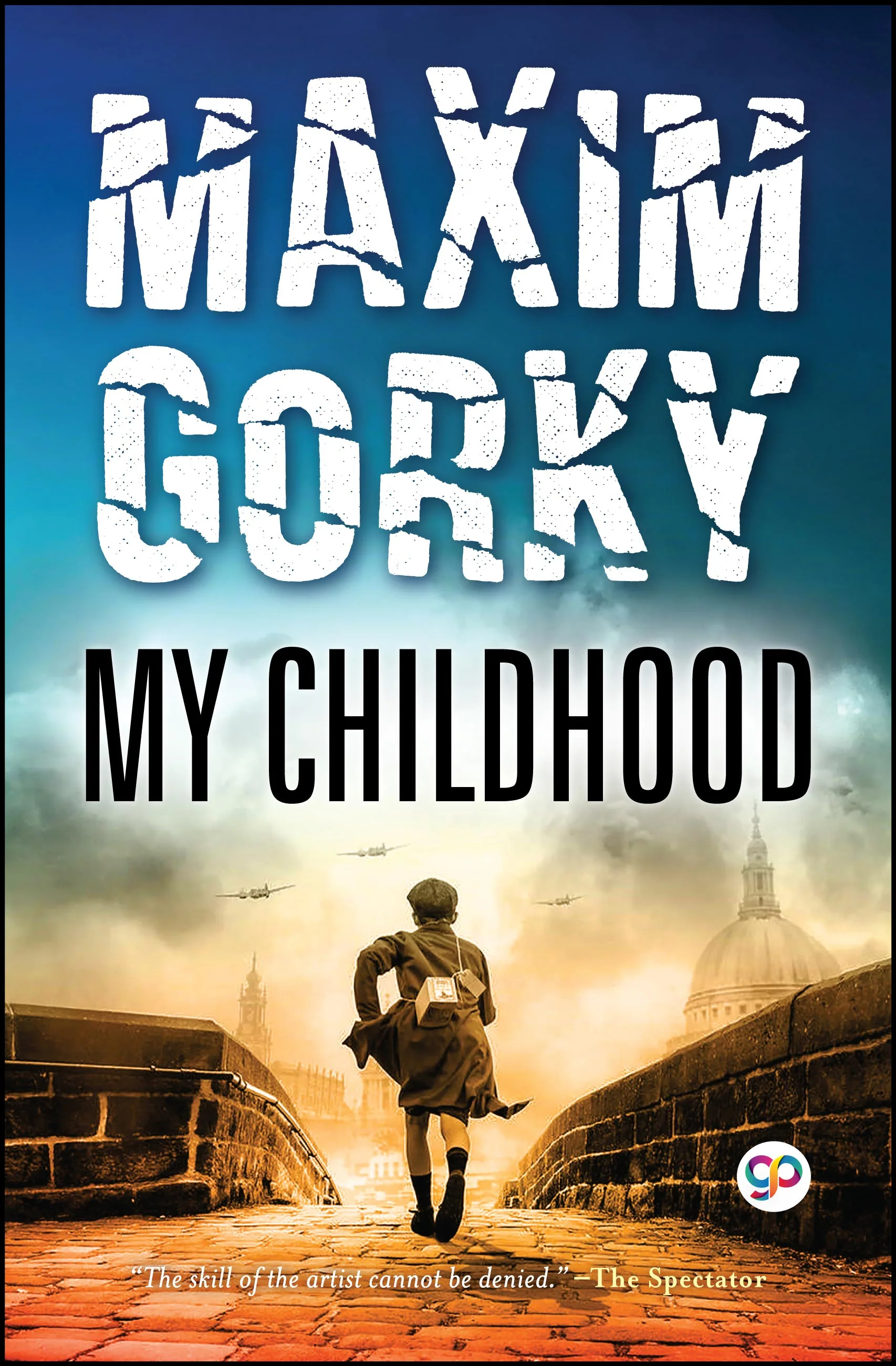
My Childhood
eBook
• INR 99.00
• English
• 9789354998614
No ratings yet
| Publisher | General Press |
|---|---|
| ISBN13 | 9789354998614 |
| ASIN/SKU | B0CFTTLY4H |
| Book Format | eBook |
| Language | English |
| List Price | INR 99.00 |
| Subject Code | BIO006000 |
| Publishing Date | 20/08/2023 |
| Book Code | BD00069222 |
Buy this Book
Amazon Stores
Ebook Stores
Other Stores
Discover My Childhood by Maxim Gorky. This book is published by General Press in eBook format, ISBN 9789354998614, ASIN B0CFTTLY4H, under Biographies and Memoirs, Russian Literature, Memoirs.
Book Description
Maxim Gorky was a Russian and Soviet writer, a founder of the socialist realism literary method, and a political activist. He was also a five-time nominee for the Nobel Prize in Literature. Around fifteen years before success as a writer, he frequently changed jobs and roamed across the Russian Empire; these experiences would later influence his writing.
‘My Childhood’ is colored by poverty and horrifying brutality, Gorky's childhood equipped him to understand—in a way denied to a Tolstoy or a Turgenev—the life of the ordinary Russian. After his father, a paperhanger and upholsterer died of cholera, five-year-old Gorky was taken to live with his grandfather, a polecat-faced tyrant who would regularly beat him unconscious, and with his grandmother, a tender mountain of a woman and a wonderful storyteller, who would kneel beside their bed (with Gorky inside it pretending to be asleep) and give God her views on the day's happenings, down to the last fascinating details. She was, in fact, Gorky's closest friend and the epic heroine of a book swarming with characters and with the sensations of a curious and often frightened little boy.
‘My Childhood’ is colored by poverty and horrifying brutality, Gorky's childhood equipped him to understand—in a way denied to a Tolstoy or a Turgenev—the life of the ordinary Russian. After his father, a paperhanger and upholsterer died of cholera, five-year-old Gorky was taken to live with his grandfather, a polecat-faced tyrant who would regularly beat him unconscious, and with his grandmother, a tender mountain of a woman and a wonderful storyteller, who would kneel beside their bed (with Gorky inside it pretending to be asleep) and give God her views on the day's happenings, down to the last fascinating details. She was, in fact, Gorky's closest friend and the epic heroine of a book swarming with characters and with the sensations of a curious and often frightened little boy.
Author Biography
Maxim Gorky was born Alexei Maximovich Peshkov in 1868. He spent his youth as a nomadic labourer. In 1898 his collection of Stories and Sketches was published and proved an immediate success. His plays include The Lower Depths (1902), Summerfolk (1904), Children of the Sun (1905), Barbarians and Enemies (1906) and Yegor Bulichev (1932). His other books include Childhood and My Universities and the novel The Mother. A socialist from his early days, he never joined the Communist Party. He offered qualified support to the Soviet state after 1918, living abroad from 1924 to 1932. In 1934 he became head of the Writers' Union but his work showed an increasing awareness that something had gone wrong with the revolution.
Editorial Reviews
Editorial Reviews will be added soon…
Book Summary
My Childhood by Maxim Gorky is the first volume of Gorky’s autobiographical trilogy, followed by In the World and My Universities. Published in 1913–1914, the book looks back on the writer’s early years in nineteenth-century Russia and presents childhood not as a period of simple innocence, but as a harsh education in poverty, violence, cruelty, love, faith, and human resilience. The narrator, Alexei Peshkov, is Gorky’s autobiographical counterpart, and the story follows him after the death of his father as he is sent to live with his mother’s family in Nizhny Novgorod. What makes My Childhood so powerful is the contrast between the ugliness of the adult world around Alexei and the flashes of kindness, imagination, beauty, and moral courage that allow him to survive it. The book is therefore both a childhood memoir and a portrait of Russian working-class life, showing how a sensitive young boy gradually develops the emotional and intellectual strength that will later shape him as a writer.
The story begins with tragedy. Alexei’s father, Maxim Peshkov, dies when the boy is still very young. His mother, Varvara, takes Alexei with her to the home of her parents, Vasily Kashirin and Akulina Kashirina. This move introduces Alexei to an entirely new world. His maternal grandfather, Vasily, is a harsh, authoritarian, and deeply unpleasant man who runs a small dyeing business. The household is dominated by arguments, rivalry, greed, physical violence, and resentment. Instead of finding the security and warmth that a child might expect from his extended family, Alexei discovers a world in which adults frequently hurt one another and children are often treated brutally.
The Kashirin household becomes the central setting of My Childhood, and Gorky uses it to represent many of the social problems of the Russia he knew. The family is constantly fighting over money, property, authority, and inheritance. Vasily is obsessed with controlling his family and maintaining his position. His sons and their wives are often jealous of one another, and even ordinary domestic life can quickly turn into conflict. Alexei observes all of this with the heightened sensitivity of a child. He does not possess the political vocabulary that a mature Gorky might use, but he understands the emotional reality of what he sees: people are suffering, and much of their suffering comes from fear, selfishness, poverty, and the abuse of power.
One of the most painful aspects of Alexei’s childhood is the violence he witnesses and experiences. Physical punishment is treated as an ordinary part of family life. Children are beaten, adults fight, and cruelty is often justified as discipline. Alexei himself becomes a victim of his grandfather’s violence. These experiences destroy any simple idea that adults are naturally wise or morally superior to children. In Alexei’s world, age does not guarantee kindness. Some of the adults around him are frightened, bitter, selfish, or violent, while some of the seemingly powerless people possess remarkable compassion.
Yet Gorky does not portray his childhood as a completely dark period. One of the most important figures in the memoir is his grandmother, Akulina Ivanovna. She becomes the emotional center of Alexei’s life and provides the love and protection that are largely absent elsewhere. Unlike his grandfather, she is warm, generous, imaginative, and deeply compassionate. She tells stories, sings, prays, and speaks to Alexei with affection. Her presence gives him a sense that life contains something beyond cruelty. Through her, he learns that poverty does not necessarily destroy generosity and that a person can remain humane even when surrounded by suffering.
Akulina is much more than a loving grandmother. She is one of the great moral influences on Alexei. Her stories open his imagination to a larger world, while her behavior teaches him empathy. She understands the suffering of other people and does not respond to hardship by becoming cruel herself. Her faith is also important. Although Gorky later became sharply critical of organized religion, he presents his grandmother’s spiritual life with genuine affection. Her religious imagination is connected with mercy, wonder, and hope rather than with punishment or domination.
Another important influence is Grigory Ivanovich, a blind or physically impaired craftsman employed by the family. He is a gentle and hardworking figure who suffers humiliation and neglect. Alexei becomes attached to him and gradually understands how vulnerable people can be treated as disposable. Grigory’s situation reinforces one of the memoir’s central ideas: society often places enormous burdens on people who have the least power to resist them. Through such characters, Gorky teaches Alexei to notice suffering that others have learned to ignore.
Alexei’s childhood is also shaped by his relationship with his mother, Varvara. She is not always present in his life, and her circumstances are complicated by poverty, family pressures, and her own difficult experiences. Alexei loves her deeply but does not always understand her decisions. Her return to the family home brings both hope and tension. For Alexei, his mother represents a connection to the life that existed before the death of his father. Yet she is also caught within the same difficult social world that controls everyone around her.
The memoir becomes especially powerful because Alexei does not simply describe events; he shows how a child learns to interpret the world. At first, he does not understand why adults behave as they do. He sees violence without fully knowing its causes, hears arguments without understanding their history, and encounters poverty without having a theory of economics or society. Gradually, however, patterns begin to emerge. He realizes that greed creates conflict, that poverty humiliates people, that power can corrupt, and that fear can make ordinary people cruel.
This gradual development of consciousness is one of the major reasons My Childhood remains important. The book is not simply a catalogue of unpleasant memories. It is the story of a mind learning to distinguish between good and evil. Alexei begins to understand that the world he has inherited does not have to be accepted as natural or inevitable. His grandmother's kindness gives him one model of human behavior, while his grandfather's cruelty gives him another. Between these extremes, he begins developing his own moral judgment.
Gorky also pays close attention to the working-class environment of nineteenth-century Russia. Poverty is not presented merely as a lack of money. It affects relationships, self-respect, education, health, and emotional life. People who are struggling to survive may become suspicious and hostile toward one another. Families can become divided by competition over scarce resources. Children may grow up quickly because they are exposed to adult problems long before they are emotionally prepared to understand them.
At the same time, Gorky refuses to suggest that poor people are naturally noble simply because they are poor. His characters possess both virtues and weaknesses. Some are generous; others are cruel. Some endure hardship with dignity; others become bitter. This complexity makes the memoir feel more realistic. Gorky is interested in the human being shaped by circumstances, not in simple moral categories.
A particularly important theme is the power of storytelling. Alexei's grandmother's stories help him survive emotionally because they transform his experience of the world. Storytelling provides a language for suffering and a way of imagining possibilities beyond immediate circumstances. This becomes especially significant when we remember that Alexei will eventually become Maxim Gorky, one of Russia's major writers. The memoir can therefore be read partly as the story of how a future writer's imagination was formed. The child who listens carefully to voices, arguments, songs, stories, and conversations is already developing the observational sensitivity that will later become literary skill.
Nature also provides moments of relief from the ugliness of domestic life. Gorky often contrasts the narrowness of the household with the larger world outside it. Light, seasons, landscapes, animals, and ordinary physical experiences remind Alexei that life contains beauty as well as suffering. These moments do not erase his problems, but they widen his sense of existence. The world is not limited to the walls of his grandfather's house.
As Alexei grows older, his understanding of his grandfather becomes more complicated. Vasily remains cruel and authoritarian, but Gorky allows readers to see him as a damaged human being rather than a simple monster. His behavior has been shaped by a brutal social environment and by his own fears and ambitions. This does not excuse his actions, but it makes the portrait psychologically richer. Gorky repeatedly shows that cruelty can reproduce itself: people who have been humiliated may humiliate others, and people who live in fear may attempt to control everyone around them.
The book also contains moments of friendship, humor, curiosity, and childish mischief. Alexei is not portrayed as a passive victim. He is curious, stubborn, observant, and sometimes rebellious. His intelligence allows him to question what adults tell him. Even when he is frightened, he continues trying to understand the people around him. This curiosity becomes one of his most important survival mechanisms.
Religion occupies an ambiguous place in the memoir. Alexei is surrounded by religious rituals and beliefs, especially through his grandmother, but he also sees hypocrisy and cruelty among people who claim to be religious. Gorky therefore distinguishes between personal faith and institutional or authoritarian religion. His grandmother's faith is associated with compassion and imagination, while other forms of religious authority can become another means of control. This tension reflects Gorky's broader skepticism about institutions while preserving his respect for genuine human spirituality.
As the memoir progresses, Alexei becomes increasingly aware that childhood cannot protect him from the realities of adult life. Death, poverty, violence, sexual relationships, family conflict, and social inequality surround him. He is forced to mature rapidly. Yet his development does not consist simply of becoming hardened. The most important achievement of his childhood is that he learns to see suffering without completely losing his capacity for compassion.
The relationship between suffering and resilience is therefore central to the book. Alexei's childhood is painful, but Gorky does not suggest that suffering automatically makes people stronger. Sometimes suffering destroys people or makes them cruel. What saves Alexei is his ability to encounter suffering alongside love, imagination, friendship, and moral examples. His grandmother's kindness becomes especially important because it gives him an alternative to the cruelty he sees around him.
By the end of My Childhood, Alexei has not escaped poverty or hardship, but he has developed a much clearer understanding of the world. He has learned that life contains both brutality and beauty, selfishness and generosity, despair and hope. He has also learned to distrust simple explanations. People are complicated, and circumstances shape them deeply. These lessons prepare him for the next stage of his life, which Gorky describes in In the World.
Ultimately, My Childhood by Maxim Gorky is much more than an autobiography about growing up in Russia. It is a deeply human account of how a child develops moral awareness in an environment marked by poverty, violence, and social inequality. The book's emotional center is the relationship between Alexei and his grandmother, whose kindness becomes a counterforce to the cruelty of his grandfather and the harshness of the world around them. Through her, Alexei learns that suffering does not have to produce hatred and that compassion can survive even in terrible circumstances.
For readers searching for a My Childhood by Maxim Gorky summary, My Childhood novel summary, Maxim Gorky autobiography, Alexei Peshkov character analysis, Akulina Ivanovna character, themes of My Childhood, Russian literature, Gorky's childhood, or an explanation of Gorky's autobiographical trilogy, the book's deepest message lies in the formation of consciousness. Gorky looks back at the child he once was and asks how that child learned to understand a world that was often cruel and unjust. His answer is found not only in suffering but also in the people who offered love, stories, friendship, and moral courage. My Childhood ultimately shows that the human spirit can be shaped by hardship without being completely defined by it, and that sometimes the smallest acts of kindness can become the foundation of an entire life.
The story begins with tragedy. Alexei’s father, Maxim Peshkov, dies when the boy is still very young. His mother, Varvara, takes Alexei with her to the home of her parents, Vasily Kashirin and Akulina Kashirina. This move introduces Alexei to an entirely new world. His maternal grandfather, Vasily, is a harsh, authoritarian, and deeply unpleasant man who runs a small dyeing business. The household is dominated by arguments, rivalry, greed, physical violence, and resentment. Instead of finding the security and warmth that a child might expect from his extended family, Alexei discovers a world in which adults frequently hurt one another and children are often treated brutally.
The Kashirin household becomes the central setting of My Childhood, and Gorky uses it to represent many of the social problems of the Russia he knew. The family is constantly fighting over money, property, authority, and inheritance. Vasily is obsessed with controlling his family and maintaining his position. His sons and their wives are often jealous of one another, and even ordinary domestic life can quickly turn into conflict. Alexei observes all of this with the heightened sensitivity of a child. He does not possess the political vocabulary that a mature Gorky might use, but he understands the emotional reality of what he sees: people are suffering, and much of their suffering comes from fear, selfishness, poverty, and the abuse of power.
One of the most painful aspects of Alexei’s childhood is the violence he witnesses and experiences. Physical punishment is treated as an ordinary part of family life. Children are beaten, adults fight, and cruelty is often justified as discipline. Alexei himself becomes a victim of his grandfather’s violence. These experiences destroy any simple idea that adults are naturally wise or morally superior to children. In Alexei’s world, age does not guarantee kindness. Some of the adults around him are frightened, bitter, selfish, or violent, while some of the seemingly powerless people possess remarkable compassion.
Yet Gorky does not portray his childhood as a completely dark period. One of the most important figures in the memoir is his grandmother, Akulina Ivanovna. She becomes the emotional center of Alexei’s life and provides the love and protection that are largely absent elsewhere. Unlike his grandfather, she is warm, generous, imaginative, and deeply compassionate. She tells stories, sings, prays, and speaks to Alexei with affection. Her presence gives him a sense that life contains something beyond cruelty. Through her, he learns that poverty does not necessarily destroy generosity and that a person can remain humane even when surrounded by suffering.
Akulina is much more than a loving grandmother. She is one of the great moral influences on Alexei. Her stories open his imagination to a larger world, while her behavior teaches him empathy. She understands the suffering of other people and does not respond to hardship by becoming cruel herself. Her faith is also important. Although Gorky later became sharply critical of organized religion, he presents his grandmother’s spiritual life with genuine affection. Her religious imagination is connected with mercy, wonder, and hope rather than with punishment or domination.
Another important influence is Grigory Ivanovich, a blind or physically impaired craftsman employed by the family. He is a gentle and hardworking figure who suffers humiliation and neglect. Alexei becomes attached to him and gradually understands how vulnerable people can be treated as disposable. Grigory’s situation reinforces one of the memoir’s central ideas: society often places enormous burdens on people who have the least power to resist them. Through such characters, Gorky teaches Alexei to notice suffering that others have learned to ignore.
Alexei’s childhood is also shaped by his relationship with his mother, Varvara. She is not always present in his life, and her circumstances are complicated by poverty, family pressures, and her own difficult experiences. Alexei loves her deeply but does not always understand her decisions. Her return to the family home brings both hope and tension. For Alexei, his mother represents a connection to the life that existed before the death of his father. Yet she is also caught within the same difficult social world that controls everyone around her.
The memoir becomes especially powerful because Alexei does not simply describe events; he shows how a child learns to interpret the world. At first, he does not understand why adults behave as they do. He sees violence without fully knowing its causes, hears arguments without understanding their history, and encounters poverty without having a theory of economics or society. Gradually, however, patterns begin to emerge. He realizes that greed creates conflict, that poverty humiliates people, that power can corrupt, and that fear can make ordinary people cruel.
This gradual development of consciousness is one of the major reasons My Childhood remains important. The book is not simply a catalogue of unpleasant memories. It is the story of a mind learning to distinguish between good and evil. Alexei begins to understand that the world he has inherited does not have to be accepted as natural or inevitable. His grandmother's kindness gives him one model of human behavior, while his grandfather's cruelty gives him another. Between these extremes, he begins developing his own moral judgment.
Gorky also pays close attention to the working-class environment of nineteenth-century Russia. Poverty is not presented merely as a lack of money. It affects relationships, self-respect, education, health, and emotional life. People who are struggling to survive may become suspicious and hostile toward one another. Families can become divided by competition over scarce resources. Children may grow up quickly because they are exposed to adult problems long before they are emotionally prepared to understand them.
At the same time, Gorky refuses to suggest that poor people are naturally noble simply because they are poor. His characters possess both virtues and weaknesses. Some are generous; others are cruel. Some endure hardship with dignity; others become bitter. This complexity makes the memoir feel more realistic. Gorky is interested in the human being shaped by circumstances, not in simple moral categories.
A particularly important theme is the power of storytelling. Alexei's grandmother's stories help him survive emotionally because they transform his experience of the world. Storytelling provides a language for suffering and a way of imagining possibilities beyond immediate circumstances. This becomes especially significant when we remember that Alexei will eventually become Maxim Gorky, one of Russia's major writers. The memoir can therefore be read partly as the story of how a future writer's imagination was formed. The child who listens carefully to voices, arguments, songs, stories, and conversations is already developing the observational sensitivity that will later become literary skill.
Nature also provides moments of relief from the ugliness of domestic life. Gorky often contrasts the narrowness of the household with the larger world outside it. Light, seasons, landscapes, animals, and ordinary physical experiences remind Alexei that life contains beauty as well as suffering. These moments do not erase his problems, but they widen his sense of existence. The world is not limited to the walls of his grandfather's house.
As Alexei grows older, his understanding of his grandfather becomes more complicated. Vasily remains cruel and authoritarian, but Gorky allows readers to see him as a damaged human being rather than a simple monster. His behavior has been shaped by a brutal social environment and by his own fears and ambitions. This does not excuse his actions, but it makes the portrait psychologically richer. Gorky repeatedly shows that cruelty can reproduce itself: people who have been humiliated may humiliate others, and people who live in fear may attempt to control everyone around them.
The book also contains moments of friendship, humor, curiosity, and childish mischief. Alexei is not portrayed as a passive victim. He is curious, stubborn, observant, and sometimes rebellious. His intelligence allows him to question what adults tell him. Even when he is frightened, he continues trying to understand the people around him. This curiosity becomes one of his most important survival mechanisms.
Religion occupies an ambiguous place in the memoir. Alexei is surrounded by religious rituals and beliefs, especially through his grandmother, but he also sees hypocrisy and cruelty among people who claim to be religious. Gorky therefore distinguishes between personal faith and institutional or authoritarian religion. His grandmother's faith is associated with compassion and imagination, while other forms of religious authority can become another means of control. This tension reflects Gorky's broader skepticism about institutions while preserving his respect for genuine human spirituality.
As the memoir progresses, Alexei becomes increasingly aware that childhood cannot protect him from the realities of adult life. Death, poverty, violence, sexual relationships, family conflict, and social inequality surround him. He is forced to mature rapidly. Yet his development does not consist simply of becoming hardened. The most important achievement of his childhood is that he learns to see suffering without completely losing his capacity for compassion.
The relationship between suffering and resilience is therefore central to the book. Alexei's childhood is painful, but Gorky does not suggest that suffering automatically makes people stronger. Sometimes suffering destroys people or makes them cruel. What saves Alexei is his ability to encounter suffering alongside love, imagination, friendship, and moral examples. His grandmother's kindness becomes especially important because it gives him an alternative to the cruelty he sees around him.
By the end of My Childhood, Alexei has not escaped poverty or hardship, but he has developed a much clearer understanding of the world. He has learned that life contains both brutality and beauty, selfishness and generosity, despair and hope. He has also learned to distrust simple explanations. People are complicated, and circumstances shape them deeply. These lessons prepare him for the next stage of his life, which Gorky describes in In the World.
Ultimately, My Childhood by Maxim Gorky is much more than an autobiography about growing up in Russia. It is a deeply human account of how a child develops moral awareness in an environment marked by poverty, violence, and social inequality. The book's emotional center is the relationship between Alexei and his grandmother, whose kindness becomes a counterforce to the cruelty of his grandfather and the harshness of the world around them. Through her, Alexei learns that suffering does not have to produce hatred and that compassion can survive even in terrible circumstances.
For readers searching for a My Childhood by Maxim Gorky summary, My Childhood novel summary, Maxim Gorky autobiography, Alexei Peshkov character analysis, Akulina Ivanovna character, themes of My Childhood, Russian literature, Gorky's childhood, or an explanation of Gorky's autobiographical trilogy, the book's deepest message lies in the formation of consciousness. Gorky looks back at the child he once was and asks how that child learned to understand a world that was often cruel and unjust. His answer is found not only in suffering but also in the people who offered love, stories, friendship, and moral courage. My Childhood ultimately shows that the human spirit can be shaped by hardship without being completely defined by it, and that sometimes the smallest acts of kindness can become the foundation of an entire life.
Sample Chapters
Sample Chapters will be added soon…
Reader Reviews
No reviews yet.
My Childhood