
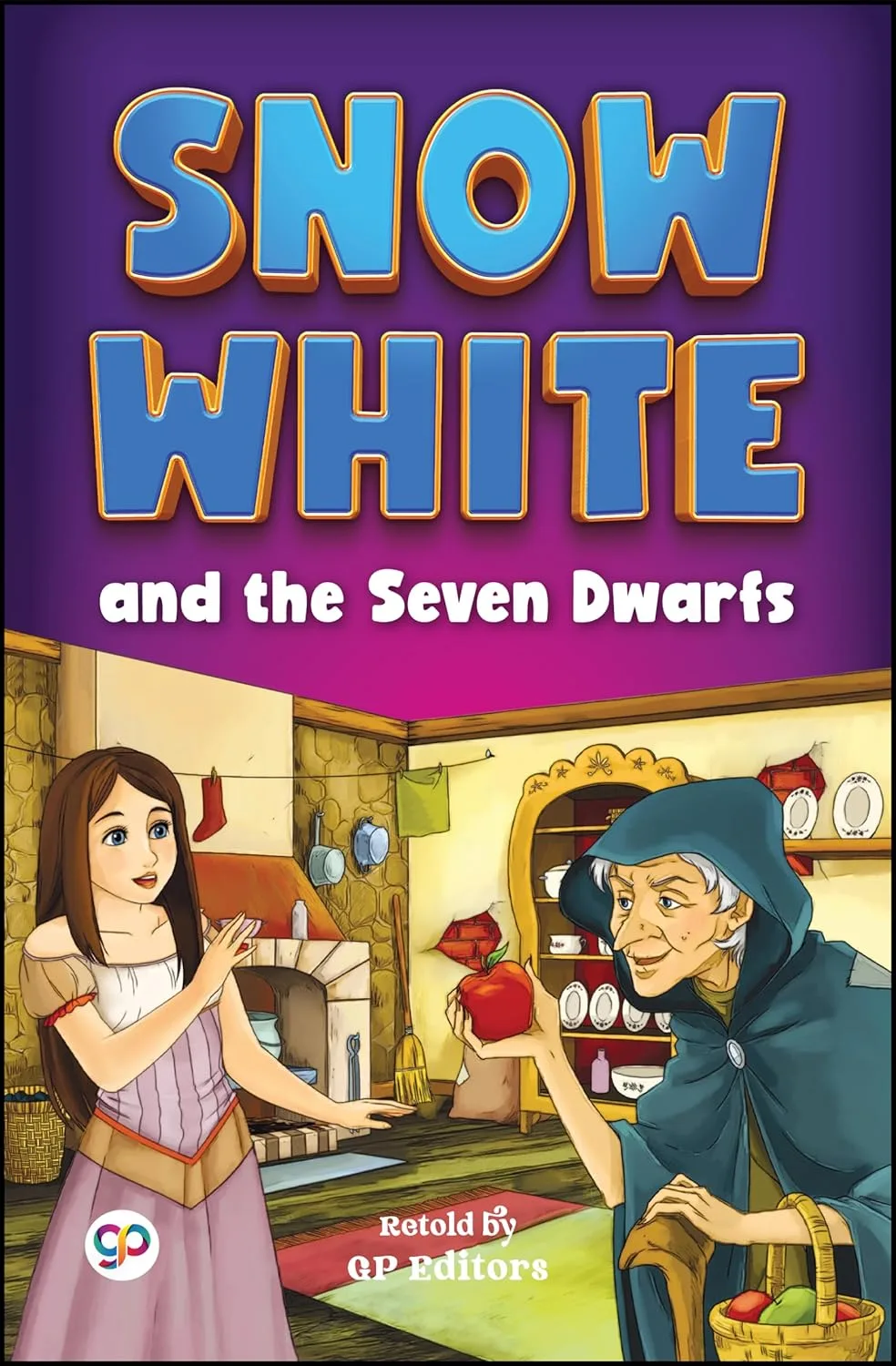
Snow White and the Seven Dwarfs
eBook
• INR 51.00
• English
• 9789390492978
No ratings yet
| Publisher | General Press |
|---|---|
| ISBN13 | 9789390492978 |
| ASIN/SKU | B0CW173BGN |
| Book Format | eBook |
| Language | English |
| List Price | INR 51.00 |
| Subject Code | JUV012030, FIC004000 |
| Book Code | BD00069236 |
Buy this Book
Amazon Stores
Ebook Stores
Other Stores
Discover Snow White and the Seven Dwarfs by Jacob Ludwig Carl Grimm. This book is published by General Press in eBook format, ISBN 9789390492978, ASIN B0CW173BGN, under Children's Books, Children's Folk Tales and Myths, Classic Literature and Fiction.
Book Description
This fully illustrated edition of “Snow White and the Seven Dwarfs” includes:
12 colourful unique illustrations
Story is retold in lucid language
Text & Images adjusts as per screen size (full size)
Once upon a time in a faraway kingdom, there lived a King and his Queen. They were fair rulers of their land and all their subjects loved them. But the only thing that the King and the Queen wished for above all else, was a child. On a cold winter night, the Queen sent out a silent prayer.
“I wish to have a daughter who has hair as black as ebony, skin as white as snow and lips as red as blood.”
By the next winter, the King and the Queen were blessed with a baby girl whose skin was as white as snow, hair as black as ebony and lips as red as blood. Nothing could make the couple happier. They named their daughter Snow White.
When Snow White was still a small child, her mother passed away. After mourning the Queen’s death, the King married again. But he did not know that the new Queen was wicked and jealous, and owned a magic mirror. She would stand in front of this magic mirror in her chambers every morning and ask,
“Mirror, mirror on the wall,
Who is the fairest of them all?”
Every morning the mirror would dutifully reply, “It you, my Queen, who is the fairest of them all.”
Snow White’s father the King died a few years later and the Queen and Snow White became the sole residents of their castle.
12 colourful unique illustrations
Story is retold in lucid language
Text & Images adjusts as per screen size (full size)
Once upon a time in a faraway kingdom, there lived a King and his Queen. They were fair rulers of their land and all their subjects loved them. But the only thing that the King and the Queen wished for above all else, was a child. On a cold winter night, the Queen sent out a silent prayer.
“I wish to have a daughter who has hair as black as ebony, skin as white as snow and lips as red as blood.”
By the next winter, the King and the Queen were blessed with a baby girl whose skin was as white as snow, hair as black as ebony and lips as red as blood. Nothing could make the couple happier. They named their daughter Snow White.
When Snow White was still a small child, her mother passed away. After mourning the Queen’s death, the King married again. But he did not know that the new Queen was wicked and jealous, and owned a magic mirror. She would stand in front of this magic mirror in her chambers every morning and ask,
“Mirror, mirror on the wall,
Who is the fairest of them all?”
Every morning the mirror would dutifully reply, “It you, my Queen, who is the fairest of them all.”
Snow White’s father the King died a few years later and the Queen and Snow White became the sole residents of their castle.
Author Biography
Jacob Ludwig Carl Grimm (1785–1863) was a German philologist, folklorist, linguist, and scholar whose work transformed the study of language, folklore, and cultural history. Best known as one half of the famous Brothers Grimm, alongside his younger brother Wilhelm Grimm, Jacob devoted his life to preserving traditional folktales, studying the origins of languages, and documenting the rich cultural heritage of the German-speaking world. His scholarly achievements continue to influence literature, linguistics, and folklore studies across the globe.
Born on January 4, 1785, in Hanau, Germany, Jacob was the eldest surviving son in a family of nine children. After the death of his father, the family faced financial hardship, but Jacob's determination and academic excellence enabled him to continue his education. He studied law at the University of Marburg, where he developed a deep interest in history, medieval literature, and philology under the guidance of the legal scholar Friedrich Carl von Savigny. These studies gradually shifted his focus from law to the historical development of language and culture.
Together with his brother Wilhelm, Jacob began collecting oral folktales from storytellers, villagers, and written sources. Their famous collection, Children's and Household Tales (Kinder- und Hausmärchen), first published in 1812, preserved timeless stories such as Cinderella, Snow White, Hansel and Gretel, Rapunzel, Rumpelstiltskin, and Sleeping Beauty. While these tales became beloved children's classics, the brothers originally intended them as scholarly records of Germany's rich oral traditions and cultural heritage.
Jacob Grimm's contributions extended far beyond folklore. He became one of the founders of modern historical linguistics and is especially remembered for Grimm's Law, a groundbreaking explanation of systematic sound changes among Indo-European languages. This discovery revolutionized the scientific study of language and established important principles that continue to guide linguists today. Along with Wilhelm, he also worked on the monumental German Dictionary (Deutsches Wörterbuch), an ambitious project documenting the history and evolution of the German language.
Throughout his life, Jacob Grimm remained committed to scholarship, education, and the preservation of cultural traditions. He served as a librarian, professor, and member of several prestigious academic institutions, earning widespread respect for his intellectual rigor and dedication.
Jacob Grimm passed away on September 20, 1863, in Berlin. Today, he is remembered not only as the collector of some of the world's most cherished fairy tales but also as a pioneering linguist whose work laid the foundation for modern language studies and helped preserve the enduring legacy of European folklore.
Born on January 4, 1785, in Hanau, Germany, Jacob was the eldest surviving son in a family of nine children. After the death of his father, the family faced financial hardship, but Jacob's determination and academic excellence enabled him to continue his education. He studied law at the University of Marburg, where he developed a deep interest in history, medieval literature, and philology under the guidance of the legal scholar Friedrich Carl von Savigny. These studies gradually shifted his focus from law to the historical development of language and culture.
Together with his brother Wilhelm, Jacob began collecting oral folktales from storytellers, villagers, and written sources. Their famous collection, Children's and Household Tales (Kinder- und Hausmärchen), first published in 1812, preserved timeless stories such as Cinderella, Snow White, Hansel and Gretel, Rapunzel, Rumpelstiltskin, and Sleeping Beauty. While these tales became beloved children's classics, the brothers originally intended them as scholarly records of Germany's rich oral traditions and cultural heritage.
Jacob Grimm's contributions extended far beyond folklore. He became one of the founders of modern historical linguistics and is especially remembered for Grimm's Law, a groundbreaking explanation of systematic sound changes among Indo-European languages. This discovery revolutionized the scientific study of language and established important principles that continue to guide linguists today. Along with Wilhelm, he also worked on the monumental German Dictionary (Deutsches Wörterbuch), an ambitious project documenting the history and evolution of the German language.
Throughout his life, Jacob Grimm remained committed to scholarship, education, and the preservation of cultural traditions. He served as a librarian, professor, and member of several prestigious academic institutions, earning widespread respect for his intellectual rigor and dedication.
Jacob Grimm passed away on September 20, 1863, in Berlin. Today, he is remembered not only as the collector of some of the world's most cherished fairy tales but also as a pioneering linguist whose work laid the foundation for modern language studies and helped preserve the enduring legacy of European folklore.
Editorial Reviews
Editorial Reviews will be added soon…
Book Summary
Snow White and the Seven Dwarfs, collected and published by Jacob and Wilhelm Grimm in the first edition of Grimms' Fairy Tales in 1812, is one of the world's most beloved fairy tales. Although often remembered as a simple children's story, it is a richly symbolic tale about innocence, jealousy, vanity, courage, kindness, and the triumph of goodness over evil. Through memorable characters and timeless themes, the Brothers Grimm created a story that continues to resonate across generations, reminding readers that true beauty comes from purity of heart rather than outward appearance.
The story begins with a queen who sits by a window during winter, sewing while snow gently falls outside. As she accidentally pricks her finger, three drops of blood fall onto the white snow. Looking at the striking contrast of red against white, she wishes for a daughter with skin as white as snow, lips as red as blood, and hair as black as ebony. Soon afterward, she gives birth to a beautiful little girl named Snow White. Tragically, the queen dies not long after her daughter's birth.
The king eventually remarries. His new queen is exceptionally beautiful, but she is also consumed by pride and vanity. She owns a magical mirror that always speaks the truth. Each day she asks, "Mirror, mirror on the wall, who is the fairest of them all?" For many years, the mirror faithfully replies that the queen herself is the fairest woman in the land. Her confidence depends entirely upon hearing these words, and her sense of worth becomes tied to being admired above everyone else.
As Snow White grows older, she becomes increasingly beautiful, not only in appearance but also in gentleness, kindness, and innocence. One day, when the queen asks her familiar question, the mirror gives a different answer. It tells her that Snow White has now become the fairest of all. Overcome with jealousy and rage, the queen cannot bear the thought of someone surpassing her beauty. Her envy quickly transforms into hatred.
Determined to eliminate her rival, the queen orders a huntsman to take Snow White deep into the forest and kill her. As proof that the task has been completed, she demands that he bring back the young girl's heart. The huntsman obeys at first, leading Snow White far into the woods. However, when he sees her innocence and hears her desperate pleas for mercy, he cannot bring himself to carry out the cruel command. Instead, he tells her to flee and never return. To deceive the queen, he kills a wild animal and presents its heart as evidence of Snow White's death.
Alone in the vast forest, Snow White wanders in fear among towering trees and unfamiliar paths. Exhausted and frightened, she eventually discovers a small cottage. Everything inside is tiny—seven little chairs, seven little plates, and seven little beds. Hungry and weary, she carefully eats a small portion from each plate and then falls asleep across the little beds.
When evening arrives, the cottage's owners return home. They are seven dwarfs, hardworking miners who spend their days digging for precious metals and gems deep beneath the mountains. Surprised to find an unexpected visitor, they soon realize that Snow White is harmless. Hearing her story, they are moved by her misfortune and offer her shelter. In return, she promises to keep their home clean, prepare meals, and care for the household while they work.
Life among the dwarfs brings Snow White peace and happiness. Far from the cruelty of the royal palace, she experiences friendship, safety, and honest labor. The dwarfs become her protectors, treating her with affection and respect. Their modest home symbolizes a life built on cooperation, kindness, and simplicity rather than wealth or power.
Meanwhile, the queen once again consults her magic mirror. To her horror, it reveals that Snow White is still alive and living with the seven dwarfs. Furious that her plan has failed, the queen decides to kill Snow White herself.
Disguising herself as an old peddler woman, she travels to the dwarfs' cottage carrying colorful lace ribbons. Despite the dwarfs' warning never to open the door to strangers, Snow White feels pity for the elderly woman and lets her inside. The disguised queen tightly laces Snow White's bodice until she can barely breathe, causing her to collapse unconscious. Fortunately, when the dwarfs return home, they quickly realize what has happened and loosen the laces, saving her life.
The queen's second attempt comes in the form of a poisoned comb. Once again disguised, she convinces Snow White to try the beautiful comb in her hair. As soon as it touches her head, Snow White falls unconscious. The dwarfs once again rescue her by removing the poisoned comb. They plead with her to trust no strangers again.
Still consumed by envy, the queen devises one final and more deadly plan. She prepares a beautiful apple, poisoning only one side while leaving the other perfectly safe. Disguised yet again as an old woman, she persuades Snow White that the fruit is harmless by eating from the unpoisoned half herself. Reassured, Snow White takes a bite from the poisoned side. Instantly, she falls into a deathlike sleep from which no ordinary remedy can awaken her.
When the dwarfs return, they find Snow White lying motionless. Unable to revive her, they mourn deeply. Believing that her beauty is too pure to bury beneath the earth, they place her inside a beautiful glass coffin on a mountaintop, where they can continue watching over her. Birds and forest animals also gather in silent sorrow, emphasizing the deep harmony Snow White shares with the natural world.
Time passes before a handsome prince traveling through the forest discovers the glass coffin. Captivated not merely by Snow White's beauty but by the peaceful innocence reflected in her face, he asks the dwarfs for permission to take the coffin with him so that he may honor her memory. As his servants carry the coffin away, they stumble over uneven ground. The sudden jolt dislodges the piece of poisoned apple lodged in Snow White's throat. She awakens as though from a long sleep.
The prince rejoices, and Snow White happily accepts his proposal of marriage. Their union represents the restoration of hope after suffering and the reward of steadfast goodness.
The wicked queen is invited to the royal wedding, unaware that Snow White is alive. Once she arrives and discovers the truth, she is overwhelmed with shock and terror. According to the Grimm version of the tale, she receives a severe punishment for her cruelty, symbolizing that unchecked envy and vanity ultimately lead to one's own destruction.
Throughout Snow White and the Seven Dwarfs, the Brothers Grimm explore profound themes beneath the fairy tale's simple narrative. The story contrasts inner beauty with outward appearance, showing that kindness, humility, and innocence possess far greater value than physical attractiveness. It also warns against jealousy, pride, and obsession with status, illustrating how these destructive emotions can consume a person's heart.
Ultimately, Snow White and the Seven Dwarfs is not simply a tale of magic and adventure but a timeless reflection on human character. It celebrates the enduring power of goodness, compassion, friendship, and hope. Through Snow White's courage, the dwarfs' loyalty, and the ultimate triumph of truth over envy, the story reminds readers that genuine beauty shines from within and that even in the darkest moments, innocence and kindness possess the strength to overcome hatred and fear.
The story begins with a queen who sits by a window during winter, sewing while snow gently falls outside. As she accidentally pricks her finger, three drops of blood fall onto the white snow. Looking at the striking contrast of red against white, she wishes for a daughter with skin as white as snow, lips as red as blood, and hair as black as ebony. Soon afterward, she gives birth to a beautiful little girl named Snow White. Tragically, the queen dies not long after her daughter's birth.
The king eventually remarries. His new queen is exceptionally beautiful, but she is also consumed by pride and vanity. She owns a magical mirror that always speaks the truth. Each day she asks, "Mirror, mirror on the wall, who is the fairest of them all?" For many years, the mirror faithfully replies that the queen herself is the fairest woman in the land. Her confidence depends entirely upon hearing these words, and her sense of worth becomes tied to being admired above everyone else.
As Snow White grows older, she becomes increasingly beautiful, not only in appearance but also in gentleness, kindness, and innocence. One day, when the queen asks her familiar question, the mirror gives a different answer. It tells her that Snow White has now become the fairest of all. Overcome with jealousy and rage, the queen cannot bear the thought of someone surpassing her beauty. Her envy quickly transforms into hatred.
Determined to eliminate her rival, the queen orders a huntsman to take Snow White deep into the forest and kill her. As proof that the task has been completed, she demands that he bring back the young girl's heart. The huntsman obeys at first, leading Snow White far into the woods. However, when he sees her innocence and hears her desperate pleas for mercy, he cannot bring himself to carry out the cruel command. Instead, he tells her to flee and never return. To deceive the queen, he kills a wild animal and presents its heart as evidence of Snow White's death.
Alone in the vast forest, Snow White wanders in fear among towering trees and unfamiliar paths. Exhausted and frightened, she eventually discovers a small cottage. Everything inside is tiny—seven little chairs, seven little plates, and seven little beds. Hungry and weary, she carefully eats a small portion from each plate and then falls asleep across the little beds.
When evening arrives, the cottage's owners return home. They are seven dwarfs, hardworking miners who spend their days digging for precious metals and gems deep beneath the mountains. Surprised to find an unexpected visitor, they soon realize that Snow White is harmless. Hearing her story, they are moved by her misfortune and offer her shelter. In return, she promises to keep their home clean, prepare meals, and care for the household while they work.
Life among the dwarfs brings Snow White peace and happiness. Far from the cruelty of the royal palace, she experiences friendship, safety, and honest labor. The dwarfs become her protectors, treating her with affection and respect. Their modest home symbolizes a life built on cooperation, kindness, and simplicity rather than wealth or power.
Meanwhile, the queen once again consults her magic mirror. To her horror, it reveals that Snow White is still alive and living with the seven dwarfs. Furious that her plan has failed, the queen decides to kill Snow White herself.
Disguising herself as an old peddler woman, she travels to the dwarfs' cottage carrying colorful lace ribbons. Despite the dwarfs' warning never to open the door to strangers, Snow White feels pity for the elderly woman and lets her inside. The disguised queen tightly laces Snow White's bodice until she can barely breathe, causing her to collapse unconscious. Fortunately, when the dwarfs return home, they quickly realize what has happened and loosen the laces, saving her life.
The queen's second attempt comes in the form of a poisoned comb. Once again disguised, she convinces Snow White to try the beautiful comb in her hair. As soon as it touches her head, Snow White falls unconscious. The dwarfs once again rescue her by removing the poisoned comb. They plead with her to trust no strangers again.
Still consumed by envy, the queen devises one final and more deadly plan. She prepares a beautiful apple, poisoning only one side while leaving the other perfectly safe. Disguised yet again as an old woman, she persuades Snow White that the fruit is harmless by eating from the unpoisoned half herself. Reassured, Snow White takes a bite from the poisoned side. Instantly, she falls into a deathlike sleep from which no ordinary remedy can awaken her.
When the dwarfs return, they find Snow White lying motionless. Unable to revive her, they mourn deeply. Believing that her beauty is too pure to bury beneath the earth, they place her inside a beautiful glass coffin on a mountaintop, where they can continue watching over her. Birds and forest animals also gather in silent sorrow, emphasizing the deep harmony Snow White shares with the natural world.
Time passes before a handsome prince traveling through the forest discovers the glass coffin. Captivated not merely by Snow White's beauty but by the peaceful innocence reflected in her face, he asks the dwarfs for permission to take the coffin with him so that he may honor her memory. As his servants carry the coffin away, they stumble over uneven ground. The sudden jolt dislodges the piece of poisoned apple lodged in Snow White's throat. She awakens as though from a long sleep.
The prince rejoices, and Snow White happily accepts his proposal of marriage. Their union represents the restoration of hope after suffering and the reward of steadfast goodness.
The wicked queen is invited to the royal wedding, unaware that Snow White is alive. Once she arrives and discovers the truth, she is overwhelmed with shock and terror. According to the Grimm version of the tale, she receives a severe punishment for her cruelty, symbolizing that unchecked envy and vanity ultimately lead to one's own destruction.
Throughout Snow White and the Seven Dwarfs, the Brothers Grimm explore profound themes beneath the fairy tale's simple narrative. The story contrasts inner beauty with outward appearance, showing that kindness, humility, and innocence possess far greater value than physical attractiveness. It also warns against jealousy, pride, and obsession with status, illustrating how these destructive emotions can consume a person's heart.
Ultimately, Snow White and the Seven Dwarfs is not simply a tale of magic and adventure but a timeless reflection on human character. It celebrates the enduring power of goodness, compassion, friendship, and hope. Through Snow White's courage, the dwarfs' loyalty, and the ultimate triumph of truth over envy, the story reminds readers that genuine beauty shines from within and that even in the darkest moments, innocence and kindness possess the strength to overcome hatred and fear.
Sample Chapters
Sample Chapters will be added soon…
Reader Reviews
No reviews yet.
Snow White and the Seven Dwarfs
Download Cover Image
Do you want to download the full cover image for Snow White and the Seven Dwarfs?