
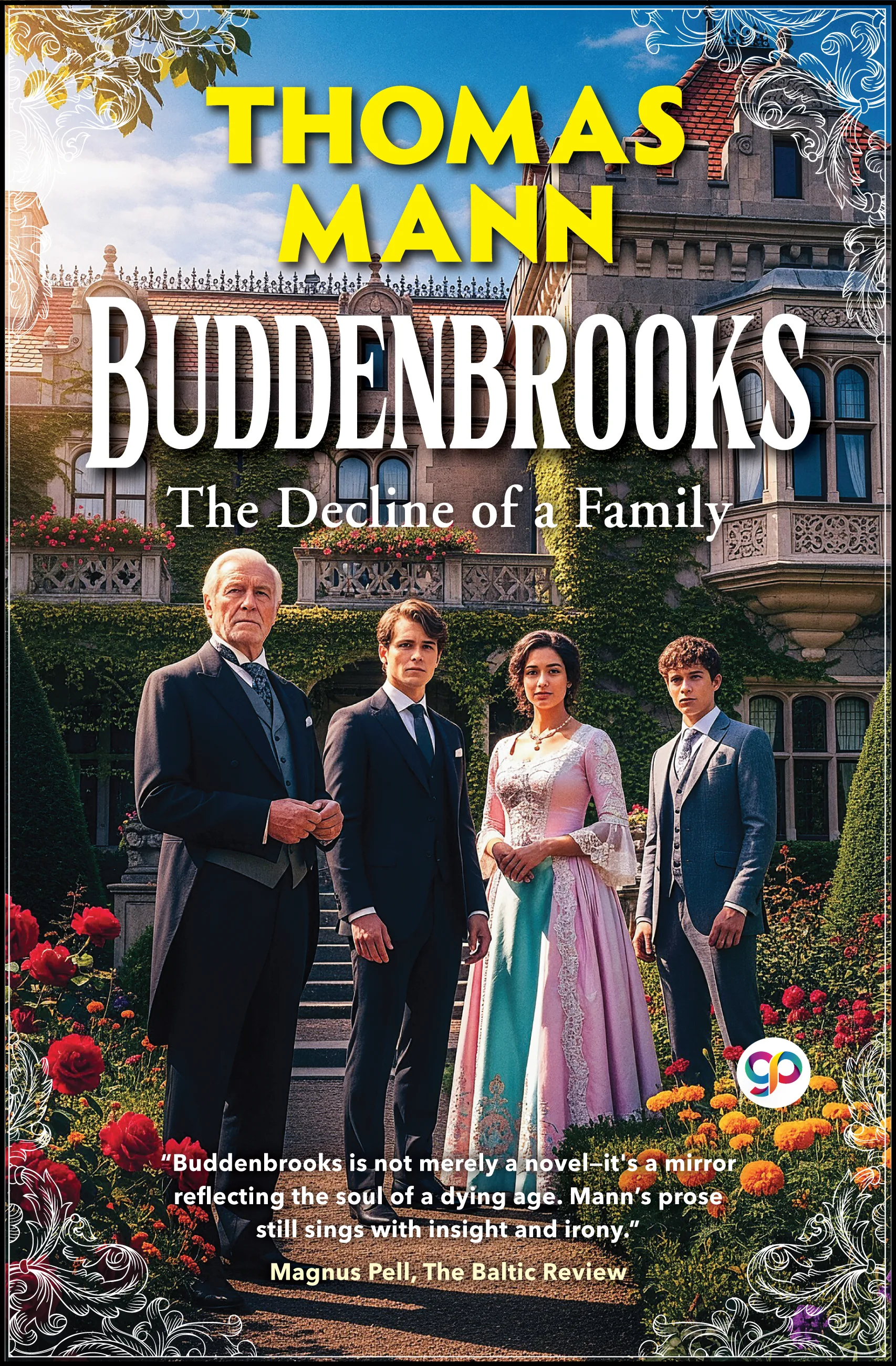
Buddenbrooks: The Decline of a Family
eBook
• INR 99.00
• English
• 9788199258174
No ratings yet
| Publisher | General Press |
|---|---|
| ISBN13 | 9788199258174 |
| ASIN/SKU | B0G19KY69V |
| Book Format | eBook |
| Language | English |
| List Price | INR 99.00 |
| Subject Code | FIC014000 |
| Book Code | BD00069241 |
Buy this Book
Amazon Stores
Ebook Stores
Other Stores
Discover Buddenbrooks: The Decline of a Family by Thomas Mann. This book is published by General Press in eBook format, ISBN 9788199258174, ASIN B0G19KY69V, under Literature and Fiction, Psychological Fiction, Historical Fiction.
Book Description
Buddenbrooks: The Decline of a Family is a celebrated German novel written by Thomas Mann and first published in 1901. Mann, who would later win the Nobel Prize in Literature in 1929, was only twenty-six when he wrote this masterpiece. Drawing inspiration from his own family’s background, Mann created a richly detailed portrait of a wealthy merchant family in Lübeck, Germany, tracing their gradual decline across four generations.
The novel chronicles the fortunes of the Buddenbrook family, beginning in the 1830s and ending toward the late 19th century. At the start, the family stands at the height of prosperity, led by the dignified patriarch Johann Buddenbrook. Over time, however, their wealth, social status, and sense of purpose begin to erode. Each generation becomes increasingly disillusioned and detached from the values of hard work and tradition that once defined the family’s success. The final heir, Hanno Buddenbrook, embodies the ultimate collapse — a sensitive, artistic boy ill-suited to the materialistic world of business.
Mann’s narrative blends social realism with psychological insight, portraying the conflict between individual desires and social expectations. His detailed descriptions of family life, commerce, and bourgeois values reveal the fragility of prosperity and the inevitability of change. Beneath the story of one family lies a deeper commentary on the decline of the German middle class and the moral and spiritual decay of modern society.
With its elegant prose and philosophical undertones, Buddenbrooks established Thomas Mann as a major literary voice in Europe. The novel remains a cornerstone of German literature, admired for its realism, moral depth, and profound understanding of human weakness. It stands as both a family saga and a timeless meditation on ambition, decay, and the passage of time.
The novel chronicles the fortunes of the Buddenbrook family, beginning in the 1830s and ending toward the late 19th century. At the start, the family stands at the height of prosperity, led by the dignified patriarch Johann Buddenbrook. Over time, however, their wealth, social status, and sense of purpose begin to erode. Each generation becomes increasingly disillusioned and detached from the values of hard work and tradition that once defined the family’s success. The final heir, Hanno Buddenbrook, embodies the ultimate collapse — a sensitive, artistic boy ill-suited to the materialistic world of business.
Mann’s narrative blends social realism with psychological insight, portraying the conflict between individual desires and social expectations. His detailed descriptions of family life, commerce, and bourgeois values reveal the fragility of prosperity and the inevitability of change. Beneath the story of one family lies a deeper commentary on the decline of the German middle class and the moral and spiritual decay of modern society.
With its elegant prose and philosophical undertones, Buddenbrooks established Thomas Mann as a major literary voice in Europe. The novel remains a cornerstone of German literature, admired for its realism, moral depth, and profound understanding of human weakness. It stands as both a family saga and a timeless meditation on ambition, decay, and the passage of time.
Author Biography
Thomas Mann was a German novelist, short story writer, social critic, philanthropist, essayist, and Nobel Prize laureate in 1929, known for his series of highly symbolic and ironic epic novels and novellas, noted for their insight into the psychology of the artist and the intellectual. His analysis and critique of the European and German soul used modernized German and Biblical stories, as well as the ideas of Goethe, Nietzsche, and Schopenhauer. His older brother was the radical writer Heinrich Mann, and three of his six children, Erika Mann, Klaus Mann and Golo Mann, also became important German writers. When Hitler came to power in 1933, Mann fled to Switzerland. When World War II broke out in 1939, he emigrated to the United States, from where he returned to Switzerland in 1952. Thomas Mann is one of the best-known exponents of the so-called Exilliteratur.
Editorial Reviews
Editorial Reviews will be added soon…
Book Summary
Buddenbrooks: The Decline of a Family, first published in 1901, is Thomas Mann’s first novel and one of the greatest family sagas in world literature. Winner of the Nobel Prize in Literature largely because of this masterpiece, Mann traces the rise and gradual decline of a wealthy German merchant family over four generations. More than a story about business fortunes, the novel is a profound exploration of family duty, changing social values, personal ambition, and the tension between material success and inner fulfillment. Through the lives of the Buddenbrook family, Mann examines how prosperity can slowly erode under the weight of changing times, fragile relationships, and the conflicting desires of each new generation.
The story begins in the prosperous Hanseatic city of Lübeck during the early nineteenth century. The Buddenbrooks are among the city's most respected merchant families, known for their successful grain business, financial stability, and impeccable reputation. Their elegant home, refined manners, and commitment to tradition symbolize both their social standing and their belief that discipline, honor, and hard work guarantee lasting success.
At the center of the family are the elder Buddenbrooks, who have built their prosperity through honesty and careful management. Their greatest hope is that future generations will preserve both the business and the family's respected name. From the very beginning, however, Thomas Mann quietly suggests that beneath this impressive exterior lie vulnerabilities that will gradually shape the family's destiny.
The second generation is led by Jean Buddenbrook, who inherits both the business and the responsibility of maintaining the family's honor. Jean is deeply religious, disciplined, and devoted to tradition. He believes that commercial success carries moral responsibilities and that personal conduct should reflect dignity and integrity. His children—Thomas, Christian, Tony, and Clara—each respond differently to the expectations placed upon them, setting the stage for the family's gradual transformation.
Among the siblings, Tony Buddenbrook becomes one of the novel's most memorable characters. Proud of her family's reputation, she sincerely wishes to fulfill her duty, even when it requires personal sacrifice. She falls in love with a young man of modest means, but her family persuades her to marry a wealthy businessman instead, believing the marriage will strengthen their social and financial position.
Tony obediently accepts this decision, placing family honor above personal happiness. Unfortunately, her marriage proves disastrous. Her husband is dishonest and eventually disgraces both himself and the Buddenbrook name. After the marriage ends, Tony returns home, carrying emotional scars but remaining fiercely loyal to her family. Later, she enters a second marriage that also fails, reinforcing one of the novel's recurring themes—that social ambition cannot guarantee happiness.
Meanwhile, Thomas Buddenbrook, the eldest son, gradually assumes leadership of the family business. Intelligent, disciplined, and ambitious, Thomas appears to embody everything the family values. Under his management, the business continues to prosper for a time, and he earns widespread respect within the community. Yet maintaining this success demands enormous personal sacrifice.
Thomas constantly suppresses his own emotions, believing that weakness has no place in a successful businessman. He measures his worth by his ability to uphold the family's reputation, even when doing so leaves him emotionally exhausted. Outwardly confident, he privately struggles with anxiety, loneliness, and an increasing awareness that the world around him is changing faster than tradition can adapt.
Thomas's younger brother, Christian, represents the opposite temperament. Sensitive, humorous, and unpredictable, Christian lacks the discipline necessary for business life. He frequently changes interests, avoids responsibility, and becomes known more for eccentric behavior than for meaningful achievement. Although often treated as comic relief, Christian's inability to fit within the family's rigid expectations reflects another aspect of decline—the growing mismatch between individual personality and inherited duty.
As the years pass, economic conditions become more competitive, and maintaining the family's business grows increasingly difficult. Traditional methods that once guaranteed prosperity begin to lose their effectiveness in a rapidly modernizing society. Thomas works tirelessly to preserve the company, but each success requires greater effort while yielding smaller rewards. Mann subtly portrays decline not as a sudden collapse but as a slow erosion brought about by countless small setbacks.
The emotional center of the novel shifts to Thomas's only son, Hanno Buddenbrook, who represents the fourth generation. Unlike his practical ancestors, Hanno has little interest in commerce or public success. Gentle, shy, and physically fragile, he is deeply drawn to music, literature, and imagination. Artistic beauty speaks to him far more than business accounts or commercial negotiations.
Hanno's sensitive nature creates a painful conflict between personal identity and family expectation. Thomas hopes his son will eventually inherit the business and restore the family's future. Yet Hanno simply cannot become the merchant his father desires. His greatest passion is music, through which he finds comfort and emotional expression. Mann uses Hanno's character to explore the growing separation between artistic sensitivity and commercial ambition.
Throughout the novel, Thomas increasingly realizes that he and Hanno belong to different worlds. While Thomas values discipline, order, and achievement, Hanno values beauty, emotion, and creativity. Their inability to fully understand one another creates quiet but profound sadness. Neither father nor son is at fault; they simply embody different responses to life itself.
Death and loss gradually become more frequent as older family members pass away and younger generations fail to carry forward the traditions that once united the household. Financial pressures mount, family influence diminishes, and the once-proud merchant house slowly loses its position within society. Mann presents this decline with remarkable realism, showing that families, like individuals, cannot escape the passage of time.
Eventually, Hanno's delicate health deteriorates, and he dies while still very young. His death effectively ends the Buddenbrook family line. Without an heir willing or able to continue the business, the family's long history comes to a quiet conclusion. The decline that began almost invisibly over decades reaches its inevitable end—not through dramatic catastrophe, but through the gradual fading of a way of life.
One of the novel's greatest strengths is its balanced portrayal of every generation. Mann does not blame a single person for the family's downfall. Instead, he suggests that historical change, personal temperament, shifting values, and human limitations all contribute to the family's fate. Each generation inherits not only wealth but also burdens that become increasingly difficult to bear.
Throughout Buddenbrooks, Thomas Mann explores timeless themes including duty, identity, family loyalty, ambition, social change, aging, and mortality. He examines how external success often conceals inner loneliness and how the pursuit of status can come at the cost of personal happiness. At the same time, he celebrates qualities such as integrity, perseverance, compassion, and artistic sensitivity, even when they seem out of place in a competitive world.
Ultimately, Buddenbrooks is far more than the story of a family's financial decline. It is a deeply human meditation on the fragile nature of success and the inevitable changes that shape every generation. Thomas Mann reminds readers that no fortune, reputation, or social position lasts forever. What endures are the values people pass on, the relationships they nurture, and the quiet dignity with which they face life's changing seasons. Through the rise and fall of the Buddenbrooks, the novel offers a moving reflection on the passage of time and the enduring complexity of family life.
The story begins in the prosperous Hanseatic city of Lübeck during the early nineteenth century. The Buddenbrooks are among the city's most respected merchant families, known for their successful grain business, financial stability, and impeccable reputation. Their elegant home, refined manners, and commitment to tradition symbolize both their social standing and their belief that discipline, honor, and hard work guarantee lasting success.
At the center of the family are the elder Buddenbrooks, who have built their prosperity through honesty and careful management. Their greatest hope is that future generations will preserve both the business and the family's respected name. From the very beginning, however, Thomas Mann quietly suggests that beneath this impressive exterior lie vulnerabilities that will gradually shape the family's destiny.
The second generation is led by Jean Buddenbrook, who inherits both the business and the responsibility of maintaining the family's honor. Jean is deeply religious, disciplined, and devoted to tradition. He believes that commercial success carries moral responsibilities and that personal conduct should reflect dignity and integrity. His children—Thomas, Christian, Tony, and Clara—each respond differently to the expectations placed upon them, setting the stage for the family's gradual transformation.
Among the siblings, Tony Buddenbrook becomes one of the novel's most memorable characters. Proud of her family's reputation, she sincerely wishes to fulfill her duty, even when it requires personal sacrifice. She falls in love with a young man of modest means, but her family persuades her to marry a wealthy businessman instead, believing the marriage will strengthen their social and financial position.
Tony obediently accepts this decision, placing family honor above personal happiness. Unfortunately, her marriage proves disastrous. Her husband is dishonest and eventually disgraces both himself and the Buddenbrook name. After the marriage ends, Tony returns home, carrying emotional scars but remaining fiercely loyal to her family. Later, she enters a second marriage that also fails, reinforcing one of the novel's recurring themes—that social ambition cannot guarantee happiness.
Meanwhile, Thomas Buddenbrook, the eldest son, gradually assumes leadership of the family business. Intelligent, disciplined, and ambitious, Thomas appears to embody everything the family values. Under his management, the business continues to prosper for a time, and he earns widespread respect within the community. Yet maintaining this success demands enormous personal sacrifice.
Thomas constantly suppresses his own emotions, believing that weakness has no place in a successful businessman. He measures his worth by his ability to uphold the family's reputation, even when doing so leaves him emotionally exhausted. Outwardly confident, he privately struggles with anxiety, loneliness, and an increasing awareness that the world around him is changing faster than tradition can adapt.
Thomas's younger brother, Christian, represents the opposite temperament. Sensitive, humorous, and unpredictable, Christian lacks the discipline necessary for business life. He frequently changes interests, avoids responsibility, and becomes known more for eccentric behavior than for meaningful achievement. Although often treated as comic relief, Christian's inability to fit within the family's rigid expectations reflects another aspect of decline—the growing mismatch between individual personality and inherited duty.
As the years pass, economic conditions become more competitive, and maintaining the family's business grows increasingly difficult. Traditional methods that once guaranteed prosperity begin to lose their effectiveness in a rapidly modernizing society. Thomas works tirelessly to preserve the company, but each success requires greater effort while yielding smaller rewards. Mann subtly portrays decline not as a sudden collapse but as a slow erosion brought about by countless small setbacks.
The emotional center of the novel shifts to Thomas's only son, Hanno Buddenbrook, who represents the fourth generation. Unlike his practical ancestors, Hanno has little interest in commerce or public success. Gentle, shy, and physically fragile, he is deeply drawn to music, literature, and imagination. Artistic beauty speaks to him far more than business accounts or commercial negotiations.
Hanno's sensitive nature creates a painful conflict between personal identity and family expectation. Thomas hopes his son will eventually inherit the business and restore the family's future. Yet Hanno simply cannot become the merchant his father desires. His greatest passion is music, through which he finds comfort and emotional expression. Mann uses Hanno's character to explore the growing separation between artistic sensitivity and commercial ambition.
Throughout the novel, Thomas increasingly realizes that he and Hanno belong to different worlds. While Thomas values discipline, order, and achievement, Hanno values beauty, emotion, and creativity. Their inability to fully understand one another creates quiet but profound sadness. Neither father nor son is at fault; they simply embody different responses to life itself.
Death and loss gradually become more frequent as older family members pass away and younger generations fail to carry forward the traditions that once united the household. Financial pressures mount, family influence diminishes, and the once-proud merchant house slowly loses its position within society. Mann presents this decline with remarkable realism, showing that families, like individuals, cannot escape the passage of time.
Eventually, Hanno's delicate health deteriorates, and he dies while still very young. His death effectively ends the Buddenbrook family line. Without an heir willing or able to continue the business, the family's long history comes to a quiet conclusion. The decline that began almost invisibly over decades reaches its inevitable end—not through dramatic catastrophe, but through the gradual fading of a way of life.
One of the novel's greatest strengths is its balanced portrayal of every generation. Mann does not blame a single person for the family's downfall. Instead, he suggests that historical change, personal temperament, shifting values, and human limitations all contribute to the family's fate. Each generation inherits not only wealth but also burdens that become increasingly difficult to bear.
Throughout Buddenbrooks, Thomas Mann explores timeless themes including duty, identity, family loyalty, ambition, social change, aging, and mortality. He examines how external success often conceals inner loneliness and how the pursuit of status can come at the cost of personal happiness. At the same time, he celebrates qualities such as integrity, perseverance, compassion, and artistic sensitivity, even when they seem out of place in a competitive world.
Ultimately, Buddenbrooks is far more than the story of a family's financial decline. It is a deeply human meditation on the fragile nature of success and the inevitable changes that shape every generation. Thomas Mann reminds readers that no fortune, reputation, or social position lasts forever. What endures are the values people pass on, the relationships they nurture, and the quiet dignity with which they face life's changing seasons. Through the rise and fall of the Buddenbrooks, the novel offers a moving reflection on the passage of time and the enduring complexity of family life.
Sample Chapters
Sample Chapters will be added soon…
Reader Reviews
No reviews yet.
Buddenbrooks: The Decline of a Family
Download Cover Image
Do you want to download the full cover image for Buddenbrooks: The Decline of a Family?