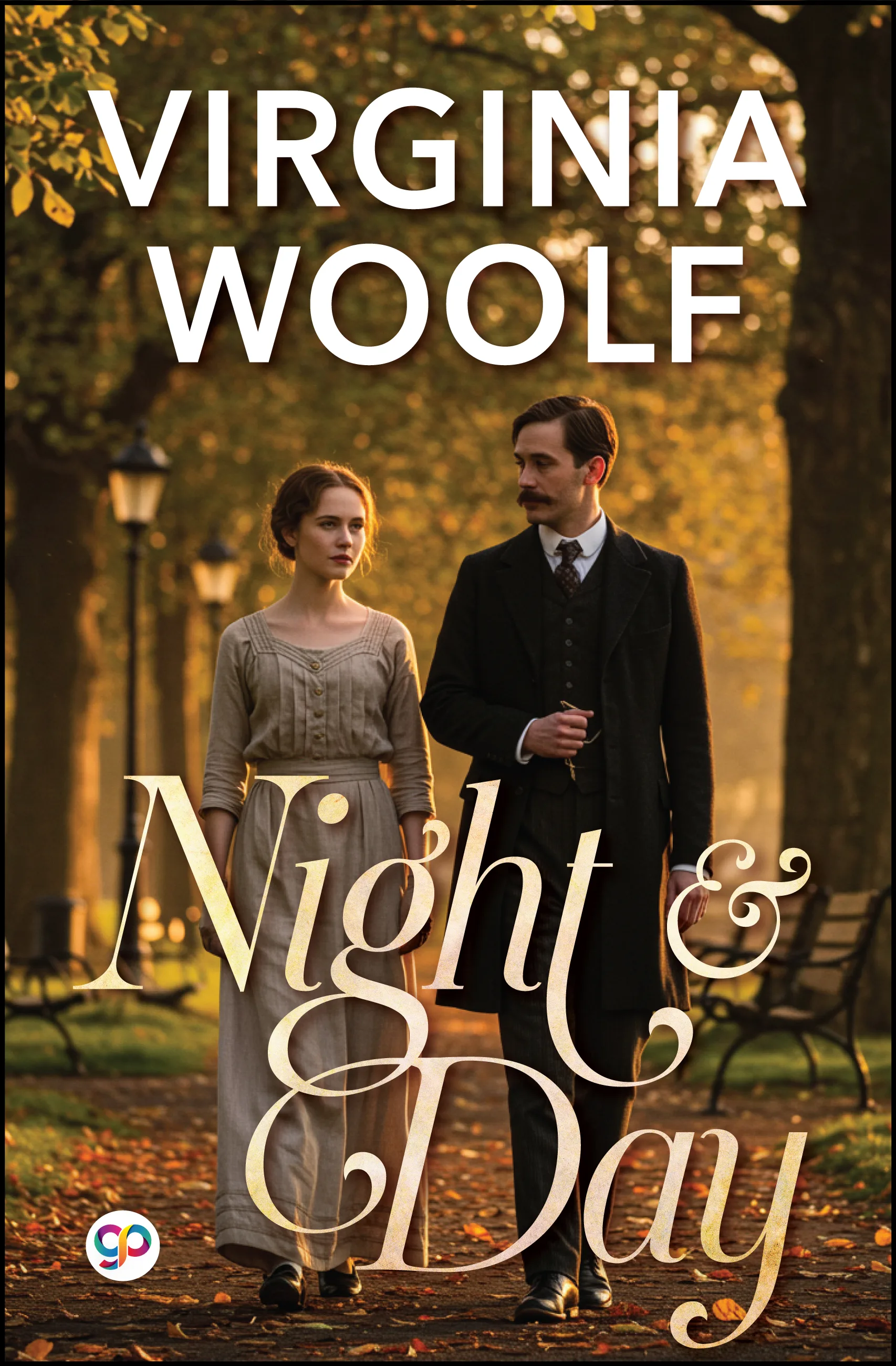
Night and Day
eBook
• INR 99.00
• English
• 9789388843508
No ratings yet
| Publisher | General Press |
|---|---|
| ISBN13 | 9789388843508 |
| ASIN/SKU | B0G19LCJFD |
| Book Format | eBook |
| Language | English |
| List Price | INR 99.00 |
| Subject Code | FIC044000 |
| Book Code | BD00069242 |
Buy this Book
Amazon Stores
Ebook Stores
Other Stores
Discover Night and Day by Virginia Woolf. This book is published by General Press in eBook format, ISBN 9789388843508, ASIN B0G19LCJFD, under Literature and Fiction, Women Fiction, Classics.
Book Description
Night and Day is a novel by Virginia Woolf, first published in 1919. Woolf, one of the foremost figures of modernist literature, is celebrated for her innovative narrative techniques, psychological insight, and exploration of gender and identity. Written soon after World War I, Night and Day belongs to her early period and reflects a more traditional style before she developed the experimental form seen in her later works like Mrs. Dalloway and To the Lighthouse.
Set in Edwardian London, the novel follows the intertwined lives of Katharine Hilbery and Mary Datchet, two intelligent and independent women navigating love, work, and self-discovery. Katharine, the granddaughter of a famous poet, struggles between fulfilling family expectations and pursuing her own intellectual ambitions. She becomes engaged to the gentle and logical Ralph Denham but is uncertain whether her feelings align with social convention or genuine love. Meanwhile, Mary, a suffragist devoted to political reform, represents the growing presence of women in public life and challenges traditional gender roles.
Through these characters, Woolf explores themes of love, marriage, individuality, and women’s independence, contrasting romantic idealism (“night”) with the rational, structured world of society (“day”). The novel examines the constraints placed upon women by class and convention, yet it also celebrates their emotional depth and intellectual capacity.
Although Night and Day follows a conventional narrative structure compared to Woolf’s later stream-of-consciousness works, it reveals her emerging interest in the inner lives of women and the tension between personal freedom and social duty. Rich in dialogue and psychological nuance, the novel captures the changing spirit of its time — when women were beginning to question their prescribed roles.
Today, Night and Day stands as a beautifully written and insightful exploration of love, identity, and the quiet rebellion of women seeking meaning beyond tradition.
Set in Edwardian London, the novel follows the intertwined lives of Katharine Hilbery and Mary Datchet, two intelligent and independent women navigating love, work, and self-discovery. Katharine, the granddaughter of a famous poet, struggles between fulfilling family expectations and pursuing her own intellectual ambitions. She becomes engaged to the gentle and logical Ralph Denham but is uncertain whether her feelings align with social convention or genuine love. Meanwhile, Mary, a suffragist devoted to political reform, represents the growing presence of women in public life and challenges traditional gender roles.
Through these characters, Woolf explores themes of love, marriage, individuality, and women’s independence, contrasting romantic idealism (“night”) with the rational, structured world of society (“day”). The novel examines the constraints placed upon women by class and convention, yet it also celebrates their emotional depth and intellectual capacity.
Although Night and Day follows a conventional narrative structure compared to Woolf’s later stream-of-consciousness works, it reveals her emerging interest in the inner lives of women and the tension between personal freedom and social duty. Rich in dialogue and psychological nuance, the novel captures the changing spirit of its time — when women were beginning to question their prescribed roles.
Today, Night and Day stands as a beautifully written and insightful exploration of love, identity, and the quiet rebellion of women seeking meaning beyond tradition.
Author Biography
Virginia Woolf is now recognized as a major twentieth-century author, a great novelist and essayist and a key figure in literary history as a feminist and a modernist. Born in 1882, she was the daughter of the editor and critic Leslie Stephen, and suffered a traumatic adolescence after the deaths of her mother, in 1895, and her step-sister Stella, in 1897, leaving her subject to breakdowns for the rest of her life. Her father died in 1904 and two years later her favourite brother Thoby died suddenly of typhoid.
With her sister, the painter Vanessa Bell, she was drawn into the company of writers and artists such as Lytton Strachey and Roger Fry, later known as the Bloomsbury Group. Among them she met Leonard Woolf, whom she married in 1912, and together they founded the Hogarth Press in 1917, which was to publish the work of T. S. Eliot, E. M. Forster and Katherine Mansfield as well as the earliest translations of Freud. Woolf lived an energetic life among friends and family, reviewing and writing, and dividing her time between London and the Sussex Downs. In 1941, fearing another attack of mental illness, she drowned herself.
Her first novel, The Voyage Out, appeared in 1915, and she then worked through the transitional Night and Day (1919) to the highly experimental and impressionistic Jacob's Room (1922). From then on her fiction became a series of brilliant and extraordinarily varied experiments, each one searching for a fresh way of presenting the relationship between individual lives and the forces of society and history. She was particularly concerned with women's experience, not only in her novels but also in her essays and her two books of feminist polemic, A Room of One's Own (1929) and Three Guineas (1938).
Her major novels include Mrs Dalloway (1925), the historical fantasy Orlando (1928), written for Vita Sackville-West, the extraordinarily poetic vision of The Waves (1931), the family saga of The Years (1937), and Between the Acts (1941). All these are published by Penguin, as are her Diaries, Volumes I-V, and selections from her essays and short stories.
With her sister, the painter Vanessa Bell, she was drawn into the company of writers and artists such as Lytton Strachey and Roger Fry, later known as the Bloomsbury Group. Among them she met Leonard Woolf, whom she married in 1912, and together they founded the Hogarth Press in 1917, which was to publish the work of T. S. Eliot, E. M. Forster and Katherine Mansfield as well as the earliest translations of Freud. Woolf lived an energetic life among friends and family, reviewing and writing, and dividing her time between London and the Sussex Downs. In 1941, fearing another attack of mental illness, she drowned herself.
Her first novel, The Voyage Out, appeared in 1915, and she then worked through the transitional Night and Day (1919) to the highly experimental and impressionistic Jacob's Room (1922). From then on her fiction became a series of brilliant and extraordinarily varied experiments, each one searching for a fresh way of presenting the relationship between individual lives and the forces of society and history. She was particularly concerned with women's experience, not only in her novels but also in her essays and her two books of feminist polemic, A Room of One's Own (1929) and Three Guineas (1938).
Her major novels include Mrs Dalloway (1925), the historical fantasy Orlando (1928), written for Vita Sackville-West, the extraordinarily poetic vision of The Waves (1931), the family saga of The Years (1937), and Between the Acts (1941). All these are published by Penguin, as are her Diaries, Volumes I-V, and selections from her essays and short stories.
Editorial Reviews
Editorial Reviews will be added soon…
Book Summary
Night and Day, published in 1919, is Virginia Woolf’s second novel and one of her most thoughtful explorations of love, marriage, personal freedom, and the changing roles of women in early twentieth-century England. Unlike her later experimental works, this novel follows a more traditional narrative structure while already revealing Woolf’s deep interest in the inner lives of her characters. Rather than focusing on dramatic events, the story examines how ordinary people struggle to understand themselves, balance social expectations with personal desires, and search for meaningful relationships. Through its rich conversations and subtle emotional shifts, Night and Day presents a sensitive portrait of individuals trying to find their place in a rapidly changing society.
The novel centers on Katharine Hilbery, a young woman from an educated and respected literary family in London. Her family takes great pride in its intellectual heritage, particularly the legacy of Katharine’s famous grandfather, a celebrated poet. Surrounded by books, conversations about literature, and social gatherings, Katharine appears to live a privileged life. Yet beneath this comfortable existence lies a deep sense of uncertainty.
Although everyone assumes she will naturally follow the path expected of women in her social class—marriage, domestic life, and polite social duties—Katharine quietly dreams of something different. She possesses a remarkable talent for mathematics and finds genuine satisfaction in logical thinking and abstract ideas. However, these interests are considered unusual for a woman of her time, and she rarely feels free to pursue them openly. This tension between personal ambition and social expectation becomes one of the novel's central themes.
At the beginning of the story, Katharine is engaged to William Rodney, an intelligent and well-mannered young writer. Rodney sincerely loves her and imagines that their marriage will complete both their lives. He is kind, cultured, and respectable, making him an ideal match according to conventional standards.
Yet Katharine herself remains emotionally uncertain. She respects Rodney but cannot convince herself that respect alone is enough for a lifetime of companionship. As their engagement continues, she becomes increasingly aware that she is agreeing to a future chosen more by social expectation than by genuine emotional conviction. Woolf uses this relationship to question the traditional belief that marriage should be accepted simply because it appears suitable on paper.
Meanwhile, another important character enters the narrative: Mary Datchet, an independent and hardworking woman deeply involved in the movement for women's rights and social reform. Unlike Katharine, Mary has chosen professional work over marriage. She lives alone, earns her own living, and dedicates herself to political and social causes.
Mary represents a new generation of women seeking independence and intellectual fulfillment outside traditional domestic roles. Although she sometimes experiences loneliness, she values the freedom to shape her own life according to her convictions. Through Mary, Woolf explores the possibilities and challenges facing women who reject conventional expectations.
Mary is close friends with Ralph Denham, a thoughtful young lawyer from a middle-class background. Ralph is ambitious, hardworking, and deeply aware of the financial struggles that have shaped his family. Unlike the privileged world in which Katharine has been raised, Ralph's life has required constant effort and responsibility. This difference in social background adds another layer to the novel's exploration of relationships.
When Ralph meets Katharine, he is immediately fascinated by her intelligence and quiet reserve. Their conversations gradually reveal a mutual understanding that neither has experienced with anyone else. Katharine discovers that Ralph encourages her to think freely rather than simply conforming to expectations. Ralph, in turn, admires Katharine's honesty and depth beneath her outward calm.
As their friendship deepens, both struggle to understand the nature of their growing feelings. Neither wishes to betray existing commitments or act dishonorably, yet both realize that genuine emotional connection cannot be ignored indefinitely. Woolf carefully portrays this emotional development through subtle conversations, moments of silence, and private reflection rather than dramatic declarations.
The title Night and Day itself symbolizes the contrasts that run throughout the novel. Night represents imagination, emotion, uncertainty, and private thought, while day reflects reason, social order, duty, and public appearances. Nearly every major character experiences a conflict between these two aspects of life, attempting to reconcile inner desires with external responsibilities.
As the story progresses, Katharine begins questioning many assumptions she has accepted since childhood. She realizes that much of her life has been shaped by other people's expectations rather than her own choices. Her engagement to Rodney increasingly feels like an obligation rather than a joyful commitment. At the same time, she becomes more confident in acknowledging her own intellectual interests and emotional needs.
Rodney also undergoes a process of self-discovery. Although disappointed by Katharine's emotional distance, he gradually recognizes that genuine love cannot be sustained by social convention alone. Rather than becoming bitter, he slowly accepts that both he and Katharine deserve relationships built upon mutual understanding rather than duty.
Mary Datchet experiences her own emotional journey. She quietly develops feelings for Ralph Denham but gradually realizes that his heart belongs elsewhere. Her disappointment is deeply painful, yet she refuses to allow personal sorrow to define her future. Instead, she continues pursuing meaningful work and maintaining her independence. Woolf portrays Mary's quiet strength with great sympathy, showing that fulfillment can take many forms beyond romantic love.
Eventually, Katharine and Rodney mutually agree to end their engagement. Although this decision causes temporary discomfort, it ultimately brings honesty and freedom to both of them. Released from an unsuitable relationship, Katharine becomes increasingly certain of her feelings for Ralph.
Ralph, however, continues struggling with doubts created by differences in class, family obligations, and financial concerns. He fears that he may not belong in Katharine's privileged world. Yet through honest conversation and growing trust, both characters come to recognize that mutual respect and emotional compatibility matter more than social distinctions.
By the novel's conclusion, Katharine and Ralph decide to build a future together. Their relationship differs fundamentally from the conventional marriages surrounding them because it grows from friendship, intellectual equality, and shared understanding rather than social expectation alone. Their union reflects Woolf's belief that successful relationships require freedom, honesty, and respect for each individual's inner life.
Throughout Night and Day, Virginia Woolf explores questions that remain deeply relevant today. She examines the meaning of love, the pressures surrounding marriage, the importance of personal identity, and the changing opportunities available to women. Rather than offering simple answers, she presents thoughtful characters whose emotional growth emerges through reflection, conversation, and gradual self-awareness.
One of the novel's greatest strengths lies in its compassionate portrayal of every character. Even those who experience disappointment or failure are treated with dignity and understanding. Woolf suggests that maturity often comes through recognizing uncomfortable truths about oneself and having the courage to make difficult but honest choices.
Ultimately, Night and Day is a quiet yet powerful meditation on the search for authenticity. It reminds readers that happiness cannot be found merely by fulfilling society's expectations but by discovering one's true values and building relationships founded on sincerity, equality, and mutual respect. Through Katharine's journey toward self-knowledge and emotional independence, Virginia Woolf celebrates the courage required to live truthfully, making Night and Day a timeless exploration of love, identity, and the freedom to shape one's own life.
The novel centers on Katharine Hilbery, a young woman from an educated and respected literary family in London. Her family takes great pride in its intellectual heritage, particularly the legacy of Katharine’s famous grandfather, a celebrated poet. Surrounded by books, conversations about literature, and social gatherings, Katharine appears to live a privileged life. Yet beneath this comfortable existence lies a deep sense of uncertainty.
Although everyone assumes she will naturally follow the path expected of women in her social class—marriage, domestic life, and polite social duties—Katharine quietly dreams of something different. She possesses a remarkable talent for mathematics and finds genuine satisfaction in logical thinking and abstract ideas. However, these interests are considered unusual for a woman of her time, and she rarely feels free to pursue them openly. This tension between personal ambition and social expectation becomes one of the novel's central themes.
At the beginning of the story, Katharine is engaged to William Rodney, an intelligent and well-mannered young writer. Rodney sincerely loves her and imagines that their marriage will complete both their lives. He is kind, cultured, and respectable, making him an ideal match according to conventional standards.
Yet Katharine herself remains emotionally uncertain. She respects Rodney but cannot convince herself that respect alone is enough for a lifetime of companionship. As their engagement continues, she becomes increasingly aware that she is agreeing to a future chosen more by social expectation than by genuine emotional conviction. Woolf uses this relationship to question the traditional belief that marriage should be accepted simply because it appears suitable on paper.
Meanwhile, another important character enters the narrative: Mary Datchet, an independent and hardworking woman deeply involved in the movement for women's rights and social reform. Unlike Katharine, Mary has chosen professional work over marriage. She lives alone, earns her own living, and dedicates herself to political and social causes.
Mary represents a new generation of women seeking independence and intellectual fulfillment outside traditional domestic roles. Although she sometimes experiences loneliness, she values the freedom to shape her own life according to her convictions. Through Mary, Woolf explores the possibilities and challenges facing women who reject conventional expectations.
Mary is close friends with Ralph Denham, a thoughtful young lawyer from a middle-class background. Ralph is ambitious, hardworking, and deeply aware of the financial struggles that have shaped his family. Unlike the privileged world in which Katharine has been raised, Ralph's life has required constant effort and responsibility. This difference in social background adds another layer to the novel's exploration of relationships.
When Ralph meets Katharine, he is immediately fascinated by her intelligence and quiet reserve. Their conversations gradually reveal a mutual understanding that neither has experienced with anyone else. Katharine discovers that Ralph encourages her to think freely rather than simply conforming to expectations. Ralph, in turn, admires Katharine's honesty and depth beneath her outward calm.
As their friendship deepens, both struggle to understand the nature of their growing feelings. Neither wishes to betray existing commitments or act dishonorably, yet both realize that genuine emotional connection cannot be ignored indefinitely. Woolf carefully portrays this emotional development through subtle conversations, moments of silence, and private reflection rather than dramatic declarations.
The title Night and Day itself symbolizes the contrasts that run throughout the novel. Night represents imagination, emotion, uncertainty, and private thought, while day reflects reason, social order, duty, and public appearances. Nearly every major character experiences a conflict between these two aspects of life, attempting to reconcile inner desires with external responsibilities.
As the story progresses, Katharine begins questioning many assumptions she has accepted since childhood. She realizes that much of her life has been shaped by other people's expectations rather than her own choices. Her engagement to Rodney increasingly feels like an obligation rather than a joyful commitment. At the same time, she becomes more confident in acknowledging her own intellectual interests and emotional needs.
Rodney also undergoes a process of self-discovery. Although disappointed by Katharine's emotional distance, he gradually recognizes that genuine love cannot be sustained by social convention alone. Rather than becoming bitter, he slowly accepts that both he and Katharine deserve relationships built upon mutual understanding rather than duty.
Mary Datchet experiences her own emotional journey. She quietly develops feelings for Ralph Denham but gradually realizes that his heart belongs elsewhere. Her disappointment is deeply painful, yet she refuses to allow personal sorrow to define her future. Instead, she continues pursuing meaningful work and maintaining her independence. Woolf portrays Mary's quiet strength with great sympathy, showing that fulfillment can take many forms beyond romantic love.
Eventually, Katharine and Rodney mutually agree to end their engagement. Although this decision causes temporary discomfort, it ultimately brings honesty and freedom to both of them. Released from an unsuitable relationship, Katharine becomes increasingly certain of her feelings for Ralph.
Ralph, however, continues struggling with doubts created by differences in class, family obligations, and financial concerns. He fears that he may not belong in Katharine's privileged world. Yet through honest conversation and growing trust, both characters come to recognize that mutual respect and emotional compatibility matter more than social distinctions.
By the novel's conclusion, Katharine and Ralph decide to build a future together. Their relationship differs fundamentally from the conventional marriages surrounding them because it grows from friendship, intellectual equality, and shared understanding rather than social expectation alone. Their union reflects Woolf's belief that successful relationships require freedom, honesty, and respect for each individual's inner life.
Throughout Night and Day, Virginia Woolf explores questions that remain deeply relevant today. She examines the meaning of love, the pressures surrounding marriage, the importance of personal identity, and the changing opportunities available to women. Rather than offering simple answers, she presents thoughtful characters whose emotional growth emerges through reflection, conversation, and gradual self-awareness.
One of the novel's greatest strengths lies in its compassionate portrayal of every character. Even those who experience disappointment or failure are treated with dignity and understanding. Woolf suggests that maturity often comes through recognizing uncomfortable truths about oneself and having the courage to make difficult but honest choices.
Ultimately, Night and Day is a quiet yet powerful meditation on the search for authenticity. It reminds readers that happiness cannot be found merely by fulfilling society's expectations but by discovering one's true values and building relationships founded on sincerity, equality, and mutual respect. Through Katharine's journey toward self-knowledge and emotional independence, Virginia Woolf celebrates the courage required to live truthfully, making Night and Day a timeless exploration of love, identity, and the freedom to shape one's own life.
Sample Chapters
Sample Chapters will be added soon…
Reader Reviews
No reviews yet.
Night and Day