
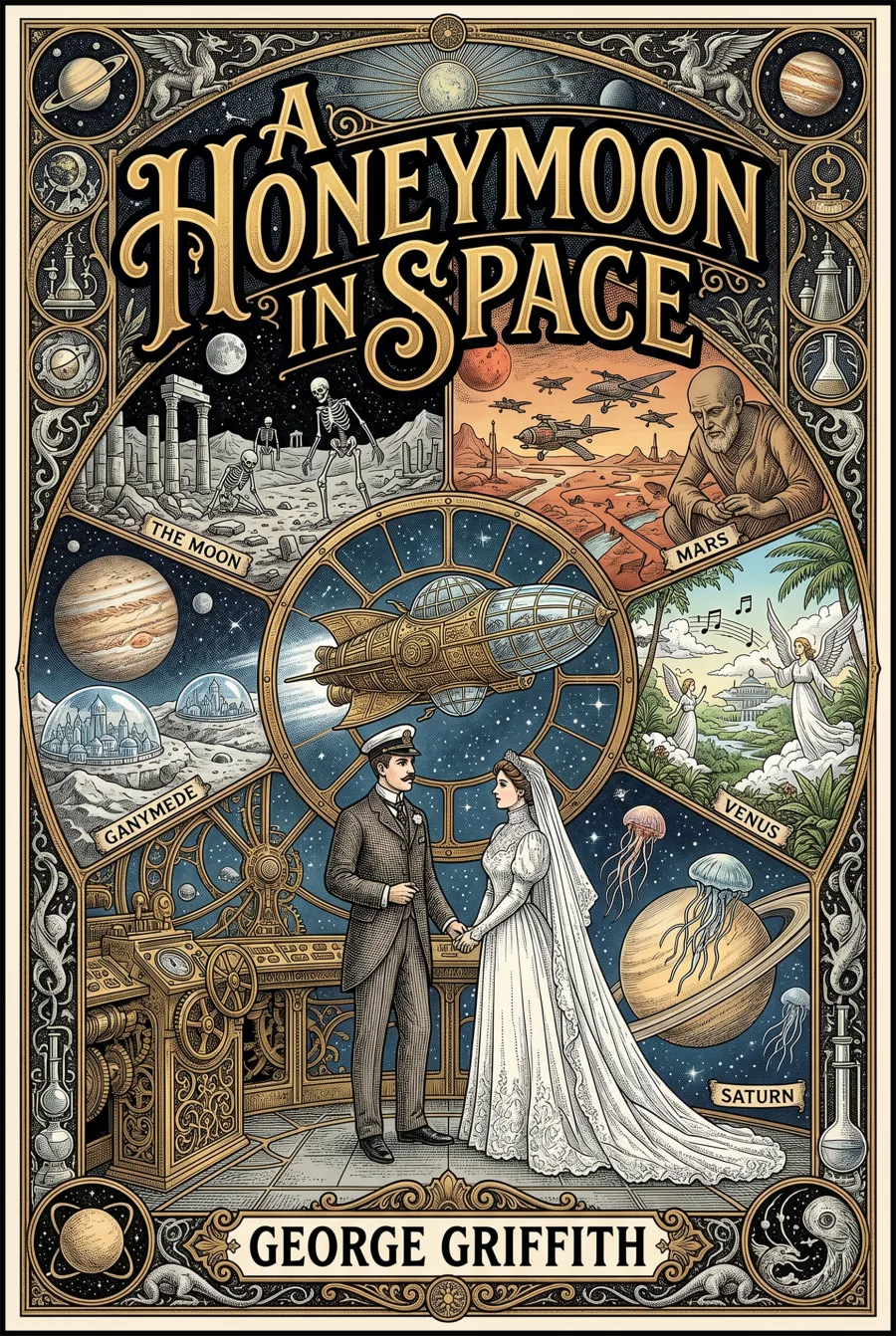
A Honeymoon in Space
eBook
• INR 51.00
• English
• 9788169359603
No ratings yet
| Publisher | General Press |
|---|---|
| ISBN13 | 9788169359603 |
| ASIN/SKU | 8169359600 |
| Book Format | eBook |
| Language | English |
| List Price | INR 51.00 |
| Subject Code | FIC028030, FIC028130, FIC027130 |
| Publishing Date | 01/09/2026 |
| Book Code | BD00070204 |
Buy this Book
Amazon Stores
Ebook Stores
Other Stores
Discover A Honeymoon in Space by George Griffith. This book is published by General Press in eBook format, ISBN 9788169359603, ASIN 8169359600, under Literature and Fiction, Space Operas Science Fiction, Exploration Science Fiction.
Book Description
What if the ultimate honeymoon meant leaving Earth behind and crossing the entire solar system? 'A Honeymoon in Space' by George Griffith is a pioneering science fiction adventure that turns marriage into an extraordinary voyage through worlds no human couple has ever seen. First published in 1901, the novel combines romance, imaginative space travel, alien civilizations, and early scientific speculation into a story that feels remarkably ambitious for its time.
The story follows Lord Redgrave, an English aristocrat and brilliant inventor who has created the Astronef, a remarkable spacecraft capable of escaping Earth's gravity through the mysterious power of the “R-force.” Redgrave is deeply in love with Lilla Zaidie Rennick, the daughter of the scientist whose work helped make the Astronef possible. When Zaidie is preparing to enter a marriage she does not truly want, Redgrave takes a daring and controversial step: he carries her away aboard his extraordinary flying machine. Their unexpected escape soon becomes a marriage, and their honeymoon takes an astonishing turn as they set off into space.
Instead of visiting familiar romantic destinations, the newlyweds embark on a grand tour of the solar system. Their journey takes them to the Moon, Mars, Venus, Jupiter, Saturn, and other distant regions, with each world offering a completely different vision of life and civilization. They encounter strange landscapes, unfamiliar creatures, advanced societies, and beings whose physical and intellectual development challenges their assumptions about humanity. Some encounters are beautiful and fascinating, while others are dangerous, forcing the couple to rely on courage, intelligence, and the capabilities of their spacecraft.
Beyond its adventure and romance, the novel reflects early twentieth-century ideas about evolution, civilization, science, and humanity's place in the universe. Griffith imagines other worlds not simply as exotic destinations but as possibilities that invite readers to compare alien societies with their own. The result is a lively blend of romance, exploration, scientific imagination, and cosmic adventure. For readers fascinated by classic science fiction and the origins of space-travel stories, 'A Honeymoon in Space' offers a wonderfully unusual journey—and one that may leave you wondering what the next world could possibly hold.
The story follows Lord Redgrave, an English aristocrat and brilliant inventor who has created the Astronef, a remarkable spacecraft capable of escaping Earth's gravity through the mysterious power of the “R-force.” Redgrave is deeply in love with Lilla Zaidie Rennick, the daughter of the scientist whose work helped make the Astronef possible. When Zaidie is preparing to enter a marriage she does not truly want, Redgrave takes a daring and controversial step: he carries her away aboard his extraordinary flying machine. Their unexpected escape soon becomes a marriage, and their honeymoon takes an astonishing turn as they set off into space.
Instead of visiting familiar romantic destinations, the newlyweds embark on a grand tour of the solar system. Their journey takes them to the Moon, Mars, Venus, Jupiter, Saturn, and other distant regions, with each world offering a completely different vision of life and civilization. They encounter strange landscapes, unfamiliar creatures, advanced societies, and beings whose physical and intellectual development challenges their assumptions about humanity. Some encounters are beautiful and fascinating, while others are dangerous, forcing the couple to rely on courage, intelligence, and the capabilities of their spacecraft.
Beyond its adventure and romance, the novel reflects early twentieth-century ideas about evolution, civilization, science, and humanity's place in the universe. Griffith imagines other worlds not simply as exotic destinations but as possibilities that invite readers to compare alien societies with their own. The result is a lively blend of romance, exploration, scientific imagination, and cosmic adventure. For readers fascinated by classic science fiction and the origins of space-travel stories, 'A Honeymoon in Space' offers a wonderfully unusual journey—and one that may leave you wondering what the next world could possibly hold.
Author Biography
Few writers of the Victorian era imagined the future with as much daring as George Griffith. Born George Chetwynd Griffith-Jones, George Griffith was a British science fiction and adventure writer whose pioneering “scientific romances” helped shape the emerging genre of science fiction in the late nineteenth century.
Born on August 20, 1857, in Plymouth, Devon, Griffith grew up as the son of a clergyman and experienced an unusually adventurous early life. He was educated partly at home, travelled abroad, worked as a teacher, and later turned to journalism and writing. His experiences as a traveller and observer of political and social change strongly influenced the imaginative worlds he created. His major breakthrough came in 1893 with 'The Angel of the Revolution', a thrilling future-war novel featuring airships, political upheaval, and revolutionary technology. Its success established him as one of Britain’s most popular science fiction writers of the period.
Griffith followed this success with 'Olga Romanoff' (1894), 'The Outlaws of the Air' (1895), 'Valdar the Oft-Born' (1895), and numerous other novels, short stories, poems, and articles. His 1901 novel 'A Honeymoon in Space', developed from the earlier 'Stories of Other Worlds', offered readers an imaginative journey through the Solar System and explored ideas about evolution and humanity’s place in the universe.
His writing was energetic, sensational, and filled with bold predictions about technology, aerial warfare, space travel, and future conflict. Although his reputation later faded beside contemporaries such as H. G. Wells, modern scholars increasingly recognize Griffith as an important figure in the development of early science fiction. He died on June 4, 1906, in the Isle of Man, aged only 48. His adventurous imagination and pioneering vision continue to give his work a distinctive place in the history of science fiction.
Born on August 20, 1857, in Plymouth, Devon, Griffith grew up as the son of a clergyman and experienced an unusually adventurous early life. He was educated partly at home, travelled abroad, worked as a teacher, and later turned to journalism and writing. His experiences as a traveller and observer of political and social change strongly influenced the imaginative worlds he created. His major breakthrough came in 1893 with 'The Angel of the Revolution', a thrilling future-war novel featuring airships, political upheaval, and revolutionary technology. Its success established him as one of Britain’s most popular science fiction writers of the period.
Griffith followed this success with 'Olga Romanoff' (1894), 'The Outlaws of the Air' (1895), 'Valdar the Oft-Born' (1895), and numerous other novels, short stories, poems, and articles. His 1901 novel 'A Honeymoon in Space', developed from the earlier 'Stories of Other Worlds', offered readers an imaginative journey through the Solar System and explored ideas about evolution and humanity’s place in the universe.
His writing was energetic, sensational, and filled with bold predictions about technology, aerial warfare, space travel, and future conflict. Although his reputation later faded beside contemporaries such as H. G. Wells, modern scholars increasingly recognize Griffith as an important figure in the development of early science fiction. He died on June 4, 1906, in the Isle of Man, aged only 48. His adventurous imagination and pioneering vision continue to give his work a distinctive place in the history of science fiction.
Editorial Reviews
Editorial Reviews will be added soon…
Book Summary
George Griffith’s 'A Honeymoon in Space' is one of the most imaginative early science-fiction novels about interplanetary travel. First published in complete book form in 1901 after appearing in an abridged serial version in 'Pearson’s Magazine', the novel turns a romantic honeymoon into an extraordinary tour of the Solar System. At its center are Lord Redgrave, an English aristocrat and inventor, and Lilla Zaidie Rennick, the woman he loves. Their journey aboard the revolutionary spacecraft Astronef takes them from Earth to the Moon, Mars, Venus, Jupiter and its satellites, and Saturn before a dangerous return journey brings them back toward their home world. Griffith combines romance, adventure, speculative science, alien civilizations, evolutionary theory, and visions of humanity’s possible future. The result is much more than a simple space adventure: it is an early attempt to imagine what human beings might discover when they escape the boundaries of Earth.
The story begins with a spectacular demonstration of the Astronef, a spacecraft capable of doing something that seems impossible for the period in which Griffith was writing: escaping Earth’s gravity and travelling through space. The machine has been developed from the ideas of Dr. Rennick, Zaidie’s deceased father, whose scientific theories had once been dismissed as impractical. Lord Redgrave financed the experiments and eventually constructed the vessel. He is not merely interested in exploration, however. He is deeply in love with Zaidie, who is travelling aboard the ocean liner 'St. Louis' toward England, where she is expected to marry the Marquis of Byfleet. Redgrave intercepts the liner in the Astronef and reveals both his invention and his feelings. He takes Zaidie and her chaperone, Mrs. Van Stuyler, aboard the spacecraft, initially under the pretext of showing them its remarkable capabilities. The romantic situation quickly becomes an audacious adventure when Redgrave carries Zaidie away from the conventional future planned for her.
The opening chapters also establish that Griffith’s imagined future is shaped by the politics of his own era. Redgrave is carrying an important diplomatic agreement between Great Britain and the United States. By using the Astronef to deliver the treaty rapidly to Washington, he helps prevent a potentially disastrous international conflict involving Britain, France, Russia, and the United States. This subplot is important because it shows how Griffith sees advanced technology as something that can transform not only science but also geopolitics. The spacecraft is potentially powerful enough to alter the balance of military power, yet Redgrave insists that it should not become an ordinary weapon of war. His first great use of it is therefore not conquest but diplomacy. Once this immediate crisis is resolved, Redgrave and Zaidie can finally begin the journey that gives the novel its title: a honeymoon in space.
Their marriage and departure mark a major shift in the book. Instead of treating space travel as an abstract scientific achievement, Griffith makes it intensely personal. Zaidie is curious, intelligent, playful, and willing to participate actively in exploration. She is not simply carried through the story as a passive romantic companion. Her scientific education allows her to question Redgrave, speculate about the worlds they see, and respond intelligently to the strange environments they encounter. Their conversations also give the story warmth and humor. Even while travelling millions of miles from Earth, the two remain recognizably human, teasing one another, discussing love, marriage, fashion, science, and the strange experience of losing all familiar notions of distance and time. The contrast between ordinary married intimacy and extraordinary cosmic surroundings is one of the novel’s most charming features.
Their first destination is the Moon, and Griffith imagines it as a largely dead, desolate world filled with immense geological structures, ruined cities, and remnants of an earlier civilization. The lunar landscape becomes a meditation on decay. The travelers explore ancient structures and discover evidence suggesting that the Moon once supported life. In one especially striking episode, they descend into the enormous crater of Newton, finding air, water, darkness, and possible signs of life. The environment is so cold and hostile that even apparently breathable air cannot be comfortably used without protection. These scenes make the Moon feel like a world whose history is almost entirely hidden, reminding the reader that planets may have lives of their own: they can develop, flourish, decline, and eventually become barren.
The journey to Mars introduces a very different kind of civilization. Mars is populated by highly developed beings who are physically imposing and intellectually advanced. Griffith makes the encounter deliberately unsettling because the Martians have progressed in science while sacrificing much of what humans consider emotional humanity. They speak English, a detail that allows communication and reinforces the idea that humanity and extraterrestrial civilizations may develop along parallel lines. The Martians have become dominated by intellect and efficiency, and their society suggests what could happen if civilization values intelligence while suppressing emotion. Their technological achievements are therefore accompanied by a spiritual and moral deficiency. The contrast is especially sharp when one Martian becomes attracted to Zaidie and experiences the return of desires that his civilization has supposedly evolved beyond. The encounter becomes dangerous, and Zaidie kills him, giving the supposedly civilized Martian world a dark and ironic quality.
Mars is therefore one of the clearest expressions of Griffith’s interest in evolution. Throughout 'A Honeymoon in Space', worlds represent different stages or directions of development. Mars is not simply an alien planet; it is a warning. A species may become extraordinarily intelligent and technologically powerful while losing qualities such as compassion, spontaneity, and emotional connection. Griffith repeatedly asks whether advancement should be measured only by knowledge and machinery or by the moral quality of a civilization. This Darwinian idea—that worlds and species rise, compete, adapt, and eventually decline—is one of the central philosophical foundations of the novel.
After the unsettling experience on Mars, the couple travels to Venus, and the change could hardly be greater. Venus appears almost like a heavenly paradise. Beneath its dense cloud cover lies a beautiful world of mountains, rivers, lakes, rich landscapes, and luminous skies. More important than the scenery, however, are the inhabitants. The Venusians are portrayed as graceful, winged, almost angelic beings who have moved beyond the moral struggles familiar to humanity. They do not appear to understand human ideas of sin and aggression. Communication between the travelers and the Venusians is achieved through music rather than ordinary speech, allowing Zaidie to bridge the gap by singing. The encounter becomes one of the most beautiful episodes in the novel because it presents a form of civilization in which spiritual development has become more important than technological power.
Yet even this paradise carries a warning. Zaidie and Redgrave begin to wonder whether human beings, with their violence, selfishness, and desires, could corrupt such an innocent civilization. Their decision to leave Venus is therefore not forced by military defeat or physical danger but by a moral realization. They understand that contact between civilizations is not automatically beneficial. Exploration can carry responsibility, and advanced or aggressive societies may damage what they do not understand. Venus becomes an idealized picture of innocence, while Earth represents a civilization still struggling with its own instincts. The encounter gives the honeymoon a surprisingly reflective dimension, because the travelers are forced to consider what kind of humanity they represent.
The next great stage of the journey takes them toward Jupiter. The planet itself is presented as a gigantic, turbulent world still at a relatively primitive stage of planetary development, so the travelers turn their attention to its moons. Their eventual stay on Ganymede, which Zaidie calls the “World of the Crystal Cities,” is among the novel’s most ambitious visions. Here they encounter an ancient, sophisticated civilization living inside enormous domed cities. Ganymede’s inhabitants have mastered technology to such an extent that they can conserve heat and water, recycle scarce resources, and use the planet’s remaining natural energy to sustain an extraordinarily refined society.
The Ganymede civilization is especially significant because it provides Griffith’s most detailed vision of humanity’s possible distant future. The inhabitants have almost completely eliminated crime because they consider it irrational and foolish. They live peacefully, value intellect, and use science not to conquer neighboring societies but to extend life and maintain their civilization. Yet their achievement comes at a terrible price: their world is dying. Water is disappearing, heat is declining, and the civilization survives by carefully managing the last resources available to it. In this way, Ganymede becomes a paradox. Its people have reached a higher level of morality and technological sophistication, but they are still unable to escape the physical limits of their world. Griffith suggests that civilization may become wiser while the planet beneath it becomes less habitable.
The final major destination is Saturn, where Griffith returns to a more exotic and prehistoric vision of life. Saturn’s environment contains strange creatures and forms of existence that seem to represent different stages of evolution. The further the travelers move through the planet’s environment, the more primitive the organisms become, eventually encountering forms resembling prehistoric reptiles and early human societies. Saturn thus functions almost like a living museum of evolutionary history. The travelers are not simply visiting another planet; they are witnessing an enormous biological story in motion. The variety of Saturn’s inhabitants reinforces Griffith’s larger idea that life can take countless forms and that the development of intelligence is only one possible path in the history of a world.
The return journey is as dangerous as the outward voyage is exciting. The Astronef is caught by the gravitational influence of a dark star, creating a crisis that tests both Redgrave’s knowledge and the limits of the ship. In the struggle to escape, extraordinary cosmic events unfold, including the collision of dark stars and the apparent birth of a new solar system. The travelers also make a brief stop on Ceres before desperately calculating a route back toward Earth. Their dwindling fuel forces them to use the gravitational influence of Mercury and Venus to alter their course, bringing them dangerously close to the Sun. Eventually they survive the ordeal and return safely to Earth.
At its deepest level, 'A Honeymoon in Space' is about far more than the romance suggested by its title. It is a meditation on progress, evolution, morality, imperial ambition, and humanity’s place in the universe. Each destination reflects a different possibility. The Moon represents decline and the mysterious remains of forgotten civilizations. Mars represents intellect without sufficient humanity. Venus represents spiritual innocence. Ganymede represents rational civilization struggling against planetary extinction. Saturn represents biological evolution in its more primitive and varied forms. Together, these worlds create a cosmic sequence through which Griffith examines what humanity might become, and what it might lose, as it advances.
The novel is also historically important because of how boldly it imagines space travel at the beginning of the twentieth century. Griffith was writing decades before human beings reached the Moon, yet he imagined spacecraft, anti-gravity propulsion, planetary tourism, extraterrestrial civilizations, space navigation, environmental adaptation, and journeys across the Solar System. The book originally appeared in serialized form as 'Stories of Other Worlds' in 1900 and was expanded into the 1901 novel, with illustrations by Stanley Wood and Harold Piffard. Its combination of speculative technology, adventure, romance, and social commentary helped establish a recognizable tradition of interplanetary science fiction.
For modern readers searching for an 'A Honeymoon in Space' summary, plot explanation, themes, or an introduction to classic science fiction, the novel is particularly interesting because it captures the excitement and anxieties of an age standing on the edge of technological transformation. Its scientific predictions are inevitably dated, and some of its social attitudes reflect the assumptions of the early twentieth century. Yet its central question remains surprisingly fresh: what will happen to human beings when technology allows them to escape the world that shaped them? Griffith’s answer is not simple. The universe contains civilizations more advanced than Earth, but advancement does not always create wisdom. Some worlds are intelligent but cruel, some pure but vulnerable, some technologically brilliant but dying, and some still trapped in primitive struggle. The great discovery of Redgrave and Zaidie is therefore not simply that other worlds exist. It is that every world offers a different mirror in which humanity can see itself.
In the end, 'A Honeymoon in Space' succeeds because its sense of wonder is inseparable from its human story. Redgrave and Zaidie begin their journey as two people escaping the ordinary expectations surrounding love and marriage, but they return with a much larger understanding of existence. Their honeymoon becomes a voyage through possible futures of life itself. Griffith combines romance, planetary adventure, speculative science, and philosophical reflection into a book that remains fascinating as an early landmark of science fiction. For readers interested in classic space adventure, Victorian and Edwardian science fiction, early depictions of Mars and Venus, extraterrestrial civilizations, or the literary history of space travel, 'A Honeymoon in Space' offers a vivid and imaginative journey—and a reminder that the oldest science-fiction stories often reveal as much about the hopes and fears of their own time as they do about the future.
The story begins with a spectacular demonstration of the Astronef, a spacecraft capable of doing something that seems impossible for the period in which Griffith was writing: escaping Earth’s gravity and travelling through space. The machine has been developed from the ideas of Dr. Rennick, Zaidie’s deceased father, whose scientific theories had once been dismissed as impractical. Lord Redgrave financed the experiments and eventually constructed the vessel. He is not merely interested in exploration, however. He is deeply in love with Zaidie, who is travelling aboard the ocean liner 'St. Louis' toward England, where she is expected to marry the Marquis of Byfleet. Redgrave intercepts the liner in the Astronef and reveals both his invention and his feelings. He takes Zaidie and her chaperone, Mrs. Van Stuyler, aboard the spacecraft, initially under the pretext of showing them its remarkable capabilities. The romantic situation quickly becomes an audacious adventure when Redgrave carries Zaidie away from the conventional future planned for her.
The opening chapters also establish that Griffith’s imagined future is shaped by the politics of his own era. Redgrave is carrying an important diplomatic agreement between Great Britain and the United States. By using the Astronef to deliver the treaty rapidly to Washington, he helps prevent a potentially disastrous international conflict involving Britain, France, Russia, and the United States. This subplot is important because it shows how Griffith sees advanced technology as something that can transform not only science but also geopolitics. The spacecraft is potentially powerful enough to alter the balance of military power, yet Redgrave insists that it should not become an ordinary weapon of war. His first great use of it is therefore not conquest but diplomacy. Once this immediate crisis is resolved, Redgrave and Zaidie can finally begin the journey that gives the novel its title: a honeymoon in space.
Their marriage and departure mark a major shift in the book. Instead of treating space travel as an abstract scientific achievement, Griffith makes it intensely personal. Zaidie is curious, intelligent, playful, and willing to participate actively in exploration. She is not simply carried through the story as a passive romantic companion. Her scientific education allows her to question Redgrave, speculate about the worlds they see, and respond intelligently to the strange environments they encounter. Their conversations also give the story warmth and humor. Even while travelling millions of miles from Earth, the two remain recognizably human, teasing one another, discussing love, marriage, fashion, science, and the strange experience of losing all familiar notions of distance and time. The contrast between ordinary married intimacy and extraordinary cosmic surroundings is one of the novel’s most charming features.
Their first destination is the Moon, and Griffith imagines it as a largely dead, desolate world filled with immense geological structures, ruined cities, and remnants of an earlier civilization. The lunar landscape becomes a meditation on decay. The travelers explore ancient structures and discover evidence suggesting that the Moon once supported life. In one especially striking episode, they descend into the enormous crater of Newton, finding air, water, darkness, and possible signs of life. The environment is so cold and hostile that even apparently breathable air cannot be comfortably used without protection. These scenes make the Moon feel like a world whose history is almost entirely hidden, reminding the reader that planets may have lives of their own: they can develop, flourish, decline, and eventually become barren.
The journey to Mars introduces a very different kind of civilization. Mars is populated by highly developed beings who are physically imposing and intellectually advanced. Griffith makes the encounter deliberately unsettling because the Martians have progressed in science while sacrificing much of what humans consider emotional humanity. They speak English, a detail that allows communication and reinforces the idea that humanity and extraterrestrial civilizations may develop along parallel lines. The Martians have become dominated by intellect and efficiency, and their society suggests what could happen if civilization values intelligence while suppressing emotion. Their technological achievements are therefore accompanied by a spiritual and moral deficiency. The contrast is especially sharp when one Martian becomes attracted to Zaidie and experiences the return of desires that his civilization has supposedly evolved beyond. The encounter becomes dangerous, and Zaidie kills him, giving the supposedly civilized Martian world a dark and ironic quality.
Mars is therefore one of the clearest expressions of Griffith’s interest in evolution. Throughout 'A Honeymoon in Space', worlds represent different stages or directions of development. Mars is not simply an alien planet; it is a warning. A species may become extraordinarily intelligent and technologically powerful while losing qualities such as compassion, spontaneity, and emotional connection. Griffith repeatedly asks whether advancement should be measured only by knowledge and machinery or by the moral quality of a civilization. This Darwinian idea—that worlds and species rise, compete, adapt, and eventually decline—is one of the central philosophical foundations of the novel.
After the unsettling experience on Mars, the couple travels to Venus, and the change could hardly be greater. Venus appears almost like a heavenly paradise. Beneath its dense cloud cover lies a beautiful world of mountains, rivers, lakes, rich landscapes, and luminous skies. More important than the scenery, however, are the inhabitants. The Venusians are portrayed as graceful, winged, almost angelic beings who have moved beyond the moral struggles familiar to humanity. They do not appear to understand human ideas of sin and aggression. Communication between the travelers and the Venusians is achieved through music rather than ordinary speech, allowing Zaidie to bridge the gap by singing. The encounter becomes one of the most beautiful episodes in the novel because it presents a form of civilization in which spiritual development has become more important than technological power.
Yet even this paradise carries a warning. Zaidie and Redgrave begin to wonder whether human beings, with their violence, selfishness, and desires, could corrupt such an innocent civilization. Their decision to leave Venus is therefore not forced by military defeat or physical danger but by a moral realization. They understand that contact between civilizations is not automatically beneficial. Exploration can carry responsibility, and advanced or aggressive societies may damage what they do not understand. Venus becomes an idealized picture of innocence, while Earth represents a civilization still struggling with its own instincts. The encounter gives the honeymoon a surprisingly reflective dimension, because the travelers are forced to consider what kind of humanity they represent.
The next great stage of the journey takes them toward Jupiter. The planet itself is presented as a gigantic, turbulent world still at a relatively primitive stage of planetary development, so the travelers turn their attention to its moons. Their eventual stay on Ganymede, which Zaidie calls the “World of the Crystal Cities,” is among the novel’s most ambitious visions. Here they encounter an ancient, sophisticated civilization living inside enormous domed cities. Ganymede’s inhabitants have mastered technology to such an extent that they can conserve heat and water, recycle scarce resources, and use the planet’s remaining natural energy to sustain an extraordinarily refined society.
The Ganymede civilization is especially significant because it provides Griffith’s most detailed vision of humanity’s possible distant future. The inhabitants have almost completely eliminated crime because they consider it irrational and foolish. They live peacefully, value intellect, and use science not to conquer neighboring societies but to extend life and maintain their civilization. Yet their achievement comes at a terrible price: their world is dying. Water is disappearing, heat is declining, and the civilization survives by carefully managing the last resources available to it. In this way, Ganymede becomes a paradox. Its people have reached a higher level of morality and technological sophistication, but they are still unable to escape the physical limits of their world. Griffith suggests that civilization may become wiser while the planet beneath it becomes less habitable.
The final major destination is Saturn, where Griffith returns to a more exotic and prehistoric vision of life. Saturn’s environment contains strange creatures and forms of existence that seem to represent different stages of evolution. The further the travelers move through the planet’s environment, the more primitive the organisms become, eventually encountering forms resembling prehistoric reptiles and early human societies. Saturn thus functions almost like a living museum of evolutionary history. The travelers are not simply visiting another planet; they are witnessing an enormous biological story in motion. The variety of Saturn’s inhabitants reinforces Griffith’s larger idea that life can take countless forms and that the development of intelligence is only one possible path in the history of a world.
The return journey is as dangerous as the outward voyage is exciting. The Astronef is caught by the gravitational influence of a dark star, creating a crisis that tests both Redgrave’s knowledge and the limits of the ship. In the struggle to escape, extraordinary cosmic events unfold, including the collision of dark stars and the apparent birth of a new solar system. The travelers also make a brief stop on Ceres before desperately calculating a route back toward Earth. Their dwindling fuel forces them to use the gravitational influence of Mercury and Venus to alter their course, bringing them dangerously close to the Sun. Eventually they survive the ordeal and return safely to Earth.
At its deepest level, 'A Honeymoon in Space' is about far more than the romance suggested by its title. It is a meditation on progress, evolution, morality, imperial ambition, and humanity’s place in the universe. Each destination reflects a different possibility. The Moon represents decline and the mysterious remains of forgotten civilizations. Mars represents intellect without sufficient humanity. Venus represents spiritual innocence. Ganymede represents rational civilization struggling against planetary extinction. Saturn represents biological evolution in its more primitive and varied forms. Together, these worlds create a cosmic sequence through which Griffith examines what humanity might become, and what it might lose, as it advances.
The novel is also historically important because of how boldly it imagines space travel at the beginning of the twentieth century. Griffith was writing decades before human beings reached the Moon, yet he imagined spacecraft, anti-gravity propulsion, planetary tourism, extraterrestrial civilizations, space navigation, environmental adaptation, and journeys across the Solar System. The book originally appeared in serialized form as 'Stories of Other Worlds' in 1900 and was expanded into the 1901 novel, with illustrations by Stanley Wood and Harold Piffard. Its combination of speculative technology, adventure, romance, and social commentary helped establish a recognizable tradition of interplanetary science fiction.
For modern readers searching for an 'A Honeymoon in Space' summary, plot explanation, themes, or an introduction to classic science fiction, the novel is particularly interesting because it captures the excitement and anxieties of an age standing on the edge of technological transformation. Its scientific predictions are inevitably dated, and some of its social attitudes reflect the assumptions of the early twentieth century. Yet its central question remains surprisingly fresh: what will happen to human beings when technology allows them to escape the world that shaped them? Griffith’s answer is not simple. The universe contains civilizations more advanced than Earth, but advancement does not always create wisdom. Some worlds are intelligent but cruel, some pure but vulnerable, some technologically brilliant but dying, and some still trapped in primitive struggle. The great discovery of Redgrave and Zaidie is therefore not simply that other worlds exist. It is that every world offers a different mirror in which humanity can see itself.
In the end, 'A Honeymoon in Space' succeeds because its sense of wonder is inseparable from its human story. Redgrave and Zaidie begin their journey as two people escaping the ordinary expectations surrounding love and marriage, but they return with a much larger understanding of existence. Their honeymoon becomes a voyage through possible futures of life itself. Griffith combines romance, planetary adventure, speculative science, and philosophical reflection into a book that remains fascinating as an early landmark of science fiction. For readers interested in classic space adventure, Victorian and Edwardian science fiction, early depictions of Mars and Venus, extraterrestrial civilizations, or the literary history of space travel, 'A Honeymoon in Space' offers a vivid and imaginative journey—and a reminder that the oldest science-fiction stories often reveal as much about the hopes and fears of their own time as they do about the future.
Sample Chapters
Sample Chapters will be added soon…
Reader Reviews
No reviews yet.
A Honeymoon in Space
Download Cover Image
Do you want to download the full cover image for A Honeymoon in Space?