
A Pickle for the Knowing Ones
eBook
• INR 51.00
• English
• 9788169359566
No ratings yet
| Publisher | General Press |
|---|---|
| ISBN13 | 9788169359566 |
| ASIN/SKU | 8169359562 |
| Book Format | eBook |
| Language | English |
| List Price | INR 51.00 |
| Subject Code | BIO026000, BIO003000, HIS036040 |
| Publishing Date | 01/09/2026 |
| Book Code | BD00070206 |
Buy this Book
Amazon Stores
Ebook Stores
Other Stores
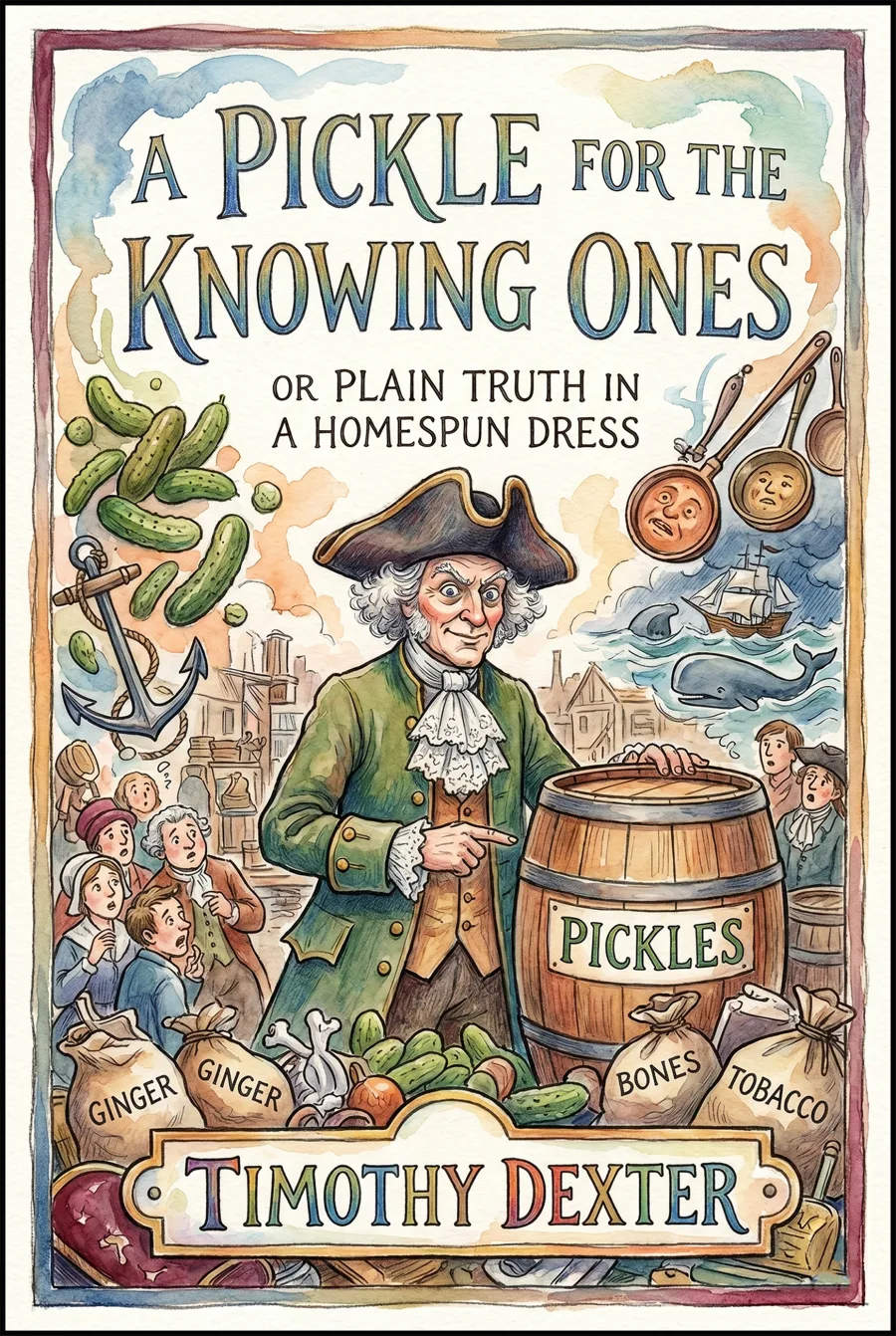
Discover A Pickle for the Knowing Ones by Timothy Dexter. This book is published by General Press in eBook format, ISBN 9788169359566, ASIN 8169359562, under Biographies and Memoirs, Memoirs, Biographies of Business and Industrial Professionals.
Book Description
What happens when a wealthy eccentric decides to explain the world entirely in his own words, rules, and spelling? 'A Pickle for the Knowing Ones' by Timothy Dexter is a uniquely comic autobiographical work that blends memoir, social commentary, political opinion, personal grievances, and eccentric philosophy into one of the strangest books in early American literature. First published in 1802, the book presents Dexter's extraordinary personality with almost no conventional punctuation and with spelling and grammar that often seem to follow rules known only to the author himself.
Rather than following a traditional plot, 'A Pickle for the Knowing Ones' takes readers directly into the restless mind of Timothy Dexter, a self-made businessman from Newburyport, Massachusetts, who became wealthy through a series of unusual and sometimes seemingly foolish commercial ventures. Dexter writes about his business dealings, family troubles, friendships, enemies, public figures, religion, politics, and his own remarkable reputation. He frequently presents himself as a misunderstood genius while criticizing the people and institutions he believes have treated him unfairly. His confidence, suspicion, humor, and grand sense of self-importance give the book its unmistakable personality.
What makes the work especially fascinating is its unconventional form. Dexter's sentences run on without normal punctuation, capital letters appear unpredictably, and words are often spelled phonetically or idiosyncratically. Yet beneath the apparent chaos is a vivid portrait of a man determined to have his say. His observations range from serious complaints about government and clergy to bizarre personal theories and extravagant claims about his own importance. He also reflects on money, morality, social status, marriage, family conflict, and the strange twists of fortune that shaped his life.
The result is less a conventional autobiography than an unforgettable glimpse into one man's imagination and worldview. Funny, bewildering, revealing, and unlike almost anything else from its period, 'A Pickle for the Knowing Ones' invites readers to decide for themselves where eccentricity ends and unexpected wisdom begins. Once you enter Timothy Dexter's peculiar world, you may find it surprisingly difficult to look away.
Rather than following a traditional plot, 'A Pickle for the Knowing Ones' takes readers directly into the restless mind of Timothy Dexter, a self-made businessman from Newburyport, Massachusetts, who became wealthy through a series of unusual and sometimes seemingly foolish commercial ventures. Dexter writes about his business dealings, family troubles, friendships, enemies, public figures, religion, politics, and his own remarkable reputation. He frequently presents himself as a misunderstood genius while criticizing the people and institutions he believes have treated him unfairly. His confidence, suspicion, humor, and grand sense of self-importance give the book its unmistakable personality.
What makes the work especially fascinating is its unconventional form. Dexter's sentences run on without normal punctuation, capital letters appear unpredictably, and words are often spelled phonetically or idiosyncratically. Yet beneath the apparent chaos is a vivid portrait of a man determined to have his say. His observations range from serious complaints about government and clergy to bizarre personal theories and extravagant claims about his own importance. He also reflects on money, morality, social status, marriage, family conflict, and the strange twists of fortune that shaped his life.
The result is less a conventional autobiography than an unforgettable glimpse into one man's imagination and worldview. Funny, bewildering, revealing, and unlike almost anything else from its period, 'A Pickle for the Knowing Ones' invites readers to decide for themselves where eccentricity ends and unexpected wisdom begins. Once you enter Timothy Dexter's peculiar world, you may find it surprisingly difficult to look away.
Author Biography
Few American eccentrics have turned a string of seemingly foolish decisions into a legend quite like Timothy Dexter. Timothy Dexter was an American merchant, eccentric writer, and author best known for his autobiographical work 'A Pickle for the Knowing Ones', a curious book that remains one of the strangest examples of early American self-publishing.
Born in Malden, Massachusetts, in 1747, Dexter came from a modest background and received little formal education. As a young man, he worked on a farm before becoming an apprentice in leather dressing. He eventually moved to Newburyport, where he established himself in business and married Elizabeth Frothingham, a prosperous widow. His fortune grew dramatically after he invested in depreciated Continental currency following the American Revolution.
Dexter became famous for business ventures that appeared ridiculous but repeatedly brought him unexpected profits. He shipped warming pans to the West Indies, where they were repurposed as molasses ladles, and sent coal to Newcastle during a miners' strike, turning an apparently foolish idea into a profitable trade. His ventures with mittens, Bibles, cats, and whalebone further strengthened his reputation as a man whose extraordinary luck often looked like genius.
His personality was as memorable as his business career. Calling himself “Lord Timothy Dexter,” he decorated his Newburyport mansion with elaborate features and statues of famous figures. His greatest literary curiosity, 'A Pickle for the Knowing Ones', appeared in 1802. Written with unconventional spelling, grammar, capitalization, and virtually no punctuation, the book reflected Dexter's boastful, humorous, and highly individual voice. A later edition famously added a page of punctuation for readers to use as they wished.
Dexter died in 1806, but his unusual life continues to fascinate readers and historians. His story endures as a remarkable blend of ambition, eccentricity, improbable fortune, and unconventional literary expression.
Born in Malden, Massachusetts, in 1747, Dexter came from a modest background and received little formal education. As a young man, he worked on a farm before becoming an apprentice in leather dressing. He eventually moved to Newburyport, where he established himself in business and married Elizabeth Frothingham, a prosperous widow. His fortune grew dramatically after he invested in depreciated Continental currency following the American Revolution.
Dexter became famous for business ventures that appeared ridiculous but repeatedly brought him unexpected profits. He shipped warming pans to the West Indies, where they were repurposed as molasses ladles, and sent coal to Newcastle during a miners' strike, turning an apparently foolish idea into a profitable trade. His ventures with mittens, Bibles, cats, and whalebone further strengthened his reputation as a man whose extraordinary luck often looked like genius.
His personality was as memorable as his business career. Calling himself “Lord Timothy Dexter,” he decorated his Newburyport mansion with elaborate features and statues of famous figures. His greatest literary curiosity, 'A Pickle for the Knowing Ones', appeared in 1802. Written with unconventional spelling, grammar, capitalization, and virtually no punctuation, the book reflected Dexter's boastful, humorous, and highly individual voice. A later edition famously added a page of punctuation for readers to use as they wished.
Dexter died in 1806, but his unusual life continues to fascinate readers and historians. His story endures as a remarkable blend of ambition, eccentricity, improbable fortune, and unconventional literary expression.
Editorial Reviews
Editorial Reviews will be added soon…
Book Summary
Timothy Dexter’s 'A Pickle for the Knowing Ones', first published in 1802, is one of the strangest, funniest, and most unconventional books in early American literature. Often described as an autobiography, satire, rant, philosophical meditation, and piece of outsider literature all at once, it refuses to behave like a normal book. Dexter writes about his business successes, political opinions, family troubles, religion, human nature, education, money, war, morality, and his own greatness, but he does so in a chaotic stream of misspelled words, unusual capitalization, almost no punctuation, abrupt changes of subject, and wildly confident assertions. The result is a book that can be difficult to read but impossible to mistake for anyone else’s work. Published when Dexter was about fifty-five, 'A Pickle for the Knowing Ones' is essentially a portrait of a man determined to tell the world what he thinks, whether the world considers him wise, foolish, eccentric, or all three.
The title itself gives an important clue to Dexter’s personality. He calls his work a “pickle” for the “knowing ones,” presenting it almost as a challenge to educated readers. Dexter was a wealthy Newburyport merchant who had become famous for his eccentric behavior and for a series of commercial ventures that appeared foolish to other people but sometimes produced extraordinary profits. He had limited formal education, yet his financial success gave him enormous confidence in his own intelligence. Rather than trying to imitate polished literary writers, Dexter embraces his own spelling and way of expressing himself. The book was originally self-published and distributed to the public, and later editions preserved its unusual language rather than correcting it into conventional English. The first edition contained roughly 8,800 words and was remarkable for its lack of punctuation.
There is no conventional plot in 'A Pickle for the Knowing Ones'. Instead, the reader enters Dexter’s mind and follows his thoughts as they jump from one subject to another. He frequently signs off as “TIMOTHY DEXTER,” as though each section were a letter or separate communication to the public. One moment he is discussing the political structure of the United States; the next he is talking about his house, his business dealings, ministers, his family, or the nature of the soul. This fragmented structure is important because the book is less interested in constructing a carefully organized argument than in creating a direct impression of Dexter’s personality. His voice is the real subject of the book.
Much of Dexter’s opening discussion concerns his elaborate property in Newburyport and his desire for recognition. He describes his house, gardens, statues, decorations, coach, and collection of images representing famous political and historical figures. His property became a kind of personal museum, filled with representations of George Washington, John Adams, Thomas Jefferson, Napoleon Bonaparte, Lord Nelson, William Pitt, and others. Dexter even commissioned statues of himself. The scale of this self-display tells us something essential about his character: wealth is not enough for him. He wants his wealth to be visible, memorable, and associated with greatness. He wants people to look at his property and, ultimately, to look at him.
This obsession with public recognition explains Dexter’s self-appointed title of “Lord Dexter.” He had no genuine hereditary title, but he adopted the name because, in his view, it reflected the opinion of ordinary people. His enormous house, extravagant decorations, statues, and coach were all part of the same performance. He imagined himself as a figure of historical importance and sometimes compared his political and intellectual influence with that of kings and emperors. The humor comes partly from the enormous gap between Dexter’s self-image and the conventional standards by which educated society judged him. Yet there is also something touching about his determination. Dexter may have been vain, but he clearly wanted his life to mean something. He wanted to escape anonymity and force history to remember him.
His political thinking is similarly unconventional. Dexter repeatedly discusses presidents, kings, political parties, regional divisions, and the need for unity. He admires strong leadership and sometimes suggests that the United States would benefit from an emperor or king. He is especially concerned about divisions between North and South and about political competition. Yet he also speaks repeatedly about peace, brotherly love, cooperation, and the importance of keeping nations together. His political philosophy is therefore contradictory but revealing. He distrusts political ambition and corruption while simultaneously imagining himself as a powerful leader. He condemns the desire for office in others while entertaining grand ideas about his own role in government. This contradiction is typical of the book: Dexter’s principles are constantly mixed with his personality.
One of the most fascinating aspects of 'A Pickle for the Knowing Ones' is Dexter’s hostility toward what he sees as hypocrisy. He repeatedly attacks politicians, lawyers, merchants, educated people, and especially members of the clergy whom he believes use religion to gain power or money. He is suspicious of elaborate religious explanations and dislikes what he regards as “priestcraft,” or the manipulation of ordinary people through religious authority. He complains that ministers can frighten people with sermons about sin, hell, death, and judgment. At the same time, Dexter does not reject spirituality altogether. He speaks frequently about God, the soul, nature, Christianity, morality, and the possibility of heaven. His objection is less to belief itself than to what he considers the exploitation of belief by institutions and hypocritical people.
Dexter’s religious ideas become particularly eccentric when he discusses the nature of God and the universe. He describes God as the God of Nature and argues that human beings exist within nature rather than separately from it. He considers the soul to be the thinking part of a person and wonders about its nature and size. Elsewhere he imagines the entire world almost as a living organism, with human beings and animals forming parts of a much larger natural system. His philosophy is not systematic, but it is often surprisingly imaginative. Beneath the spelling errors and abrupt statements lies a persistent desire to understand the world. Dexter is not content simply to repeat what authorities have told him. He wants to investigate existence for himself.
His attacks on education are equally revealing. Dexter has little patience for institutions that he believes burden families with unnecessary expense while failing to produce practical wisdom. He questions the value of spending many years and enormous amounts of money on formal education when ordinary common sense and honesty may be more useful. His criticism is partly directed at the educated elite, whom he believes sometimes use learning as a way to gain social power over less educated people. In Dexter’s world, education does not automatically equal wisdom. A person can know many things and still be dishonest, foolish, or exploitative.
This theme connects directly with Dexter’s understanding of his own reputation. Many people considered him foolish, but he insists that his business achievements prove otherwise. One of the book’s most entertaining sections explains how he made money through apparently ridiculous commercial decisions. He describes buying large quantities of whale bone and warming pans and sending them to markets where other people did not expect them to sell. The most famous example of Dexter’s business career involved shipping coal to Newcastle, a place already famous for coal production, just before circumstances made coal unusually valuable there. His successes contributed to the legend that Dexter became rich by making foolish decisions that somehow turned into brilliant ones.
Dexter’s account of his investments is filled with a mixture of boasting, humor, and genuine pride. He explains how he purchased goods cheaply, sent them to different markets, and made large profits. He also describes his purchase and resale of Bibles, which he sent to the West Indies. Whether every detail should be accepted literally is less important than the image Dexter creates of himself as a man whose instincts repeatedly defeated conventional wisdom. He believes his success demonstrates that the supposedly foolish man can sometimes understand the market better than the educated expert.
The book becomes darker when Dexter turns to his family life. He complains bitterly about his wife, whom he frequently refers to in supernatural or insulting terms, and he describes long periods of domestic conflict. His daughter’s troubled marriage to Abraham Bishop also becomes a major source of distress. Dexter claims that family members have mistreated him and cost him enormous amounts of money. His complaints are sometimes so exaggerated that they become comic, but there is genuine anger and pain beneath them. He presents himself as a persecuted man surrounded by people who have taken advantage of his generosity and wealth.
These passages complicate the idea that 'A Pickle for the Knowing Ones' is merely a joke. Dexter can be genuinely funny, but he also appears lonely, suspicious, wounded, and desperate to be taken seriously. He repeatedly insists that he is telling the truth even when his claims become extravagant. His recurring distinction between “trouth” and “Lyes” shows how important honesty is to his self-image. He believes that society is full of deception, while he sees himself as someone courageous enough to expose it. The irony is that his own exaggerated personality makes it difficult for readers to know where honest observation ends and self-created mythology begins.
Dexter also develops a strange theory of human nature in which every person contains elements of different animals. He compares people to dogs, horses, bears, cats, lions, owls, monkeys, wildcats, lambs, doves, pigs, oxen, and snakes. His basic point is that human beings are mixed creatures. Some are generous, some aggressive, some foolish, some clever, and some dishonest. He sees human nature as morally inconsistent, and he repeatedly argues that people can become much worse when given power. This is one of the more coherent philosophical ideas in the book: Dexter may have believed that the greatest danger in society was not ignorance alone but the combination of power, greed, hypocrisy, and dishonesty.
The book also contains Dexter’s dream of a world without war. Despite his fascination with kings, emperors, generals, and political power, he repeatedly advocates peace among nations. He imagines major powers cooperating to settle international disputes and hopes that humanity can become one great family. He even places himself in the imagined position of a future emperor who would rule through love rather than violence. His fantasy is grandiose, but its moral center is surprisingly simple: people should stop fighting, tell the truth, and treat one another honestly.
Another fascinating feature of 'A Pickle for the Knowing Ones' is its treatment of authorship itself. Dexter does not try to become a conventional writer. He ignores spelling, grammar, punctuation, and literary decorum. His first edition famously had no conventional stops or punctuation marks. When readers complained, Dexter’s response was not to rewrite the book properly. Instead, later editions included a page containing large quantities of punctuation marks, effectively inviting readers to place the marks wherever they believed they belonged. The second edition explained that readers could “pepper and salt” the work as they pleased.
This famous punctuation joke is more than an amusing publishing story. It perfectly represents Dexter’s attitude toward authority. Conventional writers were expected to follow rules of grammar and punctuation; Dexter simply refused. He believed the reader could understand him without those rules. In that sense, the book becomes a declaration of independence from literary convention. Its spelling is not merely an accident of poor education. It becomes part of the book’s identity. The reader is forced to encounter Dexter on Dexter’s terms.
The later portions of the work contain additional material, including pieces not written by Dexter, poems, newspaper material, and satirical or humorous texts. One section praises Dexter in absurdly elevated language, portraying him as a magnificent philosopher whose fame deserves to spread across the world. Another includes a strange sermon defending thieves through deliberately twisted biblical reasoning. These pieces extend the book’s comic atmosphere and blur the line between self-praise, parody, and deliberate satire. The later edition also preserves the famous page of punctuation marks, turning the physical design of the book into part of the joke.
For readers searching for an 'A Pickle for the Knowing Ones' summary, the most important point is that this is not a conventional autobiography with a beginning, middle, and end. It is a collage of memories, complaints, theories, political opinions, business stories, family grievances, religious reflections, boasts, jokes, and philosophical observations. Its “plot” is really the unfolding of Timothy Dexter’s personality. The reader watches him construct himself as a genius, philosopher, businessman, reformer, political thinker, victim, truth-teller, and future historical figure. Sometimes the portrait is ridiculous; sometimes it is strangely perceptive; often it is both simultaneously.
Ultimately, 'A Pickle for the Knowing Ones' is memorable because Timothy Dexter refuses to separate wisdom from foolishness, seriousness from comedy, or autobiography from performance. He wants readers to laugh, but he also wants them to listen. He complains about hypocrisy while boasting about himself; he attacks political ambition while imagining himself as emperor; he criticizes formal education while offering his own theories about the universe; he condemns deception while creating an extravagant mythology around Lord Dexter. These contradictions are not flaws that can simply be edited away. They are the heart of the book.
As a work of early American literature, 'A Pickle for the Knowing Ones' is therefore valuable not because it presents a polished philosophy or a neatly structured life story, but because it preserves an extraordinarily individual voice. Dexter writes as though literary rules, social expectations, and educated opinion have no authority over him. His book is chaotic, humorous, egotistical, angry, imaginative, and occasionally profound. Above all, it is unmistakably his. For readers interested in eccentric autobiographies, American literary history, outsider writing, satire, early American humor, or unusual classic books, 'A Pickle for the Knowing Ones' remains an extraordinary curiosity. It is the literary equivalent of Timothy Dexter’s eccentric mansion: crowded with strange objects, decorated with excessive ambition, impossible to ignore, and built according to a vision that makes complete sense only to the man who created it.
The title itself gives an important clue to Dexter’s personality. He calls his work a “pickle” for the “knowing ones,” presenting it almost as a challenge to educated readers. Dexter was a wealthy Newburyport merchant who had become famous for his eccentric behavior and for a series of commercial ventures that appeared foolish to other people but sometimes produced extraordinary profits. He had limited formal education, yet his financial success gave him enormous confidence in his own intelligence. Rather than trying to imitate polished literary writers, Dexter embraces his own spelling and way of expressing himself. The book was originally self-published and distributed to the public, and later editions preserved its unusual language rather than correcting it into conventional English. The first edition contained roughly 8,800 words and was remarkable for its lack of punctuation.
There is no conventional plot in 'A Pickle for the Knowing Ones'. Instead, the reader enters Dexter’s mind and follows his thoughts as they jump from one subject to another. He frequently signs off as “TIMOTHY DEXTER,” as though each section were a letter or separate communication to the public. One moment he is discussing the political structure of the United States; the next he is talking about his house, his business dealings, ministers, his family, or the nature of the soul. This fragmented structure is important because the book is less interested in constructing a carefully organized argument than in creating a direct impression of Dexter’s personality. His voice is the real subject of the book.
Much of Dexter’s opening discussion concerns his elaborate property in Newburyport and his desire for recognition. He describes his house, gardens, statues, decorations, coach, and collection of images representing famous political and historical figures. His property became a kind of personal museum, filled with representations of George Washington, John Adams, Thomas Jefferson, Napoleon Bonaparte, Lord Nelson, William Pitt, and others. Dexter even commissioned statues of himself. The scale of this self-display tells us something essential about his character: wealth is not enough for him. He wants his wealth to be visible, memorable, and associated with greatness. He wants people to look at his property and, ultimately, to look at him.
This obsession with public recognition explains Dexter’s self-appointed title of “Lord Dexter.” He had no genuine hereditary title, but he adopted the name because, in his view, it reflected the opinion of ordinary people. His enormous house, extravagant decorations, statues, and coach were all part of the same performance. He imagined himself as a figure of historical importance and sometimes compared his political and intellectual influence with that of kings and emperors. The humor comes partly from the enormous gap between Dexter’s self-image and the conventional standards by which educated society judged him. Yet there is also something touching about his determination. Dexter may have been vain, but he clearly wanted his life to mean something. He wanted to escape anonymity and force history to remember him.
His political thinking is similarly unconventional. Dexter repeatedly discusses presidents, kings, political parties, regional divisions, and the need for unity. He admires strong leadership and sometimes suggests that the United States would benefit from an emperor or king. He is especially concerned about divisions between North and South and about political competition. Yet he also speaks repeatedly about peace, brotherly love, cooperation, and the importance of keeping nations together. His political philosophy is therefore contradictory but revealing. He distrusts political ambition and corruption while simultaneously imagining himself as a powerful leader. He condemns the desire for office in others while entertaining grand ideas about his own role in government. This contradiction is typical of the book: Dexter’s principles are constantly mixed with his personality.
One of the most fascinating aspects of 'A Pickle for the Knowing Ones' is Dexter’s hostility toward what he sees as hypocrisy. He repeatedly attacks politicians, lawyers, merchants, educated people, and especially members of the clergy whom he believes use religion to gain power or money. He is suspicious of elaborate religious explanations and dislikes what he regards as “priestcraft,” or the manipulation of ordinary people through religious authority. He complains that ministers can frighten people with sermons about sin, hell, death, and judgment. At the same time, Dexter does not reject spirituality altogether. He speaks frequently about God, the soul, nature, Christianity, morality, and the possibility of heaven. His objection is less to belief itself than to what he considers the exploitation of belief by institutions and hypocritical people.
Dexter’s religious ideas become particularly eccentric when he discusses the nature of God and the universe. He describes God as the God of Nature and argues that human beings exist within nature rather than separately from it. He considers the soul to be the thinking part of a person and wonders about its nature and size. Elsewhere he imagines the entire world almost as a living organism, with human beings and animals forming parts of a much larger natural system. His philosophy is not systematic, but it is often surprisingly imaginative. Beneath the spelling errors and abrupt statements lies a persistent desire to understand the world. Dexter is not content simply to repeat what authorities have told him. He wants to investigate existence for himself.
His attacks on education are equally revealing. Dexter has little patience for institutions that he believes burden families with unnecessary expense while failing to produce practical wisdom. He questions the value of spending many years and enormous amounts of money on formal education when ordinary common sense and honesty may be more useful. His criticism is partly directed at the educated elite, whom he believes sometimes use learning as a way to gain social power over less educated people. In Dexter’s world, education does not automatically equal wisdom. A person can know many things and still be dishonest, foolish, or exploitative.
This theme connects directly with Dexter’s understanding of his own reputation. Many people considered him foolish, but he insists that his business achievements prove otherwise. One of the book’s most entertaining sections explains how he made money through apparently ridiculous commercial decisions. He describes buying large quantities of whale bone and warming pans and sending them to markets where other people did not expect them to sell. The most famous example of Dexter’s business career involved shipping coal to Newcastle, a place already famous for coal production, just before circumstances made coal unusually valuable there. His successes contributed to the legend that Dexter became rich by making foolish decisions that somehow turned into brilliant ones.
Dexter’s account of his investments is filled with a mixture of boasting, humor, and genuine pride. He explains how he purchased goods cheaply, sent them to different markets, and made large profits. He also describes his purchase and resale of Bibles, which he sent to the West Indies. Whether every detail should be accepted literally is less important than the image Dexter creates of himself as a man whose instincts repeatedly defeated conventional wisdom. He believes his success demonstrates that the supposedly foolish man can sometimes understand the market better than the educated expert.
The book becomes darker when Dexter turns to his family life. He complains bitterly about his wife, whom he frequently refers to in supernatural or insulting terms, and he describes long periods of domestic conflict. His daughter’s troubled marriage to Abraham Bishop also becomes a major source of distress. Dexter claims that family members have mistreated him and cost him enormous amounts of money. His complaints are sometimes so exaggerated that they become comic, but there is genuine anger and pain beneath them. He presents himself as a persecuted man surrounded by people who have taken advantage of his generosity and wealth.
These passages complicate the idea that 'A Pickle for the Knowing Ones' is merely a joke. Dexter can be genuinely funny, but he also appears lonely, suspicious, wounded, and desperate to be taken seriously. He repeatedly insists that he is telling the truth even when his claims become extravagant. His recurring distinction between “trouth” and “Lyes” shows how important honesty is to his self-image. He believes that society is full of deception, while he sees himself as someone courageous enough to expose it. The irony is that his own exaggerated personality makes it difficult for readers to know where honest observation ends and self-created mythology begins.
Dexter also develops a strange theory of human nature in which every person contains elements of different animals. He compares people to dogs, horses, bears, cats, lions, owls, monkeys, wildcats, lambs, doves, pigs, oxen, and snakes. His basic point is that human beings are mixed creatures. Some are generous, some aggressive, some foolish, some clever, and some dishonest. He sees human nature as morally inconsistent, and he repeatedly argues that people can become much worse when given power. This is one of the more coherent philosophical ideas in the book: Dexter may have believed that the greatest danger in society was not ignorance alone but the combination of power, greed, hypocrisy, and dishonesty.
The book also contains Dexter’s dream of a world without war. Despite his fascination with kings, emperors, generals, and political power, he repeatedly advocates peace among nations. He imagines major powers cooperating to settle international disputes and hopes that humanity can become one great family. He even places himself in the imagined position of a future emperor who would rule through love rather than violence. His fantasy is grandiose, but its moral center is surprisingly simple: people should stop fighting, tell the truth, and treat one another honestly.
Another fascinating feature of 'A Pickle for the Knowing Ones' is its treatment of authorship itself. Dexter does not try to become a conventional writer. He ignores spelling, grammar, punctuation, and literary decorum. His first edition famously had no conventional stops or punctuation marks. When readers complained, Dexter’s response was not to rewrite the book properly. Instead, later editions included a page containing large quantities of punctuation marks, effectively inviting readers to place the marks wherever they believed they belonged. The second edition explained that readers could “pepper and salt” the work as they pleased.
This famous punctuation joke is more than an amusing publishing story. It perfectly represents Dexter’s attitude toward authority. Conventional writers were expected to follow rules of grammar and punctuation; Dexter simply refused. He believed the reader could understand him without those rules. In that sense, the book becomes a declaration of independence from literary convention. Its spelling is not merely an accident of poor education. It becomes part of the book’s identity. The reader is forced to encounter Dexter on Dexter’s terms.
The later portions of the work contain additional material, including pieces not written by Dexter, poems, newspaper material, and satirical or humorous texts. One section praises Dexter in absurdly elevated language, portraying him as a magnificent philosopher whose fame deserves to spread across the world. Another includes a strange sermon defending thieves through deliberately twisted biblical reasoning. These pieces extend the book’s comic atmosphere and blur the line between self-praise, parody, and deliberate satire. The later edition also preserves the famous page of punctuation marks, turning the physical design of the book into part of the joke.
For readers searching for an 'A Pickle for the Knowing Ones' summary, the most important point is that this is not a conventional autobiography with a beginning, middle, and end. It is a collage of memories, complaints, theories, political opinions, business stories, family grievances, religious reflections, boasts, jokes, and philosophical observations. Its “plot” is really the unfolding of Timothy Dexter’s personality. The reader watches him construct himself as a genius, philosopher, businessman, reformer, political thinker, victim, truth-teller, and future historical figure. Sometimes the portrait is ridiculous; sometimes it is strangely perceptive; often it is both simultaneously.
Ultimately, 'A Pickle for the Knowing Ones' is memorable because Timothy Dexter refuses to separate wisdom from foolishness, seriousness from comedy, or autobiography from performance. He wants readers to laugh, but he also wants them to listen. He complains about hypocrisy while boasting about himself; he attacks political ambition while imagining himself as emperor; he criticizes formal education while offering his own theories about the universe; he condemns deception while creating an extravagant mythology around Lord Dexter. These contradictions are not flaws that can simply be edited away. They are the heart of the book.
As a work of early American literature, 'A Pickle for the Knowing Ones' is therefore valuable not because it presents a polished philosophy or a neatly structured life story, but because it preserves an extraordinarily individual voice. Dexter writes as though literary rules, social expectations, and educated opinion have no authority over him. His book is chaotic, humorous, egotistical, angry, imaginative, and occasionally profound. Above all, it is unmistakably his. For readers interested in eccentric autobiographies, American literary history, outsider writing, satire, early American humor, or unusual classic books, 'A Pickle for the Knowing Ones' remains an extraordinary curiosity. It is the literary equivalent of Timothy Dexter’s eccentric mansion: crowded with strange objects, decorated with excessive ambition, impossible to ignore, and built according to a vision that makes complete sense only to the man who created it.
Sample Chapters
Sample Chapters will be added soon…
Reader Reviews
No reviews yet.
A Pickle for the Knowing Ones
Download Cover Image
Do you want to download the full cover image for A Pickle for the Knowing Ones?