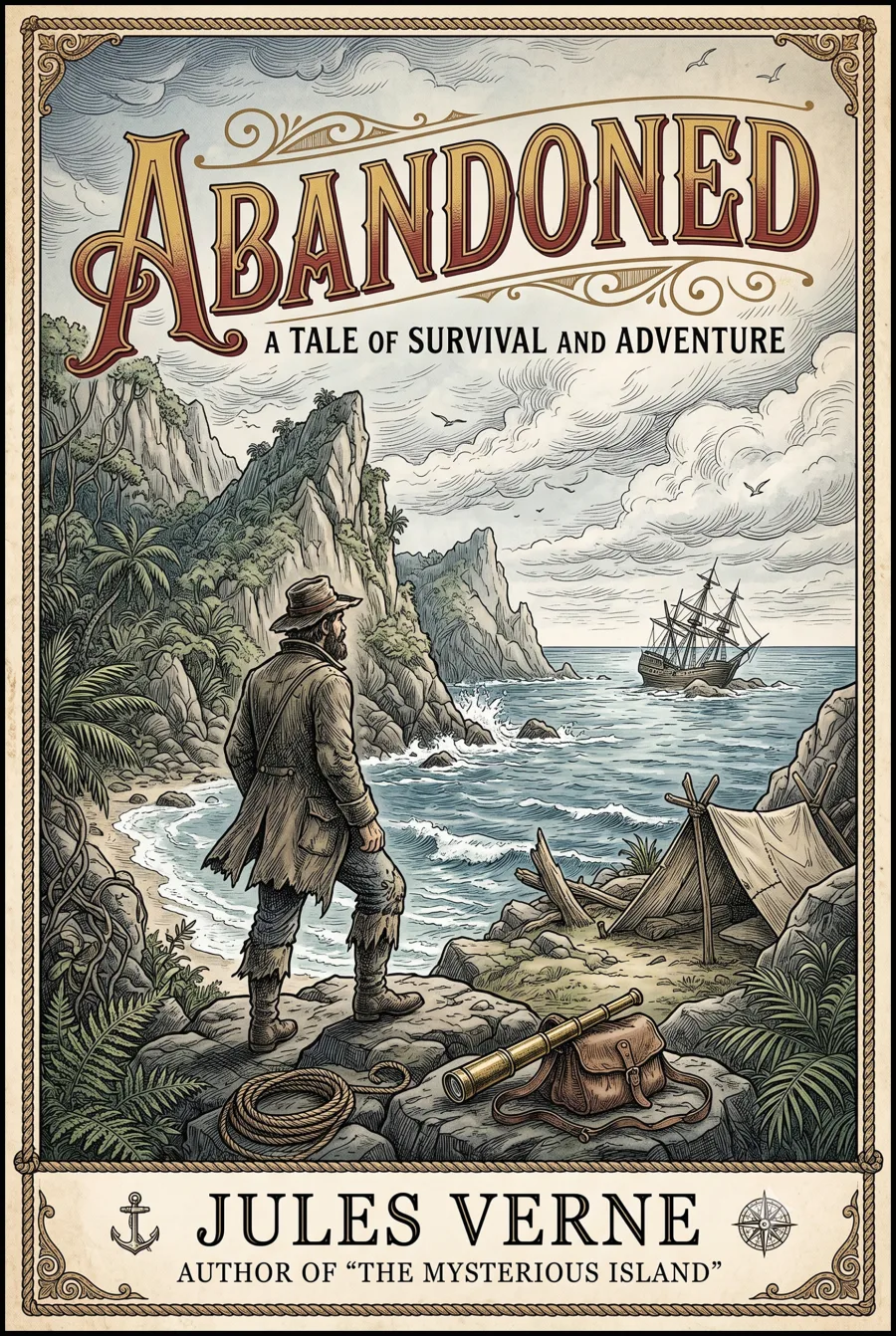
Abandoned
eBook
• INR 51.00
• English
• 9788169359009
No ratings yet
| Publisher | General Press |
|---|---|
| ISBN13 | 9788169359009 |
| ASIN/SKU | 8169359007 |
| Book Format | eBook |
| Language | English |
| List Price | INR 51.00 |
| Subject Code | FIC028010, FIC047000, FIC028060 |
| Publishing Date | 01/09/2026 |
| Book Code | BD00070207 |
Buy this Book
Amazon Stores
Ebook Stores
Other Stores
Discover Abandoned by Jules Verne. This book is published by General Press in eBook format, ISBN 9788169359009, ASIN 8169359007, under Literature and Fiction, Science Fiction Adventures, Sea Stories.
Book Description
What begins as a desperate escape from war soon becomes a remarkable struggle for survival on an island filled with secrets. 'Abandoned' by Jules Verne is a classic science fiction and adventure novel, originally published as 'L'Abandonné', and forms the second part of 'The Mysterious Island' trilogy. It continues the story of a group of castaways whose courage, practical knowledge, and teamwork have allowed them to build a new life far from civilization.
After escaping the American Civil War in a stolen balloon, engineer Cyrus Harding, journalist Gideon Spilett, sailor Pencroff, young Harbert, and Neb have established themselves on Lincoln Island. Months have passed, and they have learned to make the island their home by using their combined skills to construct shelter, tools, weapons, boats, and other useful inventions. Their peaceful sense of security, however, is disturbed when they discover evidence that another human being may have been on the island. A simple bullet found inside an animal raises an unsettling question: if the island is deserted, who fired it?
Determined to uncover the truth, the colonists explore the island and encounter a series of strange events and unexplained interventions. A mysterious chest of supplies, unexpected assistance, and other discoveries suggest that someone—or something—is watching over them. Their search eventually leads them beyond Lincoln Island, where they encounter an abandoned man whose tragic condition becomes one of the most moving elements of the story.
Blending survival, exploration, engineering, mystery, and human resilience, 'Abandoned' showcases Verne's fascination with science and the ingenuity of ordinary people facing extraordinary circumstances. Yet beneath its adventurous surface lies a deeper question about compassion, friendship, and whether civilization can truly be rebuilt from nothing. As the island's mysteries gradually unfold, readers are drawn toward a secret that makes this remarkable adventure impossible to forget.
After escaping the American Civil War in a stolen balloon, engineer Cyrus Harding, journalist Gideon Spilett, sailor Pencroff, young Harbert, and Neb have established themselves on Lincoln Island. Months have passed, and they have learned to make the island their home by using their combined skills to construct shelter, tools, weapons, boats, and other useful inventions. Their peaceful sense of security, however, is disturbed when they discover evidence that another human being may have been on the island. A simple bullet found inside an animal raises an unsettling question: if the island is deserted, who fired it?
Determined to uncover the truth, the colonists explore the island and encounter a series of strange events and unexplained interventions. A mysterious chest of supplies, unexpected assistance, and other discoveries suggest that someone—or something—is watching over them. Their search eventually leads them beyond Lincoln Island, where they encounter an abandoned man whose tragic condition becomes one of the most moving elements of the story.
Blending survival, exploration, engineering, mystery, and human resilience, 'Abandoned' showcases Verne's fascination with science and the ingenuity of ordinary people facing extraordinary circumstances. Yet beneath its adventurous surface lies a deeper question about compassion, friendship, and whether civilization can truly be rebuilt from nothing. As the island's mysteries gradually unfold, readers are drawn toward a secret that makes this remarkable adventure impossible to forget.
Author Biography
Few writers have imagined the future with the confidence and wonder of Jules Verne. Born Jules Gabriel Verne in 1828, he was a French novelist and pioneer of science fiction, best known for adventure classics such as 'Journey to the Center of the Earth', 'Twenty Thousand Leagues Under the Seas', and 'Around the World in Eighty Days'.
Verne was born in Nantes, France, into a family connected to law and maritime life. Although he initially studied law in Paris, his fascination with travel, science, technology, and storytelling gradually drew him toward literature. His early interest in the theater led him to write plays and stories, but his career changed dramatically when he began creating adventurous novels that combined scientific ideas with thrilling journeys.
His most celebrated books became part of the series known as the 'Voyages extraordinaires'. In these works, Verne took readers beneath the oceans, into unexplored lands, across continents, and even into outer space. He blended careful research with imagination, creating stories that felt both exciting and surprisingly believable. His writing often explored new inventions and scientific possibilities, making him an important figure in the development of modern science fiction.
Verne's influence reached far beyond France. His novels inspired generations of readers, scientists, inventors, filmmakers, and other writers. Some of his imaginative ideas, including submarine travel, lunar exploration, and advanced forms of transportation, appeared remarkably ahead of their time. His books have been translated into numerous languages and continue to attract readers around the world.
Jules Verne died in 1905, but his fascination with discovery and the unknown remains as powerful as ever. His ability to turn scientific curiosity into unforgettable adventure secured his place as one of the most influential authors in literary history.
Verne was born in Nantes, France, into a family connected to law and maritime life. Although he initially studied law in Paris, his fascination with travel, science, technology, and storytelling gradually drew him toward literature. His early interest in the theater led him to write plays and stories, but his career changed dramatically when he began creating adventurous novels that combined scientific ideas with thrilling journeys.
His most celebrated books became part of the series known as the 'Voyages extraordinaires'. In these works, Verne took readers beneath the oceans, into unexplored lands, across continents, and even into outer space. He blended careful research with imagination, creating stories that felt both exciting and surprisingly believable. His writing often explored new inventions and scientific possibilities, making him an important figure in the development of modern science fiction.
Verne's influence reached far beyond France. His novels inspired generations of readers, scientists, inventors, filmmakers, and other writers. Some of his imaginative ideas, including submarine travel, lunar exploration, and advanced forms of transportation, appeared remarkably ahead of their time. His books have been translated into numerous languages and continue to attract readers around the world.
Jules Verne died in 1905, but his fascination with discovery and the unknown remains as powerful as ever. His ability to turn scientific curiosity into unforgettable adventure secured his place as one of the most influential authors in literary history.
Editorial Reviews
Editorial Reviews will be added soon…
Book Summary
Jules Verne’s "Abandoned" is a classic adventure novel about survival, friendship, human ingenuity, mystery, and redemption. Originally published in French as 'L’Abandonné', the book is the second part of 'The Mysterious Island' trilogy and continues the extraordinary story of the castaways who have built a new life on Lincoln Island. Project Gutenberg identifies 'Abandoned' specifically as the second part of 'L’Île mystérieuse' ('The Mysterious Island'), and notes that the English edition commonly associated with W. H. G. Kingston was actually translated by his wife, Agnes Kinloch Kingston.
The novel begins approximately seven months after Cyrus Harding, Gideon Spilett, Pencroff, Herbert, Neb, and the faithful dog Top were swept onto Lincoln Island after escaping from the American Civil War in a balloon. Instead of treating their isolation as a permanent tragedy, the group has gradually transformed the island into a functioning little society. Their home, Granite House, has become a secure base, and through knowledge, cooperation, experimentation, and sheer determination, they have produced tools, food, clothing, transportation, communication systems, and other necessities. This is one of the central ideas of Jules Verne’s fiction: human beings are not helpless simply because nature places them in difficult circumstances. Knowledge can become a form of survival, and cooperation can turn an apparently impossible situation into an opportunity for renewal.
The opening mystery immediately changes the atmosphere. For months, the colonists have believed that they are the only human beings on the island. They have searched the landscape and found no convincing evidence that another person has ever lived there. Then, while examining a wounded animal, they discover a bullet embedded in its body. The discovery is extremely important because a bullet is unmistakable evidence of human presence. Someone has been on the island, or at least someone has recently visited it. The colonists suddenly realize that their carefully constructed understanding of their surroundings may be completely wrong. Their isolated home is not as isolated as they thought.
This discovery gives 'Abandoned' much of its suspense. The island, which previously represented safety and independence, becomes a place filled with unanswered questions. Who fired the bullet? How did that person reach the island? Is someone secretly watching the colonists? Is the unknown presence friendly or dangerous? Verne uses these questions to transform a survival story into a mystery adventure. The characters are no longer concerned only with finding food, building shelter, and protecting themselves from nature. They must now investigate the possibility that another intelligence is operating somewhere beyond their knowledge.
Cyrus Harding remains the intellectual center of the group. He is an engineer whose practical knowledge has repeatedly allowed the colonists to solve problems that would otherwise seem overwhelming. Yet one of the most appealing aspects of his character is that his intelligence is not presented merely as abstract knowledge. Harding constantly turns ideas into practical solutions. He thinks about materials, tools, energy, transportation, agriculture, construction, and communication. His approach represents Verne’s faith in science and engineering, but the novel also makes clear that Harding cannot accomplish everything alone. His success depends on the different abilities of the people around him.
Pencroff, the experienced sailor, provides practical energy and determination. Neb is fiercely loyal and courageous, while Gideon Spilett contributes observation, journalism, and intellectual curiosity. Herbert brings youth, enthusiasm, and a growing knowledge of natural science. Their personalities are different, but their differences make the colony stronger. Verne repeatedly emphasizes that survival is a collective achievement. The group succeeds because each person contributes something valuable. Their society is therefore built not simply from physical materials but from trust, responsibility, and mutual dependence.
One of the most memorable parts of the story is the colonists’ continuing effort to make Lincoln Island habitable. They build and improve their surroundings rather than simply endure them. Their work includes bridges, boats, defensive arrangements, communication systems, and other practical inventions. Their ingenuity is one of the defining features of 'Abandoned'. The novel is sometimes described as science fiction, but its science is closely connected to adventure. Verne is interested in what people can actually do with knowledge when conventional civilization disappears. Instead of waiting passively for rescue, his characters recreate pieces of civilization through their own labor.
The construction of their small society also gives the novel an important emotional dimension. The island becomes more than a place where the characters happen to be stranded. It becomes a home. They establish routines, develop relationships, cultivate resources, and create a sense of belonging. This is why the threat of an unknown presence feels so significant. The characters have spent months turning a hostile wilderness into a peaceful community, and the possibility that someone else is moving secretly through their territory threatens that peace.
Verne also introduces a lighter and more playful element through the arrival of orangutans. At one point, the animals interfere with the colonists’ carefully arranged world, creating danger and disorder. Eventually, however, one orangutan is captured and domesticated, becoming a companion and useful member of the household. The animal, Jupiter, adds warmth and humor to the narrative. His relationship with the colonists illustrates another recurring Verne theme: the boundaries between wilderness and civilization are not always rigid. Through patience and familiarity, the colonists can establish a relationship with an animal that initially appears to be merely a threat.
The colonists’ exploration of the island continues as they try to solve the mystery of the bullet and investigate signs of human activity. They travel through unfamiliar regions, explore rivers and coastlines, and search for evidence that might explain what has happened. Their expeditions are important because they repeatedly challenge their assumptions. Every new discovery suggests that Lincoln Island contains more secrets than they initially understood.
Among the novel’s most intriguing developments is the discovery of supplies that appear to have been deliberately placed for them. A chest containing useful provisions and tools raises an obvious question: who could have known that the castaways would need these things? The discovery deepens the central mystery surrounding the island. The colonists are forced to consider the possibility that someone has been helping them from a distance. The strange events are too organized to be easily dismissed as coincidence, yet the identity and motives of the mysterious benefactor remain hidden.
This mystery creates an unusual emotional tension. The unknown figure seems benevolent in some moments, but the secrecy itself is unsettling. The colonists cannot understand why someone would help them without revealing themselves. Verne therefore turns assistance into another source of suspense. Normally, discovering food or equipment would be comforting. Here, it is disturbing because every gift raises another unanswered question.
The story eventually expands beyond Lincoln Island when the colonists learn about a solitary man living on Tabor Island. Their discovery of this abandoned figure is one of the most significant developments in the book. The stranger has spent years in extreme isolation and has been reduced almost to a savage condition. Instead of treating him as a monster or abandoning him to his fate, the colonists decide to rescue him and attempt to restore his humanity. This part of the novel gives 'Abandoned' its strongest theme of redemption.
The abandoned man’s condition is especially meaningful because it presents the opposite of what the colonists have achieved. Cyrus Harding and his companions have responded to isolation by creating community. The stranger has suffered isolation without that support and has gradually lost the habits and connections that make ordinary social life possible. Verne therefore suggests that civilization is not simply a collection of inventions. It is also language, friendship, responsibility, memory, affection, and human contact.
The colonists’ decision to save the stranger reflects the moral foundation of their own society. Their survival has taught them that no individual can truly thrive alone. Even the strongest person needs companionship and purpose. Bringing the abandoned man back into their community becomes an act of compassion as well as a practical rescue. The story thereby moves beyond the question of “How can people survive?” and asks the deeper question, “What does it mean to remain human while surviving?”
The mystery of the island eventually reaches its most dramatic revelation when the colonists discover that their strange experiences have been connected to a remarkable hidden protector. Readers familiar with Verne’s wider fiction will recognize the significance of this revelation. The story connects 'The Mysterious Island' with 'Twenty Thousand Leagues Under the Seas', bringing the enigmatic Captain Nemo into the narrative. The mysterious assistance that has surrounded the colonists is finally given a human explanation, and the seemingly unrelated clues begin to fit together. This crossover is one reason 'Abandoned' is particularly important within Jules Verne’s larger body of adventure fiction.
The appearance of Captain Nemo also changes the meaning of the novel’s earlier mysteries. What seemed supernatural or impossible becomes part of a hidden network of human action. Verne enjoys creating this movement from uncertainty to explanation. The characters encounter unexplained events, investigate them scientifically, and eventually discover the mechanism behind them. The mystery is exciting not because it remains permanently unexplained, but because the truth is more extraordinary than the characters could have imagined.
At the same time, Nemo’s presence adds emotional complexity. He is not simply a mysterious rescuer. He carries his own history, regrets, and moral burdens. His connection with the abandoned man and his secret assistance to the colonists suggest that he is seeking, in his own way, a form of redemption. Verne thus brings together two kinds of abandonment: the physical abandonment suffered by the castaways and the emotional and moral isolation experienced by Nemo.
The title 'Abandoned' therefore has several layers of meaning. On the surface, it refers to people separated from ordinary society and left to survive in remote places. But the word also describes emotional isolation. A person can be surrounded by others and still be profoundly alone. The novel’s characters repeatedly overcome abandonment through human connection. The castaways form a community, the stranger is rescued from isolation, and Nemo’s hidden acts of generosity reveal that even a deeply isolated man still desires some form of connection with humanity.
One of the greatest strengths of 'Abandoned' is the balance between adventure and practical detail. Verne spends considerable time describing construction, exploration, natural resources, tools, geography, and scientific reasoning. For some readers, these passages may seem slower than the action sequences, but they are central to the novel’s identity. Verne wants readers to imagine how civilization might actually be rebuilt from limited resources. The technical details make the adventure feel grounded and give the characters’ achievements a sense of credibility.
The book is also ultimately optimistic about cooperation. The colonists survive not because one heroic individual possesses every answer but because a group of different people combines its strengths. Harding provides engineering knowledge; Pencroff brings practical experience; Spilett contributes intelligence and observation; Neb provides loyalty and courage; and Herbert brings curiosity and scientific enthusiasm. Their community works because knowledge is shared rather than hoarded.
For modern readers searching for an explanation of 'Abandoned' by Jules Verne, the novel can best be understood as a combination of survival fiction, adventure, science fiction, mystery, and moral drama. It is not simply a story about castaways stranded on an island. It is a story about what people build when everything familiar has been taken away. Lincoln Island becomes a laboratory in which Verne examines civilization itself. Shelter, food, transportation, communication, companionship, ethics, and social responsibility must all be reconstructed.
The novel also demonstrates why Jules Verne remains such an influential figure in adventure literature. His stories are driven by imagination, but they are rarely detached from practical knowledge. He imagined unusual technologies, remote environments, and extraordinary adventures while grounding them in scientific curiosity. 'Abandoned' shows this method particularly well because its central mystery is surrounded by careful descriptions of engineering and exploration.
In the end, 'Abandoned' is a story about much more than being stranded. It is about refusing to surrender to circumstances. The characters begin as people who have been violently separated from their former world, yet they gradually create a new one. They turn wilderness into a home, danger into opportunity, isolation into community, and mystery into understanding. When they encounter another human being who has been destroyed by loneliness, they do not simply move on; they attempt to restore him. That decision captures the deepest message of the novel: survival has value only when it preserves our humanity.
As a sequel to 'The Mysterious Island', 'Abandoned' expands the original survival story into a richer narrative about mystery, compassion, civilization, and redemption. Its combination of scientific adventure, island exploration, hidden assistance, human resilience, and the return of Captain Nemo makes it one of Jules Verne’s most engaging works for readers interested in classic adventure fiction. The novel ultimately argues that ingenuity can build a shelter, but friendship and compassion are what turn that shelter into a home. In Verne’s world, the greatest achievement is not merely surviving an abandoned island—it is rebuilding a meaningful human life there.
The novel begins approximately seven months after Cyrus Harding, Gideon Spilett, Pencroff, Herbert, Neb, and the faithful dog Top were swept onto Lincoln Island after escaping from the American Civil War in a balloon. Instead of treating their isolation as a permanent tragedy, the group has gradually transformed the island into a functioning little society. Their home, Granite House, has become a secure base, and through knowledge, cooperation, experimentation, and sheer determination, they have produced tools, food, clothing, transportation, communication systems, and other necessities. This is one of the central ideas of Jules Verne’s fiction: human beings are not helpless simply because nature places them in difficult circumstances. Knowledge can become a form of survival, and cooperation can turn an apparently impossible situation into an opportunity for renewal.
The opening mystery immediately changes the atmosphere. For months, the colonists have believed that they are the only human beings on the island. They have searched the landscape and found no convincing evidence that another person has ever lived there. Then, while examining a wounded animal, they discover a bullet embedded in its body. The discovery is extremely important because a bullet is unmistakable evidence of human presence. Someone has been on the island, or at least someone has recently visited it. The colonists suddenly realize that their carefully constructed understanding of their surroundings may be completely wrong. Their isolated home is not as isolated as they thought.
This discovery gives 'Abandoned' much of its suspense. The island, which previously represented safety and independence, becomes a place filled with unanswered questions. Who fired the bullet? How did that person reach the island? Is someone secretly watching the colonists? Is the unknown presence friendly or dangerous? Verne uses these questions to transform a survival story into a mystery adventure. The characters are no longer concerned only with finding food, building shelter, and protecting themselves from nature. They must now investigate the possibility that another intelligence is operating somewhere beyond their knowledge.
Cyrus Harding remains the intellectual center of the group. He is an engineer whose practical knowledge has repeatedly allowed the colonists to solve problems that would otherwise seem overwhelming. Yet one of the most appealing aspects of his character is that his intelligence is not presented merely as abstract knowledge. Harding constantly turns ideas into practical solutions. He thinks about materials, tools, energy, transportation, agriculture, construction, and communication. His approach represents Verne’s faith in science and engineering, but the novel also makes clear that Harding cannot accomplish everything alone. His success depends on the different abilities of the people around him.
Pencroff, the experienced sailor, provides practical energy and determination. Neb is fiercely loyal and courageous, while Gideon Spilett contributes observation, journalism, and intellectual curiosity. Herbert brings youth, enthusiasm, and a growing knowledge of natural science. Their personalities are different, but their differences make the colony stronger. Verne repeatedly emphasizes that survival is a collective achievement. The group succeeds because each person contributes something valuable. Their society is therefore built not simply from physical materials but from trust, responsibility, and mutual dependence.
One of the most memorable parts of the story is the colonists’ continuing effort to make Lincoln Island habitable. They build and improve their surroundings rather than simply endure them. Their work includes bridges, boats, defensive arrangements, communication systems, and other practical inventions. Their ingenuity is one of the defining features of 'Abandoned'. The novel is sometimes described as science fiction, but its science is closely connected to adventure. Verne is interested in what people can actually do with knowledge when conventional civilization disappears. Instead of waiting passively for rescue, his characters recreate pieces of civilization through their own labor.
The construction of their small society also gives the novel an important emotional dimension. The island becomes more than a place where the characters happen to be stranded. It becomes a home. They establish routines, develop relationships, cultivate resources, and create a sense of belonging. This is why the threat of an unknown presence feels so significant. The characters have spent months turning a hostile wilderness into a peaceful community, and the possibility that someone else is moving secretly through their territory threatens that peace.
Verne also introduces a lighter and more playful element through the arrival of orangutans. At one point, the animals interfere with the colonists’ carefully arranged world, creating danger and disorder. Eventually, however, one orangutan is captured and domesticated, becoming a companion and useful member of the household. The animal, Jupiter, adds warmth and humor to the narrative. His relationship with the colonists illustrates another recurring Verne theme: the boundaries between wilderness and civilization are not always rigid. Through patience and familiarity, the colonists can establish a relationship with an animal that initially appears to be merely a threat.
The colonists’ exploration of the island continues as they try to solve the mystery of the bullet and investigate signs of human activity. They travel through unfamiliar regions, explore rivers and coastlines, and search for evidence that might explain what has happened. Their expeditions are important because they repeatedly challenge their assumptions. Every new discovery suggests that Lincoln Island contains more secrets than they initially understood.
Among the novel’s most intriguing developments is the discovery of supplies that appear to have been deliberately placed for them. A chest containing useful provisions and tools raises an obvious question: who could have known that the castaways would need these things? The discovery deepens the central mystery surrounding the island. The colonists are forced to consider the possibility that someone has been helping them from a distance. The strange events are too organized to be easily dismissed as coincidence, yet the identity and motives of the mysterious benefactor remain hidden.
This mystery creates an unusual emotional tension. The unknown figure seems benevolent in some moments, but the secrecy itself is unsettling. The colonists cannot understand why someone would help them without revealing themselves. Verne therefore turns assistance into another source of suspense. Normally, discovering food or equipment would be comforting. Here, it is disturbing because every gift raises another unanswered question.
The story eventually expands beyond Lincoln Island when the colonists learn about a solitary man living on Tabor Island. Their discovery of this abandoned figure is one of the most significant developments in the book. The stranger has spent years in extreme isolation and has been reduced almost to a savage condition. Instead of treating him as a monster or abandoning him to his fate, the colonists decide to rescue him and attempt to restore his humanity. This part of the novel gives 'Abandoned' its strongest theme of redemption.
The abandoned man’s condition is especially meaningful because it presents the opposite of what the colonists have achieved. Cyrus Harding and his companions have responded to isolation by creating community. The stranger has suffered isolation without that support and has gradually lost the habits and connections that make ordinary social life possible. Verne therefore suggests that civilization is not simply a collection of inventions. It is also language, friendship, responsibility, memory, affection, and human contact.
The colonists’ decision to save the stranger reflects the moral foundation of their own society. Their survival has taught them that no individual can truly thrive alone. Even the strongest person needs companionship and purpose. Bringing the abandoned man back into their community becomes an act of compassion as well as a practical rescue. The story thereby moves beyond the question of “How can people survive?” and asks the deeper question, “What does it mean to remain human while surviving?”
The mystery of the island eventually reaches its most dramatic revelation when the colonists discover that their strange experiences have been connected to a remarkable hidden protector. Readers familiar with Verne’s wider fiction will recognize the significance of this revelation. The story connects 'The Mysterious Island' with 'Twenty Thousand Leagues Under the Seas', bringing the enigmatic Captain Nemo into the narrative. The mysterious assistance that has surrounded the colonists is finally given a human explanation, and the seemingly unrelated clues begin to fit together. This crossover is one reason 'Abandoned' is particularly important within Jules Verne’s larger body of adventure fiction.
The appearance of Captain Nemo also changes the meaning of the novel’s earlier mysteries. What seemed supernatural or impossible becomes part of a hidden network of human action. Verne enjoys creating this movement from uncertainty to explanation. The characters encounter unexplained events, investigate them scientifically, and eventually discover the mechanism behind them. The mystery is exciting not because it remains permanently unexplained, but because the truth is more extraordinary than the characters could have imagined.
At the same time, Nemo’s presence adds emotional complexity. He is not simply a mysterious rescuer. He carries his own history, regrets, and moral burdens. His connection with the abandoned man and his secret assistance to the colonists suggest that he is seeking, in his own way, a form of redemption. Verne thus brings together two kinds of abandonment: the physical abandonment suffered by the castaways and the emotional and moral isolation experienced by Nemo.
The title 'Abandoned' therefore has several layers of meaning. On the surface, it refers to people separated from ordinary society and left to survive in remote places. But the word also describes emotional isolation. A person can be surrounded by others and still be profoundly alone. The novel’s characters repeatedly overcome abandonment through human connection. The castaways form a community, the stranger is rescued from isolation, and Nemo’s hidden acts of generosity reveal that even a deeply isolated man still desires some form of connection with humanity.
One of the greatest strengths of 'Abandoned' is the balance between adventure and practical detail. Verne spends considerable time describing construction, exploration, natural resources, tools, geography, and scientific reasoning. For some readers, these passages may seem slower than the action sequences, but they are central to the novel’s identity. Verne wants readers to imagine how civilization might actually be rebuilt from limited resources. The technical details make the adventure feel grounded and give the characters’ achievements a sense of credibility.
The book is also ultimately optimistic about cooperation. The colonists survive not because one heroic individual possesses every answer but because a group of different people combines its strengths. Harding provides engineering knowledge; Pencroff brings practical experience; Spilett contributes intelligence and observation; Neb provides loyalty and courage; and Herbert brings curiosity and scientific enthusiasm. Their community works because knowledge is shared rather than hoarded.
For modern readers searching for an explanation of 'Abandoned' by Jules Verne, the novel can best be understood as a combination of survival fiction, adventure, science fiction, mystery, and moral drama. It is not simply a story about castaways stranded on an island. It is a story about what people build when everything familiar has been taken away. Lincoln Island becomes a laboratory in which Verne examines civilization itself. Shelter, food, transportation, communication, companionship, ethics, and social responsibility must all be reconstructed.
The novel also demonstrates why Jules Verne remains such an influential figure in adventure literature. His stories are driven by imagination, but they are rarely detached from practical knowledge. He imagined unusual technologies, remote environments, and extraordinary adventures while grounding them in scientific curiosity. 'Abandoned' shows this method particularly well because its central mystery is surrounded by careful descriptions of engineering and exploration.
In the end, 'Abandoned' is a story about much more than being stranded. It is about refusing to surrender to circumstances. The characters begin as people who have been violently separated from their former world, yet they gradually create a new one. They turn wilderness into a home, danger into opportunity, isolation into community, and mystery into understanding. When they encounter another human being who has been destroyed by loneliness, they do not simply move on; they attempt to restore him. That decision captures the deepest message of the novel: survival has value only when it preserves our humanity.
As a sequel to 'The Mysterious Island', 'Abandoned' expands the original survival story into a richer narrative about mystery, compassion, civilization, and redemption. Its combination of scientific adventure, island exploration, hidden assistance, human resilience, and the return of Captain Nemo makes it one of Jules Verne’s most engaging works for readers interested in classic adventure fiction. The novel ultimately argues that ingenuity can build a shelter, but friendship and compassion are what turn that shelter into a home. In Verne’s world, the greatest achievement is not merely surviving an abandoned island—it is rebuilding a meaningful human life there.
Sample Chapters
Sample Chapters will be added soon…
Reader Reviews
No reviews yet.
Abandoned