
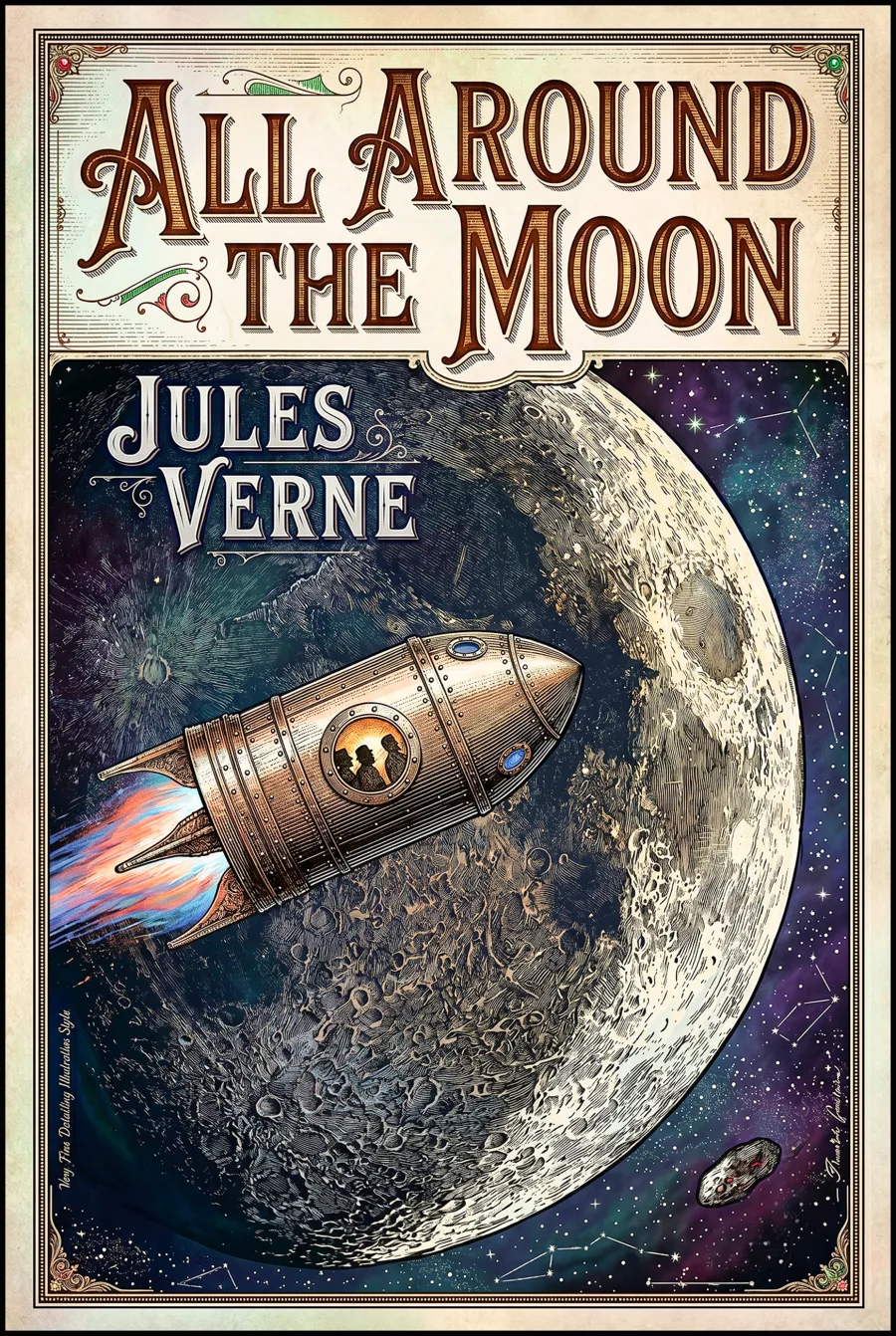
All Around the Moon
eBook
• INR 51.00
• English
• 9788169359016
No ratings yet
| Publisher | General Press |
|---|---|
| ISBN13 | 9788169359016 |
| ASIN/SKU | 8169359015 |
| Book Format | eBook |
| Language | English |
| List Price | INR 51.00 |
| Subject Code | FIC028130, FIC028020, FIC028010 |
| Publishing Date | 01/09/2026 |
| Book Code | BD00070208 |
Buy this Book
Amazon Stores
Ebook Stores
Other Stores
Discover All Around the Moon by Jules Verne. This book is published by General Press in eBook format, ISBN 9788169359016, ASIN 8169359015, under Literature and Fiction, Exploration Science Fiction, Hard Science Fiction.
Book Description
What happens when three adventurous men are fired from a giant cannon toward the Moon and suddenly realize that their carefully planned journey may be far more dangerous than expected? 'All Around the Moon' by Jules Verne is a classic science fiction adventure and the sequel to 'From the Earth to the Moon', continuing the extraordinary lunar voyage with a thrilling mixture of scientific imagination, humor, suspense, and exploration.
The story follows Impey Barbicane, Captain Nicholl, and Michel Ardan as they travel through space inside the projectile built by the Baltimore Gun Club. Their mission is unlike anything attempted before, but the excitement of reaching the Moon is soon tempered by uncertainty. As their spacecraft races through the darkness of space, the travelers must cope with unexpected changes in their trajectory, limited supplies, physical discomfort, and the frightening realization that even the smallest mistake could make their return impossible.
Verne fills the journey with lively conversations and detailed observations about astronomy, physics, the Moon, and the possibilities of human exploration. The three companions approach their situation in very different ways: Barbicane remains practical and scientific, Nicholl is cautious and disciplined, while Ardan brings optimism, humor, and a sense of adventure. Their contrasting personalities create warmth and tension as they confront the enormous emptiness surrounding them.
As they move closer to the Moon, their excitement grows, but so do the dangers. They observe the lunar surface from above, speculate about whether life might exist there, and face unexpected events that challenge their confidence in the mission. The novel captures both the wonder of discovery and the terrifying vulnerability of humans venturing beyond Earth.
With its imaginative vision of space travel and its fascination with science, 'All Around the Moon' remains an engaging early science fiction classic. Verne's remarkable journey invites readers to experience the thrill of reaching another world—and to wonder whether the travelers will ever make it home.
The story follows Impey Barbicane, Captain Nicholl, and Michel Ardan as they travel through space inside the projectile built by the Baltimore Gun Club. Their mission is unlike anything attempted before, but the excitement of reaching the Moon is soon tempered by uncertainty. As their spacecraft races through the darkness of space, the travelers must cope with unexpected changes in their trajectory, limited supplies, physical discomfort, and the frightening realization that even the smallest mistake could make their return impossible.
Verne fills the journey with lively conversations and detailed observations about astronomy, physics, the Moon, and the possibilities of human exploration. The three companions approach their situation in very different ways: Barbicane remains practical and scientific, Nicholl is cautious and disciplined, while Ardan brings optimism, humor, and a sense of adventure. Their contrasting personalities create warmth and tension as they confront the enormous emptiness surrounding them.
As they move closer to the Moon, their excitement grows, but so do the dangers. They observe the lunar surface from above, speculate about whether life might exist there, and face unexpected events that challenge their confidence in the mission. The novel captures both the wonder of discovery and the terrifying vulnerability of humans venturing beyond Earth.
With its imaginative vision of space travel and its fascination with science, 'All Around the Moon' remains an engaging early science fiction classic. Verne's remarkable journey invites readers to experience the thrill of reaching another world—and to wonder whether the travelers will ever make it home.
Author Biography
Few writers have imagined the future with the confidence and wonder of Jules Verne. Born Jules Gabriel Verne in 1828, he was a French novelist and pioneer of science fiction, best known for adventure classics such as 'Journey to the Center of the Earth', 'Twenty Thousand Leagues Under the Seas', and 'Around the World in Eighty Days'.
Verne was born in Nantes, France, into a family connected to law and maritime life. Although he initially studied law in Paris, his fascination with travel, science, technology, and storytelling gradually drew him toward literature. His early interest in the theater led him to write plays and stories, but his career changed dramatically when he began creating adventurous novels that combined scientific ideas with thrilling journeys.
His most celebrated books became part of the series known as the 'Voyages extraordinaires'. In these works, Verne took readers beneath the oceans, into unexplored lands, across continents, and even into outer space. He blended careful research with imagination, creating stories that felt both exciting and surprisingly believable. His writing often explored new inventions and scientific possibilities, making him an important figure in the development of modern science fiction.
Verne's influence reached far beyond France. His novels inspired generations of readers, scientists, inventors, filmmakers, and other writers. Some of his imaginative ideas, including submarine travel, lunar exploration, and advanced forms of transportation, appeared remarkably ahead of their time. His books have been translated into numerous languages and continue to attract readers around the world.
Jules Verne died in 1905, but his fascination with discovery and the unknown remains as powerful as ever. His ability to turn scientific curiosity into unforgettable adventure secured his place as one of the most influential authors in literary history.
Verne was born in Nantes, France, into a family connected to law and maritime life. Although he initially studied law in Paris, his fascination with travel, science, technology, and storytelling gradually drew him toward literature. His early interest in the theater led him to write plays and stories, but his career changed dramatically when he began creating adventurous novels that combined scientific ideas with thrilling journeys.
His most celebrated books became part of the series known as the 'Voyages extraordinaires'. In these works, Verne took readers beneath the oceans, into unexplored lands, across continents, and even into outer space. He blended careful research with imagination, creating stories that felt both exciting and surprisingly believable. His writing often explored new inventions and scientific possibilities, making him an important figure in the development of modern science fiction.
Verne's influence reached far beyond France. His novels inspired generations of readers, scientists, inventors, filmmakers, and other writers. Some of his imaginative ideas, including submarine travel, lunar exploration, and advanced forms of transportation, appeared remarkably ahead of their time. His books have been translated into numerous languages and continue to attract readers around the world.
Jules Verne died in 1905, but his fascination with discovery and the unknown remains as powerful as ever. His ability to turn scientific curiosity into unforgettable adventure secured his place as one of the most influential authors in literary history.
Editorial Reviews
Editorial Reviews will be added soon…
Book Summary
Jules Verne’s "All Around the Moon" is one of the foundational works of early science fiction and one of the most imaginative space-travel novels of the nineteenth century. Published as the sequel to 'From the Earth to the Moon', the novel continues the extraordinary voyage of three men—Impey Barbicane, Captain Nicholl, and Michel Ardan—who have been fired from Earth toward the Moon inside a specially constructed projectile. Rather than focusing primarily on the engineering preparations that dominate the first book, 'All Around the Moon' concentrates on the journey itself: the dangers of space travel, the strange experience of weightlessness, the scientific observations of the Moon, the psychological effects of isolation, and the desperate struggle to return safely to Earth. Project Gutenberg classifies the novel as science fiction involving space flight, the Moon, spacecraft, and manned space travel.
The story begins by briefly recalling the extraordinary events of 'From the Earth to the Moon'. The Baltimore Gun Club, a group of American artillery enthusiasts formed after the Civil War, has undertaken an almost impossible project: sending a projectile to the Moon. President Impey Barbicane has organized the enterprise, Captain Nicholl has been his former rival and eventual collaborator, and Michel Ardan, an adventurous Frenchman, has volunteered to travel inside the projectile. The three men have entered a hollow, bullet-shaped capsule fired from the enormous Columbiad cannon. 'All Around the Moon' begins at the precise moment when their journey into space is underway.
The opening moments of the voyage are terrifying. The enormous acceleration of the projectile subjects the travelers to forces that could easily kill them. The men lose consciousness, and for a time it is unclear whether the experiment has succeeded or whether the three adventurers have died inside their capsule. When Barbicane, Nicholl, and Ardan gradually recover, they discover that they are still alive. Their survival produces an immediate mixture of relief, amazement, and excitement. They have crossed a boundary that no human beings had ever crossed before in the fictional world of Verne: they are traveling through space.
This early section establishes one of the novel’s most important themes—the human desire to explore the unknown. The three men are not simply passengers. They are representatives of different forms of courage and curiosity. Barbicane is methodical, scientific, and disciplined. Nicholl is practical, skeptical, and technically knowledgeable. Ardan is enthusiastic, humorous, imaginative, and emotionally adventurous. Their personalities frequently clash, but their differences make the journey entertaining and give the novel its human warmth. They are facing an environment completely beyond ordinary human experience, yet they continue to joke, argue, calculate, eat, observe, and plan.
One of the most fascinating aspects of 'All Around the Moon' is the way Verne imagines everyday life inside a spacecraft. The travelers have food, water, air, instruments, books, and other supplies, and the projectile is designed to function as a miniature living space. Verne pays considerable attention to how the men organize their limited environment. These details may appear simple by modern standards, but they were remarkably imaginative for a nineteenth-century writer. The novel treats space travel as a practical problem: humans must not only reach space but also survive there.
The travelers soon encounter one of the most famous experiences in the book: weightlessness. As the gravitational influence of Earth changes during their journey, the men experience a strange sensation in which their bodies appear to lose their normal weight. Objects float, movements become unusual, and ordinary physical assumptions seem to disappear. Verne uses this phenomenon both scientifically and humorously. The characters are fascinated by the experience, but they also have to learn how to control themselves inside their capsule.
These scenes are important because they show how 'All Around the Moon' differs from an ordinary adventure story. Verne is interested not merely in what happens to his characters but in how the physical laws of the universe affect them. Gravity, velocity, trajectory, acceleration, temperature, atmosphere, and celestial motion become part of the adventure. His characters repeatedly calculate their position and attempt to predict what will happen next. The excitement of the story therefore comes partly from scientific uncertainty.
The journey is not completely smooth. At one point, the travelers encounter an unexpected celestial object that passes dangerously close to their projectile. The encounter causes confusion because the men initially struggle to understand what they are seeing. The object appears to be a small satellite-like body moving through space. In the novel’s imaginative cosmology, the possibility is raised that this object may have been captured by Earth’s gravitational influence and effectively become a second moon. The episode demonstrates Verne’s fascination with astronomical speculation and shows how quickly an apparently safe journey can become dangerous.
The travelers eventually discover that their trajectory is not exactly what they expected. Their projectile does not simply travel toward the Moon and land neatly on its surface. Instead, the laws of celestial mechanics alter their path. This is one of the novel’s central dramatic developments. Their original objective is to reach the Moon, but reaching the Moon is not enough. They must reach it in the correct way. A small error in trajectory can transform a planned landing into a disastrous collision or an uncontrolled journey through space.
This idea gives the novel much of its suspense. On Earth, the Gun Club members can make calculations, construct machines, and prepare elaborate plans. In space, however, they cannot simply step outside and correct a mistake. Once the projectile has been fired, the travelers are largely at the mercy of physics. Their intelligence remains essential, but their power is limited. Verne therefore creates an interesting tension between human ingenuity and the overwhelming scale of nature.
As the spacecraft approaches the Moon, the men begin observing the lunar surface. This section of the novel is among its most memorable. Through their telescopes and direct visual observations, they examine mountains, craters, valleys, plains, and other features of the lunar landscape. Verne combines genuine nineteenth-century astronomical knowledge with imaginative speculation about what might exist on the Moon. The travelers discuss lunar geography and debate whether the Moon could contain life or traces of civilization.
The Moon itself becomes almost a character in the narrative. It is distant, mysterious, beautiful, and dangerous. From Earth, it appears familiar because humans have watched it for thousands of years. From close range, however, it becomes strange and alien. The travelers see landscapes that cannot be experienced by an ordinary observer on Earth. Verne transforms the familiar night sky into an unexplored territory.
Their observations also reveal one of the limitations of human knowledge. The characters repeatedly encounter questions that cannot be answered with certainty. Is there life on the Moon? Could there once have been a lunar civilization? What lies beyond the visible hemisphere? Are certain formations geological or biological? The men make theories, reject them, and form new hypotheses. This process is important because Verne does not present science as a collection of fixed answers. Science is shown as curiosity, observation, argument, calculation, and revision.
The lunar journey also has a psychological dimension. The men are incredibly far from home, surrounded by darkness and emptiness, with no possibility of immediate rescue. Their conversations about Earth become increasingly meaningful. They remember their friends, their country, and the people who are watching their progress. The distance between the travelers and the world they left behind creates a subtle emotional tension beneath the humor and scientific discussion.
Meanwhile, the people on Earth are following the mission with enormous interest. The Baltimore Gun Club has invested tremendous pride and identity in the expedition. The journey is therefore not merely a private adventure. It represents humanity’s collective curiosity. Everyone watching from Earth wants to know whether the travelers will survive and whether the extraordinary experiment will succeed.
One of the novel’s most engaging qualities is its mixture of serious science and comic personality. Michel Ardan, in particular, refuses to behave like a solemn astronaut. He jokes about their situation, challenges Barbicane’s calculations, discusses food, and reacts to danger with a remarkable mixture of courage and humor. His personality prevents the scientific discussions from becoming completely dry. Nicholl and Barbicane, meanwhile, often bring the conversation back toward practical questions. Their interactions create a rhythm of humor, calculation, disagreement, and cooperation.
The three men also undergo an important transformation. At the beginning, Barbicane and Nicholl have a history of rivalry. Their disagreements were part of the story that led to the lunar expedition. Yet once they are trapped together in space, their rivalry becomes insignificant. Survival requires cooperation. The journey strips away the social conflicts that seemed important on Earth and replaces them with a more fundamental human bond. In the darkness of space, Barbicane and Nicholl are no longer simply rivals; they are companions whose lives depend upon one another.
Their relationship reflects a larger theme in Verne’s work: extraordinary circumstances can reveal what truly matters. Pride, competition, and personal disputes become small when compared with the dangers of nature. The travelers must trust one another, share knowledge, and make decisions together. Their expedition becomes a demonstration of the power of cooperation.
As the projectile passes around the Moon, the travelers confront the reality that they may not be able to land. Their original mission has been complicated by their altered trajectory. The Moon is close enough to observe in extraordinary detail, yet they may remain forever separated from it. This creates an ironic situation: the men have succeeded beyond anything humanity had previously imagined, but they may still fail according to the original goal of the expedition.
The return journey becomes the novel’s most suspenseful phase. The travelers must rely on calculations to determine whether they will fall back toward Earth. The possibility of missing Earth entirely is terrifying. In space, there is no road, no rescue vehicle, and no familiar landmark to guide them. A slight mistake could send the projectile into an endless orbit or into the depths of space.
The characters therefore begin thinking seriously about their chances of survival. Their earlier confidence gives way to uncertainty. They have seen the Moon, traveled through space, and accomplished something extraordinary, but now they must survive the consequences of their achievement. The novel’s adventure thus comes full circle: the same scientific ambition that carried them away from Earth must now help bring them home.
The final stages of the journey are filled with suspense. The capsule begins its descent toward Earth, and the travelers must endure another violent change in motion. The re-entry is dangerous because their projectile was never designed according to modern spacecraft principles. Verne imagines the descent as a dramatic continuation of the journey’s physical challenges. The men have survived the launch, weightlessness, lunar passage, and uncertainty of space; now the Earth itself becomes a potential threat.
The ending provides a satisfying sense of return while also preserving the extraordinary character of the adventure. The travelers do not simply come home unchanged. They have crossed a boundary between Earth and the unknown and returned with experiences no other humans possess. Their journey becomes a triumph of imagination, courage, and scientific ambition.
For readers searching for an explanation of 'All Around the Moon', the novel is best understood as a pioneering space-travel adventure rather than a modern scientific account of lunar exploration. Verne’s technology is obviously different from actual spacecraft, and some of his scientific assumptions are incorrect. The famous giant cannon, for example, would not realistically launch humans into space because the acceleration would be fatal. Yet the novel’s importance does not depend on perfect scientific prediction. What makes it remarkable is the breadth of its imagination. Verne conceived of human beings traveling toward the Moon, living inside a spacecraft, experiencing weightlessness, observing the lunar surface, calculating trajectories, and attempting to return to Earth—all long before actual human spaceflight.
The book also demonstrates Verne’s remarkable ability to turn scientific ideas into narrative suspense. Gravity becomes a danger. Velocity becomes a plot device. Astronomy becomes exploration. Mathematics becomes a survival tool. The Moon becomes an unknown world waiting to be observed. This combination of science and storytelling helped establish the tradition of scientific adventure that would later influence generations of science-fiction writers.
Ultimately, 'All Around the Moon' is a story about humanity’s urge to go beyond its boundaries. Barbicane, Nicholl, and Ardan represent three different forms of that impulse: scientific discipline, technical courage, and adventurous imagination. Together they enter an environment that no human being has experienced before. Their journey is dangerous precisely because humanity does not yet understand everything about space. Yet they go anyway.
The deeper message of the novel is therefore not simply that humans can conquer nature. Verne’s story is more nuanced. The travelers use intelligence and technology to venture into space, but once they leave Earth, they discover how small and vulnerable human beings remain. Their survival depends on knowledge, cooperation, discipline, and luck. Space does not surrender easily to human ambition.
'All Around the Moon' remains compelling because it captures a dream that has fascinated humanity for centuries: leaving Earth and seeing the Moon from close range. Jules Verne transformed that dream into an adventure filled with humor, danger, scientific speculation, friendship, and suspense. The novel’s greatest achievement is not that every prediction came true, but that it made the idea of human space travel feel imaginable. More than a century before astronauts actually walked on the Moon, Verne invited readers to picture people traveling through space, looking back at their world, and wondering what might lie beyond it. That combination of curiosity and courage is what gives 'All Around the Moon' its enduring place in the history of science fiction.
The story begins by briefly recalling the extraordinary events of 'From the Earth to the Moon'. The Baltimore Gun Club, a group of American artillery enthusiasts formed after the Civil War, has undertaken an almost impossible project: sending a projectile to the Moon. President Impey Barbicane has organized the enterprise, Captain Nicholl has been his former rival and eventual collaborator, and Michel Ardan, an adventurous Frenchman, has volunteered to travel inside the projectile. The three men have entered a hollow, bullet-shaped capsule fired from the enormous Columbiad cannon. 'All Around the Moon' begins at the precise moment when their journey into space is underway.
The opening moments of the voyage are terrifying. The enormous acceleration of the projectile subjects the travelers to forces that could easily kill them. The men lose consciousness, and for a time it is unclear whether the experiment has succeeded or whether the three adventurers have died inside their capsule. When Barbicane, Nicholl, and Ardan gradually recover, they discover that they are still alive. Their survival produces an immediate mixture of relief, amazement, and excitement. They have crossed a boundary that no human beings had ever crossed before in the fictional world of Verne: they are traveling through space.
This early section establishes one of the novel’s most important themes—the human desire to explore the unknown. The three men are not simply passengers. They are representatives of different forms of courage and curiosity. Barbicane is methodical, scientific, and disciplined. Nicholl is practical, skeptical, and technically knowledgeable. Ardan is enthusiastic, humorous, imaginative, and emotionally adventurous. Their personalities frequently clash, but their differences make the journey entertaining and give the novel its human warmth. They are facing an environment completely beyond ordinary human experience, yet they continue to joke, argue, calculate, eat, observe, and plan.
One of the most fascinating aspects of 'All Around the Moon' is the way Verne imagines everyday life inside a spacecraft. The travelers have food, water, air, instruments, books, and other supplies, and the projectile is designed to function as a miniature living space. Verne pays considerable attention to how the men organize their limited environment. These details may appear simple by modern standards, but they were remarkably imaginative for a nineteenth-century writer. The novel treats space travel as a practical problem: humans must not only reach space but also survive there.
The travelers soon encounter one of the most famous experiences in the book: weightlessness. As the gravitational influence of Earth changes during their journey, the men experience a strange sensation in which their bodies appear to lose their normal weight. Objects float, movements become unusual, and ordinary physical assumptions seem to disappear. Verne uses this phenomenon both scientifically and humorously. The characters are fascinated by the experience, but they also have to learn how to control themselves inside their capsule.
These scenes are important because they show how 'All Around the Moon' differs from an ordinary adventure story. Verne is interested not merely in what happens to his characters but in how the physical laws of the universe affect them. Gravity, velocity, trajectory, acceleration, temperature, atmosphere, and celestial motion become part of the adventure. His characters repeatedly calculate their position and attempt to predict what will happen next. The excitement of the story therefore comes partly from scientific uncertainty.
The journey is not completely smooth. At one point, the travelers encounter an unexpected celestial object that passes dangerously close to their projectile. The encounter causes confusion because the men initially struggle to understand what they are seeing. The object appears to be a small satellite-like body moving through space. In the novel’s imaginative cosmology, the possibility is raised that this object may have been captured by Earth’s gravitational influence and effectively become a second moon. The episode demonstrates Verne’s fascination with astronomical speculation and shows how quickly an apparently safe journey can become dangerous.
The travelers eventually discover that their trajectory is not exactly what they expected. Their projectile does not simply travel toward the Moon and land neatly on its surface. Instead, the laws of celestial mechanics alter their path. This is one of the novel’s central dramatic developments. Their original objective is to reach the Moon, but reaching the Moon is not enough. They must reach it in the correct way. A small error in trajectory can transform a planned landing into a disastrous collision or an uncontrolled journey through space.
This idea gives the novel much of its suspense. On Earth, the Gun Club members can make calculations, construct machines, and prepare elaborate plans. In space, however, they cannot simply step outside and correct a mistake. Once the projectile has been fired, the travelers are largely at the mercy of physics. Their intelligence remains essential, but their power is limited. Verne therefore creates an interesting tension between human ingenuity and the overwhelming scale of nature.
As the spacecraft approaches the Moon, the men begin observing the lunar surface. This section of the novel is among its most memorable. Through their telescopes and direct visual observations, they examine mountains, craters, valleys, plains, and other features of the lunar landscape. Verne combines genuine nineteenth-century astronomical knowledge with imaginative speculation about what might exist on the Moon. The travelers discuss lunar geography and debate whether the Moon could contain life or traces of civilization.
The Moon itself becomes almost a character in the narrative. It is distant, mysterious, beautiful, and dangerous. From Earth, it appears familiar because humans have watched it for thousands of years. From close range, however, it becomes strange and alien. The travelers see landscapes that cannot be experienced by an ordinary observer on Earth. Verne transforms the familiar night sky into an unexplored territory.
Their observations also reveal one of the limitations of human knowledge. The characters repeatedly encounter questions that cannot be answered with certainty. Is there life on the Moon? Could there once have been a lunar civilization? What lies beyond the visible hemisphere? Are certain formations geological or biological? The men make theories, reject them, and form new hypotheses. This process is important because Verne does not present science as a collection of fixed answers. Science is shown as curiosity, observation, argument, calculation, and revision.
The lunar journey also has a psychological dimension. The men are incredibly far from home, surrounded by darkness and emptiness, with no possibility of immediate rescue. Their conversations about Earth become increasingly meaningful. They remember their friends, their country, and the people who are watching their progress. The distance between the travelers and the world they left behind creates a subtle emotional tension beneath the humor and scientific discussion.
Meanwhile, the people on Earth are following the mission with enormous interest. The Baltimore Gun Club has invested tremendous pride and identity in the expedition. The journey is therefore not merely a private adventure. It represents humanity’s collective curiosity. Everyone watching from Earth wants to know whether the travelers will survive and whether the extraordinary experiment will succeed.
One of the novel’s most engaging qualities is its mixture of serious science and comic personality. Michel Ardan, in particular, refuses to behave like a solemn astronaut. He jokes about their situation, challenges Barbicane’s calculations, discusses food, and reacts to danger with a remarkable mixture of courage and humor. His personality prevents the scientific discussions from becoming completely dry. Nicholl and Barbicane, meanwhile, often bring the conversation back toward practical questions. Their interactions create a rhythm of humor, calculation, disagreement, and cooperation.
The three men also undergo an important transformation. At the beginning, Barbicane and Nicholl have a history of rivalry. Their disagreements were part of the story that led to the lunar expedition. Yet once they are trapped together in space, their rivalry becomes insignificant. Survival requires cooperation. The journey strips away the social conflicts that seemed important on Earth and replaces them with a more fundamental human bond. In the darkness of space, Barbicane and Nicholl are no longer simply rivals; they are companions whose lives depend upon one another.
Their relationship reflects a larger theme in Verne’s work: extraordinary circumstances can reveal what truly matters. Pride, competition, and personal disputes become small when compared with the dangers of nature. The travelers must trust one another, share knowledge, and make decisions together. Their expedition becomes a demonstration of the power of cooperation.
As the projectile passes around the Moon, the travelers confront the reality that they may not be able to land. Their original mission has been complicated by their altered trajectory. The Moon is close enough to observe in extraordinary detail, yet they may remain forever separated from it. This creates an ironic situation: the men have succeeded beyond anything humanity had previously imagined, but they may still fail according to the original goal of the expedition.
The return journey becomes the novel’s most suspenseful phase. The travelers must rely on calculations to determine whether they will fall back toward Earth. The possibility of missing Earth entirely is terrifying. In space, there is no road, no rescue vehicle, and no familiar landmark to guide them. A slight mistake could send the projectile into an endless orbit or into the depths of space.
The characters therefore begin thinking seriously about their chances of survival. Their earlier confidence gives way to uncertainty. They have seen the Moon, traveled through space, and accomplished something extraordinary, but now they must survive the consequences of their achievement. The novel’s adventure thus comes full circle: the same scientific ambition that carried them away from Earth must now help bring them home.
The final stages of the journey are filled with suspense. The capsule begins its descent toward Earth, and the travelers must endure another violent change in motion. The re-entry is dangerous because their projectile was never designed according to modern spacecraft principles. Verne imagines the descent as a dramatic continuation of the journey’s physical challenges. The men have survived the launch, weightlessness, lunar passage, and uncertainty of space; now the Earth itself becomes a potential threat.
The ending provides a satisfying sense of return while also preserving the extraordinary character of the adventure. The travelers do not simply come home unchanged. They have crossed a boundary between Earth and the unknown and returned with experiences no other humans possess. Their journey becomes a triumph of imagination, courage, and scientific ambition.
For readers searching for an explanation of 'All Around the Moon', the novel is best understood as a pioneering space-travel adventure rather than a modern scientific account of lunar exploration. Verne’s technology is obviously different from actual spacecraft, and some of his scientific assumptions are incorrect. The famous giant cannon, for example, would not realistically launch humans into space because the acceleration would be fatal. Yet the novel’s importance does not depend on perfect scientific prediction. What makes it remarkable is the breadth of its imagination. Verne conceived of human beings traveling toward the Moon, living inside a spacecraft, experiencing weightlessness, observing the lunar surface, calculating trajectories, and attempting to return to Earth—all long before actual human spaceflight.
The book also demonstrates Verne’s remarkable ability to turn scientific ideas into narrative suspense. Gravity becomes a danger. Velocity becomes a plot device. Astronomy becomes exploration. Mathematics becomes a survival tool. The Moon becomes an unknown world waiting to be observed. This combination of science and storytelling helped establish the tradition of scientific adventure that would later influence generations of science-fiction writers.
Ultimately, 'All Around the Moon' is a story about humanity’s urge to go beyond its boundaries. Barbicane, Nicholl, and Ardan represent three different forms of that impulse: scientific discipline, technical courage, and adventurous imagination. Together they enter an environment that no human being has experienced before. Their journey is dangerous precisely because humanity does not yet understand everything about space. Yet they go anyway.
The deeper message of the novel is therefore not simply that humans can conquer nature. Verne’s story is more nuanced. The travelers use intelligence and technology to venture into space, but once they leave Earth, they discover how small and vulnerable human beings remain. Their survival depends on knowledge, cooperation, discipline, and luck. Space does not surrender easily to human ambition.
'All Around the Moon' remains compelling because it captures a dream that has fascinated humanity for centuries: leaving Earth and seeing the Moon from close range. Jules Verne transformed that dream into an adventure filled with humor, danger, scientific speculation, friendship, and suspense. The novel’s greatest achievement is not that every prediction came true, but that it made the idea of human space travel feel imaginable. More than a century before astronauts actually walked on the Moon, Verne invited readers to picture people traveling through space, looking back at their world, and wondering what might lie beyond it. That combination of curiosity and courage is what gives 'All Around the Moon' its enduring place in the history of science fiction.
Sample Chapters
Sample Chapters will be added soon…
Reader Reviews
No reviews yet.
All Around the Moon
Download Cover Image
Do you want to download the full cover image for All Around the Moon?