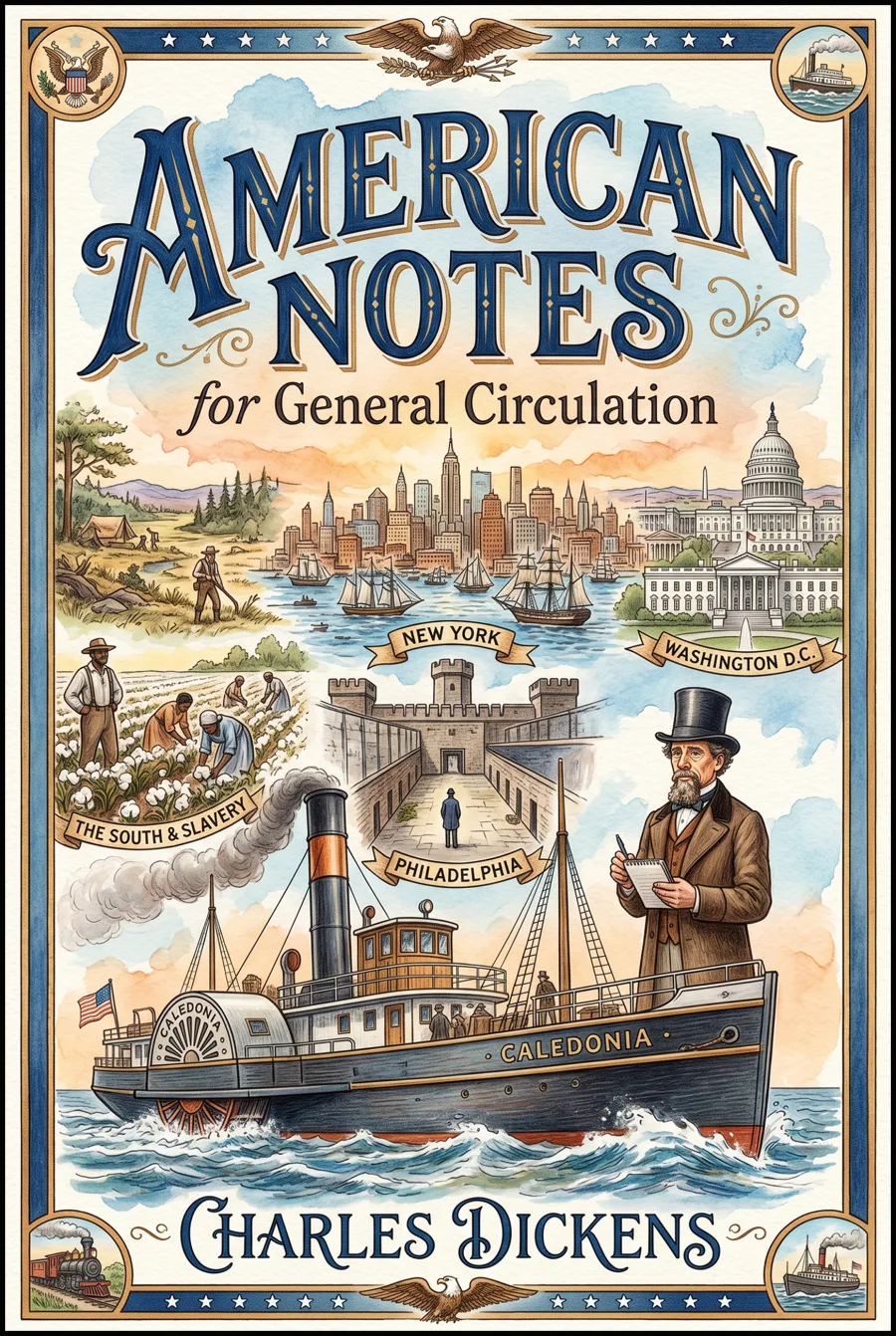
American Notes
eBook
• INR 51.00
• English
• 9788169359047
No ratings yet
| Publisher | General Press |
|---|---|
| ISBN13 | 9788169359047 |
| ASIN/SKU | 816935904X |
| Book Format | eBook |
| Language | English |
| List Price | INR 51.00 |
| Subject Code | TRV010000, HIS036040, LCO009000 |
| Publishing Date | 01/09/2026 |
| Book Code | BD00070209 |
Buy this Book
Amazon Stores
Ebook Stores
Other Stores
Discover American Notes by Charles Dickens. This book is published by General Press in eBook format, ISBN 9788169359047, ASIN 816935904X, under Non Fiction, Travelogues and Travel Essays, United States History.
Book Description
What happens when one of the world's most celebrated novelists crosses the Atlantic expecting to discover a new society, only to find a country filled with contradictions? 'American Notes' by Charles Dickens is a classic travel memoir and social commentary that records Dickens's journey through the United States and Canada while offering sharp observations on American culture, politics, transportation, education, prisons, journalism, and everyday life. Published in 1842, the book combines travel writing, reportage, humor, and criticism in Dickens's distinctive and often outspoken style.
Dickens traveled to America with great curiosity and high expectations, eager to see a nation that had built its identity around democracy and republican ideals. His journey takes him through major cities and regions, where he observes public institutions, landscapes, hotels, railways, steamboats, theaters, newspapers, and social customs. He meets people from different backgrounds and pays close attention to the ways ordinary Americans live, work, communicate, and participate in public life. His experiences gradually challenge some of his assumptions about the country and its celebrated ideals.
One of the strongest themes in 'American Notes' is the gap between principle and practice. Dickens admires aspects of American energy and ambition, yet he is openly critical of practices he considers cruel, hypocritical, or socially damaging. His discussions of prisons, mental institutions, education, slavery, political culture, and the press reveal a writer deeply concerned with human dignity and social responsibility. His descriptions are sometimes humorous and playful, but they can also become severe when he encounters injustice or behavior he finds troubling.
More than a record of places visited, 'American Notes' offers a vivid portrait of America as Dickens experienced it in the nineteenth century. His curiosity, wit, irritation, and compassion make the journey feel personal and immediate. For readers interested in Dickens, American history, travel literature, and nineteenth-century society, this fascinating book offers a memorable glimpse into a young nation through the eyes of an uncompromising observer.
Dickens traveled to America with great curiosity and high expectations, eager to see a nation that had built its identity around democracy and republican ideals. His journey takes him through major cities and regions, where he observes public institutions, landscapes, hotels, railways, steamboats, theaters, newspapers, and social customs. He meets people from different backgrounds and pays close attention to the ways ordinary Americans live, work, communicate, and participate in public life. His experiences gradually challenge some of his assumptions about the country and its celebrated ideals.
One of the strongest themes in 'American Notes' is the gap between principle and practice. Dickens admires aspects of American energy and ambition, yet he is openly critical of practices he considers cruel, hypocritical, or socially damaging. His discussions of prisons, mental institutions, education, slavery, political culture, and the press reveal a writer deeply concerned with human dignity and social responsibility. His descriptions are sometimes humorous and playful, but they can also become severe when he encounters injustice or behavior he finds troubling.
More than a record of places visited, 'American Notes' offers a vivid portrait of America as Dickens experienced it in the nineteenth century. His curiosity, wit, irritation, and compassion make the journey feel personal and immediate. For readers interested in Dickens, American history, travel literature, and nineteenth-century society, this fascinating book offers a memorable glimpse into a young nation through the eyes of an uncompromising observer.
Author Biography
Few writers have captured the struggles, hopes, humor, and contradictions of everyday life as vividly as Charles Dickens. Charles Dickens was a celebrated English novelist and social commentator whose literary work includes classics such as 'Oliver Twist', 'David Copperfield', 'Great Expectations', 'A Christmas Carol', and 'A Tale of Two Cities'. His stories brought memorable characters and powerful social themes to readers around the world, making him one of the most influential writers of the Victorian era.
Born on February 7, 1812, in Portsmouth, England, Dickens experienced financial hardship during his childhood. When his father was sent to a debtors’ prison, young Dickens was forced to work in a London factory, an experience that deeply influenced his later writing. He eventually became a journalist and began publishing stories that quickly attracted public attention. His early success with 'The Pickwick Papers' established him as a popular writer, while novels such as 'Oliver Twist' and 'Nicholas Nickleby' strengthened his reputation.
Dickens was known for his vivid descriptions, sharp humor, emotional storytelling, and unforgettable characters. Beneath the entertainment, however, his novels often exposed poverty, child labor, poor working conditions, harsh schools, and social inequality. 'A Christmas Carol', in particular, became a lasting symbol of generosity and compassion. His writing connected deeply with ordinary readers and helped encourage greater awareness of social problems.
Throughout his career, Dickens also worked as an editor, public speaker, and performer, gaining remarkable fame during his lifetime. He died on June 9, 1870, but his books have never faded from public life. Charles Dickens remains a defining voice of English literature, and his stories continue to entertain, challenge, and move readers more than a century after his death.
Born on February 7, 1812, in Portsmouth, England, Dickens experienced financial hardship during his childhood. When his father was sent to a debtors’ prison, young Dickens was forced to work in a London factory, an experience that deeply influenced his later writing. He eventually became a journalist and began publishing stories that quickly attracted public attention. His early success with 'The Pickwick Papers' established him as a popular writer, while novels such as 'Oliver Twist' and 'Nicholas Nickleby' strengthened his reputation.
Dickens was known for his vivid descriptions, sharp humor, emotional storytelling, and unforgettable characters. Beneath the entertainment, however, his novels often exposed poverty, child labor, poor working conditions, harsh schools, and social inequality. 'A Christmas Carol', in particular, became a lasting symbol of generosity and compassion. His writing connected deeply with ordinary readers and helped encourage greater awareness of social problems.
Throughout his career, Dickens also worked as an editor, public speaker, and performer, gaining remarkable fame during his lifetime. He died on June 9, 1870, but his books have never faded from public life. Charles Dickens remains a defining voice of English literature, and his stories continue to entertain, challenge, and move readers more than a century after his death.
Editorial Reviews
Editorial Reviews will be added soon…
Book Summary
Charles Dickens’s "American Notes for General Circulation", usually known simply as "American Notes", is a fascinating travel book that combines observation, social criticism, humor, political commentary, and personal reflection. Published in 1842 after Dickens’s five-month journey through the United States and Canada, the book records what he saw and experienced during his first visit to North America. Rather than presenting America as an idealized land of freedom and opportunity, Dickens offers a complicated portrait of a young republic. He admires the energy, independence, and democratic spirit he encounters, but he is also deeply disturbed by slavery, prison conditions, poverty, aggressive commercialism, public manners, and what he considers the weaknesses of American journalism and political culture. For readers looking for an 'American Notes' summary, the book is best understood not as a conventional travel diary but as Dickens’s extended attempt to compare American society with British society and to ask what kind of civilization freedom should produce.
Dickens traveled to America in 1842 accompanied by his wife, Catherine, and a small party. He was already one of Britain’s most celebrated writers, famous for works such as 'The Pickwick Papers', 'Oliver Twist', and 'The Old Curiosity Shop'. His visit therefore attracted enormous public attention. Dickens arrived with genuine enthusiasm and high expectations. He was particularly interested in seeing a society that had broken away from aristocratic Europe and had established itself around republican government. He wanted to observe American institutions firsthand and to discover whether the principles of equality and democracy produced a better social order. His journey took him through major cities and regions, including Boston, New York, Philadelphia, Washington, Baltimore, Richmond, Cincinnati, St. Louis, Pittsburgh, and other places, as well as parts of Canada.
The book begins with Dickens’s arrival in Boston, and his first impressions are generally favorable. He sees a prosperous, energetic city whose inhabitants are proud of education, civic responsibility, and public institutions. Boston particularly impresses him because of its schools, libraries, charitable organizations, and intellectual atmosphere. Dickens is interested in the relationship between education and democracy. In his view, a society in which ordinary people participate in political life must also provide opportunities for them to become informed and educated. His admiration for American educational institutions is therefore connected to a broader belief that civilization depends upon the development of the individual.
Dickens pays considerable attention to transportation and communication because these systems reveal the remarkable energy of the growing American nation. Steamboats, railways, canals, and stagecoaches carry people and goods across enormous distances. The scale of the country astonishes him. Britain is geographically compact compared with the United States, and Dickens repeatedly reflects on how American geography shapes American society. Cities are separated by vast distances, yet new technologies are rapidly connecting them. This creates an atmosphere of movement and expansion that becomes one of the defining characteristics of his American experience.
His observations of American hotels, restaurants, inns, and public spaces are often humorous. Dickens notices differences in manners, eating habits, accommodations, and social customs. His descriptions can be affectionate, but they can also be sharply satirical. He frequently compares American habits with British ones and is not reluctant to mock what he regards as excessive informality, loudness, self-confidence, or lack of refinement. These passages reveal both Dickens’s talent as an observer and the limitations of his perspective. He is not a neutral reporter. Everything he sees is filtered through Victorian British expectations about manners, class, privacy, and public behavior.
One of Dickens’s strongest impressions concerns American democracy. He recognizes that the United States has created a political system fundamentally different from Britain's hereditary social structure. He respects the principle that political authority should not belong exclusively to an aristocratic elite. Yet he becomes increasingly critical of the practical behavior he associates with democratic politics. He sees intense partisanship, political campaigning, patronage, and an eagerness to please voters. Dickens is particularly concerned that democratic institutions can become corrupted when politicians focus more on popularity than principle.
His criticism of American political culture is closely connected to his criticism of the American press. Newspapers are everywhere, and Dickens is fascinated by their influence. At the same time, he believes American journalism often sacrifices privacy and fairness for sensationalism. He is particularly disturbed by the aggressive treatment he receives from reporters and the publication of personal information about him. The experience makes him question whether a free press can become intrusive when freedom is not balanced by responsibility. This is one of the most personal elements of 'American Notes', because Dickens’s judgments about American newspapers are shaped by his own difficult experience with them.
Another major theme is American self-confidence. Dickens encounters a culture that frequently presents itself as exceptionally free, democratic, modern, and prosperous. He finds this confidence both impressive and irritating. Americans are proud of their institutions and often eager to tell visitors that their system is superior to Europe's. Dickens admires their independence but dislikes what he perceives as a tendency toward self-congratulation. This tension runs throughout the book. He is attracted to American ideals while remaining skeptical of the way Americans sometimes congratulate themselves for embodying those ideals.
The most serious moral issue in 'American Notes' is slavery. Dickens’s opposition to slavery is unmistakable, and his observations become considerably darker when he encounters the slaveholding South. He is horrified by a society that claims to value liberty while legally treating human beings as property. The contradiction between American ideals and the reality of slavery becomes one of the central arguments of the book. For Dickens, a republic cannot honestly celebrate freedom while denying freedom to millions of people.
Dickens does not treat slavery merely as an economic system. He emphasizes its human consequences. He describes the separation of families, the degradation of enslaved people, and the cruelty that becomes possible when one human being is granted legal ownership over another. His anger is particularly strong because the United States presents itself as a nation founded on liberty and equality. The existence of slavery therefore appears to Dickens not simply as a social injustice but as a profound contradiction at the heart of American democracy.
His treatment of slavery also demonstrates an important characteristic of Dickens’s social writing: he is deeply interested in institutions that transform human suffering into something ordinary. Throughout his career, Dickens criticized systems that allowed people to become invisible behind rules and bureaucratic procedures. In 'American Notes', slavery becomes an extreme example of institutionalized dehumanization. The law itself can become an instrument of cruelty when it recognizes property rights over human dignity.
Dickens is similarly interested in prisons and systems of punishment. His visit to the Eastern State Penitentiary in Philadelphia is one of the most famous sections of the book. The prison operated according to a system of strict isolation in which prisoners were kept apart from one another for long periods. The idea was that solitude would encourage reflection, repentance, and moral reform. Dickens, however, is deeply disturbed by what he sees. He believes that prolonged isolation can damage the human mind rather than heal it.
His prison criticism is particularly significant because Dickens had already shown a lifelong interest in the treatment of society’s vulnerable members. He sees punishment as a moral question rather than merely a legal one. A civilized society, in his view, should not deliberately destroy the psychological health of prisoners. His response to the Philadelphia penitentiary anticipates concerns that would become important in later discussions of solitary confinement and prison reform.
The book also contains Dickens’s observations of hospitals, schools, charitable institutions, and systems designed to help the poor. Some of these institutions impress him, particularly when they demonstrate genuine compassion and practical effectiveness. Others remind him of problems he has already encountered in Britain. Dickens is not simply searching for evidence that America is better or worse than England. Instead, he repeatedly discovers that both countries struggle with the same fundamental question: how should a wealthy society treat people who are poor, sick, imprisoned, orphaned, or otherwise vulnerable?
This comparative dimension gives 'American Notes' much of its lasting value. Dickens uses America as a mirror through which he can examine Britain. When he praises an American institution, his praise often carries an implied criticism of British shortcomings. When he condemns something in America, British readers are encouraged to ask whether their own society has similar problems. The book therefore operates on two levels: it is a record of American travel and an indirect critique of Victorian England.
Dickens is also fascinated by American cities and their rapid growth. New York, in particular, appears energetic and ambitious. He observes crowded streets, commerce, construction, transportation, immigration, and expanding neighborhoods. The city represents the promise of modern urban civilization but also its disorder. Dickens sees enormous economic energy, yet he remains alert to the poverty, noise, congestion, and social inequality that accompany rapid growth.
His descriptions of Canada provide another perspective. Dickens finds aspects of Canadian society calmer and more orderly than some of what he has experienced in the United States. His travels there broaden his understanding of North America and prevent the book from becoming a simple judgment on the United States alone. The Canadian sections also show his continued interest in landscape, transportation, settlement, and the relationship between human communities and the natural environment.
One of the book’s most revealing qualities is Dickens’s writing style. He does not present dry geographical information. Instead, he turns travel into narrative. He notices gestures, conversations, buildings, landscapes, smells, food, advertisements, newspapers, clothing, and social behavior. His descriptions can be funny, sarcastic, indignant, affectionate, or deeply emotional. The result is a book that feels personal rather than academic. Dickens wants readers to see America through his eyes, even when those eyes are opinionated.
At the same time, modern readers should approach 'American Notes' critically. Dickens sometimes makes sweeping generalizations about Americans, and his judgments are shaped by nineteenth-century British cultural assumptions. His observations are valuable historical evidence, but they are not an objective description of the United States. His frustration with the press, his expectations about manners, and his own celebrity all influence what he notices and how he interprets it.
The publication of 'American Notes' generated controversy in both Britain and America. Some Americans objected strongly to Dickens’s criticisms, particularly his discussion of slavery, the press, and American manners. The hostility contributed to a deterioration in Dickens’s relationship with American audiences. His later novel 'Martin Chuzzlewit' would contain an even more satirical treatment of American society, reflecting how strongly the trip had affected him.
Despite the controversy, 'American Notes' remains important because it captures a moment when the United States was rapidly developing into a modern industrial and democratic society. Dickens records railroads, steamboats, expanding cities, political institutions, newspapers, prisons, schools, and commercial culture at a formative stage. His book therefore has considerable historical value in addition to its literary qualities.
Ultimately, 'American Notes' is a book about ideals and contradictions. Dickens arrives in America fascinated by the promise of democracy and liberty. He finds much to admire: educational institutions, public energy, technological progress, civic initiative, and the absence of hereditary aristocratic privilege. Yet he also encounters slavery, social inequality, political opportunism, sensational journalism, harsh punishment, and cultural habits that frustrate him. His central question is whether a society can call itself free and civilized while allowing human beings to suffer within its institutions.
The enduring power of 'American Notes' lies in Dickens’s refusal to accept easy answers. He does not simply praise America or condemn it. He admires its possibilities while exposing its failures. He uses his journey to explore the meaning of freedom, democracy, education, punishment, journalism, compassion, and social responsibility. For readers interested in Charles Dickens, Victorian travel writing, American history, nineteenth-century social criticism, or the development of democratic society, 'American Notes' offers a vivid and sometimes provocative portrait of a nation in transition.
In the end, Dickens’s American journey becomes more than a travel experience. It becomes a moral investigation. He asks what happens when political freedom exists alongside economic inequality, when democratic ideals coexist with slavery, and when technological progress advances faster than social compassion. His answers are sometimes harsh, sometimes unfair, but always engaged. 'American Notes' remains compelling because it reminds us that visiting another country is also an opportunity to examine our own assumptions. Dickens travels across America, but throughout the journey he is also measuring the distance between the ideals a society claims and the way its people actually live.
Dickens traveled to America in 1842 accompanied by his wife, Catherine, and a small party. He was already one of Britain’s most celebrated writers, famous for works such as 'The Pickwick Papers', 'Oliver Twist', and 'The Old Curiosity Shop'. His visit therefore attracted enormous public attention. Dickens arrived with genuine enthusiasm and high expectations. He was particularly interested in seeing a society that had broken away from aristocratic Europe and had established itself around republican government. He wanted to observe American institutions firsthand and to discover whether the principles of equality and democracy produced a better social order. His journey took him through major cities and regions, including Boston, New York, Philadelphia, Washington, Baltimore, Richmond, Cincinnati, St. Louis, Pittsburgh, and other places, as well as parts of Canada.
The book begins with Dickens’s arrival in Boston, and his first impressions are generally favorable. He sees a prosperous, energetic city whose inhabitants are proud of education, civic responsibility, and public institutions. Boston particularly impresses him because of its schools, libraries, charitable organizations, and intellectual atmosphere. Dickens is interested in the relationship between education and democracy. In his view, a society in which ordinary people participate in political life must also provide opportunities for them to become informed and educated. His admiration for American educational institutions is therefore connected to a broader belief that civilization depends upon the development of the individual.
Dickens pays considerable attention to transportation and communication because these systems reveal the remarkable energy of the growing American nation. Steamboats, railways, canals, and stagecoaches carry people and goods across enormous distances. The scale of the country astonishes him. Britain is geographically compact compared with the United States, and Dickens repeatedly reflects on how American geography shapes American society. Cities are separated by vast distances, yet new technologies are rapidly connecting them. This creates an atmosphere of movement and expansion that becomes one of the defining characteristics of his American experience.
His observations of American hotels, restaurants, inns, and public spaces are often humorous. Dickens notices differences in manners, eating habits, accommodations, and social customs. His descriptions can be affectionate, but they can also be sharply satirical. He frequently compares American habits with British ones and is not reluctant to mock what he regards as excessive informality, loudness, self-confidence, or lack of refinement. These passages reveal both Dickens’s talent as an observer and the limitations of his perspective. He is not a neutral reporter. Everything he sees is filtered through Victorian British expectations about manners, class, privacy, and public behavior.
One of Dickens’s strongest impressions concerns American democracy. He recognizes that the United States has created a political system fundamentally different from Britain's hereditary social structure. He respects the principle that political authority should not belong exclusively to an aristocratic elite. Yet he becomes increasingly critical of the practical behavior he associates with democratic politics. He sees intense partisanship, political campaigning, patronage, and an eagerness to please voters. Dickens is particularly concerned that democratic institutions can become corrupted when politicians focus more on popularity than principle.
His criticism of American political culture is closely connected to his criticism of the American press. Newspapers are everywhere, and Dickens is fascinated by their influence. At the same time, he believes American journalism often sacrifices privacy and fairness for sensationalism. He is particularly disturbed by the aggressive treatment he receives from reporters and the publication of personal information about him. The experience makes him question whether a free press can become intrusive when freedom is not balanced by responsibility. This is one of the most personal elements of 'American Notes', because Dickens’s judgments about American newspapers are shaped by his own difficult experience with them.
Another major theme is American self-confidence. Dickens encounters a culture that frequently presents itself as exceptionally free, democratic, modern, and prosperous. He finds this confidence both impressive and irritating. Americans are proud of their institutions and often eager to tell visitors that their system is superior to Europe's. Dickens admires their independence but dislikes what he perceives as a tendency toward self-congratulation. This tension runs throughout the book. He is attracted to American ideals while remaining skeptical of the way Americans sometimes congratulate themselves for embodying those ideals.
The most serious moral issue in 'American Notes' is slavery. Dickens’s opposition to slavery is unmistakable, and his observations become considerably darker when he encounters the slaveholding South. He is horrified by a society that claims to value liberty while legally treating human beings as property. The contradiction between American ideals and the reality of slavery becomes one of the central arguments of the book. For Dickens, a republic cannot honestly celebrate freedom while denying freedom to millions of people.
Dickens does not treat slavery merely as an economic system. He emphasizes its human consequences. He describes the separation of families, the degradation of enslaved people, and the cruelty that becomes possible when one human being is granted legal ownership over another. His anger is particularly strong because the United States presents itself as a nation founded on liberty and equality. The existence of slavery therefore appears to Dickens not simply as a social injustice but as a profound contradiction at the heart of American democracy.
His treatment of slavery also demonstrates an important characteristic of Dickens’s social writing: he is deeply interested in institutions that transform human suffering into something ordinary. Throughout his career, Dickens criticized systems that allowed people to become invisible behind rules and bureaucratic procedures. In 'American Notes', slavery becomes an extreme example of institutionalized dehumanization. The law itself can become an instrument of cruelty when it recognizes property rights over human dignity.
Dickens is similarly interested in prisons and systems of punishment. His visit to the Eastern State Penitentiary in Philadelphia is one of the most famous sections of the book. The prison operated according to a system of strict isolation in which prisoners were kept apart from one another for long periods. The idea was that solitude would encourage reflection, repentance, and moral reform. Dickens, however, is deeply disturbed by what he sees. He believes that prolonged isolation can damage the human mind rather than heal it.
His prison criticism is particularly significant because Dickens had already shown a lifelong interest in the treatment of society’s vulnerable members. He sees punishment as a moral question rather than merely a legal one. A civilized society, in his view, should not deliberately destroy the psychological health of prisoners. His response to the Philadelphia penitentiary anticipates concerns that would become important in later discussions of solitary confinement and prison reform.
The book also contains Dickens’s observations of hospitals, schools, charitable institutions, and systems designed to help the poor. Some of these institutions impress him, particularly when they demonstrate genuine compassion and practical effectiveness. Others remind him of problems he has already encountered in Britain. Dickens is not simply searching for evidence that America is better or worse than England. Instead, he repeatedly discovers that both countries struggle with the same fundamental question: how should a wealthy society treat people who are poor, sick, imprisoned, orphaned, or otherwise vulnerable?
This comparative dimension gives 'American Notes' much of its lasting value. Dickens uses America as a mirror through which he can examine Britain. When he praises an American institution, his praise often carries an implied criticism of British shortcomings. When he condemns something in America, British readers are encouraged to ask whether their own society has similar problems. The book therefore operates on two levels: it is a record of American travel and an indirect critique of Victorian England.
Dickens is also fascinated by American cities and their rapid growth. New York, in particular, appears energetic and ambitious. He observes crowded streets, commerce, construction, transportation, immigration, and expanding neighborhoods. The city represents the promise of modern urban civilization but also its disorder. Dickens sees enormous economic energy, yet he remains alert to the poverty, noise, congestion, and social inequality that accompany rapid growth.
His descriptions of Canada provide another perspective. Dickens finds aspects of Canadian society calmer and more orderly than some of what he has experienced in the United States. His travels there broaden his understanding of North America and prevent the book from becoming a simple judgment on the United States alone. The Canadian sections also show his continued interest in landscape, transportation, settlement, and the relationship between human communities and the natural environment.
One of the book’s most revealing qualities is Dickens’s writing style. He does not present dry geographical information. Instead, he turns travel into narrative. He notices gestures, conversations, buildings, landscapes, smells, food, advertisements, newspapers, clothing, and social behavior. His descriptions can be funny, sarcastic, indignant, affectionate, or deeply emotional. The result is a book that feels personal rather than academic. Dickens wants readers to see America through his eyes, even when those eyes are opinionated.
At the same time, modern readers should approach 'American Notes' critically. Dickens sometimes makes sweeping generalizations about Americans, and his judgments are shaped by nineteenth-century British cultural assumptions. His observations are valuable historical evidence, but they are not an objective description of the United States. His frustration with the press, his expectations about manners, and his own celebrity all influence what he notices and how he interprets it.
The publication of 'American Notes' generated controversy in both Britain and America. Some Americans objected strongly to Dickens’s criticisms, particularly his discussion of slavery, the press, and American manners. The hostility contributed to a deterioration in Dickens’s relationship with American audiences. His later novel 'Martin Chuzzlewit' would contain an even more satirical treatment of American society, reflecting how strongly the trip had affected him.
Despite the controversy, 'American Notes' remains important because it captures a moment when the United States was rapidly developing into a modern industrial and democratic society. Dickens records railroads, steamboats, expanding cities, political institutions, newspapers, prisons, schools, and commercial culture at a formative stage. His book therefore has considerable historical value in addition to its literary qualities.
Ultimately, 'American Notes' is a book about ideals and contradictions. Dickens arrives in America fascinated by the promise of democracy and liberty. He finds much to admire: educational institutions, public energy, technological progress, civic initiative, and the absence of hereditary aristocratic privilege. Yet he also encounters slavery, social inequality, political opportunism, sensational journalism, harsh punishment, and cultural habits that frustrate him. His central question is whether a society can call itself free and civilized while allowing human beings to suffer within its institutions.
The enduring power of 'American Notes' lies in Dickens’s refusal to accept easy answers. He does not simply praise America or condemn it. He admires its possibilities while exposing its failures. He uses his journey to explore the meaning of freedom, democracy, education, punishment, journalism, compassion, and social responsibility. For readers interested in Charles Dickens, Victorian travel writing, American history, nineteenth-century social criticism, or the development of democratic society, 'American Notes' offers a vivid and sometimes provocative portrait of a nation in transition.
In the end, Dickens’s American journey becomes more than a travel experience. It becomes a moral investigation. He asks what happens when political freedom exists alongside economic inequality, when democratic ideals coexist with slavery, and when technological progress advances faster than social compassion. His answers are sometimes harsh, sometimes unfair, but always engaged. 'American Notes' remains compelling because it reminds us that visiting another country is also an opportunity to examine our own assumptions. Dickens travels across America, but throughout the journey he is also measuring the distance between the ideals a society claims and the way its people actually live.
Sample Chapters
Sample Chapters will be added soon…
Reader Reviews
No reviews yet.
American Notes