
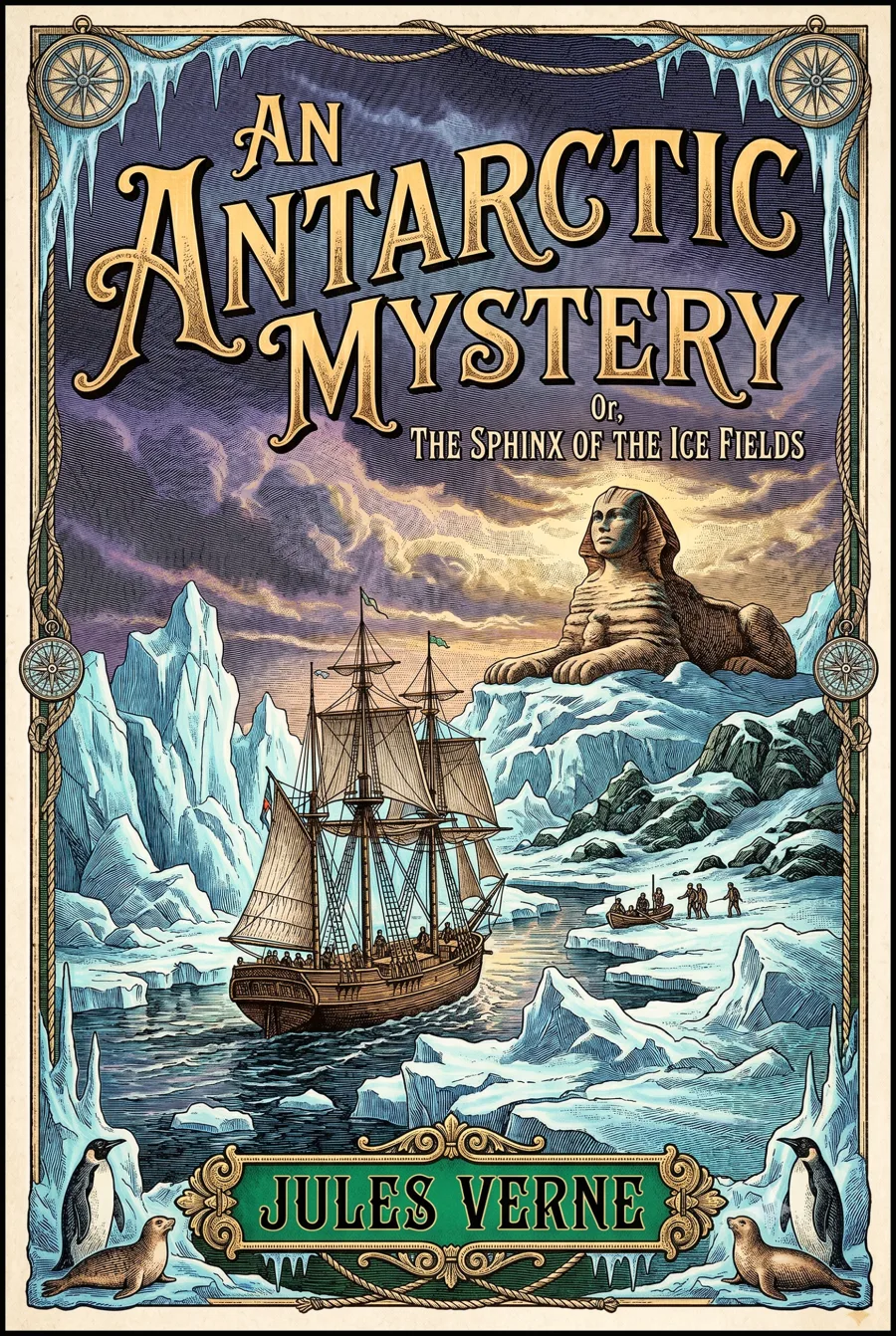
An Antarctic Mystery
eBook
• INR 51.00
• English
• 9788169359061
No ratings yet
| Publisher | General Press |
|---|---|
| ISBN13 | 9788169359061 |
| ASIN/SKU | 8169359066 |
| Book Format | eBook |
| Language | English |
| List Price | INR 51.00 |
| Subject Code | FIC047000, FIC028010, FIC022060 |
| Publishing Date | 01/09/2026 |
| Book Code | BD00070210 |
Buy this Book
Amazon Stores
Ebook Stores
Other Stores
Discover An Antarctic Mystery by Jules Verne. This book is published by General Press in eBook format, ISBN 9788169359061, ASIN 8169359066, under Literature and Fiction, Sea Stories, Science Fiction Adventures.
Book Description
What if a journey to the frozen ends of the Earth uncovered a mystery that had remained hidden for years? 'An Antarctic Mystery' by Jules Verne is a classic adventure and mystery novel that combines polar exploration, suspense, survival, and scientific imagination in one of Verne's most intriguing voyages into the unknown.
The story follows Jeorling, an American traveler who joins Captain Len Guy aboard the schooner Halbrane on an expedition toward the Antarctic. At first, Jeorling sees the voyage as a chance to experience one of the most remote and dangerous regions on Earth. But the journey soon takes on a deeper purpose when Captain Guy reveals his determination to discover what happened to his brother William Guy, whose Antarctic expedition disappeared years earlier.
As the Halbrane travels farther south, the crew faces treacherous seas, enormous icebergs, freezing temperatures, and the constant danger of becoming trapped in the polar wilderness. Yet the harsh environment is only part of their challenge. Strange clues and unexplained circumstances suggest that the missing expedition may have met with a fate very different from what everyone had assumed. Captain Guy's determination grows stronger, drawing Jeorling deeper into the search.
Verne fills the novel with vivid descriptions of the Antarctic landscape while gradually building a sense of mystery and uncertainty. The isolation of the region makes every discovery more significant and every danger more threatening. Alongside the adventure, the book explores courage, loyalty, exploration, and humanity's desire to uncover what lies beyond the boundaries of known experience.
As the expedition moves deeper into the frozen unknown, the answers surrounding the lost crew become increasingly surprising. For readers who enjoy classic adventure, maritime mysteries, and Jules Verne's imaginative storytelling, 'An Antarctic Mystery' offers a fascinating journey where the greatest discovery may be the one no one expected.
The story follows Jeorling, an American traveler who joins Captain Len Guy aboard the schooner Halbrane on an expedition toward the Antarctic. At first, Jeorling sees the voyage as a chance to experience one of the most remote and dangerous regions on Earth. But the journey soon takes on a deeper purpose when Captain Guy reveals his determination to discover what happened to his brother William Guy, whose Antarctic expedition disappeared years earlier.
As the Halbrane travels farther south, the crew faces treacherous seas, enormous icebergs, freezing temperatures, and the constant danger of becoming trapped in the polar wilderness. Yet the harsh environment is only part of their challenge. Strange clues and unexplained circumstances suggest that the missing expedition may have met with a fate very different from what everyone had assumed. Captain Guy's determination grows stronger, drawing Jeorling deeper into the search.
Verne fills the novel with vivid descriptions of the Antarctic landscape while gradually building a sense of mystery and uncertainty. The isolation of the region makes every discovery more significant and every danger more threatening. Alongside the adventure, the book explores courage, loyalty, exploration, and humanity's desire to uncover what lies beyond the boundaries of known experience.
As the expedition moves deeper into the frozen unknown, the answers surrounding the lost crew become increasingly surprising. For readers who enjoy classic adventure, maritime mysteries, and Jules Verne's imaginative storytelling, 'An Antarctic Mystery' offers a fascinating journey where the greatest discovery may be the one no one expected.
Author Biography
Few writers have imagined the future with the confidence and wonder of Jules Verne. Born Jules Gabriel Verne in 1828, he was a French novelist and pioneer of science fiction, best known for adventure classics such as 'Journey to the Center of the Earth', 'Twenty Thousand Leagues Under the Seas', and 'Around the World in Eighty Days'.
Verne was born in Nantes, France, into a family connected to law and maritime life. Although he initially studied law in Paris, his fascination with travel, science, technology, and storytelling gradually drew him toward literature. His early interest in the theater led him to write plays and stories, but his career changed dramatically when he began creating adventurous novels that combined scientific ideas with thrilling journeys.
His most celebrated books became part of the series known as the 'Voyages extraordinaires'. In these works, Verne took readers beneath the oceans, into unexplored lands, across continents, and even into outer space. He blended careful research with imagination, creating stories that felt both exciting and surprisingly believable. His writing often explored new inventions and scientific possibilities, making him an important figure in the development of modern science fiction.
Verne's influence reached far beyond France. His novels inspired generations of readers, scientists, inventors, filmmakers, and other writers. Some of his imaginative ideas, including submarine travel, lunar exploration, and advanced forms of transportation, appeared remarkably ahead of their time. His books have been translated into numerous languages and continue to attract readers around the world.
Jules Verne died in 1905, but his fascination with discovery and the unknown remains as powerful as ever. His ability to turn scientific curiosity into unforgettable adventure secured his place as one of the most influential authors in literary history.
Verne was born in Nantes, France, into a family connected to law and maritime life. Although he initially studied law in Paris, his fascination with travel, science, technology, and storytelling gradually drew him toward literature. His early interest in the theater led him to write plays and stories, but his career changed dramatically when he began creating adventurous novels that combined scientific ideas with thrilling journeys.
His most celebrated books became part of the series known as the 'Voyages extraordinaires'. In these works, Verne took readers beneath the oceans, into unexplored lands, across continents, and even into outer space. He blended careful research with imagination, creating stories that felt both exciting and surprisingly believable. His writing often explored new inventions and scientific possibilities, making him an important figure in the development of modern science fiction.
Verne's influence reached far beyond France. His novels inspired generations of readers, scientists, inventors, filmmakers, and other writers. Some of his imaginative ideas, including submarine travel, lunar exploration, and advanced forms of transportation, appeared remarkably ahead of their time. His books have been translated into numerous languages and continue to attract readers around the world.
Jules Verne died in 1905, but his fascination with discovery and the unknown remains as powerful as ever. His ability to turn scientific curiosity into unforgettable adventure secured his place as one of the most influential authors in literary history.
Editorial Reviews
Editorial Reviews will be added soon…
Book Summary
Jules Verne’s "An Antarctic Mystery", also known as 'The Sphinx of the Ice Fields', is a gripping adventure novel that combines Antarctic exploration, maritime suspense, survival, scientific curiosity, and mystery. Published in 1897, the novel is Verne’s imaginative continuation of Edgar Allan Poe’s unfinished adventure narrative 'The Narrative of Arthur Gordon Pym of Nantucket'. Rather than simply repeating Poe’s strange and unsettling voyage, Verne creates a new expedition that attempts to explain some of the mysteries surrounding Pym’s disappearance. The result is a fascinating late nineteenth-century adventure story in which rational exploration gradually encounters a phenomenon that seems to challenge ordinary scientific understanding.
The story begins with Jeorling, an American traveler and writer who has journeyed to the Falkland Islands. He is planning to return to the United States but is persuaded to join a sealing expedition aboard the schooner 'Halbrane', commanded by Captain Len Guy. Jeorling is not an experienced sailor in the same sense as the captain and crew, but he is curious, observant, and fascinated by the opportunity to travel toward the Antarctic regions. His decision to join the expedition sets the entire mystery in motion. What initially appears to be a commercial voyage soon becomes a dangerous search for lost men and an investigation into one of the strangest mysteries in polar literature.
Captain Len Guy is driven by a deeply personal reason for continuing southward. His brother, William Guy, was the captain of the 'Jane', a vessel that disappeared years earlier during an Antarctic expedition. Although many people believe that the 'Jane' and its crew were lost, Len Guy has never completely accepted that his brother is dead. The possibility that survivors may still exist becomes an obsession for him. When information suggests that the missing ship may have reached the Antarctic waters, he becomes determined to follow the trail. His decision changes the purpose of the 'Halbrane'’s voyage from ordinary sealing to a rescue mission.
Jeorling initially approaches Captain Len Guy’s story with skepticism. He is interested in the mystery but does not immediately accept the possibility that the missing sailors could still be alive. This makes him an effective narrator because he provides a rational perspective. Readers experience the extraordinary events through someone who repeatedly attempts to explain them using ordinary reasoning. His skepticism also creates a contrast with the captain’s emotional certainty and determination.
As the 'Halbrane' sails farther south, the environment becomes increasingly hostile. Ice, cold, storms, dangerous seas, and limited visibility make navigation extremely difficult. Verne’s descriptions of the Antarctic landscape create a strong sense of isolation. The farther the ship travels, the more the crew seems to leave the familiar world behind. The ocean becomes vast and threatening, while the ice creates an unpredictable maze through which the ship must carefully maneuver.
The Antarctic setting is one of the novel’s greatest strengths. Verne was writing at a time when Antarctica remained largely unexplored by Europeans. Much of the continent was still a blank space on maps, and scientific knowledge of its geography and climate was limited. This allowed Verne to transform the Antarctic into an almost mythical environment. The landscape is beautiful but frightening, and the enormous ice formations give the expedition a sense of entering a world governed by unfamiliar rules.
The search for the missing 'Jane' gradually becomes more promising. The explorers discover traces that suggest that the ship may indeed have survived longer than previously believed. These discoveries increase the tension because they transform a seemingly impossible hope into a genuine possibility. Captain Len Guy becomes convinced that his brother and the other members of the expedition may still be somewhere in the Antarctic wilderness.
Eventually, the 'Halbrane' encounters evidence of survivors. The crew finds people connected with the lost expedition, and the mystery surrounding the 'Jane' begins to unfold. Yet rescue does not mean safety. The survivors have endured extraordinary hardship, and the Antarctic environment remains capable of destroying the expedition at any moment. Verne emphasizes that survival in such an environment is not simply a matter of courage. Food, shelter, transportation, weather, health, and navigation are all matters of life and death.
The connection to Edgar Allan Poe’s 'The Narrative of Arthur Gordon Pym of Nantucket' gives the novel an additional layer of mystery. Poe’s original story ends with strange events in the far south, leaving readers with unanswered questions. Verne takes these unresolved elements and attempts to construct a continuation. His novel therefore functions partly as a literary investigation. What happened to Pym? What did he encounter in the Antarctic? Were the strange phenomena described by Poe based on something real within the fictional world? Verne uses these questions as the foundation for his own adventure.
One of the central figures in this connection is Dirk Peters, a survivor from Poe’s story. His presence provides a bridge between the two novels. Peters carries memories of the earlier expedition and helps connect the past with the new Antarctic journey. Through him, Verne transforms Poe’s mysterious ending into the beginning of another investigation.
The novel’s title, 'An Antarctic Mystery', points toward the central question that develops as the expedition advances. The explorers eventually encounter an enormous and extraordinary geographical formation known as the Sphinx of the Ice Fields. This gigantic mass of ice appears so strange and imposing that it becomes almost supernatural in its significance. The sailors struggle to understand its form and behavior, and the phenomenon becomes closely connected with the fate of the missing vessels.
The “Sphinx” is an appropriate metaphor because it represents an unanswered question. Like the ancient Sphinx, the Antarctic formation appears to guard a secret that human beings cannot easily decipher. Verne deliberately creates uncertainty between natural science and the supernatural. Is there a rational explanation for what the explorers observe, or have they encountered something that lies beyond conventional understanding?
The journey also becomes a study of human endurance. The sailors are constantly exposed to cold, exhaustion, danger, and uncertainty. Their physical survival depends on discipline and cooperation. Captain Len Guy’s determination can inspire his crew, but it can also place them in danger because his emotional attachment to his brother encourages him to continue farther into hazardous territory.
Jeorling’s role becomes increasingly important as the expedition develops. He is not merely recording events. He becomes a participant in the struggle for survival. His transformation from detached observer to active adventurer mirrors the transformation of the entire voyage. At the beginning, he expects an unusual journey; by the end, he is confronted with experiences that fundamentally challenge his understanding of the world.
Verne also pays considerable attention to the technical and practical aspects of polar exploration. Navigation, sailing, ice conditions, provisions, equipment, and ship handling are described in detail. These passages reflect Verne’s characteristic interest in technology and scientific knowledge. His characters survive not simply through luck but through observation, planning, and practical skill.
However, the deeper the expedition travels into the Antarctic, the less sufficient ordinary explanations seem to become. The novel gradually shifts from a conventional exploration story toward something more mysterious. Strange physical events begin to dominate the narrative, and the explorers find themselves confronted with a phenomenon that appears impossible.
This transition is one of the most effective aspects of 'An Antarctic Mystery'. Verne begins with familiar adventure conventions: a missing ship, a determined captain, a dangerous voyage, and a rescue mission. He then introduces increasingly extraordinary circumstances. The reader is encouraged to expect a rational explanation, because Verne is famous for grounding his fiction in science. Yet the novel ultimately pushes against the limits of that expectation.
The fate of the 'Jane' is closely tied to this mystery. The lost vessel becomes a symbol of humanity’s vulnerability in extreme environments. A ship represents civilization, technology, and human control over nature. Once it disappears into the Antarctic, however, all of those advantages become fragile. The ocean and ice can overwhelm even the most carefully planned expedition.
The novel also explores the psychological consequences of isolation. Antarctic exploration is not only a physical struggle; it is a mental one. The absence of familiar landscapes, the endless ice, the darkness, and the uncertainty about survival can affect how people perceive reality. Verne uses this atmosphere to make the mysterious events even more disturbing. When characters see something extraordinary, readers must ask whether they are witnessing a genuine phenomenon or something that only appears extraordinary because of their circumstances.
Captain Len Guy’s emotional motivation gives the story much of its human power. His search for his brother is not simply an adventurous quest. It is an expression of loyalty and hope. He refuses to abandon someone he believes may still be alive. This determination can seem reckless, but it also makes him sympathetic. His willingness to risk everything for another person gives the expedition a moral purpose beyond exploration or profit.
The relationship between personal loyalty and scientific curiosity is one of the book’s important themes. Jeorling is initially interested because the expedition offers an extraordinary experience. Len Guy is driven by family. The crew is concerned with survival and duty. These different motivations come together as the voyage becomes increasingly dangerous. The novel suggests that exploration is rarely motivated by one reason alone. Curiosity, ambition, loyalty, pride, and hope can all send people into the unknown.
As the climax approaches, the mysterious Antarctic phenomenon becomes increasingly central. The explorers realize that they are not dealing with an ordinary natural obstacle. The gigantic “Sphinx” seems to possess a strange relationship with the surrounding ice and sea. The final explanation is deliberately extraordinary and gives the novel its distinctive identity. Verne ultimately offers a scientific mechanism involving magnetism and the powerful forces of the Antarctic environment, turning what initially seems supernatural into an imaginative natural phenomenon.
This resolution is important because it reflects Verne’s characteristic approach to mystery. He frequently takes something that appears impossible and attempts to give it a technological or scientific explanation. His fiction lives in the space between known science and speculation. Even when modern science has shown that some of his ideas are inaccurate or impossible, the imaginative process remains fascinating because it demonstrates how nineteenth-century writers imagined the possibilities of science.
For readers searching for an 'An Antarctic Mystery' summary or an explanation of the ending, the final revelation is therefore best understood as Verne’s attempt to rationalize the strange world introduced by Poe. The mystery is not resolved through magic or a conventional supernatural explanation. Instead, Verne constructs an extraordinary natural mechanism that accounts for the terrifying events surrounding the missing expedition.
The ending also gives the story a feeling of closure while preserving the sense of wonder that defines the adventure. The characters have gone into a region where maps, experience, and ordinary expectations are no longer sufficient. They return with knowledge of something extraordinary, but the Antarctic remains larger than human understanding.
One of the most interesting features of 'An Antarctic Mystery' is the way it combines two literary traditions. On one side, it is a classic Jules Verne adventure: scientific, geographical, technical, and driven by exploration. On the other side, it inherits the darker atmosphere of Edgar Allan Poe. Poe’s Antarctic voyage is strange, dreamlike, and disturbing, while Verne tries to give that strangeness a coherent continuation. The result is a novel that feels different from some of Verne’s more optimistic adventure stories.
The book is also valuable as a historical document of nineteenth-century imagination. Antarctica represented one of the final great geographical frontiers of the age. Before modern polar expeditions revealed the continent’s true geography, writers could imagine extraordinary landscapes beneath the ice. Verne uses that uncertainty to create a world in which scientific possibility and adventure can coexist.
Ultimately, 'An Antarctic Mystery' is a story about the human desire to uncover what lies beyond the known world. Captain Len Guy searches for a missing brother; Jeorling searches for understanding; the crew searches for survival; and the reader searches for an explanation of the strange Antarctic mystery. Their different quests eventually become one journey into the unknown.
The novel’s enduring appeal comes from its atmosphere as much as its plot. The lonely seas, enormous ice formations, missing explorers, desperate sailors, and unexplained phenomena create a powerful sense of suspense. Yet beneath the adventure lies a humane story about loyalty and hope. Captain Len Guy refuses to believe that his brother has simply vanished, and that refusal drives the expedition forward even when reason suggests that the search is hopeless.
In conclusion, Jules Verne’s 'An Antarctic Mystery' is an imaginative blend of polar exploration, survival adventure, scientific speculation, and literary mystery. It continues the unfinished world of Edgar Allan Poe’s Antarctic tale while developing Verne’s own fascination with technology, geography, and the limits of human knowledge. The novel asks what happens when explorers enter a place where nature is still largely unknown and where familiar scientific assumptions begin to fail. Its answer is both thrilling and unsettling: the unknown may not be supernatural, but it can be so extraordinary that it appears supernatural to those who encounter it. For readers interested in Jules Verne, classic science fiction, Antarctic exploration fiction, or the connection between Poe and Verne, 'An Antarctic Mystery' offers a memorable journey into one of literature’s most mysterious frontiers.
The story begins with Jeorling, an American traveler and writer who has journeyed to the Falkland Islands. He is planning to return to the United States but is persuaded to join a sealing expedition aboard the schooner 'Halbrane', commanded by Captain Len Guy. Jeorling is not an experienced sailor in the same sense as the captain and crew, but he is curious, observant, and fascinated by the opportunity to travel toward the Antarctic regions. His decision to join the expedition sets the entire mystery in motion. What initially appears to be a commercial voyage soon becomes a dangerous search for lost men and an investigation into one of the strangest mysteries in polar literature.
Captain Len Guy is driven by a deeply personal reason for continuing southward. His brother, William Guy, was the captain of the 'Jane', a vessel that disappeared years earlier during an Antarctic expedition. Although many people believe that the 'Jane' and its crew were lost, Len Guy has never completely accepted that his brother is dead. The possibility that survivors may still exist becomes an obsession for him. When information suggests that the missing ship may have reached the Antarctic waters, he becomes determined to follow the trail. His decision changes the purpose of the 'Halbrane'’s voyage from ordinary sealing to a rescue mission.
Jeorling initially approaches Captain Len Guy’s story with skepticism. He is interested in the mystery but does not immediately accept the possibility that the missing sailors could still be alive. This makes him an effective narrator because he provides a rational perspective. Readers experience the extraordinary events through someone who repeatedly attempts to explain them using ordinary reasoning. His skepticism also creates a contrast with the captain’s emotional certainty and determination.
As the 'Halbrane' sails farther south, the environment becomes increasingly hostile. Ice, cold, storms, dangerous seas, and limited visibility make navigation extremely difficult. Verne’s descriptions of the Antarctic landscape create a strong sense of isolation. The farther the ship travels, the more the crew seems to leave the familiar world behind. The ocean becomes vast and threatening, while the ice creates an unpredictable maze through which the ship must carefully maneuver.
The Antarctic setting is one of the novel’s greatest strengths. Verne was writing at a time when Antarctica remained largely unexplored by Europeans. Much of the continent was still a blank space on maps, and scientific knowledge of its geography and climate was limited. This allowed Verne to transform the Antarctic into an almost mythical environment. The landscape is beautiful but frightening, and the enormous ice formations give the expedition a sense of entering a world governed by unfamiliar rules.
The search for the missing 'Jane' gradually becomes more promising. The explorers discover traces that suggest that the ship may indeed have survived longer than previously believed. These discoveries increase the tension because they transform a seemingly impossible hope into a genuine possibility. Captain Len Guy becomes convinced that his brother and the other members of the expedition may still be somewhere in the Antarctic wilderness.
Eventually, the 'Halbrane' encounters evidence of survivors. The crew finds people connected with the lost expedition, and the mystery surrounding the 'Jane' begins to unfold. Yet rescue does not mean safety. The survivors have endured extraordinary hardship, and the Antarctic environment remains capable of destroying the expedition at any moment. Verne emphasizes that survival in such an environment is not simply a matter of courage. Food, shelter, transportation, weather, health, and navigation are all matters of life and death.
The connection to Edgar Allan Poe’s 'The Narrative of Arthur Gordon Pym of Nantucket' gives the novel an additional layer of mystery. Poe’s original story ends with strange events in the far south, leaving readers with unanswered questions. Verne takes these unresolved elements and attempts to construct a continuation. His novel therefore functions partly as a literary investigation. What happened to Pym? What did he encounter in the Antarctic? Were the strange phenomena described by Poe based on something real within the fictional world? Verne uses these questions as the foundation for his own adventure.
One of the central figures in this connection is Dirk Peters, a survivor from Poe’s story. His presence provides a bridge between the two novels. Peters carries memories of the earlier expedition and helps connect the past with the new Antarctic journey. Through him, Verne transforms Poe’s mysterious ending into the beginning of another investigation.
The novel’s title, 'An Antarctic Mystery', points toward the central question that develops as the expedition advances. The explorers eventually encounter an enormous and extraordinary geographical formation known as the Sphinx of the Ice Fields. This gigantic mass of ice appears so strange and imposing that it becomes almost supernatural in its significance. The sailors struggle to understand its form and behavior, and the phenomenon becomes closely connected with the fate of the missing vessels.
The “Sphinx” is an appropriate metaphor because it represents an unanswered question. Like the ancient Sphinx, the Antarctic formation appears to guard a secret that human beings cannot easily decipher. Verne deliberately creates uncertainty between natural science and the supernatural. Is there a rational explanation for what the explorers observe, or have they encountered something that lies beyond conventional understanding?
The journey also becomes a study of human endurance. The sailors are constantly exposed to cold, exhaustion, danger, and uncertainty. Their physical survival depends on discipline and cooperation. Captain Len Guy’s determination can inspire his crew, but it can also place them in danger because his emotional attachment to his brother encourages him to continue farther into hazardous territory.
Jeorling’s role becomes increasingly important as the expedition develops. He is not merely recording events. He becomes a participant in the struggle for survival. His transformation from detached observer to active adventurer mirrors the transformation of the entire voyage. At the beginning, he expects an unusual journey; by the end, he is confronted with experiences that fundamentally challenge his understanding of the world.
Verne also pays considerable attention to the technical and practical aspects of polar exploration. Navigation, sailing, ice conditions, provisions, equipment, and ship handling are described in detail. These passages reflect Verne’s characteristic interest in technology and scientific knowledge. His characters survive not simply through luck but through observation, planning, and practical skill.
However, the deeper the expedition travels into the Antarctic, the less sufficient ordinary explanations seem to become. The novel gradually shifts from a conventional exploration story toward something more mysterious. Strange physical events begin to dominate the narrative, and the explorers find themselves confronted with a phenomenon that appears impossible.
This transition is one of the most effective aspects of 'An Antarctic Mystery'. Verne begins with familiar adventure conventions: a missing ship, a determined captain, a dangerous voyage, and a rescue mission. He then introduces increasingly extraordinary circumstances. The reader is encouraged to expect a rational explanation, because Verne is famous for grounding his fiction in science. Yet the novel ultimately pushes against the limits of that expectation.
The fate of the 'Jane' is closely tied to this mystery. The lost vessel becomes a symbol of humanity’s vulnerability in extreme environments. A ship represents civilization, technology, and human control over nature. Once it disappears into the Antarctic, however, all of those advantages become fragile. The ocean and ice can overwhelm even the most carefully planned expedition.
The novel also explores the psychological consequences of isolation. Antarctic exploration is not only a physical struggle; it is a mental one. The absence of familiar landscapes, the endless ice, the darkness, and the uncertainty about survival can affect how people perceive reality. Verne uses this atmosphere to make the mysterious events even more disturbing. When characters see something extraordinary, readers must ask whether they are witnessing a genuine phenomenon or something that only appears extraordinary because of their circumstances.
Captain Len Guy’s emotional motivation gives the story much of its human power. His search for his brother is not simply an adventurous quest. It is an expression of loyalty and hope. He refuses to abandon someone he believes may still be alive. This determination can seem reckless, but it also makes him sympathetic. His willingness to risk everything for another person gives the expedition a moral purpose beyond exploration or profit.
The relationship between personal loyalty and scientific curiosity is one of the book’s important themes. Jeorling is initially interested because the expedition offers an extraordinary experience. Len Guy is driven by family. The crew is concerned with survival and duty. These different motivations come together as the voyage becomes increasingly dangerous. The novel suggests that exploration is rarely motivated by one reason alone. Curiosity, ambition, loyalty, pride, and hope can all send people into the unknown.
As the climax approaches, the mysterious Antarctic phenomenon becomes increasingly central. The explorers realize that they are not dealing with an ordinary natural obstacle. The gigantic “Sphinx” seems to possess a strange relationship with the surrounding ice and sea. The final explanation is deliberately extraordinary and gives the novel its distinctive identity. Verne ultimately offers a scientific mechanism involving magnetism and the powerful forces of the Antarctic environment, turning what initially seems supernatural into an imaginative natural phenomenon.
This resolution is important because it reflects Verne’s characteristic approach to mystery. He frequently takes something that appears impossible and attempts to give it a technological or scientific explanation. His fiction lives in the space between known science and speculation. Even when modern science has shown that some of his ideas are inaccurate or impossible, the imaginative process remains fascinating because it demonstrates how nineteenth-century writers imagined the possibilities of science.
For readers searching for an 'An Antarctic Mystery' summary or an explanation of the ending, the final revelation is therefore best understood as Verne’s attempt to rationalize the strange world introduced by Poe. The mystery is not resolved through magic or a conventional supernatural explanation. Instead, Verne constructs an extraordinary natural mechanism that accounts for the terrifying events surrounding the missing expedition.
The ending also gives the story a feeling of closure while preserving the sense of wonder that defines the adventure. The characters have gone into a region where maps, experience, and ordinary expectations are no longer sufficient. They return with knowledge of something extraordinary, but the Antarctic remains larger than human understanding.
One of the most interesting features of 'An Antarctic Mystery' is the way it combines two literary traditions. On one side, it is a classic Jules Verne adventure: scientific, geographical, technical, and driven by exploration. On the other side, it inherits the darker atmosphere of Edgar Allan Poe. Poe’s Antarctic voyage is strange, dreamlike, and disturbing, while Verne tries to give that strangeness a coherent continuation. The result is a novel that feels different from some of Verne’s more optimistic adventure stories.
The book is also valuable as a historical document of nineteenth-century imagination. Antarctica represented one of the final great geographical frontiers of the age. Before modern polar expeditions revealed the continent’s true geography, writers could imagine extraordinary landscapes beneath the ice. Verne uses that uncertainty to create a world in which scientific possibility and adventure can coexist.
Ultimately, 'An Antarctic Mystery' is a story about the human desire to uncover what lies beyond the known world. Captain Len Guy searches for a missing brother; Jeorling searches for understanding; the crew searches for survival; and the reader searches for an explanation of the strange Antarctic mystery. Their different quests eventually become one journey into the unknown.
The novel’s enduring appeal comes from its atmosphere as much as its plot. The lonely seas, enormous ice formations, missing explorers, desperate sailors, and unexplained phenomena create a powerful sense of suspense. Yet beneath the adventure lies a humane story about loyalty and hope. Captain Len Guy refuses to believe that his brother has simply vanished, and that refusal drives the expedition forward even when reason suggests that the search is hopeless.
In conclusion, Jules Verne’s 'An Antarctic Mystery' is an imaginative blend of polar exploration, survival adventure, scientific speculation, and literary mystery. It continues the unfinished world of Edgar Allan Poe’s Antarctic tale while developing Verne’s own fascination with technology, geography, and the limits of human knowledge. The novel asks what happens when explorers enter a place where nature is still largely unknown and where familiar scientific assumptions begin to fail. Its answer is both thrilling and unsettling: the unknown may not be supernatural, but it can be so extraordinary that it appears supernatural to those who encounter it. For readers interested in Jules Verne, classic science fiction, Antarctic exploration fiction, or the connection between Poe and Verne, 'An Antarctic Mystery' offers a memorable journey into one of literature’s most mysterious frontiers.
Sample Chapters
Sample Chapters will be added soon…
Reader Reviews
No reviews yet.
An Antarctic Mystery
Download Cover Image
Do you want to download the full cover image for An Antarctic Mystery?