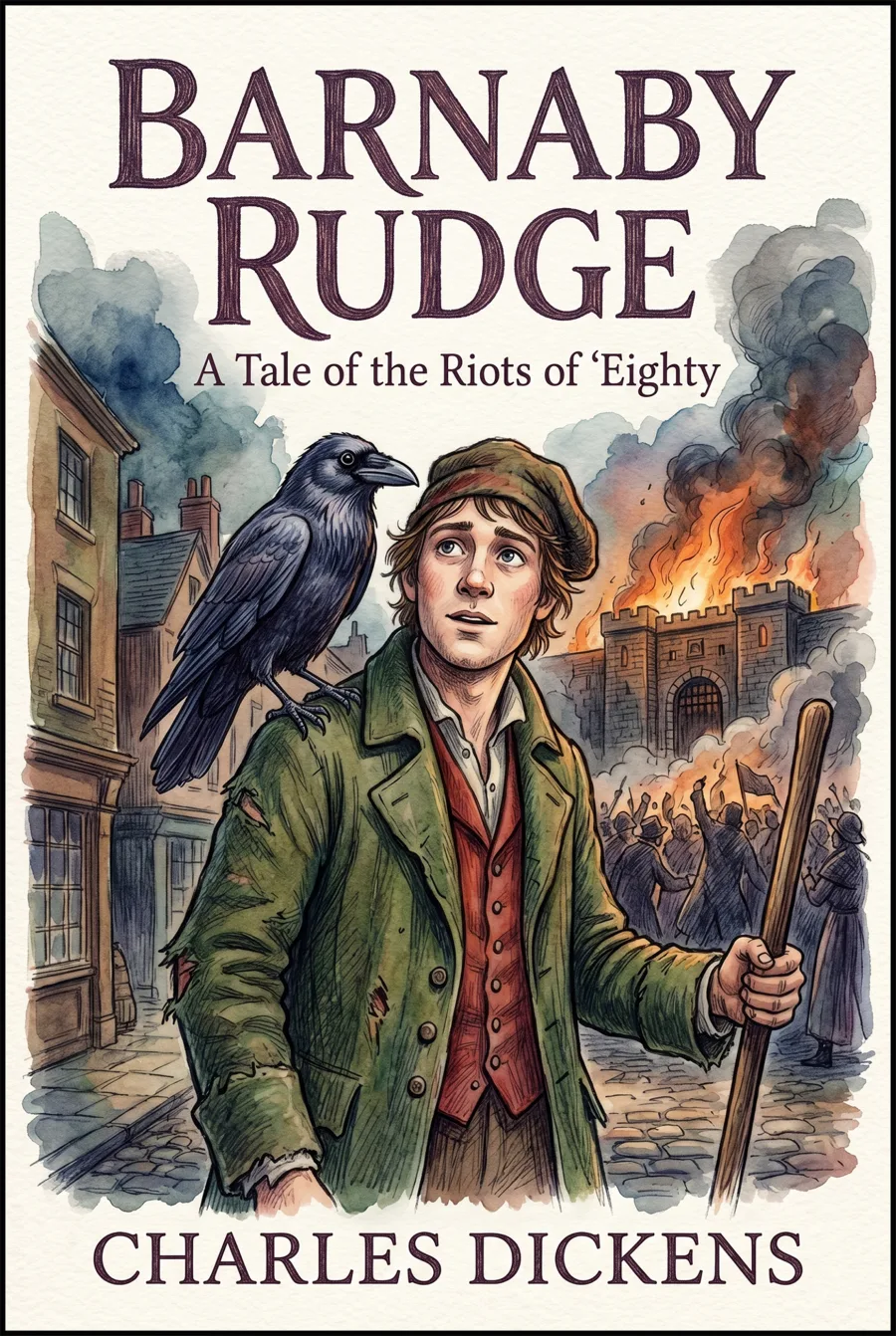
Barnaby Rudge
eBook
• INR 51.00
• English
• 9788169359085
No ratings yet
| Publisher | General Press |
|---|---|
| ISBN13 | 9788169359085 |
| ASIN/SKU | 8169359082 |
| Book Format | eBook |
| Language | English |
| List Price | INR 51.00 |
| Subject Code | FIC014000, FIC022060, FIC043000 |
| Publishing Date | 01/09/2026 |
| Book Code | BD00070211 |
Buy this Book
Amazon Stores
Ebook Stores
Other Stores
Discover Barnaby Rudge by Charles Dickens. This book is published by General Press in eBook format, ISBN 9788169359085, ASIN 8169359082, under Literature and Fiction, Historical Fiction, Historical Mystery.
Book Description
In a city already filled with fear, resentment, and political tension, ordinary lives are about to be swept into the violence of a historic uprising. 'Barnaby Rudge' by Charles Dickens is a classic historical fiction novel that combines mystery, family drama, romance, social conflict, and suspense against the backdrop of the Gordon Riots of 1780.
The story follows a wide range of characters whose lives become unexpectedly connected as unrest spreads through London. At the center is Barnaby Rudge, a simple-minded but kind-hearted young man whose innocence makes him both vulnerable and strangely memorable. Accompanied by his beloved raven, Grip, Barnaby becomes caught up in events far beyond his understanding. His widowed mother, Mary Rudge, carries painful secrets connected to the past, while other families struggle with love, ambition, jealousy, and old grievances.
Alongside these personal stories are the lives of characters such as Gabriel Varden, a respectable locksmith; his spirited daughter Dolly; and the mysterious stranger Hugh, whose rough charm and uncertain loyalties add to the novel's tension. As relationships become increasingly complicated, private conflicts begin to mirror the larger divisions taking place across society.
When the Gordon Riots erupt, the boundaries between personal anger and collective violence begin to disappear. Crowds become mobs, homes and businesses are threatened, and characters who once seemed secure find themselves facing sudden danger. Dickens uses the chaos to explore how fear, prejudice, manipulation, and social frustration can transform ordinary people.
Blending intimate human drama with a vivid historical setting, 'Barnaby Rudge' is both a gripping story and a thoughtful examination of violence and its consequences. As the characters' hidden connections gradually come to light, readers are drawn deeper into a world where almost no life remains untouched by the turmoil.
The story follows a wide range of characters whose lives become unexpectedly connected as unrest spreads through London. At the center is Barnaby Rudge, a simple-minded but kind-hearted young man whose innocence makes him both vulnerable and strangely memorable. Accompanied by his beloved raven, Grip, Barnaby becomes caught up in events far beyond his understanding. His widowed mother, Mary Rudge, carries painful secrets connected to the past, while other families struggle with love, ambition, jealousy, and old grievances.
Alongside these personal stories are the lives of characters such as Gabriel Varden, a respectable locksmith; his spirited daughter Dolly; and the mysterious stranger Hugh, whose rough charm and uncertain loyalties add to the novel's tension. As relationships become increasingly complicated, private conflicts begin to mirror the larger divisions taking place across society.
When the Gordon Riots erupt, the boundaries between personal anger and collective violence begin to disappear. Crowds become mobs, homes and businesses are threatened, and characters who once seemed secure find themselves facing sudden danger. Dickens uses the chaos to explore how fear, prejudice, manipulation, and social frustration can transform ordinary people.
Blending intimate human drama with a vivid historical setting, 'Barnaby Rudge' is both a gripping story and a thoughtful examination of violence and its consequences. As the characters' hidden connections gradually come to light, readers are drawn deeper into a world where almost no life remains untouched by the turmoil.
Author Biography
Few writers have captured the struggles, hopes, humor, and contradictions of everyday life as vividly as Charles Dickens. Charles Dickens was a celebrated English novelist and social commentator whose literary work includes classics such as 'Oliver Twist', 'David Copperfield', 'Great Expectations', 'A Christmas Carol', and 'A Tale of Two Cities'. His stories brought memorable characters and powerful social themes to readers around the world, making him one of the most influential writers of the Victorian era.
Born on February 7, 1812, in Portsmouth, England, Dickens experienced financial hardship during his childhood. When his father was sent to a debtors’ prison, young Dickens was forced to work in a London factory, an experience that deeply influenced his later writing. He eventually became a journalist and began publishing stories that quickly attracted public attention. His early success with 'The Pickwick Papers' established him as a popular writer, while novels such as 'Oliver Twist' and 'Nicholas Nickleby' strengthened his reputation.
Dickens was known for his vivid descriptions, sharp humor, emotional storytelling, and unforgettable characters. Beneath the entertainment, however, his novels often exposed poverty, child labor, poor working conditions, harsh schools, and social inequality. 'A Christmas Carol', in particular, became a lasting symbol of generosity and compassion. His writing connected deeply with ordinary readers and helped encourage greater awareness of social problems.
Throughout his career, Dickens also worked as an editor, public speaker, and performer, gaining remarkable fame during his lifetime. He died on June 9, 1870, but his books have never faded from public life. Charles Dickens remains a defining voice of English literature, and his stories continue to entertain, challenge, and move readers more than a century after his death.
Born on February 7, 1812, in Portsmouth, England, Dickens experienced financial hardship during his childhood. When his father was sent to a debtors’ prison, young Dickens was forced to work in a London factory, an experience that deeply influenced his later writing. He eventually became a journalist and began publishing stories that quickly attracted public attention. His early success with 'The Pickwick Papers' established him as a popular writer, while novels such as 'Oliver Twist' and 'Nicholas Nickleby' strengthened his reputation.
Dickens was known for his vivid descriptions, sharp humor, emotional storytelling, and unforgettable characters. Beneath the entertainment, however, his novels often exposed poverty, child labor, poor working conditions, harsh schools, and social inequality. 'A Christmas Carol', in particular, became a lasting symbol of generosity and compassion. His writing connected deeply with ordinary readers and helped encourage greater awareness of social problems.
Throughout his career, Dickens also worked as an editor, public speaker, and performer, gaining remarkable fame during his lifetime. He died on June 9, 1870, but his books have never faded from public life. Charles Dickens remains a defining voice of English literature, and his stories continue to entertain, challenge, and move readers more than a century after his death.
Editorial Reviews
Editorial Reviews will be added soon…
Book Summary
Charles Dickens’s "Barnaby Rudge" is a powerful historical novel that combines mystery, family drama, romance, crime, social unrest, and political violence. Published in 1841, it was one of Dickens’s earliest historical novels and one of only two novels he contributed to the short-lived weekly publication 'Master Humphrey’s Clock'. Set primarily in London during the Gordon Riots of 1780, 'Barnaby Rudge' explores how private resentments and personal conflicts can become entangled with public anger until an entire society is swept into chaos. For readers looking for a 'Barnaby Rudge' summary, the novel is much more than the story of its eccentric title character. It is a carefully constructed narrative about secrets, guilt, prejudice, mob psychology, family loyalty, love, and the terrifying ease with which ordinary people can become participants in collective violence.
The novel opens in a remote and mysterious atmosphere at the Maypole Inn, an old country tavern near Chigwell. The inn is run by John Willet, a sturdy, conservative man who takes great pride in his establishment and strongly believes that his opinions are correct. John’s son, Joe Willet, is very different. Young, impatient, and eager to make his own way in the world, Joe frequently clashes with his father. Their arguments reveal one of Dickens’s recurring themes: the conflict between generations and between rigid authority and youthful independence.
The story soon introduces Geoffrey Haredale, a wealthy landowner and Catholic whose family has a long history of conflict with another prominent family. Haredale is honorable and passionate but also deeply affected by the violence and injustice surrounding him. His brother, Reuben Haredale, was murdered years earlier, and the crime remains one of the novel’s central mysteries. The unresolved murder creates an atmosphere of suspicion that hangs over several characters and relationships.
Haredale’s niece, Emma Haredale, is one of the novel’s central female characters. She is intelligent, attractive, and emotionally strong, and she becomes involved in a complicated romantic relationship with Edward Chester. Edward is the son of Sir John Chester, a sophisticated and manipulative gentleman who represents another kind of danger in the novel. Edward genuinely loves Emma, but his father strongly opposes the relationship because of his hostility toward Geoffrey Haredale. The conflict between the two families therefore becomes a major obstacle to the lovers.
Alongside these characters appears the mysterious Barnaby Rudge, the title character. Barnaby is a young man with an intellectual disability, characterized by Dickens as innocent, impulsive, and easily influenced. He is often accompanied by his pet raven, Grip, which has become one of the most memorable animals in Dickens’s fiction. Barnaby’s simplicity contrasts sharply with the complexity and deceit of the adults around him. He tends to respond emotionally rather than strategically, making him vulnerable in a world where people frequently manipulate one another for political, personal, or financial reasons.
Barnaby lives with his devoted mother, Mary Rudge. Their relationship is one of the most touching parts of the novel. Mary is fiercely protective of her son, and her life is shaped by an important secret involving Barnaby’s father and the murder mystery surrounding the Haredale family. Dickens gradually reveals that Barnaby’s family history is connected to the central crime, making the personal and historical elements of the story increasingly intertwined.
The early sections of the novel are deliberately mysterious. Dickens introduces a large cast of characters whose lives appear separate but gradually begin to intersect. The Maypole Inn, the Haredale family, the Chester family, Barnaby and his mother, the locksmith Gabriel Varden, and several other figures all become part of the same narrative web. This structure allows Dickens to create suspense because the reader understands that seemingly unrelated events will eventually prove connected.
Gabriel Varden is another important character. He is a respectable locksmith, a practical man, and a figure of moral stability. His daughter Dolly Varden is lively, beautiful, flirtatious, and independent-minded. Dolly attracts considerable attention from several men, including Joe Willet and Hugh. Her presence introduces a lighter romantic and comic element into a novel otherwise filled with secrets and violence.
The locksmith’s family also becomes connected to a group of socially disruptive characters. Among them is Dennis, the hangman, whose occupation and personality contribute to Dickens’s dark exploration of crime and punishment. There is also Hugh, a rough, energetic, and unpredictable young man associated with the Maypole. Hugh is physically powerful but morally unstable, and his actions become increasingly important as the novel progresses.
The novel’s first major mystery concerns the murder of Reuben Haredale. Dickens does not immediately reveal the killer or the full circumstances of the crime. Instead, he allows suspicion to move from one character to another. The uncertainty creates an atmosphere in which the past seems constantly capable of returning to disturb the present. Secrets that characters have attempted to bury continue to influence their lives.
At the same time, the romantic story becomes increasingly complicated. Edward Chester loves Emma Haredale, but Sir John Chester manipulates his son and attempts to prevent the marriage. Sir John is one of Dickens’s most polished villains. Unlike openly brutal characters, he uses manners, sophistication, and social status as weapons. He can appear reasonable while acting selfishly and cruelly. Through him, Dickens demonstrates that evil does not always look violent or uncivilized. Sometimes it wears fashionable clothes and speaks politely.
The personal conflicts of the characters gradually become overshadowed by a much larger historical crisis. Religious and political tensions in London begin to intensify. The Gordon Riots of 1780 were real historical events in which anti-Catholic agitation developed into widespread violence, destruction, looting, and attacks on institutions and individuals. Dickens uses these events as the historical framework for the second half of the novel.
The transition from private drama to public disorder is one of the book’s most important structural achievements. At first, characters are primarily concerned with family arguments, romantic relationships, money, revenge, and personal secrets. As political agitation grows, however, individual grievances become connected with the anger of the crowd. Dickens shows how quickly public frustration can become destructive when fear, prejudice, rumor, and manipulation combine.
The anti-Catholic movement gives Dickens an opportunity to examine religious prejudice. Geoffrey Haredale, as a Catholic landowner, becomes vulnerable because his religious identity places him in opposition to the beliefs of the rioters. The novel makes clear that political and religious slogans can be used to justify violence against individuals who have done nothing to deserve it. Dickens is less interested in the technical political arguments behind the riots than in their human consequences.
Barnaby becomes especially vulnerable during this period. His innocence, impulsiveness, and desire for excitement make him easy to manipulate. The mob offers him a sense of belonging and adventure, but he does not fully understand the consequences of the violence around him. Dickens uses Barnaby to show how easily vulnerable individuals can become caught up in collective movements. He is not motivated by sophisticated political ideology. He is drawn into the crowd because he is impressionable and fascinated by the excitement.
The famous raven Grip contributes to Barnaby’s distinctive identity. Grip is intelligent, mischievous, and strangely charismatic. Dickens gives the bird an almost theatrical presence, and its repeated cries add an eerie quality to the narrative. Grip also became famous outside the novel and is sometimes regarded as one of Dickens’s most memorable animal creations.
As the Gordon Riots erupt, the peaceful world of the earlier chapters is transformed. London becomes a landscape of fire, destruction, crowds, fear, and uncertainty. Buildings are attacked, prisons are threatened, and private homes become targets. Dickens’s descriptions of the riots are among the most powerful sections of the novel because they capture the psychological transformation of a crowd.
The mob in 'Barnaby Rudge' is not portrayed as a collection of individual personalities. It becomes something larger and more frightening. People who might behave reasonably on their own can become reckless when surrounded by thousands of others. Anger becomes contagious. Rumors become facts. Violence creates more violence. Dickens understands that collective behavior can strip individuals of their sense of responsibility.
One of the most important themes in 'Barnaby Rudge' is therefore mob psychology. Dickens shows that political violence is not produced solely by ideology. It can also emerge from excitement, alcohol, resentment, fear, opportunism, and the desire to belong. Once the crowd begins destroying property and attacking people, individuals can participate in acts they might never commit alone.
The riots also reveal the weakness of social institutions under pressure. Authorities struggle to control the situation, while prisons, homes, businesses, and public buildings become vulnerable. Dickens emphasizes how quickly the appearance of social order can disappear. Civilization depends upon people agreeing to follow certain rules; when those rules collapse, violence can spread with astonishing speed.
Barnaby’s involvement becomes increasingly dangerous. He is eventually captured and placed in serious danger, forcing the people who care about him to confront the consequences of the political turmoil. His mother’s love becomes particularly important. Mary Rudge represents unconditional loyalty in contrast to the selfishness and manipulation displayed by many other characters.
The mystery surrounding Barnaby’s father and the old Haredale murder is eventually brought to light. Dickens reveals the connections among the characters and explains the secrets that have driven so much of the earlier narrative. The revelation gives emotional meaning to events that initially seemed disconnected. The murder mystery is therefore not merely a puzzle; it represents the destructive power of hidden guilt and unresolved violence.
The romantic plots also reach their conclusions. Edward and Emma must overcome the opposition created by their families, while Dolly Varden’s relationships develop toward their own resolutions. Joe Willet, meanwhile, experiences hardship and personal growth. His early conflict with his father is transformed by his experiences, and their relationship eventually demonstrates the possibility of reconciliation.
The character of Hugh also receives a significant resolution. His actions during the riots expose the consequences of allowing resentment and aggression to control one’s behavior. Dickens does not reduce his characters to simple heroes and villains. Many are shaped by circumstances, weaknesses, and choices. Yet the novel ultimately distinguishes between people who accept responsibility for their actions and those who use social disorder as an excuse for cruelty.
Barnaby himself becomes a symbol of innocence caught in a violent world. His vulnerability makes his experiences particularly painful. He does not fully understand the political issues surrounding him, yet he suffers because powerful people and crowds use him for their own purposes. Dickens’s treatment of Barnaby also invites readers to think about how society treats people who are different or unable to protect themselves.
The ending brings the major mysteries and relationships toward resolution. The immediate violence of the Gordon Riots eventually subsides, and society begins the difficult process of restoring order. Yet Dickens does not suggest that everything can simply return to the way it was. Violence leaves consequences. People have been injured, relationships have changed, and hidden truths have been exposed. The restoration of peace is therefore accompanied by moral reckoning.
For readers searching for the meaning of 'Barnaby Rudge', the novel’s central message is closely connected to the danger of uncontrolled collective anger. Dickens shows that society becomes vulnerable when prejudice and resentment are encouraged rather than challenged. The Gordon Riots provide the historical example, but the warning is broader. Any community can become destructive when people stop thinking independently and begin allowing fear, rumor, or hatred to determine their actions.
The novel also examines the contrast between innocence and manipulation. Barnaby is innocent, but others understand how to exploit his innocence. Edward and Emma are sincere in their love, but their relationship is manipulated by family pride. John Willet believes strongly in his authority, but his stubbornness damages his relationship with his son. Sir John Chester uses sophistication to manipulate those around him. Again and again, Dickens shows how people can become trapped by pride, secrecy, prejudice, or ambition.
One of the reasons 'Barnaby Rudge' remains significant is its combination of historical fiction and psychological drama. Dickens uses a real historical event as the setting, but he fills that setting with fictional characters whose private lives allow readers to experience the wider crisis on an intimate scale. The riots are not merely something happening in the background. They enter homes, destroy relationships, threaten families, and transform ordinary people.
The novel also demonstrates Dickens’s characteristic concern with social responsibility. Institutions matter, but individuals matter too. A society is shaped by the choices people make when confronted with injustice, temptation, fear, or violence. The book repeatedly asks whether people will protect one another or exploit moments of weakness.
In conclusion, 'Barnaby Rudge' is a richly layered historical novel about mystery, love, family conflict, prejudice, political unrest, and mob violence. Its title character represents innocence caught in forces he cannot fully understand, while the surrounding characters demonstrate the many ways people respond to power, fear, and social pressure. Through the Gordon Riots, Dickens creates a dramatic warning about what happens when prejudice and collective anger overwhelm reason and compassion.
For anyone looking for an in-depth 'Barnaby Rudge' summary, the novel’s lasting importance lies in the way its private and public stories reinforce one another. The secrets of individual families mirror the hidden tensions of society; personal resentment grows into political hatred; and a crowd of ordinary people becomes capable of extraordinary destruction. Yet Dickens also leaves room for loyalty, love, forgiveness, and renewal. Beneath its dark historical setting, 'Barnaby Rudge' ultimately argues that human beings are responsible for preserving their humanity even when the world around them descends into chaos.
The novel opens in a remote and mysterious atmosphere at the Maypole Inn, an old country tavern near Chigwell. The inn is run by John Willet, a sturdy, conservative man who takes great pride in his establishment and strongly believes that his opinions are correct. John’s son, Joe Willet, is very different. Young, impatient, and eager to make his own way in the world, Joe frequently clashes with his father. Their arguments reveal one of Dickens’s recurring themes: the conflict between generations and between rigid authority and youthful independence.
The story soon introduces Geoffrey Haredale, a wealthy landowner and Catholic whose family has a long history of conflict with another prominent family. Haredale is honorable and passionate but also deeply affected by the violence and injustice surrounding him. His brother, Reuben Haredale, was murdered years earlier, and the crime remains one of the novel’s central mysteries. The unresolved murder creates an atmosphere of suspicion that hangs over several characters and relationships.
Haredale’s niece, Emma Haredale, is one of the novel’s central female characters. She is intelligent, attractive, and emotionally strong, and she becomes involved in a complicated romantic relationship with Edward Chester. Edward is the son of Sir John Chester, a sophisticated and manipulative gentleman who represents another kind of danger in the novel. Edward genuinely loves Emma, but his father strongly opposes the relationship because of his hostility toward Geoffrey Haredale. The conflict between the two families therefore becomes a major obstacle to the lovers.
Alongside these characters appears the mysterious Barnaby Rudge, the title character. Barnaby is a young man with an intellectual disability, characterized by Dickens as innocent, impulsive, and easily influenced. He is often accompanied by his pet raven, Grip, which has become one of the most memorable animals in Dickens’s fiction. Barnaby’s simplicity contrasts sharply with the complexity and deceit of the adults around him. He tends to respond emotionally rather than strategically, making him vulnerable in a world where people frequently manipulate one another for political, personal, or financial reasons.
Barnaby lives with his devoted mother, Mary Rudge. Their relationship is one of the most touching parts of the novel. Mary is fiercely protective of her son, and her life is shaped by an important secret involving Barnaby’s father and the murder mystery surrounding the Haredale family. Dickens gradually reveals that Barnaby’s family history is connected to the central crime, making the personal and historical elements of the story increasingly intertwined.
The early sections of the novel are deliberately mysterious. Dickens introduces a large cast of characters whose lives appear separate but gradually begin to intersect. The Maypole Inn, the Haredale family, the Chester family, Barnaby and his mother, the locksmith Gabriel Varden, and several other figures all become part of the same narrative web. This structure allows Dickens to create suspense because the reader understands that seemingly unrelated events will eventually prove connected.
Gabriel Varden is another important character. He is a respectable locksmith, a practical man, and a figure of moral stability. His daughter Dolly Varden is lively, beautiful, flirtatious, and independent-minded. Dolly attracts considerable attention from several men, including Joe Willet and Hugh. Her presence introduces a lighter romantic and comic element into a novel otherwise filled with secrets and violence.
The locksmith’s family also becomes connected to a group of socially disruptive characters. Among them is Dennis, the hangman, whose occupation and personality contribute to Dickens’s dark exploration of crime and punishment. There is also Hugh, a rough, energetic, and unpredictable young man associated with the Maypole. Hugh is physically powerful but morally unstable, and his actions become increasingly important as the novel progresses.
The novel’s first major mystery concerns the murder of Reuben Haredale. Dickens does not immediately reveal the killer or the full circumstances of the crime. Instead, he allows suspicion to move from one character to another. The uncertainty creates an atmosphere in which the past seems constantly capable of returning to disturb the present. Secrets that characters have attempted to bury continue to influence their lives.
At the same time, the romantic story becomes increasingly complicated. Edward Chester loves Emma Haredale, but Sir John Chester manipulates his son and attempts to prevent the marriage. Sir John is one of Dickens’s most polished villains. Unlike openly brutal characters, he uses manners, sophistication, and social status as weapons. He can appear reasonable while acting selfishly and cruelly. Through him, Dickens demonstrates that evil does not always look violent or uncivilized. Sometimes it wears fashionable clothes and speaks politely.
The personal conflicts of the characters gradually become overshadowed by a much larger historical crisis. Religious and political tensions in London begin to intensify. The Gordon Riots of 1780 were real historical events in which anti-Catholic agitation developed into widespread violence, destruction, looting, and attacks on institutions and individuals. Dickens uses these events as the historical framework for the second half of the novel.
The transition from private drama to public disorder is one of the book’s most important structural achievements. At first, characters are primarily concerned with family arguments, romantic relationships, money, revenge, and personal secrets. As political agitation grows, however, individual grievances become connected with the anger of the crowd. Dickens shows how quickly public frustration can become destructive when fear, prejudice, rumor, and manipulation combine.
The anti-Catholic movement gives Dickens an opportunity to examine religious prejudice. Geoffrey Haredale, as a Catholic landowner, becomes vulnerable because his religious identity places him in opposition to the beliefs of the rioters. The novel makes clear that political and religious slogans can be used to justify violence against individuals who have done nothing to deserve it. Dickens is less interested in the technical political arguments behind the riots than in their human consequences.
Barnaby becomes especially vulnerable during this period. His innocence, impulsiveness, and desire for excitement make him easy to manipulate. The mob offers him a sense of belonging and adventure, but he does not fully understand the consequences of the violence around him. Dickens uses Barnaby to show how easily vulnerable individuals can become caught up in collective movements. He is not motivated by sophisticated political ideology. He is drawn into the crowd because he is impressionable and fascinated by the excitement.
The famous raven Grip contributes to Barnaby’s distinctive identity. Grip is intelligent, mischievous, and strangely charismatic. Dickens gives the bird an almost theatrical presence, and its repeated cries add an eerie quality to the narrative. Grip also became famous outside the novel and is sometimes regarded as one of Dickens’s most memorable animal creations.
As the Gordon Riots erupt, the peaceful world of the earlier chapters is transformed. London becomes a landscape of fire, destruction, crowds, fear, and uncertainty. Buildings are attacked, prisons are threatened, and private homes become targets. Dickens’s descriptions of the riots are among the most powerful sections of the novel because they capture the psychological transformation of a crowd.
The mob in 'Barnaby Rudge' is not portrayed as a collection of individual personalities. It becomes something larger and more frightening. People who might behave reasonably on their own can become reckless when surrounded by thousands of others. Anger becomes contagious. Rumors become facts. Violence creates more violence. Dickens understands that collective behavior can strip individuals of their sense of responsibility.
One of the most important themes in 'Barnaby Rudge' is therefore mob psychology. Dickens shows that political violence is not produced solely by ideology. It can also emerge from excitement, alcohol, resentment, fear, opportunism, and the desire to belong. Once the crowd begins destroying property and attacking people, individuals can participate in acts they might never commit alone.
The riots also reveal the weakness of social institutions under pressure. Authorities struggle to control the situation, while prisons, homes, businesses, and public buildings become vulnerable. Dickens emphasizes how quickly the appearance of social order can disappear. Civilization depends upon people agreeing to follow certain rules; when those rules collapse, violence can spread with astonishing speed.
Barnaby’s involvement becomes increasingly dangerous. He is eventually captured and placed in serious danger, forcing the people who care about him to confront the consequences of the political turmoil. His mother’s love becomes particularly important. Mary Rudge represents unconditional loyalty in contrast to the selfishness and manipulation displayed by many other characters.
The mystery surrounding Barnaby’s father and the old Haredale murder is eventually brought to light. Dickens reveals the connections among the characters and explains the secrets that have driven so much of the earlier narrative. The revelation gives emotional meaning to events that initially seemed disconnected. The murder mystery is therefore not merely a puzzle; it represents the destructive power of hidden guilt and unresolved violence.
The romantic plots also reach their conclusions. Edward and Emma must overcome the opposition created by their families, while Dolly Varden’s relationships develop toward their own resolutions. Joe Willet, meanwhile, experiences hardship and personal growth. His early conflict with his father is transformed by his experiences, and their relationship eventually demonstrates the possibility of reconciliation.
The character of Hugh also receives a significant resolution. His actions during the riots expose the consequences of allowing resentment and aggression to control one’s behavior. Dickens does not reduce his characters to simple heroes and villains. Many are shaped by circumstances, weaknesses, and choices. Yet the novel ultimately distinguishes between people who accept responsibility for their actions and those who use social disorder as an excuse for cruelty.
Barnaby himself becomes a symbol of innocence caught in a violent world. His vulnerability makes his experiences particularly painful. He does not fully understand the political issues surrounding him, yet he suffers because powerful people and crowds use him for their own purposes. Dickens’s treatment of Barnaby also invites readers to think about how society treats people who are different or unable to protect themselves.
The ending brings the major mysteries and relationships toward resolution. The immediate violence of the Gordon Riots eventually subsides, and society begins the difficult process of restoring order. Yet Dickens does not suggest that everything can simply return to the way it was. Violence leaves consequences. People have been injured, relationships have changed, and hidden truths have been exposed. The restoration of peace is therefore accompanied by moral reckoning.
For readers searching for the meaning of 'Barnaby Rudge', the novel’s central message is closely connected to the danger of uncontrolled collective anger. Dickens shows that society becomes vulnerable when prejudice and resentment are encouraged rather than challenged. The Gordon Riots provide the historical example, but the warning is broader. Any community can become destructive when people stop thinking independently and begin allowing fear, rumor, or hatred to determine their actions.
The novel also examines the contrast between innocence and manipulation. Barnaby is innocent, but others understand how to exploit his innocence. Edward and Emma are sincere in their love, but their relationship is manipulated by family pride. John Willet believes strongly in his authority, but his stubbornness damages his relationship with his son. Sir John Chester uses sophistication to manipulate those around him. Again and again, Dickens shows how people can become trapped by pride, secrecy, prejudice, or ambition.
One of the reasons 'Barnaby Rudge' remains significant is its combination of historical fiction and psychological drama. Dickens uses a real historical event as the setting, but he fills that setting with fictional characters whose private lives allow readers to experience the wider crisis on an intimate scale. The riots are not merely something happening in the background. They enter homes, destroy relationships, threaten families, and transform ordinary people.
The novel also demonstrates Dickens’s characteristic concern with social responsibility. Institutions matter, but individuals matter too. A society is shaped by the choices people make when confronted with injustice, temptation, fear, or violence. The book repeatedly asks whether people will protect one another or exploit moments of weakness.
In conclusion, 'Barnaby Rudge' is a richly layered historical novel about mystery, love, family conflict, prejudice, political unrest, and mob violence. Its title character represents innocence caught in forces he cannot fully understand, while the surrounding characters demonstrate the many ways people respond to power, fear, and social pressure. Through the Gordon Riots, Dickens creates a dramatic warning about what happens when prejudice and collective anger overwhelm reason and compassion.
For anyone looking for an in-depth 'Barnaby Rudge' summary, the novel’s lasting importance lies in the way its private and public stories reinforce one another. The secrets of individual families mirror the hidden tensions of society; personal resentment grows into political hatred; and a crowd of ordinary people becomes capable of extraordinary destruction. Yet Dickens also leaves room for loyalty, love, forgiveness, and renewal. Beneath its dark historical setting, 'Barnaby Rudge' ultimately argues that human beings are responsible for preserving their humanity even when the world around them descends into chaos.
Sample Chapters
Sample Chapters will be added soon…
Reader Reviews
No reviews yet.
Barnaby Rudge