
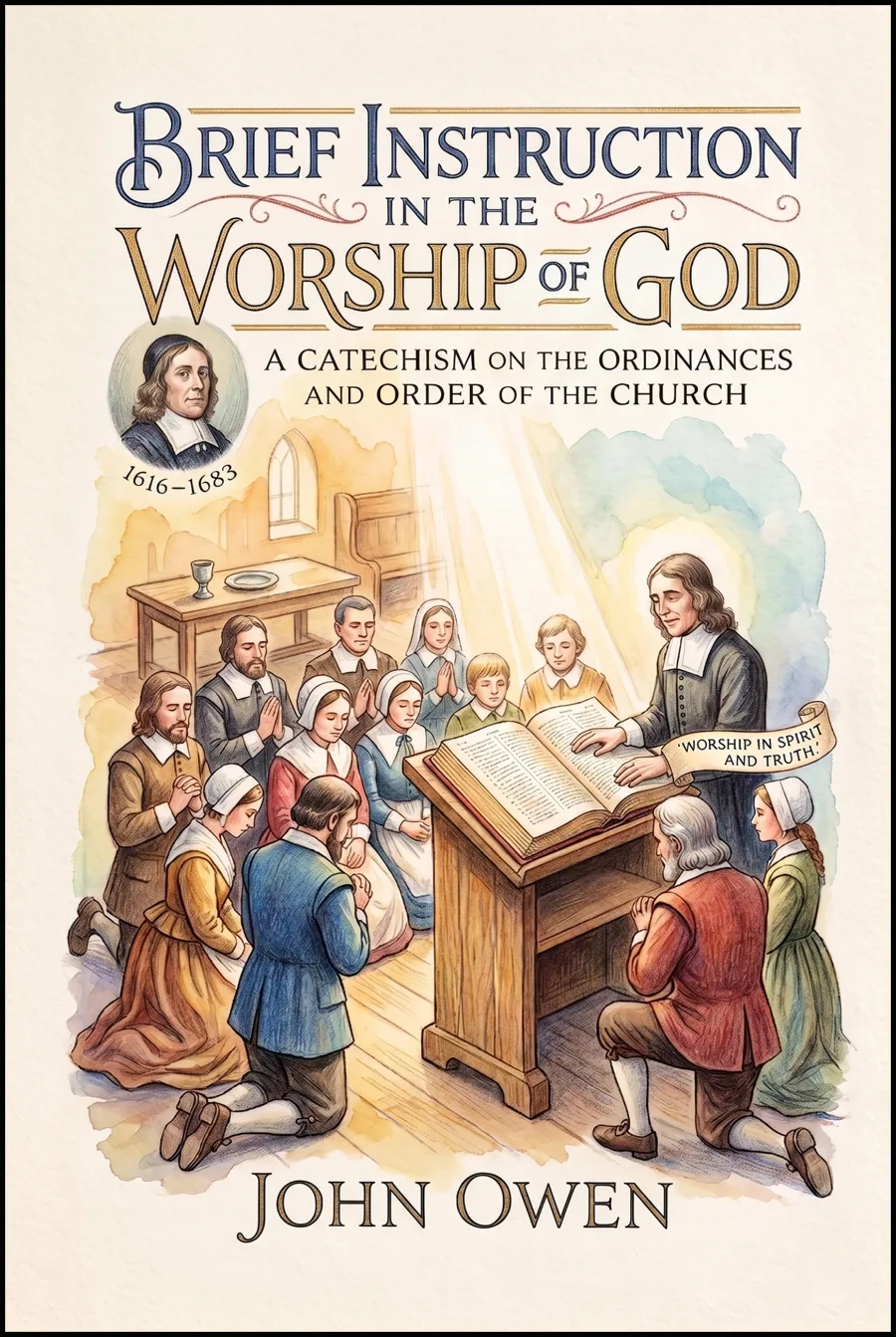
Brief Instruction in the Worship of God
eBook
• INR 51.00
• English
• 9788169359092
No ratings yet
| Publisher | General Press |
|---|---|
| ISBN13 | 9788169359092 |
| ASIN/SKU | 8169359090 |
| Book Format | eBook |
| Language | English |
| List Price | INR 51.00 |
| Subject Code | REL055020, REL067050, REL015000 |
| Publishing Date | 01/09/2026 |
| Book Code | BD00070212 |
Buy this Book
Amazon Stores
Ebook Stores
Other Stores
Discover Brief Instruction in the Worship of God by John Owen. This book is published by General Press in eBook format, ISBN 9788169359092, ASIN 8169359090, under Christian Books and Bibles, Christian Worship and Devotion, Ecclesiology Christian Theology.
Book Description
What does it truly mean to worship God, and how should faith shape the way a person lives each day? 'Brief Instruction in the Worship of God' by John Owen is a classic Christian theology and devotional work that offers a concise yet thoughtful guide to sincere, reverent worship and the spiritual life. Written from the perspective of one of the most influential English Puritan theologians, the work encourages readers to look beyond outward religious habits and consider the deeper attitude of the heart.
Owen explains that genuine worship must be grounded in a true understanding of God and expressed through humility, obedience, faith, and love. He emphasizes the importance of approaching God with reverence rather than treating worship as a mere ceremony or routine. For Owen, Christian worship is closely connected with the believer's everyday relationship with God, making it a matter of both public devotion and personal spiritual discipline.
The book also reflects Owen's broader concern with the purity and sincerity of Christian practice. He urges readers to examine their motives and to recognize the difference between outward religious observance and worship that comes from genuine faith. Scripture, prayer, meditation, and obedience are presented as essential parts of a life centered on God.
Although written in a seventeenth-century theological setting, Owen's central questions remain relevant to readers who want to understand the meaning and purpose of Christian worship. His direct approach challenges comfortable assumptions while encouraging a deeper, more personal devotion. For anyone interested in Puritan theology, Christian spirituality, or the foundations of worship, 'Brief Instruction in the Worship of God' offers a compact introduction to Owen's deeply serious vision of faith—one that invites readers to reconsider not only how they worship, but why.
Owen explains that genuine worship must be grounded in a true understanding of God and expressed through humility, obedience, faith, and love. He emphasizes the importance of approaching God with reverence rather than treating worship as a mere ceremony or routine. For Owen, Christian worship is closely connected with the believer's everyday relationship with God, making it a matter of both public devotion and personal spiritual discipline.
The book also reflects Owen's broader concern with the purity and sincerity of Christian practice. He urges readers to examine their motives and to recognize the difference between outward religious observance and worship that comes from genuine faith. Scripture, prayer, meditation, and obedience are presented as essential parts of a life centered on God.
Although written in a seventeenth-century theological setting, Owen's central questions remain relevant to readers who want to understand the meaning and purpose of Christian worship. His direct approach challenges comfortable assumptions while encouraging a deeper, more personal devotion. For anyone interested in Puritan theology, Christian spirituality, or the foundations of worship, 'Brief Instruction in the Worship of God' offers a compact introduction to Owen's deeply serious vision of faith—one that invites readers to reconsider not only how they worship, but why.
Author Biography
John Owen was a thinker whose writings shaped English Puritan theology and continue to challenge readers centuries later. Born in 1616, John Owen was an English Puritan theologian, pastor, and prolific author best known for influential works such as 'The Mortification of Sin', 'Communion with God', and 'The Death of Death in the Death of Christ'. His life was closely connected with the religious and political upheavals of seventeenth-century England.
Born in Stadhampton, Oxfordshire, Owen grew up in a Puritan household and showed remarkable intellectual ability from an early age. He entered Queen’s College, Oxford, at just twelve and studied subjects ranging from classics and philosophy to theology, Hebrew, and mathematics. After leaving Oxford in 1637 because of disagreements with Archbishop William Laud’s religious policies, he worked as a chaplain and later served churches in Essex. His experiences during the English Civil War strengthened his religious convictions and helped establish his reputation as a thoughtful and forceful preacher.
Owen became increasingly prominent in religious and academic life. He served as Dean of Christ Church and Vice-Chancellor of the University of Oxford during the 1650s, while also producing a remarkable body of theological writing. His books explored subjects such as sin, temptation, salvation, Christian fellowship, Scripture, the Trinity, and religious liberty. His writing is known for its depth, careful biblical reasoning, strong theological argument, and serious attention to the inner life of believers.
Although his prose can be demanding, Owen’s influence has remained remarkably strong. His works have been repeatedly published, studied, and recommended by generations of Christian readers and scholars. More than three centuries after his death in 1683, John Owen remains an important voice in Puritan literature and a lasting influence on Christian theology and devotional writing.
Born in Stadhampton, Oxfordshire, Owen grew up in a Puritan household and showed remarkable intellectual ability from an early age. He entered Queen’s College, Oxford, at just twelve and studied subjects ranging from classics and philosophy to theology, Hebrew, and mathematics. After leaving Oxford in 1637 because of disagreements with Archbishop William Laud’s religious policies, he worked as a chaplain and later served churches in Essex. His experiences during the English Civil War strengthened his religious convictions and helped establish his reputation as a thoughtful and forceful preacher.
Owen became increasingly prominent in religious and academic life. He served as Dean of Christ Church and Vice-Chancellor of the University of Oxford during the 1650s, while also producing a remarkable body of theological writing. His books explored subjects such as sin, temptation, salvation, Christian fellowship, Scripture, the Trinity, and religious liberty. His writing is known for its depth, careful biblical reasoning, strong theological argument, and serious attention to the inner life of believers.
Although his prose can be demanding, Owen’s influence has remained remarkably strong. His works have been repeatedly published, studied, and recommended by generations of Christian readers and scholars. More than three centuries after his death in 1683, John Owen remains an important voice in Puritan literature and a lasting influence on Christian theology and devotional writing.
Editorial Reviews
Editorial Reviews will be added soon…
Book Summary
John Owen’s "A Brief Instruction in the Worship of God and Discipline of the Churches of the New Testament" is a concise but remarkably rich work on Christian worship, church life, biblical authority, and the responsibilities of believers and church leaders. First published in 1667, the work was written during a period when religious dissent in England was politically and ecclesiastically sensitive. Owen’s name was initially omitted from the publication, and the work was intended in part to provide guidance for congregations following an independent or congregational model of church government. The book eventually became known as the “Independents’ Catechism.” Although the title promises a “brief instruction,” readers quickly discover that Owen is addressing questions of enormous importance: How should God be worshipped? Who has the authority to determine Christian worship? What is the place of Scripture? What should a Christian church look like? What are the responsibilities of pastors, elders, and members? And how can ordinary believers participate in worship in a way that genuinely honors God?
The structure of the book is distinctive. Owen presents a series of questions and answers and then follows each answer with a detailed explanation and biblical confirmation. The work contains more than fifty questions, beginning with the nature of worship and moving toward the organization, government, discipline, and officers of the New Testament church. This catechetical format makes the book systematic, but Owen’s explanations are much more than short doctrinal definitions. He repeatedly pauses to explore the biblical reasoning behind each conclusion. The result is both a theological guide and a practical manual for understanding Christian worship. At its heart lies a simple but demanding conviction: Christians must worship God according to God’s own revealed will rather than according to human preference, imagination, tradition, or convenience.
The central argument of 'Brief Instruction in the Worship of God' appears in its opening question. Owen asks what God requires from human beings so that God may be glorified and people may be accepted by him. His answer is that God must be worshipped “in and by the ways of his own appointment.” This principle controls almost everything that follows. Owen distinguishes between the inward worship of God—faith, love, fear, trust, obedience, and submission—and the outward forms by which that inward worship is expressed. Human beings naturally owe God worship because he is their Creator and sovereign Lord, but the particular forms and ordinances through which Christian worship is carried out must come from God’s revelation. For Owen, therefore, worship is not simply whatever religious activity a sincere person happens to find meaningful. Genuine Christian worship involves willing submission to God’s authority.
This leads to one of the book’s most important themes: the sufficiency and authority of Scripture. Owen argues that the ways in which God is to be worshipped are made known through the written Word. He describes Scripture as providing a full revelation of God’s will concerning worship and Christian obedience. This conviction reflects the Puritan concern often summarized as the “regulative principle of worship,” although Owen develops the idea in his own detailed theological manner. The question is not merely whether a practice is harmless or emotionally uplifting. The deeper question is whether it has divine warrant. Owen believes that because God is the one being worshipped, God possesses the right to determine how that worship is to take place.
This emphasis becomes especially significant when Owen considers human inventions in religion. He argues that people may be naturally aware that God should be worshipped, but human reason by itself cannot determine all the appropriate forms of divine worship. According to Owen, God has revealed these matters in Scripture, and Christians should therefore resist adding religious practices simply because they appear attractive, dignified, traditional, or spiritually useful. His concern is not that beauty, order, or sincerity are inherently wrong. Rather, he fears that human beings can gradually substitute their own ideas for God’s commands. In Owen’s view, the danger is especially serious because religious invention can appear pious while quietly shifting authority away from God.
Owen next explains that the forms of divine worship have not always been identical throughout biblical history. The church has existed under different covenantal arrangements, and God has instituted different ordinances for different periods. Yet Owen sees continuity beneath these changes: God has always required his people to worship him according to his revealed will. The coming of Christ and the establishment of the New Testament therefore represent a genuine development in worship rather than an abandonment of divine order. Christian worship must be understood in light of Christ’s completed work and the institutions he has established for his church.
An important part of Owen’s argument concerns the purpose of gospel ordinances. He does not treat worship as a collection of empty ceremonies. Instead, Christian institutions are intended to shape the spiritual life of believers. Owen asks what Christians should seek when observing Christ’s ordinances and points toward several goals: sanctifying God’s name, expressing submission to Christ, building believers up in faith, and strengthening mutual love and communion within the church. This is crucial to understanding the practical heart of the book. Owen is not advocating formalism. He wants worship to produce spiritual reality. External obedience matters because it should be connected to inward faith, holiness, communion, and dependence upon Christ.
For Owen, worship is therefore deeply connected with Christian identity. When believers gather according to Christ’s commands, they are publicly acknowledging that Jesus Christ is their Lord. Worship becomes a visible confession of allegiance. It also becomes an instrument through which believers encourage one another. The church is not simply an audience gathered to observe a religious performance; it is a covenant community in which Christians participate in the life and worship of Christ together. This explains why Owen gives so much attention to church discipline and government. The manner in which a congregation is organized is not an unimportant administrative question. It reflects convictions about Christ’s authority, the nature of the church, and the responsibilities believers owe to one another.
The second major subject of the book is therefore the discipline and constitution of New Testament churches. Owen describes the church as a gathered community of believers with recognized responsibilities, offices, ordinances, and forms of discipline. His vision is strongly congregational and emphasizes the participation and responsibility of the local church. The church is not merely a building or a clerical institution. It is a spiritual community organized under the authority of Christ and governed according to the principles found in Scripture. The members of the church have obligations toward one another, while those appointed to leadership carry particular responsibilities.
Owen pays particular attention to church officers and the character required of those who undertake spiritual leadership. Leadership in the church, in his understanding, is not primarily a position of prestige or social influence. It is a serious spiritual calling. He warns against entering ministry from improper motives, including external pressure, personal advantage, or financial gain. His discussion of pastoral responsibility emphasizes willingness, spiritual qualification, diligence, and a genuine readiness to serve. The minister is not simply a religious professional. He is entrusted with responsibility for the spiritual welfare of Christ’s people.
This emphasis gives the book a surprisingly humane quality. Beneath Owen’s dense theological reasoning is a deep concern about what happens to actual people when worship and church leadership become detached from spiritual reality. He recognizes that religious institutions can become distorted by ambition, money, tradition, fear, or social pressure. His answer is not to abandon organized Christianity but to return continually to the authority of Christ and Scripture. Church leaders must serve rather than dominate, and church members must participate rather than remain passive spectators.
Another major concern is the relationship between inward and outward religion. Owen refuses to accept the idea that private spirituality makes corporate worship unnecessary. At the same time, he rejects the idea that outward participation alone constitutes genuine Christianity. The two belong together. External worship should express internal faith, while faithful participation in the ordinances can strengthen and encourage inward devotion. Owen explains that God’s appointed forms of worship not only express faith but also assist and stimulate it. This makes his theology of worship more balanced than a simple opposition between “spiritual” and “ceremonial” religion.
The book also addresses the question of whether Christians might eventually become so spiritually mature that they no longer need the institutions of the gospel. Owen rejects this idea. According to the structure of his catechism, the Christian’s spiritual growth does not free him from Christ’s commands. Greater maturity should produce deeper obedience, not independence from Christ’s appointed means. In other words, Christian maturity is not measured by how little one needs the church, Scripture, worship, fellowship, and ordinances. True maturity is demonstrated by a growing willingness to live faithfully within the pattern Christ has given.
One of the most interesting aspects of 'Brief Instruction in the Worship of God' is Owen’s treatment of religious ceremonies and human additions. He challenges the assumption that churches possess unlimited freedom to invent practices that make worship more impressive or aesthetically appealing. His objection is ultimately theological: worship belongs to God, and therefore the church must not treat divine worship as an area in which human creativity has unrestricted authority. This question remains relevant because churches in every generation face the temptation to judge worship primarily by popularity, emotional impact, visual appeal, novelty, or cultural expectations. Owen asks readers to begin somewhere deeper: What has Christ commanded, and what does Scripture teach?
The tone of the book is serious, but its ultimate purpose is constructive. Owen wants believers to understand worship not as a burden but as a privilege and responsibility. To worship God according to his will is to acknowledge God’s holiness, authority, wisdom, and goodness. It is also to recognize that Christianity is not something believers are free to redesign according to their personal preferences. Christ is Lord of the church, and Christian worship is therefore an act of submission as well as devotion.
The enduring value of 'Brief Instruction in the Worship of God' lies in the way it connects doctrine with everyday church life. Owen does not leave theology in the realm of abstract speculation. Questions about Scripture lead to questions about worship; questions about worship lead to questions about church government; questions about church government lead to questions about leadership, discipline, fellowship, and Christian responsibility. The entire structure reflects his belief that what Christians believe about God must shape how they live together.
For modern readers searching for a clear summary of John Owen’s theology of worship, the book can initially seem demanding because Owen writes from a seventeenth-century Puritan context and assumes familiarity with Scripture and theological debate. Yet its central message is surprisingly accessible. Worship is about honoring God according to his revealed will. Scripture is the authoritative guide for that worship. Christ is the head of the church. Gospel ordinances exist for the spiritual good of believers. Church leaders must serve with integrity. Church members have real responsibilities to one another. And Christian worship should produce genuine faith, holiness, obedience, love, and communion.
Ultimately, 'A Brief Instruction in the Worship of God' is not merely a book about church ceremonies or denominational structures. It is a meditation on the question of who has the right to determine how Christians approach God. Owen’s answer is unwavering: God himself. The seriousness of that answer explains both the theological intensity and the practical usefulness of the work. He believes that worship becomes meaningful precisely when believers stop treating it as something they design for themselves and instead receive it as something Christ has given to his church. In that sense, the book remains a powerful introduction to John Owen’s understanding of biblical worship, New Testament church discipline, Christian fellowship, and the authority of Scripture. Its deepest lesson is simple but demanding: authentic worship begins when human preference gives way to reverent obedience, and when the church gathers not merely to perform religious activities but to glorify God, submit to Christ, grow in faith, and live faithfully as his people.
The structure of the book is distinctive. Owen presents a series of questions and answers and then follows each answer with a detailed explanation and biblical confirmation. The work contains more than fifty questions, beginning with the nature of worship and moving toward the organization, government, discipline, and officers of the New Testament church. This catechetical format makes the book systematic, but Owen’s explanations are much more than short doctrinal definitions. He repeatedly pauses to explore the biblical reasoning behind each conclusion. The result is both a theological guide and a practical manual for understanding Christian worship. At its heart lies a simple but demanding conviction: Christians must worship God according to God’s own revealed will rather than according to human preference, imagination, tradition, or convenience.
The central argument of 'Brief Instruction in the Worship of God' appears in its opening question. Owen asks what God requires from human beings so that God may be glorified and people may be accepted by him. His answer is that God must be worshipped “in and by the ways of his own appointment.” This principle controls almost everything that follows. Owen distinguishes between the inward worship of God—faith, love, fear, trust, obedience, and submission—and the outward forms by which that inward worship is expressed. Human beings naturally owe God worship because he is their Creator and sovereign Lord, but the particular forms and ordinances through which Christian worship is carried out must come from God’s revelation. For Owen, therefore, worship is not simply whatever religious activity a sincere person happens to find meaningful. Genuine Christian worship involves willing submission to God’s authority.
This leads to one of the book’s most important themes: the sufficiency and authority of Scripture. Owen argues that the ways in which God is to be worshipped are made known through the written Word. He describes Scripture as providing a full revelation of God’s will concerning worship and Christian obedience. This conviction reflects the Puritan concern often summarized as the “regulative principle of worship,” although Owen develops the idea in his own detailed theological manner. The question is not merely whether a practice is harmless or emotionally uplifting. The deeper question is whether it has divine warrant. Owen believes that because God is the one being worshipped, God possesses the right to determine how that worship is to take place.
This emphasis becomes especially significant when Owen considers human inventions in religion. He argues that people may be naturally aware that God should be worshipped, but human reason by itself cannot determine all the appropriate forms of divine worship. According to Owen, God has revealed these matters in Scripture, and Christians should therefore resist adding religious practices simply because they appear attractive, dignified, traditional, or spiritually useful. His concern is not that beauty, order, or sincerity are inherently wrong. Rather, he fears that human beings can gradually substitute their own ideas for God’s commands. In Owen’s view, the danger is especially serious because religious invention can appear pious while quietly shifting authority away from God.
Owen next explains that the forms of divine worship have not always been identical throughout biblical history. The church has existed under different covenantal arrangements, and God has instituted different ordinances for different periods. Yet Owen sees continuity beneath these changes: God has always required his people to worship him according to his revealed will. The coming of Christ and the establishment of the New Testament therefore represent a genuine development in worship rather than an abandonment of divine order. Christian worship must be understood in light of Christ’s completed work and the institutions he has established for his church.
An important part of Owen’s argument concerns the purpose of gospel ordinances. He does not treat worship as a collection of empty ceremonies. Instead, Christian institutions are intended to shape the spiritual life of believers. Owen asks what Christians should seek when observing Christ’s ordinances and points toward several goals: sanctifying God’s name, expressing submission to Christ, building believers up in faith, and strengthening mutual love and communion within the church. This is crucial to understanding the practical heart of the book. Owen is not advocating formalism. He wants worship to produce spiritual reality. External obedience matters because it should be connected to inward faith, holiness, communion, and dependence upon Christ.
For Owen, worship is therefore deeply connected with Christian identity. When believers gather according to Christ’s commands, they are publicly acknowledging that Jesus Christ is their Lord. Worship becomes a visible confession of allegiance. It also becomes an instrument through which believers encourage one another. The church is not simply an audience gathered to observe a religious performance; it is a covenant community in which Christians participate in the life and worship of Christ together. This explains why Owen gives so much attention to church discipline and government. The manner in which a congregation is organized is not an unimportant administrative question. It reflects convictions about Christ’s authority, the nature of the church, and the responsibilities believers owe to one another.
The second major subject of the book is therefore the discipline and constitution of New Testament churches. Owen describes the church as a gathered community of believers with recognized responsibilities, offices, ordinances, and forms of discipline. His vision is strongly congregational and emphasizes the participation and responsibility of the local church. The church is not merely a building or a clerical institution. It is a spiritual community organized under the authority of Christ and governed according to the principles found in Scripture. The members of the church have obligations toward one another, while those appointed to leadership carry particular responsibilities.
Owen pays particular attention to church officers and the character required of those who undertake spiritual leadership. Leadership in the church, in his understanding, is not primarily a position of prestige or social influence. It is a serious spiritual calling. He warns against entering ministry from improper motives, including external pressure, personal advantage, or financial gain. His discussion of pastoral responsibility emphasizes willingness, spiritual qualification, diligence, and a genuine readiness to serve. The minister is not simply a religious professional. He is entrusted with responsibility for the spiritual welfare of Christ’s people.
This emphasis gives the book a surprisingly humane quality. Beneath Owen’s dense theological reasoning is a deep concern about what happens to actual people when worship and church leadership become detached from spiritual reality. He recognizes that religious institutions can become distorted by ambition, money, tradition, fear, or social pressure. His answer is not to abandon organized Christianity but to return continually to the authority of Christ and Scripture. Church leaders must serve rather than dominate, and church members must participate rather than remain passive spectators.
Another major concern is the relationship between inward and outward religion. Owen refuses to accept the idea that private spirituality makes corporate worship unnecessary. At the same time, he rejects the idea that outward participation alone constitutes genuine Christianity. The two belong together. External worship should express internal faith, while faithful participation in the ordinances can strengthen and encourage inward devotion. Owen explains that God’s appointed forms of worship not only express faith but also assist and stimulate it. This makes his theology of worship more balanced than a simple opposition between “spiritual” and “ceremonial” religion.
The book also addresses the question of whether Christians might eventually become so spiritually mature that they no longer need the institutions of the gospel. Owen rejects this idea. According to the structure of his catechism, the Christian’s spiritual growth does not free him from Christ’s commands. Greater maturity should produce deeper obedience, not independence from Christ’s appointed means. In other words, Christian maturity is not measured by how little one needs the church, Scripture, worship, fellowship, and ordinances. True maturity is demonstrated by a growing willingness to live faithfully within the pattern Christ has given.
One of the most interesting aspects of 'Brief Instruction in the Worship of God' is Owen’s treatment of religious ceremonies and human additions. He challenges the assumption that churches possess unlimited freedom to invent practices that make worship more impressive or aesthetically appealing. His objection is ultimately theological: worship belongs to God, and therefore the church must not treat divine worship as an area in which human creativity has unrestricted authority. This question remains relevant because churches in every generation face the temptation to judge worship primarily by popularity, emotional impact, visual appeal, novelty, or cultural expectations. Owen asks readers to begin somewhere deeper: What has Christ commanded, and what does Scripture teach?
The tone of the book is serious, but its ultimate purpose is constructive. Owen wants believers to understand worship not as a burden but as a privilege and responsibility. To worship God according to his will is to acknowledge God’s holiness, authority, wisdom, and goodness. It is also to recognize that Christianity is not something believers are free to redesign according to their personal preferences. Christ is Lord of the church, and Christian worship is therefore an act of submission as well as devotion.
The enduring value of 'Brief Instruction in the Worship of God' lies in the way it connects doctrine with everyday church life. Owen does not leave theology in the realm of abstract speculation. Questions about Scripture lead to questions about worship; questions about worship lead to questions about church government; questions about church government lead to questions about leadership, discipline, fellowship, and Christian responsibility. The entire structure reflects his belief that what Christians believe about God must shape how they live together.
For modern readers searching for a clear summary of John Owen’s theology of worship, the book can initially seem demanding because Owen writes from a seventeenth-century Puritan context and assumes familiarity with Scripture and theological debate. Yet its central message is surprisingly accessible. Worship is about honoring God according to his revealed will. Scripture is the authoritative guide for that worship. Christ is the head of the church. Gospel ordinances exist for the spiritual good of believers. Church leaders must serve with integrity. Church members have real responsibilities to one another. And Christian worship should produce genuine faith, holiness, obedience, love, and communion.
Ultimately, 'A Brief Instruction in the Worship of God' is not merely a book about church ceremonies or denominational structures. It is a meditation on the question of who has the right to determine how Christians approach God. Owen’s answer is unwavering: God himself. The seriousness of that answer explains both the theological intensity and the practical usefulness of the work. He believes that worship becomes meaningful precisely when believers stop treating it as something they design for themselves and instead receive it as something Christ has given to his church. In that sense, the book remains a powerful introduction to John Owen’s understanding of biblical worship, New Testament church discipline, Christian fellowship, and the authority of Scripture. Its deepest lesson is simple but demanding: authentic worship begins when human preference gives way to reverent obedience, and when the church gathers not merely to perform religious activities but to glorify God, submit to Christ, grow in faith, and live faithfully as his people.
Sample Chapters
Sample Chapters will be added soon…
Reader Reviews
No reviews yet.
Brief Instruction in the Worship of God
Download Cover Image
Do you want to download the full cover image for Brief Instruction in the Worship of God?