
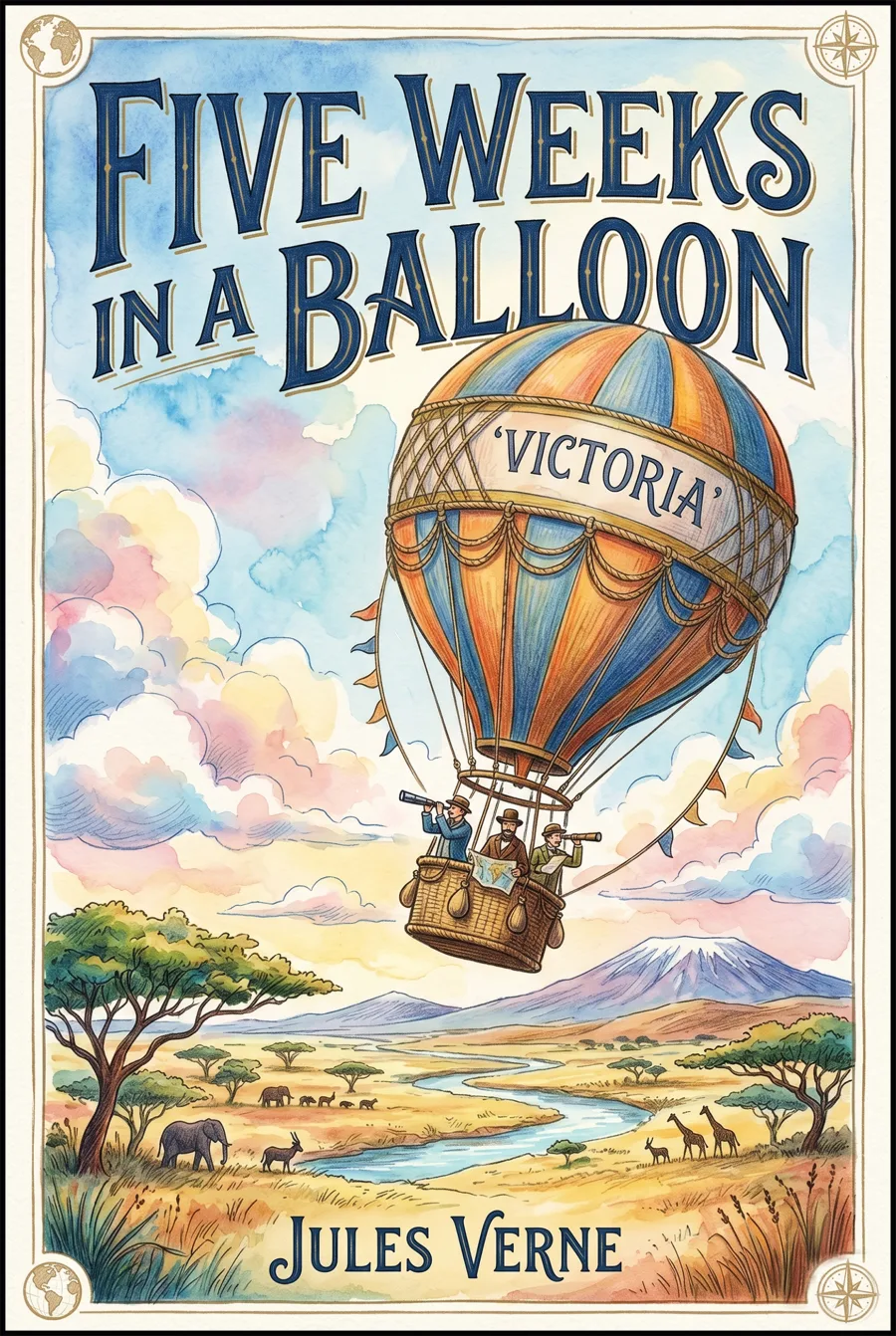
Five Weeks in a Balloon
eBook
• INR 51.00
• English
• 9788169359108
No ratings yet
| Publisher | General Press |
|---|---|
| ISBN13 | 9788169359108 |
| ASIN/SKU | 8169359104 |
| Book Format | eBook |
| Language | English |
| List Price | INR 51.00 |
| Subject Code | FIC028010, FIC028060, FIC014000 |
| Publishing Date | 01/09/2026 |
| Book Code | BD00070214 |
Buy this Book
Amazon Stores
Ebook Stores
Other Stores
Discover Five Weeks in a Balloon by Jules Verne. This book is published by General Press in eBook format, ISBN 9788169359108, ASIN 8169359104, under Literature and Fiction, Science Fiction Adventures, Steampunk Fiction.
Book Description
What if you could cross an entire continent without touching the ground, carried only by the wind and your courage? 'Five Weeks in a Balloon' by Jules Verne is a classic adventure and science fiction novel that follows an ambitious aerial expedition across the unexplored regions of Africa, combining travel, discovery, danger, and scientific imagination.
The story follows Dr. Samuel Fergusson, an adventurous and determined explorer who believes that a balloon can make it possible to travel across Africa more efficiently than traditional expeditions. He is joined by his loyal friend Dick Kennedy, a skilled hunter, and Joe, Fergusson's cheerful and resourceful servant. Together, they set off aboard the balloon Victoria, beginning an extraordinary journey from east to west across the African continent.
Their expedition takes them over vast deserts, forests, rivers, mountains, and unfamiliar territories. Along the way, the travelers encounter wild animals, hostile groups, dangerous weather, and unexpected obstacles that repeatedly threaten their progress. Fergusson's knowledge and careful planning become essential as the travelers struggle to conserve supplies, control their altitude, and use changing winds to guide their course. Meanwhile, the very nature of their journey creates a constant sense of uncertainty, since one mistake could leave them stranded far from safety.
Verne combines geographical detail with imaginative technology, creating a lively picture of nineteenth-century exploration while keeping the narrative fast-moving and suspenseful. The friendship between Fergusson, Kennedy, and Joe also gives the adventure warmth and humor, balancing the dangers they face.
Full of discovery, scientific curiosity, and thrilling escapes, 'Five Weeks in a Balloon' captures Jules Verne's fascination with exploration and the possibilities of human invention. The farther the Victoria travels, the more unpredictable the journey becomes, making this classic adventure a compelling invitation to discover what awaits beyond the horizon.
The story follows Dr. Samuel Fergusson, an adventurous and determined explorer who believes that a balloon can make it possible to travel across Africa more efficiently than traditional expeditions. He is joined by his loyal friend Dick Kennedy, a skilled hunter, and Joe, Fergusson's cheerful and resourceful servant. Together, they set off aboard the balloon Victoria, beginning an extraordinary journey from east to west across the African continent.
Their expedition takes them over vast deserts, forests, rivers, mountains, and unfamiliar territories. Along the way, the travelers encounter wild animals, hostile groups, dangerous weather, and unexpected obstacles that repeatedly threaten their progress. Fergusson's knowledge and careful planning become essential as the travelers struggle to conserve supplies, control their altitude, and use changing winds to guide their course. Meanwhile, the very nature of their journey creates a constant sense of uncertainty, since one mistake could leave them stranded far from safety.
Verne combines geographical detail with imaginative technology, creating a lively picture of nineteenth-century exploration while keeping the narrative fast-moving and suspenseful. The friendship between Fergusson, Kennedy, and Joe also gives the adventure warmth and humor, balancing the dangers they face.
Full of discovery, scientific curiosity, and thrilling escapes, 'Five Weeks in a Balloon' captures Jules Verne's fascination with exploration and the possibilities of human invention. The farther the Victoria travels, the more unpredictable the journey becomes, making this classic adventure a compelling invitation to discover what awaits beyond the horizon.
Author Biography
Few writers have imagined the future with the confidence and wonder of Jules Verne. Born Jules Gabriel Verne in 1828, he was a French novelist and pioneer of science fiction, best known for adventure classics such as 'Journey to the Center of the Earth', 'Twenty Thousand Leagues Under the Seas', and 'Around the World in Eighty Days'.
Verne was born in Nantes, France, into a family connected to law and maritime life. Although he initially studied law in Paris, his fascination with travel, science, technology, and storytelling gradually drew him toward literature. His early interest in the theater led him to write plays and stories, but his career changed dramatically when he began creating adventurous novels that combined scientific ideas with thrilling journeys.
His most celebrated books became part of the series known as the 'Voyages extraordinaires'. In these works, Verne took readers beneath the oceans, into unexplored lands, across continents, and even into outer space. He blended careful research with imagination, creating stories that felt both exciting and surprisingly believable. His writing often explored new inventions and scientific possibilities, making him an important figure in the development of modern science fiction.
Verne's influence reached far beyond France. His novels inspired generations of readers, scientists, inventors, filmmakers, and other writers. Some of his imaginative ideas, including submarine travel, lunar exploration, and advanced forms of transportation, appeared remarkably ahead of their time. His books have been translated into numerous languages and continue to attract readers around the world.
Jules Verne died in 1905, but his fascination with discovery and the unknown remains as powerful as ever. His ability to turn scientific curiosity into unforgettable adventure secured his place as one of the most influential authors in literary history.
Verne was born in Nantes, France, into a family connected to law and maritime life. Although he initially studied law in Paris, his fascination with travel, science, technology, and storytelling gradually drew him toward literature. His early interest in the theater led him to write plays and stories, but his career changed dramatically when he began creating adventurous novels that combined scientific ideas with thrilling journeys.
His most celebrated books became part of the series known as the 'Voyages extraordinaires'. In these works, Verne took readers beneath the oceans, into unexplored lands, across continents, and even into outer space. He blended careful research with imagination, creating stories that felt both exciting and surprisingly believable. His writing often explored new inventions and scientific possibilities, making him an important figure in the development of modern science fiction.
Verne's influence reached far beyond France. His novels inspired generations of readers, scientists, inventors, filmmakers, and other writers. Some of his imaginative ideas, including submarine travel, lunar exploration, and advanced forms of transportation, appeared remarkably ahead of their time. His books have been translated into numerous languages and continue to attract readers around the world.
Jules Verne died in 1905, but his fascination with discovery and the unknown remains as powerful as ever. His ability to turn scientific curiosity into unforgettable adventure secured his place as one of the most influential authors in literary history.
Editorial Reviews
Editorial Reviews will be added soon…
Book Summary
Jules Verne’s "Five Weeks in a Balloon" (Cinq semaines en ballon), published in 1863, is one of the earliest and most important adventure novels by the French writer who would become famous as a pioneer of science fiction. The book combines exploration, geography, scientific curiosity, danger, humor, and the excitement of technological discovery. It follows Dr. Samuel Fergusson, an inventive and determined English explorer who plans an extraordinary journey across Africa in a specially designed balloon. Accompanied by his loyal friend Dick Kennedy and his resourceful servant Joe, Fergusson attempts to cross the African continent from east to west without relying on conventional overland travel. The result is an energetic adventure story that explores the unknown world through the nineteenth-century imagination. For readers looking for a 'Five Weeks in a Balloon' summary, the novel is essentially a story about exploration and survival, but it is also a portrait of human curiosity and confidence in science.
The novel begins in London, where Dr. Samuel Fergusson announces an ambitious expedition that immediately attracts public attention. Fergusson is not an ordinary traveler. He is a scientist, explorer, inventor, and fearless thinker who believes that many geographical mysteries can be solved through a combination of courage and technology. His plan is to travel across Africa by balloon, beginning near Zanzibar on the eastern coast and eventually reaching the Atlantic side of the continent. Such a journey was extremely dangerous in the nineteenth century because large portions of Africa remained poorly mapped by Europeans, and previous expeditions had encountered disease, hostile environments, difficult terrain, and violent conflicts. Fergusson believes that traveling through the air will allow him to avoid many of these obstacles. Instead of crossing deserts, forests, mountains, and rivers on foot, he intends to float above them.
The two people who accompany him are very different from each other. Dick Kennedy is a skilled hunter and a practical man who is deeply loyal to Fergusson but initially doubts the wisdom of the expedition. Kennedy is courageous, physically capable, and experienced in the outdoors, yet he sees the balloon journey as an unnecessary gamble. Joe, Fergusson’s servant, is almost the opposite. He is cheerful, energetic, adventurous, and completely confident in his master. Joe embraces the expedition with enthusiasm and often provides comic relief during moments of tension. The three men therefore form a well-balanced team: Fergusson provides scientific knowledge and leadership, Kennedy contributes practical survival skills and caution, and Joe supplies energy, optimism, and ingenuity.
The balloon itself is central to the novel. Fergusson has designed it to make long-distance travel possible without constantly ascending and descending to obtain fresh gas. His idea is to use a system involving hydrogen and heating that allows the balloon to maintain its buoyancy while reducing the need for frequent landings. The technical details are characteristic of Jules Verne, who loved to explain how inventions and machines might work. Although some of the science has aged and certain mechanisms are unrealistic by modern standards, the descriptions give the journey a convincing sense of engineering and scientific purpose. Verne's readers were invited to imagine that the seemingly impossible might become possible if an intelligent person could understand the laws of nature and apply them creatively.
The expedition begins in Zanzibar, where the travelers prepare their balloon and begin their journey over the African landscape. From the very beginning, the trip is unpredictable. Weather conditions, geographical obstacles, animals, local conflicts, and mechanical problems repeatedly threaten the travelers. The balloon gives the men an extraordinary advantage because they can observe the land from above, but it also creates a new kind of vulnerability. They are dependent on wind and atmospheric conditions, and a change in the weather can send them far away from their intended route. The balloon is both their vehicle and their fragile shelter.
As the travelers move westward, the novel becomes a succession of discoveries and dangers. Fergusson is fascinated by the geography below him, carefully observing rivers, lakes, mountains, forests, and settlements. He attempts to connect what he sees with the geographical information already available to European explorers. Verne uses these observations to turn the adventure into a kind of popular geography lesson. Readers are introduced to the physical and cultural landscape of nineteenth-century Africa through the eyes of the explorers. This mixture of education and adventure is one of the novel's defining characteristics.
One important feature of the story is its connection to the real history of African exploration. Verne incorporates names, expeditions, geographical theories, and discoveries associated with explorers of his era. Fergusson's journey is partly inspired by the great European expeditions that attempted to solve mysteries such as the sources of major African rivers. The novel was written at a time when European audiences were fascinated by reports from Africa, and Verne transforms that fascination into a fictional adventure. Readers interested in the historical background of 'Five Weeks in a Balloon' will therefore find that it reflects the nineteenth-century enthusiasm for exploration as well as the era's incomplete and often problematic understanding of Africa.
One of the early major episodes involves the travelers' encounter with a hostile group and their attempt to escape danger from the air. The balloon repeatedly allows them to survive situations that would be much more difficult on the ground. Yet the men are never completely safe. Their altitude, limited supplies, and dependence on the weather mean that every decision matters. Fergusson must constantly calculate how much hydrogen, food, water, and other resources remain. His scientific confidence is tested by circumstances that cannot always be controlled through calculation.
The journey also introduces the travelers to extraordinary wildlife. Verne fills the narrative with encounters involving elephants, lions, crocodiles, hippopotamuses, and other animals. These scenes contribute to the traditional adventure-story atmosphere of the novel, but they also demonstrate the explorers' dependence on knowledge and quick thinking. Kennedy's skills as a hunter become especially important. His ability to respond to physical danger complements Fergusson's intellectual approach. Joe, meanwhile, repeatedly demonstrates that practical common sense can be just as valuable as formal scientific knowledge.
The novel's middle sections become increasingly tense as the travelers face the consequences of their ambitious route. Their balloon does not simply carry them smoothly across the continent. They encounter storms, strong winds, shortages, and situations in which they must descend closer to the ground than they would prefer. At times, the expedition seems to be approaching disaster. Yet Fergusson refuses to surrender easily. His determination is one of his defining characteristics. He treats problems as challenges to be solved rather than reasons to abandon the expedition.
This confidence in human ingenuity is one of the most important themes in 'Five Weeks in a Balloon'. Fergusson represents the nineteenth-century ideal of the scientific explorer: a person who combines intellectual curiosity with practical courage. He does not believe that the unknown should remain unknown simply because it is frightening. Instead, he believes that careful observation, technology, and reason can expand the boundaries of human knowledge. Verne repeatedly presents scientific thinking as a form of adventure. Learning about the world is itself a thrilling experience.
At the same time, the novel does not portray nature as something humans can completely control. The travelers can design their balloon and calculate their route, but they cannot command the wind or eliminate storms. They can understand geography, but they cannot guarantee that every landscape will be safe. They can prepare for danger, but they cannot remove uncertainty. This tension between technological confidence and the unpredictability of nature gives the story much of its excitement.
Joe provides an important emotional balance to the more serious scientific discussions. His enthusiasm makes the expedition feel less like a formal scientific mission and more like an extraordinary adventure shared among friends. He is willing to take risks and often finds humor in circumstances that would terrify other people. His loyalty to Fergusson is unquestionable, and his willingness to help repeatedly becomes important when the group encounters trouble. The relationship between Fergusson, Kennedy, and Joe is therefore one of the novel's greatest strengths. Their personalities differ, but their trust in one another gradually becomes essential to survival.
Dick Kennedy also undergoes a subtle transformation. At the beginning, he is skeptical about the balloon and worried about the risks. He is not naturally attracted to Fergusson's abstract scientific ambitions. Yet as the expedition continues, Kennedy demonstrates that loyalty and friendship can overcome disagreement. He becomes an indispensable member of the team. His skepticism is not cowardice; rather, it represents practical judgment. Verne uses him to balance Fergusson's boldness. Where Fergusson asks, “Can this be done?” Kennedy often asks, “Should we really do it?” The tension between these perspectives creates a believable and entertaining partnership.
As the expedition progresses, the travelers encounter increasingly serious threats. They are forced to navigate difficult weather, hostile encounters, and dwindling resources. At one point, their situation becomes particularly desperate when they find themselves with insufficient means to continue safely. The balloon's advantages begin to disappear, and survival depends upon ingenuity and cooperation. These episodes demonstrate that the journey is not simply a technological demonstration. The machine may be brilliant, but it is the human beings inside it who ultimately determine whether it will succeed.
One of the novel's most memorable ideas is the image of Africa seen from the sky. The balloon gives the travelers a perspective that ordinary explorers cannot easily obtain. Rivers become lines across the landscape, forests stretch into enormous green expanses, and settlements appear as small points below. Verne uses this elevated perspective to create a sense of wonder. The world becomes both enormous and comprehensible. Geography is transformed into an adventure, and scientific observation becomes visually exciting.
However, modern readers should also recognize that the novel reflects the attitudes of its nineteenth-century European setting. Its depiction of Africa and African peoples is shaped by the colonial assumptions of the period, and some descriptions may feel stereotypical, paternalistic, or outdated today. The book should therefore be appreciated as a historical literary artifact as well as an adventure novel. Understanding the context in which Verne wrote helps readers distinguish between the book's enduring imaginative qualities and ideas that belong to its era.
The climax of the novel arrives as the expedition faces the possibility that its carefully planned journey may fail. The balloon is damaged and the travelers are pushed toward the limits of their endurance. Their supplies become increasingly important, and the natural environment becomes more threatening. Fergusson's scientific knowledge, Kennedy's practical skills, and Joe's courage are all required. Rather than presenting a single heroic figure who saves everyone, Verne emphasizes teamwork. Each man contributes something the others lack.
Eventually, after weeks of extraordinary travel, the explorers reach the western side of the continent. Their journey has taken them across vast territories and through countless dangers. The success of the expedition is not simply measured by reaching its destination. It represents the completion of an audacious experiment. Fergusson has demonstrated that a balloon can, at least within Verne's fictional world, become a vehicle for systematic exploration on a continental scale.
The ending provides a satisfying sense of achievement, but the larger significance of the story lies in what the journey represents. 'Five Weeks in a Balloon' is a novel about the desire to know what lies beyond the familiar. Fergusson is driven by curiosity rather than wealth or political power. He wants to see, measure, understand, and discover. This makes the novel an early expression of the theme that would dominate much of Jules Verne's later work: technology can open doors to worlds that once seemed inaccessible.
In summary, 'Five Weeks in a Balloon' is both an adventure novel and a celebration of exploration, science, friendship, and human ingenuity. The plot follows Dr. Samuel Fergusson, Dick Kennedy, and Joe as they attempt to cross Africa by balloon, facing storms, wild animals, hostile encounters, geographical challenges, mechanical difficulties, and dwindling supplies. The novel's excitement comes from the constant uncertainty of the journey, while its intellectual appeal comes from Verne's fascination with geography, engineering, and scientific possibility. Fergusson represents curiosity and invention, Kennedy represents practical courage and caution, and Joe represents optimism and loyalty. Together they create one of Verne's earliest memorable adventure teams.
For readers searching for the meaning, themes, characters, and ending of 'Five Weeks in a Balloon', the novel's central message can be understood quite simply: human beings are driven to explore because curiosity is stronger than fear. Verne imagines a world in which science can transform the impossible into the possible, while still reminding readers that nature remains powerful and unpredictable. Although some scientific ideas and cultural attitudes in the novel belong unmistakably to the nineteenth century, its sense of wonder remains timeless. The book captures the thrill of looking at an unexplored world and asking, “What if we could go there?” That question lies at the heart of Jules Verne's fiction, and 'Five Weeks in a Balloon' stands as one of the earliest and clearest examples of his lifelong fascination with adventure, invention, discovery, and the limitless possibilities of human imagination.
The novel begins in London, where Dr. Samuel Fergusson announces an ambitious expedition that immediately attracts public attention. Fergusson is not an ordinary traveler. He is a scientist, explorer, inventor, and fearless thinker who believes that many geographical mysteries can be solved through a combination of courage and technology. His plan is to travel across Africa by balloon, beginning near Zanzibar on the eastern coast and eventually reaching the Atlantic side of the continent. Such a journey was extremely dangerous in the nineteenth century because large portions of Africa remained poorly mapped by Europeans, and previous expeditions had encountered disease, hostile environments, difficult terrain, and violent conflicts. Fergusson believes that traveling through the air will allow him to avoid many of these obstacles. Instead of crossing deserts, forests, mountains, and rivers on foot, he intends to float above them.
The two people who accompany him are very different from each other. Dick Kennedy is a skilled hunter and a practical man who is deeply loyal to Fergusson but initially doubts the wisdom of the expedition. Kennedy is courageous, physically capable, and experienced in the outdoors, yet he sees the balloon journey as an unnecessary gamble. Joe, Fergusson’s servant, is almost the opposite. He is cheerful, energetic, adventurous, and completely confident in his master. Joe embraces the expedition with enthusiasm and often provides comic relief during moments of tension. The three men therefore form a well-balanced team: Fergusson provides scientific knowledge and leadership, Kennedy contributes practical survival skills and caution, and Joe supplies energy, optimism, and ingenuity.
The balloon itself is central to the novel. Fergusson has designed it to make long-distance travel possible without constantly ascending and descending to obtain fresh gas. His idea is to use a system involving hydrogen and heating that allows the balloon to maintain its buoyancy while reducing the need for frequent landings. The technical details are characteristic of Jules Verne, who loved to explain how inventions and machines might work. Although some of the science has aged and certain mechanisms are unrealistic by modern standards, the descriptions give the journey a convincing sense of engineering and scientific purpose. Verne's readers were invited to imagine that the seemingly impossible might become possible if an intelligent person could understand the laws of nature and apply them creatively.
The expedition begins in Zanzibar, where the travelers prepare their balloon and begin their journey over the African landscape. From the very beginning, the trip is unpredictable. Weather conditions, geographical obstacles, animals, local conflicts, and mechanical problems repeatedly threaten the travelers. The balloon gives the men an extraordinary advantage because they can observe the land from above, but it also creates a new kind of vulnerability. They are dependent on wind and atmospheric conditions, and a change in the weather can send them far away from their intended route. The balloon is both their vehicle and their fragile shelter.
As the travelers move westward, the novel becomes a succession of discoveries and dangers. Fergusson is fascinated by the geography below him, carefully observing rivers, lakes, mountains, forests, and settlements. He attempts to connect what he sees with the geographical information already available to European explorers. Verne uses these observations to turn the adventure into a kind of popular geography lesson. Readers are introduced to the physical and cultural landscape of nineteenth-century Africa through the eyes of the explorers. This mixture of education and adventure is one of the novel's defining characteristics.
One important feature of the story is its connection to the real history of African exploration. Verne incorporates names, expeditions, geographical theories, and discoveries associated with explorers of his era. Fergusson's journey is partly inspired by the great European expeditions that attempted to solve mysteries such as the sources of major African rivers. The novel was written at a time when European audiences were fascinated by reports from Africa, and Verne transforms that fascination into a fictional adventure. Readers interested in the historical background of 'Five Weeks in a Balloon' will therefore find that it reflects the nineteenth-century enthusiasm for exploration as well as the era's incomplete and often problematic understanding of Africa.
One of the early major episodes involves the travelers' encounter with a hostile group and their attempt to escape danger from the air. The balloon repeatedly allows them to survive situations that would be much more difficult on the ground. Yet the men are never completely safe. Their altitude, limited supplies, and dependence on the weather mean that every decision matters. Fergusson must constantly calculate how much hydrogen, food, water, and other resources remain. His scientific confidence is tested by circumstances that cannot always be controlled through calculation.
The journey also introduces the travelers to extraordinary wildlife. Verne fills the narrative with encounters involving elephants, lions, crocodiles, hippopotamuses, and other animals. These scenes contribute to the traditional adventure-story atmosphere of the novel, but they also demonstrate the explorers' dependence on knowledge and quick thinking. Kennedy's skills as a hunter become especially important. His ability to respond to physical danger complements Fergusson's intellectual approach. Joe, meanwhile, repeatedly demonstrates that practical common sense can be just as valuable as formal scientific knowledge.
The novel's middle sections become increasingly tense as the travelers face the consequences of their ambitious route. Their balloon does not simply carry them smoothly across the continent. They encounter storms, strong winds, shortages, and situations in which they must descend closer to the ground than they would prefer. At times, the expedition seems to be approaching disaster. Yet Fergusson refuses to surrender easily. His determination is one of his defining characteristics. He treats problems as challenges to be solved rather than reasons to abandon the expedition.
This confidence in human ingenuity is one of the most important themes in 'Five Weeks in a Balloon'. Fergusson represents the nineteenth-century ideal of the scientific explorer: a person who combines intellectual curiosity with practical courage. He does not believe that the unknown should remain unknown simply because it is frightening. Instead, he believes that careful observation, technology, and reason can expand the boundaries of human knowledge. Verne repeatedly presents scientific thinking as a form of adventure. Learning about the world is itself a thrilling experience.
At the same time, the novel does not portray nature as something humans can completely control. The travelers can design their balloon and calculate their route, but they cannot command the wind or eliminate storms. They can understand geography, but they cannot guarantee that every landscape will be safe. They can prepare for danger, but they cannot remove uncertainty. This tension between technological confidence and the unpredictability of nature gives the story much of its excitement.
Joe provides an important emotional balance to the more serious scientific discussions. His enthusiasm makes the expedition feel less like a formal scientific mission and more like an extraordinary adventure shared among friends. He is willing to take risks and often finds humor in circumstances that would terrify other people. His loyalty to Fergusson is unquestionable, and his willingness to help repeatedly becomes important when the group encounters trouble. The relationship between Fergusson, Kennedy, and Joe is therefore one of the novel's greatest strengths. Their personalities differ, but their trust in one another gradually becomes essential to survival.
Dick Kennedy also undergoes a subtle transformation. At the beginning, he is skeptical about the balloon and worried about the risks. He is not naturally attracted to Fergusson's abstract scientific ambitions. Yet as the expedition continues, Kennedy demonstrates that loyalty and friendship can overcome disagreement. He becomes an indispensable member of the team. His skepticism is not cowardice; rather, it represents practical judgment. Verne uses him to balance Fergusson's boldness. Where Fergusson asks, “Can this be done?” Kennedy often asks, “Should we really do it?” The tension between these perspectives creates a believable and entertaining partnership.
As the expedition progresses, the travelers encounter increasingly serious threats. They are forced to navigate difficult weather, hostile encounters, and dwindling resources. At one point, their situation becomes particularly desperate when they find themselves with insufficient means to continue safely. The balloon's advantages begin to disappear, and survival depends upon ingenuity and cooperation. These episodes demonstrate that the journey is not simply a technological demonstration. The machine may be brilliant, but it is the human beings inside it who ultimately determine whether it will succeed.
One of the novel's most memorable ideas is the image of Africa seen from the sky. The balloon gives the travelers a perspective that ordinary explorers cannot easily obtain. Rivers become lines across the landscape, forests stretch into enormous green expanses, and settlements appear as small points below. Verne uses this elevated perspective to create a sense of wonder. The world becomes both enormous and comprehensible. Geography is transformed into an adventure, and scientific observation becomes visually exciting.
However, modern readers should also recognize that the novel reflects the attitudes of its nineteenth-century European setting. Its depiction of Africa and African peoples is shaped by the colonial assumptions of the period, and some descriptions may feel stereotypical, paternalistic, or outdated today. The book should therefore be appreciated as a historical literary artifact as well as an adventure novel. Understanding the context in which Verne wrote helps readers distinguish between the book's enduring imaginative qualities and ideas that belong to its era.
The climax of the novel arrives as the expedition faces the possibility that its carefully planned journey may fail. The balloon is damaged and the travelers are pushed toward the limits of their endurance. Their supplies become increasingly important, and the natural environment becomes more threatening. Fergusson's scientific knowledge, Kennedy's practical skills, and Joe's courage are all required. Rather than presenting a single heroic figure who saves everyone, Verne emphasizes teamwork. Each man contributes something the others lack.
Eventually, after weeks of extraordinary travel, the explorers reach the western side of the continent. Their journey has taken them across vast territories and through countless dangers. The success of the expedition is not simply measured by reaching its destination. It represents the completion of an audacious experiment. Fergusson has demonstrated that a balloon can, at least within Verne's fictional world, become a vehicle for systematic exploration on a continental scale.
The ending provides a satisfying sense of achievement, but the larger significance of the story lies in what the journey represents. 'Five Weeks in a Balloon' is a novel about the desire to know what lies beyond the familiar. Fergusson is driven by curiosity rather than wealth or political power. He wants to see, measure, understand, and discover. This makes the novel an early expression of the theme that would dominate much of Jules Verne's later work: technology can open doors to worlds that once seemed inaccessible.
In summary, 'Five Weeks in a Balloon' is both an adventure novel and a celebration of exploration, science, friendship, and human ingenuity. The plot follows Dr. Samuel Fergusson, Dick Kennedy, and Joe as they attempt to cross Africa by balloon, facing storms, wild animals, hostile encounters, geographical challenges, mechanical difficulties, and dwindling supplies. The novel's excitement comes from the constant uncertainty of the journey, while its intellectual appeal comes from Verne's fascination with geography, engineering, and scientific possibility. Fergusson represents curiosity and invention, Kennedy represents practical courage and caution, and Joe represents optimism and loyalty. Together they create one of Verne's earliest memorable adventure teams.
For readers searching for the meaning, themes, characters, and ending of 'Five Weeks in a Balloon', the novel's central message can be understood quite simply: human beings are driven to explore because curiosity is stronger than fear. Verne imagines a world in which science can transform the impossible into the possible, while still reminding readers that nature remains powerful and unpredictable. Although some scientific ideas and cultural attitudes in the novel belong unmistakably to the nineteenth century, its sense of wonder remains timeless. The book captures the thrill of looking at an unexplored world and asking, “What if we could go there?” That question lies at the heart of Jules Verne's fiction, and 'Five Weeks in a Balloon' stands as one of the earliest and clearest examples of his lifelong fascination with adventure, invention, discovery, and the limitless possibilities of human imagination.
Sample Chapters
Sample Chapters will be added soon…
Reader Reviews
No reviews yet.
Five Weeks in a Balloon
Download Cover Image
Do you want to download the full cover image for Five Weeks in a Balloon?