
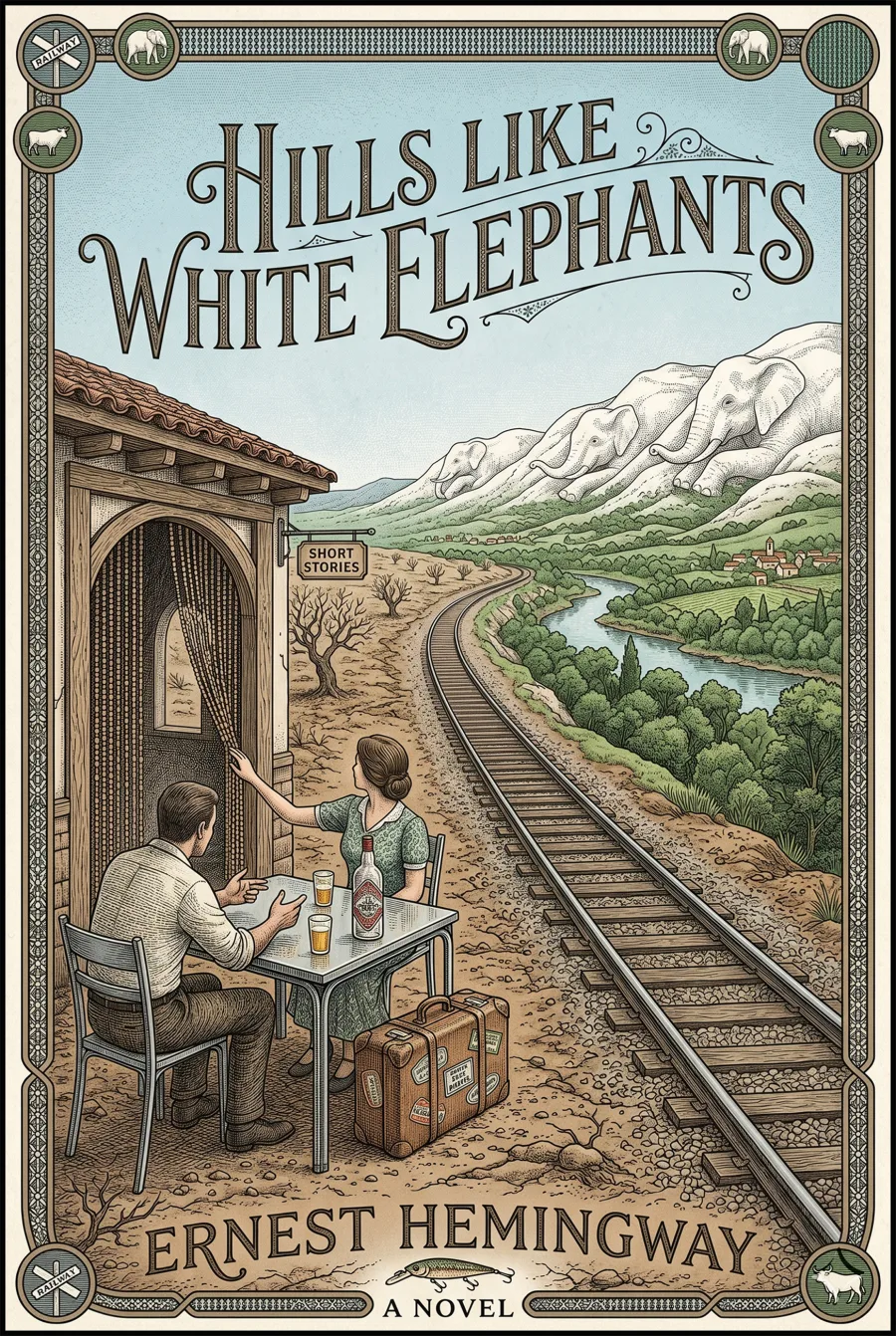
Hills Like White Elephants
eBook
• INR 51.00
• English
• 9788169359764
No ratings yet
| Publisher | General Press |
|---|---|
| ISBN13 | 9788169359764 |
| ASIN/SKU | 8169359767 |
| Book Format | eBook |
| Language | English |
| List Price | INR 51.00 |
| Subject Code | FIC025000, FIC029000, FIC004000 |
| Publishing Date | 01/09/2026 |
| Book Code | BD00070215 |
Buy this Book
Amazon Stores
Ebook Stores
Other Stores
Discover Hills Like White Elephants by Ernest Hemingway. This book is published by General Press in eBook format, ISBN 9788169359764, ASIN 8169359767, under Literature and Fiction, Psychological Fiction, Short Stories and Anthologies.
Book Description
A seemingly simple conversation at a remote railway station gradually reveals a deeply personal decision that could change two people's lives forever. 'Hills Like White Elephants' by Ernest Hemingway is a classic modernist literary short story that explores love, communication, choice, and emotional conflict through Hemingway's famously restrained and understated style.
The story follows an American man and a young woman named Jig as they wait for a train at a small station in Spain's Ebro Valley. They are traveling together, but beneath their casual conversation lies an unresolved issue that neither addresses openly. The man repeatedly tries to persuade Jig to undergo an unnamed medical procedure, suggesting that it would solve their problems and allow them to return to the carefree life they once enjoyed. Jig, however, is uncertain and struggles to understand what the decision will mean for their relationship and their future.
Much of the story's power comes from what remains unsaid. Hemingway never directly explains the procedure, leaving readers to understand its significance through fragments of dialogue, pauses, gestures, and carefully chosen observations. The couple's conversation moves between ordinary subjects such as drinks, the landscape, and the approaching train while gradually exposing their different hopes and fears. Jig seems to want reassurance that their relationship can have meaning, while the man focuses on convincing her that the decision is simple and harmless.
The hills in the distance, which Jig compares to white elephants, become a subtle symbol of the choice facing them and the possibility of a future they cannot easily discuss. With remarkable economy, Hemingway creates tension without dramatic confrontation, allowing the emotional weight to emerge beneath the surface. 'Hills Like White Elephants' is a quiet but unforgettable story about how silence, persuasion, and love can shape a life-changing choice—leaving readers to decide what happens when the train finally arrives.
The story follows an American man and a young woman named Jig as they wait for a train at a small station in Spain's Ebro Valley. They are traveling together, but beneath their casual conversation lies an unresolved issue that neither addresses openly. The man repeatedly tries to persuade Jig to undergo an unnamed medical procedure, suggesting that it would solve their problems and allow them to return to the carefree life they once enjoyed. Jig, however, is uncertain and struggles to understand what the decision will mean for their relationship and their future.
Much of the story's power comes from what remains unsaid. Hemingway never directly explains the procedure, leaving readers to understand its significance through fragments of dialogue, pauses, gestures, and carefully chosen observations. The couple's conversation moves between ordinary subjects such as drinks, the landscape, and the approaching train while gradually exposing their different hopes and fears. Jig seems to want reassurance that their relationship can have meaning, while the man focuses on convincing her that the decision is simple and harmless.
The hills in the distance, which Jig compares to white elephants, become a subtle symbol of the choice facing them and the possibility of a future they cannot easily discuss. With remarkable economy, Hemingway creates tension without dramatic confrontation, allowing the emotional weight to emerge beneath the surface. 'Hills Like White Elephants' is a quiet but unforgettable story about how silence, persuasion, and love can shape a life-changing choice—leaving readers to decide what happens when the train finally arrives.
Author Biography
Few writers have shaped modern literature as profoundly as Ernest Hemingway, whose spare prose and unforgettable characters made him one of the most influential American authors of the 20th century. Best known for his novels, short stories, and journalism, Hemingway created celebrated works such as 'The Sun Also Rises', 'A Farewell to Arms', 'For Whom the Bell Tolls', and 'The Old Man and the Sea'.
Born on July 21, 1899, in Oak Park, Illinois, Hemingway developed an early interest in writing and journalism. After serving as an ambulance driver during World War I, he drew deeply on his experiences of war, love, loss, and courage in his fiction. He later worked as a journalist and became part of the vibrant literary community of 1920s Paris, where he associated with other important writers and artists.
Hemingway's writing was famous for its simplicity, precision, and emotional restraint. His short, direct sentences often carried deeper meanings beneath the surface, a technique that became closely associated with his distinctive style. His stories frequently explored themes of courage, masculinity, conflict, endurance, and the struggle to find meaning in a difficult world.
Among his greatest achievements, 'The Old Man and the Sea' earned the Pulitzer Prize for Fiction in 1953, while Hemingway received the Nobel Prize in Literature in 1954 for his powerful influence on contemporary prose. His adventurous life, travels, and experiences also became an important part of his public image.
Hemingway died in 1961, but his influence remains strong. His distinctive voice, disciplined prose, and enduring stories continue to inspire writers and readers, securing his place as a lasting figure in world literature.
Born on July 21, 1899, in Oak Park, Illinois, Hemingway developed an early interest in writing and journalism. After serving as an ambulance driver during World War I, he drew deeply on his experiences of war, love, loss, and courage in his fiction. He later worked as a journalist and became part of the vibrant literary community of 1920s Paris, where he associated with other important writers and artists.
Hemingway's writing was famous for its simplicity, precision, and emotional restraint. His short, direct sentences often carried deeper meanings beneath the surface, a technique that became closely associated with his distinctive style. His stories frequently explored themes of courage, masculinity, conflict, endurance, and the struggle to find meaning in a difficult world.
Among his greatest achievements, 'The Old Man and the Sea' earned the Pulitzer Prize for Fiction in 1953, while Hemingway received the Nobel Prize in Literature in 1954 for his powerful influence on contemporary prose. His adventurous life, travels, and experiences also became an important part of his public image.
Hemingway died in 1961, but his influence remains strong. His distinctive voice, disciplined prose, and enduring stories continue to inspire writers and readers, securing his place as a lasting figure in world literature.
Editorial Reviews
Editorial Reviews will be added soon…
Book Summary
Ernest Hemingway’s 'Hills Like White Elephants' is one of the most famous short stories in modern American literature and one of the clearest examples of Hemingway’s “iceberg” style of writing. First published in 1927 in the literary magazine 'transition' and later included in his collection 'Men Without Women', the story is remarkably brief, yet it explores enormous questions about love, responsibility, communication, abortion, emotional pressure, and the uncertainty of human relationships. The plot appears simple: an American man and a young woman named Jig wait at a Spanish railway station for a train to Madrid. While drinking beer and anise liqueur, they discuss an unnamed “operation.” Hemingway never explicitly identifies the procedure as an abortion, but the conversation, circumstances, and subsequent history of the story make its meaning clear. The power of the story comes from what is left unsaid. Rather than explaining the characters’ feelings directly, Hemingway allows their words, silences, gestures, and surroundings to reveal the emotional conflict underneath.
The story opens at a railway station in the Ebro Valley of Spain. The station lies between two lines of rails, and the landscape is divided in a striking way. On one side are dry, barren hills; on the other is a greener, more fertile landscape with fields, trees, and a river. The contrast is immediately important because it reflects the central choice facing Jig and the American. They are physically waiting between destinations, and emotionally they are also suspended between two possible futures. The train will eventually take them away from the station, but Hemingway makes the waiting itself the center of the story. They are not merely waiting for transportation. They are waiting to decide what kind of life they will have.
The American and Jig have been traveling together for some time. They appear to have a relationship built around movement, drinking, hotels, and temporary pleasures. They are not married, and their lifestyle seems deliberately free of permanent commitments. The American clearly wants to maintain this freedom. When the conversation turns to the “operation,” he argues that it is a simple procedure and repeatedly tells Jig that it will solve their problem. He insists that he will support whatever decision she makes, but his language gradually reveals that he strongly wants her to have the abortion.
Jig, however, does not appear convinced. She asks what will happen afterward and whether their relationship will return to the way it was before. Her questions reveal that the pregnancy has changed her understanding of their life together. What previously seemed exciting and carefree now looks incomplete. She begins to imagine a future in which they could have a child and live differently. At the same time, she is frightened by the consequences of becoming a mother and uncertain about whether the American truly loves her. The story never gives us a direct description of her internal thoughts. Instead, Hemingway lets her uncertainty emerge through fragments of conversation.
The title, 'Hills Like White Elephants', comes from Jig’s observation of the distant hills. She says that they look like white elephants. The phrase is unusual because it transforms an ordinary landscape into a symbol. A “white elephant” can refer to something rare, beautiful, and valuable, but it can also mean an unwanted or burdensome possession. Jig’s comparison therefore carries several possible meanings. The hills may represent the unborn child, something both extraordinary and potentially burdensome. They may also represent the complicated future that the couple cannot stop thinking about. Most importantly, the phrase demonstrates Jig’s imaginative way of seeing the world. She notices beauty and symbolism where the American tends to see practical problems.
The American responds to the landscape differently. He is more focused on the operation and on convincing Jig that it is easy. He tells her that it is “perfectly simple,” a phrase he repeats in different forms throughout the story. This repetition is significant because the operation may be medically simple, but the emotional decision is anything but simple. Hemingway creates irony by placing the man’s repeated insistence on simplicity against Jig’s increasingly complicated emotional responses. The more he tells her that the decision is easy, the clearer it becomes that the situation is deeply difficult.
The couple’s conversation is the central action of the story. Almost nothing happens physically. They sit, drink, look at the landscape, speak with the bartender, and wait for the train. Yet emotionally, the story is full of movement. Jig moves between curiosity, hope, fear, resignation, anger, and desperation. The American moves between persuasion, reassurance, irritation, and emotional pressure. Their conversation becomes a struggle in which each person is trying to influence the other without openly acknowledging the full emotional stakes.
One of the most important features of Hemingway’s writing is his use of dialogue without explanation. The narrator does not tell us that the American is manipulative or that Jig feels trapped. Instead, readers must infer these things from what the characters say. The American repeatedly claims that he does not want Jig to do anything she does not want to do. Yet he also tells her that he knows the operation is simple and that everything will be fine if she has it. He emphasizes that afterward they can return to their carefree life of traveling together. His argument therefore depends on the assumption that their previous lifestyle is the ideal one.
Jig sees the situation differently. She asks whether the American will stay with her and whether they can still be happy. At one point, she imagines a life in which they could have everything and do not need to travel constantly. Her longing is subtle but powerful. She appears to be considering motherhood not simply as an isolated event but as an opportunity to give their relationship permanence and meaning. The pregnancy has forced her to confront the possibility that their relationship cannot remain indefinitely detached from responsibility.
The American’s behavior suggests that he sees the pregnancy primarily as a threat to their existing lifestyle. He does not seem ready to become a father, and he is afraid that the relationship will change. His insistence that Jig undergo the operation is therefore connected to his desire to preserve the past. He wants the freedom, drinking, travel, and intimacy they already share without accepting the consequences of their sexual relationship. Jig, meanwhile, seems increasingly aware that returning to the past may be impossible regardless of what she decides.
The railway station itself becomes a powerful symbol. The couple is between destinations, surrounded by tracks leading in different directions. The station represents a moment of decision. They are literally and metaphorically at a crossroads. One route leads toward an operation and potentially toward the continuation of their previous lifestyle. Another possibility leads toward parenthood and a radically different future. Hemingway never states these alternatives in such direct terms, but the setting makes the choice visible.
The two sides of the valley reinforce this symbolism. One side is dry, hot, and barren, while the other is green and fertile. The fertile landscape naturally evokes ideas of growth, life, and possibility, while the dry landscape can suggest sterility and emotional emptiness. Yet Hemingway does not reduce the symbolism to a simple equation in which one side is good and the other bad. Parenthood can bring joy, but it can also bring responsibility and difficulty. Freedom can bring pleasure, but it can also bring loneliness. Both futures contain uncertainty.
Jig’s name is also significant. “Jig” suggests a dance, movement, and rhythm, and she is indeed caught in an emotional dance with the American. She changes position, asks questions, retreats, challenges him, and eventually asks him to stop talking. Her movements through the conversation resemble the shifting possibilities of the relationship itself. She is trying to find a position from which she can understand what she wants, but the American’s pressure makes that difficult.
The story’s treatment of abortion is especially notable because Hemingway never uses the word. The “operation” remains deliberately unnamed. This is part of his iceberg technique: the author gives readers only the visible portion of the story and expects them to infer the submerged meaning. In the 1920s, abortion was highly controversial and generally illegal in many places, making the subject particularly sensitive. Hemingway’s decision not to name it allows the story to focus less on medical or political arguments and more on the emotional and moral conflict between two people.
One of the story’s deepest themes is communication and the failure of communication. The American and Jig talk constantly, but they rarely communicate honestly. Their words often conceal more than they reveal. When the American says that he wants Jig to be happy, the reader can hear the pressure underneath his reassurance. When Jig says she is fine, it is clear that she is not. They use polite and ordinary phrases to discuss something that could permanently change their lives. Their conversation therefore becomes an example of how two people can speak endlessly while remaining emotionally isolated.
Hemingway also explores the unequal nature of decision-making within intimate relationships. Although the pregnancy involves both characters, Jig bears the physical and emotional consequences in a way the American does not. He can describe the operation as simple because his body is not undergoing it. His repeated reassurance therefore carries an implicit imbalance of power. Jig recognizes this imbalance, even if she does not state it directly. Her frustration grows because the American wants to present the decision as mutual while simultaneously pushing her toward the outcome he prefers.
At the same time, Hemingway avoids turning the American into a simple villain. He is selfish and pressuring, but he may also be frightened. His desire to avoid fatherhood may come from immaturity, fear of responsibility, or genuine belief that he and Jig cannot build a stable life with a child. He tells her that he does not want her to have the operation unless she wants it. His problem is that he cannot genuinely accept a choice that differs from his own preference. This makes him more psychologically realistic than a purely cruel character.
Jig is similarly complex. She is not presented as an uncomplicated symbol of motherhood. She is uncertain and sometimes appears to consider the operation seriously. She knows that having a child will change her life. She also seems to understand that their relationship may already be damaged beyond repair. Her desire for a child may partly reflect her hope that the relationship can become more meaningful. Her fear of the operation may therefore be intertwined with a deeper fear that, without the pregnancy, there will be nothing holding the couple together.
The final portion of the story is intentionally ambiguous. Jig asks the American to stop talking and tells him that she is all right. The American asks whether she feels better and she says that she feels fine. But Hemingway gives us no definitive statement about what she has decided. We do not know whether she will undergo the operation. We do not know whether the couple will remain together. We do not know whether their relationship will recover. This ambiguity is essential. The story is not primarily interested in delivering a clear moral conclusion. Instead, it leaves readers inside the uncertainty that the characters themselves are experiencing.
For readers searching for a 'Hills Like White Elephants' summary, the central conflict is therefore not simply whether Jig will have an abortion. The deeper question is what each character is willing to sacrifice for the relationship. The American wants to preserve freedom and avoid responsibility, while Jig is beginning to desire a more permanent and meaningful life. The pregnancy forces both of them to confront the limitations of their existing relationship. Their disagreement exposes a deeper incompatibility that existed before the conversation began.
The symbolism throughout the story strengthens this emotional conflict. The hills, the valley, the railway tracks, the beer, the absinthe, the waiting train, and the repeated references to the operation all contribute to a carefully constructed atmosphere. The white hills can suggest beauty, fertility, burden, or an uncertain future. The railway tracks represent diverging paths. The dry and fertile sides of the valley suggest different possibilities. The alcohol reflects the couple’s attempt to maintain their familiar lifestyle and perhaps to avoid confronting difficult emotions directly.
Hemingway’s writing style is perhaps the greatest reason the story remains so widely studied. He uses short sentences, ordinary vocabulary, repetition, silence, and carefully chosen details. Nothing is explained unnecessarily. The reader becomes an active participant, reconstructing the emotional story from fragments. This technique is often called the “iceberg theory”: the writer shows only the surface while the larger emotional reality remains beneath it. 'Hills Like White Elephants' is one of the clearest demonstrations of this method because almost everything important is implied rather than explicitly stated.
Ultimately, 'Hills Like White Elephants' is a story about a relationship standing at a crossroads. Jig and the American are not merely deciding what to do about an unwanted pregnancy. They are deciding whether they can imagine the same future. The American wants the past to continue unchanged; Jig is beginning to recognize that life may demand a different direction. Their conversation reveals love, fear, pressure, uncertainty, and emotional distance without ever resolving them.
The enduring power of Hemingway’s story comes from its refusal to tell readers exactly what to think. It does not offer an easy judgment about abortion, motherhood, freedom, or the man and woman involved. Instead, it presents a painful moment in which two people discover that loving each other may not be enough to make their desires compatible. For readers interested in Ernest Hemingway’s short stories, modernist literature, symbolism, the iceberg theory, abortion in literature, or close readings of 'Hills Like White Elephants', the story remains a remarkably rich work. Its few pages contain an entire relationship: its pleasures, its evasions, its hopes, its fears, and the quiet realization that sometimes the most important decisions in life are the ones people struggle hardest to say aloud.
The story opens at a railway station in the Ebro Valley of Spain. The station lies between two lines of rails, and the landscape is divided in a striking way. On one side are dry, barren hills; on the other is a greener, more fertile landscape with fields, trees, and a river. The contrast is immediately important because it reflects the central choice facing Jig and the American. They are physically waiting between destinations, and emotionally they are also suspended between two possible futures. The train will eventually take them away from the station, but Hemingway makes the waiting itself the center of the story. They are not merely waiting for transportation. They are waiting to decide what kind of life they will have.
The American and Jig have been traveling together for some time. They appear to have a relationship built around movement, drinking, hotels, and temporary pleasures. They are not married, and their lifestyle seems deliberately free of permanent commitments. The American clearly wants to maintain this freedom. When the conversation turns to the “operation,” he argues that it is a simple procedure and repeatedly tells Jig that it will solve their problem. He insists that he will support whatever decision she makes, but his language gradually reveals that he strongly wants her to have the abortion.
Jig, however, does not appear convinced. She asks what will happen afterward and whether their relationship will return to the way it was before. Her questions reveal that the pregnancy has changed her understanding of their life together. What previously seemed exciting and carefree now looks incomplete. She begins to imagine a future in which they could have a child and live differently. At the same time, she is frightened by the consequences of becoming a mother and uncertain about whether the American truly loves her. The story never gives us a direct description of her internal thoughts. Instead, Hemingway lets her uncertainty emerge through fragments of conversation.
The title, 'Hills Like White Elephants', comes from Jig’s observation of the distant hills. She says that they look like white elephants. The phrase is unusual because it transforms an ordinary landscape into a symbol. A “white elephant” can refer to something rare, beautiful, and valuable, but it can also mean an unwanted or burdensome possession. Jig’s comparison therefore carries several possible meanings. The hills may represent the unborn child, something both extraordinary and potentially burdensome. They may also represent the complicated future that the couple cannot stop thinking about. Most importantly, the phrase demonstrates Jig’s imaginative way of seeing the world. She notices beauty and symbolism where the American tends to see practical problems.
The American responds to the landscape differently. He is more focused on the operation and on convincing Jig that it is easy. He tells her that it is “perfectly simple,” a phrase he repeats in different forms throughout the story. This repetition is significant because the operation may be medically simple, but the emotional decision is anything but simple. Hemingway creates irony by placing the man’s repeated insistence on simplicity against Jig’s increasingly complicated emotional responses. The more he tells her that the decision is easy, the clearer it becomes that the situation is deeply difficult.
The couple’s conversation is the central action of the story. Almost nothing happens physically. They sit, drink, look at the landscape, speak with the bartender, and wait for the train. Yet emotionally, the story is full of movement. Jig moves between curiosity, hope, fear, resignation, anger, and desperation. The American moves between persuasion, reassurance, irritation, and emotional pressure. Their conversation becomes a struggle in which each person is trying to influence the other without openly acknowledging the full emotional stakes.
One of the most important features of Hemingway’s writing is his use of dialogue without explanation. The narrator does not tell us that the American is manipulative or that Jig feels trapped. Instead, readers must infer these things from what the characters say. The American repeatedly claims that he does not want Jig to do anything she does not want to do. Yet he also tells her that he knows the operation is simple and that everything will be fine if she has it. He emphasizes that afterward they can return to their carefree life of traveling together. His argument therefore depends on the assumption that their previous lifestyle is the ideal one.
Jig sees the situation differently. She asks whether the American will stay with her and whether they can still be happy. At one point, she imagines a life in which they could have everything and do not need to travel constantly. Her longing is subtle but powerful. She appears to be considering motherhood not simply as an isolated event but as an opportunity to give their relationship permanence and meaning. The pregnancy has forced her to confront the possibility that their relationship cannot remain indefinitely detached from responsibility.
The American’s behavior suggests that he sees the pregnancy primarily as a threat to their existing lifestyle. He does not seem ready to become a father, and he is afraid that the relationship will change. His insistence that Jig undergo the operation is therefore connected to his desire to preserve the past. He wants the freedom, drinking, travel, and intimacy they already share without accepting the consequences of their sexual relationship. Jig, meanwhile, seems increasingly aware that returning to the past may be impossible regardless of what she decides.
The railway station itself becomes a powerful symbol. The couple is between destinations, surrounded by tracks leading in different directions. The station represents a moment of decision. They are literally and metaphorically at a crossroads. One route leads toward an operation and potentially toward the continuation of their previous lifestyle. Another possibility leads toward parenthood and a radically different future. Hemingway never states these alternatives in such direct terms, but the setting makes the choice visible.
The two sides of the valley reinforce this symbolism. One side is dry, hot, and barren, while the other is green and fertile. The fertile landscape naturally evokes ideas of growth, life, and possibility, while the dry landscape can suggest sterility and emotional emptiness. Yet Hemingway does not reduce the symbolism to a simple equation in which one side is good and the other bad. Parenthood can bring joy, but it can also bring responsibility and difficulty. Freedom can bring pleasure, but it can also bring loneliness. Both futures contain uncertainty.
Jig’s name is also significant. “Jig” suggests a dance, movement, and rhythm, and she is indeed caught in an emotional dance with the American. She changes position, asks questions, retreats, challenges him, and eventually asks him to stop talking. Her movements through the conversation resemble the shifting possibilities of the relationship itself. She is trying to find a position from which she can understand what she wants, but the American’s pressure makes that difficult.
The story’s treatment of abortion is especially notable because Hemingway never uses the word. The “operation” remains deliberately unnamed. This is part of his iceberg technique: the author gives readers only the visible portion of the story and expects them to infer the submerged meaning. In the 1920s, abortion was highly controversial and generally illegal in many places, making the subject particularly sensitive. Hemingway’s decision not to name it allows the story to focus less on medical or political arguments and more on the emotional and moral conflict between two people.
One of the story’s deepest themes is communication and the failure of communication. The American and Jig talk constantly, but they rarely communicate honestly. Their words often conceal more than they reveal. When the American says that he wants Jig to be happy, the reader can hear the pressure underneath his reassurance. When Jig says she is fine, it is clear that she is not. They use polite and ordinary phrases to discuss something that could permanently change their lives. Their conversation therefore becomes an example of how two people can speak endlessly while remaining emotionally isolated.
Hemingway also explores the unequal nature of decision-making within intimate relationships. Although the pregnancy involves both characters, Jig bears the physical and emotional consequences in a way the American does not. He can describe the operation as simple because his body is not undergoing it. His repeated reassurance therefore carries an implicit imbalance of power. Jig recognizes this imbalance, even if she does not state it directly. Her frustration grows because the American wants to present the decision as mutual while simultaneously pushing her toward the outcome he prefers.
At the same time, Hemingway avoids turning the American into a simple villain. He is selfish and pressuring, but he may also be frightened. His desire to avoid fatherhood may come from immaturity, fear of responsibility, or genuine belief that he and Jig cannot build a stable life with a child. He tells her that he does not want her to have the operation unless she wants it. His problem is that he cannot genuinely accept a choice that differs from his own preference. This makes him more psychologically realistic than a purely cruel character.
Jig is similarly complex. She is not presented as an uncomplicated symbol of motherhood. She is uncertain and sometimes appears to consider the operation seriously. She knows that having a child will change her life. She also seems to understand that their relationship may already be damaged beyond repair. Her desire for a child may partly reflect her hope that the relationship can become more meaningful. Her fear of the operation may therefore be intertwined with a deeper fear that, without the pregnancy, there will be nothing holding the couple together.
The final portion of the story is intentionally ambiguous. Jig asks the American to stop talking and tells him that she is all right. The American asks whether she feels better and she says that she feels fine. But Hemingway gives us no definitive statement about what she has decided. We do not know whether she will undergo the operation. We do not know whether the couple will remain together. We do not know whether their relationship will recover. This ambiguity is essential. The story is not primarily interested in delivering a clear moral conclusion. Instead, it leaves readers inside the uncertainty that the characters themselves are experiencing.
For readers searching for a 'Hills Like White Elephants' summary, the central conflict is therefore not simply whether Jig will have an abortion. The deeper question is what each character is willing to sacrifice for the relationship. The American wants to preserve freedom and avoid responsibility, while Jig is beginning to desire a more permanent and meaningful life. The pregnancy forces both of them to confront the limitations of their existing relationship. Their disagreement exposes a deeper incompatibility that existed before the conversation began.
The symbolism throughout the story strengthens this emotional conflict. The hills, the valley, the railway tracks, the beer, the absinthe, the waiting train, and the repeated references to the operation all contribute to a carefully constructed atmosphere. The white hills can suggest beauty, fertility, burden, or an uncertain future. The railway tracks represent diverging paths. The dry and fertile sides of the valley suggest different possibilities. The alcohol reflects the couple’s attempt to maintain their familiar lifestyle and perhaps to avoid confronting difficult emotions directly.
Hemingway’s writing style is perhaps the greatest reason the story remains so widely studied. He uses short sentences, ordinary vocabulary, repetition, silence, and carefully chosen details. Nothing is explained unnecessarily. The reader becomes an active participant, reconstructing the emotional story from fragments. This technique is often called the “iceberg theory”: the writer shows only the surface while the larger emotional reality remains beneath it. 'Hills Like White Elephants' is one of the clearest demonstrations of this method because almost everything important is implied rather than explicitly stated.
Ultimately, 'Hills Like White Elephants' is a story about a relationship standing at a crossroads. Jig and the American are not merely deciding what to do about an unwanted pregnancy. They are deciding whether they can imagine the same future. The American wants the past to continue unchanged; Jig is beginning to recognize that life may demand a different direction. Their conversation reveals love, fear, pressure, uncertainty, and emotional distance without ever resolving them.
The enduring power of Hemingway’s story comes from its refusal to tell readers exactly what to think. It does not offer an easy judgment about abortion, motherhood, freedom, or the man and woman involved. Instead, it presents a painful moment in which two people discover that loving each other may not be enough to make their desires compatible. For readers interested in Ernest Hemingway’s short stories, modernist literature, symbolism, the iceberg theory, abortion in literature, or close readings of 'Hills Like White Elephants', the story remains a remarkably rich work. Its few pages contain an entire relationship: its pleasures, its evasions, its hopes, its fears, and the quiet realization that sometimes the most important decisions in life are the ones people struggle hardest to say aloud.
Sample Chapters
Sample Chapters will be added soon…
Reader Reviews
No reviews yet.
Hills Like White Elephants
Download Cover Image
Do you want to download the full cover image for Hills Like White Elephants?