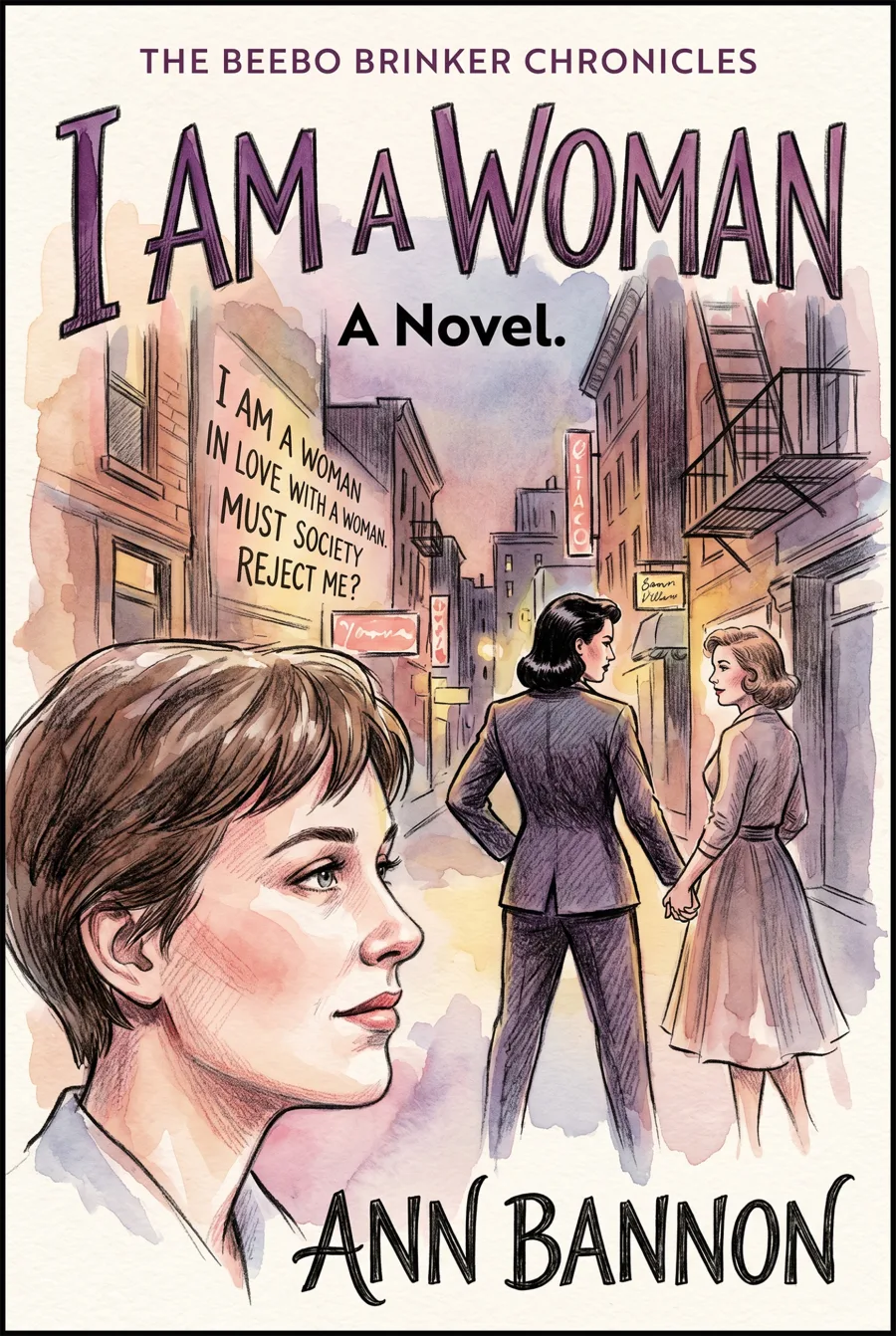
I Am a Woman
eBook
• INR 51.00
• English
• 9788169359023
No ratings yet
| Publisher | General Press |
|---|---|
| ISBN13 | 9788169359023 |
| ASIN/SKU | 8169359023 |
| Book Format | eBook |
| Language | English |
| List Price | INR 51.00 |
| Subject Code | FIC018000, FIC027210, FIC069000 |
| Publishing Date | 01/09/2026 |
| Book Code | BD00070216 |
Buy this Book
Amazon Stores
Ebook Stores
Other Stores
Discover I Am a Woman by Ann Bannon. This book is published by General Press in eBook format, ISBN 9788169359023, ASIN 8169359023, under Literature and Fiction, Romance, Adult Fiction.
Book Description
What happens when a young woman begins to question the life she has been told she should want? 'I Am a Woman' by Ann Bannon is a groundbreaking lesbian fiction novel that explores desire, identity, loneliness, and the search for emotional freedom in 1950s America. First published in 1959, the novel became an important part of Bannon's celebrated “Beebo Brinker” series and helped bring lesbian relationships and experiences into popular fiction at a time when such subjects were rarely treated openly.
The story centers on Laura Landon, a young woman whose conventional life leaves her increasingly uncertain and dissatisfied. Married to a man but struggling to understand her own feelings, Laura enters a world very different from the one she has known when she encounters women who live outside traditional expectations. Among them is Beth Cullison, a confident and emotionally compelling woman whose presence forces Laura to confront feelings she has tried to ignore.
As Laura becomes more involved in this new social circle, she begins to experience both excitement and fear. Her attraction to women offers the possibility of genuine connection, but it also creates difficult questions about marriage, respectability, social judgment, and the kind of future she truly wants. Bannon portrays these conflicts with an emphasis on the emotional lives of her characters, showing how difficult it can be to reconcile personal desire with the expectations imposed by society.
Rather than presenting identity as something simple or easily resolved, 'I Am a Woman' captures the uncertainty, longing, and courage involved in discovering oneself. Its honest exploration of love and self-acceptance makes it a significant work of classic lesbian literature, and Laura's journey continues to invite readers into a story of desire, choice, and awakening.
The story centers on Laura Landon, a young woman whose conventional life leaves her increasingly uncertain and dissatisfied. Married to a man but struggling to understand her own feelings, Laura enters a world very different from the one she has known when she encounters women who live outside traditional expectations. Among them is Beth Cullison, a confident and emotionally compelling woman whose presence forces Laura to confront feelings she has tried to ignore.
As Laura becomes more involved in this new social circle, she begins to experience both excitement and fear. Her attraction to women offers the possibility of genuine connection, but it also creates difficult questions about marriage, respectability, social judgment, and the kind of future she truly wants. Bannon portrays these conflicts with an emphasis on the emotional lives of her characters, showing how difficult it can be to reconcile personal desire with the expectations imposed by society.
Rather than presenting identity as something simple or easily resolved, 'I Am a Woman' captures the uncertainty, longing, and courage involved in discovering oneself. Its honest exploration of love and self-acceptance makes it a significant work of classic lesbian literature, and Laura's journey continues to invite readers into a story of desire, choice, and awakening.
Author Biography
Ann Bannon helped bring lesbian lives and relationships into mainstream American literature at a time when such stories were rarely given a voice. Ann Bannon was an American author best known for her pioneering lesbian fiction, particularly the groundbreaking Beebo Brinker series, which became an important part of LGBTQ+ literary history.
Born Ann Weldy in Joliet, Illinois, in 1932, she grew up during an era when discussions of sexuality were often surrounded by silence and social stigma. She later married and had children, but her personal experiences and observations of women struggling with identity, desire, and social expectations inspired her writing. In the 1950s, she began publishing novels that explored lesbian relationships with unusual openness and sympathy for the period.
Her best-known books include Odd Girl Out (1957), I Am a Woman (1959), Women in the Shadows (1959), Journey to a Woman (1960), The Marriage (1960), and Beebo Brinker (1962). Together, these novels became known as the Beebo Brinker Chronicles. Written as accessible, emotionally engaging popular fiction, the books portrayed lesbian characters as complex individuals seeking love, belonging, friendship, and independence rather than simply as stereotypes or tragic figures.
Although Bannon initially wrote under a pen name, her books found a devoted readership and circulated widely, particularly among women searching for stories that reflected experiences they rarely saw represented elsewhere. Over time, her work gained greater recognition for helping establish lesbian fiction as an important literary and cultural form. She later worked as an academic and educator, earning a doctorate in linguistics and pursuing a long career in teaching.
Ann Bannon's novels remain significant not only for their historical importance but also for the readers who continue to discover them. Her willingness to write openly about lesbian lives helped create space for generations of LGBTQ+ writers and readers, securing her lasting place in queer literary history.
Born Ann Weldy in Joliet, Illinois, in 1932, she grew up during an era when discussions of sexuality were often surrounded by silence and social stigma. She later married and had children, but her personal experiences and observations of women struggling with identity, desire, and social expectations inspired her writing. In the 1950s, she began publishing novels that explored lesbian relationships with unusual openness and sympathy for the period.
Her best-known books include Odd Girl Out (1957), I Am a Woman (1959), Women in the Shadows (1959), Journey to a Woman (1960), The Marriage (1960), and Beebo Brinker (1962). Together, these novels became known as the Beebo Brinker Chronicles. Written as accessible, emotionally engaging popular fiction, the books portrayed lesbian characters as complex individuals seeking love, belonging, friendship, and independence rather than simply as stereotypes or tragic figures.
Although Bannon initially wrote under a pen name, her books found a devoted readership and circulated widely, particularly among women searching for stories that reflected experiences they rarely saw represented elsewhere. Over time, her work gained greater recognition for helping establish lesbian fiction as an important literary and cultural form. She later worked as an academic and educator, earning a doctorate in linguistics and pursuing a long career in teaching.
Ann Bannon's novels remain significant not only for their historical importance but also for the readers who continue to discover them. Her willingness to write openly about lesbian lives helped create space for generations of LGBTQ+ writers and readers, securing her lasting place in queer literary history.
Editorial Reviews
Editorial Reviews will be added soon…
Book Summary
Ann Bannon’s 'I Am a Woman' is a landmark lesbian pulp novel first published in 1959 and the second book in what later became known as 'The Beebo Brinker Chronicles'. Set largely in New York City’s Greenwich Village, the novel follows Laura Landon as she struggles to understand her sexuality, build an independent life, and find emotional security in a society that gives her almost no language for what she feels. The book is often remembered for its romance between Laura and the charismatic Beebo Brinker, but its deeper subject is self-recognition: what happens when a woman realizes that the life expected of her may not be the life she wants. Bannon combines melodrama, romance, sexual tension, loneliness, and psychological conflict to tell a story that was unusually sympathetic toward lesbian characters for its time. The novel was originally marketed under the provocative full title 'I Am a Woman in Love With a Woman—Must Society Reject Me?', reflecting the anxieties surrounding lesbian identity in 1950s America.
The story continues Laura Landon’s journey from 'Odd Girl Out'. After the painful end of her relationship with Beth, Laura is emotionally exhausted and uncertain about her future. She has already discovered that her feelings for women are real, but knowing this does not automatically give her confidence or a sense of belonging. Instead, she enters the larger world of Greenwich Village carrying shame, fear, loneliness, and a desperate need to understand herself. Her move to New York is therefore more than a change of location. It represents an attempt to escape the expectations that have controlled her life and discover whether there is somewhere in the world where she can exist without constantly pretending to be someone else. The novel's Greenwich Village setting is important because it gives Laura access to a hidden social world of lesbian and gay people, bars, friendships, romances, and unconventional relationships. For a woman living in the 1950s, such a community could feel both liberating and frightening.
Laura’s emotional problems are intensified by her relationship with her father. He is harsh, judgmental, and deeply difficult for her to confront. His treatment of Laura is connected to painful family history, including the deaths of her mother and brother, which has left an unresolved wound between them. Laura’s sense of guilt and inadequacy is therefore not simply about sexuality. She has spent much of her life feeling that she has disappointed the people around her. Her father represents the authority of the conventional world—the world that tells her what a respectable woman should be, how she should behave, whom she should love, and what kind of future she should pursue. By leaving him and coming to New York, Laura is attempting to break away from that definition of womanhood, even though she has not yet developed a confident definition of her own.
One of the first important people Laura meets in Greenwich Village is Jack Mann, a witty, perceptive gay man who becomes one of the novel’s most sympathetic characters. Jack is important because he gives Laura something she desperately needs: someone who understands the hidden world she is entering without treating her feelings as something shameful or monstrous. He can joke about sexuality and relationships, but beneath his humor is genuine emotional intelligence. He recognizes Laura’s attraction to women before she is fully prepared to acknowledge it herself. His friendship helps her understand that homosexuality is not simply a private psychological problem. There are other people living outside heterosexual conventions, and they have their own communities, disappointments, friendships, desires, and dreams. Jack therefore functions as both friend and guide, helping Laura move from isolation toward self-awareness.
Laura’s living situation also introduces her to Marcie, a woman whose attitude toward sexuality is very different from Laura’s. Marcie is more confident, curious, and willing to experiment, but she does not necessarily approach Laura’s feelings with the same seriousness Laura does. This creates one of the novel’s central emotional tensions. Laura tends to love intensely and sincerely, while the people she becomes attached to are not always capable of giving her the same emotional commitment. Her attraction to Marcie becomes increasingly painful because Laura wants emotional certainty from someone who is treating the relationship more casually. Bannon uses this situation to show how dangerous emotional dependence can become when a person is still struggling with self-worth. Laura is not merely trying to win another woman’s affection; she is looking for confirmation that she herself is worthy of being loved.
The turning point of 'I Am a Woman' comes with the introduction of Beebo Brinker. Beebo is one of the most memorable characters in lesbian pulp fiction: tall, physically imposing, handsome, confident, masculine in appearance, and completely comfortable moving through the Village on her own terms. She represents almost everything that fascinates and frightens Laura. Where Laura is hesitant, Beebo is direct. Where Laura worries about what other people think, Beebo seems much less concerned with conventional approval. Where Laura is uncertain about her place in the world, Beebo has developed a recognizable identity within the lesbian community. Ann Bannon later explained that Beebo was partly a character she created because she needed such a woman to exist in fiction. She imagined Beebo as a bold, charismatic, almost larger-than-life figure, and the character eventually became the central figure of the entire series.
Laura and Beebo’s attraction is powerful because the two women complement and challenge one another. Laura is drawn to Beebo’s confidence and physical presence, while Beebo is fascinated by Laura’s femininity and emotional sensitivity. Their relationship is not presented as a simple rescue story in which the confident woman saves the confused woman. Instead, both women bring their own needs and weaknesses into the relationship. Laura wants security and unconditional love, while Beebo wants to be desired and accepted as the woman she actually is. Their attraction therefore has both romantic and psychological dimensions. They are attracted to one another not only because of physical chemistry but because each possesses qualities the other lacks.
The romance between Laura and Beebo becomes the emotional heart of the novel. Once Laura begins living with Beebo, she experiences something close to the domestic intimacy she has been searching for. Yet happiness does not immediately erase her insecurity. Laura continues to struggle with her feelings about Marcie, her father, and her own identity. She can be deeply affectionate toward Beebo one moment and cruel or rejecting the next. This instability is one of the novel’s most important features because Bannon does not portray sexual self-discovery as a clean or effortless process. Laura has to unlearn years of fear and social conditioning, and that process is messy.
The contrast between Laura and Beebo also allows Bannon to explore gender roles. Beebo is a masculine woman in a period when women were strongly pressured to conform to narrow definitions of femininity. Her appearance and behavior challenge those expectations. Yet the novel does not simply present her masculinity as a costume. Beebo’s identity is fundamental to how she understands herself. Laura is attracted to precisely those qualities that make Beebo unconventional, but when Laura becomes frightened or emotionally overwhelmed, those same qualities can become targets for her anger. This contradiction is crucial. Laura wants the freedom represented by Beebo, but she also fears the social consequences of openly embracing it. Scholars have noted that Bannon repeatedly connects her characters’ bodies, gender presentation, and desires to their struggle for dignity and self-acceptance.
Another major theme in 'I Am a Woman' is the destructive power of shame. Laura’s greatest enemy is not simply society or her father. It is the voice inside her that tells her she is abnormal, selfish, or incapable of having a legitimate future. She wants love, but she has been taught that the kind of love she desires is unacceptable. This creates a painful psychological split. Part of Laura wants to live honestly, while another part wants the safety of conventional respectability. Her relationships become battlegrounds between these two desires.
Bannon’s treatment of lesbian life is particularly significant because of the era in which the novel appeared. Lesbian pulp fiction was often produced within a commercial system that relied on sensational covers, suggestive titles, and sexual themes. Yet Bannon used the genre to create characters with emotional depth and recognizable human problems. Her novels did not simply portray lesbian characters as objects of curiosity for heterosexual readers. They offered women who might have felt isolated a literary world in which people like them existed. Contemporary lesbian publications recognized this difference, particularly the unusually hopeful ending of 'I Am a Woman'.
The novel’s climax brings Laura’s unresolved conflicts to a crisis. Her relationship with Marcie finally reaches a point where Laura is forced to confront the truth about what she feels. Instead of finding the romantic confirmation she hopes for, she experiences another painful disappointment. Her emotional collapse is connected to her confrontation with her father, and the conflict becomes violent. Laura fears that she may have seriously injured or even killed him, and she wanders through the night in a state of terror and confusion. This sequence brings together the novel’s central pressures: family trauma, sexual shame, emotional dependence, and the desperate need to find someone who will accept her.
Yet the ending of 'I Am a Woman' is remarkably hopeful for its period. Laura eventually turns toward Jack and Beebo rather than remaining isolated. She apologizes to Beebo and admits her love. The two women walk away together, arm in arm. This simple gesture carries enormous significance because Bannon refuses to punish her lesbian characters merely for being lesbian. Earlier works of lesbian fiction frequently ended with death, madness, separation, suicide, or total isolation. Bannon instead allows Laura and Beebo the possibility of continuing their lives together. The ending does not promise that their relationship will be easy or permanent, but it does grant them something equally important: the possibility of happiness.
This is why 'I Am a Woman' remains more important than its pulp-fiction label might initially suggest. It is certainly melodramatic, and some of its language and social assumptions are unmistakably products of the 1950s. The emotional situations can be exaggerated, and the relationships sometimes operate according to the heightened conventions of pulp romance. But underneath those conventions is a deeply humane story about a woman trying to become honest with herself. Laura’s journey is not simply about choosing between Marcie and Beebo. It is about choosing whether she will continue living according to other people’s expectations or attempt to create a life based on her own emotional truth.
The title itself captures that struggle. 'I Am a Woman' sounds simple, but in the context of the original marketing phrase—“I Am a Woman in Love With a Woman—Must Society Reject Me?”—it becomes a declaration of identity and a question about social acceptance. Bannon later admitted that she had preferred another title, 'Strangers in This World', but her publisher recognized the commercial value of a title that directly signaled the novel’s forbidden subject matter. The book became a major success, and Beebo Brinker went on to become the most enduring character of Bannon’s literary career.
Ultimately, 'I Am a Woman' is a story about loneliness, desire, identity, friendship, and the difficult path toward self-acceptance. Laura begins the novel frightened and emotionally dependent, uncertain whether there is a place for her in the world. Greenwich Village introduces her to people who demonstrate that she is not alone. Jack gives her friendship and understanding; Marcie exposes the dangers of confusing desire with emotional commitment; and Beebo gives her a vision of love that is more direct, passionate, and accepting. Through these relationships, Laura gradually moves toward the possibility of living honestly.
For readers searching for an 'I Am a Woman' book summary, a summary of Ann Bannon’s Beebo Brinker novels, an explanation of the Laura and Beebo relationship, or an introduction to classic lesbian pulp fiction, the novel is especially valuable as both literature and cultural history. It captures the fears and possibilities surrounding queer identity in 1950s America while giving its central characters emotional complexity that was rare in popular fiction of the period. Most importantly, Bannon allows Laura to survive her confusion and pain without requiring her to surrender the possibility of love. The novel’s lasting message is therefore quietly radical: discovering who you are may be frightening, and living honestly may come with consequences, but a life built around truth can still contain tenderness, companionship, and hope.
The story continues Laura Landon’s journey from 'Odd Girl Out'. After the painful end of her relationship with Beth, Laura is emotionally exhausted and uncertain about her future. She has already discovered that her feelings for women are real, but knowing this does not automatically give her confidence or a sense of belonging. Instead, she enters the larger world of Greenwich Village carrying shame, fear, loneliness, and a desperate need to understand herself. Her move to New York is therefore more than a change of location. It represents an attempt to escape the expectations that have controlled her life and discover whether there is somewhere in the world where she can exist without constantly pretending to be someone else. The novel's Greenwich Village setting is important because it gives Laura access to a hidden social world of lesbian and gay people, bars, friendships, romances, and unconventional relationships. For a woman living in the 1950s, such a community could feel both liberating and frightening.
Laura’s emotional problems are intensified by her relationship with her father. He is harsh, judgmental, and deeply difficult for her to confront. His treatment of Laura is connected to painful family history, including the deaths of her mother and brother, which has left an unresolved wound between them. Laura’s sense of guilt and inadequacy is therefore not simply about sexuality. She has spent much of her life feeling that she has disappointed the people around her. Her father represents the authority of the conventional world—the world that tells her what a respectable woman should be, how she should behave, whom she should love, and what kind of future she should pursue. By leaving him and coming to New York, Laura is attempting to break away from that definition of womanhood, even though she has not yet developed a confident definition of her own.
One of the first important people Laura meets in Greenwich Village is Jack Mann, a witty, perceptive gay man who becomes one of the novel’s most sympathetic characters. Jack is important because he gives Laura something she desperately needs: someone who understands the hidden world she is entering without treating her feelings as something shameful or monstrous. He can joke about sexuality and relationships, but beneath his humor is genuine emotional intelligence. He recognizes Laura’s attraction to women before she is fully prepared to acknowledge it herself. His friendship helps her understand that homosexuality is not simply a private psychological problem. There are other people living outside heterosexual conventions, and they have their own communities, disappointments, friendships, desires, and dreams. Jack therefore functions as both friend and guide, helping Laura move from isolation toward self-awareness.
Laura’s living situation also introduces her to Marcie, a woman whose attitude toward sexuality is very different from Laura’s. Marcie is more confident, curious, and willing to experiment, but she does not necessarily approach Laura’s feelings with the same seriousness Laura does. This creates one of the novel’s central emotional tensions. Laura tends to love intensely and sincerely, while the people she becomes attached to are not always capable of giving her the same emotional commitment. Her attraction to Marcie becomes increasingly painful because Laura wants emotional certainty from someone who is treating the relationship more casually. Bannon uses this situation to show how dangerous emotional dependence can become when a person is still struggling with self-worth. Laura is not merely trying to win another woman’s affection; she is looking for confirmation that she herself is worthy of being loved.
The turning point of 'I Am a Woman' comes with the introduction of Beebo Brinker. Beebo is one of the most memorable characters in lesbian pulp fiction: tall, physically imposing, handsome, confident, masculine in appearance, and completely comfortable moving through the Village on her own terms. She represents almost everything that fascinates and frightens Laura. Where Laura is hesitant, Beebo is direct. Where Laura worries about what other people think, Beebo seems much less concerned with conventional approval. Where Laura is uncertain about her place in the world, Beebo has developed a recognizable identity within the lesbian community. Ann Bannon later explained that Beebo was partly a character she created because she needed such a woman to exist in fiction. She imagined Beebo as a bold, charismatic, almost larger-than-life figure, and the character eventually became the central figure of the entire series.
Laura and Beebo’s attraction is powerful because the two women complement and challenge one another. Laura is drawn to Beebo’s confidence and physical presence, while Beebo is fascinated by Laura’s femininity and emotional sensitivity. Their relationship is not presented as a simple rescue story in which the confident woman saves the confused woman. Instead, both women bring their own needs and weaknesses into the relationship. Laura wants security and unconditional love, while Beebo wants to be desired and accepted as the woman she actually is. Their attraction therefore has both romantic and psychological dimensions. They are attracted to one another not only because of physical chemistry but because each possesses qualities the other lacks.
The romance between Laura and Beebo becomes the emotional heart of the novel. Once Laura begins living with Beebo, she experiences something close to the domestic intimacy she has been searching for. Yet happiness does not immediately erase her insecurity. Laura continues to struggle with her feelings about Marcie, her father, and her own identity. She can be deeply affectionate toward Beebo one moment and cruel or rejecting the next. This instability is one of the novel’s most important features because Bannon does not portray sexual self-discovery as a clean or effortless process. Laura has to unlearn years of fear and social conditioning, and that process is messy.
The contrast between Laura and Beebo also allows Bannon to explore gender roles. Beebo is a masculine woman in a period when women were strongly pressured to conform to narrow definitions of femininity. Her appearance and behavior challenge those expectations. Yet the novel does not simply present her masculinity as a costume. Beebo’s identity is fundamental to how she understands herself. Laura is attracted to precisely those qualities that make Beebo unconventional, but when Laura becomes frightened or emotionally overwhelmed, those same qualities can become targets for her anger. This contradiction is crucial. Laura wants the freedom represented by Beebo, but she also fears the social consequences of openly embracing it. Scholars have noted that Bannon repeatedly connects her characters’ bodies, gender presentation, and desires to their struggle for dignity and self-acceptance.
Another major theme in 'I Am a Woman' is the destructive power of shame. Laura’s greatest enemy is not simply society or her father. It is the voice inside her that tells her she is abnormal, selfish, or incapable of having a legitimate future. She wants love, but she has been taught that the kind of love she desires is unacceptable. This creates a painful psychological split. Part of Laura wants to live honestly, while another part wants the safety of conventional respectability. Her relationships become battlegrounds between these two desires.
Bannon’s treatment of lesbian life is particularly significant because of the era in which the novel appeared. Lesbian pulp fiction was often produced within a commercial system that relied on sensational covers, suggestive titles, and sexual themes. Yet Bannon used the genre to create characters with emotional depth and recognizable human problems. Her novels did not simply portray lesbian characters as objects of curiosity for heterosexual readers. They offered women who might have felt isolated a literary world in which people like them existed. Contemporary lesbian publications recognized this difference, particularly the unusually hopeful ending of 'I Am a Woman'.
The novel’s climax brings Laura’s unresolved conflicts to a crisis. Her relationship with Marcie finally reaches a point where Laura is forced to confront the truth about what she feels. Instead of finding the romantic confirmation she hopes for, she experiences another painful disappointment. Her emotional collapse is connected to her confrontation with her father, and the conflict becomes violent. Laura fears that she may have seriously injured or even killed him, and she wanders through the night in a state of terror and confusion. This sequence brings together the novel’s central pressures: family trauma, sexual shame, emotional dependence, and the desperate need to find someone who will accept her.
Yet the ending of 'I Am a Woman' is remarkably hopeful for its period. Laura eventually turns toward Jack and Beebo rather than remaining isolated. She apologizes to Beebo and admits her love. The two women walk away together, arm in arm. This simple gesture carries enormous significance because Bannon refuses to punish her lesbian characters merely for being lesbian. Earlier works of lesbian fiction frequently ended with death, madness, separation, suicide, or total isolation. Bannon instead allows Laura and Beebo the possibility of continuing their lives together. The ending does not promise that their relationship will be easy or permanent, but it does grant them something equally important: the possibility of happiness.
This is why 'I Am a Woman' remains more important than its pulp-fiction label might initially suggest. It is certainly melodramatic, and some of its language and social assumptions are unmistakably products of the 1950s. The emotional situations can be exaggerated, and the relationships sometimes operate according to the heightened conventions of pulp romance. But underneath those conventions is a deeply humane story about a woman trying to become honest with herself. Laura’s journey is not simply about choosing between Marcie and Beebo. It is about choosing whether she will continue living according to other people’s expectations or attempt to create a life based on her own emotional truth.
The title itself captures that struggle. 'I Am a Woman' sounds simple, but in the context of the original marketing phrase—“I Am a Woman in Love With a Woman—Must Society Reject Me?”—it becomes a declaration of identity and a question about social acceptance. Bannon later admitted that she had preferred another title, 'Strangers in This World', but her publisher recognized the commercial value of a title that directly signaled the novel’s forbidden subject matter. The book became a major success, and Beebo Brinker went on to become the most enduring character of Bannon’s literary career.
Ultimately, 'I Am a Woman' is a story about loneliness, desire, identity, friendship, and the difficult path toward self-acceptance. Laura begins the novel frightened and emotionally dependent, uncertain whether there is a place for her in the world. Greenwich Village introduces her to people who demonstrate that she is not alone. Jack gives her friendship and understanding; Marcie exposes the dangers of confusing desire with emotional commitment; and Beebo gives her a vision of love that is more direct, passionate, and accepting. Through these relationships, Laura gradually moves toward the possibility of living honestly.
For readers searching for an 'I Am a Woman' book summary, a summary of Ann Bannon’s Beebo Brinker novels, an explanation of the Laura and Beebo relationship, or an introduction to classic lesbian pulp fiction, the novel is especially valuable as both literature and cultural history. It captures the fears and possibilities surrounding queer identity in 1950s America while giving its central characters emotional complexity that was rare in popular fiction of the period. Most importantly, Bannon allows Laura to survive her confusion and pain without requiring her to surrender the possibility of love. The novel’s lasting message is therefore quietly radical: discovering who you are may be frightening, and living honestly may come with consequences, but a life built around truth can still contain tenderness, companionship, and hope.
Sample Chapters
Sample Chapters will be added soon…
Reader Reviews
No reviews yet.
I Am a Woman