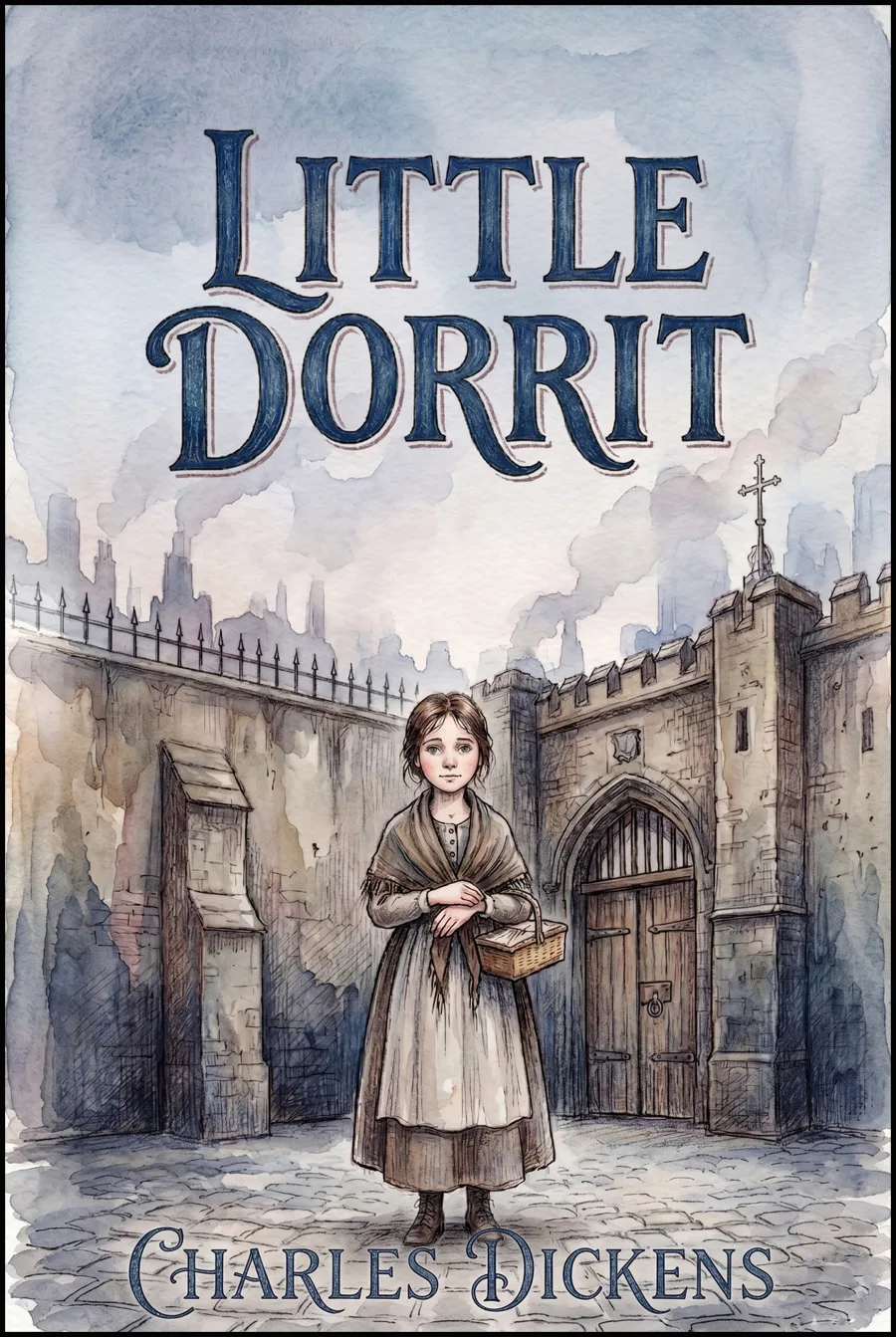
Little Dorrit
eBook
• INR 51.00
• English
• 9788169359115
No ratings yet
| Publisher | General Press |
|---|---|
| ISBN13 | 9788169359115 |
| ASIN/SKU | 8169359112 |
| Book Format | eBook |
| Language | English |
| List Price | INR 51.00 |
| Subject Code | FIC052000, FIC027170, FIC019000 |
| Publishing Date | 01/09/2026 |
| Book Code | BD00070217 |
Buy this Book
Amazon Stores
Ebook Stores
Other Stores
Discover Little Dorrit by Charles Dickens. This book is published by General Press in eBook format, ISBN 9788169359115, ASIN 8169359112, under Literature and Fiction, Fiction Satire, Victorian Historical Romance.
Book Description
Behind the walls of a debtor's prison, a young woman quietly holds together a family while dreaming of a life beyond poverty and confinement. 'Little Dorrit' by Charles Dickens is a classic Victorian novel that blends social satire, family drama, romance, and social criticism to explore poverty, imprisonment, wealth, bureaucracy, and the complicated ways people become trapped by society.
The story centers on Amy Dorrit, affectionately known as Little Dorrit, who has spent most of her life living in the Marshalsea debtors' prison in London with her father, William Dorrit. While her father has become accustomed to his unusual life and takes pride in his status as the prison's longest-serving resident, Amy quietly supports him and her family through her kindness, hard work, and selflessness. Her older sister Fanny dreams of social advancement, while her brother Tip struggles with responsibility, leaving Amy to carry much of the family's emotional burden.
Amy's life changes when Arthur Clennam returns to England after many years abroad and becomes interested in the Dorrit family. As Arthur tries to understand his own troubled past, he becomes increasingly connected to Amy and to the mysteries surrounding her family. Their lives become entangled with wealthy households, ambitious social climbers, financial schemes, and the absurd machinery of government bureaucracy.
Dickens uses the Dorrit family's experiences to expose a society where poverty can become a prison and wealth does not necessarily bring freedom or happiness. With memorable characters, emotional depth, humor, and sharp social observation, 'Little Dorrit' remains a powerful portrait of people searching for dignity and belonging in an unforgiving world. As Amy's story unfolds, readers are drawn into a web of secrets, relationships, and unexpected turns that make this Dickens classic difficult to put down.
The story centers on Amy Dorrit, affectionately known as Little Dorrit, who has spent most of her life living in the Marshalsea debtors' prison in London with her father, William Dorrit. While her father has become accustomed to his unusual life and takes pride in his status as the prison's longest-serving resident, Amy quietly supports him and her family through her kindness, hard work, and selflessness. Her older sister Fanny dreams of social advancement, while her brother Tip struggles with responsibility, leaving Amy to carry much of the family's emotional burden.
Amy's life changes when Arthur Clennam returns to England after many years abroad and becomes interested in the Dorrit family. As Arthur tries to understand his own troubled past, he becomes increasingly connected to Amy and to the mysteries surrounding her family. Their lives become entangled with wealthy households, ambitious social climbers, financial schemes, and the absurd machinery of government bureaucracy.
Dickens uses the Dorrit family's experiences to expose a society where poverty can become a prison and wealth does not necessarily bring freedom or happiness. With memorable characters, emotional depth, humor, and sharp social observation, 'Little Dorrit' remains a powerful portrait of people searching for dignity and belonging in an unforgiving world. As Amy's story unfolds, readers are drawn into a web of secrets, relationships, and unexpected turns that make this Dickens classic difficult to put down.
Author Biography
Few writers have captured the struggles, hopes, humor, and contradictions of everyday life as vividly as Charles Dickens. Charles Dickens was a celebrated English novelist and social commentator whose literary work includes classics such as 'Oliver Twist', 'David Copperfield', 'Great Expectations', 'A Christmas Carol', and 'A Tale of Two Cities'. His stories brought memorable characters and powerful social themes to readers around the world, making him one of the most influential writers of the Victorian era.
Born on February 7, 1812, in Portsmouth, England, Dickens experienced financial hardship during his childhood. When his father was sent to a debtors’ prison, young Dickens was forced to work in a London factory, an experience that deeply influenced his later writing. He eventually became a journalist and began publishing stories that quickly attracted public attention. His early success with 'The Pickwick Papers' established him as a popular writer, while novels such as 'Oliver Twist' and 'Nicholas Nickleby' strengthened his reputation.
Dickens was known for his vivid descriptions, sharp humor, emotional storytelling, and unforgettable characters. Beneath the entertainment, however, his novels often exposed poverty, child labor, poor working conditions, harsh schools, and social inequality. 'A Christmas Carol', in particular, became a lasting symbol of generosity and compassion. His writing connected deeply with ordinary readers and helped encourage greater awareness of social problems.
Throughout his career, Dickens also worked as an editor, public speaker, and performer, gaining remarkable fame during his lifetime. He died on June 9, 1870, but his books have never faded from public life. Charles Dickens remains a defining voice of English literature, and his stories continue to entertain, challenge, and move readers more than a century after his death.
Born on February 7, 1812, in Portsmouth, England, Dickens experienced financial hardship during his childhood. When his father was sent to a debtors’ prison, young Dickens was forced to work in a London factory, an experience that deeply influenced his later writing. He eventually became a journalist and began publishing stories that quickly attracted public attention. His early success with 'The Pickwick Papers' established him as a popular writer, while novels such as 'Oliver Twist' and 'Nicholas Nickleby' strengthened his reputation.
Dickens was known for his vivid descriptions, sharp humor, emotional storytelling, and unforgettable characters. Beneath the entertainment, however, his novels often exposed poverty, child labor, poor working conditions, harsh schools, and social inequality. 'A Christmas Carol', in particular, became a lasting symbol of generosity and compassion. His writing connected deeply with ordinary readers and helped encourage greater awareness of social problems.
Throughout his career, Dickens also worked as an editor, public speaker, and performer, gaining remarkable fame during his lifetime. He died on June 9, 1870, but his books have never faded from public life. Charles Dickens remains a defining voice of English literature, and his stories continue to entertain, challenge, and move readers more than a century after his death.
Editorial Reviews
Editorial Reviews will be added soon…
Book Summary
Charles Dickens’s "Little Dorrit", published in monthly installments between 1855 and 1857, is one of his most powerful and socially critical novels. It combines family drama, romance, satire, mystery, and moral commentary to examine a society trapped by poverty, bureaucracy, debt, pride, and false ideas of respectability. At the center of the story is Amy Dorrit, affectionately known as Little Dorrit, a quiet young woman whose entire life has been shaped by the Marshalsea debtors’ prison in London. Despite growing up inside a place associated with shame and deprivation, Amy develops remarkable kindness, patience, and emotional strength. Alongside her is Arthur Clennam, a thoughtful but troubled man who returns to England after many years abroad and gradually becomes involved in the Dorrit family's complicated history. For readers searching for a 'Little Dorrit' summary, the novel is much more than a story about a poor girl living in prison. It is Dickens’s penetrating exploration of what happens when institutions become more important than human beings and when people confuse money, social status, and appearances with genuine worth.
The novel opens with Arthur Clennam returning to London after spending many years in China with his father. Arthur comes home following his father's death, carrying a sense of emotional exhaustion and uncertainty about his future. His relationship with his parents had been difficult, particularly because his father had imposed strict religious and moral expectations upon him during childhood. Arthur returns to England with an old family mystery troubling his mind. His father’s final words, “Your mother,” and an unexplained message connected with the family business suggest that something hidden lies behind his parents’ past. Arthur soon visits his mother, Mrs. Clennam, who is physically disabled and emotionally severe. She lives in a gloomy house and maintains an intense religious rigidity that has shaped the household.
At the same time, the reader is introduced to the world of the Marshalsea debtors’ prison. William Dorrit has been imprisoned there for many years because of unpaid debts. Dickens uses the prison to expose the cruelty and absurdity of a system in which people could be confined not because they were violent criminals but because they could not pay what they owed. Dorrit has spent so long inside the Marshalsea that he has developed a strange relationship with his imprisonment. He considers himself an important figure among the prisoners and is known as the “Father of the Marshalsea.” His pride allows him to maintain a sense of dignity, but it also prevents him from recognizing how deeply his situation has affected his family.
Amy Dorrit, his youngest daughter, is the emotional heart of the novel. She is small, modest, self-effacing, and extraordinarily considerate of others. Although she has grown up in prison, she does not allow bitterness to dominate her personality. She quietly supports her father, helps her older sister Fanny, and cares for her brother Edward, known as Tip. Amy has become so accustomed to taking responsibility for everyone around her that she rarely thinks about her own needs. Dickens deliberately contrasts her material poverty with her moral richness. The prison may have limited her physical freedom, but it has not imprisoned her compassion.
Amy's sister Fanny is very different. She is ambitious, sensitive to social status, and eager to escape the humiliation associated with the Marshalsea. Her desire for a better life is understandable, but Dickens shows how easily ambition can become vanity when it is based on appearances. Tip, meanwhile, is irresponsible and frequently gets into trouble. The three Dorrit children represent different responses to poverty: Amy responds with self-sacrifice, Fanny with social ambition, and Tip with carelessness.
Arthur Clennam becomes acquainted with Amy and her family after learning about their circumstances. He is struck by Amy's gentleness and by the strange way in which her life has been shaped by the prison. Arthur begins to investigate the connection between his family and the Dorrits. This investigation gradually leads him into the complicated world of the Circumlocution Office, one of Dickens’s most famous satirical creations. The government department exists primarily to avoid doing anything. Whenever someone asks for assistance, officials pass the matter from one desk to another until the original problem disappears beneath layers of paperwork.
The Circumlocution Office is Dickens’s symbol for bureaucratic government that has forgotten its purpose. Its guiding principle is essentially that nothing should ever be accomplished. Dickens mocks officials who are proud of their titles, procedures, and traditions while being completely indifferent to the suffering of ordinary people. Through this satire, 'Little Dorrit' becomes a broader criticism of institutions that preserve themselves rather than serve the public. The absurdity is funny, but beneath the humor lies genuine anger. Dickens suggests that bureaucracy can become a form of imprisonment just as restrictive as the Marshalsea.
Arthur's life becomes increasingly connected with the Dorrit family and with another major character, Daniel Doyce. Doyce is an inventor whose practical intelligence and creativity receive little recognition from the government. His experiences with the Circumlocution Office demonstrate how institutions can discourage innovation. Instead of encouraging useful ideas, the bureaucracy creates endless obstacles. Doyce eventually leaves England with Arthur, establishing a business abroad. This subplot reinforces Dickens’s criticism of a society that claims to value progress while making progress almost impossible.
The story takes a dramatic turn when William Dorrit unexpectedly discovers that he has inherited a large fortune. The man who has spent years imprisoned for debt suddenly becomes wealthy and socially respectable. He and his children leave the Marshalsea and travel through Europe, determined to forget their former lives. This transformation is one of Dickens’s most revealing social experiments. Money changes how society treats the Dorrits almost instantly. People who once looked down upon them now welcome them. Their wealth gives them access to social circles that would previously have been closed.
Yet William Dorrit struggles with his new freedom. The Marshalsea has become such a fundamental part of his identity that he finds it difficult to live outside it emotionally. He becomes obsessed with avoiding any reminder of his former poverty. He wants to behave like a gentleman and fears being associated with debtors or people of lower social position. Dickens uses this transformation to show that imprisonment does not necessarily end when physical prison doors open. Shame, pride, and social conditioning can continue to imprison a person long afterward.
Amy experiences the opposite problem. She is suddenly wealthy, but she does not become arrogant. Her essential personality remains unchanged. She continues to care about people rather than social status. Her kindness becomes especially important because many of the people around her are obsessed with appearances. Through Amy, Dickens presents an alternative idea of wealth. True richness, the novel suggests, lies not in money but in generosity, loyalty, patience, and love.
The romantic relationships in the novel are deliberately complicated. Arthur has feelings for Amy, but he is older, emotionally burdened, and uncertain of his own place in life. Amy, meanwhile, develops feelings for Arthur, although she initially believes that he is interested in someone else. Arthur becomes connected with Pet Meagles, a young woman who represents another possible romantic future. Pet eventually marries Henry Gowan, a man whose selfishness and artistic pretensions conceal a deeply unpleasant personality. Their marriage becomes one of the novel’s studies of relationships based on illusion rather than genuine understanding.
Another important character is Rigaud, a dangerous and manipulative man who appears early in the novel. He is imprisoned in Marseilles and later becomes connected with the wider mystery surrounding the Clennam family. Rigaud represents predatory selfishness. He is charming when necessary but fundamentally motivated by greed and control. His presence creates a darker atmosphere within the otherwise comic and satirical narrative.
Meanwhile, Arthur becomes increasingly concerned about the mystery surrounding his mother. Mrs. Clennam appears to be connected to a hidden injustice from the past, and the truth gradually emerges through old family documents, secrets, and relationships. Dickens structures the novel like a mystery, slowly revealing how different characters and events are connected. The personal history of the Clennam family becomes inseparable from the broader themes of guilt, repression, and inherited suffering.
A major theme of 'Little Dorrit' is imprisonment. The Marshalsea is the most obvious prison, but Dickens shows that almost every major character is trapped by something. Arthur is imprisoned by guilt and uncertainty. Mrs. Clennam is imprisoned by religious severity and the past. William Dorrit is imprisoned by pride and shame even after becoming wealthy. Fanny is imprisoned by her desire for social approval. Tip is trapped by irresponsibility. The officials of the Circumlocution Office are imprisoned by bureaucracy and tradition. Even wealthy characters can be trapped by vanity, marriage, or social expectations.
This idea makes the title especially meaningful. Little Dorrit is physically associated with the Marshalsea, but emotionally she is one of the novel's freest characters. She is not controlled by greed or social ambition. Her freedom comes from her ability to love and forgive. Dickens therefore reverses conventional ideas about imprisonment. A person may possess money, status, and physical freedom and still live in a prison of the mind. Conversely, someone with almost nothing can possess genuine moral freedom.
Another central theme is the destructive power of debt. Dickens was deeply familiar with the social consequences of debt and poverty, and he uses the Marshalsea to criticize a system that treats financial failure as a reason for imprisonment. The novel shows how debt affects entire families rather than simply individual debtors. Amy, for example, never created her father's debts, yet she grows up inside the prison and becomes responsible for caring for him. Dickens makes the reader see poverty not as a simple personal failure but as a social condition that can trap generations.
The novel also explores the difference between genuine kindness and social respectability. Many characters who appear respectable behave selfishly, while characters who society considers insignificant prove to be generous and loyal. Dickens repeatedly asks readers to look beyond appearances. Amy's modesty and poverty conceal extraordinary emotional strength. By contrast, people with money and status often reveal themselves to be vain, cruel, or shallow.
As the mysteries surrounding the Clennam family become clearer, the story moves toward a dramatic confrontation with the past. Hidden wrongdoing eventually comes to light, and characters who have spent years protecting secrets are forced to face their consequences. The revelation is closely connected with the Dorrit family's unexpected rise and fall, showing how the lives of apparently unrelated people can be connected through decisions made years earlier.
The final portions of the novel bring tragedy and reconciliation together. William Dorrit, despite his outward success, is unable to escape the psychological damage of his years in prison. His decline is deeply moving because Dickens shows how poverty and imprisonment can leave wounds that money cannot simply erase. Amy remains devoted to him throughout his decline. Her love is one of the most consistent moral forces in the novel.
Eventually, Amy and Arthur's relationship develops into the emotional resolution of the story. Their marriage is not presented as a fairy-tale reward for suffering but as the beginning of a quieter and more mature form of happiness. Arthur has spent much of his life feeling lost, while Amy has spent hers caring for everyone except herself. Their relationship gives both characters a chance to build a life based on mutual affection rather than wealth or social ambition.
The ending does not completely erase the darkness of the novel. Dickens does not pretend that social injustice disappears simply because individual characters find happiness. The Circumlocution Office remains a symbol of institutional absurdity, and the damage caused by poverty, debt, pride, and bureaucracy cannot easily be undone. Yet the conclusion offers hope through human relationships. Love, compassion, loyalty, and forgiveness become forms of resistance against the systems that reduce people to financial or social categories.
In conclusion, 'Little Dorrit' is a profound novel about poverty, debt, bureaucracy, family secrets, social class, love, and psychological imprisonment. Charles Dickens uses the story of Amy Dorrit and Arthur Clennam to examine a society in which institutions often fail the people they are supposed to serve. The Marshalsea represents literal imprisonment, while the Circumlocution Office represents bureaucratic imprisonment. William Dorrit's transformation from debtor to wealthy gentleman exposes the superficiality of social status, while Amy's steady kindness demonstrates that true dignity does not depend on money.
For readers looking for the main themes and meaning of 'Little Dorrit', the novel's deepest message is that freedom and human worth cannot be measured by wealth, reputation, or position. Dickens asks us to notice the invisible prisons people carry inside themselves and to recognize the humanity of those whom society labels as failures. Amy Dorrit remains memorable because she refuses to let suffering make her cruel. She possesses little materially, yet she gives generously. Her story ultimately suggests that compassion can survive even in the harshest circumstances. Through her, Dickens creates one of his gentlest and most enduring characters, while through the wider novel he delivers a fierce criticism of a society that too often values paperwork over people, appearances over truth, and wealth over human dignity.
The novel opens with Arthur Clennam returning to London after spending many years in China with his father. Arthur comes home following his father's death, carrying a sense of emotional exhaustion and uncertainty about his future. His relationship with his parents had been difficult, particularly because his father had imposed strict religious and moral expectations upon him during childhood. Arthur returns to England with an old family mystery troubling his mind. His father’s final words, “Your mother,” and an unexplained message connected with the family business suggest that something hidden lies behind his parents’ past. Arthur soon visits his mother, Mrs. Clennam, who is physically disabled and emotionally severe. She lives in a gloomy house and maintains an intense religious rigidity that has shaped the household.
At the same time, the reader is introduced to the world of the Marshalsea debtors’ prison. William Dorrit has been imprisoned there for many years because of unpaid debts. Dickens uses the prison to expose the cruelty and absurdity of a system in which people could be confined not because they were violent criminals but because they could not pay what they owed. Dorrit has spent so long inside the Marshalsea that he has developed a strange relationship with his imprisonment. He considers himself an important figure among the prisoners and is known as the “Father of the Marshalsea.” His pride allows him to maintain a sense of dignity, but it also prevents him from recognizing how deeply his situation has affected his family.
Amy Dorrit, his youngest daughter, is the emotional heart of the novel. She is small, modest, self-effacing, and extraordinarily considerate of others. Although she has grown up in prison, she does not allow bitterness to dominate her personality. She quietly supports her father, helps her older sister Fanny, and cares for her brother Edward, known as Tip. Amy has become so accustomed to taking responsibility for everyone around her that she rarely thinks about her own needs. Dickens deliberately contrasts her material poverty with her moral richness. The prison may have limited her physical freedom, but it has not imprisoned her compassion.
Amy's sister Fanny is very different. She is ambitious, sensitive to social status, and eager to escape the humiliation associated with the Marshalsea. Her desire for a better life is understandable, but Dickens shows how easily ambition can become vanity when it is based on appearances. Tip, meanwhile, is irresponsible and frequently gets into trouble. The three Dorrit children represent different responses to poverty: Amy responds with self-sacrifice, Fanny with social ambition, and Tip with carelessness.
Arthur Clennam becomes acquainted with Amy and her family after learning about their circumstances. He is struck by Amy's gentleness and by the strange way in which her life has been shaped by the prison. Arthur begins to investigate the connection between his family and the Dorrits. This investigation gradually leads him into the complicated world of the Circumlocution Office, one of Dickens’s most famous satirical creations. The government department exists primarily to avoid doing anything. Whenever someone asks for assistance, officials pass the matter from one desk to another until the original problem disappears beneath layers of paperwork.
The Circumlocution Office is Dickens’s symbol for bureaucratic government that has forgotten its purpose. Its guiding principle is essentially that nothing should ever be accomplished. Dickens mocks officials who are proud of their titles, procedures, and traditions while being completely indifferent to the suffering of ordinary people. Through this satire, 'Little Dorrit' becomes a broader criticism of institutions that preserve themselves rather than serve the public. The absurdity is funny, but beneath the humor lies genuine anger. Dickens suggests that bureaucracy can become a form of imprisonment just as restrictive as the Marshalsea.
Arthur's life becomes increasingly connected with the Dorrit family and with another major character, Daniel Doyce. Doyce is an inventor whose practical intelligence and creativity receive little recognition from the government. His experiences with the Circumlocution Office demonstrate how institutions can discourage innovation. Instead of encouraging useful ideas, the bureaucracy creates endless obstacles. Doyce eventually leaves England with Arthur, establishing a business abroad. This subplot reinforces Dickens’s criticism of a society that claims to value progress while making progress almost impossible.
The story takes a dramatic turn when William Dorrit unexpectedly discovers that he has inherited a large fortune. The man who has spent years imprisoned for debt suddenly becomes wealthy and socially respectable. He and his children leave the Marshalsea and travel through Europe, determined to forget their former lives. This transformation is one of Dickens’s most revealing social experiments. Money changes how society treats the Dorrits almost instantly. People who once looked down upon them now welcome them. Their wealth gives them access to social circles that would previously have been closed.
Yet William Dorrit struggles with his new freedom. The Marshalsea has become such a fundamental part of his identity that he finds it difficult to live outside it emotionally. He becomes obsessed with avoiding any reminder of his former poverty. He wants to behave like a gentleman and fears being associated with debtors or people of lower social position. Dickens uses this transformation to show that imprisonment does not necessarily end when physical prison doors open. Shame, pride, and social conditioning can continue to imprison a person long afterward.
Amy experiences the opposite problem. She is suddenly wealthy, but she does not become arrogant. Her essential personality remains unchanged. She continues to care about people rather than social status. Her kindness becomes especially important because many of the people around her are obsessed with appearances. Through Amy, Dickens presents an alternative idea of wealth. True richness, the novel suggests, lies not in money but in generosity, loyalty, patience, and love.
The romantic relationships in the novel are deliberately complicated. Arthur has feelings for Amy, but he is older, emotionally burdened, and uncertain of his own place in life. Amy, meanwhile, develops feelings for Arthur, although she initially believes that he is interested in someone else. Arthur becomes connected with Pet Meagles, a young woman who represents another possible romantic future. Pet eventually marries Henry Gowan, a man whose selfishness and artistic pretensions conceal a deeply unpleasant personality. Their marriage becomes one of the novel’s studies of relationships based on illusion rather than genuine understanding.
Another important character is Rigaud, a dangerous and manipulative man who appears early in the novel. He is imprisoned in Marseilles and later becomes connected with the wider mystery surrounding the Clennam family. Rigaud represents predatory selfishness. He is charming when necessary but fundamentally motivated by greed and control. His presence creates a darker atmosphere within the otherwise comic and satirical narrative.
Meanwhile, Arthur becomes increasingly concerned about the mystery surrounding his mother. Mrs. Clennam appears to be connected to a hidden injustice from the past, and the truth gradually emerges through old family documents, secrets, and relationships. Dickens structures the novel like a mystery, slowly revealing how different characters and events are connected. The personal history of the Clennam family becomes inseparable from the broader themes of guilt, repression, and inherited suffering.
A major theme of 'Little Dorrit' is imprisonment. The Marshalsea is the most obvious prison, but Dickens shows that almost every major character is trapped by something. Arthur is imprisoned by guilt and uncertainty. Mrs. Clennam is imprisoned by religious severity and the past. William Dorrit is imprisoned by pride and shame even after becoming wealthy. Fanny is imprisoned by her desire for social approval. Tip is trapped by irresponsibility. The officials of the Circumlocution Office are imprisoned by bureaucracy and tradition. Even wealthy characters can be trapped by vanity, marriage, or social expectations.
This idea makes the title especially meaningful. Little Dorrit is physically associated with the Marshalsea, but emotionally she is one of the novel's freest characters. She is not controlled by greed or social ambition. Her freedom comes from her ability to love and forgive. Dickens therefore reverses conventional ideas about imprisonment. A person may possess money, status, and physical freedom and still live in a prison of the mind. Conversely, someone with almost nothing can possess genuine moral freedom.
Another central theme is the destructive power of debt. Dickens was deeply familiar with the social consequences of debt and poverty, and he uses the Marshalsea to criticize a system that treats financial failure as a reason for imprisonment. The novel shows how debt affects entire families rather than simply individual debtors. Amy, for example, never created her father's debts, yet she grows up inside the prison and becomes responsible for caring for him. Dickens makes the reader see poverty not as a simple personal failure but as a social condition that can trap generations.
The novel also explores the difference between genuine kindness and social respectability. Many characters who appear respectable behave selfishly, while characters who society considers insignificant prove to be generous and loyal. Dickens repeatedly asks readers to look beyond appearances. Amy's modesty and poverty conceal extraordinary emotional strength. By contrast, people with money and status often reveal themselves to be vain, cruel, or shallow.
As the mysteries surrounding the Clennam family become clearer, the story moves toward a dramatic confrontation with the past. Hidden wrongdoing eventually comes to light, and characters who have spent years protecting secrets are forced to face their consequences. The revelation is closely connected with the Dorrit family's unexpected rise and fall, showing how the lives of apparently unrelated people can be connected through decisions made years earlier.
The final portions of the novel bring tragedy and reconciliation together. William Dorrit, despite his outward success, is unable to escape the psychological damage of his years in prison. His decline is deeply moving because Dickens shows how poverty and imprisonment can leave wounds that money cannot simply erase. Amy remains devoted to him throughout his decline. Her love is one of the most consistent moral forces in the novel.
Eventually, Amy and Arthur's relationship develops into the emotional resolution of the story. Their marriage is not presented as a fairy-tale reward for suffering but as the beginning of a quieter and more mature form of happiness. Arthur has spent much of his life feeling lost, while Amy has spent hers caring for everyone except herself. Their relationship gives both characters a chance to build a life based on mutual affection rather than wealth or social ambition.
The ending does not completely erase the darkness of the novel. Dickens does not pretend that social injustice disappears simply because individual characters find happiness. The Circumlocution Office remains a symbol of institutional absurdity, and the damage caused by poverty, debt, pride, and bureaucracy cannot easily be undone. Yet the conclusion offers hope through human relationships. Love, compassion, loyalty, and forgiveness become forms of resistance against the systems that reduce people to financial or social categories.
In conclusion, 'Little Dorrit' is a profound novel about poverty, debt, bureaucracy, family secrets, social class, love, and psychological imprisonment. Charles Dickens uses the story of Amy Dorrit and Arthur Clennam to examine a society in which institutions often fail the people they are supposed to serve. The Marshalsea represents literal imprisonment, while the Circumlocution Office represents bureaucratic imprisonment. William Dorrit's transformation from debtor to wealthy gentleman exposes the superficiality of social status, while Amy's steady kindness demonstrates that true dignity does not depend on money.
For readers looking for the main themes and meaning of 'Little Dorrit', the novel's deepest message is that freedom and human worth cannot be measured by wealth, reputation, or position. Dickens asks us to notice the invisible prisons people carry inside themselves and to recognize the humanity of those whom society labels as failures. Amy Dorrit remains memorable because she refuses to let suffering make her cruel. She possesses little materially, yet she gives generously. Her story ultimately suggests that compassion can survive even in the harshest circumstances. Through her, Dickens creates one of his gentlest and most enduring characters, while through the wider novel he delivers a fierce criticism of a society that too often values paperwork over people, appearances over truth, and wealth over human dignity.
Sample Chapters
Sample Chapters will be added soon…
Reader Reviews
No reviews yet.
Little Dorrit