
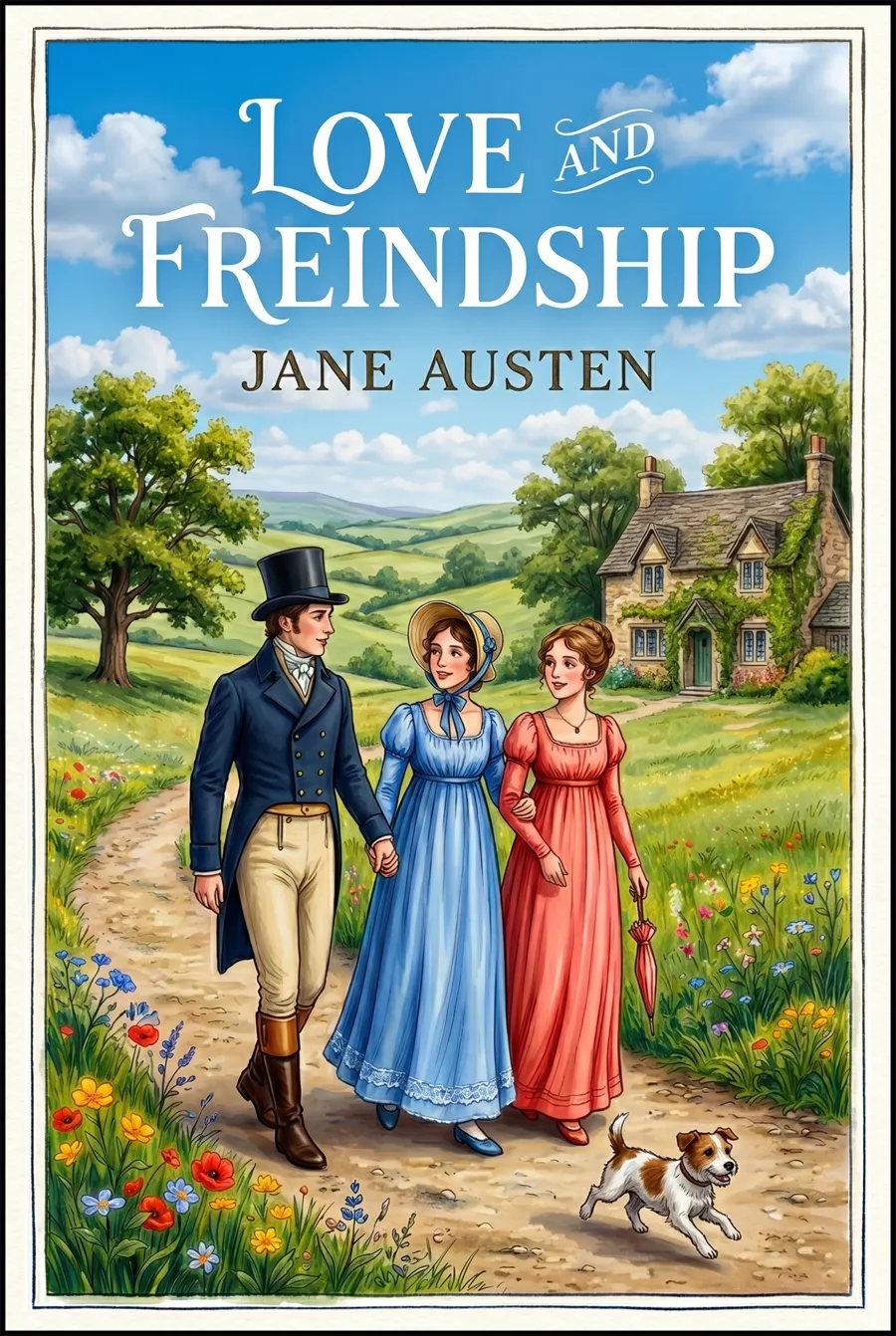
Love and Freindship
eBook
• INR 51.00
• English
• 9788169359382
No ratings yet
| Publisher | General Press |
|---|---|
| ISBN13 | 9788169359382 |
| ASIN/SKU | 8169359384 |
| Book Format | eBook |
| Language | English |
| List Price | INR 51.00 |
| Subject Code | FIC016000, FIC027050, FIC027250 |
| Publishing Date | 01/09/2026 |
| Book Code | BD00070218 |
Buy this Book
Amazon Stores
Ebook Stores
Other Stores
Discover Love and Freindship by Jane Austen. This book is published by General Press in eBook format, ISBN 9788169359382, ASIN 8169359384, under Literature and Fiction, Humorous Fiction, Historical Romances.
Book Description
What if every romantic disaster could be treated as a grand adventure? 'Love and Freindship' by Jane Austen is a witty early work of comic fiction that playfully mocks romantic conventions, sentimental novels, exaggerated emotions, and the fashionable manners of eighteenth-century society. Written when Austen was still a teenager, this short, delightfully mischievous work shows the sharp humor and social observation that would later become hallmarks of her writing.
The story takes the form of a series of letters written by Laura, an older woman who recounts the extraordinary events of her youth to Marianne, the daughter of her friend Isabel. Laura's life is filled with dramatic escapes, sudden romances, unexpected marriages, fainting spells, financial troubles, and astonishing changes of fortune. She presents each event with complete seriousness, even when her behavior and the situations around her are wonderfully absurd. Her friendship with Isabel is equally extravagant, as the two women repeatedly declare their devotion to one another while being swept along by increasingly ridiculous circumstances.
Austen uses Laura's adventures to parody the sentimental heroines and romantic plots that were popular in her time. Characters fall passionately in love almost instantly, make impulsive decisions, and react to ordinary difficulties with theatrical emotion. Instead of simply celebrating love and friendship, Austen exposes how easily exaggerated ideals can become foolish or impractical when confronted with real life.
Despite its youthful origins, 'Love and Freindship' is lively, clever, and surprisingly sophisticated. Its playful tone, absurd situations, and sharp satire offer an entertaining glimpse into Austen's developing literary genius. For anyone curious about the mischievous young writer behind the later classics, this charming work is a fascinating invitation into Jane Austen's earliest imagination.
The story takes the form of a series of letters written by Laura, an older woman who recounts the extraordinary events of her youth to Marianne, the daughter of her friend Isabel. Laura's life is filled with dramatic escapes, sudden romances, unexpected marriages, fainting spells, financial troubles, and astonishing changes of fortune. She presents each event with complete seriousness, even when her behavior and the situations around her are wonderfully absurd. Her friendship with Isabel is equally extravagant, as the two women repeatedly declare their devotion to one another while being swept along by increasingly ridiculous circumstances.
Austen uses Laura's adventures to parody the sentimental heroines and romantic plots that were popular in her time. Characters fall passionately in love almost instantly, make impulsive decisions, and react to ordinary difficulties with theatrical emotion. Instead of simply celebrating love and friendship, Austen exposes how easily exaggerated ideals can become foolish or impractical when confronted with real life.
Despite its youthful origins, 'Love and Freindship' is lively, clever, and surprisingly sophisticated. Its playful tone, absurd situations, and sharp satire offer an entertaining glimpse into Austen's developing literary genius. For anyone curious about the mischievous young writer behind the later classics, this charming work is a fascinating invitation into Jane Austen's earliest imagination.
Author Biography
Few writers have captured the quiet drama of everyday life as brilliantly as Jane Austen. Jane Austen was an English novelist best known for her works of romantic fiction, social commentary, and comedy of manners, including 'Pride and Prejudice', 'Sense and Sensibility', 'Emma', and 'Persuasion'.
Born on December 16, 1775, in Steventon, Hampshire, England, Austen grew up in a close-knit, intellectually lively family. Her father, George Austen, was a clergyman who encouraged reading and education, and Jane developed a love of books and writing from an early age. Although she lived in a period when women's opportunities were limited, she turned her sharp observations of society, family, class, marriage, and human behavior into memorable literature.
Austen published 'Sense and Sensibility' in 1811, followed by 'Pride and Prejudice' in 1813. She later published 'Mansfield Park' and 'Emma', while 'Northanger Abbey' and 'Persuasion' appeared after her death. Her novels are celebrated for their witty dialogue, subtle irony, strong female characters, and keen understanding of relationships. Rather than relying on grand adventures, Austen found rich drama in ordinary social situations, revealing how money, reputation, class, and expectations shaped people's choices.
Austen died on July 18, 1817, at the age of 41, but her literary reputation continued to grow. Her novels have remained widely read, adapted for film and television, translated into numerous languages, and studied across the world. Today, Jane Austen is regarded as one of the most influential figures in English literature, and her insightful stories of love, society, and human nature continue to feel remarkably fresh and relevant.
Born on December 16, 1775, in Steventon, Hampshire, England, Austen grew up in a close-knit, intellectually lively family. Her father, George Austen, was a clergyman who encouraged reading and education, and Jane developed a love of books and writing from an early age. Although she lived in a period when women's opportunities were limited, she turned her sharp observations of society, family, class, marriage, and human behavior into memorable literature.
Austen published 'Sense and Sensibility' in 1811, followed by 'Pride and Prejudice' in 1813. She later published 'Mansfield Park' and 'Emma', while 'Northanger Abbey' and 'Persuasion' appeared after her death. Her novels are celebrated for their witty dialogue, subtle irony, strong female characters, and keen understanding of relationships. Rather than relying on grand adventures, Austen found rich drama in ordinary social situations, revealing how money, reputation, class, and expectations shaped people's choices.
Austen died on July 18, 1817, at the age of 41, but her literary reputation continued to grow. Her novels have remained widely read, adapted for film and television, translated into numerous languages, and studied across the world. Today, Jane Austen is regarded as one of the most influential figures in English literature, and her insightful stories of love, society, and human nature continue to feel remarkably fresh and relevant.
Editorial Reviews
Editorial Reviews will be added soon…
Book Summary
Jane Austen’s 'Love and Freindship'—deliberately spelled “Freindship” in the original—is one of her earliest surviving works and one of the clearest examples of her youthful comic genius. Written around 1790, when Austen was only fourteen, the work is a short epistolary tale that mercilessly parodies the sentimental novels and romantic conventions that were fashionable in the eighteenth century. Rather than presenting love as noble, friendship as pure, and emotional sensitivity as evidence of a superior character, Austen turns these ideas upside down. Her heroines faint constantly, fall in love almost instantly, elope without practical thought, make disastrous decisions in the name of feeling, and treat wildly improbable coincidences as perfectly normal. The result is an unusually funny early work that is also important for understanding how Austen developed the wit, irony, and social observation that later made novels such as 'Pride and Prejudice', 'Sense and Sensibility', and 'Emma' so distinctive.
The story is presented through a series of letters. Isabel writes to her old friend Laura and asks her to tell Isabel’s daughter, Marianne, about the misfortunes and adventures of her life. Isabel jokingly observes that Laura is now fifty-five and therefore, presumably, safe from the “disagreeable Lovers” and “obstinate Fathers” who once made her life so difficult. Laura agrees to tell her story, presenting her experiences as a kind of moral education for Marianne. This framing is important because Austen immediately creates a gap between Laura’s understanding of her life and the reader’s understanding of it. Laura believes that she is an exceptionally sensitive and unfortunate woman whose sufferings prove the depth of her feelings. The reader, however, gradually recognizes that Laura is often ridiculous, self-absorbed, and unable to distinguish genuine emotion from theatrical sentiment.
Laura begins by describing her unusual childhood and background. She presents herself as a woman of remarkable accomplishments, beauty, sensitivity, and refinement. Her family history is itself improbably dramatic, involving different countries, unusual relationships, and aristocratic connections. This exaggerated biography immediately resembles the kind of sensational romantic fiction Austen is mocking. Laura is not merely an ordinary young woman; she is determined to see herself as the heroine of an extraordinary romance. Her heightened self-image is central to the humor of the story. Everything that happens to her becomes evidence of her exceptional destiny, even when the events are the predictable consequences of her own poor judgment.
The major turning point comes when a handsome young stranger named Edward Lindsey arrives at Laura’s family home. He and his servant have lost their way and seek shelter. Laura is instantly captivated by Edward, and her attraction quickly becomes what she regards as profound love. There is no gradual process of knowing one another, no meaningful conversation about compatibility, and no sensible consideration of marriage. Edward soon reveals that his father wants him to marry Lady Dorothea, but Edward dislikes the proposed match. The obvious solution, according to the conventions of sentimental fiction, is rebellion in the name of love. Laura and Edward therefore marry almost immediately. The speed of their romance is one of Austen’s most effective jokes: the story exposes how romantic novels can transform physical attraction and dramatic circumstances into supposedly eternal love.
Edward’s family predictably disapproves of the marriage. His father is angry, while his sister Augusta is also unhappy about Laura’s arrival. Instead of treating these difficulties realistically, Laura interprets them through the language of romantic persecution. Her husband’s family opposition becomes proof that their love is heroic. Austen is making fun of the sentimental idea that true love must always face some dramatic external obstacle. In 'Love and Freindship', characters frequently create their own problems and then congratulate themselves for enduring them.
Laura and Edward eventually visit another young married couple, Augustus and Sophia. Laura immediately becomes devoted to Sophia, and the two women declare an intense friendship almost as soon as they meet. Their friendship is as exaggerated as Laura’s romance with Edward. They identify one another as kindred spirits because they share the same taste for emotional excess. Their behavior provides Austen with some of the funniest scenes in the work. When Edward and Augustus are reunited, their emotional reaction is so extravagantly passionate that Laura and Sophia faint from the intensity of the moment. The fainting is not an isolated joke. Throughout the story, Austen repeatedly uses fainting to expose the absurdity of sentimental fiction, where heroines are expected to collapse whenever their feelings become too powerful.
The friendship between Laura and Sophia becomes even more important when the financial consequences of romantic rebellion begin to appear. Augustus has taken money from his father in order to elope with Sophia, and the couple soon finds itself deeply in debt. Eventually Augustus is arrested because of his financial problems. The household is threatened with seizure, and the romantic dream begins to collapse under the weight of ordinary economic reality. This is one of the most important comic contrasts in 'Love and Freindship': the characters believe that love and friendship can solve everything, while money, debt, family authority, and practical circumstances repeatedly prove otherwise.
When Edward leaves to help Augustus, Laura and Sophia decide to leave as well. They consider going to London to help their friend, but Sophia cannot bear the thought of seeing Augustus in distress. Their response is characteristically sentimental: they are more comfortable imagining suffering than confronting it. Eventually they travel toward Scotland in search of Sophia’s relatives. The journey becomes increasingly absurd, with coincidence following coincidence. Austen deliberately pushes the conventions of romantic adventure beyond credibility, making the story resemble a parody of every melodramatic plot device at once.
One of the strangest episodes occurs when Laura and Sophia encounter an elderly gentleman named Lord St. Clair at an inn. Laura suddenly recognizes him as her grandfather, and he confirms that both Laura and Sophia are his long-lost granddaughters. The discovery is absurdly convenient, but that is precisely the point. In sentimental and melodramatic fiction, lost relatives often reappear at exactly the moment when they are needed. Austen exaggerates this convention until it becomes ridiculous. Additional young relatives soon appear, and the family connections multiply with almost comic speed. Lord St. Clair gives money to the newly discovered grandchildren and then disappears from the immediate story. Rather than questioning the extraordinary coincidence, Laura accepts it as another episode in her remarkable life.
Laura and Sophia next become involved in the romantic affairs of Sophia’s relatives. They meet Janetta, a young woman whose father intends her to marry a man whom Laura and Sophia consider unsuitable. They decide that Janetta should instead elope with Captain M’Kenzie, whom they regard as a more appropriate romantic hero. Their intervention shows another aspect of Austen’s satire: the women believe they are acting out of friendship and sympathy, but they are really imposing their own romantic fantasies upon someone else’s life. They encourage Janetta to reject practical considerations and follow the conventions of passionate love. The result is another elopement, confirming their belief that they have successfully rescued a heroine from an unhappy marriage.
Yet Laura and Sophia themselves soon fall into trouble. Their sense of entitlement and their inability to recognize practical boundaries lead them to attempt to take money from Macdonald. When they are discovered, they are expelled. Their behavior is strikingly inconsistent with their self-image as exceptionally virtuous and sensitive women. Austen’s comedy depends on this contradiction. Laura constantly describes herself as deeply moral, but her actions frequently reveal selfishness, carelessness, and poor judgment. The reader is therefore invited to notice what Laura herself cannot see: her supposed “sensibility” is often little more than self-dramatization.
The final part of the story becomes increasingly tragic while remaining comic in its treatment of sentimental conventions. Laura and Sophia encounter a carriage accident and discover that the victims are Edward and Augustus. Edward briefly regains consciousness, and the reunion between the two men is described with the same exaggerated emotional language that has characterized the story from the beginning. Edward dies, and Sophia repeatedly faints from grief. Eventually Sophia dies as well, after becoming ill from exposure to the cold. Her death is deliberately excessive, almost parodic, because Austen is demonstrating what happens when the conventions of sentimental romance are followed to their most extreme conclusion.
Laura is left to continue her life and recount her extraordinary history. The ending does not offer the comforting resolution that readers of conventional romance might expect. Instead, Austen leaves behind the impression that Laura has learned surprisingly little from her experiences. She still sees herself as the innocent victim of unfortunate circumstances. This is essential to the satire. The lesson of 'Love and Freindship' is not simply that romantic stories can be exaggerated. Austen is showing that people can use romantic language to excuse foolishness, selfishness, and irresponsibility.
One of the central themes of 'Love and Freindship' is therefore the difference between genuine emotion and performative emotion. Austen does not suggest that love or friendship is meaningless. Instead, she questions the fashionable idea that the strongest feeling must automatically be the truest or most valuable feeling. Laura and Sophia constantly insist on the depth of their emotions, but their actions are often impulsive and destructive. Their friendship is based on shared theatricality rather than understanding, and their romantic relationships are formed before they have had time to know the people they supposedly adore.
The title itself is part of the joke. “Love and Freindship” sounds like a serious romantic work, but the misspelling and subtitle—“Deceived in Freindship and Betrayed in Love”—signal Austen’s comic intentions from the beginning. The story is less interested in celebrating love and friendship than in exposing the absurd ways people talk about them. The exaggerated language of devotion becomes funny because the characters use it so frequently and so casually.
The work is also significant because it provides an early glimpse of the Jane Austen who would later become one of English literature’s greatest comic novelists. Although 'Love and Freindship' is youthful and deliberately outrageous, its central technique is recognizably Austenian: she creates characters who misunderstand themselves and allows readers to see the truth behind their words. Laura is funny because she sincerely believes her own version of events. Austen does not need to interrupt constantly to tell readers that Laura is foolish. The irony emerges from the contrast between Laura’s dramatic interpretation and the obvious absurdity of what she describes.
For readers looking for a 'Love and Freindship' summary, the book can therefore be understood as both a comic story and an early literary experiment. It is a parody of eighteenth-century sentimental fiction, particularly the “cult of sensibility,” with its emphasis on extreme feeling, instant attachment, fainting heroines, tragic accidents, family secrets, elopements, and miraculous coincidences. Scholars have identified this parody of sentimental conventions as one of the work’s defining characteristics.
Ultimately, 'Love and Freindship' is much more than a curiosity from Jane Austen’s childhood. It shows a remarkably young writer already testing the power of irony and comic exaggeration. Its characters believe that sensitivity makes them superior, that love justifies impulsive behavior, and that friendship requires dramatic demonstrations of emotion. Austen quietly destroys these assumptions by allowing the characters to take them completely seriously. The resulting story is chaotic, funny, dark, and surprisingly sophisticated. For readers interested in Jane Austen’s early works, Austen’s juvenilia, sentimental fiction, or the origins of her later comic style, 'Love and Freindship' offers an entertaining glimpse into the development of a writer who would eventually transform the English novel. It may be short, but its satire is remarkably sharp: beneath the fainting, elopements, coincidences, tragic deaths, and extravagant declarations lies a young Austen asking a very serious question—what happens when people mistake the performance of feeling for genuine love, friendship, and moral character?
The story is presented through a series of letters. Isabel writes to her old friend Laura and asks her to tell Isabel’s daughter, Marianne, about the misfortunes and adventures of her life. Isabel jokingly observes that Laura is now fifty-five and therefore, presumably, safe from the “disagreeable Lovers” and “obstinate Fathers” who once made her life so difficult. Laura agrees to tell her story, presenting her experiences as a kind of moral education for Marianne. This framing is important because Austen immediately creates a gap between Laura’s understanding of her life and the reader’s understanding of it. Laura believes that she is an exceptionally sensitive and unfortunate woman whose sufferings prove the depth of her feelings. The reader, however, gradually recognizes that Laura is often ridiculous, self-absorbed, and unable to distinguish genuine emotion from theatrical sentiment.
Laura begins by describing her unusual childhood and background. She presents herself as a woman of remarkable accomplishments, beauty, sensitivity, and refinement. Her family history is itself improbably dramatic, involving different countries, unusual relationships, and aristocratic connections. This exaggerated biography immediately resembles the kind of sensational romantic fiction Austen is mocking. Laura is not merely an ordinary young woman; she is determined to see herself as the heroine of an extraordinary romance. Her heightened self-image is central to the humor of the story. Everything that happens to her becomes evidence of her exceptional destiny, even when the events are the predictable consequences of her own poor judgment.
The major turning point comes when a handsome young stranger named Edward Lindsey arrives at Laura’s family home. He and his servant have lost their way and seek shelter. Laura is instantly captivated by Edward, and her attraction quickly becomes what she regards as profound love. There is no gradual process of knowing one another, no meaningful conversation about compatibility, and no sensible consideration of marriage. Edward soon reveals that his father wants him to marry Lady Dorothea, but Edward dislikes the proposed match. The obvious solution, according to the conventions of sentimental fiction, is rebellion in the name of love. Laura and Edward therefore marry almost immediately. The speed of their romance is one of Austen’s most effective jokes: the story exposes how romantic novels can transform physical attraction and dramatic circumstances into supposedly eternal love.
Edward’s family predictably disapproves of the marriage. His father is angry, while his sister Augusta is also unhappy about Laura’s arrival. Instead of treating these difficulties realistically, Laura interprets them through the language of romantic persecution. Her husband’s family opposition becomes proof that their love is heroic. Austen is making fun of the sentimental idea that true love must always face some dramatic external obstacle. In 'Love and Freindship', characters frequently create their own problems and then congratulate themselves for enduring them.
Laura and Edward eventually visit another young married couple, Augustus and Sophia. Laura immediately becomes devoted to Sophia, and the two women declare an intense friendship almost as soon as they meet. Their friendship is as exaggerated as Laura’s romance with Edward. They identify one another as kindred spirits because they share the same taste for emotional excess. Their behavior provides Austen with some of the funniest scenes in the work. When Edward and Augustus are reunited, their emotional reaction is so extravagantly passionate that Laura and Sophia faint from the intensity of the moment. The fainting is not an isolated joke. Throughout the story, Austen repeatedly uses fainting to expose the absurdity of sentimental fiction, where heroines are expected to collapse whenever their feelings become too powerful.
The friendship between Laura and Sophia becomes even more important when the financial consequences of romantic rebellion begin to appear. Augustus has taken money from his father in order to elope with Sophia, and the couple soon finds itself deeply in debt. Eventually Augustus is arrested because of his financial problems. The household is threatened with seizure, and the romantic dream begins to collapse under the weight of ordinary economic reality. This is one of the most important comic contrasts in 'Love and Freindship': the characters believe that love and friendship can solve everything, while money, debt, family authority, and practical circumstances repeatedly prove otherwise.
When Edward leaves to help Augustus, Laura and Sophia decide to leave as well. They consider going to London to help their friend, but Sophia cannot bear the thought of seeing Augustus in distress. Their response is characteristically sentimental: they are more comfortable imagining suffering than confronting it. Eventually they travel toward Scotland in search of Sophia’s relatives. The journey becomes increasingly absurd, with coincidence following coincidence. Austen deliberately pushes the conventions of romantic adventure beyond credibility, making the story resemble a parody of every melodramatic plot device at once.
One of the strangest episodes occurs when Laura and Sophia encounter an elderly gentleman named Lord St. Clair at an inn. Laura suddenly recognizes him as her grandfather, and he confirms that both Laura and Sophia are his long-lost granddaughters. The discovery is absurdly convenient, but that is precisely the point. In sentimental and melodramatic fiction, lost relatives often reappear at exactly the moment when they are needed. Austen exaggerates this convention until it becomes ridiculous. Additional young relatives soon appear, and the family connections multiply with almost comic speed. Lord St. Clair gives money to the newly discovered grandchildren and then disappears from the immediate story. Rather than questioning the extraordinary coincidence, Laura accepts it as another episode in her remarkable life.
Laura and Sophia next become involved in the romantic affairs of Sophia’s relatives. They meet Janetta, a young woman whose father intends her to marry a man whom Laura and Sophia consider unsuitable. They decide that Janetta should instead elope with Captain M’Kenzie, whom they regard as a more appropriate romantic hero. Their intervention shows another aspect of Austen’s satire: the women believe they are acting out of friendship and sympathy, but they are really imposing their own romantic fantasies upon someone else’s life. They encourage Janetta to reject practical considerations and follow the conventions of passionate love. The result is another elopement, confirming their belief that they have successfully rescued a heroine from an unhappy marriage.
Yet Laura and Sophia themselves soon fall into trouble. Their sense of entitlement and their inability to recognize practical boundaries lead them to attempt to take money from Macdonald. When they are discovered, they are expelled. Their behavior is strikingly inconsistent with their self-image as exceptionally virtuous and sensitive women. Austen’s comedy depends on this contradiction. Laura constantly describes herself as deeply moral, but her actions frequently reveal selfishness, carelessness, and poor judgment. The reader is therefore invited to notice what Laura herself cannot see: her supposed “sensibility” is often little more than self-dramatization.
The final part of the story becomes increasingly tragic while remaining comic in its treatment of sentimental conventions. Laura and Sophia encounter a carriage accident and discover that the victims are Edward and Augustus. Edward briefly regains consciousness, and the reunion between the two men is described with the same exaggerated emotional language that has characterized the story from the beginning. Edward dies, and Sophia repeatedly faints from grief. Eventually Sophia dies as well, after becoming ill from exposure to the cold. Her death is deliberately excessive, almost parodic, because Austen is demonstrating what happens when the conventions of sentimental romance are followed to their most extreme conclusion.
Laura is left to continue her life and recount her extraordinary history. The ending does not offer the comforting resolution that readers of conventional romance might expect. Instead, Austen leaves behind the impression that Laura has learned surprisingly little from her experiences. She still sees herself as the innocent victim of unfortunate circumstances. This is essential to the satire. The lesson of 'Love and Freindship' is not simply that romantic stories can be exaggerated. Austen is showing that people can use romantic language to excuse foolishness, selfishness, and irresponsibility.
One of the central themes of 'Love and Freindship' is therefore the difference between genuine emotion and performative emotion. Austen does not suggest that love or friendship is meaningless. Instead, she questions the fashionable idea that the strongest feeling must automatically be the truest or most valuable feeling. Laura and Sophia constantly insist on the depth of their emotions, but their actions are often impulsive and destructive. Their friendship is based on shared theatricality rather than understanding, and their romantic relationships are formed before they have had time to know the people they supposedly adore.
The title itself is part of the joke. “Love and Freindship” sounds like a serious romantic work, but the misspelling and subtitle—“Deceived in Freindship and Betrayed in Love”—signal Austen’s comic intentions from the beginning. The story is less interested in celebrating love and friendship than in exposing the absurd ways people talk about them. The exaggerated language of devotion becomes funny because the characters use it so frequently and so casually.
The work is also significant because it provides an early glimpse of the Jane Austen who would later become one of English literature’s greatest comic novelists. Although 'Love and Freindship' is youthful and deliberately outrageous, its central technique is recognizably Austenian: she creates characters who misunderstand themselves and allows readers to see the truth behind their words. Laura is funny because she sincerely believes her own version of events. Austen does not need to interrupt constantly to tell readers that Laura is foolish. The irony emerges from the contrast between Laura’s dramatic interpretation and the obvious absurdity of what she describes.
For readers looking for a 'Love and Freindship' summary, the book can therefore be understood as both a comic story and an early literary experiment. It is a parody of eighteenth-century sentimental fiction, particularly the “cult of sensibility,” with its emphasis on extreme feeling, instant attachment, fainting heroines, tragic accidents, family secrets, elopements, and miraculous coincidences. Scholars have identified this parody of sentimental conventions as one of the work’s defining characteristics.
Ultimately, 'Love and Freindship' is much more than a curiosity from Jane Austen’s childhood. It shows a remarkably young writer already testing the power of irony and comic exaggeration. Its characters believe that sensitivity makes them superior, that love justifies impulsive behavior, and that friendship requires dramatic demonstrations of emotion. Austen quietly destroys these assumptions by allowing the characters to take them completely seriously. The resulting story is chaotic, funny, dark, and surprisingly sophisticated. For readers interested in Jane Austen’s early works, Austen’s juvenilia, sentimental fiction, or the origins of her later comic style, 'Love and Freindship' offers an entertaining glimpse into the development of a writer who would eventually transform the English novel. It may be short, but its satire is remarkably sharp: beneath the fainting, elopements, coincidences, tragic deaths, and extravagant declarations lies a young Austen asking a very serious question—what happens when people mistake the performance of feeling for genuine love, friendship, and moral character?
Sample Chapters
Sample Chapters will be added soon…
Reader Reviews
No reviews yet.
Love and Freindship
Download Cover Image
Do you want to download the full cover image for Love and Freindship?