
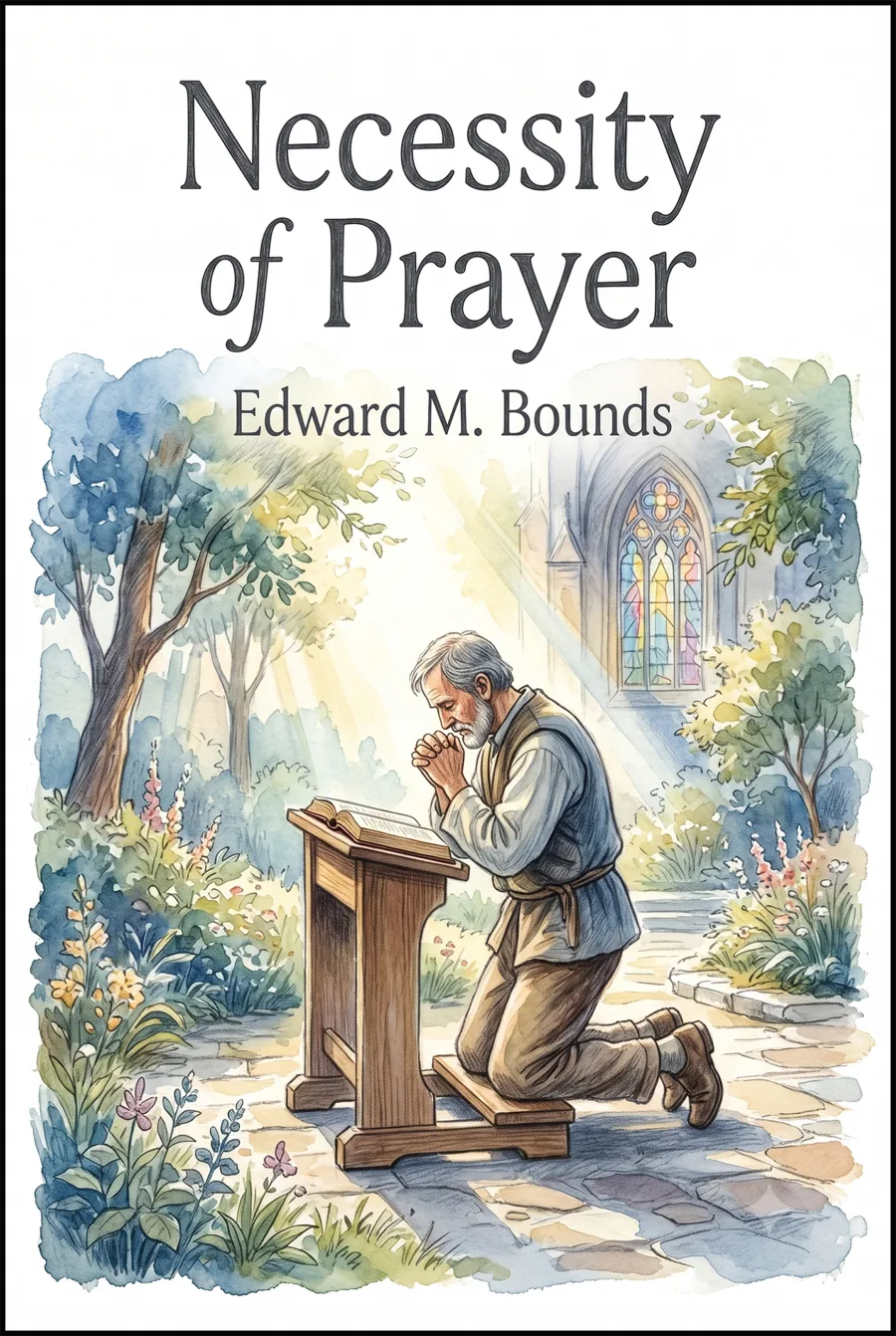
Necessity of Prayer
eBook
• INR 51.00
• English
• 9788169359122
No ratings yet
| Publisher | General Press |
|---|---|
| ISBN13 | 9788169359122 |
| ASIN/SKU | 8169359120 |
| Book Format | eBook |
| Language | English |
| List Price | INR 51.00 |
| Subject Code | REL012080, REL012120, REL012020 |
| Publishing Date | 01/09/2026 |
| Book Code | BD00070219 |
Buy this Book
Amazon Stores
Ebook Stores
Other Stores
Discover Necessity of Prayer by Edward M. Bounds. This book is published by General Press in eBook format, ISBN 9788169359122, ASIN 8169359120, under Christian Books and Bibles, Christian Prayer Books, Christian Spiritual Growth.
Book Description
Prayer is more than a religious routine; it is the foundation of a living relationship with God. 'Necessity of Prayer' by Edward M. Bounds is a classic Christian devotional and spiritual-growth book that explores why prayer is essential to faith, character, ministry, and the everyday life of a believer. With a direct and deeply personal style, Bounds challenges readers to reconsider how seriously they approach prayer.
Rather than presenting prayer as a quick solution to life's problems, Bounds describes it as a vital discipline through which people draw closer to God and develop spiritual strength. He argues that meaningful prayer requires sincerity, persistence, faith, humility, and a genuine desire to seek God's will. For Bounds, prayer is not something reserved for moments of crisis; it should become a consistent part of daily life. A believer who neglects prayer, he suggests, gradually loses the spiritual power and perspective needed to live faithfully.
Throughout the book, Bounds examines the connection between prayer and personal transformation. He emphasizes that effective prayer begins with the heart and requires more than simply repeating words. Prayer shapes motives, strengthens faith, deepens dependence on God, and prepares people to face temptation, hardship, and responsibility. He also gives particular attention to the importance of prayer in Christian service, arguing that spiritual work cannot be separated from a strong life of devotion.
Written with urgency and conviction, 'Necessity of Prayer' remains relevant to readers who want to develop a more disciplined and meaningful prayer life. Bounds' message is simple but challenging: prayer is not an optional addition to faith but one of its essential foundations. For anyone seeking a deeper spiritual life, this enduring Christian classic offers much to reflect on—and much to put into practice.
Rather than presenting prayer as a quick solution to life's problems, Bounds describes it as a vital discipline through which people draw closer to God and develop spiritual strength. He argues that meaningful prayer requires sincerity, persistence, faith, humility, and a genuine desire to seek God's will. For Bounds, prayer is not something reserved for moments of crisis; it should become a consistent part of daily life. A believer who neglects prayer, he suggests, gradually loses the spiritual power and perspective needed to live faithfully.
Throughout the book, Bounds examines the connection between prayer and personal transformation. He emphasizes that effective prayer begins with the heart and requires more than simply repeating words. Prayer shapes motives, strengthens faith, deepens dependence on God, and prepares people to face temptation, hardship, and responsibility. He also gives particular attention to the importance of prayer in Christian service, arguing that spiritual work cannot be separated from a strong life of devotion.
Written with urgency and conviction, 'Necessity of Prayer' remains relevant to readers who want to develop a more disciplined and meaningful prayer life. Bounds' message is simple but challenging: prayer is not an optional addition to faith but one of its essential foundations. For anyone seeking a deeper spiritual life, this enduring Christian classic offers much to reflect on—and much to put into practice.
Author Biography
Few Christian writers have written about prayer with the intensity and conviction of Edward McKendree Bounds. Edward M. Bounds was an American Methodist minister, preacher, and religious author best known for his influential writings on prayer, including 'Power Through Prayer', 'Purpose in Prayer', and 'The Necessity of Prayer'. His life and work were shaped by a deep belief that prayer was not simply a religious duty but the foundation of meaningful Christian living and ministry.
Born on August 15, 1835, in Shelby County, Missouri, Bounds initially studied law and was admitted to the bar before answering a call to Christian ministry at the age of twenty-four. He began preaching in Missouri and later served as a Methodist pastor. During the American Civil War, he became a prisoner after refusing to take an oath of allegiance, and he later served as a chaplain with the Fifth Missouri Regiment. These experiences strengthened his faith and influenced the seriousness with which he approached his spiritual calling.
Bounds eventually became widely respected for his disciplined prayer life, extensive Bible study, and powerful devotional writing. His prose is direct, passionate, and often challenging, urging readers to move beyond routine religion toward a deeper and more personal life of faith. 'Power Through Prayer' remains his best-known work, emphasizing the connection between a preacher's character, prayer life, and effectiveness in ministry. Other notable books include 'The Reality of Prayer', 'Prayer and Praying Men', 'The Weapon of Prayer', and 'Purpose in Prayer'.
Although many of his books were published or widely circulated after his death in 1913, his influence continued to grow. Today, Edward M. Bounds remains a lasting voice in Christian devotional literature, inspiring readers and ministers who seek a more purposeful, disciplined, and deeply prayerful life.
Born on August 15, 1835, in Shelby County, Missouri, Bounds initially studied law and was admitted to the bar before answering a call to Christian ministry at the age of twenty-four. He began preaching in Missouri and later served as a Methodist pastor. During the American Civil War, he became a prisoner after refusing to take an oath of allegiance, and he later served as a chaplain with the Fifth Missouri Regiment. These experiences strengthened his faith and influenced the seriousness with which he approached his spiritual calling.
Bounds eventually became widely respected for his disciplined prayer life, extensive Bible study, and powerful devotional writing. His prose is direct, passionate, and often challenging, urging readers to move beyond routine religion toward a deeper and more personal life of faith. 'Power Through Prayer' remains his best-known work, emphasizing the connection between a preacher's character, prayer life, and effectiveness in ministry. Other notable books include 'The Reality of Prayer', 'Prayer and Praying Men', 'The Weapon of Prayer', and 'Purpose in Prayer'.
Although many of his books were published or widely circulated after his death in 1913, his influence continued to grow. Today, Edward M. Bounds remains a lasting voice in Christian devotional literature, inspiring readers and ministers who seek a more purposeful, disciplined, and deeply prayerful life.
Editorial Reviews
Editorial Reviews will be added soon…
Book Summary
Edward M. Bounds’s "The Necessity of Prayer" is a classic Christian devotional work centered on one powerful conviction: prayer is not an optional religious activity but an essential part of a living relationship with God. First published in the early twentieth century, the book gathers Bounds’s passionate teaching about prayer, faith, persistence, spiritual discipline, and the character of the person who prays. Rather than presenting prayer as a technique for obtaining everything one wants, Bounds describes it as the means through which believers draw near to God, receive spiritual strength, deepen their faith, and become useful in his purposes. For readers searching for 'The Necessity of Prayer' summary, the central message is straightforward but demanding: if Christian faith is meant to be real and active, prayer must occupy a central place in the believer’s life. Bounds repeatedly argues that spiritual weakness is often connected with a weak prayer life, while spiritual power grows through sincere, persistent, believing communion with God.
The book begins with the idea contained in its title. Prayer is necessary because Christianity itself depends upon a living relationship with God. Bounds does not treat prayer as a formal ceremony performed at particular times merely because tradition requires it. Prayer is communication with God, an expression of dependence, and a channel through which divine grace works in the life of the believer. A Christian may possess knowledge of Scripture, attend church, understand theology, and participate in religious activities, but without prayer, Bounds believes that these things can become external and lifeless. Prayer brings belief into personal experience. It turns theological conviction into dependence, worship, confession, petition, thanksgiving, and spiritual communion.
One of Bounds’s most important themes is that prayer must be sincere. He strongly rejects empty or mechanical prayer. A person may repeat religious words without truly seeking God, but such repetition does not represent the kind of prayer he has in mind. Genuine prayer comes from the heart. It involves desire, earnestness, humility, and faith. Bounds repeatedly emphasizes that God is not impressed merely by the length or elegance of a prayer. What matters is the spiritual reality behind it. Prayer should arise from a person who genuinely recognizes his or her dependence upon God.
Faith is therefore essential to Bounds’s understanding of prayer. He believes that prayer without faith becomes little more than religious speech. Faith means trusting God's character and believing that he hears and responds to those who seek him. Bounds does not present faith as a magical force by which human beings control God. Instead, faith establishes the relationship in which prayer becomes meaningful. The person who prays must believe that God is real, attentive, powerful, wise, and good. Such confidence allows the believer to pray boldly while remaining submitted to God's will.
Bounds also places enormous emphasis on persistence. One of the clearest lessons of 'The Necessity of Prayer' is that serious prayer cannot be reduced to occasional requests made when circumstances become difficult. The Christian must continue praying even when an answer seems delayed. Bounds sees persistence as evidence that a person's desire is genuine. Delayed answers do not necessarily mean that God has ignored the prayer. Instead, they may become opportunities for deeper faith, patience, self-examination, and dependence upon God. The persistent believer learns to continue seeking God even when immediate results are not visible.
This emphasis on perseverance distinguishes Bounds's approach from a simplistic understanding of prayer. Prayer is not presented as a transaction in which a person asks for something and expects an immediate response. It is a discipline that changes the person who practices it. The act of continuing to pray can strengthen patience and reshape desires. A believer who repeatedly brings a concern before God may gradually learn to distinguish between selfish wants and deeper spiritual needs. Prayer can therefore become an instrument of transformation as much as a means of petition.
Another major theme is the relationship between prayer and spiritual character. Bounds argues that the quality of a person's prayer life cannot be separated from the quality of the person's life. A believer who knowingly embraces dishonesty, bitterness, pride, selfishness, or disobedience cannot expect prayer to remain spiritually healthy. Prayer exposes the heart. When people come honestly before God, they are confronted with their motives, weaknesses, sins, fears, and desires. Prayer therefore requires humility. It is impossible to approach God sincerely while maintaining the illusion of self-sufficiency.
Bounds's understanding of prayer is also deeply connected with holiness. He does not believe that prayer exists simply to make life easier. Its purpose includes making believers more like Christ. Prayer creates a setting in which people surrender themselves to God and allow their desires to be corrected. The more deeply a person seeks God, the more that person should desire righteousness, obedience, love, and service. Prayer and Christian character therefore reinforce one another: prayer strengthens holy living, while holy living creates greater freedom and sincerity in prayer.
The author repeatedly warns against superficial religion. One of his major concerns is that churches and individual Christians can become highly active while remaining spiritually weak. Programs, organizations, preaching, education, and religious institutions may all have value, but Bounds believes they cannot substitute for prayer. For him, the true strength of Christian work comes from spiritual dependence upon God. A church may appear successful from the outside and still lack spiritual vitality if its people do not pray earnestly. In this respect, 'The Necessity of Prayer' is not only a personal devotional book but also a challenge to the church.
Bounds gives special importance to ministers and spiritual leaders. He believes that those who preach, teach, or lead others must cultivate a serious prayer life. The effectiveness of ministry cannot ultimately be measured by public speaking ability, intellectual knowledge, organizational talent, or popularity. The deeper question is whether the minister is spiritually connected to God. Bounds sees prayer as the hidden source of spiritual authority. A person may possess impressive abilities, but without prayer those abilities can become merely human strengths. Prayer, in Bounds's vision, is what places human work under divine direction.
This idea extends to the entire church. Bounds believes that prayer should not be left primarily to ministers or particularly devoted Christians. Every believer has a responsibility to pray. Christian community becomes stronger when ordinary members pray for one another, for their leaders, for those who are suffering, and for the spread of the gospel. Prayer creates spiritual solidarity. It reminds Christians that they are not isolated individuals but members of a larger body with responsibilities toward one another.
The book also explores prayer as a source of spiritual power. Bounds frequently uses strong language about the power that prayer releases, but the underlying idea is that prayer connects human weakness with divine strength. Human beings have limited wisdom, energy, and ability. Prayer acknowledges these limitations and looks to God for what humans cannot provide themselves. For Bounds, this dependence is not weakness in the negative sense. It is the beginning of genuine spiritual strength. The person who knows that he or she needs God is better positioned to receive and use God's help.
Another important subject is the connection between prayer and the Bible. Bounds does not treat prayer as an isolated spiritual exercise. Scripture provides the language, promises, teachings, and understanding through which believers learn to pray. Biblical prayer is informed by biblical truth. The more Christians understand God's character and promises through Scripture, the more intelligently and confidently they can approach God. Prayer and Scripture therefore belong together. Scripture speaks God's revealed truth to believers, while prayer becomes the believer's response to God.
Bounds also stresses the importance of earnest desire. He believes that prayer must involve the heart, not merely the intellect. A person may know exactly what to say and still pray without real spiritual engagement. True prayer involves longing. It matters enough to the person praying that he or she is willing to wait, continue, sacrifice, and seek God seriously. This does not mean that every prayer must be emotionally dramatic. Rather, it means that prayer should be genuine. Bounds wants believers to move beyond casual religious language and develop an authentic hunger for God.
One of the book's most encouraging ideas is that prayer is available to ordinary people. Bounds does not suggest that believers need unusual intelligence, wealth, social influence, or religious status to become people of prayer. Prayer is fundamentally an act of dependence that anyone can practice. The poor, the discouraged, the busy, the weak, and the spiritually uncertain can all come before God. In this sense, prayer levels the ground between people. Human distinctions become secondary when everyone recognizes the same basic need for divine grace.
At the same time, Bounds's writing can feel demanding because he has a very high view of prayer. He does not recommend treating prayer as something squeezed into whatever time remains after more important activities are completed. Instead, he argues that prayer deserves deliberate attention. The believer must make time for it. This involves discipline because modern life, even in Bounds's era, easily distracts people from quiet communion with God. His challenge is therefore practical: if prayer is truly necessary, Christians must organize their lives in a way that reflects that conviction.
The book's treatment of answered prayer is also important. Bounds encourages believers to pray with confidence, but he does not reduce God's response to human expectations. God remains sovereign and wise. The purpose of prayer is not to force God to satisfy every desire but to bring human desires into relationship with God's purposes. This distinction protects Bounds's teaching from becoming a simple prosperity message. Prayer can involve requests for healing, provision, guidance, strength, and other needs, but the believer must ultimately trust God's wisdom.
Suffering and difficulty therefore have a place in Bounds's theology of prayer. Hard circumstances often reveal the limits of human strength and drive people toward God. Instead of seeing suffering only as an obstacle, Bounds sees it as a context in which prayer can become deeper. Trials may teach believers to depend on God more fully. They can expose false confidence and redirect attention toward eternal realities. Prayer becomes the place where fear is brought into God's presence and where endurance is strengthened.
The overall message of 'The Necessity of Prayer' can be understood through the relationship between prayer, faith, and action. Bounds does not encourage passive religion. Prayer should lead to obedience and service. A person who genuinely seeks God should become increasingly willing to act according to God's purposes. Prayer prepares the believer for work, gives strength during work, and keeps that work from becoming merely self-directed. In Bounds's vision, the Christian life is not “pray instead of act” but “pray so that action is guided, strengthened, and purified by dependence on God.”
The book's enduring appeal comes from its simplicity and intensity. Bounds does not attempt to make prayer fashionable or intellectually complicated. He keeps returning to the same fundamental truth: Christians need God, and prayer is one of the primary ways they acknowledge and live out that need. His repeated emphasis may feel almost insistent, but that insistence is deliberate. He wants readers to see that prayer is not a minor department of Christianity. It reaches into every part of Christian existence.
For readers looking for the main themes and lessons of 'The Necessity of Prayer', the book can be summarized around several connected ideas: prayer is essential to spiritual life; genuine prayer requires faith; persistent prayer develops endurance; holy living strengthens the integrity of prayer; Scripture guides prayer; ministers and churches need prayer for spiritual effectiveness; and prayer ultimately changes the person who prays. Bounds's central concern is not simply whether Christians ask God for enough things but whether they actually know what it means to depend upon God.
In conclusion, Edward M. Bounds's 'The Necessity of Prayer' is a passionate call to recover prayer as the center of Christian life and ministry. It argues that prayer is necessary because human strength is insufficient, spiritual growth requires divine grace, and meaningful Christian service cannot flourish without dependence upon God. Through his discussion of faith, persistence, holiness, Scripture, spiritual leadership, answered prayer, and perseverance, Bounds presents prayer as both a privilege and a discipline. His message remains powerful because it speaks to a universal human experience: people often discover their deepest need for God when their own resources are no longer enough. Ultimately, 'The Necessity of Prayer' teaches that prayer is not merely about getting something from God. It is about seeking God himself, trusting his character, surrendering personal desires to his wisdom, receiving strength for faithful living, and becoming the kind of person who can serve others with humility and love. For Bounds, a strong prayer life is not an accessory to Christianity—it is one of the clearest signs that faith is alive.
The book begins with the idea contained in its title. Prayer is necessary because Christianity itself depends upon a living relationship with God. Bounds does not treat prayer as a formal ceremony performed at particular times merely because tradition requires it. Prayer is communication with God, an expression of dependence, and a channel through which divine grace works in the life of the believer. A Christian may possess knowledge of Scripture, attend church, understand theology, and participate in religious activities, but without prayer, Bounds believes that these things can become external and lifeless. Prayer brings belief into personal experience. It turns theological conviction into dependence, worship, confession, petition, thanksgiving, and spiritual communion.
One of Bounds’s most important themes is that prayer must be sincere. He strongly rejects empty or mechanical prayer. A person may repeat religious words without truly seeking God, but such repetition does not represent the kind of prayer he has in mind. Genuine prayer comes from the heart. It involves desire, earnestness, humility, and faith. Bounds repeatedly emphasizes that God is not impressed merely by the length or elegance of a prayer. What matters is the spiritual reality behind it. Prayer should arise from a person who genuinely recognizes his or her dependence upon God.
Faith is therefore essential to Bounds’s understanding of prayer. He believes that prayer without faith becomes little more than religious speech. Faith means trusting God's character and believing that he hears and responds to those who seek him. Bounds does not present faith as a magical force by which human beings control God. Instead, faith establishes the relationship in which prayer becomes meaningful. The person who prays must believe that God is real, attentive, powerful, wise, and good. Such confidence allows the believer to pray boldly while remaining submitted to God's will.
Bounds also places enormous emphasis on persistence. One of the clearest lessons of 'The Necessity of Prayer' is that serious prayer cannot be reduced to occasional requests made when circumstances become difficult. The Christian must continue praying even when an answer seems delayed. Bounds sees persistence as evidence that a person's desire is genuine. Delayed answers do not necessarily mean that God has ignored the prayer. Instead, they may become opportunities for deeper faith, patience, self-examination, and dependence upon God. The persistent believer learns to continue seeking God even when immediate results are not visible.
This emphasis on perseverance distinguishes Bounds's approach from a simplistic understanding of prayer. Prayer is not presented as a transaction in which a person asks for something and expects an immediate response. It is a discipline that changes the person who practices it. The act of continuing to pray can strengthen patience and reshape desires. A believer who repeatedly brings a concern before God may gradually learn to distinguish between selfish wants and deeper spiritual needs. Prayer can therefore become an instrument of transformation as much as a means of petition.
Another major theme is the relationship between prayer and spiritual character. Bounds argues that the quality of a person's prayer life cannot be separated from the quality of the person's life. A believer who knowingly embraces dishonesty, bitterness, pride, selfishness, or disobedience cannot expect prayer to remain spiritually healthy. Prayer exposes the heart. When people come honestly before God, they are confronted with their motives, weaknesses, sins, fears, and desires. Prayer therefore requires humility. It is impossible to approach God sincerely while maintaining the illusion of self-sufficiency.
Bounds's understanding of prayer is also deeply connected with holiness. He does not believe that prayer exists simply to make life easier. Its purpose includes making believers more like Christ. Prayer creates a setting in which people surrender themselves to God and allow their desires to be corrected. The more deeply a person seeks God, the more that person should desire righteousness, obedience, love, and service. Prayer and Christian character therefore reinforce one another: prayer strengthens holy living, while holy living creates greater freedom and sincerity in prayer.
The author repeatedly warns against superficial religion. One of his major concerns is that churches and individual Christians can become highly active while remaining spiritually weak. Programs, organizations, preaching, education, and religious institutions may all have value, but Bounds believes they cannot substitute for prayer. For him, the true strength of Christian work comes from spiritual dependence upon God. A church may appear successful from the outside and still lack spiritual vitality if its people do not pray earnestly. In this respect, 'The Necessity of Prayer' is not only a personal devotional book but also a challenge to the church.
Bounds gives special importance to ministers and spiritual leaders. He believes that those who preach, teach, or lead others must cultivate a serious prayer life. The effectiveness of ministry cannot ultimately be measured by public speaking ability, intellectual knowledge, organizational talent, or popularity. The deeper question is whether the minister is spiritually connected to God. Bounds sees prayer as the hidden source of spiritual authority. A person may possess impressive abilities, but without prayer those abilities can become merely human strengths. Prayer, in Bounds's vision, is what places human work under divine direction.
This idea extends to the entire church. Bounds believes that prayer should not be left primarily to ministers or particularly devoted Christians. Every believer has a responsibility to pray. Christian community becomes stronger when ordinary members pray for one another, for their leaders, for those who are suffering, and for the spread of the gospel. Prayer creates spiritual solidarity. It reminds Christians that they are not isolated individuals but members of a larger body with responsibilities toward one another.
The book also explores prayer as a source of spiritual power. Bounds frequently uses strong language about the power that prayer releases, but the underlying idea is that prayer connects human weakness with divine strength. Human beings have limited wisdom, energy, and ability. Prayer acknowledges these limitations and looks to God for what humans cannot provide themselves. For Bounds, this dependence is not weakness in the negative sense. It is the beginning of genuine spiritual strength. The person who knows that he or she needs God is better positioned to receive and use God's help.
Another important subject is the connection between prayer and the Bible. Bounds does not treat prayer as an isolated spiritual exercise. Scripture provides the language, promises, teachings, and understanding through which believers learn to pray. Biblical prayer is informed by biblical truth. The more Christians understand God's character and promises through Scripture, the more intelligently and confidently they can approach God. Prayer and Scripture therefore belong together. Scripture speaks God's revealed truth to believers, while prayer becomes the believer's response to God.
Bounds also stresses the importance of earnest desire. He believes that prayer must involve the heart, not merely the intellect. A person may know exactly what to say and still pray without real spiritual engagement. True prayer involves longing. It matters enough to the person praying that he or she is willing to wait, continue, sacrifice, and seek God seriously. This does not mean that every prayer must be emotionally dramatic. Rather, it means that prayer should be genuine. Bounds wants believers to move beyond casual religious language and develop an authentic hunger for God.
One of the book's most encouraging ideas is that prayer is available to ordinary people. Bounds does not suggest that believers need unusual intelligence, wealth, social influence, or religious status to become people of prayer. Prayer is fundamentally an act of dependence that anyone can practice. The poor, the discouraged, the busy, the weak, and the spiritually uncertain can all come before God. In this sense, prayer levels the ground between people. Human distinctions become secondary when everyone recognizes the same basic need for divine grace.
At the same time, Bounds's writing can feel demanding because he has a very high view of prayer. He does not recommend treating prayer as something squeezed into whatever time remains after more important activities are completed. Instead, he argues that prayer deserves deliberate attention. The believer must make time for it. This involves discipline because modern life, even in Bounds's era, easily distracts people from quiet communion with God. His challenge is therefore practical: if prayer is truly necessary, Christians must organize their lives in a way that reflects that conviction.
The book's treatment of answered prayer is also important. Bounds encourages believers to pray with confidence, but he does not reduce God's response to human expectations. God remains sovereign and wise. The purpose of prayer is not to force God to satisfy every desire but to bring human desires into relationship with God's purposes. This distinction protects Bounds's teaching from becoming a simple prosperity message. Prayer can involve requests for healing, provision, guidance, strength, and other needs, but the believer must ultimately trust God's wisdom.
Suffering and difficulty therefore have a place in Bounds's theology of prayer. Hard circumstances often reveal the limits of human strength and drive people toward God. Instead of seeing suffering only as an obstacle, Bounds sees it as a context in which prayer can become deeper. Trials may teach believers to depend on God more fully. They can expose false confidence and redirect attention toward eternal realities. Prayer becomes the place where fear is brought into God's presence and where endurance is strengthened.
The overall message of 'The Necessity of Prayer' can be understood through the relationship between prayer, faith, and action. Bounds does not encourage passive religion. Prayer should lead to obedience and service. A person who genuinely seeks God should become increasingly willing to act according to God's purposes. Prayer prepares the believer for work, gives strength during work, and keeps that work from becoming merely self-directed. In Bounds's vision, the Christian life is not “pray instead of act” but “pray so that action is guided, strengthened, and purified by dependence on God.”
The book's enduring appeal comes from its simplicity and intensity. Bounds does not attempt to make prayer fashionable or intellectually complicated. He keeps returning to the same fundamental truth: Christians need God, and prayer is one of the primary ways they acknowledge and live out that need. His repeated emphasis may feel almost insistent, but that insistence is deliberate. He wants readers to see that prayer is not a minor department of Christianity. It reaches into every part of Christian existence.
For readers looking for the main themes and lessons of 'The Necessity of Prayer', the book can be summarized around several connected ideas: prayer is essential to spiritual life; genuine prayer requires faith; persistent prayer develops endurance; holy living strengthens the integrity of prayer; Scripture guides prayer; ministers and churches need prayer for spiritual effectiveness; and prayer ultimately changes the person who prays. Bounds's central concern is not simply whether Christians ask God for enough things but whether they actually know what it means to depend upon God.
In conclusion, Edward M. Bounds's 'The Necessity of Prayer' is a passionate call to recover prayer as the center of Christian life and ministry. It argues that prayer is necessary because human strength is insufficient, spiritual growth requires divine grace, and meaningful Christian service cannot flourish without dependence upon God. Through his discussion of faith, persistence, holiness, Scripture, spiritual leadership, answered prayer, and perseverance, Bounds presents prayer as both a privilege and a discipline. His message remains powerful because it speaks to a universal human experience: people often discover their deepest need for God when their own resources are no longer enough. Ultimately, 'The Necessity of Prayer' teaches that prayer is not merely about getting something from God. It is about seeking God himself, trusting his character, surrendering personal desires to his wisdom, receiving strength for faithful living, and becoming the kind of person who can serve others with humility and love. For Bounds, a strong prayer life is not an accessory to Christianity—it is one of the clearest signs that faith is alive.
Sample Chapters
Sample Chapters will be added soon…
Reader Reviews
No reviews yet.
Necessity of Prayer
Download Cover Image
Do you want to download the full cover image for Necessity of Prayer?