
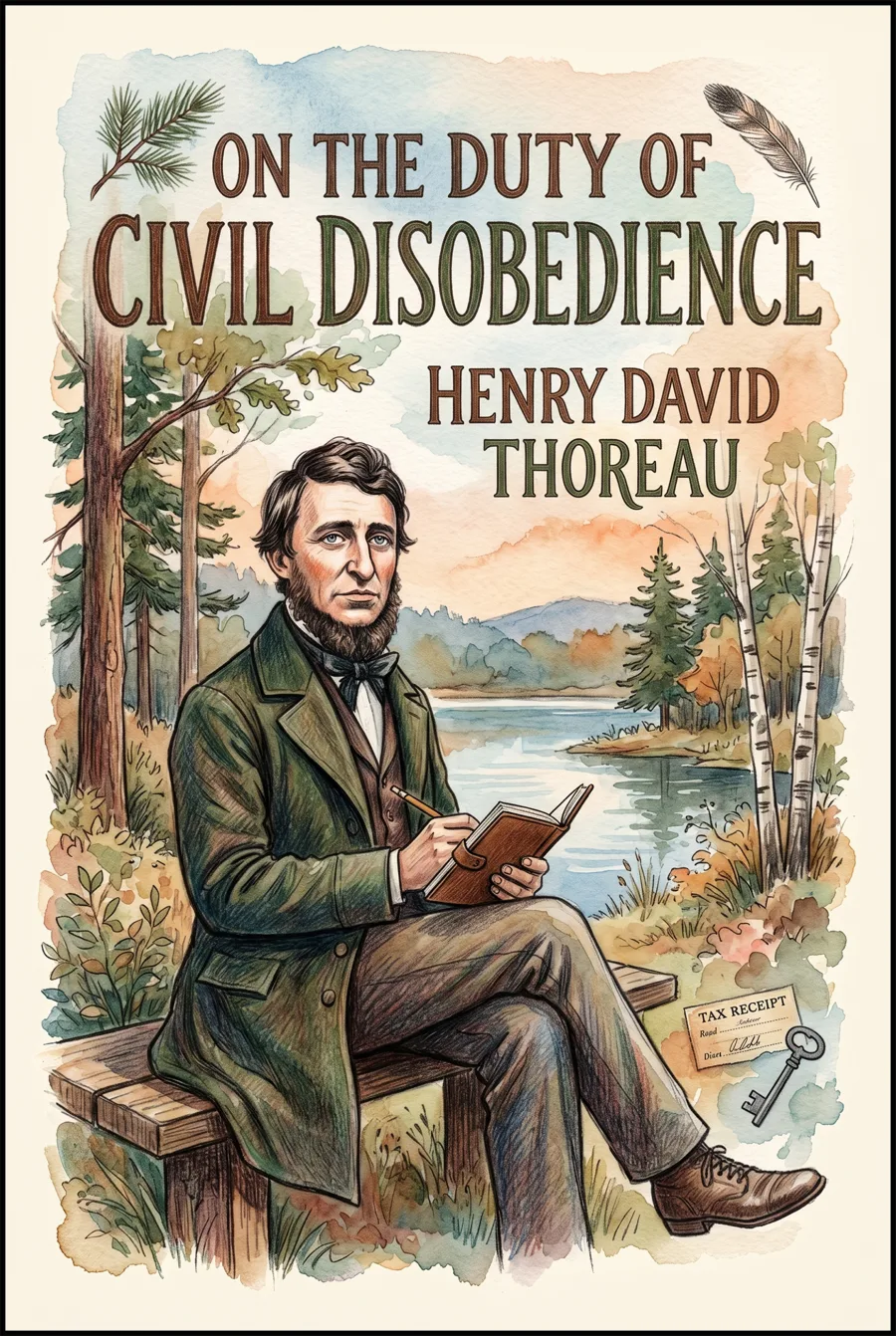
On the Duty of Civil Disobedience
eBook
• INR 51.00
• English
• 9788169359467
No ratings yet
| Publisher | General Press |
|---|---|
| ISBN13 | 9788169359467 |
| ASIN/SKU | 8169359465 |
| Book Format | eBook |
| Language | English |
| List Price | INR 51.00 |
| Subject Code | PHI019000, PHI005000, POL010000 |
| Publishing Date | 01/09/2026 |
| Book Code | BD00070220 |
Buy this Book
Amazon Stores
Ebook Stores
Other Stores
Discover On the Duty of Civil Disobedience by Henry David Thoreau. This book is published by General Press in eBook format, ISBN 9788169359467, ASIN 8169359465, under Non Fiction, Political Philosophy, Philosophy of Ethics and Morality.
Book Description
What should an individual do when the laws of a government demand obedience to injustice? 'On the Duty of Civil Disobedience' by Henry David Thoreau is a classic political philosophy and social criticism essay that challenges readers to think carefully about conscience, government, individual responsibility, and the limits of lawful authority. Originally published in 1849, the work grew from Thoreau's own refusal to support a government he believed was acting unjustly.
Thoreau argues that people should not simply obey laws because they are laws. In his view, conscience must come before unquestioning loyalty to the state, especially when government participates in wrongdoing. He is particularly critical of slavery and the Mexican-American War, which he saw as examples of a government using its power in ways that violated basic moral principles. Rather than waiting for political institutions to correct themselves, Thoreau believes individuals have a personal responsibility to resist injustice.
The essay explores the difference between passive disagreement and meaningful action. Thoreau suggests that when a government requires someone to become an instrument of injustice, refusing to cooperate can be a powerful form of protest. His own experience of withholding payment of a tax becomes an example of how a person can peacefully resist without surrendering personal integrity. He also questions whether majority rule is necessarily the same as moral truth, arguing that numbers alone cannot determine what is right.
Direct, provocative, and deeply personal, 'On the Duty of Civil Disobedience' remains influential because it asks a question that never entirely disappears: when authority and conscience come into conflict, which should we follow? Its answer continues to challenge readers to consider what it truly means to stand against injustice.
Thoreau argues that people should not simply obey laws because they are laws. In his view, conscience must come before unquestioning loyalty to the state, especially when government participates in wrongdoing. He is particularly critical of slavery and the Mexican-American War, which he saw as examples of a government using its power in ways that violated basic moral principles. Rather than waiting for political institutions to correct themselves, Thoreau believes individuals have a personal responsibility to resist injustice.
The essay explores the difference between passive disagreement and meaningful action. Thoreau suggests that when a government requires someone to become an instrument of injustice, refusing to cooperate can be a powerful form of protest. His own experience of withholding payment of a tax becomes an example of how a person can peacefully resist without surrendering personal integrity. He also questions whether majority rule is necessarily the same as moral truth, arguing that numbers alone cannot determine what is right.
Direct, provocative, and deeply personal, 'On the Duty of Civil Disobedience' remains influential because it asks a question that never entirely disappears: when authority and conscience come into conflict, which should we follow? Its answer continues to challenge readers to consider what it truly means to stand against injustice.
Author Biography
Few writers have turned a simple life in the woods into a lasting philosophy of freedom, nature, and self-reliance quite like Henry David Thoreau. An American essayist, poet, philosopher, and naturalist, Thoreau is best known for his influential works 'Walden' and 'Civil Disobedience', which continue to shape conversations about nature, individuality, and social responsibility.
Born on July 12, 1817, in Concord, Massachusetts, Thoreau grew up in a modest family and later studied at Harvard College, graduating in 1837. After returning to Concord, he became closely associated with the Transcendentalist movement and developed friendships with influential thinkers, including Ralph Waldo Emerson. His ideas were deeply rooted in close observation of the natural world, independent thought, and the belief that people should live deliberately rather than simply follow society's expectations.
Thoreau's most famous experiment in simple living began in 1845, when he built a small cabin near Walden Pond on land owned by Emerson. He spent more than two years there, observing nature and reflecting on work, society, solitude, and the meaning of a meaningful life. These experiences became the foundation of 'Walden', published in 1854. His essay 'Civil Disobedience', first published in 1849, argued that individuals should not blindly obey unjust laws, an idea that later influenced figures such as Mahatma Gandhi and Martin Luther King Jr.
Thoreau's writing is admired for its clarity, wit, vivid descriptions of nature, and bold philosophical questioning. Although he was not widely celebrated during his lifetime, his reputation grew steadily after his death in 1862. Today, his work remains especially relevant in discussions about environmentalism, simple living, political conscience, and personal freedom. His enduring legacy lies in his invitation to slow down, think independently, and live more deliberately.
Born on July 12, 1817, in Concord, Massachusetts, Thoreau grew up in a modest family and later studied at Harvard College, graduating in 1837. After returning to Concord, he became closely associated with the Transcendentalist movement and developed friendships with influential thinkers, including Ralph Waldo Emerson. His ideas were deeply rooted in close observation of the natural world, independent thought, and the belief that people should live deliberately rather than simply follow society's expectations.
Thoreau's most famous experiment in simple living began in 1845, when he built a small cabin near Walden Pond on land owned by Emerson. He spent more than two years there, observing nature and reflecting on work, society, solitude, and the meaning of a meaningful life. These experiences became the foundation of 'Walden', published in 1854. His essay 'Civil Disobedience', first published in 1849, argued that individuals should not blindly obey unjust laws, an idea that later influenced figures such as Mahatma Gandhi and Martin Luther King Jr.
Thoreau's writing is admired for its clarity, wit, vivid descriptions of nature, and bold philosophical questioning. Although he was not widely celebrated during his lifetime, his reputation grew steadily after his death in 1862. Today, his work remains especially relevant in discussions about environmentalism, simple living, political conscience, and personal freedom. His enduring legacy lies in his invitation to slow down, think independently, and live more deliberately.
Editorial Reviews
Editorial Reviews will be added soon…
Book Summary
Henry David Thoreau’s 'On the Duty of Civil Disobedience', usually known simply as 'Civil Disobedience', is one of the most influential essays in political philosophy, individual ethics, and the history of peaceful resistance. First published in 1849 under the title 'Resistance to Civil Government', the essay grew out of Thoreau’s opposition to slavery and the Mexican-American War. It was also shaped by his own experience of spending a night in jail after refusing to pay a poll tax. At the heart of the work is a deceptively simple question: What should a person do when the government requires obedience to something that the individual believes is morally wrong? Thoreau’s answer is uncompromising. Conscience must come before the state, and moral responsibility must come before obedience to the law.
The essay begins with Thoreau’s famous argument that the best government is one that governs as little as possible. He does not begin by claiming that all government is unnecessary or that society should immediately descend into disorder. Instead, he questions the assumption that government is automatically good simply because it is established, legal, or supported by a majority. Government, in his view, is a human instrument created to serve people, and like any human instrument it can be misused. A government can become an obstacle rather than a protection when its institutions begin serving political interests instead of justice. Thoreau therefore asks readers to examine government critically rather than treating it as something deserving automatic loyalty.
This leads to one of the most important ideas in 'On the Duty of Civil Disobedience': the majority does not automatically determine what is morally right. Democracy gives political power to the majority, but numbers alone do not create truth or justice. A majority may be powerful while still being wrong. Thoreau is especially concerned about situations in which individuals recognize an injustice but continue to support it merely because the law, the government, or the majority approves of it. For him, morality cannot be reduced to a vote. A person does not become morally innocent simply because thousands or millions of other people have made the same mistake.
Thoreau consequently places individual conscience above political authority. He asks why a person should possess a conscience if that conscience is simply surrendered whenever a government issues a command. His ideal citizen is not someone who blindly follows every law, but someone who thinks, judges, and accepts personal responsibility for his actions. The distinction between legality and morality is central to the essay. Something can be legal and still be profoundly unjust, while breaking a law can sometimes be the morally correct action. Thoreau therefore urges people to cultivate respect for what is right rather than respect for law merely because it is law.
The immediate political background makes this argument especially powerful. Thoreau was writing at a time when the United States was involved in the Mexican-American War and slavery remained an accepted institution in the country. He believed that the war was unjust and that the government’s continued protection of slavery made ordinary citizens participants in an immoral system. His frustration was not merely with politicians. He was equally critical of ordinary people who claimed to oppose slavery or the war but continued to cooperate with the institutions that supported them. In Thoreau’s eyes, privately believing that something is wrong is not enough if one's actions continue to sustain it.
This is where the idea of civil disobedience becomes more concrete. Thoreau argues that a person has a moral duty not necessarily to solve every injustice in the world, but at least to avoid becoming an active participant in injustice. This is an important distinction. He does not demand that every individual dedicate an entire lifetime to reforming society. Instead, he asks people to examine the consequences of their own conduct. If a government is doing something immoral, the individual should not automatically provide the money, labor, obedience, or institutional support that allows the wrongdoing to continue.
Thoreau is particularly skeptical of relying on ordinary political procedures to correct serious injustice. He questions the effectiveness of voting, petitions, and waiting for politicians to act. Voting, he suggests, can become little more than an expression of preference rather than an act of genuine moral commitment. A person may vote against slavery, for example, and then return to ordinary life without changing any of his behavior. Thoreau wants something more demanding: action that makes the individual personally responsible for his convictions. His criticism is therefore aimed not only at government but also at passive citizens who condemn injustice in conversation while continuing to cooperate with it in practice.
His own refusal to pay taxes becomes the practical example through which he develops this philosophy. Thoreau refused to pay a poll tax because he did not want his money to support a government engaged in slavery and war. His refusal eventually led to his imprisonment for one night. Someone else paid the tax against his wishes, and Thoreau was released. The incident gave him an unusually direct perspective on the relationship between the individual and the state. Rather than seeing prison as proof that he had done something wrong, he regarded his imprisonment as evidence that the government could punish his body but could not force his conscience to approve of what he considered unjust.
The jail episode is one of the most memorable parts of the essay because Thoreau transforms a small personal event into a larger philosophical argument. By entering prison, he discovers that the state possesses physical power but not necessarily moral authority. The government can take a person’s property or restrict his physical freedom, but it cannot make an unjust action just. In this sense, imprisonment can paradoxically become a form of freedom. The individual who accepts punishment rather than surrendering conscience demonstrates that moral independence is stronger than political coercion.
Thoreau also argues that refusing to cooperate with an unjust government can be more meaningful than simply criticizing it. He is suspicious of people who petition the government to correct an evil while continuing to support the same government through their taxes and obedience. If citizens truly believe that an institution is committing an injustice, he asks why they should continue providing that institution with the resources necessary to operate. His proposed solution is therefore withdrawal of support. Civil disobedience becomes an active form of noncooperation.
An especially important element of Thoreau’s argument is his emphasis on personal action. He believes that meaningful social change does not always begin with large organizations, political campaigns, or mass movements. Sometimes it begins with one person refusing to participate. He imagines that if even a small number of genuinely committed people withdrew their support from an unjust institution, the institution would eventually be weakened. His famous example of refusing taxes illustrates this principle: if the government depends upon citizens for money and cooperation, citizens possess a powerful moral tool when they choose not to provide either.
Thoreau’s concept of civil disobedience is therefore not simply rebellion for its own sake. He is not encouraging people to break laws whenever they dislike them. His argument depends on a serious moral distinction between personal convenience and genuine injustice. Civil disobedience becomes justified when obedience would make a person an accomplice to wrongdoing. The person who breaks an unjust law must also be willing to accept the consequences. This willingness is crucial because it demonstrates that civil disobedience is not selfish lawlessness. The dissenter accepts punishment while refusing to surrender the principle that motivated the resistance.
Another major theme is the tension between being a “good citizen” and being a morally responsible human being. Thoreau challenges the conventional assumption that obedience equals citizenship. A government may call obedience patriotic, but Thoreau asks readers to consider whether true patriotism sometimes requires resistance. In his view, the person who obeys an unjust command simply because it comes from an official authority may actually be behaving less responsibly than the person who refuses. The morally courageous citizen may therefore appear disobedient from the government’s perspective while acting faithfully according to conscience.
The essay also explores the danger of turning people into instruments of government. Thoreau worries about individuals who become little more than functioning parts of a political machine. Soldiers, officials, taxpayers, and other citizens can perform their assigned duties without asking whether those duties are morally defensible. Once people stop thinking for themselves, an unjust system can continue operating smoothly. Thoreau’s real target is therefore not merely government machinery but the human willingness to become machinery within it. His ideal citizen remains intellectually awake and morally independent.
At the same time, 'On the Duty of Civil Disobedience' is deeply connected to Thoreau’s broader Transcendentalist belief in the authority of the individual. The individual has an inner moral capacity that cannot be completely replaced by institutions. Political systems may establish rules, but they cannot determine the deepest questions of right and wrong. Thoreau’s argument consequently has a spiritual dimension: conscience represents a higher obligation than political convenience. The individual must be willing to stand alone if necessary.
The conclusion of the essay returns to the question of what a truly just government would look like. Thoreau does not simply dream of chaos or permanent political conflict. He imagines a government that recognizes the moral independence of individuals and governs with their genuine consent. The state, at its best, should not crush conscience but respect it. A free society, in Thoreau’s understanding, is one in which people are treated as human beings first and political subjects second. The ultimate goal is not endless rebellion but a political order in which government deserves obedience because it acts justly.
The lasting importance of 'On the Duty of Civil Disobedience' comes from the way Thoreau connects political freedom with personal responsibility. His central question remains relevant whenever laws, institutions, or governments come into conflict with ethical principles. The essay asks readers to move beyond the comfortable position of saying, “I disagree with this,” and instead consider the more difficult question, “Am I helping this injustice continue?” That shift from opinion to responsibility is the heart of Thoreau’s philosophy.
The influence of the essay eventually extended far beyond the circumstances in which Thoreau wrote it. Its principles became important to later traditions of nonviolent resistance and influenced figures such as Mahatma Gandhi and Martin Luther King Jr. Its continuing appeal lies in the fact that it does not depend entirely on one political issue. Although slavery and the Mexican-American War provide its immediate context, its larger subject is the individual’s relationship with authority.
Ultimately, 'On the Duty of Civil Disobedience' is a powerful argument for moral courage. Thoreau asks us to recognize that injustice often survives not simply because powerful people create it, but because ordinary people cooperate with it. Laws can command behavior, but they cannot relieve individuals of moral responsibility. Government may possess authority, but authority does not automatically make an action right. For Thoreau, the first responsibility of a human being is to conscience. When the state demands participation in wrongdoing, the individual must be prepared to withdraw support, resist peacefully, and, if necessary, accept the consequences. The essay’s enduring message is therefore both political and deeply personal: a just society begins with individuals who are willing to think for themselves, refuse to participate in injustice, and place moral truth above the comfort of obedience.
The essay begins with Thoreau’s famous argument that the best government is one that governs as little as possible. He does not begin by claiming that all government is unnecessary or that society should immediately descend into disorder. Instead, he questions the assumption that government is automatically good simply because it is established, legal, or supported by a majority. Government, in his view, is a human instrument created to serve people, and like any human instrument it can be misused. A government can become an obstacle rather than a protection when its institutions begin serving political interests instead of justice. Thoreau therefore asks readers to examine government critically rather than treating it as something deserving automatic loyalty.
This leads to one of the most important ideas in 'On the Duty of Civil Disobedience': the majority does not automatically determine what is morally right. Democracy gives political power to the majority, but numbers alone do not create truth or justice. A majority may be powerful while still being wrong. Thoreau is especially concerned about situations in which individuals recognize an injustice but continue to support it merely because the law, the government, or the majority approves of it. For him, morality cannot be reduced to a vote. A person does not become morally innocent simply because thousands or millions of other people have made the same mistake.
Thoreau consequently places individual conscience above political authority. He asks why a person should possess a conscience if that conscience is simply surrendered whenever a government issues a command. His ideal citizen is not someone who blindly follows every law, but someone who thinks, judges, and accepts personal responsibility for his actions. The distinction between legality and morality is central to the essay. Something can be legal and still be profoundly unjust, while breaking a law can sometimes be the morally correct action. Thoreau therefore urges people to cultivate respect for what is right rather than respect for law merely because it is law.
The immediate political background makes this argument especially powerful. Thoreau was writing at a time when the United States was involved in the Mexican-American War and slavery remained an accepted institution in the country. He believed that the war was unjust and that the government’s continued protection of slavery made ordinary citizens participants in an immoral system. His frustration was not merely with politicians. He was equally critical of ordinary people who claimed to oppose slavery or the war but continued to cooperate with the institutions that supported them. In Thoreau’s eyes, privately believing that something is wrong is not enough if one's actions continue to sustain it.
This is where the idea of civil disobedience becomes more concrete. Thoreau argues that a person has a moral duty not necessarily to solve every injustice in the world, but at least to avoid becoming an active participant in injustice. This is an important distinction. He does not demand that every individual dedicate an entire lifetime to reforming society. Instead, he asks people to examine the consequences of their own conduct. If a government is doing something immoral, the individual should not automatically provide the money, labor, obedience, or institutional support that allows the wrongdoing to continue.
Thoreau is particularly skeptical of relying on ordinary political procedures to correct serious injustice. He questions the effectiveness of voting, petitions, and waiting for politicians to act. Voting, he suggests, can become little more than an expression of preference rather than an act of genuine moral commitment. A person may vote against slavery, for example, and then return to ordinary life without changing any of his behavior. Thoreau wants something more demanding: action that makes the individual personally responsible for his convictions. His criticism is therefore aimed not only at government but also at passive citizens who condemn injustice in conversation while continuing to cooperate with it in practice.
His own refusal to pay taxes becomes the practical example through which he develops this philosophy. Thoreau refused to pay a poll tax because he did not want his money to support a government engaged in slavery and war. His refusal eventually led to his imprisonment for one night. Someone else paid the tax against his wishes, and Thoreau was released. The incident gave him an unusually direct perspective on the relationship between the individual and the state. Rather than seeing prison as proof that he had done something wrong, he regarded his imprisonment as evidence that the government could punish his body but could not force his conscience to approve of what he considered unjust.
The jail episode is one of the most memorable parts of the essay because Thoreau transforms a small personal event into a larger philosophical argument. By entering prison, he discovers that the state possesses physical power but not necessarily moral authority. The government can take a person’s property or restrict his physical freedom, but it cannot make an unjust action just. In this sense, imprisonment can paradoxically become a form of freedom. The individual who accepts punishment rather than surrendering conscience demonstrates that moral independence is stronger than political coercion.
Thoreau also argues that refusing to cooperate with an unjust government can be more meaningful than simply criticizing it. He is suspicious of people who petition the government to correct an evil while continuing to support the same government through their taxes and obedience. If citizens truly believe that an institution is committing an injustice, he asks why they should continue providing that institution with the resources necessary to operate. His proposed solution is therefore withdrawal of support. Civil disobedience becomes an active form of noncooperation.
An especially important element of Thoreau’s argument is his emphasis on personal action. He believes that meaningful social change does not always begin with large organizations, political campaigns, or mass movements. Sometimes it begins with one person refusing to participate. He imagines that if even a small number of genuinely committed people withdrew their support from an unjust institution, the institution would eventually be weakened. His famous example of refusing taxes illustrates this principle: if the government depends upon citizens for money and cooperation, citizens possess a powerful moral tool when they choose not to provide either.
Thoreau’s concept of civil disobedience is therefore not simply rebellion for its own sake. He is not encouraging people to break laws whenever they dislike them. His argument depends on a serious moral distinction between personal convenience and genuine injustice. Civil disobedience becomes justified when obedience would make a person an accomplice to wrongdoing. The person who breaks an unjust law must also be willing to accept the consequences. This willingness is crucial because it demonstrates that civil disobedience is not selfish lawlessness. The dissenter accepts punishment while refusing to surrender the principle that motivated the resistance.
Another major theme is the tension between being a “good citizen” and being a morally responsible human being. Thoreau challenges the conventional assumption that obedience equals citizenship. A government may call obedience patriotic, but Thoreau asks readers to consider whether true patriotism sometimes requires resistance. In his view, the person who obeys an unjust command simply because it comes from an official authority may actually be behaving less responsibly than the person who refuses. The morally courageous citizen may therefore appear disobedient from the government’s perspective while acting faithfully according to conscience.
The essay also explores the danger of turning people into instruments of government. Thoreau worries about individuals who become little more than functioning parts of a political machine. Soldiers, officials, taxpayers, and other citizens can perform their assigned duties without asking whether those duties are morally defensible. Once people stop thinking for themselves, an unjust system can continue operating smoothly. Thoreau’s real target is therefore not merely government machinery but the human willingness to become machinery within it. His ideal citizen remains intellectually awake and morally independent.
At the same time, 'On the Duty of Civil Disobedience' is deeply connected to Thoreau’s broader Transcendentalist belief in the authority of the individual. The individual has an inner moral capacity that cannot be completely replaced by institutions. Political systems may establish rules, but they cannot determine the deepest questions of right and wrong. Thoreau’s argument consequently has a spiritual dimension: conscience represents a higher obligation than political convenience. The individual must be willing to stand alone if necessary.
The conclusion of the essay returns to the question of what a truly just government would look like. Thoreau does not simply dream of chaos or permanent political conflict. He imagines a government that recognizes the moral independence of individuals and governs with their genuine consent. The state, at its best, should not crush conscience but respect it. A free society, in Thoreau’s understanding, is one in which people are treated as human beings first and political subjects second. The ultimate goal is not endless rebellion but a political order in which government deserves obedience because it acts justly.
The lasting importance of 'On the Duty of Civil Disobedience' comes from the way Thoreau connects political freedom with personal responsibility. His central question remains relevant whenever laws, institutions, or governments come into conflict with ethical principles. The essay asks readers to move beyond the comfortable position of saying, “I disagree with this,” and instead consider the more difficult question, “Am I helping this injustice continue?” That shift from opinion to responsibility is the heart of Thoreau’s philosophy.
The influence of the essay eventually extended far beyond the circumstances in which Thoreau wrote it. Its principles became important to later traditions of nonviolent resistance and influenced figures such as Mahatma Gandhi and Martin Luther King Jr. Its continuing appeal lies in the fact that it does not depend entirely on one political issue. Although slavery and the Mexican-American War provide its immediate context, its larger subject is the individual’s relationship with authority.
Ultimately, 'On the Duty of Civil Disobedience' is a powerful argument for moral courage. Thoreau asks us to recognize that injustice often survives not simply because powerful people create it, but because ordinary people cooperate with it. Laws can command behavior, but they cannot relieve individuals of moral responsibility. Government may possess authority, but authority does not automatically make an action right. For Thoreau, the first responsibility of a human being is to conscience. When the state demands participation in wrongdoing, the individual must be prepared to withdraw support, resist peacefully, and, if necessary, accept the consequences. The essay’s enduring message is therefore both political and deeply personal: a just society begins with individuals who are willing to think for themselves, refuse to participate in injustice, and place moral truth above the comfort of obedience.
Sample Chapters
Sample Chapters will be added soon…
Reader Reviews
No reviews yet.
On the Duty of Civil Disobedience
Download Cover Image
Do you want to download the full cover image for On the Duty of Civil Disobedience?