
Struwwelpeter in English Translation
eBook
• INR 51.00
• English
• 9788169359054
No ratings yet
| Publisher | General Press |
|---|---|
| ISBN13 | 9788169359054 |
| ASIN/SKU | 8169359058 |
| Book Format | eBook |
| Language | English |
| List Price | INR 51.00 |
| Subject Code | JUV070000, JUV039220, JUV019000 |
| Publishing Date | 01/09/2026 |
| Book Code | BD00070222 |
Buy this Book
Amazon Stores
Ebook Stores
Other Stores
Discover Struwwelpeter in English Translation by Heinrich Hoffmann. This book is published by General Press in eBook format, ISBN 9788169359054, ASIN 8169359058, under Children's Books, Children's Poetry, Children's Family Life Books.
Book Description
What happens when children ignore every warning and discover that their actions can have surprisingly dramatic consequences? 'Struwwelpeter in English Translation' by Heinrich Hoffmann is a classic children’s literature collection of humorous, darkly comic cautionary tales that teaches lessons about manners, obedience, self-control, and kindness through memorable rhymes and exaggerated illustrations. First published in 1845, the book has remained famous for its unusual combination of playful storytelling and grim consequences.
Rather than telling one continuous story, the book brings together a series of short tales about children who refuse to listen or behave sensibly. One of the most famous is Struwwelpeter himself, a boy whose wild hair and uncut fingernails show what happens when personal grooming is completely ignored. Other stories feature children whose stubbornness, curiosity, cruelty, carelessness, or refusal to follow instructions leads to increasingly dramatic results. A child who plays with matches faces a terrifying accident, while another who refuses to eat suffers the consequences of his stubbornness. The exaggerated punishments are presented with dark humor, turning ordinary childhood misbehavior into unforgettable scenes.
Hoffmann's simple rhymes and vivid characters make each episode easy to remember, while the English translation allows modern readers to experience the strange charm of this nineteenth-century German classic. Although some of the punishments may seem startling to contemporary readers, the stories reflect an older style of children's literature in which moral lessons were taught through shock, humor, and memorable examples.
With its lively verse, eccentric characters, and wonderfully bizarre imagination, 'Struwwelpeter' is far more than a collection of children's warnings. It is a fascinating glimpse into the history of children's storytelling—and a book whose strange little stories are difficult to forget once you've encountered them.
Rather than telling one continuous story, the book brings together a series of short tales about children who refuse to listen or behave sensibly. One of the most famous is Struwwelpeter himself, a boy whose wild hair and uncut fingernails show what happens when personal grooming is completely ignored. Other stories feature children whose stubbornness, curiosity, cruelty, carelessness, or refusal to follow instructions leads to increasingly dramatic results. A child who plays with matches faces a terrifying accident, while another who refuses to eat suffers the consequences of his stubbornness. The exaggerated punishments are presented with dark humor, turning ordinary childhood misbehavior into unforgettable scenes.
Hoffmann's simple rhymes and vivid characters make each episode easy to remember, while the English translation allows modern readers to experience the strange charm of this nineteenth-century German classic. Although some of the punishments may seem startling to contemporary readers, the stories reflect an older style of children's literature in which moral lessons were taught through shock, humor, and memorable examples.
With its lively verse, eccentric characters, and wonderfully bizarre imagination, 'Struwwelpeter' is far more than a collection of children's warnings. It is a fascinating glimpse into the history of children's storytelling—and a book whose strange little stories are difficult to forget once you've encountered them.
Author Biography
Few children’s books have achieved the lasting cultural impact of a small homemade Christmas gift, but Heinrich Hoffmann turned one such gift into a literary classic. Heinrich Hoffmann (1809–1894) was a German psychiatrist, poet, and children’s author, best known for 'Der Struwwelpeter' ('Shockheaded Peter'), the vividly illustrated collection of cautionary tales that made him internationally famous.
Born on June 13, 1809, in Frankfurt am Main, Hoffmann initially dreamed of writing but followed his father’s wishes and studied medicine in Heidelberg and Halle, earning his medical degree in 1833. After further study in Paris, he returned to Frankfurt, where he established a medical practice and helped provide free treatment through a clinic for poor patients. His career later expanded into anatomy, psychiatry, and public service. From 1851 to 1888, he directed Frankfurt’s institution for people with mental illnesses and epilepsy, where he advocated more humane treatment and helped develop a model psychiatric clinic.
Hoffmann’s literary breakthrough came almost by accident. In 1844, while searching for a suitable Christmas present for his young son Carl, he was dissatisfied with the children’s books available and created his own. The result was 'Der Struwwelpeter', published in 1845 and filled with memorable rhymes, striking illustrations, mischievous children, and exaggerated consequences. Its playful yet unsettling style quickly captured readers’ imaginations, and the book went through countless editions. Hoffmann also wrote other children’s books, poetry, humorous works, and political satire, including 'King Nut-Cracker or The Dream of Poor Reinhold' and the poetry collection 'Auf heiteren Pfaden'.
Hoffmann died in Frankfurt on September 20, 1894. His career bridged medicine, literature, and social reform, but his greatest legacy remains 'Der Struwwelpeter', a distinctive classic that continues to fascinate readers and shape the history of children’s literature.
Born on June 13, 1809, in Frankfurt am Main, Hoffmann initially dreamed of writing but followed his father’s wishes and studied medicine in Heidelberg and Halle, earning his medical degree in 1833. After further study in Paris, he returned to Frankfurt, where he established a medical practice and helped provide free treatment through a clinic for poor patients. His career later expanded into anatomy, psychiatry, and public service. From 1851 to 1888, he directed Frankfurt’s institution for people with mental illnesses and epilepsy, where he advocated more humane treatment and helped develop a model psychiatric clinic.
Hoffmann’s literary breakthrough came almost by accident. In 1844, while searching for a suitable Christmas present for his young son Carl, he was dissatisfied with the children’s books available and created his own. The result was 'Der Struwwelpeter', published in 1845 and filled with memorable rhymes, striking illustrations, mischievous children, and exaggerated consequences. Its playful yet unsettling style quickly captured readers’ imaginations, and the book went through countless editions. Hoffmann also wrote other children’s books, poetry, humorous works, and political satire, including 'King Nut-Cracker or The Dream of Poor Reinhold' and the poetry collection 'Auf heiteren Pfaden'.
Hoffmann died in Frankfurt on September 20, 1894. His career bridged medicine, literature, and social reform, but his greatest legacy remains 'Der Struwwelpeter', a distinctive classic that continues to fascinate readers and shape the history of children’s literature.
Editorial Reviews
Editorial Reviews will be added soon…
Book Summary
"Struwwelpeter" by Heinrich Hoffmann is one of the strangest, most memorable, and most controversial classics of children’s literature. First published in Germany in the mid-nineteenth century, the book is a collection of short rhyming stories accompanied by vivid illustrations, each showing what happens when children refuse to behave as adults expect. Rather than offering gentle lessons about kindness and obedience, Hoffmann uses exaggeration, dark humor, absurdity, and sometimes shocking punishment to make his moral points unforgettable. The English translation preserves the basic character of this unusual work: simple rhymes, memorable characters, comic pictures, and cautionary tales in which ordinary childhood disobedience can lead to extraordinary consequences. The book contains ten principal stories, covering subjects such as cleanliness, cruelty, playing with matches, bullying, thumb-sucking, refusing food, restlessness, carelessness, and ignoring warnings.
The history behind 'Struwwelpeter' is almost as interesting as the stories themselves. Heinrich Hoffmann was a Frankfurt physician who was dissatisfied with the children's books available when he wanted a Christmas present for his young son. Instead of buying a book he disliked, he created one himself, writing the verses and drawing the pictures. The work originally appeared in 1845 under a longer title roughly meaning “Funny Stories and Droll Pictures for Children from Three to Six Years.” It later became known as 'Der Struwwelpeter', after the wild-haired boy who appears in the opening story. The first English translation appeared in 1848, and the book subsequently became internationally famous.
The central idea of 'Struwwelpeter' is extremely simple: children are expected to learn social rules, and when they deliberately ignore those rules, consequences follow. Yet Hoffmann does not present these lessons through realistic family situations. Instead, he turns small acts of disobedience into exaggerated disasters. A child who refuses to eat does not merely lose his appetite; he wastes away. A child who sucks his thumb does not simply receive a reprimand; a tailor arrives with enormous scissors. A boy who will not sit still at the dinner table causes an entire meal to collapse onto the floor. The exaggeration is essential to the book's effect. Hoffmann transforms everyday parental warnings into grotesque little dramas that children can easily remember.
The opening story, “Shock-Headed Peter,” introduces the title character. Struwwelpeter is a boy who refuses to groom himself. His hair grows wildly, his fingernails become excessively long, and his general appearance becomes increasingly untidy. The story is humorous rather than complicated, but it establishes one of the book's most important themes: society has rules about how a child should present himself. Cleanliness, grooming, and personal discipline are treated as signs of good behavior. The contrast between the child's stubbornness and his ridiculous appearance makes the lesson visually immediate. Struwwelpeter is not evil or dangerous; he is simply unwilling to follow ordinary expectations. That makes him an especially effective emblem for the book as a whole.
The next story, “The Story of Cruel Frederick,” moves from personal appearance to cruelty. Frederick is an aggressive and violent boy who mistreats animals and people. He hurts birds, torments cats, and behaves brutally toward his dog. Eventually, however, the dog turns against him and bites him. Frederick is forced to remain in bed while the dog enjoys his food and occupies his place. The reversal is comic but meaningful. Hoffmann's message is that cruelty eventually produces consequences for the person who practices it. The story also broadens the moral scope of 'Struwwelpeter': good behavior is not merely about obeying parents; it also concerns how one treats weaker creatures.
“The Dreadful Story of Harriet and the Matches” is perhaps the book's most famous and disturbing episode. Harriet is warned not to play with matches while her mother is away. She ignores the warning, lights the matches, and accidentally sets herself on fire. The story ends tragically, with her cats mourning her. The extreme punishment reflects nineteenth-century attitudes toward moral instruction, but the underlying warning remains recognizable. Fire is dangerous, and children may not understand how quickly a small experiment can become an uncontrollable disaster. Hoffmann's method is deliberately terrifying because he wants the image to remain in the child's mind. Among the stories in 'Struwwelpeter', this one most clearly demonstrates how the book turns a parental warning into a miniature nightmare.
“The Story of the Inky Boys” introduces a different kind of moral lesson: bullying and prejudice. Three boys mock and insult a dark-skinned child. St. Nicholas intervenes and punishes the bullies by dipping them in black ink, making them even darker than the boy they have mocked. The episode is rooted in the social assumptions of its nineteenth-century setting, so modern readers may find its imagery and language uncomfortable. Nevertheless, the basic dramatic structure is clear: children who humiliate another child because of appearance are themselves subjected to humiliation. The story therefore condemns cruelty, mockery, and discriminatory behavior through an exaggerated reversal. It is also one of the places where reading 'Struwwelpeter' historically is important, because the moral intention and the imagery belong to a very different cultural period.
“The Story of the Wild Huntsman” is unusual because its central figure is not a misbehaving child. A hunter falls asleep beneath a tree, and a hare takes advantage of the situation by seizing the hunter's gun and spectacles. The hunter becomes the victim of the very violence associated with hunting. The scene develops into comic chaos, with the hare attempting to turn the tables on the man who normally possesses all the power. The story adds variety to the collection while reinforcing Hoffmann's interest in reversals of authority. The powerful can suddenly become powerless, and those who assume control over others may discover what it feels like to be vulnerable themselves.
One of the most famous stories is “The Story of Little Suck-a-Thumb.” Conrad is warned by his mother not to suck his thumb. She tells him that a tailor will come with giant scissors if he disobeys. As soon as she leaves, Conrad begins sucking his thumb again. The tailor appears and cuts off his thumbs. The story is intentionally grotesque, turning a common childhood habit into an unforgettable nightmare. From a modern perspective, the punishment seems wildly disproportionate, but that disproportion is precisely Hoffmann's technique. He is not interested in subtle psychological realism. He wants a child to associate the forbidden behavior with an image so striking that it cannot easily be forgotten.
“The Story of Augustus, Who Would Not Have Any Soup” focuses on food and obedience. Augustus begins as a healthy, cheerful child, but one day he announces that he will not eat his soup. He continues refusing food day after day. As a result, he becomes increasingly weak and thin until he eventually dies. A soup tureen is placed on his grave, creating one of the book's bleakest jokes. The story is clearly designed as a warning against refusing food, but modern readers may also see something more complex in it. The tale dramatizes a child's struggle for control and shows how a seemingly small act of refusal can become an absolute rejection of adult authority.
“The Story of Fidgety Philip” is much more comic. Philip cannot sit quietly at the dinner table. He wiggles, rocks his chair, grabs at the tablecloth, and ultimately pulls the entire meal onto the floor. His parents are furious, and the carefully controlled dinner becomes complete chaos. This story has attracted particular interest from modern readers because Philip's restless behavior resembles descriptions of attention difficulties and hyperactivity. Some psychiatric commentators have even identified the story as an early literary portrayal of behavior now associated with ADHD, although such modern diagnoses should not simply be projected backward onto a nineteenth-century fictional character. What Hoffmann clearly captures is the tension between an energetic child and adults who expect prolonged stillness, obedience, and self-control.
“The Story of Johnny Head-in-Air” presents another child who has difficulty paying attention to his immediate surroundings. Johnny habitually looks upward rather than watching where he is going. Eventually he walks straight into a river and has to be rescued. His schoolbag floats away, adding a comic consequence to his carelessness. The lesson is straightforward: attention matters, and daydreaming at the wrong moment can be dangerous. Yet the story is also sympathetic in an unexpected way. Johnny is not deliberately malicious. His problem is that his imagination and attention seem directed elsewhere. This makes him one of the more recognizable children in the collection.
The final story, “The Story of Flying Robert,” concerns a boy who goes outdoors during a storm despite the warnings of adults. The wind catches his umbrella and lifts him into the air. Robert is carried away, disappearing into the distance. The ending is deliberately unresolved and unsettling. Unlike Augustus or Harriet, Robert is not shown dying, but the reader is left with the frightening knowledge that he has been carried beyond anyone's control. The story perfectly summarizes Hoffmann's method: an ordinary act of disobedience becomes a fantastical event with potentially disastrous consequences.
Taken together, the ten stories form a surprisingly coherent portrait of nineteenth-century ideas about childhood. Hoffmann emphasizes cleanliness, obedience, self-control, table manners, caution, respect for animals, kindness toward others, and responsiveness to parental authority. The stories are not traditional narratives with elaborate plots and character development. Instead, each is a compact moral machine. A behavior is introduced, a warning is given, the warning is ignored, and the consequence arrives. The illustrations reinforce this structure by showing readers exactly what has happened. This combination of verse and image helped make 'Struwwelpeter' unusually influential, and the work has often been described as a precursor to modern comics because its pictures and short narrative sequences work together so directly.
What makes 'Struwwelpeter' fascinating today is the distance between its original educational purpose and modern attitudes toward children. Contemporary parents may consider the punishments unnecessarily violent or psychologically harsh. Yet the book remains valuable as a historical artifact and as an example of how children's literature has changed. Hoffmann understood that children respond strongly to memorable images, repetition, rhythm, exaggeration, and humor. His stories are easy to follow, but their pictures are often impossible to forget. The book's continued cultural influence shows how effectively he combined these elements.
Another reason 'Struwwelpeter' continues to attract readers is its psychological ambiguity. The children are naughty, but they are also impulsive, stubborn, curious, distracted, emotional, and independent. In other words, they behave like recognizable children. The adults, meanwhile, often represent an orderly world that insists on rules. Hoffmann clearly sides with discipline, but his exaggerated storytelling also makes the adult world look absurd. The giant scissors, the black ink, the runaway tablecloth, the flying umbrella, and the soup on Augustus's grave are so extreme that the book becomes darkly comic rather than simply instructional.
The English translation is particularly interesting because rhyme and rhythm are central to the original experience. 'Struwwelpeter' is not simply a collection of moral lessons translated from one language into another; it is a work in which sound, repetition, illustration, and comic timing are essential. English editions have therefore had to reproduce the spirit of Hoffmann's short rhyming verses while making the language accessible to English-speaking readers. The surviving English editions and digital versions demonstrate how widely the book has circulated. Project Gutenberg, for example, provides an English edition titled 'Struwwelpeter: Merry Stories and Funny Pictures', describing it as a collection of ten rhymed cautionary tales and identifying its themes as children's conduct, behavior, and moral instruction.
Ultimately, 'Struwwelpeter' is much more than a collection of old-fashioned children's warnings. It is a landmark in children's literature, an early example of visual storytelling, a fascinating record of nineteenth-century ideas about discipline, and an enduring study in the power of exaggerated consequences. Its stories can be funny, disturbing, absurd, cruel, and surprisingly perceptive at the same time. Readers searching for an ''in-depth summary of Struwwelpeter'', an ''English translation of Struwwelpeter'', or an explanation of ''Heinrich Hoffmann's classic children's book'' will find that its apparent simplicity hides a richer cultural history. The book asks children to behave, but it also reveals what adults fear about childhood: disorder, impulsiveness, curiosity, aggression, carelessness, and resistance to authority. That combination of humor and unease is the secret of its longevity. More than a century and a half after its creation, 'Struwwelpeter' remains unforgettable because Hoffmann understood a simple truth about storytelling: a lesson wrapped in an ordinary warning may be forgotten, but a strange, shocking, and vividly imagined story can stay in the mind forever.
The history behind 'Struwwelpeter' is almost as interesting as the stories themselves. Heinrich Hoffmann was a Frankfurt physician who was dissatisfied with the children's books available when he wanted a Christmas present for his young son. Instead of buying a book he disliked, he created one himself, writing the verses and drawing the pictures. The work originally appeared in 1845 under a longer title roughly meaning “Funny Stories and Droll Pictures for Children from Three to Six Years.” It later became known as 'Der Struwwelpeter', after the wild-haired boy who appears in the opening story. The first English translation appeared in 1848, and the book subsequently became internationally famous.
The central idea of 'Struwwelpeter' is extremely simple: children are expected to learn social rules, and when they deliberately ignore those rules, consequences follow. Yet Hoffmann does not present these lessons through realistic family situations. Instead, he turns small acts of disobedience into exaggerated disasters. A child who refuses to eat does not merely lose his appetite; he wastes away. A child who sucks his thumb does not simply receive a reprimand; a tailor arrives with enormous scissors. A boy who will not sit still at the dinner table causes an entire meal to collapse onto the floor. The exaggeration is essential to the book's effect. Hoffmann transforms everyday parental warnings into grotesque little dramas that children can easily remember.
The opening story, “Shock-Headed Peter,” introduces the title character. Struwwelpeter is a boy who refuses to groom himself. His hair grows wildly, his fingernails become excessively long, and his general appearance becomes increasingly untidy. The story is humorous rather than complicated, but it establishes one of the book's most important themes: society has rules about how a child should present himself. Cleanliness, grooming, and personal discipline are treated as signs of good behavior. The contrast between the child's stubbornness and his ridiculous appearance makes the lesson visually immediate. Struwwelpeter is not evil or dangerous; he is simply unwilling to follow ordinary expectations. That makes him an especially effective emblem for the book as a whole.
The next story, “The Story of Cruel Frederick,” moves from personal appearance to cruelty. Frederick is an aggressive and violent boy who mistreats animals and people. He hurts birds, torments cats, and behaves brutally toward his dog. Eventually, however, the dog turns against him and bites him. Frederick is forced to remain in bed while the dog enjoys his food and occupies his place. The reversal is comic but meaningful. Hoffmann's message is that cruelty eventually produces consequences for the person who practices it. The story also broadens the moral scope of 'Struwwelpeter': good behavior is not merely about obeying parents; it also concerns how one treats weaker creatures.
“The Dreadful Story of Harriet and the Matches” is perhaps the book's most famous and disturbing episode. Harriet is warned not to play with matches while her mother is away. She ignores the warning, lights the matches, and accidentally sets herself on fire. The story ends tragically, with her cats mourning her. The extreme punishment reflects nineteenth-century attitudes toward moral instruction, but the underlying warning remains recognizable. Fire is dangerous, and children may not understand how quickly a small experiment can become an uncontrollable disaster. Hoffmann's method is deliberately terrifying because he wants the image to remain in the child's mind. Among the stories in 'Struwwelpeter', this one most clearly demonstrates how the book turns a parental warning into a miniature nightmare.
“The Story of the Inky Boys” introduces a different kind of moral lesson: bullying and prejudice. Three boys mock and insult a dark-skinned child. St. Nicholas intervenes and punishes the bullies by dipping them in black ink, making them even darker than the boy they have mocked. The episode is rooted in the social assumptions of its nineteenth-century setting, so modern readers may find its imagery and language uncomfortable. Nevertheless, the basic dramatic structure is clear: children who humiliate another child because of appearance are themselves subjected to humiliation. The story therefore condemns cruelty, mockery, and discriminatory behavior through an exaggerated reversal. It is also one of the places where reading 'Struwwelpeter' historically is important, because the moral intention and the imagery belong to a very different cultural period.
“The Story of the Wild Huntsman” is unusual because its central figure is not a misbehaving child. A hunter falls asleep beneath a tree, and a hare takes advantage of the situation by seizing the hunter's gun and spectacles. The hunter becomes the victim of the very violence associated with hunting. The scene develops into comic chaos, with the hare attempting to turn the tables on the man who normally possesses all the power. The story adds variety to the collection while reinforcing Hoffmann's interest in reversals of authority. The powerful can suddenly become powerless, and those who assume control over others may discover what it feels like to be vulnerable themselves.
One of the most famous stories is “The Story of Little Suck-a-Thumb.” Conrad is warned by his mother not to suck his thumb. She tells him that a tailor will come with giant scissors if he disobeys. As soon as she leaves, Conrad begins sucking his thumb again. The tailor appears and cuts off his thumbs. The story is intentionally grotesque, turning a common childhood habit into an unforgettable nightmare. From a modern perspective, the punishment seems wildly disproportionate, but that disproportion is precisely Hoffmann's technique. He is not interested in subtle psychological realism. He wants a child to associate the forbidden behavior with an image so striking that it cannot easily be forgotten.
“The Story of Augustus, Who Would Not Have Any Soup” focuses on food and obedience. Augustus begins as a healthy, cheerful child, but one day he announces that he will not eat his soup. He continues refusing food day after day. As a result, he becomes increasingly weak and thin until he eventually dies. A soup tureen is placed on his grave, creating one of the book's bleakest jokes. The story is clearly designed as a warning against refusing food, but modern readers may also see something more complex in it. The tale dramatizes a child's struggle for control and shows how a seemingly small act of refusal can become an absolute rejection of adult authority.
“The Story of Fidgety Philip” is much more comic. Philip cannot sit quietly at the dinner table. He wiggles, rocks his chair, grabs at the tablecloth, and ultimately pulls the entire meal onto the floor. His parents are furious, and the carefully controlled dinner becomes complete chaos. This story has attracted particular interest from modern readers because Philip's restless behavior resembles descriptions of attention difficulties and hyperactivity. Some psychiatric commentators have even identified the story as an early literary portrayal of behavior now associated with ADHD, although such modern diagnoses should not simply be projected backward onto a nineteenth-century fictional character. What Hoffmann clearly captures is the tension between an energetic child and adults who expect prolonged stillness, obedience, and self-control.
“The Story of Johnny Head-in-Air” presents another child who has difficulty paying attention to his immediate surroundings. Johnny habitually looks upward rather than watching where he is going. Eventually he walks straight into a river and has to be rescued. His schoolbag floats away, adding a comic consequence to his carelessness. The lesson is straightforward: attention matters, and daydreaming at the wrong moment can be dangerous. Yet the story is also sympathetic in an unexpected way. Johnny is not deliberately malicious. His problem is that his imagination and attention seem directed elsewhere. This makes him one of the more recognizable children in the collection.
The final story, “The Story of Flying Robert,” concerns a boy who goes outdoors during a storm despite the warnings of adults. The wind catches his umbrella and lifts him into the air. Robert is carried away, disappearing into the distance. The ending is deliberately unresolved and unsettling. Unlike Augustus or Harriet, Robert is not shown dying, but the reader is left with the frightening knowledge that he has been carried beyond anyone's control. The story perfectly summarizes Hoffmann's method: an ordinary act of disobedience becomes a fantastical event with potentially disastrous consequences.
Taken together, the ten stories form a surprisingly coherent portrait of nineteenth-century ideas about childhood. Hoffmann emphasizes cleanliness, obedience, self-control, table manners, caution, respect for animals, kindness toward others, and responsiveness to parental authority. The stories are not traditional narratives with elaborate plots and character development. Instead, each is a compact moral machine. A behavior is introduced, a warning is given, the warning is ignored, and the consequence arrives. The illustrations reinforce this structure by showing readers exactly what has happened. This combination of verse and image helped make 'Struwwelpeter' unusually influential, and the work has often been described as a precursor to modern comics because its pictures and short narrative sequences work together so directly.
What makes 'Struwwelpeter' fascinating today is the distance between its original educational purpose and modern attitudes toward children. Contemporary parents may consider the punishments unnecessarily violent or psychologically harsh. Yet the book remains valuable as a historical artifact and as an example of how children's literature has changed. Hoffmann understood that children respond strongly to memorable images, repetition, rhythm, exaggeration, and humor. His stories are easy to follow, but their pictures are often impossible to forget. The book's continued cultural influence shows how effectively he combined these elements.
Another reason 'Struwwelpeter' continues to attract readers is its psychological ambiguity. The children are naughty, but they are also impulsive, stubborn, curious, distracted, emotional, and independent. In other words, they behave like recognizable children. The adults, meanwhile, often represent an orderly world that insists on rules. Hoffmann clearly sides with discipline, but his exaggerated storytelling also makes the adult world look absurd. The giant scissors, the black ink, the runaway tablecloth, the flying umbrella, and the soup on Augustus's grave are so extreme that the book becomes darkly comic rather than simply instructional.
The English translation is particularly interesting because rhyme and rhythm are central to the original experience. 'Struwwelpeter' is not simply a collection of moral lessons translated from one language into another; it is a work in which sound, repetition, illustration, and comic timing are essential. English editions have therefore had to reproduce the spirit of Hoffmann's short rhyming verses while making the language accessible to English-speaking readers. The surviving English editions and digital versions demonstrate how widely the book has circulated. Project Gutenberg, for example, provides an English edition titled 'Struwwelpeter: Merry Stories and Funny Pictures', describing it as a collection of ten rhymed cautionary tales and identifying its themes as children's conduct, behavior, and moral instruction.
Ultimately, 'Struwwelpeter' is much more than a collection of old-fashioned children's warnings. It is a landmark in children's literature, an early example of visual storytelling, a fascinating record of nineteenth-century ideas about discipline, and an enduring study in the power of exaggerated consequences. Its stories can be funny, disturbing, absurd, cruel, and surprisingly perceptive at the same time. Readers searching for an ''in-depth summary of Struwwelpeter'', an ''English translation of Struwwelpeter'', or an explanation of ''Heinrich Hoffmann's classic children's book'' will find that its apparent simplicity hides a richer cultural history. The book asks children to behave, but it also reveals what adults fear about childhood: disorder, impulsiveness, curiosity, aggression, carelessness, and resistance to authority. That combination of humor and unease is the secret of its longevity. More than a century and a half after its creation, 'Struwwelpeter' remains unforgettable because Hoffmann understood a simple truth about storytelling: a lesson wrapped in an ordinary warning may be forgotten, but a strange, shocking, and vividly imagined story can stay in the mind forever.
Sample Chapters
Sample Chapters will be added soon…
Reader Reviews
No reviews yet.
Struwwelpeter in English Translation
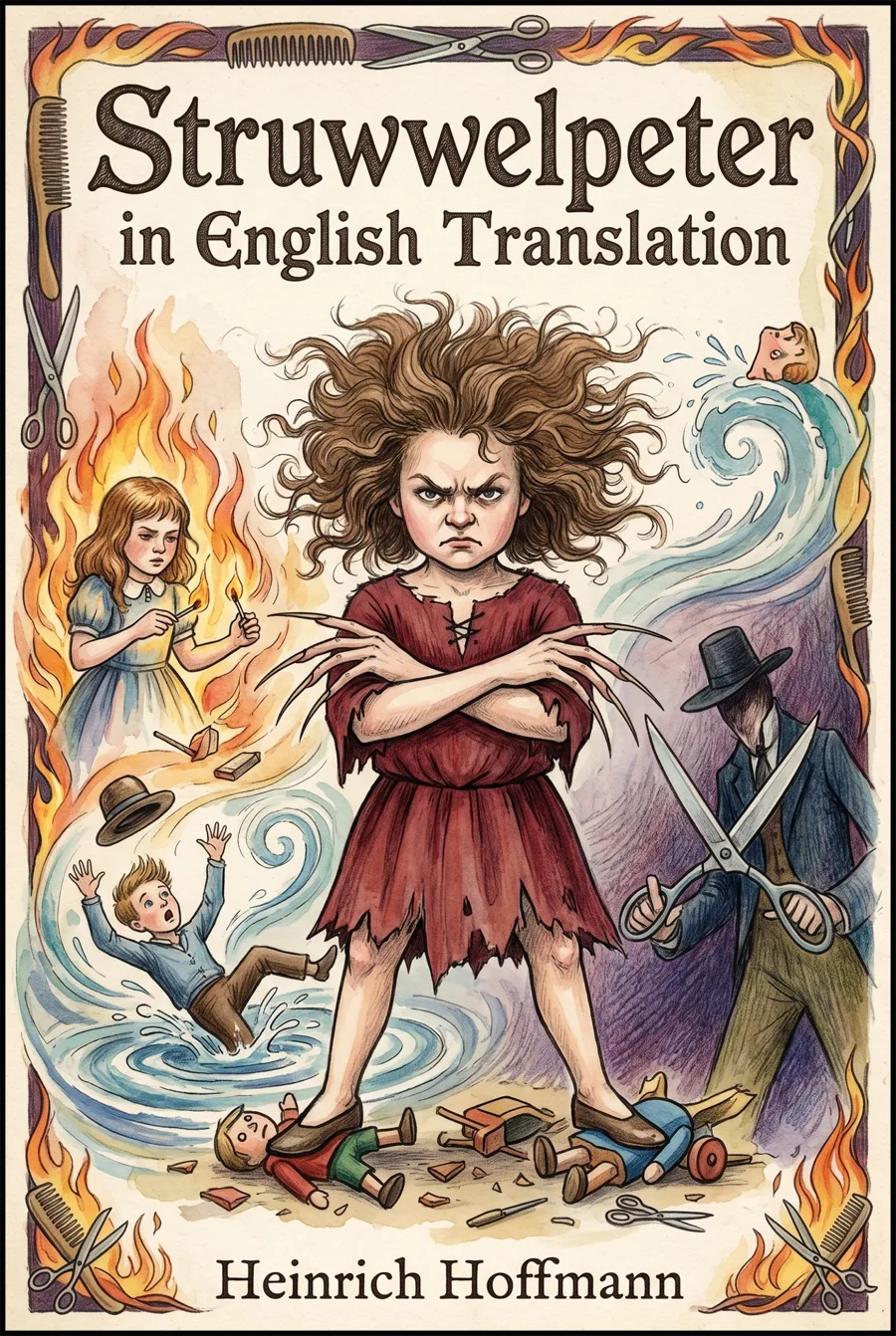
Download Cover Image
Do you want to download the full cover image for Struwwelpeter in English Translation?