
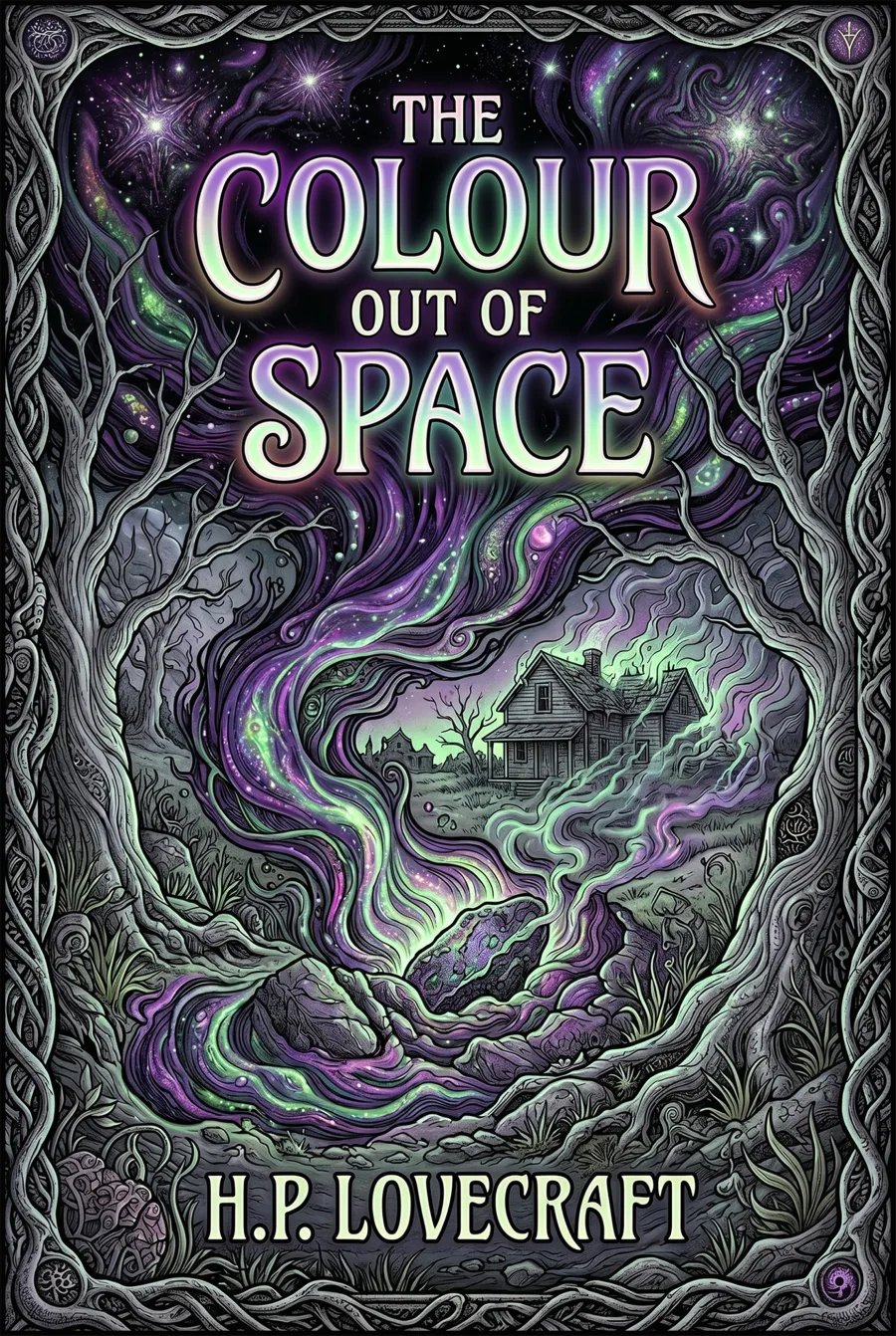
The Colour Out of Space
eBook
• INR 51.00
• English
• 9788169359078
No ratings yet
| Publisher | General Press |
|---|---|
| ISBN13 | 9788169359078 |
| ASIN/SKU | 8169359074 |
| Book Format | eBook |
| Language | English |
| List Price | INR 51.00 |
| Subject Code | FIC015000, FIC028090, FIC031070 |
| Publishing Date | 01/09/2026 |
| Book Code | BD00070223 |
Buy this Book
Amazon Stores
Ebook Stores
Other Stores
Discover The Colour Out of Space by H.P. Lovecraft. This book is published by General Press in eBook format, ISBN 9788169359078, ASIN 8169359074, under Literature and Fiction, Horror Literature and Fiction, First Contact Science Fiction.
Book Description
What if something fell from the sky that science could not explain, and its very presence began to poison everything around it? 'The Colour Out of Space' by H. P. Lovecraft is a classic cosmic horror and science fiction short story that explores the terror of encountering a force so alien that the human mind has no way to understand it. First published in 1927, the story combines eerie atmosphere, psychological dread, and Lovecraft's fascination with mysterious forces beyond human knowledge.
The story is set near Arkham, Massachusetts, where a strange meteorite crashes onto the land of the Gardner family. Scientists arrive to examine the unusual object, but the substance it leaves behind does not behave like anything known on Earth. Soon afterward, the Gardner farm begins to change in disturbing ways. Plants grow to unnatural sizes, crops develop strange qualities, and the surrounding landscape takes on an unhealthy appearance. The family initially hopes that the effects will pass, but the mysterious influence only becomes more unsettling.
As the strange phenomenon spreads, the Gardners themselves begin to suffer. Their physical health, behavior, and sense of reality gradually deteriorate, while the land around them becomes increasingly lifeless and unnatural. Neighbors are frightened by what they witness but struggle to understand what is happening. The narrator attempts to piece together the events, yet the evidence offers no comforting explanation.
What makes 'The Colour Out of Space' so disturbing is not simply the strange entity at its center, but the idea that humanity may encounter something completely outside its experience. Lovecraft creates fear through uncertainty, isolation, and the limits of human understanding. The story's haunting imagery and slow-building tension make it one of his most memorable works of cosmic horror, leaving readers to wonder what truly arrived in that lonely Massachusetts field.
The story is set near Arkham, Massachusetts, where a strange meteorite crashes onto the land of the Gardner family. Scientists arrive to examine the unusual object, but the substance it leaves behind does not behave like anything known on Earth. Soon afterward, the Gardner farm begins to change in disturbing ways. Plants grow to unnatural sizes, crops develop strange qualities, and the surrounding landscape takes on an unhealthy appearance. The family initially hopes that the effects will pass, but the mysterious influence only becomes more unsettling.
As the strange phenomenon spreads, the Gardners themselves begin to suffer. Their physical health, behavior, and sense of reality gradually deteriorate, while the land around them becomes increasingly lifeless and unnatural. Neighbors are frightened by what they witness but struggle to understand what is happening. The narrator attempts to piece together the events, yet the evidence offers no comforting explanation.
What makes 'The Colour Out of Space' so disturbing is not simply the strange entity at its center, but the idea that humanity may encounter something completely outside its experience. Lovecraft creates fear through uncertainty, isolation, and the limits of human understanding. The story's haunting imagery and slow-building tension make it one of his most memorable works of cosmic horror, leaving readers to wonder what truly arrived in that lonely Massachusetts field.
Author Biography
Few writers have made the unknown feel as terrifying as H.P. Lovecraft. Howard Phillips Lovecraft was an American writer best known for his influential weird fiction, cosmic horror, and works such as 'The Call of Cthulhu', 'The Shadow over Innsmouth', and 'At the Mountains of Madness'.
Born on August 20, 1890, in Providence, Rhode Island, Lovecraft grew up in a literary household and developed an early fascination with mythology, astronomy, science, and Gothic literature. Although his childhood was marked by family difficulties and periods of isolation, he became an avid reader and began writing stories and poetry at a young age. He later became deeply involved in amateur journalism, an experience that helped him develop his distinctive literary voice and connect with other writers.
Lovecraft's fiction is famous for its unsettling atmosphere and its portrayal of humanity as small and vulnerable in an immense, mysterious universe. Rather than relying solely on traditional monsters, he created horror from the idea that ancient forces and incomprehensible beings exist beyond human understanding. His fictional mythology, including figures such as Cthulhu and Nyarlathotep, became central to what is now known as the Cthulhu Mythos.
During his lifetime, Lovecraft achieved only limited mainstream recognition, publishing much of his fiction in pulp magazines such as 'Weird Tales'. After his death in 1937, however, his reputation grew dramatically. Collections of his stories introduced his work to generations of readers, while writers, filmmakers, artists, and game creators drew inspiration from his cosmic vision of horror.
Today, Lovecraft remains a defining figure in modern horror fiction, and his imaginative influence continues to shape how popular culture explores fear, mystery, and the vast unknown.
Born on August 20, 1890, in Providence, Rhode Island, Lovecraft grew up in a literary household and developed an early fascination with mythology, astronomy, science, and Gothic literature. Although his childhood was marked by family difficulties and periods of isolation, he became an avid reader and began writing stories and poetry at a young age. He later became deeply involved in amateur journalism, an experience that helped him develop his distinctive literary voice and connect with other writers.
Lovecraft's fiction is famous for its unsettling atmosphere and its portrayal of humanity as small and vulnerable in an immense, mysterious universe. Rather than relying solely on traditional monsters, he created horror from the idea that ancient forces and incomprehensible beings exist beyond human understanding. His fictional mythology, including figures such as Cthulhu and Nyarlathotep, became central to what is now known as the Cthulhu Mythos.
During his lifetime, Lovecraft achieved only limited mainstream recognition, publishing much of his fiction in pulp magazines such as 'Weird Tales'. After his death in 1937, however, his reputation grew dramatically. Collections of his stories introduced his work to generations of readers, while writers, filmmakers, artists, and game creators drew inspiration from his cosmic vision of horror.
Today, Lovecraft remains a defining figure in modern horror fiction, and his imaginative influence continues to shape how popular culture explores fear, mystery, and the vast unknown.
Editorial Reviews
Editorial Reviews will be added soon…
Book Summary
H. P. Lovecraft’s "The Colour Out of Space" is one of the most powerful examples of cosmic horror in twentieth-century literature. First published in 1927, the short story combines science fiction, psychological horror, rural Gothic, and supernatural terror to tell a frightening story about an ordinary farming family destroyed by something that comes from beyond the known universe. Unlike a conventional horror story, however, 'The Colour Out of Space' does not give its readers a recognizable monster that can be fought, understood, or defeated. Its central horror is something radically alien—an inexplicable force that human language, science, and imagination cannot properly describe. The story asks a disturbing question: what would happen if something entered our world that was not merely dangerous, but fundamentally outside the laws and categories through which human beings understand reality?
The story begins with an unnamed surveyor from Boston who has been sent to the countryside near Arkham, Massachusetts, to examine land connected with the construction of a new reservoir. He notices a strange, desolate area known by local people as the “blasted heath.” The surrounding countryside is heavily wooded, but this particular section of land is unnaturally dead. Nothing grows there, and the landscape has a gray, exhausted appearance that makes it feel as though some invisible force has drained the life from the earth. The surveyor is curious about the area and begins asking local people about its history. The townspeople are reluctant to talk, and what little information he receives is mixed with rumors, fear, and superstition. Eventually, he finds an elderly man named Ammi Pierce, who is willing to tell him what happened many years earlier.
Ammi’s story takes the reader back to the 1880s, when the land was occupied by the Gardner family. Nahum Gardner, his wife, and their children live on a productive farm and initially have no reason to suspect that anything is wrong with their property. Their peaceful existence changes dramatically when a meteorite crashes into their land. The meteorite is examined by several professors from a nearby college, who are fascinated by its strange physical properties. It is unlike any ordinary meteorite they have encountered. The stone behaves in ways that seem impossible according to conventional science. It contains a strange, luminous substance or globule that cannot be properly classified, and its spectrum does not correspond to any known color. The scientists conduct experiments, but their attempts to understand the object ultimately fail.
This early scientific investigation is important because Lovecraft establishes one of the story’s central ideas: human knowledge has limits. The professors are intelligent and experienced, but intelligence alone is not enough to understand something that originates outside the familiar universe. Their instruments can measure certain physical effects, yet they cannot explain what the meteorite actually is. The strange material gradually disappears, leaving behind no satisfying scientific explanation. The scientists eventually lose interest, but the disappearance of the meteorite does not mean that the danger has disappeared. In fact, the true horror is only beginning.
After the meteorite falls, the Gardner farm undergoes a series of increasingly disturbing changes. At first, the effects appear almost beneficial. Plants and crops grow with extraordinary speed and size. The farm seems unusually fertile, and Nahum initially hopes that the strange event may actually bring prosperity. But the apparent abundance is deceptive. The crops are grotesque rather than healthy, and their fruit is tasteless and unsuitable for consumption. The natural world around the farm has not become healthier; it has become corrupted. Trees begin displaying unnatural characteristics, and the land seems increasingly disconnected from the ordinary rhythms of nature.
The transformation becomes even more frightening as the animals begin to suffer. Livestock become sick, deformed, violent, or strangely altered. Their behavior no longer follows familiar patterns, and their bodies appear to be wasting away from within. The family watches helplessly as the farm, once a symbol of security and self-sufficiency, becomes a place of contamination. The poisoned environment affects everything connected to it—plants, animals, water, and eventually human beings. Lovecraft creates much of the story’s horror by allowing these changes to happen gradually. There is no single dramatic attack. Instead, the reader witnesses the slow destruction of an entire ecosystem.
The family’s well becomes particularly important because it appears to be connected to the alien force. The water is increasingly suspected of being contaminated, yet the exact nature of the contamination remains unknown. Nahum understands that something is terribly wrong, but he cannot identify the cause or discover how to stop it. The family is effectively trapped inside an invisible disaster. The force does not behave like a disease that doctors can diagnose or like a predator that people can escape. It is part of the environment itself. The more the characters try to continue living normally, the more completely the alien presence takes control of their surroundings.
The psychological deterioration of the Gardner family is as important as their physical decline. Nahum’s wife begins to suffer mentally, and the children gradually become victims of the same mysterious influence. The family members lose their ability to communicate normally, and the household becomes increasingly isolated from the outside world. The terror is especially effective because the Gardners are not destroyed all at once. They are slowly stripped of their health, reason, relationships, and sense of security. The family home, which should be a place of protection, becomes the center of an expanding nightmare.
Ammi Pierce is one of the few people who repeatedly visits the Gardner property and witnesses what is happening. His friendship with Nahum allows him to see the family’s decline at close range. Yet Ammi is powerless. He can recognize that something is wrong, but he cannot understand the nature of the force or find a practical way to fight it. His helplessness reinforces one of Lovecraft’s most important themes: human beings may recognize danger without possessing the knowledge necessary to overcome it.
As the story progresses, the horror becomes increasingly surreal. The trees begin to glow with the strange radiance associated with the alien presence. The landscape itself seems to respond to the force. The boundaries between living and nonliving matter become uncertain, and the familiar laws of nature appear to break down. Lovecraft does not provide a detailed scientific explanation because the absence of explanation is central to the story. The reader is meant to experience the same confusion as the characters. Something is happening, but ordinary language cannot fully contain it.
The tragedy of the Gardner family eventually reaches its most horrifying stage. One by one, the members of the household disappear, die, or are transformed beyond recognition. Nahum becomes increasingly hopeless and finally understands that the force has somehow taken possession of the farm. His final condition is particularly disturbing because he realizes that escape is almost impossible. The family has not simply encountered an external monster; they have been absorbed into an environment that has become hostile to human life.
Ammi eventually witnesses the final catastrophe. The strange force rises from the well and produces an extraordinary radiance before apparently leaving the earth and returning to the sky. Yet the departure does not bring complete relief. The Gardner property is left as a barren, gray wasteland, with every trace of ordinary life apparently destroyed. The land becomes the “blasted heath” that the surveyor sees at the beginning of the story. The landscape is therefore not merely the setting of the horror; it is its final physical evidence. Decades after the original meteorite strike, the area remains poisoned and lifeless.
The ending is particularly unsettling because the narrator realizes that the alien presence may not be completely gone. Something may still remain beneath the abandoned well, and local people believe that the blight continues to spread. The narrator himself notices something strange about the sunlight near the well and becomes increasingly uncomfortable with the possibility that the contamination is still active. The proposed reservoir may eventually cover the area with water, but this solution does not provide certainty. Lovecraft deliberately leaves the reader with the possibility that humanity has not defeated the threat at all.
At the heart of 'The Colour Out of Space' is Lovecraft’s idea of ''cosmic horror''. The story suggests that the universe is vastly larger, stranger, and less comprehensible than human beings usually imagine. The alien force is terrifying not because it hates humanity but because it does not appear to care about humanity whatsoever. It has no understandable motive, no moral purpose, and no recognizable emotional relationship with its victims. It behaves according to laws that belong to a reality beyond human experience. This indifference is more frightening than ordinary evil because there is nothing to reason with and nothing to persuade.
The story also explores the limits of science. Lovecraft was fascinated by scientific discovery, but he repeatedly used science to demonstrate how little humanity actually knows. The professors can examine the meteorite, test its properties, and record its unusual behavior, yet they cannot comprehend its true nature. Their failure is not simply a failure of intelligence; it is a reminder that human senses and scientific categories may be inadequate when confronted with phenomena outside our normal universe.
The meteorite itself can therefore be understood as a symbol of the unknown. It arrives from beyond the familiar world and introduces something that cannot be named. Even its “color” cannot be properly described because it does not belong to the ordinary spectrum of human perception. The title is consequently crucial: the horror is not merely a strange color but a phenomenon that exists beyond the boundaries of what human beings understand as color, matter, life, and nature.
Another major theme is the corruption of nature. The Gardner farm begins as a productive, living environment, but the alien influence turns growth itself into something frightening. Plants become larger but unhealthy. Animals become distorted. Water becomes dangerous. The land eventually becomes barren. This makes the story an unusually powerful example of environmental horror: the natural world is not simply attacked from outside but transformed from within. The things that normally sustain life—soil, water, crops, trees, and sunlight—become sources of terror.
Ultimately, 'The Colour Out of Space' is a story about human helplessness in the face of an incomprehensible universe. The Gardner family is destroyed not because they are morally wicked or because they make one catastrophic mistake, but because they happen to live where something alien arrives. That randomness is essential to Lovecraft’s horror. There is no comforting lesson that evil will be punished or good will be rewarded. The universe does not appear to operate according to human ideas of justice.
For readers searching for an ''in-depth summary of 'The Colour Out of Space', a ''plot summary of H. P. Lovecraft’s cosmic horror story'', or an explanation of its ''themes, symbolism, characters, and ending'', the story can ultimately be understood as a meditation on the terrifying limits of human knowledge. It transforms a meteorite, a farm, a well, and a strange patch of countryside into symbols of a much larger fear: that reality contains dimensions so alien that human beings may never be capable of understanding them. The lasting power of 'The Colour Out of Space' comes from precisely this uncertainty. The creature is never given a conventional identity, the threat is never completely explained, and the ending never guarantees that the danger has passed. Instead, Lovecraft leaves the reader staring into the unknown, where something may still exist beyond the visible universe—something that cannot be named, cannot be understood, and may not even recognize that humanity is there.
The story begins with an unnamed surveyor from Boston who has been sent to the countryside near Arkham, Massachusetts, to examine land connected with the construction of a new reservoir. He notices a strange, desolate area known by local people as the “blasted heath.” The surrounding countryside is heavily wooded, but this particular section of land is unnaturally dead. Nothing grows there, and the landscape has a gray, exhausted appearance that makes it feel as though some invisible force has drained the life from the earth. The surveyor is curious about the area and begins asking local people about its history. The townspeople are reluctant to talk, and what little information he receives is mixed with rumors, fear, and superstition. Eventually, he finds an elderly man named Ammi Pierce, who is willing to tell him what happened many years earlier.
Ammi’s story takes the reader back to the 1880s, when the land was occupied by the Gardner family. Nahum Gardner, his wife, and their children live on a productive farm and initially have no reason to suspect that anything is wrong with their property. Their peaceful existence changes dramatically when a meteorite crashes into their land. The meteorite is examined by several professors from a nearby college, who are fascinated by its strange physical properties. It is unlike any ordinary meteorite they have encountered. The stone behaves in ways that seem impossible according to conventional science. It contains a strange, luminous substance or globule that cannot be properly classified, and its spectrum does not correspond to any known color. The scientists conduct experiments, but their attempts to understand the object ultimately fail.
This early scientific investigation is important because Lovecraft establishes one of the story’s central ideas: human knowledge has limits. The professors are intelligent and experienced, but intelligence alone is not enough to understand something that originates outside the familiar universe. Their instruments can measure certain physical effects, yet they cannot explain what the meteorite actually is. The strange material gradually disappears, leaving behind no satisfying scientific explanation. The scientists eventually lose interest, but the disappearance of the meteorite does not mean that the danger has disappeared. In fact, the true horror is only beginning.
After the meteorite falls, the Gardner farm undergoes a series of increasingly disturbing changes. At first, the effects appear almost beneficial. Plants and crops grow with extraordinary speed and size. The farm seems unusually fertile, and Nahum initially hopes that the strange event may actually bring prosperity. But the apparent abundance is deceptive. The crops are grotesque rather than healthy, and their fruit is tasteless and unsuitable for consumption. The natural world around the farm has not become healthier; it has become corrupted. Trees begin displaying unnatural characteristics, and the land seems increasingly disconnected from the ordinary rhythms of nature.
The transformation becomes even more frightening as the animals begin to suffer. Livestock become sick, deformed, violent, or strangely altered. Their behavior no longer follows familiar patterns, and their bodies appear to be wasting away from within. The family watches helplessly as the farm, once a symbol of security and self-sufficiency, becomes a place of contamination. The poisoned environment affects everything connected to it—plants, animals, water, and eventually human beings. Lovecraft creates much of the story’s horror by allowing these changes to happen gradually. There is no single dramatic attack. Instead, the reader witnesses the slow destruction of an entire ecosystem.
The family’s well becomes particularly important because it appears to be connected to the alien force. The water is increasingly suspected of being contaminated, yet the exact nature of the contamination remains unknown. Nahum understands that something is terribly wrong, but he cannot identify the cause or discover how to stop it. The family is effectively trapped inside an invisible disaster. The force does not behave like a disease that doctors can diagnose or like a predator that people can escape. It is part of the environment itself. The more the characters try to continue living normally, the more completely the alien presence takes control of their surroundings.
The psychological deterioration of the Gardner family is as important as their physical decline. Nahum’s wife begins to suffer mentally, and the children gradually become victims of the same mysterious influence. The family members lose their ability to communicate normally, and the household becomes increasingly isolated from the outside world. The terror is especially effective because the Gardners are not destroyed all at once. They are slowly stripped of their health, reason, relationships, and sense of security. The family home, which should be a place of protection, becomes the center of an expanding nightmare.
Ammi Pierce is one of the few people who repeatedly visits the Gardner property and witnesses what is happening. His friendship with Nahum allows him to see the family’s decline at close range. Yet Ammi is powerless. He can recognize that something is wrong, but he cannot understand the nature of the force or find a practical way to fight it. His helplessness reinforces one of Lovecraft’s most important themes: human beings may recognize danger without possessing the knowledge necessary to overcome it.
As the story progresses, the horror becomes increasingly surreal. The trees begin to glow with the strange radiance associated with the alien presence. The landscape itself seems to respond to the force. The boundaries between living and nonliving matter become uncertain, and the familiar laws of nature appear to break down. Lovecraft does not provide a detailed scientific explanation because the absence of explanation is central to the story. The reader is meant to experience the same confusion as the characters. Something is happening, but ordinary language cannot fully contain it.
The tragedy of the Gardner family eventually reaches its most horrifying stage. One by one, the members of the household disappear, die, or are transformed beyond recognition. Nahum becomes increasingly hopeless and finally understands that the force has somehow taken possession of the farm. His final condition is particularly disturbing because he realizes that escape is almost impossible. The family has not simply encountered an external monster; they have been absorbed into an environment that has become hostile to human life.
Ammi eventually witnesses the final catastrophe. The strange force rises from the well and produces an extraordinary radiance before apparently leaving the earth and returning to the sky. Yet the departure does not bring complete relief. The Gardner property is left as a barren, gray wasteland, with every trace of ordinary life apparently destroyed. The land becomes the “blasted heath” that the surveyor sees at the beginning of the story. The landscape is therefore not merely the setting of the horror; it is its final physical evidence. Decades after the original meteorite strike, the area remains poisoned and lifeless.
The ending is particularly unsettling because the narrator realizes that the alien presence may not be completely gone. Something may still remain beneath the abandoned well, and local people believe that the blight continues to spread. The narrator himself notices something strange about the sunlight near the well and becomes increasingly uncomfortable with the possibility that the contamination is still active. The proposed reservoir may eventually cover the area with water, but this solution does not provide certainty. Lovecraft deliberately leaves the reader with the possibility that humanity has not defeated the threat at all.
At the heart of 'The Colour Out of Space' is Lovecraft’s idea of ''cosmic horror''. The story suggests that the universe is vastly larger, stranger, and less comprehensible than human beings usually imagine. The alien force is terrifying not because it hates humanity but because it does not appear to care about humanity whatsoever. It has no understandable motive, no moral purpose, and no recognizable emotional relationship with its victims. It behaves according to laws that belong to a reality beyond human experience. This indifference is more frightening than ordinary evil because there is nothing to reason with and nothing to persuade.
The story also explores the limits of science. Lovecraft was fascinated by scientific discovery, but he repeatedly used science to demonstrate how little humanity actually knows. The professors can examine the meteorite, test its properties, and record its unusual behavior, yet they cannot comprehend its true nature. Their failure is not simply a failure of intelligence; it is a reminder that human senses and scientific categories may be inadequate when confronted with phenomena outside our normal universe.
The meteorite itself can therefore be understood as a symbol of the unknown. It arrives from beyond the familiar world and introduces something that cannot be named. Even its “color” cannot be properly described because it does not belong to the ordinary spectrum of human perception. The title is consequently crucial: the horror is not merely a strange color but a phenomenon that exists beyond the boundaries of what human beings understand as color, matter, life, and nature.
Another major theme is the corruption of nature. The Gardner farm begins as a productive, living environment, but the alien influence turns growth itself into something frightening. Plants become larger but unhealthy. Animals become distorted. Water becomes dangerous. The land eventually becomes barren. This makes the story an unusually powerful example of environmental horror: the natural world is not simply attacked from outside but transformed from within. The things that normally sustain life—soil, water, crops, trees, and sunlight—become sources of terror.
Ultimately, 'The Colour Out of Space' is a story about human helplessness in the face of an incomprehensible universe. The Gardner family is destroyed not because they are morally wicked or because they make one catastrophic mistake, but because they happen to live where something alien arrives. That randomness is essential to Lovecraft’s horror. There is no comforting lesson that evil will be punished or good will be rewarded. The universe does not appear to operate according to human ideas of justice.
For readers searching for an ''in-depth summary of 'The Colour Out of Space', a ''plot summary of H. P. Lovecraft’s cosmic horror story'', or an explanation of its ''themes, symbolism, characters, and ending'', the story can ultimately be understood as a meditation on the terrifying limits of human knowledge. It transforms a meteorite, a farm, a well, and a strange patch of countryside into symbols of a much larger fear: that reality contains dimensions so alien that human beings may never be capable of understanding them. The lasting power of 'The Colour Out of Space' comes from precisely this uncertainty. The creature is never given a conventional identity, the threat is never completely explained, and the ending never guarantees that the danger has passed. Instead, Lovecraft leaves the reader staring into the unknown, where something may still exist beyond the visible universe—something that cannot be named, cannot be understood, and may not even recognize that humanity is there.
Sample Chapters
Sample Chapters will be added soon…
Reader Reviews
No reviews yet.
The Colour Out of Space
Download Cover Image
Do you want to download the full cover image for The Colour Out of Space?