
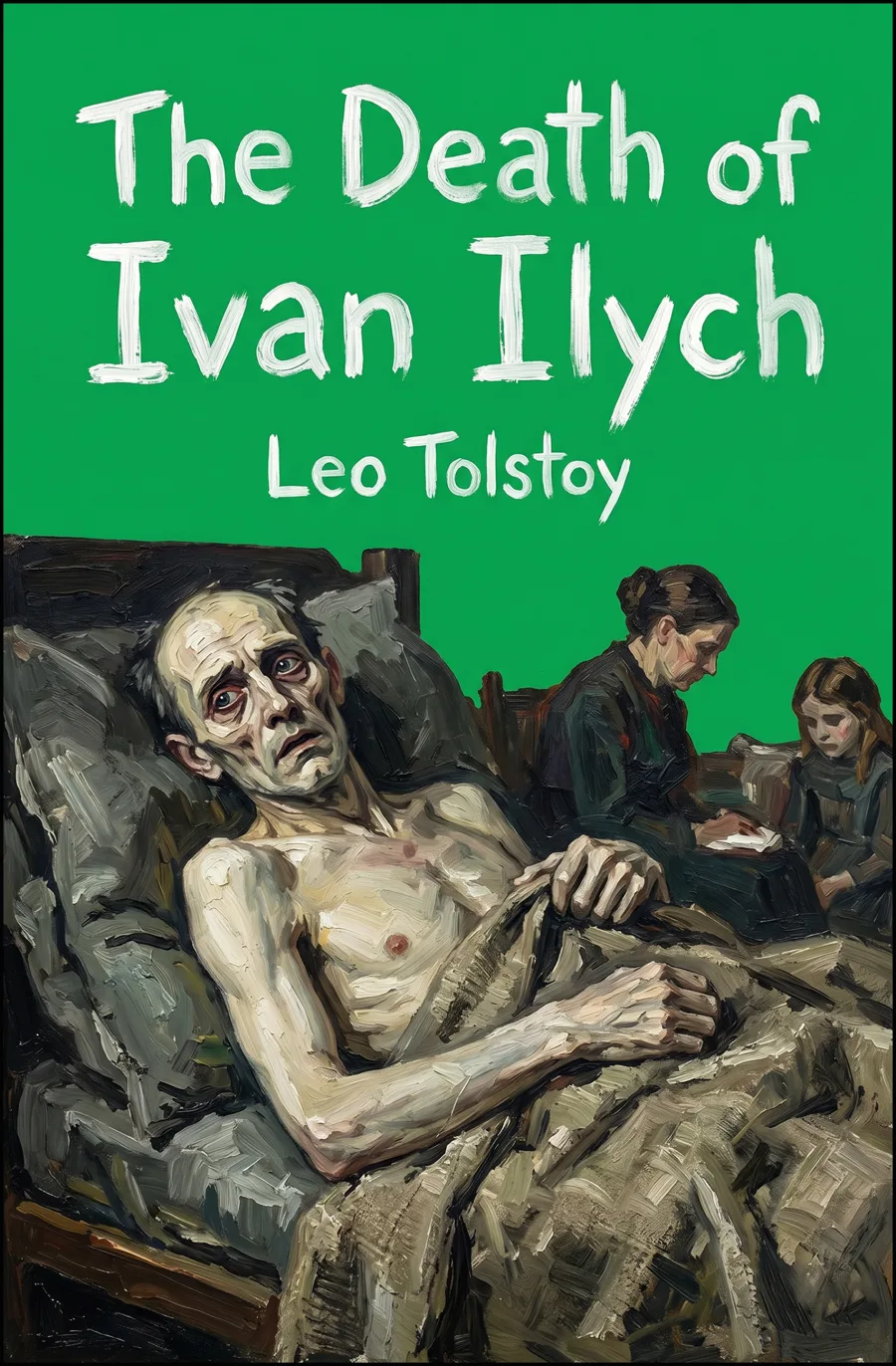
The Death of Ivan Ilych
eBook
• INR 51.00
• English
• 9788169359146
No ratings yet
| Publisher | General Press |
|---|---|
| ISBN13 | 9788169359146 |
| ASIN/SKU | 8169359147 |
| Book Format | eBook |
| Language | English |
| List Price | INR 51.00 |
| Subject Code | FIC025000, FIC039000, FIC052000 |
| Publishing Date | 01/09/2026 |
| Book Code | BD00070224 |
Buy this Book
Amazon Stores
Ebook Stores
Other Stores
Discover The Death of Ivan Ilych by Leo Tolstoy. This book is published by General Press in eBook format, ISBN 9788169359146, ASIN 8169359147, under Literature and Fiction, Psychological Fiction, Metaphysical and Visionary Fiction.
Book Description
What happens when a successful life suddenly comes face to face with the reality it has been avoiding? 'The Death of Ivan Ilych' by Leo Tolstoy is a powerful philosophical novella and work of literary fiction that explores mortality, family, social ambition, and the search for meaning when death can no longer be ignored.
Ivan Ilych is a respected Russian judge who has built his life around the values that society considers successful. He enjoys a comfortable career, a respectable home, and the approval of people in his social circle. Yet beneath this orderly existence, his marriage has become strained, and much of his life is shaped by appearances, professional advancement, and the desire to live in a way that seems proper to others. Ivan rarely questions whether this comfortable life is truly fulfilling.
Everything changes when he suffers an unexpected injury that develops into a serious and mysterious illness. As his physical condition worsens, Ivan is forced to confront the possibility of his own death. His colleagues and family struggle to respond to his suffering, often treating his illness as an inconvenience rather than recognizing the emotional terror behind it. Increasingly isolated, Ivan begins to examine his past and question whether the life he has lived was genuinely right or merely socially acceptable.
Tolstoy's writing is striking for its honesty and emotional depth. Rather than presenting death as an abstract idea, he shows how the awareness of mortality can transform a person's understanding of family, success, regret, and compassion. The novella quietly asks what makes a life meaningful and whether it is ever too late to face uncomfortable truths. Short, intimate, and deeply moving, 'The Death of Ivan Ilych' remains one of Tolstoy's most unforgettable works, inviting readers to look at their own lives with fresh eyes.
Ivan Ilych is a respected Russian judge who has built his life around the values that society considers successful. He enjoys a comfortable career, a respectable home, and the approval of people in his social circle. Yet beneath this orderly existence, his marriage has become strained, and much of his life is shaped by appearances, professional advancement, and the desire to live in a way that seems proper to others. Ivan rarely questions whether this comfortable life is truly fulfilling.
Everything changes when he suffers an unexpected injury that develops into a serious and mysterious illness. As his physical condition worsens, Ivan is forced to confront the possibility of his own death. His colleagues and family struggle to respond to his suffering, often treating his illness as an inconvenience rather than recognizing the emotional terror behind it. Increasingly isolated, Ivan begins to examine his past and question whether the life he has lived was genuinely right or merely socially acceptable.
Tolstoy's writing is striking for its honesty and emotional depth. Rather than presenting death as an abstract idea, he shows how the awareness of mortality can transform a person's understanding of family, success, regret, and compassion. The novella quietly asks what makes a life meaningful and whether it is ever too late to face uncomfortable truths. Short, intimate, and deeply moving, 'The Death of Ivan Ilych' remains one of Tolstoy's most unforgettable works, inviting readers to look at their own lives with fresh eyes.
Author Biography
Few writers have explored the human heart, family, society, and morality as deeply as Leo Tolstoy. Leo Tolstoy, whose full name was Lev Nikolayevich Tolstoy, was a Russian novelist and philosopher best known for his monumental works of literature, including 'War and Peace' and 'Anna Karenina'.
Born on September 9, 1828, at Yasnaya Polyana, a family estate in the Russian Empire, Tolstoy grew up in an aristocratic family but developed a lifelong concern for ordinary people and social injustice. After studying at Kazan University and serving in the military, he began publishing stories inspired by his experiences. His early works, including 'Childhood', 'Boyhood', and 'Youth', established him as a promising young writer.
Tolstoy reached his greatest literary heights with 'War and Peace', an expansive novel that combines historical events, philosophy, and the personal lives of several families during the Napoleonic Wars. He followed it with 'Anna Karenina', a powerful exploration of love, marriage, family, social expectations, and personal happiness. His writing is admired for its psychological depth, vivid characters, realistic details, and thoughtful examination of moral questions.
In his later years, Tolstoy became increasingly interested in spirituality, pacifism, simple living, and social reform. Works such as 'The Death of Ivan Ilyich', 'Resurrection', and 'The Kreutzer Sonata' reflected his changing beliefs and criticism of social inequality and organized institutions. His ideas influenced writers, activists, and thinkers around the world, including Mahatma Gandhi.
Tolstoy died in 1910, but his influence has never faded. His timeless stories and profound questions about love, conscience, society, and the meaning of life continue to make him one of the most important and widely read authors in world literature.
Born on September 9, 1828, at Yasnaya Polyana, a family estate in the Russian Empire, Tolstoy grew up in an aristocratic family but developed a lifelong concern for ordinary people and social injustice. After studying at Kazan University and serving in the military, he began publishing stories inspired by his experiences. His early works, including 'Childhood', 'Boyhood', and 'Youth', established him as a promising young writer.
Tolstoy reached his greatest literary heights with 'War and Peace', an expansive novel that combines historical events, philosophy, and the personal lives of several families during the Napoleonic Wars. He followed it with 'Anna Karenina', a powerful exploration of love, marriage, family, social expectations, and personal happiness. His writing is admired for its psychological depth, vivid characters, realistic details, and thoughtful examination of moral questions.
In his later years, Tolstoy became increasingly interested in spirituality, pacifism, simple living, and social reform. Works such as 'The Death of Ivan Ilyich', 'Resurrection', and 'The Kreutzer Sonata' reflected his changing beliefs and criticism of social inequality and organized institutions. His ideas influenced writers, activists, and thinkers around the world, including Mahatma Gandhi.
Tolstoy died in 1910, but his influence has never faded. His timeless stories and profound questions about love, conscience, society, and the meaning of life continue to make him one of the most important and widely read authors in world literature.
Editorial Reviews
Editorial Reviews will be added soon…
Book Summary
Leo Tolstoy’s "The Death of Ivan Ilyich", first published in 1886, is one of the most powerful short novels in world literature. Although the story is relatively brief, it asks enormous questions about death, the meaning of life, social ambition, family relationships, suffering, fear, and spiritual awakening. Rather than treating death as a distant event, Tolstoy places it at the very center of ordinary middle-class life. Ivan Ilyich is a successful Russian judge who has spent much of his life pursuing the things society tells him are important: a respectable career, a comfortable home, social approval, money, and the appearance of a successful marriage. When he develops a mysterious illness that gradually becomes fatal, these familiar goals begin to lose their meaning. For readers searching for 'The Death of Ivan Ilych' summary, the central idea is that Ivan's physical death becomes the occasion for a deeper moral awakening. Tolstoy uses his final illness to ask whether a person can discover the truth about life only when death forces him to stop pretending.
The novel begins surprisingly with Ivan Ilyich already dead. His colleagues learn about his death and gather for his funeral. Instead of beginning with grief, Tolstoy immediately reveals the emotional emptiness surrounding Ivan's death. His fellow judges think about how his death might affect their careers and positions. Some consider which promotion may now become available. Others are concerned about the practical inconvenience of attending the funeral. Ivan's wife, Praskovya Fedorovna, is primarily concerned about money and the financial consequences of her husband's death. She asks about pension arrangements and ways to obtain additional financial support. This opening is deliberately uncomfortable because Tolstoy shows that even death can become absorbed into ordinary social concerns.
The reaction of Ivan's friend Peter Ivanovich is especially revealing. While he participates in the funeral rituals, his mind repeatedly turns toward his own situation. He is reminded that death is inevitable, but instead of confronting that truth deeply, he quickly reassures himself that Ivan has died and he is still alive. This establishes one of the novel's central themes: people know intellectually that death will come, but they often live as though it applies only to other people. Ivan's death creates a temporary disturbance in the comfortable illusion of permanence, but the living quickly return to their routines.
After this opening, Tolstoy goes back in time to tell Ivan's life story. Ivan Ilyich is presented as an ordinary man rather than a great villain or hero. He is intelligent, ambitious, reasonably successful, and concerned with behaving properly. He grows up in a respectable family and enters the legal profession. Over time, he advances through various government positions and eventually becomes a judge. His career gives him status, financial security, and social respectability. He is proud of his professional success because his work appears orderly and rational. He knows how to separate personal emotions from official responsibilities, and he enjoys the sense of control that his position gives him.
Ivan's approach to life is built around what Tolstoy describes as propriety. He wants everything to be respectable, tasteful, and socially acceptable. He does not necessarily pursue extreme wealth or power. Instead, he wants the comfortable life of a successful professional. He wants the right friends, the right clothes, the right home, and the right social position. His great mistake is not that he consciously chooses evil. It is that he rarely stops to ask whether the life he is building is genuinely meaningful.
Ivan marries Praskovya Fedorovna partly because the relationship seems socially appropriate. At first, marriage appears pleasant enough, but the relationship soon becomes difficult. Praskovya becomes demanding and dissatisfied, while Ivan becomes increasingly irritated by domestic conflict. Instead of trying to understand one another deeply, they retreat into separate lives. Ivan finds refuge in his career and social activities, while his wife focuses on her own expectations and frustrations. Their marriage gradually becomes an arrangement rather than a loving partnership.
When family life becomes uncomfortable, Ivan discovers that he can protect himself through social conventions. He tries to keep his professional life separate from his personal problems. At work, everything has rules, procedures, and proper forms. He finds comfort in this structure. His success as a judge therefore becomes more than a career; it becomes a way of avoiding emotional and existential questions.
Eventually, Ivan moves into a new house and becomes deeply involved in decorating it. This section of the novel is significant because Tolstoy shows how much emotional energy Ivan invests in creating the appearance of an ideal life. He becomes excited about arranging furniture, choosing decorations, and creating a refined environment. He wants his home to reflect his social success. During the process, however, he suffers an accident while hanging curtains and injures himself. The injury initially appears insignificant, but it becomes the beginning of his fatal illness.
Ivan starts experiencing pain in his side and an unpleasant taste in his mouth. Doctors examine him and offer different explanations. Ivan becomes increasingly anxious because he cannot obtain a clear answer about what is happening to his body. The doctors behave according to professional routines, discussing his condition in technical language and treating him almost as a medical problem rather than as a frightened human being. Ivan begins to recognize something that had previously seemed impossible: he may be seriously ill, and he may die.
His reaction is one of denial and terror. At first, Ivan cannot accept that death might actually be approaching him. He knows that people die, but he has always treated death as an abstract fact belonging to others. Now the abstract idea becomes personal. The thought of his own death becomes unbearable. He searches for explanations, consults doctors, and attempts to convince himself that his illness is temporary. Yet the pain continues.
Tolstoy's descriptions of Ivan's suffering are psychologically intense because the physical pain is accompanied by a growing sense of isolation. Ivan feels that no one around him truly understands what he is experiencing. His family becomes impatient with his illness. His wife complains about the inconvenience and expense. His colleagues continue their ordinary lives. Even the doctors seem more interested in diagnosis and professional procedure than in Ivan's fear.
The contrast between Ivan's inner experience and the behavior of those around him is one of the novel's most painful elements. Everyone continues behaving as though life should proceed normally. Ivan, however, can no longer participate in the illusion. He is forced to think about death constantly. His illness strips away the distractions that once protected him from existential questions.
Ivan becomes increasingly bitter. He resents his wife, doctors, friends, and circumstances. He asks himself why this is happening to him. He knows that other people die, but he feels that death is somehow unreasonable when it comes to him. This response is deeply human. Tolstoy does not make Ivan's fear ridiculous. Instead, he shows how terrifying it is when a person suddenly realizes that the ordinary future he assumed he possessed may no longer exist.
One of the few people who treats Ivan with genuine compassion is his servant, Gerasim. Gerasim is young, healthy, straightforward, and unpretentious. He helps Ivan with his physical needs without embarrassment or irritation. He is willing to sit with Ivan, hold his legs, and remain near him when others would rather avoid the discomfort of illness. Most importantly, Gerasim does not pretend that death is not happening. He understands that Ivan is dying and accepts the fact naturally.
Gerasim becomes a moral contrast to the other characters. He does not possess Ivan's social status, education, or professional success, but he has something Ivan's former life lacked: genuine human sympathy. Gerasim's kindness is uncomplicated. He does not help Ivan because of social obligation or personal advantage. He helps because another human being is suffering. His presence gives Ivan brief relief from loneliness and suggests that compassion may be more valuable than all the social achievements Ivan once pursued.
As his illness progresses, Ivan begins reviewing his life. This is the emotional center of the novel. He asks himself whether he has lived correctly. At first, he insists that he has lived exactly as society expected. He has had a respectable career, followed social conventions, married appropriately, raised a family, and maintained a good position. What, then, could possibly be wrong?
But the closer he looks, the more uncertain he becomes. He begins to recognize that much of his life has been shaped by superficial standards. He has pursued what looked good rather than what was truly good. He has often been selfish, indifferent, and concerned with appearances. He has avoided genuine emotional intimacy because it was inconvenient. His life may have been socially successful while being spiritually empty.
This realization creates one of the novel's deepest conflicts. Ivan desperately wants to believe that his life has been right, but his approaching death makes self-deception increasingly difficult. He experiences intense psychological suffering because he cannot reconcile the life he lived with the reality he now faces. He asks himself whether he has wasted his life.
Tolstoy presents this process as a kind of moral judgment, but the judge is Ivan himself. No external authority condemns him. His own conscience begins to reveal the truth. The more he recognizes the artificiality of his old values, the more painful his awareness becomes. Yet this pain also opens the possibility of transformation.
Ivan's relationship with his son becomes particularly significant. His son, Vasya, appears to be one of the few family members capable of genuine emotional concern for him. During a moment of tenderness, Ivan sees that his son is frightened and grieving. This awakens something in Ivan that has been buried beneath years of social convention. He begins to feel compassion rather than simply demanding sympathy.
The novel's final movement is therefore not merely about physical decline but about spiritual change. Ivan gradually moves from asking, “Why is this happening to me?” toward a deeper question: “How should I have lived?” The distinction is crucial. At first, Ivan sees himself as a victim of an unfair fate. Later, he begins to understand that his suffering has exposed a fundamental problem in the way he has lived.
Near the end, Ivan experiences an extraordinary internal struggle. He is terrified of death, yet he also begins to sense that his fear is connected with the false life he has been defending. If the life he lived was wrong, perhaps death is not simply the destruction of something valuable. Perhaps death can become the doorway through which he finally understands what genuine life means.
Ivan's final transformation occurs through compassion. He becomes aware of the suffering his family is experiencing and realizes that he has been demanding that others feel sorry for him without fully seeing their pain. For perhaps the first time, he thinks beyond himself. He wants to relieve their suffering rather than insist upon his own importance. This shift from self-centered fear to love is the spiritual “resurrection” contained within the story.
The ending is deliberately mysterious and deeply symbolic. Ivan experiences a change in his perception of death. What had seemed like a terrifying darkness begins to lose its power. Tolstoy does not provide a conventional theological explanation of what happens after death. Instead, he focuses on Ivan's inner experience. When Ivan finally stops resisting love and accepts compassion, his fear of death diminishes. The physical end becomes connected with a spiritual awakening.
The title, 'The Death of Ivan Ilyich', therefore has an ironic depth. The novel is about a man who is physically dying, but it gradually becomes a story about discovering life. Ivan has spent years living according to social expectations without examining whether those expectations reflect genuine human values. Only when death approaches does he understand how little of his life was truly his own. His final moments suggest that authentic living requires love, honesty, compassion, and awareness of mortality.
One of Tolstoy's greatest achievements in the novella is his portrayal of ordinary evil. Ivan is not a monstrous person. He is ordinary. His selfishness, vanity, ambition, and emotional distance are all socially acceptable. That is precisely what makes the story disturbing. Tolstoy suggests that a person can live an apparently respectable life while gradually losing contact with what matters most. The danger is not always dramatic wrongdoing. Sometimes it is simply allowing habit, status, comfort, and convention to replace genuine moral reflection.
The novel also offers a sharp criticism of social hypocrisy. Ivan's colleagues behave politely but are mainly concerned with practical consequences. His wife behaves as though his illness is an inconvenience. Doctors hide behind professional language. Society has many rituals for dealing with death, but few people are willing to face its emotional reality. Tolstoy exposes the distance between socially correct behavior and genuine compassion.
Gerasim remains one of the most important characters because he demonstrates the alternative. He accepts reality, serves another person without embarrassment, and does not try to hide suffering behind polite language. His simplicity contains a wisdom that Ivan's sophisticated social world lacks. Through Gerasim, Tolstoy suggests that compassion and humility may be closer to truth than status and intellectual sophistication.
Ultimately, 'The Death of Ivan Ilyich' is a story about how death can reveal the truth about life. Ivan spends most of his existence pursuing comfort, respectability, career advancement, and social approval. None of these things is inherently evil, but they become destructive when they replace love, honesty, and authentic human connection. His illness forces him to confront the question he avoided throughout his life: Was I really living, or was I merely performing the life expected of me?
In conclusion, 'The Death of Ivan Ilych' is a profoundly moving exploration of mortality, fear, suffering, family, social hypocrisy, and spiritual awakening. Tolstoy takes the apparently ordinary life of a successful judge and gradually reveals its hidden emptiness. Ivan's illness strips away his professional identity and social defenses until he is left alone with the reality of death. Yet this terrible experience also creates the possibility of redemption. Through Gerasim's compassion, his son's love, and his own final recognition of selfishness, Ivan begins to understand that genuine life is found not in status or comfort but in love and concern for others.
For readers searching for the main themes, meaning, characters, and ending of 'The Death of Ivan Ilyich', the novella's deepest lesson is that awareness of death can become a test of whether we have truly lived. Tolstoy does not suggest that everyone must reject ordinary work, family, or material comfort. Rather, he asks us not to confuse these things with the meaning of life itself. Ivan's final awakening comes when he stops asking only what he can preserve for himself and begins caring about the suffering of others. In that moment, fear gives way to compassion, and death loses some of its terror. The story remains unforgettable because it speaks to a universal fear while offering a quiet challenge: do not wait until the end of life to discover what makes life worth living.
The novel begins surprisingly with Ivan Ilyich already dead. His colleagues learn about his death and gather for his funeral. Instead of beginning with grief, Tolstoy immediately reveals the emotional emptiness surrounding Ivan's death. His fellow judges think about how his death might affect their careers and positions. Some consider which promotion may now become available. Others are concerned about the practical inconvenience of attending the funeral. Ivan's wife, Praskovya Fedorovna, is primarily concerned about money and the financial consequences of her husband's death. She asks about pension arrangements and ways to obtain additional financial support. This opening is deliberately uncomfortable because Tolstoy shows that even death can become absorbed into ordinary social concerns.
The reaction of Ivan's friend Peter Ivanovich is especially revealing. While he participates in the funeral rituals, his mind repeatedly turns toward his own situation. He is reminded that death is inevitable, but instead of confronting that truth deeply, he quickly reassures himself that Ivan has died and he is still alive. This establishes one of the novel's central themes: people know intellectually that death will come, but they often live as though it applies only to other people. Ivan's death creates a temporary disturbance in the comfortable illusion of permanence, but the living quickly return to their routines.
After this opening, Tolstoy goes back in time to tell Ivan's life story. Ivan Ilyich is presented as an ordinary man rather than a great villain or hero. He is intelligent, ambitious, reasonably successful, and concerned with behaving properly. He grows up in a respectable family and enters the legal profession. Over time, he advances through various government positions and eventually becomes a judge. His career gives him status, financial security, and social respectability. He is proud of his professional success because his work appears orderly and rational. He knows how to separate personal emotions from official responsibilities, and he enjoys the sense of control that his position gives him.
Ivan's approach to life is built around what Tolstoy describes as propriety. He wants everything to be respectable, tasteful, and socially acceptable. He does not necessarily pursue extreme wealth or power. Instead, he wants the comfortable life of a successful professional. He wants the right friends, the right clothes, the right home, and the right social position. His great mistake is not that he consciously chooses evil. It is that he rarely stops to ask whether the life he is building is genuinely meaningful.
Ivan marries Praskovya Fedorovna partly because the relationship seems socially appropriate. At first, marriage appears pleasant enough, but the relationship soon becomes difficult. Praskovya becomes demanding and dissatisfied, while Ivan becomes increasingly irritated by domestic conflict. Instead of trying to understand one another deeply, they retreat into separate lives. Ivan finds refuge in his career and social activities, while his wife focuses on her own expectations and frustrations. Their marriage gradually becomes an arrangement rather than a loving partnership.
When family life becomes uncomfortable, Ivan discovers that he can protect himself through social conventions. He tries to keep his professional life separate from his personal problems. At work, everything has rules, procedures, and proper forms. He finds comfort in this structure. His success as a judge therefore becomes more than a career; it becomes a way of avoiding emotional and existential questions.
Eventually, Ivan moves into a new house and becomes deeply involved in decorating it. This section of the novel is significant because Tolstoy shows how much emotional energy Ivan invests in creating the appearance of an ideal life. He becomes excited about arranging furniture, choosing decorations, and creating a refined environment. He wants his home to reflect his social success. During the process, however, he suffers an accident while hanging curtains and injures himself. The injury initially appears insignificant, but it becomes the beginning of his fatal illness.
Ivan starts experiencing pain in his side and an unpleasant taste in his mouth. Doctors examine him and offer different explanations. Ivan becomes increasingly anxious because he cannot obtain a clear answer about what is happening to his body. The doctors behave according to professional routines, discussing his condition in technical language and treating him almost as a medical problem rather than as a frightened human being. Ivan begins to recognize something that had previously seemed impossible: he may be seriously ill, and he may die.
His reaction is one of denial and terror. At first, Ivan cannot accept that death might actually be approaching him. He knows that people die, but he has always treated death as an abstract fact belonging to others. Now the abstract idea becomes personal. The thought of his own death becomes unbearable. He searches for explanations, consults doctors, and attempts to convince himself that his illness is temporary. Yet the pain continues.
Tolstoy's descriptions of Ivan's suffering are psychologically intense because the physical pain is accompanied by a growing sense of isolation. Ivan feels that no one around him truly understands what he is experiencing. His family becomes impatient with his illness. His wife complains about the inconvenience and expense. His colleagues continue their ordinary lives. Even the doctors seem more interested in diagnosis and professional procedure than in Ivan's fear.
The contrast between Ivan's inner experience and the behavior of those around him is one of the novel's most painful elements. Everyone continues behaving as though life should proceed normally. Ivan, however, can no longer participate in the illusion. He is forced to think about death constantly. His illness strips away the distractions that once protected him from existential questions.
Ivan becomes increasingly bitter. He resents his wife, doctors, friends, and circumstances. He asks himself why this is happening to him. He knows that other people die, but he feels that death is somehow unreasonable when it comes to him. This response is deeply human. Tolstoy does not make Ivan's fear ridiculous. Instead, he shows how terrifying it is when a person suddenly realizes that the ordinary future he assumed he possessed may no longer exist.
One of the few people who treats Ivan with genuine compassion is his servant, Gerasim. Gerasim is young, healthy, straightforward, and unpretentious. He helps Ivan with his physical needs without embarrassment or irritation. He is willing to sit with Ivan, hold his legs, and remain near him when others would rather avoid the discomfort of illness. Most importantly, Gerasim does not pretend that death is not happening. He understands that Ivan is dying and accepts the fact naturally.
Gerasim becomes a moral contrast to the other characters. He does not possess Ivan's social status, education, or professional success, but he has something Ivan's former life lacked: genuine human sympathy. Gerasim's kindness is uncomplicated. He does not help Ivan because of social obligation or personal advantage. He helps because another human being is suffering. His presence gives Ivan brief relief from loneliness and suggests that compassion may be more valuable than all the social achievements Ivan once pursued.
As his illness progresses, Ivan begins reviewing his life. This is the emotional center of the novel. He asks himself whether he has lived correctly. At first, he insists that he has lived exactly as society expected. He has had a respectable career, followed social conventions, married appropriately, raised a family, and maintained a good position. What, then, could possibly be wrong?
But the closer he looks, the more uncertain he becomes. He begins to recognize that much of his life has been shaped by superficial standards. He has pursued what looked good rather than what was truly good. He has often been selfish, indifferent, and concerned with appearances. He has avoided genuine emotional intimacy because it was inconvenient. His life may have been socially successful while being spiritually empty.
This realization creates one of the novel's deepest conflicts. Ivan desperately wants to believe that his life has been right, but his approaching death makes self-deception increasingly difficult. He experiences intense psychological suffering because he cannot reconcile the life he lived with the reality he now faces. He asks himself whether he has wasted his life.
Tolstoy presents this process as a kind of moral judgment, but the judge is Ivan himself. No external authority condemns him. His own conscience begins to reveal the truth. The more he recognizes the artificiality of his old values, the more painful his awareness becomes. Yet this pain also opens the possibility of transformation.
Ivan's relationship with his son becomes particularly significant. His son, Vasya, appears to be one of the few family members capable of genuine emotional concern for him. During a moment of tenderness, Ivan sees that his son is frightened and grieving. This awakens something in Ivan that has been buried beneath years of social convention. He begins to feel compassion rather than simply demanding sympathy.
The novel's final movement is therefore not merely about physical decline but about spiritual change. Ivan gradually moves from asking, “Why is this happening to me?” toward a deeper question: “How should I have lived?” The distinction is crucial. At first, Ivan sees himself as a victim of an unfair fate. Later, he begins to understand that his suffering has exposed a fundamental problem in the way he has lived.
Near the end, Ivan experiences an extraordinary internal struggle. He is terrified of death, yet he also begins to sense that his fear is connected with the false life he has been defending. If the life he lived was wrong, perhaps death is not simply the destruction of something valuable. Perhaps death can become the doorway through which he finally understands what genuine life means.
Ivan's final transformation occurs through compassion. He becomes aware of the suffering his family is experiencing and realizes that he has been demanding that others feel sorry for him without fully seeing their pain. For perhaps the first time, he thinks beyond himself. He wants to relieve their suffering rather than insist upon his own importance. This shift from self-centered fear to love is the spiritual “resurrection” contained within the story.
The ending is deliberately mysterious and deeply symbolic. Ivan experiences a change in his perception of death. What had seemed like a terrifying darkness begins to lose its power. Tolstoy does not provide a conventional theological explanation of what happens after death. Instead, he focuses on Ivan's inner experience. When Ivan finally stops resisting love and accepts compassion, his fear of death diminishes. The physical end becomes connected with a spiritual awakening.
The title, 'The Death of Ivan Ilyich', therefore has an ironic depth. The novel is about a man who is physically dying, but it gradually becomes a story about discovering life. Ivan has spent years living according to social expectations without examining whether those expectations reflect genuine human values. Only when death approaches does he understand how little of his life was truly his own. His final moments suggest that authentic living requires love, honesty, compassion, and awareness of mortality.
One of Tolstoy's greatest achievements in the novella is his portrayal of ordinary evil. Ivan is not a monstrous person. He is ordinary. His selfishness, vanity, ambition, and emotional distance are all socially acceptable. That is precisely what makes the story disturbing. Tolstoy suggests that a person can live an apparently respectable life while gradually losing contact with what matters most. The danger is not always dramatic wrongdoing. Sometimes it is simply allowing habit, status, comfort, and convention to replace genuine moral reflection.
The novel also offers a sharp criticism of social hypocrisy. Ivan's colleagues behave politely but are mainly concerned with practical consequences. His wife behaves as though his illness is an inconvenience. Doctors hide behind professional language. Society has many rituals for dealing with death, but few people are willing to face its emotional reality. Tolstoy exposes the distance between socially correct behavior and genuine compassion.
Gerasim remains one of the most important characters because he demonstrates the alternative. He accepts reality, serves another person without embarrassment, and does not try to hide suffering behind polite language. His simplicity contains a wisdom that Ivan's sophisticated social world lacks. Through Gerasim, Tolstoy suggests that compassion and humility may be closer to truth than status and intellectual sophistication.
Ultimately, 'The Death of Ivan Ilyich' is a story about how death can reveal the truth about life. Ivan spends most of his existence pursuing comfort, respectability, career advancement, and social approval. None of these things is inherently evil, but they become destructive when they replace love, honesty, and authentic human connection. His illness forces him to confront the question he avoided throughout his life: Was I really living, or was I merely performing the life expected of me?
In conclusion, 'The Death of Ivan Ilych' is a profoundly moving exploration of mortality, fear, suffering, family, social hypocrisy, and spiritual awakening. Tolstoy takes the apparently ordinary life of a successful judge and gradually reveals its hidden emptiness. Ivan's illness strips away his professional identity and social defenses until he is left alone with the reality of death. Yet this terrible experience also creates the possibility of redemption. Through Gerasim's compassion, his son's love, and his own final recognition of selfishness, Ivan begins to understand that genuine life is found not in status or comfort but in love and concern for others.
For readers searching for the main themes, meaning, characters, and ending of 'The Death of Ivan Ilyich', the novella's deepest lesson is that awareness of death can become a test of whether we have truly lived. Tolstoy does not suggest that everyone must reject ordinary work, family, or material comfort. Rather, he asks us not to confuse these things with the meaning of life itself. Ivan's final awakening comes when he stops asking only what he can preserve for himself and begins caring about the suffering of others. In that moment, fear gives way to compassion, and death loses some of its terror. The story remains unforgettable because it speaks to a universal fear while offering a quiet challenge: do not wait until the end of life to discover what makes life worth living.
Sample Chapters
Sample Chapters will be added soon…
Reader Reviews
No reviews yet.
The Death of Ivan Ilych
Download Cover Image
Do you want to download the full cover image for The Death of Ivan Ilych?