
The Devil's Dictionary
eBook
• INR 51.00
• English
• 9788169359719
No ratings yet
| Publisher | General Press |
|---|---|
| ISBN13 | 9788169359719 |
| ASIN/SKU | 8169359716 |
| Book Format | eBook |
| Language | English |
| List Price | INR 51.00 |
| Subject Code | HUM007000, HUM019000, REF008000 |
| Publishing Date | 01/09/2026 |
| Book Code | BD00070226 |
Buy this Book
Amazon Stores
Ebook Stores
Other Stores
Discover The Devil's Dictionary by Ambrose Bierce. This book is published by General Press in eBook format, ISBN 9788169359719, ASIN 8169359716, under Humor and Entertainment, Humor Parody, Language Humor.
Book Description
What if a dictionary stopped explaining words and started exposing the strange habits, hypocrisies, and contradictions of human beings? 'The Devil’s Dictionary' by Ambrose Bierce is a classic satirical and humorous work that turns ordinary definitions into sharp observations about society, politics, religion, ambition, love, and human nature. Rather than offering a conventional narrative, Bierce creates a collection of witty, provocative definitions designed to make readers laugh while also making them think.
The book grew from Bierce’s newspaper writings and developed into one of the most distinctive works of American satire. Each entry takes a familiar word and gives it an unexpected meaning, often twisting conventional wisdom into something cynical, absurd, or darkly funny. Words connected with government, wealth, war, morality, friendship, marriage, education, and social respectability become opportunities for Bierce to question the values people usually accept without much thought.
Bierce's humor is rarely gentle. His definitions can be sarcastic, bitter, playful, and deliberately shocking, reflecting his skepticism toward institutions and the people who operate them. Beneath the jokes, however, is a keen understanding of human weakness. The book repeatedly exposes vanity, hypocrisy, greed, self-interest, and the tendency to disguise personal motives behind respectable language. Its compact entries make it easy to read in short bursts, while the layered wit often rewards a second look.
What makes 'The Devil’s Dictionary' enduring is the way Bierce transforms language itself into a weapon of satire. The result is an unusual blend of humor, social criticism, and philosophical observation that still feels surprisingly relevant. For readers who enjoy clever wordplay and fearless satire, this eccentric dictionary offers a memorable journey into the darker—and often funnier—side of human nature.
The book grew from Bierce’s newspaper writings and developed into one of the most distinctive works of American satire. Each entry takes a familiar word and gives it an unexpected meaning, often twisting conventional wisdom into something cynical, absurd, or darkly funny. Words connected with government, wealth, war, morality, friendship, marriage, education, and social respectability become opportunities for Bierce to question the values people usually accept without much thought.
Bierce's humor is rarely gentle. His definitions can be sarcastic, bitter, playful, and deliberately shocking, reflecting his skepticism toward institutions and the people who operate them. Beneath the jokes, however, is a keen understanding of human weakness. The book repeatedly exposes vanity, hypocrisy, greed, self-interest, and the tendency to disguise personal motives behind respectable language. Its compact entries make it easy to read in short bursts, while the layered wit often rewards a second look.
What makes 'The Devil’s Dictionary' enduring is the way Bierce transforms language itself into a weapon of satire. The result is an unusual blend of humor, social criticism, and philosophical observation that still feels surprisingly relevant. For readers who enjoy clever wordplay and fearless satire, this eccentric dictionary offers a memorable journey into the darker—and often funnier—side of human nature.
Author Biography
Few American writers could turn cynicism, war, and the darker corners of human nature into prose as sharp and memorable as Ambrose Bierce. Ambrose Bierce was an American author, journalist, and satirist best known for his short stories, war fiction, and the celebrated satirical dictionary 'The Devil’s Dictionary'. Born on June 24, 1842, in Meigs County, Ohio, he grew up in a large, poor family before moving to Indiana, where he developed an early interest in reading and literature.
Bierce’s life was shaped profoundly by the American Civil War. He served in the Union Army and experienced some of the conflict’s most brutal realities, including the Battle of Chickamauga and the Battle of Shiloh. His wartime experiences later became powerful material for his fiction, giving his stories an unusually grim realism. Works such as “An Occurrence at Owl Creek Bridge,” “Chickamauga,” and “The Devil’s Dream” explore fear, death, illusion, and the psychological effects of violence with striking precision.
After the war, Bierce established himself as a journalist and literary figure in San Francisco. His writing was known for its dark humor, skepticism, biting wit, and precise style. In 'The Devil’s Dictionary', originally published in sections before appearing in book form, he offered famously sardonic definitions that exposed hypocrisy and human foolishness. His fiction also helped shape the development of American psychological and supernatural storytelling.
Bierce became one of the most distinctive literary voices of his era, influencing later writers with his economical prose and fearless treatment of uncomfortable subjects. In 1913, he traveled to Mexico during the Mexican Revolution and disappeared, leaving the circumstances of his death uncertain. More than a century later, his stories and satirical observations remain widely read, preserving Ambrose Bierce’s legacy as a master of dark American literature and a writer whose wit still feels remarkably modern.
Bierce’s life was shaped profoundly by the American Civil War. He served in the Union Army and experienced some of the conflict’s most brutal realities, including the Battle of Chickamauga and the Battle of Shiloh. His wartime experiences later became powerful material for his fiction, giving his stories an unusually grim realism. Works such as “An Occurrence at Owl Creek Bridge,” “Chickamauga,” and “The Devil’s Dream” explore fear, death, illusion, and the psychological effects of violence with striking precision.
After the war, Bierce established himself as a journalist and literary figure in San Francisco. His writing was known for its dark humor, skepticism, biting wit, and precise style. In 'The Devil’s Dictionary', originally published in sections before appearing in book form, he offered famously sardonic definitions that exposed hypocrisy and human foolishness. His fiction also helped shape the development of American psychological and supernatural storytelling.
Bierce became one of the most distinctive literary voices of his era, influencing later writers with his economical prose and fearless treatment of uncomfortable subjects. In 1913, he traveled to Mexico during the Mexican Revolution and disappeared, leaving the circumstances of his death uncertain. More than a century later, his stories and satirical observations remain widely read, preserving Ambrose Bierce’s legacy as a master of dark American literature and a writer whose wit still feels remarkably modern.
Editorial Reviews
Editorial Reviews will be added soon…
Book Summary
Ambrose Bierce’s "The Devil’s Dictionary" is unlike an ordinary dictionary, and that is precisely the point. Instead of explaining words according to their accepted meanings, Bierce turns familiar words upside down and gives them new definitions that expose human hypocrisy, vanity, greed, political manipulation, foolishness, and self-deception. The result is a work of dark humor, American satire, social criticism, and philosophical observation that remains remarkably sharp more than a century after its complete publication. The book was not written as a conventional continuous narrative. Bierce developed its definitions over several decades, beginning with newspaper and magazine pieces in the nineteenth century. A substantial portion appeared in book form in 1906 as 'The Cynic’s Word Book', while the more complete version under the title 'The Devil’s Dictionary' appeared in 1911. For readers searching for an 'in-depth summary of The Devil’s Dictionary', the most important thing to understand is that the book is essentially a portrait of humanity disguised as a dictionary: every definition is a small mirror, and many of those mirrors are deliberately unflattering.
The central idea behind 'The Devil’s Dictionary' is wonderfully simple. Bierce takes a word whose conventional definition appears respectable, neutral, or even noble and asks what that word means when it is actually used by imperfect human beings. His dictionary therefore becomes an alternative vocabulary for understanding society. A word such as “politics,” “patriotism,” “religion,” “marriage,” “love,” “success,” “wealth,” or “virtue” is not treated as an abstract ideal. Instead, Bierce examines the motives, contradictions, and self-interest that often hide behind it. His humor comes from the distance between what people claim a word means and what their behavior suggests it really means. This makes the book both a comedy and a critique. The joke is rarely just the joke. Beneath the punchline is usually an accusation.
One of the most distinctive features of Bierce’s writing is his ability to compress an entire argument into a single sentence. The definitions are often extremely short, but they contain the structure of a miniature essay. He uses irony, paradox, exaggeration, wordplay, sarcasm, absurdity, and reversal to produce these effects. A dictionary normally gives authority to language; Bierce uses the dictionary format to challenge authority itself. He effectively says that official meanings are not necessarily truthful meanings. Language can conceal reality just as easily as it can describe it. In this sense, 'The Devil’s Dictionary' is not simply a book of funny definitions. It is a sustained investigation into the relationship between words, power, and human behavior.
The book’s treatment of politics is particularly memorable. Bierce had spent much of his career as a journalist and observed American public life closely, and his political definitions are among the sharpest in the collection. He distrusts politicians, patriotic slogans, public speeches, political institutions, and the tendency of citizens to surrender independent judgment to leaders and parties. His famous definition of “vote,” for example, transforms the democratic ballot from a symbol of civic responsibility into an instrument through which people may help damage their own society. The humor is intentionally uncomfortable because Bierce is questioning an assumption that democratic language often leaves unquestioned: that political participation automatically makes people wise or virtuous. For him, the existence of a vote does not guarantee that voters will use it intelligently.
Bierce is equally suspicious of patriotism when it becomes a justification for violence or unquestioning obedience. In 'The Devil’s Dictionary', political language repeatedly appears as a mechanism for disguising selfish interests as noble causes. Diplomacy, for instance, becomes a form of patriotic deception rather than the dignified art of international negotiation. This pattern appears throughout the book. Institutions describe themselves in elevated language, while Bierce examines the less elevated motives underneath. Government may speak of justice while pursuing power; war may be presented as glorious while producing death; politicians may speak of public service while pursuing personal advantage. His satire works by stripping away the respectable vocabulary and replacing it with brutally candid interpretations.
War and human violence form another important layer of Bierce’s worldview. His attitude toward war is unsurprising given his own experience as a Union soldier during the American Civil War. Although 'The Devil’s Dictionary' is not a war memoir, the experience of violence helps explain the book’s deep suspicion of heroic language. Bierce understands how easily destruction can be transformed into rhetoric. Words such as “valor,” “patriotism,” “hero,” and “enemy” can make terrible actions sound noble. His satire repeatedly attacks this transformation. The reader is encouraged to look behind grand public language and ask what is actually happening to ordinary human beings.
Religion is also subjected to Bierce’s irreverent treatment. He does not simply attack belief for the sake of provocation; rather, he enjoys exposing the contradictions that arise when human beings claim absolute certainty about morality, salvation, divine authority, or religious institutions. His treatment of Satan is especially revealing. Instead of presenting the Devil as the ultimate embodiment of evil, Bierce turns the traditional religious framework upside down and makes Satan an almost comic figure who recognizes something deeply uncomfortable about humanity. In one of the book’s characteristic jokes, Satan asks that human beings be allowed to make their own laws, implying that people are quite capable of creating their own misery without supernatural assistance. The joke works because it reverses the conventional idea of the Devil as humanity’s principal corrupter. Bierce suggests that human beings themselves are remarkably competent at producing corruption.
Human nature is perhaps the true subject of the entire dictionary. Bierce’s cynicism is directed not toward one particular institution but toward recurring human weaknesses. Vanity, greed, jealousy, hypocrisy, ambition, cowardice, self-interest, and intellectual laziness appear again and again. Yet his cynicism is more complicated than simple hatred of humanity. He is fascinated by people precisely because they are contradictory. Human beings want to appear moral while behaving selfishly. They praise humility while craving recognition. They condemn dishonesty while tolerating lies that benefit them. They celebrate independence while following crowds. They demand justice when they are victims and excuses when they are responsible.
This is why the book remains funny even when its worldview is bleak. Bierce recognizes that people are ridiculous, but he also recognizes that their ridiculousness is deeply human. His satire is therefore not detached philosophical pessimism. It is an active literary confrontation with self-deception. When Bierce defines “vanity,” “virtue,” “humanity,” or “satire,” he is not merely inventing clever jokes. He is challenging the reader to examine familiar moral vocabulary and ask whether it has been corrupted by everyday behavior.
Marriage, love, friendship, family, and social relationships also receive Bierce’s characteristic treatment. He is skeptical of sentimental explanations of human relationships because sentiment can conceal selfishness, dependence, possession, or social expectation. This does not mean that every definition should be read as a literal statement of Bierce’s personal philosophy. The exaggerated voice is part of the artistic design. The “devil” of the title is a persona, a deliberately wicked interpreter who refuses to flatter the reader. Bierce exaggerates because exaggeration makes hidden contradictions visible.
Another major theme is language itself. 'The Devil’s Dictionary' asks readers to think about how words acquire authority. A dictionary usually creates the impression that meanings are stable and objective. Bierce turns that expectation into a joke. He gives definitions that are deliberately subjective, often absurd, but sometimes more psychologically revealing than conventional definitions. His method suggests that language is shaped by social power and human interests. If a society repeatedly calls something “virtue,” perhaps we should ask who benefits from that definition. If a government calls something “patriotism,” perhaps we should ask what behavior the word is being used to encourage. If someone calls himself “honest,” perhaps we should look at what he is trying to convince us of.
The book’s structure reinforces this philosophy. There is no traditional plot, protagonist, climax, or conclusion. Instead, readers move alphabetically from one word to another. This creates an unusual reading experience. Each entry can function independently, but the accumulation of definitions gradually creates a larger portrait of society. One joke may concern politics, another religion, another marriage, another money, another death, and another language. Yet the same underlying questions return: Why do people behave as they do? Why do they disguise their motives? Why do respectable words so often conceal questionable actions?
Bierce also enriches the dictionary with mock quotations, poems, invented authorities, anecdotes, and fictional commentators. His preface itself plays with the conventions of authorship and literary authority, and many of the supposedly eminent poets or commentators are products of Bierce’s own imagination. Standard Ebooks notes that Bierce frequently used pseudonyms and invented voices for the poetic material and dramatic additions found in the work. These devices make the dictionary feel larger than a collection of definitions. Bierce creates a miniature literary universe in which scholarship, poetry, journalism, morality, and reference writing can all be mocked.
The poetry is particularly useful because it gives Bierce another way to sharpen a joke. A definition may establish an idea, while a short poem pushes that idea toward absurdity. His mock-serious tone is essential. He often writes as if he were a solemn scholar presenting an authoritative reference book, even when the definition itself is outrageous. That contrast between formal presentation and outrageous content produces much of the book’s humor. The reader knows the author is pretending to be serious, but the seriousness of the form makes the satire more powerful.
The title 'The Devil’s Dictionary' therefore carries several meanings. The “Devil” represents the voice that refuses conventional moral comfort. It is the voice willing to say that respectable institutions may be hypocritical, that supposedly noble motives may conceal selfishness, and that human beings may not be as rational or virtuous as they imagine. The title also signals that the book is intentionally mischievous. Bierce is creating an anti-dictionary, a reference book for readers who suspect that official definitions are sometimes incomplete or dishonest.
Despite its nineteenth- and early-twentieth-century origins, 'The Devil’s Dictionary' continues to feel contemporary because the human weaknesses it attacks have not disappeared. Political spin, corporate language, public relations, social vanity, ideological slogans, self-promotion, moral hypocrisy, and the manipulation of language remain familiar features of modern life. This is one reason Bierce’s definitions continue to circulate as quotations. The book does not depend entirely on historical references. Its deepest target is human behavior, and human behavior changes more slowly than technology or political institutions.
At the same time, modern readers should approach the book with some historical awareness. Bierce’s humor can be harsh, offensive, deliberately provocative, and shaped by the prejudices and assumptions of his period. Some jokes that once functioned as satire may now seem dated or troubling. The book is best understood not as a collection of timeless moral truths but as a historical work of aggressive comic criticism. Its value lies partly in seeing how a particular American writer used wit to attack the language and institutions around him.
Ultimately, 'The Devil’s Dictionary' is a book about seeing through appearances. Its definitions encourage readers to distrust easy explanations, fashionable virtues, political slogans, sentimental claims, and authoritative language. Bierce’s great literary trick is to make skepticism entertaining. He does not lecture the reader about hypocrisy; he gives hypocrisy a punchline. He does not write a philosophical treatise about vanity; he defines vanity in a way that makes the reader recognize it immediately. He does not produce a conventional argument about political manipulation; he changes the meanings of political words until their hidden assumptions become visible.
The central idea behind 'The Devil’s Dictionary' is wonderfully simple. Bierce takes a word whose conventional definition appears respectable, neutral, or even noble and asks what that word means when it is actually used by imperfect human beings. His dictionary therefore becomes an alternative vocabulary for understanding society. A word such as “politics,” “patriotism,” “religion,” “marriage,” “love,” “success,” “wealth,” or “virtue” is not treated as an abstract ideal. Instead, Bierce examines the motives, contradictions, and self-interest that often hide behind it. His humor comes from the distance between what people claim a word means and what their behavior suggests it really means. This makes the book both a comedy and a critique. The joke is rarely just the joke. Beneath the punchline is usually an accusation.
One of the most distinctive features of Bierce’s writing is his ability to compress an entire argument into a single sentence. The definitions are often extremely short, but they contain the structure of a miniature essay. He uses irony, paradox, exaggeration, wordplay, sarcasm, absurdity, and reversal to produce these effects. A dictionary normally gives authority to language; Bierce uses the dictionary format to challenge authority itself. He effectively says that official meanings are not necessarily truthful meanings. Language can conceal reality just as easily as it can describe it. In this sense, 'The Devil’s Dictionary' is not simply a book of funny definitions. It is a sustained investigation into the relationship between words, power, and human behavior.
The book’s treatment of politics is particularly memorable. Bierce had spent much of his career as a journalist and observed American public life closely, and his political definitions are among the sharpest in the collection. He distrusts politicians, patriotic slogans, public speeches, political institutions, and the tendency of citizens to surrender independent judgment to leaders and parties. His famous definition of “vote,” for example, transforms the democratic ballot from a symbol of civic responsibility into an instrument through which people may help damage their own society. The humor is intentionally uncomfortable because Bierce is questioning an assumption that democratic language often leaves unquestioned: that political participation automatically makes people wise or virtuous. For him, the existence of a vote does not guarantee that voters will use it intelligently.
Bierce is equally suspicious of patriotism when it becomes a justification for violence or unquestioning obedience. In 'The Devil’s Dictionary', political language repeatedly appears as a mechanism for disguising selfish interests as noble causes. Diplomacy, for instance, becomes a form of patriotic deception rather than the dignified art of international negotiation. This pattern appears throughout the book. Institutions describe themselves in elevated language, while Bierce examines the less elevated motives underneath. Government may speak of justice while pursuing power; war may be presented as glorious while producing death; politicians may speak of public service while pursuing personal advantage. His satire works by stripping away the respectable vocabulary and replacing it with brutally candid interpretations.
War and human violence form another important layer of Bierce’s worldview. His attitude toward war is unsurprising given his own experience as a Union soldier during the American Civil War. Although 'The Devil’s Dictionary' is not a war memoir, the experience of violence helps explain the book’s deep suspicion of heroic language. Bierce understands how easily destruction can be transformed into rhetoric. Words such as “valor,” “patriotism,” “hero,” and “enemy” can make terrible actions sound noble. His satire repeatedly attacks this transformation. The reader is encouraged to look behind grand public language and ask what is actually happening to ordinary human beings.
Religion is also subjected to Bierce’s irreverent treatment. He does not simply attack belief for the sake of provocation; rather, he enjoys exposing the contradictions that arise when human beings claim absolute certainty about morality, salvation, divine authority, or religious institutions. His treatment of Satan is especially revealing. Instead of presenting the Devil as the ultimate embodiment of evil, Bierce turns the traditional religious framework upside down and makes Satan an almost comic figure who recognizes something deeply uncomfortable about humanity. In one of the book’s characteristic jokes, Satan asks that human beings be allowed to make their own laws, implying that people are quite capable of creating their own misery without supernatural assistance. The joke works because it reverses the conventional idea of the Devil as humanity’s principal corrupter. Bierce suggests that human beings themselves are remarkably competent at producing corruption.
Human nature is perhaps the true subject of the entire dictionary. Bierce’s cynicism is directed not toward one particular institution but toward recurring human weaknesses. Vanity, greed, jealousy, hypocrisy, ambition, cowardice, self-interest, and intellectual laziness appear again and again. Yet his cynicism is more complicated than simple hatred of humanity. He is fascinated by people precisely because they are contradictory. Human beings want to appear moral while behaving selfishly. They praise humility while craving recognition. They condemn dishonesty while tolerating lies that benefit them. They celebrate independence while following crowds. They demand justice when they are victims and excuses when they are responsible.
This is why the book remains funny even when its worldview is bleak. Bierce recognizes that people are ridiculous, but he also recognizes that their ridiculousness is deeply human. His satire is therefore not detached philosophical pessimism. It is an active literary confrontation with self-deception. When Bierce defines “vanity,” “virtue,” “humanity,” or “satire,” he is not merely inventing clever jokes. He is challenging the reader to examine familiar moral vocabulary and ask whether it has been corrupted by everyday behavior.
Marriage, love, friendship, family, and social relationships also receive Bierce’s characteristic treatment. He is skeptical of sentimental explanations of human relationships because sentiment can conceal selfishness, dependence, possession, or social expectation. This does not mean that every definition should be read as a literal statement of Bierce’s personal philosophy. The exaggerated voice is part of the artistic design. The “devil” of the title is a persona, a deliberately wicked interpreter who refuses to flatter the reader. Bierce exaggerates because exaggeration makes hidden contradictions visible.
Another major theme is language itself. 'The Devil’s Dictionary' asks readers to think about how words acquire authority. A dictionary usually creates the impression that meanings are stable and objective. Bierce turns that expectation into a joke. He gives definitions that are deliberately subjective, often absurd, but sometimes more psychologically revealing than conventional definitions. His method suggests that language is shaped by social power and human interests. If a society repeatedly calls something “virtue,” perhaps we should ask who benefits from that definition. If a government calls something “patriotism,” perhaps we should ask what behavior the word is being used to encourage. If someone calls himself “honest,” perhaps we should look at what he is trying to convince us of.
The book’s structure reinforces this philosophy. There is no traditional plot, protagonist, climax, or conclusion. Instead, readers move alphabetically from one word to another. This creates an unusual reading experience. Each entry can function independently, but the accumulation of definitions gradually creates a larger portrait of society. One joke may concern politics, another religion, another marriage, another money, another death, and another language. Yet the same underlying questions return: Why do people behave as they do? Why do they disguise their motives? Why do respectable words so often conceal questionable actions?
Bierce also enriches the dictionary with mock quotations, poems, invented authorities, anecdotes, and fictional commentators. His preface itself plays with the conventions of authorship and literary authority, and many of the supposedly eminent poets or commentators are products of Bierce’s own imagination. Standard Ebooks notes that Bierce frequently used pseudonyms and invented voices for the poetic material and dramatic additions found in the work. These devices make the dictionary feel larger than a collection of definitions. Bierce creates a miniature literary universe in which scholarship, poetry, journalism, morality, and reference writing can all be mocked.
The poetry is particularly useful because it gives Bierce another way to sharpen a joke. A definition may establish an idea, while a short poem pushes that idea toward absurdity. His mock-serious tone is essential. He often writes as if he were a solemn scholar presenting an authoritative reference book, even when the definition itself is outrageous. That contrast between formal presentation and outrageous content produces much of the book’s humor. The reader knows the author is pretending to be serious, but the seriousness of the form makes the satire more powerful.
The title 'The Devil’s Dictionary' therefore carries several meanings. The “Devil” represents the voice that refuses conventional moral comfort. It is the voice willing to say that respectable institutions may be hypocritical, that supposedly noble motives may conceal selfishness, and that human beings may not be as rational or virtuous as they imagine. The title also signals that the book is intentionally mischievous. Bierce is creating an anti-dictionary, a reference book for readers who suspect that official definitions are sometimes incomplete or dishonest.
Despite its nineteenth- and early-twentieth-century origins, 'The Devil’s Dictionary' continues to feel contemporary because the human weaknesses it attacks have not disappeared. Political spin, corporate language, public relations, social vanity, ideological slogans, self-promotion, moral hypocrisy, and the manipulation of language remain familiar features of modern life. This is one reason Bierce’s definitions continue to circulate as quotations. The book does not depend entirely on historical references. Its deepest target is human behavior, and human behavior changes more slowly than technology or political institutions.
At the same time, modern readers should approach the book with some historical awareness. Bierce’s humor can be harsh, offensive, deliberately provocative, and shaped by the prejudices and assumptions of his period. Some jokes that once functioned as satire may now seem dated or troubling. The book is best understood not as a collection of timeless moral truths but as a historical work of aggressive comic criticism. Its value lies partly in seeing how a particular American writer used wit to attack the language and institutions around him.
Ultimately, 'The Devil’s Dictionary' is a book about seeing through appearances. Its definitions encourage readers to distrust easy explanations, fashionable virtues, political slogans, sentimental claims, and authoritative language. Bierce’s great literary trick is to make skepticism entertaining. He does not lecture the reader about hypocrisy; he gives hypocrisy a punchline. He does not write a philosophical treatise about vanity; he defines vanity in a way that makes the reader recognize it immediately. He does not produce a conventional argument about political manipulation; he changes the meanings of political words until their hidden assumptions become visible.
Sample Chapters
Sample Chapters will be added soon…
Reader Reviews
No reviews yet.
The Devil's Dictionary
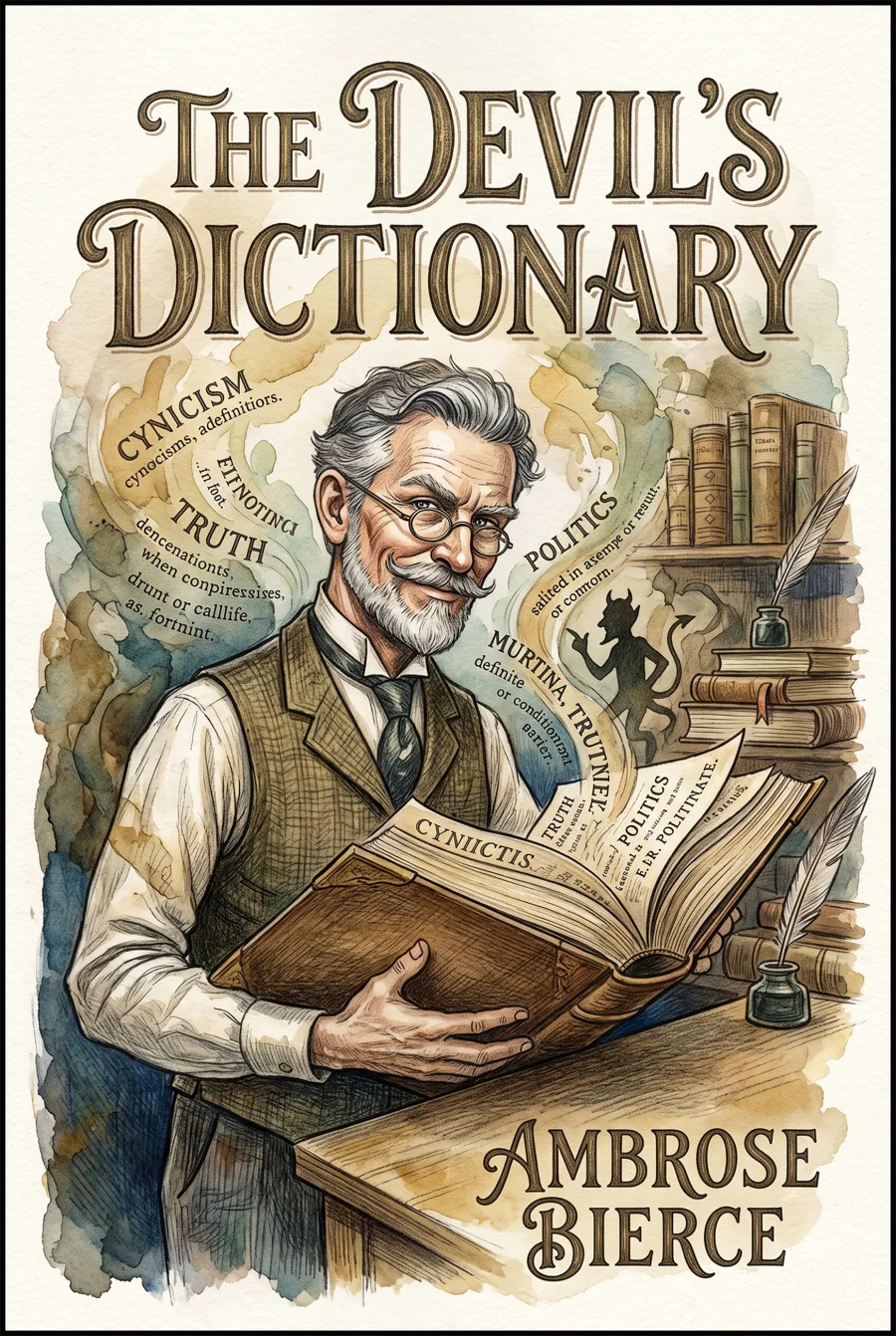
Download Cover Image
Do you want to download the full cover image for The Devil's Dictionary?