
The Diary of a Madman, The Government Inspector, and Selected Stories
eBook
• INR 51.00
• English
• 9788169359160
No ratings yet
| Publisher | General Press |
|---|---|
| ISBN13 | 9788169359160 |
| ASIN/SKU | 8169359163 |
| Book Format | eBook |
| Language | English |
| List Price | INR 51.00 |
| Subject Code | FIC052000, FIC025000, DRA016000 |
| Publishing Date | 01/09/2026 |
| Book Code | BD00070227 |
Buy this Book
Amazon Stores
Ebook Stores
Other Stores
Discover The Diary of a Madman, The Government Inspector, and Selected Stories by Nikolai Gogol. This book is published by General Press in eBook format, ISBN 9788169359160, ASIN 8169359163, under Literature and Fiction, Fiction Satire, Psychological Fiction.
Book Description
Step into a world where ordinary people become trapped by vanity, bureaucracy, loneliness, and the absurdity of everyday life. 'The Diary of a Madman, The Government Inspector and Selected Stories' by Nikolai Gogol is a classic Russian literature collection blending satire, dark comedy, psychological fiction, and social criticism to expose the strange and often hilarious weaknesses of human society.
The collection brings together some of Gogol's most memorable works, each offering a different glimpse into his sharp and imaginative view of life. In “The Diary of a Madman,” a lonely and frustrated government clerk gradually loses his grip on reality as his dissatisfaction with his low social position and desire for recognition take over his imagination. His diary becomes increasingly bizarre, revealing how isolation and obsession can distort a person's understanding of the world.
“The Government Inspector” turns corruption and fear into farce. When officials in a provincial Russian town mistakenly believe that an insignificant traveler is a secret government inspector sent to investigate them, panic spreads through the administration. Desperate to protect their positions, the officials flatter, bribe, and deceive the supposed inspector, creating a hilarious portrait of institutional corruption and hypocrisy.
The selected stories expand these themes through eccentric characters, strange circumstances, and Gogol's distinctive mixture of humor and melancholy. Beneath the comedy lies a deeper concern with poverty, social hierarchy, bureaucracy, appearance, and the struggle of ordinary people to find dignity in an uncaring world. Gogol's characters are often ridiculous, but they are also deeply human, making their failures surprisingly moving.
Funny, unsettling, and endlessly inventive, this collection shows why Gogol remains one of the great masters of literary satire. Its strange characters and unforgettable situations invite readers to laugh first—and then wonder what those laughs reveal about society and themselves.
The collection brings together some of Gogol's most memorable works, each offering a different glimpse into his sharp and imaginative view of life. In “The Diary of a Madman,” a lonely and frustrated government clerk gradually loses his grip on reality as his dissatisfaction with his low social position and desire for recognition take over his imagination. His diary becomes increasingly bizarre, revealing how isolation and obsession can distort a person's understanding of the world.
“The Government Inspector” turns corruption and fear into farce. When officials in a provincial Russian town mistakenly believe that an insignificant traveler is a secret government inspector sent to investigate them, panic spreads through the administration. Desperate to protect their positions, the officials flatter, bribe, and deceive the supposed inspector, creating a hilarious portrait of institutional corruption and hypocrisy.
The selected stories expand these themes through eccentric characters, strange circumstances, and Gogol's distinctive mixture of humor and melancholy. Beneath the comedy lies a deeper concern with poverty, social hierarchy, bureaucracy, appearance, and the struggle of ordinary people to find dignity in an uncaring world. Gogol's characters are often ridiculous, but they are also deeply human, making their failures surprisingly moving.
Funny, unsettling, and endlessly inventive, this collection shows why Gogol remains one of the great masters of literary satire. Its strange characters and unforgettable situations invite readers to laugh first—and then wonder what those laughs reveal about society and themselves.
Author Biography
Few writers have made the ordinary world feel quite as strange, comic, and unsettling as Nikolai Gogol. Nikolai Gogol was a Ukrainian-born Russian writer best known for his short stories, satire, plays, and fiction, including 'Dead Souls', 'The Government Inspector', 'The Overcoat', and 'The Nose'.
Born in 1809 in Sorochyntsi, in present-day Ukraine, Gogol grew up surrounded by Ukrainian folklore, traditions, and stories that later became an important part of his imagination. He studied at the Nizhyn Gymnasium, where he developed an early interest in writing and theater, before moving to St. Petersburg in 1828 to pursue a literary career. His first literary attempt, a Romantic poem published under a pseudonym, was poorly received, but he soon found his voice in prose.
Gogol's breakthrough came with 'Evenings on a Farm Near Dikanka', a collection inspired by Ukrainian village life and folklore. He later turned toward sharper social satire, producing works such as 'The Government Inspector', which humorously exposed corruption and hypocrisy among Russian officials. His masterpiece, 'Dead Souls', followed an ambitious trickster traveling through provincial Russia and became a powerful portrait of greed, dishonesty, and social absurdity.
His writing is distinctive for its blend of humor, realism, fantasy, and the grotesque. Stories such as 'The Nose', 'Diary of a Madman', and 'The Overcoat' transform everyday experiences into strange and memorable tales while revealing the loneliness and frustrations of ordinary people. His unusual style helped bridge Romanticism and realism and influenced generations of Russian and world writers.
Gogol died in Moscow in 1852, but his imaginative vision has never faded. His ability to find both comedy and tragedy in human life continues to make his work a lasting part of world literature.
Born in 1809 in Sorochyntsi, in present-day Ukraine, Gogol grew up surrounded by Ukrainian folklore, traditions, and stories that later became an important part of his imagination. He studied at the Nizhyn Gymnasium, where he developed an early interest in writing and theater, before moving to St. Petersburg in 1828 to pursue a literary career. His first literary attempt, a Romantic poem published under a pseudonym, was poorly received, but he soon found his voice in prose.
Gogol's breakthrough came with 'Evenings on a Farm Near Dikanka', a collection inspired by Ukrainian village life and folklore. He later turned toward sharper social satire, producing works such as 'The Government Inspector', which humorously exposed corruption and hypocrisy among Russian officials. His masterpiece, 'Dead Souls', followed an ambitious trickster traveling through provincial Russia and became a powerful portrait of greed, dishonesty, and social absurdity.
His writing is distinctive for its blend of humor, realism, fantasy, and the grotesque. Stories such as 'The Nose', 'Diary of a Madman', and 'The Overcoat' transform everyday experiences into strange and memorable tales while revealing the loneliness and frustrations of ordinary people. His unusual style helped bridge Romanticism and realism and influenced generations of Russian and world writers.
Gogol died in Moscow in 1852, but his imaginative vision has never faded. His ability to find both comedy and tragedy in human life continues to make his work a lasting part of world literature.
Editorial Reviews
Editorial Reviews will be added soon…
Book Summary
Nikolai Gogol’s "The Diary of a Madman, The Government Inspector, and Selected Stories" brings together some of the Russian writer’s most memorable works of satire, absurdity, psychological disturbance, and social criticism. Although the pieces differ greatly in plot and form, they share a recognizable Gogolian vision: ordinary people trapped inside ridiculous systems, obsessed with status, frightened by authority, humiliated by social expectations, and often unable to distinguish reality from illusion. Gogol turns bureaucrats, clerks, officials, servants, shopkeepers, artists, and minor aristocrats into unforgettable characters whose comic situations gradually reveal something deeply sad about human existence. For readers searching for a summary of 'The Diary of a Madman', 'The Government Inspector', and Gogol’s selected stories, the collection is best understood as an exploration of vanity, bureaucracy, social hierarchy, identity, madness, deception, and the strange absurdity of everyday life.
The title pieces provide the strongest introduction to Gogol’s literary world. “Diary of a Madman” is a short first-person story that follows Aksenty Ivanovich Poprishchin, a low-ranking government clerk whose dissatisfaction with his social position gradually develops into a complete break with reality. At the beginning, Poprishchin appears eccentric but recognizably human. He is frustrated by his job, resentful of his superiors, and fascinated by the daughter of his director. He dreams of being more important than he is and constantly imagines possibilities that might allow him to escape his humiliating position. His deepest problem is his obsession with social rank. He cannot accept that he occupies a low place in the bureaucratic hierarchy.
Poprishchin's growing fixation on status becomes increasingly detached from reality. He discovers, or believes he discovers, that two dogs are exchanging letters with one another. He reads these imagined letters and becomes convinced that they contain information about the people around him. This strange episode marks a transition from eccentricity to psychological collapse. Gogol does not simply portray Poprishchin as a mad man whose thoughts have no connection with reality. Instead, his madness grows out of the pressures and frustrations of his ordinary social world.
Poprishchin eventually becomes convinced that he is Ferdinand VIII, the king of Spain. His delusion allows him to escape the humiliating identity of a minor clerk. In his imagination, he has become someone powerful and important. Yet this apparent escape is deeply tragic. The more completely he abandons reality, the more clearly the reader sees how desperately he wanted dignity and recognition. His madness becomes a distorted response to a society that constantly tells him that his worth depends on his position.
The ending of “Diary of a Madman” is particularly disturbing because Poprishchin is taken to an asylum. His final cries are confused, frightened, and painfully human. He calls for his mother and begs to be removed from his suffering. Gogol ends without offering a simple explanation or solution. The reader is left with the uncomfortable question of where madness begins and whether the society surrounding Poprishchin is itself rational. The bureaucracy that humiliates him is presented as absurd throughout the story, so his eventual breakdown feels like both a personal tragedy and a social indictment.
'The Government Inspector' expands Gogol’s satire from one individual to an entire town. The play begins when the town's officials receive alarming news: a government inspector is expected to arrive secretly from St. Petersburg to investigate corruption and administrative failures. The officials immediately panic because they know they have much to hide. They have abused their authority, neglected their responsibilities, taken bribes, and manipulated the people under their control. Instead of correcting their behavior, however, they become obsessed with protecting themselves.
The mayor, Anton Antonovich Skvoznik-Dmukhanovsky, is at the center of this corrupt world. He is an experienced official who understands how the system works and how to benefit from it. He knows that public institutions are supposed to serve the people, but he treats his position as an opportunity for personal advantage. The other officials behave similarly. The judge, hospital administrator, school inspector, and postmaster each have their own failures and secrets.
The comic misunderstanding that drives the play occurs when the officials mistake Khlestakov, a young and insignificant government clerk traveling through town, for the expected inspector. Khlestakov is not the powerful official they imagine him to be. He is vain, irresponsible, deeply concerned with appearances, and living beyond his means. When the terrified officials begin treating him with extraordinary respect, however, he quickly realizes that he can exploit their fear.
Khlestakov becomes increasingly confident as the officials flatter him and offer him money. He exaggerates his importance and invents stories about his connections, wealth, and influence. He claims to have relationships with powerful figures and presents himself as far more important than he really is. The officials believe him because they are so frightened of being exposed that they are willing to believe almost anything.
This is one of the central comic mechanisms of 'The Government Inspector': corruption makes deception easy. Khlestakov succeeds not because he is particularly intelligent but because the officials are guilty. Their own fear creates the conditions for their manipulation. They see what they expect to see. Since they believe the inspector must be someone powerful, they transform an ordinary man into a figure of enormous authority.
The mayor becomes particularly desperate to impress Khlestakov. His wife and daughter also become involved, creating another layer of comic competition. Khlestakov flirts with both women and eventually proposes to the mayor's daughter. Meanwhile, the officials continue trying to gain his favor through gifts and loans. The entire town effectively exposes itself through its attempts to hide its corruption.
Khlestakov eventually leaves with the money and promises he has collected. Only after his departure does the postmaster reveal that he has opened Khlestakov's correspondence and discovered the truth. Khlestakov has been laughing at the officials and describing them as ridiculous. The officials realize that they have been deceived, but their humiliation is not yet complete.
The play ends with one of the most famous moments in Gogol's work: the announcement that a real government inspector has arrived and wants to see them immediately. The officials freeze in shock. The curtain falls on their stunned silence. The ending is effective because the deception they have created for themselves has finally collapsed. They were not merely fooled by Khlestakov; they were fooled by their own corruption, fear, vanity, and willingness to flatter authority.
The play's central theme is therefore bureaucracy as a system of moral distortion. Gogol does not simply attack individual corrupt officials. He presents a whole administrative culture in which bribery, dishonesty, incompetence, and fear have become normal. People perform their roles without fulfilling the responsibilities those roles supposedly represent. The result is a society where everyone knows the system is broken but continues participating in it.
Another major theme is the power of appearances. Nearly every character in 'The Government Inspector' cares about how things look. The officials want to appear competent; Khlestakov wants to appear important; the mayor's family wants to appear fashionable and respectable. Reality matters less than presentation. Gogol suggests that a society obsessed with appearances becomes particularly vulnerable to deception.
The selected stories in the collection deepen these concerns. One of Gogol's most famous stories, “The Overcoat,” follows Akaky Akakievich Bashmachkin, a poor and insignificant government clerk whose entire life revolves around copying documents. Akaky is socially invisible. His colleagues mock him, his work is repetitive, and he possesses almost nothing beyond the basic necessities of life. Yet Gogol treats this seemingly insignificant man with unusual tenderness.
Akaky's life changes when his old overcoat becomes so worn that he must obtain a new one. Saving enough money for the coat becomes an enormous project. He cuts expenses, gives up small pleasures, and thinks constantly about the new garment. When the coat is finally completed, it brings him something he has rarely experienced: attention and respect. His colleagues congratulate him, and for a brief time he feels that he has entered another social world.
The happiness is short-lived. On his way home from a gathering, Akaky is attacked and robbed of his new overcoat. He desperately seeks help, but the authorities respond with indifference. His suffering is treated as an inconvenience rather than a tragedy. He becomes ill and dies soon afterward. After his death, rumors spread about a ghost haunting the streets and stealing overcoats from passersby.
“The Overcoat” is simultaneously comic, tragic, and supernatural. Its famous closing image transforms Akaky from an invisible bureaucrat into a figure who can no longer be ignored. Gogol uses the ghost story to express a kind of posthumous revenge against a society that refused to recognize Akaky's humanity while he was alive. The story asks readers to consider what happens when institutions and individuals become so obsessed with hierarchy that they stop seeing the suffering person in front of them.
Another important work associated with Gogol's selected stories is “The Nose,” a bizarre satire about identity and social status. Major Kovalyov wakes one morning and discovers that his nose has disappeared. Even more absurdly, the nose appears independently in public and seems to have a higher social rank than Kovalyov himself. Kovalyov is horrified not only because he has lost part of his body but because his social identity depends so heavily on appearance and status.
He desperately searches for his missing nose and encounters it dressed as a high-ranking official. The absurd situation becomes a parody of bureaucratic society: the nose has somehow become more important than the man to whom it belongs. Kovalyov's panic reveals how deeply he depends upon appearances. His concern is not simply physical discomfort; he fears that without his nose he cannot participate properly in society.
“The Nose” pushes Gogol's surrealism to an extreme, but its social criticism is clear. In a world obsessed with rank, identity can become detached from the actual person. Titles, uniforms, appearances, and positions begin to matter more than human substance. The absurdity of the story therefore exposes an underlying truth about social hierarchy.
Gogol's story “Nevsky Prospect” similarly examines the difference between appearance and reality. Nevsky Prospect, the fashionable avenue of St. Petersburg, appears glamorous and exciting, but Gogol gradually reveals that the surface hides disappointment, deception, and moral emptiness. The story follows two men who become fascinated by women they encounter on the street, but their experiences unfold in radically different ways. The contrast shows how easily people project fantasies onto strangers and mistake appearances for truth.
This concern with illusion appears throughout Gogol's writing. His characters repeatedly construct imaginary versions of themselves and others. Poprishchin imagines himself as a monarch. Khlestakov imagines himself as an important public figure. Kovalyov's nose becomes a separate social identity. Akaky's overcoat becomes a symbol of status and recognition. These characters are different, but they share a common vulnerability: they live in a society where external appearances strongly influence personal worth.
Gogol's humor is therefore rarely simple comedy. His absurd situations often make readers laugh before making them uncomfortable. A clerk chasing his own nose is funny, but the joke becomes darker when we realize that the clerk's identity is almost entirely defined by social status. A corrupt mayor being fooled by a boastful young man is amusing, but beneath the comedy is a serious criticism of institutional corruption. A poor clerk's obsession with an overcoat may seem ridiculous, but the story becomes heartbreaking when the reader realizes that the coat represents his only opportunity to experience dignity.
The collection also demonstrates Gogol's distinctive use of the grotesque. Bodies, identities, objects, and institutions behave strangely. A nose walks around independently; a dead man's ghost steals clothing; a clerk becomes convinced he is a king; officials mistake an ordinary traveler for a government inspector. Yet these bizarre events often reveal emotional truths more clearly than realistic storytelling might. Gogol uses the impossible to make ordinary social realities look strange.
One of the most enduring themes across these works is the struggle for human dignity. Gogol's characters are often ridiculous, but they are not simply objects of ridicule. Many of them are lonely people seeking recognition. Akaky wants respect. Poprishchin wants importance. Kovalyov wants social acceptance. Even Khlestakov wants admiration, though he expresses this desire through deception and vanity. Their weaknesses are exaggerated, but their underlying needs are recognizable.
The bureaucracy in Gogol's stories is especially important because it creates a world in which human beings are reduced to titles and ranks. A person is valuable because of position rather than character. This is why Gogol's clerks are so memorable. They are trapped in a system that tells them exactly where they belong. Those at the bottom are humiliated, while those at the top protect their privileges. The result is a cycle in which almost everyone seeks status rather than genuine human connection.
Gogol's writing also anticipates later traditions of psychological and existential literature. His characters often experience alienation, fragmented identity, anxiety, and absurdity. They live in worlds where ordinary rules suddenly become unstable. This makes his work surprisingly modern. Long before twentieth-century writers made absurdity and alienation central literary themes, Gogol was already showing how strange everyday existence could become.
The collection's greatest strength is therefore the combination of comedy and compassion. Gogol can make readers laugh at the foolishness of his characters while simultaneously making them feel pity for those characters. He does not offer simple moral lessons. Instead, he creates situations in which the reader gradually recognizes the connection between personal weakness and social conditions. People behave foolishly, but the world around them often encourages that foolishness.
Ultimately, 'The Diary of a Madman, The Government Inspector, and Selected Stories' presents a world where reality is constantly distorted by bureaucracy, vanity, fear, and social hierarchy. “Diary of a Madman” explores the psychological consequences of humiliation and obsession with status. 'The Government Inspector' exposes institutional corruption through farce and mistaken identity. “The Overcoat” reveals the tragedy of social invisibility and the human desire for dignity. “The Nose” turns identity and rank into surreal comedy. “Nevsky Prospect” questions the reliability of appearances and romantic fantasy.
For readers looking for the main themes and meaning of Gogol's works, the collection's central insight is that absurdity often hides beneath ordinary life. People may believe they are rational, respectable, and socially successful, yet their behavior can be driven by fear, vanity, greed, loneliness, and the desire to be recognized. Gogol's genius lies in making these contradictions visible. His characters are funny because they are exaggerated, but they are memorable because they are human.
In the end, Gogol does not simply ask us to laugh at corrupt officials, foolish clerks, vain social climbers, or confused dreamers. He asks us to recognize ourselves in them. We too can become obsessed with appearances, titles, possessions, approval, and social position. We too can participate in systems that diminish other people. Beneath the grotesque humor, Gogol's deepest concern is therefore profoundly humane: what happens to people when society forgets that they are human beings? His answer is often tragic, but his satire gives that tragedy a strange and unforgettable comic form. That combination of laughter, discomfort, sympathy, and social criticism is what makes 'The Diary of a Madman', 'The Government Inspector', and Gogol's selected stories enduring classics of Russian literature.
The title pieces provide the strongest introduction to Gogol’s literary world. “Diary of a Madman” is a short first-person story that follows Aksenty Ivanovich Poprishchin, a low-ranking government clerk whose dissatisfaction with his social position gradually develops into a complete break with reality. At the beginning, Poprishchin appears eccentric but recognizably human. He is frustrated by his job, resentful of his superiors, and fascinated by the daughter of his director. He dreams of being more important than he is and constantly imagines possibilities that might allow him to escape his humiliating position. His deepest problem is his obsession with social rank. He cannot accept that he occupies a low place in the bureaucratic hierarchy.
Poprishchin's growing fixation on status becomes increasingly detached from reality. He discovers, or believes he discovers, that two dogs are exchanging letters with one another. He reads these imagined letters and becomes convinced that they contain information about the people around him. This strange episode marks a transition from eccentricity to psychological collapse. Gogol does not simply portray Poprishchin as a mad man whose thoughts have no connection with reality. Instead, his madness grows out of the pressures and frustrations of his ordinary social world.
Poprishchin eventually becomes convinced that he is Ferdinand VIII, the king of Spain. His delusion allows him to escape the humiliating identity of a minor clerk. In his imagination, he has become someone powerful and important. Yet this apparent escape is deeply tragic. The more completely he abandons reality, the more clearly the reader sees how desperately he wanted dignity and recognition. His madness becomes a distorted response to a society that constantly tells him that his worth depends on his position.
The ending of “Diary of a Madman” is particularly disturbing because Poprishchin is taken to an asylum. His final cries are confused, frightened, and painfully human. He calls for his mother and begs to be removed from his suffering. Gogol ends without offering a simple explanation or solution. The reader is left with the uncomfortable question of where madness begins and whether the society surrounding Poprishchin is itself rational. The bureaucracy that humiliates him is presented as absurd throughout the story, so his eventual breakdown feels like both a personal tragedy and a social indictment.
'The Government Inspector' expands Gogol’s satire from one individual to an entire town. The play begins when the town's officials receive alarming news: a government inspector is expected to arrive secretly from St. Petersburg to investigate corruption and administrative failures. The officials immediately panic because they know they have much to hide. They have abused their authority, neglected their responsibilities, taken bribes, and manipulated the people under their control. Instead of correcting their behavior, however, they become obsessed with protecting themselves.
The mayor, Anton Antonovich Skvoznik-Dmukhanovsky, is at the center of this corrupt world. He is an experienced official who understands how the system works and how to benefit from it. He knows that public institutions are supposed to serve the people, but he treats his position as an opportunity for personal advantage. The other officials behave similarly. The judge, hospital administrator, school inspector, and postmaster each have their own failures and secrets.
The comic misunderstanding that drives the play occurs when the officials mistake Khlestakov, a young and insignificant government clerk traveling through town, for the expected inspector. Khlestakov is not the powerful official they imagine him to be. He is vain, irresponsible, deeply concerned with appearances, and living beyond his means. When the terrified officials begin treating him with extraordinary respect, however, he quickly realizes that he can exploit their fear.
Khlestakov becomes increasingly confident as the officials flatter him and offer him money. He exaggerates his importance and invents stories about his connections, wealth, and influence. He claims to have relationships with powerful figures and presents himself as far more important than he really is. The officials believe him because they are so frightened of being exposed that they are willing to believe almost anything.
This is one of the central comic mechanisms of 'The Government Inspector': corruption makes deception easy. Khlestakov succeeds not because he is particularly intelligent but because the officials are guilty. Their own fear creates the conditions for their manipulation. They see what they expect to see. Since they believe the inspector must be someone powerful, they transform an ordinary man into a figure of enormous authority.
The mayor becomes particularly desperate to impress Khlestakov. His wife and daughter also become involved, creating another layer of comic competition. Khlestakov flirts with both women and eventually proposes to the mayor's daughter. Meanwhile, the officials continue trying to gain his favor through gifts and loans. The entire town effectively exposes itself through its attempts to hide its corruption.
Khlestakov eventually leaves with the money and promises he has collected. Only after his departure does the postmaster reveal that he has opened Khlestakov's correspondence and discovered the truth. Khlestakov has been laughing at the officials and describing them as ridiculous. The officials realize that they have been deceived, but their humiliation is not yet complete.
The play ends with one of the most famous moments in Gogol's work: the announcement that a real government inspector has arrived and wants to see them immediately. The officials freeze in shock. The curtain falls on their stunned silence. The ending is effective because the deception they have created for themselves has finally collapsed. They were not merely fooled by Khlestakov; they were fooled by their own corruption, fear, vanity, and willingness to flatter authority.
The play's central theme is therefore bureaucracy as a system of moral distortion. Gogol does not simply attack individual corrupt officials. He presents a whole administrative culture in which bribery, dishonesty, incompetence, and fear have become normal. People perform their roles without fulfilling the responsibilities those roles supposedly represent. The result is a society where everyone knows the system is broken but continues participating in it.
Another major theme is the power of appearances. Nearly every character in 'The Government Inspector' cares about how things look. The officials want to appear competent; Khlestakov wants to appear important; the mayor's family wants to appear fashionable and respectable. Reality matters less than presentation. Gogol suggests that a society obsessed with appearances becomes particularly vulnerable to deception.
The selected stories in the collection deepen these concerns. One of Gogol's most famous stories, “The Overcoat,” follows Akaky Akakievich Bashmachkin, a poor and insignificant government clerk whose entire life revolves around copying documents. Akaky is socially invisible. His colleagues mock him, his work is repetitive, and he possesses almost nothing beyond the basic necessities of life. Yet Gogol treats this seemingly insignificant man with unusual tenderness.
Akaky's life changes when his old overcoat becomes so worn that he must obtain a new one. Saving enough money for the coat becomes an enormous project. He cuts expenses, gives up small pleasures, and thinks constantly about the new garment. When the coat is finally completed, it brings him something he has rarely experienced: attention and respect. His colleagues congratulate him, and for a brief time he feels that he has entered another social world.
The happiness is short-lived. On his way home from a gathering, Akaky is attacked and robbed of his new overcoat. He desperately seeks help, but the authorities respond with indifference. His suffering is treated as an inconvenience rather than a tragedy. He becomes ill and dies soon afterward. After his death, rumors spread about a ghost haunting the streets and stealing overcoats from passersby.
“The Overcoat” is simultaneously comic, tragic, and supernatural. Its famous closing image transforms Akaky from an invisible bureaucrat into a figure who can no longer be ignored. Gogol uses the ghost story to express a kind of posthumous revenge against a society that refused to recognize Akaky's humanity while he was alive. The story asks readers to consider what happens when institutions and individuals become so obsessed with hierarchy that they stop seeing the suffering person in front of them.
Another important work associated with Gogol's selected stories is “The Nose,” a bizarre satire about identity and social status. Major Kovalyov wakes one morning and discovers that his nose has disappeared. Even more absurdly, the nose appears independently in public and seems to have a higher social rank than Kovalyov himself. Kovalyov is horrified not only because he has lost part of his body but because his social identity depends so heavily on appearance and status.
He desperately searches for his missing nose and encounters it dressed as a high-ranking official. The absurd situation becomes a parody of bureaucratic society: the nose has somehow become more important than the man to whom it belongs. Kovalyov's panic reveals how deeply he depends upon appearances. His concern is not simply physical discomfort; he fears that without his nose he cannot participate properly in society.
“The Nose” pushes Gogol's surrealism to an extreme, but its social criticism is clear. In a world obsessed with rank, identity can become detached from the actual person. Titles, uniforms, appearances, and positions begin to matter more than human substance. The absurdity of the story therefore exposes an underlying truth about social hierarchy.
Gogol's story “Nevsky Prospect” similarly examines the difference between appearance and reality. Nevsky Prospect, the fashionable avenue of St. Petersburg, appears glamorous and exciting, but Gogol gradually reveals that the surface hides disappointment, deception, and moral emptiness. The story follows two men who become fascinated by women they encounter on the street, but their experiences unfold in radically different ways. The contrast shows how easily people project fantasies onto strangers and mistake appearances for truth.
This concern with illusion appears throughout Gogol's writing. His characters repeatedly construct imaginary versions of themselves and others. Poprishchin imagines himself as a monarch. Khlestakov imagines himself as an important public figure. Kovalyov's nose becomes a separate social identity. Akaky's overcoat becomes a symbol of status and recognition. These characters are different, but they share a common vulnerability: they live in a society where external appearances strongly influence personal worth.
Gogol's humor is therefore rarely simple comedy. His absurd situations often make readers laugh before making them uncomfortable. A clerk chasing his own nose is funny, but the joke becomes darker when we realize that the clerk's identity is almost entirely defined by social status. A corrupt mayor being fooled by a boastful young man is amusing, but beneath the comedy is a serious criticism of institutional corruption. A poor clerk's obsession with an overcoat may seem ridiculous, but the story becomes heartbreaking when the reader realizes that the coat represents his only opportunity to experience dignity.
The collection also demonstrates Gogol's distinctive use of the grotesque. Bodies, identities, objects, and institutions behave strangely. A nose walks around independently; a dead man's ghost steals clothing; a clerk becomes convinced he is a king; officials mistake an ordinary traveler for a government inspector. Yet these bizarre events often reveal emotional truths more clearly than realistic storytelling might. Gogol uses the impossible to make ordinary social realities look strange.
One of the most enduring themes across these works is the struggle for human dignity. Gogol's characters are often ridiculous, but they are not simply objects of ridicule. Many of them are lonely people seeking recognition. Akaky wants respect. Poprishchin wants importance. Kovalyov wants social acceptance. Even Khlestakov wants admiration, though he expresses this desire through deception and vanity. Their weaknesses are exaggerated, but their underlying needs are recognizable.
The bureaucracy in Gogol's stories is especially important because it creates a world in which human beings are reduced to titles and ranks. A person is valuable because of position rather than character. This is why Gogol's clerks are so memorable. They are trapped in a system that tells them exactly where they belong. Those at the bottom are humiliated, while those at the top protect their privileges. The result is a cycle in which almost everyone seeks status rather than genuine human connection.
Gogol's writing also anticipates later traditions of psychological and existential literature. His characters often experience alienation, fragmented identity, anxiety, and absurdity. They live in worlds where ordinary rules suddenly become unstable. This makes his work surprisingly modern. Long before twentieth-century writers made absurdity and alienation central literary themes, Gogol was already showing how strange everyday existence could become.
The collection's greatest strength is therefore the combination of comedy and compassion. Gogol can make readers laugh at the foolishness of his characters while simultaneously making them feel pity for those characters. He does not offer simple moral lessons. Instead, he creates situations in which the reader gradually recognizes the connection between personal weakness and social conditions. People behave foolishly, but the world around them often encourages that foolishness.
Ultimately, 'The Diary of a Madman, The Government Inspector, and Selected Stories' presents a world where reality is constantly distorted by bureaucracy, vanity, fear, and social hierarchy. “Diary of a Madman” explores the psychological consequences of humiliation and obsession with status. 'The Government Inspector' exposes institutional corruption through farce and mistaken identity. “The Overcoat” reveals the tragedy of social invisibility and the human desire for dignity. “The Nose” turns identity and rank into surreal comedy. “Nevsky Prospect” questions the reliability of appearances and romantic fantasy.
For readers looking for the main themes and meaning of Gogol's works, the collection's central insight is that absurdity often hides beneath ordinary life. People may believe they are rational, respectable, and socially successful, yet their behavior can be driven by fear, vanity, greed, loneliness, and the desire to be recognized. Gogol's genius lies in making these contradictions visible. His characters are funny because they are exaggerated, but they are memorable because they are human.
In the end, Gogol does not simply ask us to laugh at corrupt officials, foolish clerks, vain social climbers, or confused dreamers. He asks us to recognize ourselves in them. We too can become obsessed with appearances, titles, possessions, approval, and social position. We too can participate in systems that diminish other people. Beneath the grotesque humor, Gogol's deepest concern is therefore profoundly humane: what happens to people when society forgets that they are human beings? His answer is often tragic, but his satire gives that tragedy a strange and unforgettable comic form. That combination of laughter, discomfort, sympathy, and social criticism is what makes 'The Diary of a Madman', 'The Government Inspector', and Gogol's selected stories enduring classics of Russian literature.
Sample Chapters
Sample Chapters will be added soon…
Reader Reviews
No reviews yet.
The Diary of a Madman, The Government Inspector, and Selected Stories
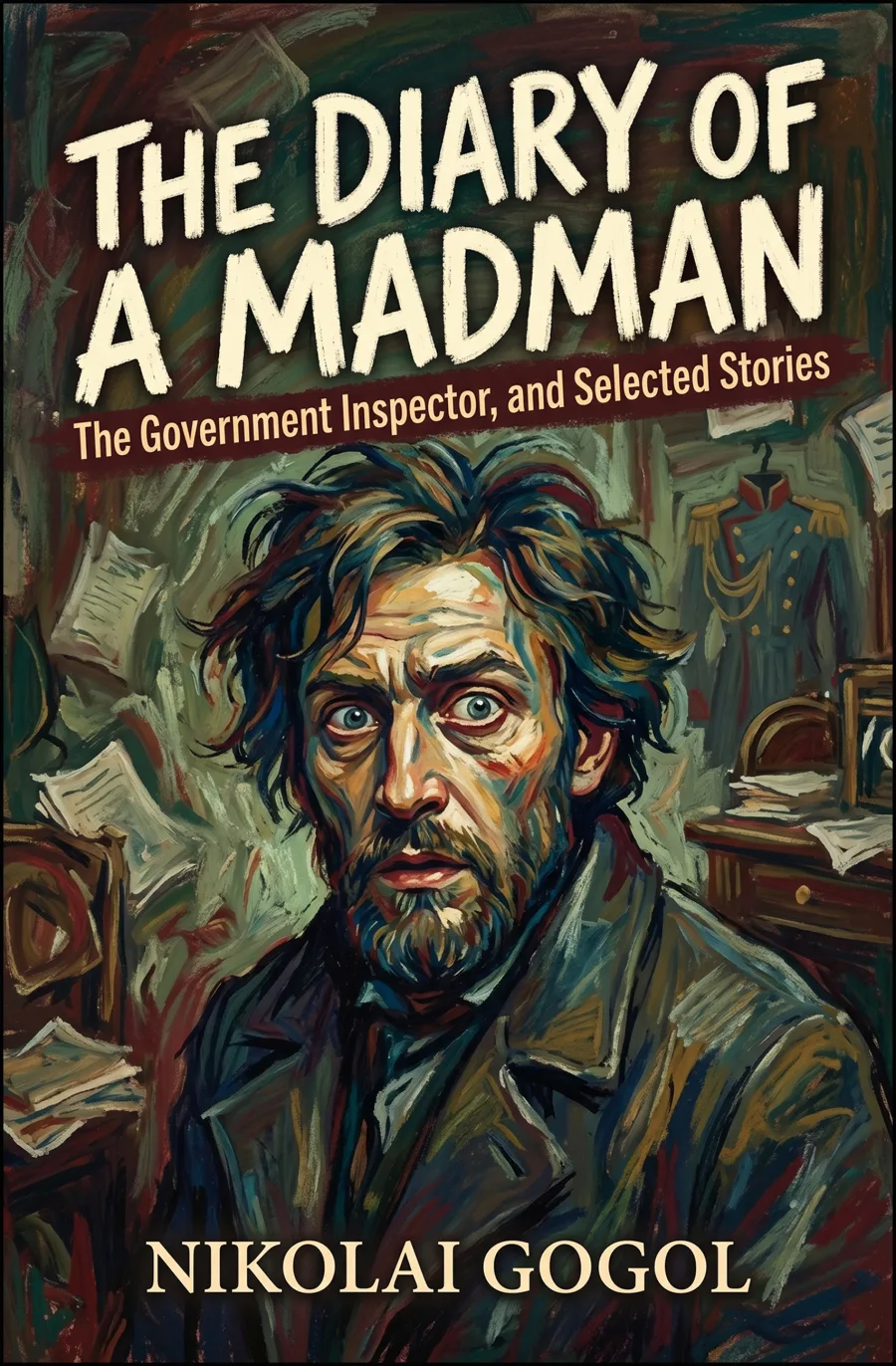
Download Cover Image
Do you want to download the full cover image for The Diary of a Madman, The Government Inspector, and Selected Stories?