
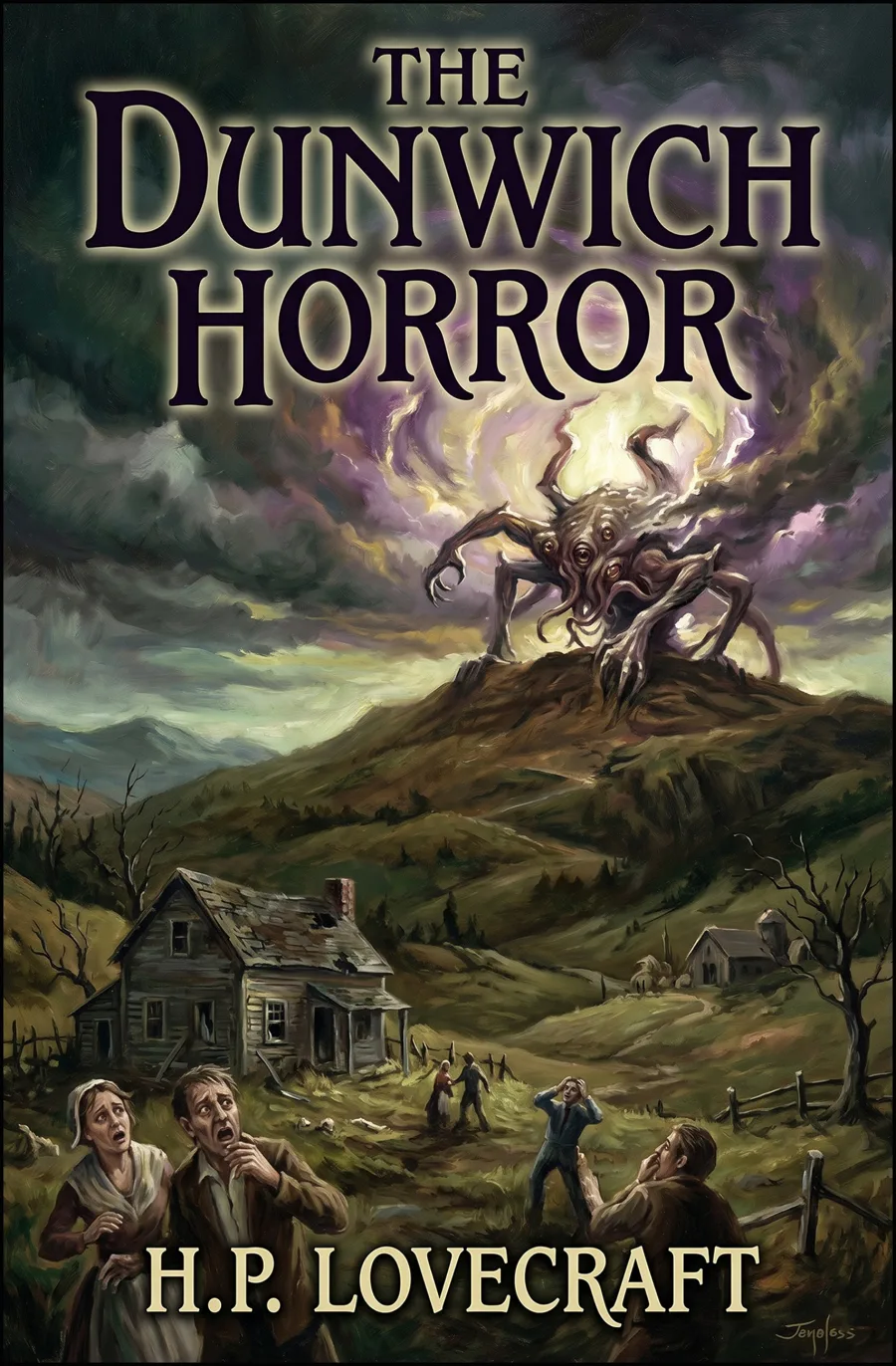
The Dunwich Horror
eBook
• INR 51.00
• English
• 9788169359672
No ratings yet
| Publisher | General Press |
|---|---|
| ISBN13 | 9788169359672 |
| ASIN/SKU | 8169359678 |
| Book Format | eBook |
| Language | English |
| List Price | INR 51.00 |
| Subject Code | FIC015000, FIC031070, FIC066000 |
| Publishing Date | 01/09/2026 |
| Book Code | BD00070228 |
Buy this Book
Amazon Stores
Ebook Stores
Other Stores
Discover The Dunwich Horror by H.P. Lovecraft. This book is published by General Press in eBook format, ISBN 9788169359672, ASIN 8169359678, under Literature and Fiction, Horror Literature and Fiction, Supernatural Thrillers.
Book Description
Something ancient is stirring in the quiet hills of rural Massachusetts, and the people of Dunwich have no idea how close they are to a nightmare beyond human understanding. 'The Dunwich Horror' by H. P. Lovecraft is a classic cosmic horror story that combines supernatural terror, forbidden knowledge, strange rituals, and the unsettling idea that humanity may not be alone—or even safe—in the universe.
The story centers on Wilbur Whateley, a mysterious child born to Lavinia Whateley, a troubled woman from one of Dunwich's most secretive families. From the beginning, Wilbur is unlike other children. He grows at an unnatural rate, displays an extraordinary intelligence, and becomes deeply interested in ancient occult writings, particularly the dreaded Necronomicon. His grandfather, Old Whateley, encourages these strange studies while conducting disturbing experiments on the family's isolated farm. Meanwhile, something unseen is being raised and hidden within the Whateley property, and the increasingly strange events around the family begin to alarm the local community.
As Wilbur grows older, his obsession with forbidden knowledge becomes more urgent. His search for a way to unlock ancient powers eventually brings him into conflict with scholars who recognize the terrifying implications of what he is attempting. When Wilbur's plans begin to affect the outside world, Dunwich faces a threat that is far more frightening than anything its inhabitants could have imagined.
Lovecraft builds the horror through atmosphere and suggestion, turning an isolated New England village into a place of creeping dread. The story explores forbidden knowledge, human curiosity, inherited secrets, and forces so vast that ordinary understanding seems almost meaningless. For readers drawn to classic supernatural and cosmic horror, 'The Dunwich Horror' offers a chilling journey into the unknown—one that reveals its darkest secrets only when it is almost too late to turn back.
The story centers on Wilbur Whateley, a mysterious child born to Lavinia Whateley, a troubled woman from one of Dunwich's most secretive families. From the beginning, Wilbur is unlike other children. He grows at an unnatural rate, displays an extraordinary intelligence, and becomes deeply interested in ancient occult writings, particularly the dreaded Necronomicon. His grandfather, Old Whateley, encourages these strange studies while conducting disturbing experiments on the family's isolated farm. Meanwhile, something unseen is being raised and hidden within the Whateley property, and the increasingly strange events around the family begin to alarm the local community.
As Wilbur grows older, his obsession with forbidden knowledge becomes more urgent. His search for a way to unlock ancient powers eventually brings him into conflict with scholars who recognize the terrifying implications of what he is attempting. When Wilbur's plans begin to affect the outside world, Dunwich faces a threat that is far more frightening than anything its inhabitants could have imagined.
Lovecraft builds the horror through atmosphere and suggestion, turning an isolated New England village into a place of creeping dread. The story explores forbidden knowledge, human curiosity, inherited secrets, and forces so vast that ordinary understanding seems almost meaningless. For readers drawn to classic supernatural and cosmic horror, 'The Dunwich Horror' offers a chilling journey into the unknown—one that reveals its darkest secrets only when it is almost too late to turn back.
Author Biography
Few writers have made the unknown feel as terrifying as H.P. Lovecraft. Howard Phillips Lovecraft was an American writer best known for his influential weird fiction, cosmic horror, and works such as 'The Call of Cthulhu', 'The Shadow over Innsmouth', and 'At the Mountains of Madness'.
Born on August 20, 1890, in Providence, Rhode Island, Lovecraft grew up in a literary household and developed an early fascination with mythology, astronomy, science, and Gothic literature. Although his childhood was marked by family difficulties and periods of isolation, he became an avid reader and began writing stories and poetry at a young age. He later became deeply involved in amateur journalism, an experience that helped him develop his distinctive literary voice and connect with other writers.
Lovecraft's fiction is famous for its unsettling atmosphere and its portrayal of humanity as small and vulnerable in an immense, mysterious universe. Rather than relying solely on traditional monsters, he created horror from the idea that ancient forces and incomprehensible beings exist beyond human understanding. His fictional mythology, including figures such as Cthulhu and Nyarlathotep, became central to what is now known as the Cthulhu Mythos.
During his lifetime, Lovecraft achieved only limited mainstream recognition, publishing much of his fiction in pulp magazines such as 'Weird Tales'. After his death in 1937, however, his reputation grew dramatically. Collections of his stories introduced his work to generations of readers, while writers, filmmakers, artists, and game creators drew inspiration from his cosmic vision of horror.
Today, Lovecraft remains a defining figure in modern horror fiction, and his imaginative influence continues to shape how popular culture explores fear, mystery, and the vast unknown.
Born on August 20, 1890, in Providence, Rhode Island, Lovecraft grew up in a literary household and developed an early fascination with mythology, astronomy, science, and Gothic literature. Although his childhood was marked by family difficulties and periods of isolation, he became an avid reader and began writing stories and poetry at a young age. He later became deeply involved in amateur journalism, an experience that helped him develop his distinctive literary voice and connect with other writers.
Lovecraft's fiction is famous for its unsettling atmosphere and its portrayal of humanity as small and vulnerable in an immense, mysterious universe. Rather than relying solely on traditional monsters, he created horror from the idea that ancient forces and incomprehensible beings exist beyond human understanding. His fictional mythology, including figures such as Cthulhu and Nyarlathotep, became central to what is now known as the Cthulhu Mythos.
During his lifetime, Lovecraft achieved only limited mainstream recognition, publishing much of his fiction in pulp magazines such as 'Weird Tales'. After his death in 1937, however, his reputation grew dramatically. Collections of his stories introduced his work to generations of readers, while writers, filmmakers, artists, and game creators drew inspiration from his cosmic vision of horror.
Today, Lovecraft remains a defining figure in modern horror fiction, and his imaginative influence continues to shape how popular culture explores fear, mystery, and the vast unknown.
Editorial Reviews
Editorial Reviews will be added soon…
Book Summary
H. P. Lovecraft’s 'The Dunwich Horror' is one of the defining works of cosmic horror and one of the most important stories connected with the Cthulhu Mythos. Written in 1928 and first published in 'Weird Tales' in April 1929, the story combines occult mystery, supernatural terror, rural isolation, forbidden knowledge, and the terrifying idea that humanity is only a small part of a much larger universe. Unlike a conventional horror story, 'The Dunwich Horror' does not depend primarily on a visible monster or a simple battle between good and evil. Its deepest fear comes from the possibility that ancient forces exist beyond human understanding and that certain people may discover ways to communicate with, or accidentally unleash, those forces. The result is a story in which the unknown becomes more frightening than anything the characters can fully see.
The story begins by introducing Dunwich, a remote and decaying village in rural Massachusetts. Lovecraft presents the town as isolated from modern civilization, surrounded by forests, hills, neglected farms, and ancient stone formations. The landscape itself feels unnatural. The houses are old and poorly maintained, the inhabitants are suspicious and withdrawn, and the surrounding countryside seems to preserve secrets from a distant past. This setting is essential to the story because Dunwich is not merely the location of the horror; it creates the conditions that allow the horror to grow unnoticed. The town exists at the edge of ordinary society, and its isolation makes it easier for strange events to be ignored.
At the center of this disturbing environment is the Whateley family. Lavinia Whateley, an isolated woman from a family already associated with strange practices, gives birth to Wilbur Whateley in 1913. His birth is immediately surrounded by ominous signs. Strange noises are heard in the hills, dogs bark throughout the night, and the event feels connected to something far beyond an ordinary human birth. Wilbur's grandfather, Old Whateley, is already regarded by the villagers as a practitioner of dark magic, and the identity of Wilbur's father remains mysterious. As the story progresses, it becomes increasingly clear that Wilbur's parentage is connected to Yog-Sothoth, one of Lovecraft's most powerful cosmic entities.
Wilbur's childhood quickly establishes that he is not an ordinary human being. He develops at an extraordinary speed, learning to walk and speak far earlier than a normal child and growing rapidly toward adulthood. Yet his intelligence is even more remarkable than his physical development. He becomes deeply interested in occult knowledge and ancient books, encouraged by his grandfather. The villagers regard him with fear and suspicion, while animals react to him with unusual hostility. There is something fundamentally alien about Wilbur, even though he appears largely human. His strange behavior and rapid development create one of the story's most important mysteries: what exactly is Wilbur Whateley?
While Wilbur grows, the Whateley family carries out an even more disturbing secret. Old Whateley purchases enormous quantities of cattle, but the size of his herd never seems to increase. The animals appear injured in strange ways, suggesting that something is feeding upon them. At the same time, the Whateley farmhouse undergoes repeated alterations. Rooms are enlarged, walls are removed, and the family seems to be making space for something that is growing inside the house. The townspeople notice these changes but never truly investigate them. Their failure to act becomes an important part of the horror because the danger is not hidden by magic alone; it is also protected by human indifference.
The creature inside the farmhouse is invisible. This is one of Lovecraft's most effective ideas in the story. Instead of immediately presenting the reader with a recognizable monster, he creates terror through traces: enormous footprints, damaged animals, strange noises, ruined structures, and the physical evidence of something that cannot be seen. The unseen creature becomes increasingly large and powerful as the years pass. Eventually, the truth behind the Whateley family's strange activities becomes clearer. Old Whateley and Wilbur are attempting to prepare the way for the arrival or liberation of cosmic beings from beyond the ordinary dimensions of human existence.
The source of this forbidden knowledge is partly contained in the 'Necronomicon', Lovecraft's fictional occult book. Wilbur becomes obsessed with obtaining a complete copy because his family's damaged version lacks crucial information needed to complete their plans. He eventually travels to Miskatonic University in Arkham, whose library possesses a rare copy of the book. There he meets Dr. Henry Armitage, the university librarian. Armitage immediately recognizes that Wilbur's interest in the 'Necronomicon' is dangerous. Rather than allowing him access to the book, he refuses his request and takes steps to prevent Wilbur from obtaining the information elsewhere.
Wilbur's attempt to steal the university's copy of the 'Necronomicon' becomes a turning point. He breaks into the library but is attacked by a guard dog. The dog kills him, and when Armitage and his colleagues arrive, they discover something horrifying about Wilbur's body. Beneath his clothing, he is not entirely human. His corpse reveals a bizarre anatomy that exposes the truth he has tried to conceal throughout his life. The shocking discovery confirms that Wilbur is a hybrid being, connected by blood to a cosmic entity rather than belonging entirely to the human world. His death, however, does not end the danger. In fact, it releases the far greater horror.
With Wilbur gone, there is no one left to control the enormous invisible entity growing inside the Whateley farmhouse. Eventually the farmhouse is destroyed, and the creature escapes into the surrounding countryside. The result is a terrifying period of destruction throughout Dunwich. Because the creature cannot be seen normally, the villagers experience its presence indirectly. Crops and trees are destroyed, enormous tracks appear in the earth, animals are killed, buildings are damaged, and people disappear or are violently attacked. The invisible monster moves through the landscape like an enormous force of nature, demonstrating how powerless ordinary human beings are against it.
The horror becomes especially effective because Lovecraft repeatedly delays the creature's full revelation. The monster is enormous, but its invisibility prevents the characters from understanding its true shape. The reader is therefore forced to imagine something worse than any detailed description might provide. This is a central technique of cosmic horror: what cannot be comprehended becomes more frightening than what can be clearly seen.
Eventually, Dr. Armitage, Professor Warren Rice, and Dr. Francis Morgan travel to Dunwich to confront the creature. Unlike the villagers, these men possess the knowledge necessary to understand what is happening. Their response demonstrates one of the story's most important contrasts: ignorance offers temporary comfort, but knowledge provides the only possibility of survival. Armitage and his colleagues use occult knowledge and a special powder that makes the invisible creature visible. For a brief period, its true form can be perceived.
What they see is almost beyond description. The monster is gigantic and grotesque, and its appearance reveals the horrifying truth about Wilbur's secret. The creature is Wilbur's twin brother, but it is far less human in appearance. It resembles the cosmic father more closely than Wilbur does. In other words, Wilbur himself was not the greatest horror. He was only the more human-looking half of a much larger supernatural experiment.
The creature is ultimately destroyed by Armitage and his companions, bringing the immediate threat to Dunwich to an end. Yet the conclusion does not feel like a conventional victory. The characters have survived, but they have also learned something that ordinary people were never meant to know. They now understand that the universe contains forces vastly older and more powerful than humanity. The apparent victory therefore carries an unsettling implication: humanity has not conquered the universe's darkness; it has merely prevented one particular manifestation of that darkness from breaking through.
This is why 'The Dunwich Horror' is best understood as a story of cosmic horror rather than simply a monster story. Lovecraft's central fear is not that a monster might attack a village. His deeper fear is that human civilization may exist inside a universe whose true nature is incomprehensible. Yog-Sothoth, the Old Ones, and the mysterious dimensions surrounding them are not presented as ordinary supernatural villains. They represent realities that exist outside the limits of normal human perception. The human mind can barely comprehend them, and direct knowledge of them can itself become destructive.
Another important theme is forbidden knowledge. Wilbur's desire to obtain the complete 'Necronomicon' shows the danger of pursuing information without understanding its consequences. Books, learning, and intellectual curiosity are normally associated with progress, but Lovecraft turns them into sources of terror. The more the characters discover, the more they realize how little they actually understand. Knowledge does not make the universe safer; it reveals how dangerous the universe already was.
The story also explores isolation and willful ignorance. The people of Dunwich know that the Whateleys are strange. They see the damaged cattle, hear unexplained sounds, observe the family's bizarre behavior, and witness increasingly unnatural events. Yet they largely choose not to interfere. Their isolation becomes a form of blindness. The community's refusal to confront what is happening allows the danger to grow. In this sense, the Dunwich horror is partly created by the town's unwillingness to look directly at reality.
The character of Dr. Henry Armitage provides an important counterpoint. He represents disciplined knowledge rather than reckless curiosity. He studies dangerous information but understands that knowledge must be accompanied by responsibility. His role also connects 'The Dunwich Horror' to the wider Lovecraftian world of Miskatonic University, Arkham, and the 'Necronomicon'. The story helped establish many of the elements that became central to the Cthulhu Mythos and remains one of the foundational Lovecraft tales.
Ultimately, 'The Dunwich Horror' is a story about humanity confronting the limits of its own understanding. Wilbur Whateley is frightening because he is neither completely human nor completely alien. The invisible creature is frightening because it cannot initially be perceived. Yog-Sothoth is frightening because it belongs to a reality larger than human existence. Even the landscape of Dunwich is frightening because it suggests that the world contains ancient secrets that civilization has merely covered over.
The story's enduring power comes from this combination of atmosphere, mystery, and existential fear. Lovecraft transforms a remote Massachusetts village into a doorway to an incomprehensible universe. The horror does not disappear simply because the monster is destroyed. Instead, the reader is left with the unsettling knowledge that the forces behind the Dunwich events still exist beyond human reach. The village survives, but the universe remains vast, indifferent, and full of things that humanity may never understand.
For readers searching for an ''in-depth summary of 'The Dunwich Horror''', the central storyline can therefore be understood as the tragic consequence of a family's attempt to summon or release forces beyond the human world. Wilbur Whateley, born from a supernatural union involving Yog-Sothoth, grows rapidly while studying forbidden occult knowledge. His family secretly raises an enormous invisible twin creature and prepares for a cosmic transformation. Wilbur's attempt to obtain the 'Necronomicon' ends in his death, but his death allows the hidden creature to escape and devastate Dunwich. Dr. Armitage and his colleagues finally reveal and destroy the monster, discovering that it is Wilbur's monstrous twin. The ending resolves the immediate threat while reinforcing Lovecraft's larger message: humanity occupies only a tiny and fragile place within an ancient universe whose deepest realities remain beyond human comprehension.
As a work of classic horror literature, 'The Dunwich Horror' remains especially significant because it helped define the modern concept of cosmic horror. Its influence can be seen in countless later stories about forbidden dimensions, ancient entities, occult books, isolated communities, and protagonists who discover that reality is much stranger than they believed. More than a century after Lovecraft's birth, the story continues to unsettle readers because its ultimate threat is not simply death. It is the possibility that the universe has no obligation to make sense to us—and that behind the familiar world may exist powers so immense that human beings are little more than accidental witnesses to them.
The story begins by introducing Dunwich, a remote and decaying village in rural Massachusetts. Lovecraft presents the town as isolated from modern civilization, surrounded by forests, hills, neglected farms, and ancient stone formations. The landscape itself feels unnatural. The houses are old and poorly maintained, the inhabitants are suspicious and withdrawn, and the surrounding countryside seems to preserve secrets from a distant past. This setting is essential to the story because Dunwich is not merely the location of the horror; it creates the conditions that allow the horror to grow unnoticed. The town exists at the edge of ordinary society, and its isolation makes it easier for strange events to be ignored.
At the center of this disturbing environment is the Whateley family. Lavinia Whateley, an isolated woman from a family already associated with strange practices, gives birth to Wilbur Whateley in 1913. His birth is immediately surrounded by ominous signs. Strange noises are heard in the hills, dogs bark throughout the night, and the event feels connected to something far beyond an ordinary human birth. Wilbur's grandfather, Old Whateley, is already regarded by the villagers as a practitioner of dark magic, and the identity of Wilbur's father remains mysterious. As the story progresses, it becomes increasingly clear that Wilbur's parentage is connected to Yog-Sothoth, one of Lovecraft's most powerful cosmic entities.
Wilbur's childhood quickly establishes that he is not an ordinary human being. He develops at an extraordinary speed, learning to walk and speak far earlier than a normal child and growing rapidly toward adulthood. Yet his intelligence is even more remarkable than his physical development. He becomes deeply interested in occult knowledge and ancient books, encouraged by his grandfather. The villagers regard him with fear and suspicion, while animals react to him with unusual hostility. There is something fundamentally alien about Wilbur, even though he appears largely human. His strange behavior and rapid development create one of the story's most important mysteries: what exactly is Wilbur Whateley?
While Wilbur grows, the Whateley family carries out an even more disturbing secret. Old Whateley purchases enormous quantities of cattle, but the size of his herd never seems to increase. The animals appear injured in strange ways, suggesting that something is feeding upon them. At the same time, the Whateley farmhouse undergoes repeated alterations. Rooms are enlarged, walls are removed, and the family seems to be making space for something that is growing inside the house. The townspeople notice these changes but never truly investigate them. Their failure to act becomes an important part of the horror because the danger is not hidden by magic alone; it is also protected by human indifference.
The creature inside the farmhouse is invisible. This is one of Lovecraft's most effective ideas in the story. Instead of immediately presenting the reader with a recognizable monster, he creates terror through traces: enormous footprints, damaged animals, strange noises, ruined structures, and the physical evidence of something that cannot be seen. The unseen creature becomes increasingly large and powerful as the years pass. Eventually, the truth behind the Whateley family's strange activities becomes clearer. Old Whateley and Wilbur are attempting to prepare the way for the arrival or liberation of cosmic beings from beyond the ordinary dimensions of human existence.
The source of this forbidden knowledge is partly contained in the 'Necronomicon', Lovecraft's fictional occult book. Wilbur becomes obsessed with obtaining a complete copy because his family's damaged version lacks crucial information needed to complete their plans. He eventually travels to Miskatonic University in Arkham, whose library possesses a rare copy of the book. There he meets Dr. Henry Armitage, the university librarian. Armitage immediately recognizes that Wilbur's interest in the 'Necronomicon' is dangerous. Rather than allowing him access to the book, he refuses his request and takes steps to prevent Wilbur from obtaining the information elsewhere.
Wilbur's attempt to steal the university's copy of the 'Necronomicon' becomes a turning point. He breaks into the library but is attacked by a guard dog. The dog kills him, and when Armitage and his colleagues arrive, they discover something horrifying about Wilbur's body. Beneath his clothing, he is not entirely human. His corpse reveals a bizarre anatomy that exposes the truth he has tried to conceal throughout his life. The shocking discovery confirms that Wilbur is a hybrid being, connected by blood to a cosmic entity rather than belonging entirely to the human world. His death, however, does not end the danger. In fact, it releases the far greater horror.
With Wilbur gone, there is no one left to control the enormous invisible entity growing inside the Whateley farmhouse. Eventually the farmhouse is destroyed, and the creature escapes into the surrounding countryside. The result is a terrifying period of destruction throughout Dunwich. Because the creature cannot be seen normally, the villagers experience its presence indirectly. Crops and trees are destroyed, enormous tracks appear in the earth, animals are killed, buildings are damaged, and people disappear or are violently attacked. The invisible monster moves through the landscape like an enormous force of nature, demonstrating how powerless ordinary human beings are against it.
The horror becomes especially effective because Lovecraft repeatedly delays the creature's full revelation. The monster is enormous, but its invisibility prevents the characters from understanding its true shape. The reader is therefore forced to imagine something worse than any detailed description might provide. This is a central technique of cosmic horror: what cannot be comprehended becomes more frightening than what can be clearly seen.
Eventually, Dr. Armitage, Professor Warren Rice, and Dr. Francis Morgan travel to Dunwich to confront the creature. Unlike the villagers, these men possess the knowledge necessary to understand what is happening. Their response demonstrates one of the story's most important contrasts: ignorance offers temporary comfort, but knowledge provides the only possibility of survival. Armitage and his colleagues use occult knowledge and a special powder that makes the invisible creature visible. For a brief period, its true form can be perceived.
What they see is almost beyond description. The monster is gigantic and grotesque, and its appearance reveals the horrifying truth about Wilbur's secret. The creature is Wilbur's twin brother, but it is far less human in appearance. It resembles the cosmic father more closely than Wilbur does. In other words, Wilbur himself was not the greatest horror. He was only the more human-looking half of a much larger supernatural experiment.
The creature is ultimately destroyed by Armitage and his companions, bringing the immediate threat to Dunwich to an end. Yet the conclusion does not feel like a conventional victory. The characters have survived, but they have also learned something that ordinary people were never meant to know. They now understand that the universe contains forces vastly older and more powerful than humanity. The apparent victory therefore carries an unsettling implication: humanity has not conquered the universe's darkness; it has merely prevented one particular manifestation of that darkness from breaking through.
This is why 'The Dunwich Horror' is best understood as a story of cosmic horror rather than simply a monster story. Lovecraft's central fear is not that a monster might attack a village. His deeper fear is that human civilization may exist inside a universe whose true nature is incomprehensible. Yog-Sothoth, the Old Ones, and the mysterious dimensions surrounding them are not presented as ordinary supernatural villains. They represent realities that exist outside the limits of normal human perception. The human mind can barely comprehend them, and direct knowledge of them can itself become destructive.
Another important theme is forbidden knowledge. Wilbur's desire to obtain the complete 'Necronomicon' shows the danger of pursuing information without understanding its consequences. Books, learning, and intellectual curiosity are normally associated with progress, but Lovecraft turns them into sources of terror. The more the characters discover, the more they realize how little they actually understand. Knowledge does not make the universe safer; it reveals how dangerous the universe already was.
The story also explores isolation and willful ignorance. The people of Dunwich know that the Whateleys are strange. They see the damaged cattle, hear unexplained sounds, observe the family's bizarre behavior, and witness increasingly unnatural events. Yet they largely choose not to interfere. Their isolation becomes a form of blindness. The community's refusal to confront what is happening allows the danger to grow. In this sense, the Dunwich horror is partly created by the town's unwillingness to look directly at reality.
The character of Dr. Henry Armitage provides an important counterpoint. He represents disciplined knowledge rather than reckless curiosity. He studies dangerous information but understands that knowledge must be accompanied by responsibility. His role also connects 'The Dunwich Horror' to the wider Lovecraftian world of Miskatonic University, Arkham, and the 'Necronomicon'. The story helped establish many of the elements that became central to the Cthulhu Mythos and remains one of the foundational Lovecraft tales.
Ultimately, 'The Dunwich Horror' is a story about humanity confronting the limits of its own understanding. Wilbur Whateley is frightening because he is neither completely human nor completely alien. The invisible creature is frightening because it cannot initially be perceived. Yog-Sothoth is frightening because it belongs to a reality larger than human existence. Even the landscape of Dunwich is frightening because it suggests that the world contains ancient secrets that civilization has merely covered over.
The story's enduring power comes from this combination of atmosphere, mystery, and existential fear. Lovecraft transforms a remote Massachusetts village into a doorway to an incomprehensible universe. The horror does not disappear simply because the monster is destroyed. Instead, the reader is left with the unsettling knowledge that the forces behind the Dunwich events still exist beyond human reach. The village survives, but the universe remains vast, indifferent, and full of things that humanity may never understand.
For readers searching for an ''in-depth summary of 'The Dunwich Horror''', the central storyline can therefore be understood as the tragic consequence of a family's attempt to summon or release forces beyond the human world. Wilbur Whateley, born from a supernatural union involving Yog-Sothoth, grows rapidly while studying forbidden occult knowledge. His family secretly raises an enormous invisible twin creature and prepares for a cosmic transformation. Wilbur's attempt to obtain the 'Necronomicon' ends in his death, but his death allows the hidden creature to escape and devastate Dunwich. Dr. Armitage and his colleagues finally reveal and destroy the monster, discovering that it is Wilbur's monstrous twin. The ending resolves the immediate threat while reinforcing Lovecraft's larger message: humanity occupies only a tiny and fragile place within an ancient universe whose deepest realities remain beyond human comprehension.
As a work of classic horror literature, 'The Dunwich Horror' remains especially significant because it helped define the modern concept of cosmic horror. Its influence can be seen in countless later stories about forbidden dimensions, ancient entities, occult books, isolated communities, and protagonists who discover that reality is much stranger than they believed. More than a century after Lovecraft's birth, the story continues to unsettle readers because its ultimate threat is not simply death. It is the possibility that the universe has no obligation to make sense to us—and that behind the familiar world may exist powers so immense that human beings are little more than accidental witnesses to them.
Sample Chapters
Sample Chapters will be added soon…
Reader Reviews
No reviews yet.
The Dunwich Horror
Download Cover Image
Do you want to download the full cover image for The Dunwich Horror?