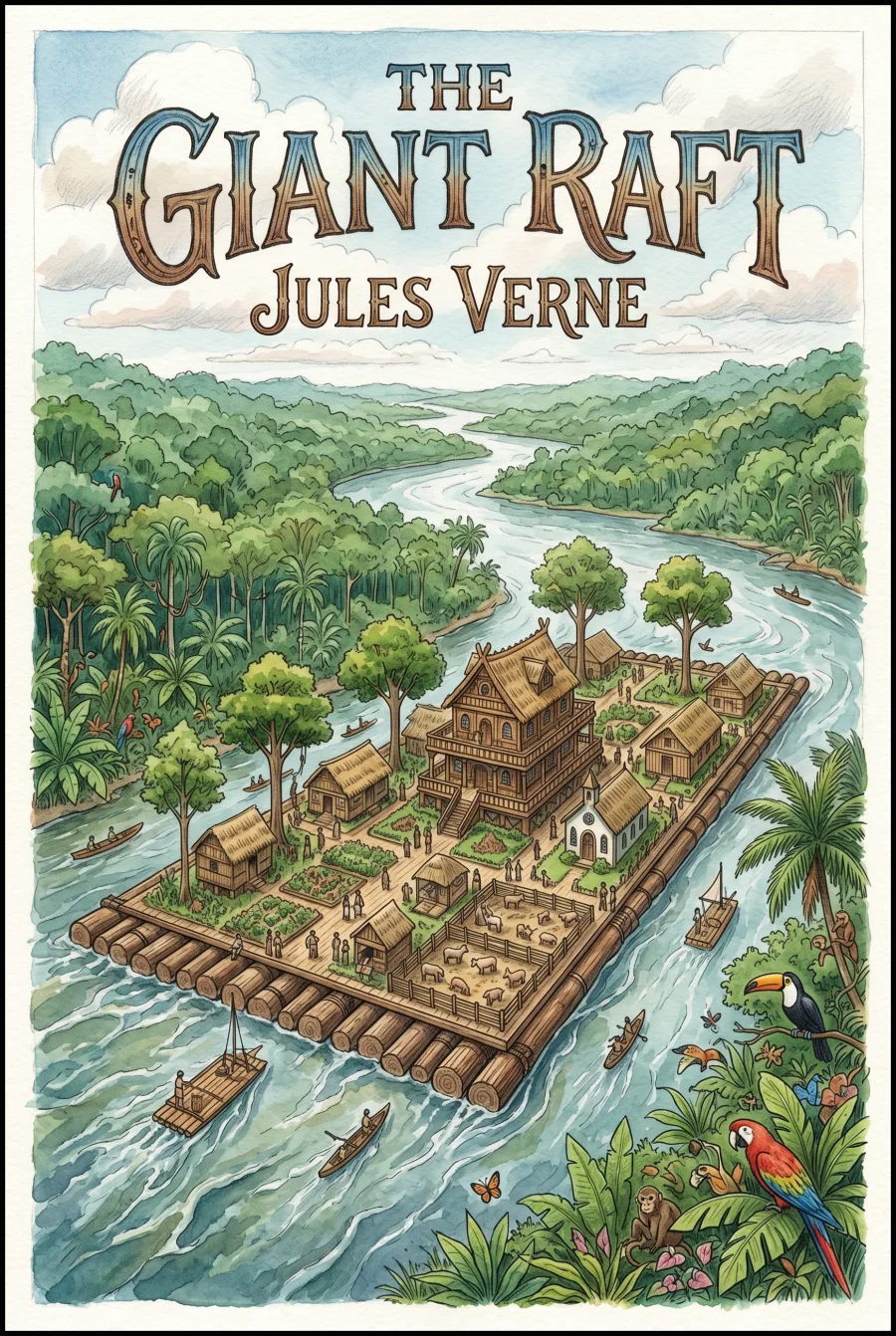
The Giant Raft
eBook
• INR 51.00
• English
• 9788169359177
No ratings yet
| Publisher | General Press |
|---|---|
| ISBN13 | 9788169359177 |
| ASIN/SKU | 8169359171 |
| Book Format | eBook |
| Language | English |
| List Price | INR 51.00 |
| Subject Code | FIC002000, FIC022060, FIC030000 |
| Publishing Date | 01/09/2026 |
| Book Code | BD00070229 |
Buy this Book
Amazon Stores
Ebook Stores
Other Stores
Discover The Giant Raft by Jules Verne. This book is published by General Press in eBook format, ISBN 9788169359177, ASIN 8169359171, under Literature and Fiction, Action and Adventure Fiction, Historical Mystery.
Book Description
Imagine building a floating home large enough to carry an entire family, livestock, supplies, and a small community down one of the world's greatest rivers. 'The Giant Raft' by Jules Verne is an adventurous classic that blends travel fiction, mystery, family drama, and suspense as a peaceful journey through the Amazon becomes increasingly dangerous and unpredictable.
The story follows the Garral family, who live comfortably on a large estate in the Brazilian province of Amazonas. Their patriarch, Joam Garral, is a respected landowner who has built a happy life with his family, but he carries a secret from his past that could destroy everything he has created. When his daughter Minha is preparing to marry Manoel, a young army officer, the family decides to make the long journey down the Amazon River to celebrate the wedding and reunite with relatives.
To transport the family and their belongings, Joam Garral constructs an enormous raft, essentially creating a floating village capable of carrying people, animals, houses, gardens, and provisions. The voyage begins as a remarkable adventure, allowing Verne to describe the breathtaking scenery, wildlife, settlements, and immense power of the Amazon. Yet beneath the excitement lies a growing mystery surrounding Garral's identity and his earlier life.
As the raft moves deeper into the river, old secrets begin to surface, and the family's happiness is threatened by forces beyond their control. Suspicion, danger, and a long-hidden injustice gradually turn the journey into a desperate struggle for truth and survival.
With its vivid Amazonian setting, ingenious raft, emotional family story, and mounting suspense, 'The Giant Raft' captures Jules Verne's talent for combining exploration with mystery. The deeper the raft travels, the closer the family comes to a revelation that could change their lives forever.
The story follows the Garral family, who live comfortably on a large estate in the Brazilian province of Amazonas. Their patriarch, Joam Garral, is a respected landowner who has built a happy life with his family, but he carries a secret from his past that could destroy everything he has created. When his daughter Minha is preparing to marry Manoel, a young army officer, the family decides to make the long journey down the Amazon River to celebrate the wedding and reunite with relatives.
To transport the family and their belongings, Joam Garral constructs an enormous raft, essentially creating a floating village capable of carrying people, animals, houses, gardens, and provisions. The voyage begins as a remarkable adventure, allowing Verne to describe the breathtaking scenery, wildlife, settlements, and immense power of the Amazon. Yet beneath the excitement lies a growing mystery surrounding Garral's identity and his earlier life.
As the raft moves deeper into the river, old secrets begin to surface, and the family's happiness is threatened by forces beyond their control. Suspicion, danger, and a long-hidden injustice gradually turn the journey into a desperate struggle for truth and survival.
With its vivid Amazonian setting, ingenious raft, emotional family story, and mounting suspense, 'The Giant Raft' captures Jules Verne's talent for combining exploration with mystery. The deeper the raft travels, the closer the family comes to a revelation that could change their lives forever.
Author Biography
Few writers have imagined the future with the confidence and wonder of Jules Verne. Born Jules Gabriel Verne in 1828, he was a French novelist and pioneer of science fiction, best known for adventure classics such as 'Journey to the Center of the Earth', 'Twenty Thousand Leagues Under the Seas', and 'Around the World in Eighty Days'.
Verne was born in Nantes, France, into a family connected to law and maritime life. Although he initially studied law in Paris, his fascination with travel, science, technology, and storytelling gradually drew him toward literature. His early interest in the theater led him to write plays and stories, but his career changed dramatically when he began creating adventurous novels that combined scientific ideas with thrilling journeys.
His most celebrated books became part of the series known as the 'Voyages extraordinaires'. In these works, Verne took readers beneath the oceans, into unexplored lands, across continents, and even into outer space. He blended careful research with imagination, creating stories that felt both exciting and surprisingly believable. His writing often explored new inventions and scientific possibilities, making him an important figure in the development of modern science fiction.
Verne's influence reached far beyond France. His novels inspired generations of readers, scientists, inventors, filmmakers, and other writers. Some of his imaginative ideas, including submarine travel, lunar exploration, and advanced forms of transportation, appeared remarkably ahead of their time. His books have been translated into numerous languages and continue to attract readers around the world.
Jules Verne died in 1905, but his fascination with discovery and the unknown remains as powerful as ever. His ability to turn scientific curiosity into unforgettable adventure secured his place as one of the most influential authors in literary history.
Verne was born in Nantes, France, into a family connected to law and maritime life. Although he initially studied law in Paris, his fascination with travel, science, technology, and storytelling gradually drew him toward literature. His early interest in the theater led him to write plays and stories, but his career changed dramatically when he began creating adventurous novels that combined scientific ideas with thrilling journeys.
His most celebrated books became part of the series known as the 'Voyages extraordinaires'. In these works, Verne took readers beneath the oceans, into unexplored lands, across continents, and even into outer space. He blended careful research with imagination, creating stories that felt both exciting and surprisingly believable. His writing often explored new inventions and scientific possibilities, making him an important figure in the development of modern science fiction.
Verne's influence reached far beyond France. His novels inspired generations of readers, scientists, inventors, filmmakers, and other writers. Some of his imaginative ideas, including submarine travel, lunar exploration, and advanced forms of transportation, appeared remarkably ahead of their time. His books have been translated into numerous languages and continue to attract readers around the world.
Jules Verne died in 1905, but his fascination with discovery and the unknown remains as powerful as ever. His ability to turn scientific curiosity into unforgettable adventure secured his place as one of the most influential authors in literary history.
Editorial Reviews
Editorial Reviews will be added soon…
Book Summary
Jules Verne’s "The Giant Raft" (La Jangada), published in 1881, is an adventure novel that combines river exploration, mystery, romance, family loyalty, and the excitement of nineteenth-century technology. Set primarily along the enormous Amazon River, the story follows a wealthy Brazilian family traveling downstream on an immense floating platform while an old legal mystery threatens to destroy their happiness. The novel is sometimes known by the alternative title 'Eight Hundred Leagues on the Amazon', a reference to the extraordinary journey undertaken by the characters. For readers searching for a 'The Giant Raft' summary, the book is much more than a travel adventure. It is a story about a family's hope for a new beginning, the power of the past to return unexpectedly, and the ways in which love, loyalty, science, and courage can help people confront apparently impossible circumstances.
The novel opens in the Brazilian city of Iquitos, where Joam Garral, a respected and prosperous landowner, prepares to undertake a remarkable journey down the Amazon. Garral is the head of a large and affectionate family. He lives on a substantial estate with his wife, Yaquita, their daughter Minha, their son Benito, and their trusted servants and friends. His life appears peaceful and successful, but beneath that comfortable exterior lies a secret connected to his past. Garral has spent years living under an assumed identity, and although his family does not fully understand the reason for this, the past is about to catch up with him.
The central attraction of the novel is the enormous raft constructed for the family's journey. Rather than using a conventional boat, Garral and his companions build a gigantic floating platform made from timber and equipped with living quarters, furniture, supplies, animals, and everything needed for an extended voyage. The raft is essentially a floating homestead. It is so large that the family can live comfortably while traveling down the river. Verne uses this unusual vehicle to turn the Amazon itself into a moving setting for the story. The characters do not simply travel through the landscape; they carry their home with them.
The journey is prompted by the marriage of Garral's daughter, Minha, to Manoel, a young Portuguese man who works as a doctor. The wedding is planned at the end of the voyage, and the family looks forward to celebrating the marriage in Belém, near the mouth of the Amazon. The journey is therefore initially a joyful one. It is both a family expedition and a wedding procession. Friends, relatives, servants, and workers accompany the Garrals, creating a lively community on the giant raft.
Among the important characters is Benito, Garral's son, who is courageous, energetic, and deeply devoted to his family. His close friend Fragoso, a cheerful and adventurous man, adds humor and vitality to the expedition. Fragoso is particularly interested in one of the young women connected with the family and eventually develops a romantic relationship of his own. The interactions among the travelers give the story warmth and make the enormous expedition feel like a shared human experience rather than merely a geographical adventure.
The Amazon River is almost a character in its own right. Verne describes its immense scale, complex network of tributaries, forests, islands, wildlife, settlements, and changing currents. The travelers encounter a landscape that is both beautiful and dangerous. The river can be peaceful and majestic one moment and unpredictable the next. Sandbanks, rapids, storms, insects, animals, and other hazards constantly remind the characters that nature cannot be completely controlled.
Verne's fascination with geography is evident throughout the novel. The journey allows him to introduce readers to the Amazon basin in considerable detail. The characters travel through regions that were still unfamiliar to many European readers of the nineteenth century. As in many of Verne's adventure novels, factual information about geography and natural history is woven into the narrative. Readers interested in the Amazon River, nineteenth-century exploration, and Jules Verne's travel fiction will find the book particularly rich in descriptive detail.
At first, the journey seems to be proceeding successfully. The family enjoys the scenery, prepares for the wedding, and looks forward to reaching their destination. But an unexpected problem appears when a mysterious message reaches Garral. The message contains information that threatens to expose his hidden identity and connect him with an old crime. Garral is deeply disturbed because he knows that revealing the truth could change everything.
The mystery revolves around an event that occurred years earlier in Peru. Garral had previously been known by another name, and he had become involved in a complicated legal and political situation. He was accused of a serious crime, and circumstances forced him to flee and begin a new life in Brazil. The details of the accusation are complicated, but the essential point is that Garral has lived for years under the shadow of an injustice he has never been able to resolve.
The return of this old accusation creates the central conflict of the novel. Garral's family knows him as a respected and honorable man. They cannot easily understand why he suddenly becomes anxious about the past. For Garral, however, the problem is terrifying because he fears that the law will once again take control of his life. His new family, wealth, and happiness cannot protect him if the old accusation is revived.
The situation becomes increasingly serious as the raft continues its journey. Garral must decide whether to reveal the truth to his family and risk destroying their sense of security or remain silent and hope that the problem disappears. His silence creates tension because the reader understands that the family is approaching a crisis without knowing its full nature.
The romance between Minha and Manoel provides an emotional counterpoint to the darker mystery. Minha loves Manoel deeply, and their relationship is presented as sincere and affectionate. Manoel, as a doctor, is also closely connected with the family's welfare. His medical knowledge becomes useful during the journey, and his loyalty to Minha and her family strengthens as the story becomes more dangerous.
The giant raft itself symbolizes the family's unity. Everyone lives together, shares the same journey, and depends upon one another. Yet the raft also becomes a symbol of vulnerability. Because the entire family is traveling together, any threat to one person can affect everyone. The physical closeness of the passengers makes the emotional secrets surrounding Garral even more significant.
As the journey progresses, the legal mystery becomes unavoidable. Garral is eventually arrested or placed under suspicion because authorities believe that the man traveling under the name Joam Garral is actually someone wanted for a crime. The family is devastated. The happy wedding journey turns into a nightmare. Garral insists on his innocence, but the evidence and legal circumstances appear to work against him.
This part of the novel reveals Verne's interest in justice and identity. Garral's problem is not simply that he may be accused unfairly; it is that his entire present life depends upon a past identity that he has kept hidden. The novel asks whether a person can truly escape an unjust past by starting again somewhere else. Garral has built a new life through honesty and hard work, yet the old accusation still has the power to reach him.
The mystery also creates a conflict between legal proof and moral truth. The authorities are interested in evidence, documents, testimony, and identity. Garral's family knows the man they love and trust. These two forms of knowledge do not easily fit together. The story therefore raises an important question: can a legal system recognize the truth when circumstances and evidence point in another direction?
The novel's tension increases as the travelers approach the region where Garral's fate will be determined. Benito becomes determined to defend his father. His loyalty drives him into dangerous situations. He refuses to accept that Garral should be sacrificed simply because the legal system has reached a conclusion. His actions demonstrate one of the novel's recurring values: family loyalty can motivate extraordinary courage.
Fragoso also plays an important role in the story's lighter moments. Verne frequently balances danger with humor, and Fragoso's optimism helps maintain the adventurous tone even when the family's situation becomes desperate. His presence reminds readers that the novel is not purely a legal mystery but also a journey filled with human relationships.
One of the novel's most interesting features is its mixture of technological and natural adventure. Verne is fascinated by the practical problems of navigating a gigantic raft. The characters must manage the structure, steer through the river, protect their supplies, and respond to changing environmental conditions. The raft becomes a technological achievement that allows human beings to inhabit and travel through a vast natural environment. Yet Verne repeatedly shows that technology has limits. The river remains stronger than any human plan.
The Amazon setting also creates an atmosphere of isolation. The travelers are moving through enormous spaces in which help may be distant and communication uncertain. This isolation makes the legal crisis more frightening. Garral cannot simply return home and seek ordinary legal assistance. His journey has carried him into a world where escape routes are limited and every decision matters.
Eventually, the deeper truth behind Garral's past begins to emerge. The novel gradually reveals the circumstances surrounding the original crime and the reasons Garral was forced to live under another identity. The mystery involves mistaken assumptions, concealed information, and the limitations of the legal system. Verne builds the story toward a resolution in which evidence and truth must finally be brought together.
The revelation of Garral's past is important because it transforms the reader's understanding of the entire journey. What initially seemed like a joyful family expedition becomes a journey toward judgment and vindication. The wedding, which was supposed to be the main event, is overshadowed by the question of whether Garral will be able to clear his name.
At the emotional center of the novel is the family's response to Garral's crisis. His wife, Yaquita, remains devoted to him. Minha and Benito refuse to abandon him. Manoel also stands by the family. Their loyalty demonstrates that Garral's true identity is not defined by legal documents or accusations but by the life he has lived with the people who know him best.
The novel's themes of identity and justice are closely connected to its broader theme of family. Garral's greatest fear is not simply punishment. It is the destruction of the family he has built. He worries that his past will stain his children's lives and destroy the happiness they have created. The story therefore presents justice as something with consequences extending beyond the accused individual.
Verne also explores the idea that courage is not simply physical bravery. Benito demonstrates physical courage during dangerous episodes, but Garral's courage is more internal. He must confront the possibility that everything he has built could collapse. The family must also show emotional courage by continuing to trust him despite uncertainty.
The ending brings together the novel's adventure, mystery, and emotional storylines. The truth about Garral's identity and the old accusation is finally clarified, allowing justice to be restored. The family is able to move beyond the threat that has haunted them, and the romantic storyline involving Minha and Manoel can return to the foreground. The journey that began as a celebration therefore becomes a test of family loyalty and moral truth before finally reaching resolution.
For readers looking for the main themes and meaning of 'The Giant Raft', the novel's central message is that a person's true identity is revealed not merely by names, documents, or social position but by character and relationships. Garral's past matters, but so does the life he has lived since then. His family knows him through his actions, and their faith in him becomes an important form of moral evidence.
The novel also celebrates exploration. Verne transforms the Amazon into a place of mystery and wonder while using the enormous raft as a symbol of human ingenuity. The journey demonstrates the nineteenth-century fascination with technological innovation and geographical discovery. Yet the story never allows technology to completely dominate nature. The river remains immense, unpredictable, and powerful.
At the same time, modern readers should approach the novel as a product of its nineteenth-century context. Verne's descriptions of the Amazon and its peoples reflect the geographical knowledge and cultural attitudes of his period, and some passages may feel dated today. Nevertheless, the novel remains valuable for its imaginative construction of a river journey and its combination of adventure with mystery and family drama.
In conclusion, 'The Giant Raft' is a richly imaginative Jules Verne adventure about a remarkable family journey down the Amazon River. Joam Garral sets out on a gigantic floating home with his wife, children, friends, and servants, expecting a peaceful voyage culminating in his daughter's marriage to Manoel. Instead, a hidden chapter of Garral's past resurfaces, turning the journey into a struggle for justice and survival. The enormous raft becomes both a symbol of family unity and a vehicle carrying the characters toward a confrontation with the past.
Ultimately, 'The Giant Raft' combines everything that makes Jules Verne's adventure fiction distinctive: unusual technology, geographical exploration, danger, mystery, romance, scientific curiosity, and determined characters facing extraordinary circumstances. Its deepest emotional theme, however, is loyalty. When Garral's past threatens his future, his family refuses to abandon him. Their devotion demonstrates that genuine belonging is built through years of trust and shared life. For readers searching for a 'The Giant Raft' book summary, the novel can therefore be understood as both an Amazon adventure and a story of moral endurance: a family travels hundreds of leagues down one of the world's greatest rivers and discovers that the greatest journey is not simply across a continent, but through fear, uncertainty, memory, and the struggle to establish the truth.
The novel opens in the Brazilian city of Iquitos, where Joam Garral, a respected and prosperous landowner, prepares to undertake a remarkable journey down the Amazon. Garral is the head of a large and affectionate family. He lives on a substantial estate with his wife, Yaquita, their daughter Minha, their son Benito, and their trusted servants and friends. His life appears peaceful and successful, but beneath that comfortable exterior lies a secret connected to his past. Garral has spent years living under an assumed identity, and although his family does not fully understand the reason for this, the past is about to catch up with him.
The central attraction of the novel is the enormous raft constructed for the family's journey. Rather than using a conventional boat, Garral and his companions build a gigantic floating platform made from timber and equipped with living quarters, furniture, supplies, animals, and everything needed for an extended voyage. The raft is essentially a floating homestead. It is so large that the family can live comfortably while traveling down the river. Verne uses this unusual vehicle to turn the Amazon itself into a moving setting for the story. The characters do not simply travel through the landscape; they carry their home with them.
The journey is prompted by the marriage of Garral's daughter, Minha, to Manoel, a young Portuguese man who works as a doctor. The wedding is planned at the end of the voyage, and the family looks forward to celebrating the marriage in Belém, near the mouth of the Amazon. The journey is therefore initially a joyful one. It is both a family expedition and a wedding procession. Friends, relatives, servants, and workers accompany the Garrals, creating a lively community on the giant raft.
Among the important characters is Benito, Garral's son, who is courageous, energetic, and deeply devoted to his family. His close friend Fragoso, a cheerful and adventurous man, adds humor and vitality to the expedition. Fragoso is particularly interested in one of the young women connected with the family and eventually develops a romantic relationship of his own. The interactions among the travelers give the story warmth and make the enormous expedition feel like a shared human experience rather than merely a geographical adventure.
The Amazon River is almost a character in its own right. Verne describes its immense scale, complex network of tributaries, forests, islands, wildlife, settlements, and changing currents. The travelers encounter a landscape that is both beautiful and dangerous. The river can be peaceful and majestic one moment and unpredictable the next. Sandbanks, rapids, storms, insects, animals, and other hazards constantly remind the characters that nature cannot be completely controlled.
Verne's fascination with geography is evident throughout the novel. The journey allows him to introduce readers to the Amazon basin in considerable detail. The characters travel through regions that were still unfamiliar to many European readers of the nineteenth century. As in many of Verne's adventure novels, factual information about geography and natural history is woven into the narrative. Readers interested in the Amazon River, nineteenth-century exploration, and Jules Verne's travel fiction will find the book particularly rich in descriptive detail.
At first, the journey seems to be proceeding successfully. The family enjoys the scenery, prepares for the wedding, and looks forward to reaching their destination. But an unexpected problem appears when a mysterious message reaches Garral. The message contains information that threatens to expose his hidden identity and connect him with an old crime. Garral is deeply disturbed because he knows that revealing the truth could change everything.
The mystery revolves around an event that occurred years earlier in Peru. Garral had previously been known by another name, and he had become involved in a complicated legal and political situation. He was accused of a serious crime, and circumstances forced him to flee and begin a new life in Brazil. The details of the accusation are complicated, but the essential point is that Garral has lived for years under the shadow of an injustice he has never been able to resolve.
The return of this old accusation creates the central conflict of the novel. Garral's family knows him as a respected and honorable man. They cannot easily understand why he suddenly becomes anxious about the past. For Garral, however, the problem is terrifying because he fears that the law will once again take control of his life. His new family, wealth, and happiness cannot protect him if the old accusation is revived.
The situation becomes increasingly serious as the raft continues its journey. Garral must decide whether to reveal the truth to his family and risk destroying their sense of security or remain silent and hope that the problem disappears. His silence creates tension because the reader understands that the family is approaching a crisis without knowing its full nature.
The romance between Minha and Manoel provides an emotional counterpoint to the darker mystery. Minha loves Manoel deeply, and their relationship is presented as sincere and affectionate. Manoel, as a doctor, is also closely connected with the family's welfare. His medical knowledge becomes useful during the journey, and his loyalty to Minha and her family strengthens as the story becomes more dangerous.
The giant raft itself symbolizes the family's unity. Everyone lives together, shares the same journey, and depends upon one another. Yet the raft also becomes a symbol of vulnerability. Because the entire family is traveling together, any threat to one person can affect everyone. The physical closeness of the passengers makes the emotional secrets surrounding Garral even more significant.
As the journey progresses, the legal mystery becomes unavoidable. Garral is eventually arrested or placed under suspicion because authorities believe that the man traveling under the name Joam Garral is actually someone wanted for a crime. The family is devastated. The happy wedding journey turns into a nightmare. Garral insists on his innocence, but the evidence and legal circumstances appear to work against him.
This part of the novel reveals Verne's interest in justice and identity. Garral's problem is not simply that he may be accused unfairly; it is that his entire present life depends upon a past identity that he has kept hidden. The novel asks whether a person can truly escape an unjust past by starting again somewhere else. Garral has built a new life through honesty and hard work, yet the old accusation still has the power to reach him.
The mystery also creates a conflict between legal proof and moral truth. The authorities are interested in evidence, documents, testimony, and identity. Garral's family knows the man they love and trust. These two forms of knowledge do not easily fit together. The story therefore raises an important question: can a legal system recognize the truth when circumstances and evidence point in another direction?
The novel's tension increases as the travelers approach the region where Garral's fate will be determined. Benito becomes determined to defend his father. His loyalty drives him into dangerous situations. He refuses to accept that Garral should be sacrificed simply because the legal system has reached a conclusion. His actions demonstrate one of the novel's recurring values: family loyalty can motivate extraordinary courage.
Fragoso also plays an important role in the story's lighter moments. Verne frequently balances danger with humor, and Fragoso's optimism helps maintain the adventurous tone even when the family's situation becomes desperate. His presence reminds readers that the novel is not purely a legal mystery but also a journey filled with human relationships.
One of the novel's most interesting features is its mixture of technological and natural adventure. Verne is fascinated by the practical problems of navigating a gigantic raft. The characters must manage the structure, steer through the river, protect their supplies, and respond to changing environmental conditions. The raft becomes a technological achievement that allows human beings to inhabit and travel through a vast natural environment. Yet Verne repeatedly shows that technology has limits. The river remains stronger than any human plan.
The Amazon setting also creates an atmosphere of isolation. The travelers are moving through enormous spaces in which help may be distant and communication uncertain. This isolation makes the legal crisis more frightening. Garral cannot simply return home and seek ordinary legal assistance. His journey has carried him into a world where escape routes are limited and every decision matters.
Eventually, the deeper truth behind Garral's past begins to emerge. The novel gradually reveals the circumstances surrounding the original crime and the reasons Garral was forced to live under another identity. The mystery involves mistaken assumptions, concealed information, and the limitations of the legal system. Verne builds the story toward a resolution in which evidence and truth must finally be brought together.
The revelation of Garral's past is important because it transforms the reader's understanding of the entire journey. What initially seemed like a joyful family expedition becomes a journey toward judgment and vindication. The wedding, which was supposed to be the main event, is overshadowed by the question of whether Garral will be able to clear his name.
At the emotional center of the novel is the family's response to Garral's crisis. His wife, Yaquita, remains devoted to him. Minha and Benito refuse to abandon him. Manoel also stands by the family. Their loyalty demonstrates that Garral's true identity is not defined by legal documents or accusations but by the life he has lived with the people who know him best.
The novel's themes of identity and justice are closely connected to its broader theme of family. Garral's greatest fear is not simply punishment. It is the destruction of the family he has built. He worries that his past will stain his children's lives and destroy the happiness they have created. The story therefore presents justice as something with consequences extending beyond the accused individual.
Verne also explores the idea that courage is not simply physical bravery. Benito demonstrates physical courage during dangerous episodes, but Garral's courage is more internal. He must confront the possibility that everything he has built could collapse. The family must also show emotional courage by continuing to trust him despite uncertainty.
The ending brings together the novel's adventure, mystery, and emotional storylines. The truth about Garral's identity and the old accusation is finally clarified, allowing justice to be restored. The family is able to move beyond the threat that has haunted them, and the romantic storyline involving Minha and Manoel can return to the foreground. The journey that began as a celebration therefore becomes a test of family loyalty and moral truth before finally reaching resolution.
For readers looking for the main themes and meaning of 'The Giant Raft', the novel's central message is that a person's true identity is revealed not merely by names, documents, or social position but by character and relationships. Garral's past matters, but so does the life he has lived since then. His family knows him through his actions, and their faith in him becomes an important form of moral evidence.
The novel also celebrates exploration. Verne transforms the Amazon into a place of mystery and wonder while using the enormous raft as a symbol of human ingenuity. The journey demonstrates the nineteenth-century fascination with technological innovation and geographical discovery. Yet the story never allows technology to completely dominate nature. The river remains immense, unpredictable, and powerful.
At the same time, modern readers should approach the novel as a product of its nineteenth-century context. Verne's descriptions of the Amazon and its peoples reflect the geographical knowledge and cultural attitudes of his period, and some passages may feel dated today. Nevertheless, the novel remains valuable for its imaginative construction of a river journey and its combination of adventure with mystery and family drama.
In conclusion, 'The Giant Raft' is a richly imaginative Jules Verne adventure about a remarkable family journey down the Amazon River. Joam Garral sets out on a gigantic floating home with his wife, children, friends, and servants, expecting a peaceful voyage culminating in his daughter's marriage to Manoel. Instead, a hidden chapter of Garral's past resurfaces, turning the journey into a struggle for justice and survival. The enormous raft becomes both a symbol of family unity and a vehicle carrying the characters toward a confrontation with the past.
Ultimately, 'The Giant Raft' combines everything that makes Jules Verne's adventure fiction distinctive: unusual technology, geographical exploration, danger, mystery, romance, scientific curiosity, and determined characters facing extraordinary circumstances. Its deepest emotional theme, however, is loyalty. When Garral's past threatens his future, his family refuses to abandon him. Their devotion demonstrates that genuine belonging is built through years of trust and shared life. For readers searching for a 'The Giant Raft' book summary, the novel can therefore be understood as both an Amazon adventure and a story of moral endurance: a family travels hundreds of leagues down one of the world's greatest rivers and discovers that the greatest journey is not simply across a continent, but through fear, uncertainty, memory, and the struggle to establish the truth.
Sample Chapters
Sample Chapters will be added soon…
Reader Reviews
No reviews yet.
The Giant Raft