
The Green Mummy
eBook
• INR 51.00
• English
• 9788169359610
No ratings yet
| Publisher | General Press |
|---|---|
| ISBN13 | 9788169359610 |
| ASIN/SKU | 8169359619 |
| Book Format | eBook |
| Language | English |
| List Price | INR 51.00 |
| Subject Code | FIC022030, FIC022060, FIC030000 |
| Publishing Date | 01/09/2026 |
| Book Code | BD00070230 |
Buy this Book
Amazon Stores
Ebook Stores
Other Stores
Discover The Green Mummy by Fergus Hume. This book is published by General Press in eBook format, ISBN 9788169359610, ASIN 8169359619, under Literature and Fiction, Traditional Detective Mysteries, Historical Mystery.
Book Description
A priceless ancient mummy arrives in England, but when its mysterious coffin is opened, the discovery inside is far more shocking than anyone could have imagined. 'The Green Mummy' by Fergus Hume is a classic mystery and crime novel that combines romance, murder, archaeological intrigue, hidden treasure, and suspense in a gripping tale of secrets and deception.
The story begins with Archie Hope, a young man determined to marry Lucy Kendal, the stepdaughter of the eccentric Professor Braddock. To gain the professor’s approval, Archie helps acquire a rare Peruvian mummy, believed to be the preserved body of Inca Caxas. Braddock is fascinated by the ancient relic and eager to study it, but the mummy carries a secret far more valuable than its archaeological importance. Hidden within its history are mysterious emeralds, lost fortunes, and a trail of intrigue stretching from Peru to England.
When Braddock’s assistant, Sidney Bolton, is sent to bring the mummy home, the journey ends in tragedy. The expected mummy disappears, while Bolton’s body is discovered inside the packing case. Suddenly, what seemed to be an unusual archaeological acquisition becomes a baffling murder mystery. Archie finds himself drawn into the investigation, knowing that solving the crime may be the only way to secure his future with Lucy.
As the mystery deepens, suspicion falls on a colorful group of characters, including the secretive Professor Braddock, a mysterious Peruvian gentleman, a sea captain with a questionable past, and others who may have their own reasons for wanting the mummy. Old manuscripts, concealed jewels, disguises, and buried secrets gradually reveal connections between the present crime and events that happened years earlier.
With its blend of romance, mystery, and adventure, 'The Green Mummy' keeps the reader guessing as every new clue raises another question. If you enjoy classic detective fiction filled with unusual characters and forgotten secrets, this strange and atmospheric mystery is well worth uncovering.
The story begins with Archie Hope, a young man determined to marry Lucy Kendal, the stepdaughter of the eccentric Professor Braddock. To gain the professor’s approval, Archie helps acquire a rare Peruvian mummy, believed to be the preserved body of Inca Caxas. Braddock is fascinated by the ancient relic and eager to study it, but the mummy carries a secret far more valuable than its archaeological importance. Hidden within its history are mysterious emeralds, lost fortunes, and a trail of intrigue stretching from Peru to England.
When Braddock’s assistant, Sidney Bolton, is sent to bring the mummy home, the journey ends in tragedy. The expected mummy disappears, while Bolton’s body is discovered inside the packing case. Suddenly, what seemed to be an unusual archaeological acquisition becomes a baffling murder mystery. Archie finds himself drawn into the investigation, knowing that solving the crime may be the only way to secure his future with Lucy.
As the mystery deepens, suspicion falls on a colorful group of characters, including the secretive Professor Braddock, a mysterious Peruvian gentleman, a sea captain with a questionable past, and others who may have their own reasons for wanting the mummy. Old manuscripts, concealed jewels, disguises, and buried secrets gradually reveal connections between the present crime and events that happened years earlier.
With its blend of romance, mystery, and adventure, 'The Green Mummy' keeps the reader guessing as every new clue raises another question. If you enjoy classic detective fiction filled with unusual characters and forgotten secrets, this strange and atmospheric mystery is well worth uncovering.
Author Biography
Few Victorian-era mystery writers created such an immediate sensation with a single novel as Fergus Hume. Fergus Hume was an English-born novelist best known for his detective fiction, particularly 'The Mystery of a Hansom Cab', a pioneering crime novel that became an international bestseller and helped shape the development of detective literature.
Born Fergusson Wright Hume in 1859 in England, he moved with his family to New Zealand as a child and later trained and worked as a solicitor in Melbourne, Australia. His legal background gave him a useful familiarity with crime, evidence, and human motives, elements that would become central to his fiction. When he began writing 'The Mystery of a Hansom Cab', Hume struggled to find a publisher and eventually arranged for the novel to be published in Melbourne in 1886. Its gripping murder mystery, atmospheric setting, and intricate plot quickly attracted readers. The book became extraordinarily popular, selling in large numbers and establishing Hume as a successful novelist.
Although 'The Mystery of a Hansom Cab' remains his most famous work, Hume wrote extensively throughout his career, producing more than 100 novels and numerous short stories. His fiction frequently combined murder, deception, hidden identities, romantic complications, and unexpected revelations. His storytelling was shaped by the conventions of Victorian sensation fiction, yet his emphasis on investigation and clues helped anticipate the more systematic detective stories that became popular in the years that followed.
Hume eventually returned to England and continued writing until his death in 1932. His literary career demonstrates how crime fiction could move from popular entertainment toward a more structured and influential genre. Today, Fergus Hume is remembered especially for 'The Mystery of a Hansom Cab', a landmark of early detective fiction whose success helped establish the enduring appeal of the murder mystery.
Born Fergusson Wright Hume in 1859 in England, he moved with his family to New Zealand as a child and later trained and worked as a solicitor in Melbourne, Australia. His legal background gave him a useful familiarity with crime, evidence, and human motives, elements that would become central to his fiction. When he began writing 'The Mystery of a Hansom Cab', Hume struggled to find a publisher and eventually arranged for the novel to be published in Melbourne in 1886. Its gripping murder mystery, atmospheric setting, and intricate plot quickly attracted readers. The book became extraordinarily popular, selling in large numbers and establishing Hume as a successful novelist.
Although 'The Mystery of a Hansom Cab' remains his most famous work, Hume wrote extensively throughout his career, producing more than 100 novels and numerous short stories. His fiction frequently combined murder, deception, hidden identities, romantic complications, and unexpected revelations. His storytelling was shaped by the conventions of Victorian sensation fiction, yet his emphasis on investigation and clues helped anticipate the more systematic detective stories that became popular in the years that followed.
Hume eventually returned to England and continued writing until his death in 1932. His literary career demonstrates how crime fiction could move from popular entertainment toward a more structured and influential genre. Today, Fergus Hume is remembered especially for 'The Mystery of a Hansom Cab', a landmark of early detective fiction whose success helped establish the enduring appeal of the murder mystery.
Editorial Reviews
Editorial Reviews will be added soon…
Book Summary
Fergus Hume’s "The Green Mummy" is a richly plotted mystery novel that combines murder, romance, archaeology, buried treasure, deception, mistaken identity, and detective intrigue. First published in 1908, the novel belongs to the tradition of Victorian and Edwardian mystery fiction, but it also carries the adventurous atmosphere of a treasure hunt. At the center of the story is a mysterious Peruvian mummy whose green-colored wrappings conceal a history of theft, family inheritance, priceless emeralds, and murder. What begins as a romantic arrangement between two young lovers gradually develops into a complicated criminal mystery involving Professor Braddock, his assistant Sidney Bolton, the mysterious Mrs. Jasher, a Peruvian nobleman, and a long-lost manuscript. Hume's novel is particularly effective because the reader is repeatedly encouraged to suspect one character, only to discover that another secret lies behind the apparent evidence. The result is a classic mystery built around the question of who stole the mummy, who murdered Bolton, and what became of the valuable jewels hidden with the body.
The novel opens in the quiet village of Gartley, where Archie Hope and Lucy Kendal are deeply in love. Their romance, however, has encountered an obstacle in the form of Lucy’s stepfather, Professor Braddock. Braddock is a demanding and somewhat eccentric archaeologist who has devoted much of his life to the study of ancient remains. He does not readily approve of Archie as a husband for Lucy, and Archie therefore devises an unusual way to win his consent. He purchases a valuable Peruvian mummy from Malta and makes the acquisition part of his bargain with the professor. The mummy is remarkable because of its unusual green wrappings and its supposed connection with an ancient Inca ruler. At this stage, the object seems to be primarily an archaeological curiosity, but Hume quickly suggests that it has a much more valuable secret attached to it.
Professor Braddock is thrilled by the mummy, but his enthusiasm is not entirely academic. Unknown to Archie and Lucy, Braddock has his own reasons for wanting the particular mummy. The story gradually reveals that he knows of an ancient Peruvian manuscript describing the burial of Inca Caxas. According to the manuscript, the Inca was buried with valuable jewels, including two remarkable emeralds. The mummy therefore represents not merely an archaeological specimen but a possible fortune. This hidden motive becomes one of the central sources of tension in 'The Green Mummy', because several characters eventually learn that the supposedly priceless body contains something worth stealing. Hume uses this secret to transform an archaeological mystery into a murder mystery driven by greed and ambition.
The mummy is sent from Malta toward England under the supervision of Sidney Bolton, Professor Braddock’s assistant. Bolton is an intelligent young man who has been working under Braddock and hopes to improve his social position. Unfortunately, he also becomes aware of the mummy's hidden value. Bolton discovers information about the emeralds and realizes that Braddock's interest in the mummy may be motivated by more than scholarship. He is therefore no longer merely an assistant transporting an archaeological object; he becomes a potential rival in the struggle to obtain the treasure. This knowledge places him in danger, and Hume uses his growing awareness to establish the novel's central murder mystery.
When the mummy finally reaches Gartley, something is terribly wrong. The packing case that should contain the ancient mummy instead contains the dead body of Sidney Bolton. He has been strangled with a red window cord. The mummy itself has disappeared. The discovery immediately creates a seemingly impossible crime. Someone has murdered Bolton, removed the mummy, transported the body in its place, and escaped with an enormous and highly recognizable object. The police are baffled because there appears to be no simple explanation for how the murderer could have carried out the substitution without being noticed. The disappearance becomes a sensation, and newspapers throughout the country eagerly report the strange case.
This opening mystery gives the novel its strongest detective-fiction quality. The question is not simply who killed Bolton, but how the murderer managed to steal something as conspicuous as a mummy. Hume deliberately creates a crime that seems physically difficult to accomplish. The police search for clues, but the more they investigate, the more confusing the situation becomes. The mummy is too unusual to be easily hidden or sold, while Bolton's murder suggests that someone was willing to commit a serious crime to obtain it. The disappearance therefore seems to involve someone with detailed knowledge of the mummy and its value.
Suspicion soon falls on several people. Professor Braddock's behavior is examined carefully because he clearly wanted the mummy and possessed knowledge concerning its contents. Mrs. Jasher, a mysterious widow living near the village, also becomes a figure of interest. She is intelligent, worldly, and ambitious, and she has her own reasons for wanting to improve her position in life. Her relationship with Professor Braddock further complicates the situation. She has hoped to marry him, partly because she wants security and respectability after years of hardship. Yet she is also capable of manipulating people, making it difficult for the other characters to determine how much of her story they can believe.
The investigation becomes even more complicated when the missing mummy unexpectedly reappears. Archie Hope discovers the strange green mummy case in Mrs. Jasher's garden. The discovery seems almost too convenient. The object everyone has been searching for is suddenly sitting on her property. Naturally, suspicion falls heavily upon her. Villagers begin to assume that she must have been involved in the theft, and gossip soon connects her with Bolton's murder as well. Hume uses this episode to demonstrate the danger of circumstantial evidence. A person can appear guilty simply because incriminating evidence happens to be found nearby, even when the actual story is much more complicated.
The discovery also gives Don Pedro de Gayangos, a Peruvian gentleman, a new reason to become involved. Don Pedro has a personal connection to the mummy because he is descended from Inca Caxas. He has spent years searching for the body of his ancestor, which was stolen from his family during a period of political turmoil in Peru. His father had been the guardian of the mummy, but an Englishman named Vasa, who had once been treated as a guest by the family, eventually stole it. Don Pedro's mission is therefore not simply financial. He wants to recover the remains of his ancestor and restore a lost family inheritance. At the same time, the emeralds described in the ancient manuscript offer him the possibility of recovering his family's fortune.
Don Pedro's story expands the novel beyond the immediate murder investigation. The mummy now has a long history stretching from ancient Peru to modern England. The ancient manuscript becomes especially important because it describes the burial of Inca Caxas and the jewels placed with his body. Through this document, Hume connects the present-day mystery with a crime committed years earlier. The reader realizes that the murder of Bolton is only the latest event in a chain of greed, theft, and betrayal that began generations before. The mummy is essentially the physical object connecting all these different lives.
Another important figure is Sir Frank Random, who becomes involved in the mystery and helps piece together the scattered information. Hume frequently uses conversations between the characters to reveal new pieces of the puzzle. Instead of presenting the mystery as a straightforward police investigation, he allows information to emerge through personal histories, letters, confessions, manuscripts, and unexpected discoveries. This creates a layered narrative in which the reader must continually reconsider earlier assumptions.
Mrs. Jasher's past eventually becomes central to the mystery. Her life has been marked by poverty, difficult marriages, travel, failed attempts at respectable employment, and repeated struggles for financial security. She has worked on the stage, lectured, kept a boarding establishment, and served as a nurse. Her experiences have made her resourceful but also morally complicated. Her desire for security explains why she is attracted to Professor Braddock, but it also helps explain why she becomes entangled in the schemes surrounding the mummy. Hume does not portray her as simply evil; instead, he presents her as someone shaped by years of hardship, whose ambition and moral compromises repeatedly bring her into dangerous situations.
The mystery deepens when the story reveals that Sidney Bolton himself had learned about the emeralds. He had reasons to distrust Braddock and had considered stealing the jewels. Bolton's knowledge gives several characters a possible motive for his death. At the same time, evidence emerges suggesting that Professor Braddock may know considerably more about the murder than he initially admits. The question becomes whether Braddock himself arranged the crime, whether someone acting for him committed it, or whether another character manipulated events to make the professor appear guilty.
Hume's greatest strength in 'The Green Mummy' is his use of shifting suspicion. Just when the evidence appears to establish one explanation, another piece of information changes the picture. The mummy is found, then questioned again; characters accuse one another; old documents reveal unexpected connections; and seemingly innocent actions acquire new meanings. The title object functions almost like a silent witness. It moves from one person to another while carrying evidence of a much older crime.
As the novel progresses, the ancient manuscript becomes increasingly important. It provides information that helps explain the mummy's identity, the jewels, and the history of Inca Caxas. The characters must interpret the document carefully because their fortunes depend upon understanding it correctly. Hume uses the manuscript as both a historical record and a detective clue. Like a letter in a traditional mystery novel, it contains information that can transform the entire case when properly understood.
The story eventually moves toward the truth through a combination of confession, recognition, circumstantial evidence, and recovered documents. The apparently separate mysteries—Bolton's murder, the missing mummy, the Peruvian inheritance, the emeralds, and Mrs. Jasher's strange behavior—are gradually brought together. Hume's method is deliberately elaborate. Rather than revealing the answer immediately, he allows the reader to follow a long chain of consequences in which each character has concealed something.
At its heart, 'The Green Mummy' is a novel about greed and the destructive power of secrets. The mummy itself is valuable because people believe it contains treasure, but the real danger comes from what people are willing to do to obtain that treasure. Characters lie, manipulate, steal, and in some cases commit murder because they believe wealth will transform their lives. The novel therefore uses the archaeological mystery as a vehicle for exploring ordinary human weaknesses: ambition, jealousy, insecurity, pride, and the desire for social advancement.
The romance between Archie Hope and Lucy Kendal provides a contrasting emotional thread. Their relationship represents sincerity in a story filled with deception. Archie must navigate Professor Braddock's authority, the mystery surrounding the mummy, and the dangers created by the competing ambitions of the adults around them. Their love gives the narrative a human center, preventing the story from becoming merely an exercise in puzzle-solving.
Ultimately, 'The Green Mummy' is best understood as a classic early twentieth-century mystery novel built around an extraordinary archaeological object. It combines the appeal of a detective story with the atmosphere of an adventure tale and the emotional complications of a romance. The central mystery begins with a mummy arriving from Malta and a murdered assistant being discovered in its packing case, but the solution reaches backward into the history of Peru and forward into the tangled lives of the English characters. The ancient body becomes the key to a modern crime, while the manuscript becomes the key to understanding the past.
For readers searching for an ''in-depth summary of 'The Green Mummy' by Fergus Hume'', the novel's central storyline can be summed up as a mystery of murder, theft, inheritance, and hidden treasure. Archie Hope acquires a mysterious Peruvian mummy in order to win Professor Braddock's approval for his marriage to Lucy. But when the mummy arrives, Braddock's assistant Sidney Bolton is found strangled inside its packing case, while the mummy has disappeared. The investigation leads to Mrs. Jasher, Professor Braddock, Don Pedro de Gayangos, and the forgotten history of Inca Caxas. An ancient manuscript reveals that the mummy was buried with valuable emeralds, explaining why several characters have powerful motives to obtain it. As old secrets are uncovered and false suspicions collapse, the separate strands of the mystery gradually converge.
What makes 'The Green Mummy' memorable is not simply the mystery of the missing mummy but the way Fergus Hume turns that mystery into a web of human relationships. Beneath the sensational plot are people searching for love, respectability, wealth, security, recognition, and revenge. The mummy may be ancient, but the motives surrounding it are unmistakably human. Hume ultimately shows that the most dangerous secrets are not those hidden inside a tomb but those hidden inside people. Through its combination of romance, murder, archaeology, treasure hunting, and detective investigation, 'The Green Mummy' remains an engaging example of classic mystery fiction and a fascinating choice for readers interested in Victorian and Edwardian crime novels, historical mysteries, lost treasure stories, and atmospheric detective fiction.
The novel opens in the quiet village of Gartley, where Archie Hope and Lucy Kendal are deeply in love. Their romance, however, has encountered an obstacle in the form of Lucy’s stepfather, Professor Braddock. Braddock is a demanding and somewhat eccentric archaeologist who has devoted much of his life to the study of ancient remains. He does not readily approve of Archie as a husband for Lucy, and Archie therefore devises an unusual way to win his consent. He purchases a valuable Peruvian mummy from Malta and makes the acquisition part of his bargain with the professor. The mummy is remarkable because of its unusual green wrappings and its supposed connection with an ancient Inca ruler. At this stage, the object seems to be primarily an archaeological curiosity, but Hume quickly suggests that it has a much more valuable secret attached to it.
Professor Braddock is thrilled by the mummy, but his enthusiasm is not entirely academic. Unknown to Archie and Lucy, Braddock has his own reasons for wanting the particular mummy. The story gradually reveals that he knows of an ancient Peruvian manuscript describing the burial of Inca Caxas. According to the manuscript, the Inca was buried with valuable jewels, including two remarkable emeralds. The mummy therefore represents not merely an archaeological specimen but a possible fortune. This hidden motive becomes one of the central sources of tension in 'The Green Mummy', because several characters eventually learn that the supposedly priceless body contains something worth stealing. Hume uses this secret to transform an archaeological mystery into a murder mystery driven by greed and ambition.
The mummy is sent from Malta toward England under the supervision of Sidney Bolton, Professor Braddock’s assistant. Bolton is an intelligent young man who has been working under Braddock and hopes to improve his social position. Unfortunately, he also becomes aware of the mummy's hidden value. Bolton discovers information about the emeralds and realizes that Braddock's interest in the mummy may be motivated by more than scholarship. He is therefore no longer merely an assistant transporting an archaeological object; he becomes a potential rival in the struggle to obtain the treasure. This knowledge places him in danger, and Hume uses his growing awareness to establish the novel's central murder mystery.
When the mummy finally reaches Gartley, something is terribly wrong. The packing case that should contain the ancient mummy instead contains the dead body of Sidney Bolton. He has been strangled with a red window cord. The mummy itself has disappeared. The discovery immediately creates a seemingly impossible crime. Someone has murdered Bolton, removed the mummy, transported the body in its place, and escaped with an enormous and highly recognizable object. The police are baffled because there appears to be no simple explanation for how the murderer could have carried out the substitution without being noticed. The disappearance becomes a sensation, and newspapers throughout the country eagerly report the strange case.
This opening mystery gives the novel its strongest detective-fiction quality. The question is not simply who killed Bolton, but how the murderer managed to steal something as conspicuous as a mummy. Hume deliberately creates a crime that seems physically difficult to accomplish. The police search for clues, but the more they investigate, the more confusing the situation becomes. The mummy is too unusual to be easily hidden or sold, while Bolton's murder suggests that someone was willing to commit a serious crime to obtain it. The disappearance therefore seems to involve someone with detailed knowledge of the mummy and its value.
Suspicion soon falls on several people. Professor Braddock's behavior is examined carefully because he clearly wanted the mummy and possessed knowledge concerning its contents. Mrs. Jasher, a mysterious widow living near the village, also becomes a figure of interest. She is intelligent, worldly, and ambitious, and she has her own reasons for wanting to improve her position in life. Her relationship with Professor Braddock further complicates the situation. She has hoped to marry him, partly because she wants security and respectability after years of hardship. Yet she is also capable of manipulating people, making it difficult for the other characters to determine how much of her story they can believe.
The investigation becomes even more complicated when the missing mummy unexpectedly reappears. Archie Hope discovers the strange green mummy case in Mrs. Jasher's garden. The discovery seems almost too convenient. The object everyone has been searching for is suddenly sitting on her property. Naturally, suspicion falls heavily upon her. Villagers begin to assume that she must have been involved in the theft, and gossip soon connects her with Bolton's murder as well. Hume uses this episode to demonstrate the danger of circumstantial evidence. A person can appear guilty simply because incriminating evidence happens to be found nearby, even when the actual story is much more complicated.
The discovery also gives Don Pedro de Gayangos, a Peruvian gentleman, a new reason to become involved. Don Pedro has a personal connection to the mummy because he is descended from Inca Caxas. He has spent years searching for the body of his ancestor, which was stolen from his family during a period of political turmoil in Peru. His father had been the guardian of the mummy, but an Englishman named Vasa, who had once been treated as a guest by the family, eventually stole it. Don Pedro's mission is therefore not simply financial. He wants to recover the remains of his ancestor and restore a lost family inheritance. At the same time, the emeralds described in the ancient manuscript offer him the possibility of recovering his family's fortune.
Don Pedro's story expands the novel beyond the immediate murder investigation. The mummy now has a long history stretching from ancient Peru to modern England. The ancient manuscript becomes especially important because it describes the burial of Inca Caxas and the jewels placed with his body. Through this document, Hume connects the present-day mystery with a crime committed years earlier. The reader realizes that the murder of Bolton is only the latest event in a chain of greed, theft, and betrayal that began generations before. The mummy is essentially the physical object connecting all these different lives.
Another important figure is Sir Frank Random, who becomes involved in the mystery and helps piece together the scattered information. Hume frequently uses conversations between the characters to reveal new pieces of the puzzle. Instead of presenting the mystery as a straightforward police investigation, he allows information to emerge through personal histories, letters, confessions, manuscripts, and unexpected discoveries. This creates a layered narrative in which the reader must continually reconsider earlier assumptions.
Mrs. Jasher's past eventually becomes central to the mystery. Her life has been marked by poverty, difficult marriages, travel, failed attempts at respectable employment, and repeated struggles for financial security. She has worked on the stage, lectured, kept a boarding establishment, and served as a nurse. Her experiences have made her resourceful but also morally complicated. Her desire for security explains why she is attracted to Professor Braddock, but it also helps explain why she becomes entangled in the schemes surrounding the mummy. Hume does not portray her as simply evil; instead, he presents her as someone shaped by years of hardship, whose ambition and moral compromises repeatedly bring her into dangerous situations.
The mystery deepens when the story reveals that Sidney Bolton himself had learned about the emeralds. He had reasons to distrust Braddock and had considered stealing the jewels. Bolton's knowledge gives several characters a possible motive for his death. At the same time, evidence emerges suggesting that Professor Braddock may know considerably more about the murder than he initially admits. The question becomes whether Braddock himself arranged the crime, whether someone acting for him committed it, or whether another character manipulated events to make the professor appear guilty.
Hume's greatest strength in 'The Green Mummy' is his use of shifting suspicion. Just when the evidence appears to establish one explanation, another piece of information changes the picture. The mummy is found, then questioned again; characters accuse one another; old documents reveal unexpected connections; and seemingly innocent actions acquire new meanings. The title object functions almost like a silent witness. It moves from one person to another while carrying evidence of a much older crime.
As the novel progresses, the ancient manuscript becomes increasingly important. It provides information that helps explain the mummy's identity, the jewels, and the history of Inca Caxas. The characters must interpret the document carefully because their fortunes depend upon understanding it correctly. Hume uses the manuscript as both a historical record and a detective clue. Like a letter in a traditional mystery novel, it contains information that can transform the entire case when properly understood.
The story eventually moves toward the truth through a combination of confession, recognition, circumstantial evidence, and recovered documents. The apparently separate mysteries—Bolton's murder, the missing mummy, the Peruvian inheritance, the emeralds, and Mrs. Jasher's strange behavior—are gradually brought together. Hume's method is deliberately elaborate. Rather than revealing the answer immediately, he allows the reader to follow a long chain of consequences in which each character has concealed something.
At its heart, 'The Green Mummy' is a novel about greed and the destructive power of secrets. The mummy itself is valuable because people believe it contains treasure, but the real danger comes from what people are willing to do to obtain that treasure. Characters lie, manipulate, steal, and in some cases commit murder because they believe wealth will transform their lives. The novel therefore uses the archaeological mystery as a vehicle for exploring ordinary human weaknesses: ambition, jealousy, insecurity, pride, and the desire for social advancement.
The romance between Archie Hope and Lucy Kendal provides a contrasting emotional thread. Their relationship represents sincerity in a story filled with deception. Archie must navigate Professor Braddock's authority, the mystery surrounding the mummy, and the dangers created by the competing ambitions of the adults around them. Their love gives the narrative a human center, preventing the story from becoming merely an exercise in puzzle-solving.
Ultimately, 'The Green Mummy' is best understood as a classic early twentieth-century mystery novel built around an extraordinary archaeological object. It combines the appeal of a detective story with the atmosphere of an adventure tale and the emotional complications of a romance. The central mystery begins with a mummy arriving from Malta and a murdered assistant being discovered in its packing case, but the solution reaches backward into the history of Peru and forward into the tangled lives of the English characters. The ancient body becomes the key to a modern crime, while the manuscript becomes the key to understanding the past.
For readers searching for an ''in-depth summary of 'The Green Mummy' by Fergus Hume'', the novel's central storyline can be summed up as a mystery of murder, theft, inheritance, and hidden treasure. Archie Hope acquires a mysterious Peruvian mummy in order to win Professor Braddock's approval for his marriage to Lucy. But when the mummy arrives, Braddock's assistant Sidney Bolton is found strangled inside its packing case, while the mummy has disappeared. The investigation leads to Mrs. Jasher, Professor Braddock, Don Pedro de Gayangos, and the forgotten history of Inca Caxas. An ancient manuscript reveals that the mummy was buried with valuable emeralds, explaining why several characters have powerful motives to obtain it. As old secrets are uncovered and false suspicions collapse, the separate strands of the mystery gradually converge.
What makes 'The Green Mummy' memorable is not simply the mystery of the missing mummy but the way Fergus Hume turns that mystery into a web of human relationships. Beneath the sensational plot are people searching for love, respectability, wealth, security, recognition, and revenge. The mummy may be ancient, but the motives surrounding it are unmistakably human. Hume ultimately shows that the most dangerous secrets are not those hidden inside a tomb but those hidden inside people. Through its combination of romance, murder, archaeology, treasure hunting, and detective investigation, 'The Green Mummy' remains an engaging example of classic mystery fiction and a fascinating choice for readers interested in Victorian and Edwardian crime novels, historical mysteries, lost treasure stories, and atmospheric detective fiction.
Sample Chapters
Sample Chapters will be added soon…
Reader Reviews
No reviews yet.
The Green Mummy
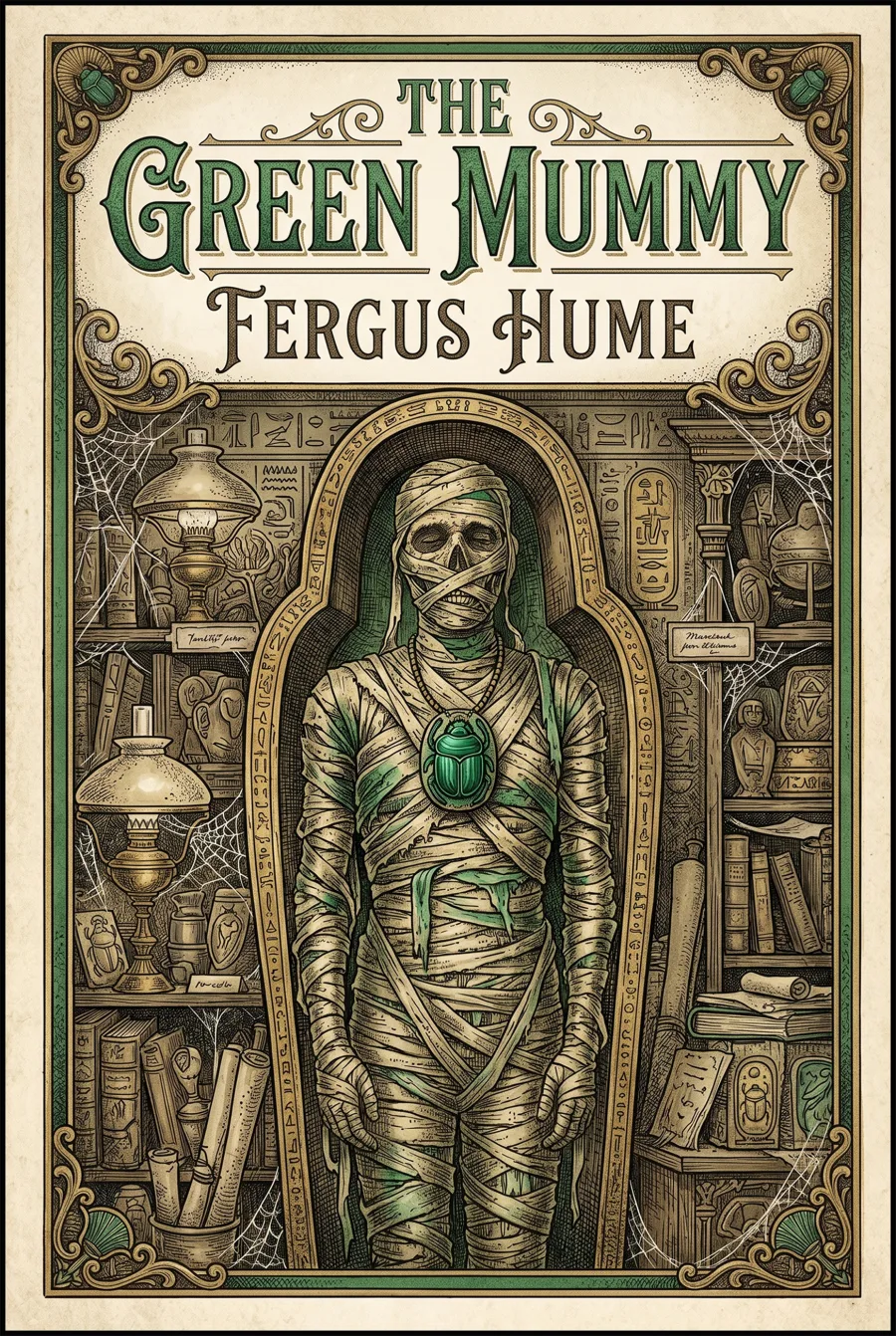
Download Cover Image
Do you want to download the full cover image for The Green Mummy?